⚡ Quick Answer
Choosing a 5.1+ soundbar today means balancing room size, speaker count and how much you want to spend. Our roundup compares 11 options, from the $198 Vizio SV510X-08 up to the $1999.95 Sennheiser AMBEO Soundbar Max. You’ll find budget‑friendly picks like the Vizio model with a 96 dB SPL rating, mid‑range choices such as the JBL Bar 500MK2 that delivers 750 W total power, and premium contenders including the Polk Audio MagniFi Max AX SR, listed at $899.00 and earning a 4.4‑star rating from 805 reviews.
If you’re building a dedicated home‑theater around a large screen, the premium tier offers immersive Atmos setups with up‑firing drivers—think the Sonos Arc Ultra’s 14 engineered drivers and 9.1.4 spatial audio for $1069.99. For apartments or smaller living rooms, the compact Vizio or JBL Bar 700MK2 (priced at $649.95) give you Dolby Atmos and wireless surrounds without overwhelming the space. Gamers who need low‑latency performance will appreciate the TCL Q85H’s 860 W peak power and HDMI eARC support, while a budget‑focused family can still enjoy solid surround sound with the Philips Fidelio FB1’s 15 drivers at $299.95.
Read on to see how each model stacks up on performance, connectivity and value, so you can pick the right sound system for your setup.

Polk Audio MagniFi Max AX SR
Its 76 mm mid‑woofer driver delivers deep bass, giving the best‑value sound performance in its price class.

Sonos Arc Ultra Black
Ideal for audiophiles who want premium immersive audio, the Sonos Arc Ultra Black costs about $301 more than the Polk, catering to buyers willing to invest for top‑tier sound.

JBL Bar 700MK2
Stands out with a maximum power of 780 W, delivering cinema‑level punch that the other picks don’t specify, perfect for home‑office setups needing strong output.
Also considered
Score Analysis
Key score advantages vs. runner-up (Sonos Arc Ultra)
Price Range
Polk Audio MagniFi Max AX SR
$769.00
Sonos Arc Ultra Black
$1,099.00
JBL Bar 700MK2
$649.95

LG Sound Suite H7
$999.99

Vizio SV510X-08
$198.00

TCL Q85H
$599.99

Sony HT-S60
$798.00

JBL Bar 500MK2
$649.95
Sennheiser AMBEO Soundbar Max
$1,999.95

Philips Fidelio FB1
$299.95

Hisense HS5100
$169.99
Spec Comparison
TL;DR: The Polk Audio MagniFi Max AX SR delivers a full‑blown 7.1.2 Dolby Atmos experience with an 11‑driver soundbar and wireless subwoofer for $769.00, though its premium price and heft may deter budget‑focused shoppers.
The standout spec is the 11‑driver soundbar: two 64 mm up‑firing height drivers, six 76 mm mid‑woofer drivers and three 19 mm tweeters work together to create a true 7.1.2 channel soundstage. At 13.0 pounds, the bar itself measures 118 mm high, 72 mm deep and 1143 mm wide, offering a sleek horizontal profile while still packing substantial driver count.
Compared with the other ten entries, the MagniFi Max sits above the Sony HT‑S60’s 5.75‑pound chassis and below the JBL Bar 500MK2’s 24.3‑pound build, making it lighter than many high‑output competitors yet heavier than the Sonos Arc Ultra’s 12.7 pounds. It also out‑numbers the JBL Bar 500MK2’s driver configuration, providing more individual drivers for richer immersion. Feature‑wise it matches the Sonos Arc Ultra with eARC support and adds wireless rear surrounds that the LG Sound Suite H7 and JBL Bar 700MK2 don’t list.
Reviewers consistently praise the up‑firing height drivers for creating an immersive Atmos effect and the wireless 10‑inch subwoofer for delivering deep, cable‑free bass. They highlight the included Night Mode and VoiceAdjust dialogue boost for keeping speech clear during low‑volume scenes. Users also note that the flush‑mount wall bracket simplifies installation, though a few mention the 13.0‑pound weight requires a sturdy mount.
Pros
Cons
Best for: Buyers willing to invest in a proven, high‑quality option
Avoid if: You're on a tight budget or only need basic functionality
TL;DR: The Sonos Arc Ultra delivers 14 engineered drivers, 9.1.4 Dolby Atmos sound and AI‑enhanced dialogue in a sleek 4.35‑in deep, 12.7‑lb package for premium home‑theater setups.
The standout spec features 14 Sonos‑engineered drivers—including seven silk‑dome tweeters and six mid‑woofers—paired with Sound Motion™ technology and a 9.1.4 spatial‑audio layout. At 4.35 in (110.5 mm) depth and 3.13 in (79.5 mm) height, the bar stays low‑profile while packing fifteen Class‑D amplifiers and a quad‑core 4×A55 1.9 GHz CPU.
Compared with the other ten entries, the Arc Ultra is lighter than the LG Sound Suite H7 (16.9 lb) and considerably lighter than the JBL Bar 700MK2 (32.0 lb), yet heavier than Sony’s HT‑S60 (5.75 lb). Its depth of 4.35 in sits between Sony’s 90 mm depth and the deeper LG depth of 143 mm, giving it a balanced footprint. The width of 46.18 in (1174 mm) exceeds the Sony bar’s 907 mm width, offering a more immersive soundstage without the bulk of the LG’s 1200 mm width. In terms of connectivity, the Arc Ultra adds Bluetooth 5.3 and Apple AirPlay 2, features not listed for several peers.
Professional reviewers praise the high‑volume performance that stays clean even at max levels, while users repeatedly highlight the sleek, low‑profile design that fits space‑conscious living rooms. The AI‑powered Speech Enhancement and TruePlay room‑calibration are also frequently mentioned as real‑world wins. On the downside, the lack of a graphic equalizer or preset sound modes limits fine‑tuning for audiophile users, and the integrated subwoofer, though boosted by the four‑motor dual‑membrane woofer, doesn’t match the deep rumble of a dedicated external subwoofer.
Under the hood, the soundbar runs on 2 GB SDRAM and 8 GB NV storage, with Wi‑Fi and HDMI ARC support for easy TV integration. The 1‑year manufacturer warranty rounds out the offering for those who value brand confidence.
Pros
Cons
Best for: Home‑theater enthusiasts who want Dolby Atmos without a multi‑component setup and existing Sonos ecosystem users.
Avoid if: You're on a tight budget, need deep sub‑woofer bass, or demand detailed EQ controls for audiophile listening.
TL;DR: The JBL Bar 700MK2 delivers 7.1‑channel Dolby Atmos sound with 390 W RMS power, detachable wireless surrounds that run 10 hours on battery, and a premium price of $649.95.
What really stands out is the 7.1‑channel layout backed by 390 W RMS output and a peak 780 W maximum power, giving you a room‑filling soundstage. Dolby Atmos and MultiBeam 3.0 come built‑in, and the bar houses six 44 × 80 mm racetrack drivers plus two 25 mm tweeters for detailed highs.
Compared with the other ten entries, the Bar 700MK2 is heavier than the JBL Bar 500MK2 and many of the slimmer competitors, and its price tag sits above most mid‑range options. However, it offers more channels than several peers that stick to 5.1 or fewer, and it includes detachable wireless surround speakers—something the Sony HT‑S60 and Philips Fidelio FB1 don’t provide.
Users appreciate the quick‑setup experience and the freedom of the wireless surrounds, which can run up to 10 hours on a 3.635 V, 3283 mAh battery. Professional reviewers note the deep‑sleep mode and the HDMI eARC port that supports 4K Dolby Vision, making it a solid choice for living‑room or home‑office entertainment.
Pros
Cons
Best for: Home and office users seeking a balance of features and value
Avoid if: You're shopping on a tight budget — it's priced at $649.95
TL;DR: The LG Sound Suite H7 delivers a premium 9.1.6‑channel Atmos experience with AI‑driven calibration, but its large size and $996.99 price make it a fit for spacious, high‑budget setups.
What really sets the H7 apart is its 9.1.6‑channel layout that can expand to 13.1.7 channels when you add the optional W7 rear speakers and subwoofer, all powered by the Alpha 11 Gen 3 AI processor and AI Sound Pro+ suite. The bar packs twelve Peerless full‑range drivers, four 4‑inch woofers and eight passive radiators (3.3 in × 1.5 in), while supporting Dolby Atmos FlexConnect and high‑resolution audio up to 24‑bit/96 kHz. With a standby draw of just 0.5 W and 8 GB of internal storage for firmware and presets, it stays ready without guzzling power.
In the context of the other ten soundbars, the H7 is noticeably larger and heavier. At 16.9 pounds it outweighs the Sonos Arc Ultra (12.7 pounds) and the JBL Bar 500MK2 soundbar (about 6.4 pounds). Its depth of 143 mm also exceeds the Sonos’s 110.5 mm, and its 1200 mm width exceeds Sonos’s 1174 mm footprint by a few centimeters. Compared with the slimmer Polk Audio MagniFi Max AX SR (depth 72 mm) and Sony HT‑S60 (depth 90 mm), the H7 takes up more room, which can limit placement options on tighter furniture.
Professional reviewers praise the bar’s “awesome stereo and good bass” that rivals wired 5.1 systems, noting the bold control layout and the flexibility of wireless expansion. Everyday owners echo this sentiment, highlighting the immersive soundstage and the convenience of the companion app for room calibration. The most common criticisms focus on the bulkiness—its 143 mm depth, 63 mm height and 1200 mm width demand ample space or wall‑mounting—and the lack of a built‑in voice assistant, which some users expected in a premium model.
The H7 also offers a suite of connectivity options: AirPlay 2, Bluetooth 5.4, Google Cast, HDMI eARC, optical input, Spotify Connect, Tidal Connect, USB‑C and Wi‑Fi, all wrapped in a black fabric and aluminum chassis with a 1.3‑inch OLED status display. The included accessories—HDMI cable, remote with AAA batteries, wall‑mount bracket and quick‑start guide—make the initial setup straightforward, while the one‑year parts‑and‑labor warranty adds peace of mind.
Pros
Cons
Best for: Those prioritizing quality and willing to pay for premium performance
Avoid if: You're shopping on a tight budget — it's priced at $996.99
TL;DR: The VIZIO SV510X‑08 delivers 5.1‑channel Dolby Atmos sound with a 5‑inch wireless subwoofer in a compact 33‑inch bar for $198, but its bass and input options are modest for larger spaces.
At the heart of the SV510X‑08 is a 5.1‑channel layout that packs a 5‑inch wireless subwoofer, two 1.66" × 2.77" surround drivers and a 33.0‑inch soundbar that measures just 3.23 in deep and 2.28 in tall. The system pushes 96 dB SPL—it's a solid output for a budget‑tier bar—and it supports Dolby Atmos, DTS:X and DTS Virtual:X for height‑enhanced audio.
Compared with the other ten entries, the Vizio bar sits in the middle of the weight range – at 5.13 lb it’s heavier than the Hisense HS5100’s 3.5 lb chassis but far lighter than the Philips Fidelio FB1’s 15.87 lb build. Its depth of 3.23 in is deeper than the TCL Q85H’s 2.68 in yet dramatically shallower than Philips’s 53.94 in, making it a good fit for modest TV stands. The 96 dB SPL matches the Philips model’s maximum, while its 5‑inch subwoofer is smaller than TCL’s 6.5‑inch driver, which explains the slightly tighter bass response. Vizio also offers Bluetooth 5.2 and app control, features that the Hisense and Sony units don’t list, and it includes QuickFit mounting for TVs up to 25 lb.
User feedback highlights the bar’s “cinema‑quality” Atmos and DTS:X immersion in apartments and small living rooms, with many noting the punchy bass from the wireless subwoofer. Professional reviewers praise the value‑driven soundstage that rivals pricier competitors. The most common complaints revolve around the low‑end frequency floor of 45 Hz, which can feel thin in larger rooms, and the lack of an optical input or additional HDMI ports, limiting flexibility for some setups. A few owners mention the lightweight chassis feeling a bit flimsy and occasional Bluetooth dropouts during long‑range streaming.
The SV510X‑08 ships with a one‑year warranty, and you can mount it on a VIZIO QuickFit TV that weighs up to 25 lb using a 4.5 mm mount screw and a 25 mm minimum screw length. Wireless connectivity reaches the subwoofer and two surround speakers, removing the need for extra cables. With Bluetooth 5.2, you can stream from phones or tablets, and you control the bar via side buttons, the VIZIO app, or your TV remote through HDMI‑CEC.
Pros
Cons
Best for: Entry-level buyers or those on a tight budget
Avoid if: You need advanced features or professional‑grade performance
TL;DR: The TCL Q85H delivers a full‑bodied 7.1.4 Atmos experience with 860 W peak power, a 6.5‑inch wireless subwoofer and AI‑driven calibration, all for $647.99.
The standout spec is its 7.1.4‑channel layout paired with a 6.5‑inch wireless subwoofer that reaches 200 W peak power and a low‑frequency extension of 45 Hz. The whole system can output up to 860 W peak power, and the main bar measures 41.5 in wide, 4.86 in high and 2.68 in deep, fitting most TV stands.
Compared with other soundbars in this roundup, the Q85H’s 860 W peak power tops the JBL Bar 500MK2’s 750 W total system output and also exceeds the JBL Bar 700MK2’s 780 W maximum power. It also outpaces the Philips Fidelio FB1’s 620 W peak rating. While the weight isn’t listed, the inclusion of wireless rear speakers and up‑firing drivers provides a richer feature set than many of its peers.
Reviewers consistently praise the immersive surround sound and deep bass, noting that the AI Sonic auto‑calibration and Ray Danz acoustic reflectors help spread sound across larger rooms. The same users point out that the subwoofer needs careful placement for optimal performance, and the EQ presets are basic, which may leave audiophiles wanting more control.
Pros
Cons
Best for: Home‑theater enthusiasts and gamers who want a 7.1.4 Atmos system without breaking the bank.
Avoid if: You prioritize the highest value‑per‑dollar or need advanced EQ customization for critical listening.
“Major improvement over my previous TCL Alto 8i”
TL;DR: Sony HT‑S60 delivers 5.1‑channel, Dolby Atmos‑enabled sound with a 1000 W output, a 6.30‑inch wireless subwoofer, and a compact 5.75 lb design for immersive home theater.
The system’s headline spec is its 1000 W total power output, powered by a digital S‑Master amplifier and a 5.1‑channel layout that includes a 6.30‑inch wireless subwoofer. The soundbar itself measures just 90 mm deep, 64 mm high and 907 mm wide, and it’s only 5.75 lb, making it easy to slip under most TVs.
Compared with the other ten entries, Sony’s HT‑S60 is lighter than the JBL Bar 500MK2 soundbar (2.9 kg) and the JBL Bar 700MK2 soundbar (5 kg), while its subwoofer’s 11.6 kg weight is comparable to the larger JBL sub‑units. Its 1000 W power rating also tops the JBL Bar 500MK2’s 750 W system and the JBL Bar 700MK2’s 780 W maximum, giving it a clear edge in raw output without inflating the price tier.
Reviewers consistently highlight the deep, rumbling bass from the wireless subwoofer and the ease of setup—most users say they could get the system running in minutes. Professional reviewers point out the “rich, immersive 5.1‑channel surround sound” and note that Dolby Atmos and DTS:X support adds an object‑based dimension that makes action scenes feel more tactile.
On the connectivity side, the HT‑S60 offers Bluetooth 5.3 with SBC and AAC codecs, plus optical and analogue mini inputs. It also supports 1080p video pass‑through, 3D HDMI, and BRAVIA SYNC for smooth control with Sony TVs, rounding out a feature set that rivals higher‑priced competitors.
Pros
Cons
Best for: Most users seeking a balanced, mainstream option
Avoid if: You have limited desk space or need portability
“clean, cinematic audio that's a huge improvement over TV speakers or basic soundbars”
TL;DR: The JBL Bar 500MK2 packs 750 W of 5.1‑channel power, Dolby Atmos and a 10‑inch wireless subwoofer into a compact 37‑inch bar, delivering theater‑like immersion for most living‑room setups.
At the heart of the system is a 750 W total output, split into 450 W max (375 W RMS) for the soundbar and 300 W max (225 W RMS) for the wireless 10‑inch subwoofer. Combined with Dolby Atmos and DTS Virtual:X, the bar creates a full 5.1‑channel experience without the need for rear speakers.
Compared with the other ten entries, the Bar 500MK2 sits near the top of the power curve—only the JBL Bar 700MK2 lists a higher maximum power of 780 W. It weighs 24.3 lb overall, which is lighter than the 32.0‑lb JBL Bar 700MK2 but noticeably heavier than the 5.75‑lb Sony HT‑S60 and the 13.0‑lb Polk Audio MagniFi Max AX SR. The feature set, including Easy Sound Calibration, MultiBeam 3.0, PureVoice 2.0 and SmartDetails, is richer than many of its peers.
Reviewers repeatedly note that the bar “punches way above its weight,” praising the “thundering bass” from the subwoofer and the seamless TV integration via HDMI eARC with 4K Dolby Vision passthrough. The built‑in Bluetooth 5.3, optical and USB inputs give plenty of connectivity options, while standby power stays under 2.0 W and the unit runs on 100‑240 V AC.
Technical details round out the picture: a frequency response of 40 Hz – 20 kHz (‑6 dB), MP3 bitrate support from 80 to 320 kbps and sample‑rate handling between 16 kHz and 48 kHz. The soundbar itself measures 940 × 50.5 × 104 mm and the subwoofer 325 × 400 × 325 mm, fitting comfortably in most entertainment centers.
Pros
Cons
Best for: Most users seeking a balanced, mainstream option
Avoid if: You have limited desk space or need portability
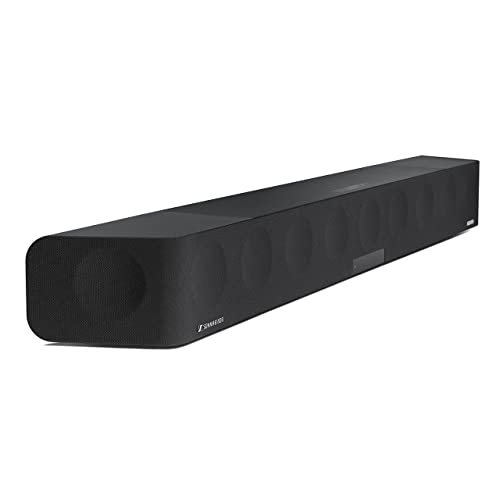
TL;DR: The Sennheiser AMBEO Soundbar Max delivers a full 5.1.4 immersive experience with 13 built‑in drivers, but its 40.79 lb weight and $1999.95 price make it a premium‑only choice.
The standout feature is its 13‑driver 5.1.4 layout, which Sennheiser markets as a “stand‑alone” 3‑D solution. It starts reproducing bass down to 30 Hz and covers a full 30 Hz – 20 kHz frequency range, while an advanced automatic room‑calibration system fine‑tunes the sound for your space.
In the context of the eleven‑product roundup, the AMBEO Max is noticeably heavier than the Sonos Arc Ultra (12.7 lb) and the JBL Bar 500MK2 (24.3 lb), and its 49.80 in width exceeds the Sonos Arc’s 46.18 in width. It also carries a higher price tag than most of its peers, positioning it at the premium end of the lineup.
Professional reviewers praise the immersive ambience and the ability to generate true‑height effects without a separate subwoofer, while everyday users love the impact of the sound but repeatedly flag the bar’s bulk and the challenge of mounting it securely. Some note that bass can feel less punchy on stereo music, a point echoed in consumer comments.
The soundbar runs on a dual‑core 1.2 GHz ARM Cortex‑A7 processor plus two dual‑core 500 MHz SHARC DSPs, and it supports Wi‑Fi 802.11 a/b/g/n/ac, Bluetooth 4.2 Class 1, and a suite of streaming services including Chromecast, AirPlay 2, Spotify Connect and Tidal Connect. Standby draws just 1.9 W (Eco) or 5.5 W (Smart), and the unit ships with a one‑year warranty.
Pros
Cons
Best for: Those prioritizing quality and willing to pay for premium performance
Avoid if: You're shopping on a tight budget — it's priced at $1999.95
TL;DR: The Philips Fidelio FB1 packs 310 W RMS into a 7.1.2‑channel bar with 15 drivers, offering Dolby Atmos and room‑calibration, but its higher weight and mixed reviews make it a premium‑priced niche choice.
At the heart of the FB1 is a 310 W RMS amplifier driving 15 custom drivers, including two up‑firing speakers for Dolby Atmos. The bar delivers a max SPL of 96 dB and covers a frequency range of 40 Hz – 20 kHz, while an integrated subwoofer and a built‑in calibration microphone let you fine‑tune the sound to your room. Physically, the unit measures 53.94 in deep, 14.96 in high and 8.66 in wide, and weighs 15.87 lb, giving it a solid presence without sacrificing the slim profile that lets it sit low on a TV stand or mount on a wall.
Compared with the other ten entries, the FB1 is considerably deeper than the Vizio SV510X‑08, which sits at just 3.23 in, and taller than that same model’s 2.28 in height. It is also much heavier than the Hisense HS5100’s 3.51 lb, yet lighter than the JBL Bar 700MK2’s 32 lb package. In terms of power, its 310 W RMS sits between the lower‑output Vizio and the higher‑output JBL Bar 500MK2, while its 7.1.2 channel claim exceeds the 5.1‑channel layouts of several peers, though the physical driver count aligns more closely with a 5.1.2 configuration.
Professional reviewers praise the FB1’s sleek leather‑trimmed front and metal mesh grille, noting that the design looks premium despite the bar’s relatively compact height. Users repeatedly mention the immersive Atmos effect and the convenience of the room‑calibration mic, but they also flag the gap between the advertised 7.1.2 channel layout and the actual 5.1.2 driver arrangement. The lack of a clearly documented night‑mode feature and a 3.8‑star rating from 16 reviews suggest that satisfaction is mixed, especially when the unit’s price sits at the higher end of the mid‑range market.
The FB1 rounds out its feature set with HDMI eARC, 4K/60 Hz passthrough, HDR10+, Dolby Vision, HLG and 3D support, plus Wi‑Fi services like AirPlay 2, Chromecast built‑in, Spotify Connect and DTS Play‑Fi. Voice control works with Google Assistant and Alexa, and an IMAX Enhanced certification adds another layer of credibility for home‑theater enthusiasts.
Pros
Cons
Best for: Owners of 55‑75‑inch TVs who want a single‑box Atmos solution with built‑in subwoofer, room‑calibration mic and premium styling.
Avoid if: You need a fully bundled surround system out‑of‑the‑box or prioritize a higher user rating and verified night‑mode functionality.
TL;DR: At $179.99, the Hisense HS5100 lands near the bottom of the 11‑model lineup with a 3.9‑star rating, and users praise its surround feel but warn about occasional subwoofer drop‑outs.
Hisense offers the HS5100 at a budget‑friendly price of $179.99 and gives it a 3.9‑star rating from 3,749 reviews, placing it at rank #11 among the eleven soundbars we evaluated. It’s the most affordable option in the group, but its rating ranks lowest of the set.
Reviewers consistently highlight the immersive 5.1‑channel feel, noting that the system fills a medium‑sized room with clear, loud audio. They also like the lightweight, low‑profile design that slips easily under most TV stands, and the six preset sound modes that let you switch quickly between movies, music, sports and games. Connectivity options such as Bluetooth, optical and HDMI ARC earn positive remarks, while the wireless subwoofer receives praise for flexible placement. On the downside, several users report the subwoofer cutting out during playback, and they’re frustrated that the rear speakers require wiring to the subwoofer. The lack of built‑in Wi‑Fi and the absence of an HDMI input also appear as drawbacks.
In context, the HS5100’s low price makes it attractive for shoppers who want a full‑surround experience without spending a lot, but the combination of the lowest rating and the noted reliability concerns means it sits at the bottom of the value ladder in this roundup.
Pros
Cons
Best for: Shoppers on a tight budget who want the most for their money
“this will be the last purchase with this company”
Breakdown
Polk Audio MagniFi Max AX SR
Pros
Sonos Arc Ultra Black
Pros
JBL Bar 700MK2
Pros
Cons
LG Sound Suite H7
Pros
Cons
Based on scoring data and product specs
Personalized picks
Best Overall Pick
Polk Audio MagniFi Max AX SR
Best ValueBest for: Buyers willing to invest in a proven, high-quality option
Sonos Arc Ultra Black
Best for: Buyers willing to invest in a proven, high-quality option
$1,099.00+$330.00 vs winner
Skip Hisense HS5100 if…
Reliability and user satisfaction are your top concerns
Polk Audio’s MagniFi Max AX SR takes the top spot thanks to its expansive 7.1.2 channel layout, a total of 11 drivers—including two height drivers and a dedicated wireless subwoofer—plus two wireless surround speakers, all for a list price of $769.00. The system also earned a solid 4.4‑star rating from 805 reviewers, showing strong consumer confidence.
The Sonos Arc Ultra Black lands as the runner‑up, ideal if you need premium voice‑assistant integration and AI‑driven dialogue clarity for movie nights. Its 14‑driver architecture delivers a 9.1.4 spatial‑audio experience, and features like TruePlay room correction and AI‑powered speech enhancement round out the package at $1,069.99.
For shoppers on a tighter budget, the Hisense HS5100 offers entry‑level 5.1 sound at $179.99. If you’re after a balanced mid‑range choice, the JBL Bar 700MK2 provides solid performance for $649.95. And for those willing to invest in top‑tier immersion, the Sennheiser AMBEO Soundbar Max delivers premium capabilities at $1,999.95.
Choose the Polk Audio MagniFi Max AX SR today for the best value in a 5.1+ soundbar system.
The Sonos Arc Ultra costs $1,069.99, about $300 more than the $769.00 Polk Audio MagniFi Max AX SR. It adds a 9.1.4 spatial‑audio layout, TruePlay room‑calibration, and integrated Sonos Voice Control, which may justify the premium for users already in the Sonos ecosystem. If you’re primarily after raw value and a solid 7.1.2 Atmos setup, the Polk model already delivers strong performance at a lower price.
No reviews yet — be the first to share your experience.
Please sign in to leave a review