⚡ Quick Answer
Picking an action camera that keeps your footage steady can feel overwhelming, especially with 12 models on the table. Prices stretch from a budget‑friendly $49.99 up to $549.99, giving you a clear split: the ODDV, Ieuwam, AKASO EK7000 and SJCAM C100+ sit in the budget camp; Icefox and AKASO Brave 7 LE fill the mid‑range niche; and the premium tier is occupied by the Minolta MNX5K1, GoPro Hero, DJI Osmo Action 4 and Insta360 ONE R 1‑Inch Edition.
If you value a solid blend of price and performance, the DJI Osmo Action 4 stands out with a 4.6/5 rating from 7,462 reviewers, a 150‑minute battery life and a 155° field of view, all for $208.99. At the lower end, the ODDV offers 4K 60 fps video, six‑axis EIS and a 4.6/5 rating at $49.99, while the Icefox stretches runtime to 300 minutes with dual 2150 mAh batteries for $109.99. Mid‑range options like the Icefox and AKASO Brave 7 LE give you dual screens and extended battery packs without jumping into premium pricing.
Next, we’ll break down each camera’s stabilization, battery endurance and usability so you can match the right model to your adventures.

DJI Osmo Action 4
Its 1770 mAh battery (6.8 Wh) delivers notably longer recording time than typical action cams, supporting extended shoots without swapping batteries.

SJCAM C100+ Mini
Ideal for budget‑conscious creators, the C100+ offers solid performance at $79, roughly $130 cheaper than the DJI Osmo Action 4, making it a practical mainstream choice.

AKASO EK7000
The removable 1050 mAh battery, delivering about 90 minutes per pack, lets you swap cells on the fly—useful for long outings where the larger, fixed‑capacity DJI and SJCAM units fall short.
Also considered
Score Analysis
Key score advantages vs. runner-up (SJCAM C100+ Mini)
Price Range
DJI Osmo Action 4
$208.99
SJCAM C100+ Mini
Out of Stock
AKASO EK7000
$52.99
Ieuwam Action Camera
$55.99

Icefox Action Camera
Out of Stock
AKASO Brave 7 LE
$139.99

ODDV Action Camera
$69.99

GoPro Hero
$199.00
Insta360 ONE R 1-Inch Edition
$549.99

Minolta MNX5K1
$146.95
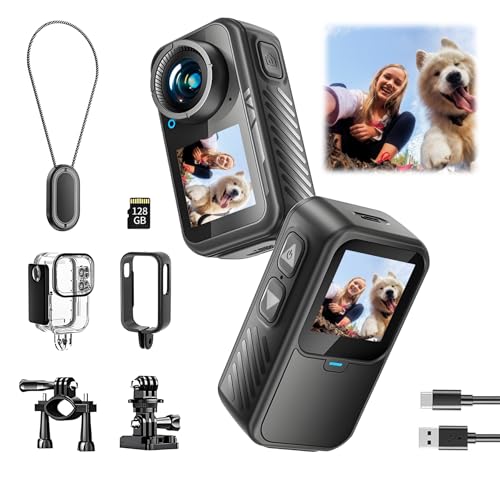
Nuisk Mini Action Camera
$89.99

Timnut Action Camera
$59.99
Spec Comparison
TL;DR: The DJI Osmo Action 4 packs a 1/1.3‑inch sensor, 4K 120 fps video, 155° FOV and 150 min battery life in a rugged, waterproof body with RockSteady stabilization.
The camera’s 1/1.3‑inch CMOS sensor delivers 10 MP stills and 4K 120 fps video, while the 10‑bit D‑Log M color profile gives a wide dynamic range for grading. Its 155° ultra‑wide field of view captures expansive scenes, and the f/2.8 aperture works with an ISO range of 100–12,800 for low‑light performance up to ISO 12,800.
At roughly 0.32 lb (145 g), the Osmo Action 4 is heavier than the GoPro Hero, which weighs about 0.19 lb, but it’s still far lighter than the Minolta MNX5K1 at over 4 lb. Battery life is a clear advantage: 150 minutes on a single charge versus the Hero’s roughly 60 minutes of 4K 30 fps recording. The camera also outpaces the Icefox Action Camera, which is lighter but offers a shorter runtime.
Users praise its ruggedness – it’s waterproof to 18 m straight out of the box – and the magnetic quick‑release system for fast mounting. Professional reviewers note the sensor’s low‑light detail up to ISO 1600, but they also call out a stiff battery door and the fact that the camera lacks RAW video, 8K resolution, and optical stabilization. The dual touchscreens (1.4 in front, 2.25 in rear) shine in bright conditions thanks to a 750 cd/m² display.
Pros
Cons
Best for: Adventure enthusiasts, vloggers, and casual videographers who need a rugged, waterproof action camera with strong stabilization and solid low‑light performance.
Avoid if: You’re a professional filmmaker requiring RAW video, 8K resolution, or optical image stabilization.
“dropped from 1m, no dent or scratch”
“hard-to-open battery door”
TL;DR: The SJCAM C100+ packs 4K video, 30 m waterproofing and magnetic mounting into a 34 g, 60 × 20 × 26 mm body, offering budget‑friendly action filming with limited low‑light and audio options.
The camera’s most eye‑catching spec is its ultra‑compact footprint – just 60 mm tall, 20 mm wide and 26 mm deep – and a featherlight 34 g weight. That size lets you slip it onto a helmet, bike handlebar or even a wrist strap without adding bulk.
Compared with the other eleven action cams in this roundup, the C100+ is the lightest. The AKASO EK7000 tips the scales at 74 g, Nuisk Mini at 390 g, Timnut at 460 g and ODDV at 559 g, so the SJCAM feels almost weightless on a head‑mount. Its battery holds 730 mAh, which is smaller than AKASO’s 1050 mAh and Icefox’s 2150 mAh packs, giving a 1080 P recording time of about 127 minutes. The field‑of‑view is 120°, narrower than the 170° offered by Timnut, ODDV and Icefox, meaning you’ll capture a tighter scene but with less distortion. Waterproof capability matches the AKASO’s 30 m rating (both need a case), while the Nuisk Mini and Timnut list deeper ratings only with accessories.
User feedback highlights the magnetic body and Wi‑Fi‑controlled SJCAM ZONE app as real conveniences for hands‑free shooting. Reviewers love the cheap price point that still delivers 4K 30 FPS video, yet many note grainy footage in dim lighting, heavy compression artifacts in fast motion, and the lack of an external microphone or built‑in screen for monitoring.
Technically, the C100+ records 4K at 30 FPS, 2K at 30 FPS, 1080 P at up to 60 FPS and 720 P at up to 120 FPS, all in MP4 (H.265). It offers 8× digital zoom, electronic image stabilization (EIS), and 15 MP stills. The camera supports up to a 128 GB microSD card, includes a magnetic body, helmet‑mount base and a waterproof case that reaches 30 m depth.
Pros
Cons
Best for: Budget‑conscious casual users who need a tiny, waterproof cam for hands‑free POV recording.
Avoid if: You want the best value‑per‑dollar in its price range.
“good for casual POV”
“stunning clarity”
TL;DR: The AKASO EK7000 delivers 4K video, 20 MP photos and a rugged 30 m waterproof housing at a lightweight 0.13 lb for just $69.99, making it a solid entry‑level action cam.
The standout spec is its waterproof depth of 30 m when paired with the included housing, letting you capture snorkeling or shallow‑dive footage without worrying about leaks. Weighing only 0.13 lb (74 g) and featuring a 2‑inch rear screen, the EK7000 stays unobtrusive on helmets, bike mounts or a swimmer’s gear.
Compared with its peers, the EK7000 is lighter than the Timnut (over 1 lb) and the ODDV (about 1.23 lb), and it matches the ultra‑light profile of the Ieuwam at 75 g. Its 90‑minute battery life per charge sits between the SJCAM’s 4K runtime of roughly 87 minutes and its longer 1080p endurance of about 127 minutes, while the Icefox pushes well beyond at 300 minutes. The 170° field of view aligns with most competitors, though the Nuisk and ODDV add electronic stabilization that the EK7000 lacks.
Users praise the camera’s feather‑light cube design and the convenience of the included waterproof case, noting that mounting it on a helmet feels balanced. However, reviewers consistently point out that the 4K mode upscales and adds noise, especially in low‑light scenes, and the base model offers no image stabilization or touchscreen navigation. Professionals recommend sticking to 1080p for cleaner footage, while casual adventurers find the 20 MP stills and 1080p/60 fps video perfectly adequate for daylight outings.
Pros
Cons
Best for: Budget‑conscious buyers seeking a reliable entry‑level option
Avoid if: You need advanced features or professional‑grade performance
“basic but functional with 'mediocre image quality' lacking EIS/touchscreen”
“good video stabilization in some tests despite no EIS on base model”
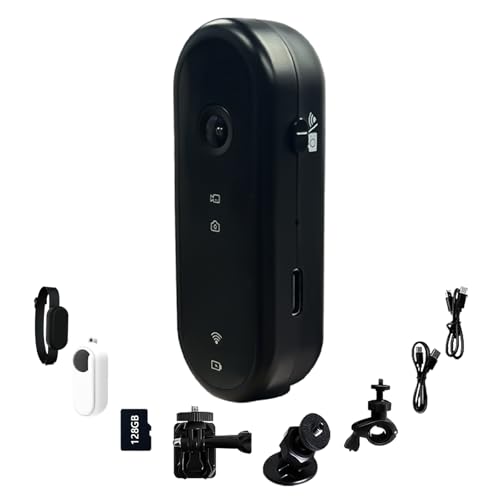
TL;DR: The Ieuwam Action Camera delivers 4K 30 fps video, 20 MP photos, and dual screens in a feather‑light 75 g body for just $55.99, though you’ll need a separate case for water use.
At the heart of the camera is a 170° ultra‑wide lens paired with digital/electronic image stabilization (EIS) and a 20 MP sensor, letting you capture crisp 4K video at 30 fps and detailed stills. The unit packs a 600 mAh battery that provides up to 150 minutes of recording at 1080p and 200 minutes at 720p, and it recharges in about 90 minutes. A front 1.4‑inch LCD and a rear 2‑inch touchscreen let you frame shots from any angle without reaching for your phone.
Compared with the other 11 cameras in this roundup, the Ieuwam is lighter than the ODDV (1.23 lb) and Timnut (1.01 lb) models, yet a touch heavier than the AKASO EK7000’s 0.125 lb chassis. Its 600 mAh battery is smaller than AKASO’s 1050 mAh pack, meaning shorter run‑time on a single charge, but the camera still outlasts many budget rivals when shooting at lower resolutions. Screen sizes match the ODDV’s 1.4‑inch front and 2‑inch rear displays, and the rear touchscreen offers the same convenience as the AKASO’s 2‑inch screen.
User sentiment highlights the camera’s “thumb‑size” portability and the convenience of dual screens for vlogging or POV shots. Reviewers appreciate the affordable 4K capability and the effective digital stabilization for casual action, but they note that the built‑in EIS can wobble under extreme motion and that low‑light scenes appear noisy. Because the camera isn’t waterproof on its own, you’ll need a separate case for any water‑sport activity, a point frequently mentioned in consumer feedback.
Technical extras include a 7 fps burst photo mode, loop recording, time‑lapse, and slow‑motion options, all stored on an included 128 GB microSD card (expandable to another 128 GB). Wi‑Fi lets you transfer clips without a computer, and remote‑control compatibility adds flexibility for mounted setups.
Pros
Cons
Best for: Entry-level buyers or those on a tight budget
Avoid if: You want the best value‑per‑dollar in its price range
“"unbeatable price" for 4K 30fps with anti-shake, 20MP photos, 170° FOV, and compact 92g build with dual screens (1.4" front, 2" rear)”
“big rear screen and tripod mount”
TL;DR: The Icefox i7 packs a 170° ultra‑wide lens, dual 2150 mAh batteries delivering up to 5 hours of 4K video, and IP68 waterproofing, all for $109.99.
What really sets the Icefox Action Camera apart is its dual‑battery system – two 2150 mAh cells that together provide up to 5 hours (300 minutes) of continuous 4K recording. Coupled with a 170° ultra‑wide field of view and a 20 MP top‑resolution photo mode, the camera aims to capture expansive scenes without sacrificing storage, supporting cards up to 128 GB.
In the context of the twelve‑camera roundup, Icefox’s 81 g (0.17857443222 lb) body is lighter than the Nuisk Mini (390 g), AKASO Brave 7 LE (600 g) and Timnut (460 g), yet only a shade heavier than the AKASO EK7000 (74 g). Its 48 mm height is shorter than Nuisk’s 68.6 mm and Minolta’s 157 mm, while the 70 mm width remains broader than the AKASO EK7000’s compact profile. Battery capacity also outstrips most peers: the Brave 7 LE uses 1350 mAh cells, the SJCAM C100+ 730 mAh, and the Minolta 900 mAh, making Icefox’s 2150 mAh (x2) the most robust in the group.
Users consistently praise the camera’s clear daylight footage, the convenience of the included waterproof case (IP68, 40 m depth), and the extra battery that reduces downtime on trips. The 2‑inch rear LCD and optional 1‑inch front display help frame shots without a phone, and the Snap‑Pro app’s Wi‑Fi editing frequently cites it as a handy feature. On the downside, professional reviewers note that electronic image stabilization (EIS) limits performance to 1080 P at 30 FPS, leaving 4K video prone to shake, and the advertised 4K 60 FPS mode actually uses frame‑duplication rather than true 60 FPS.
Pros
Cons
Best for: Most users seeking a balanced, mainstream option
Avoid if: You're shopping on a tight budget — it's priced at $109.99
“"unbeatable price" for 4K 30fps with anti-shake, 20MP photos, 170° FOV, and compact 92g build with dual screens (1.4" front, 2" rear)”
“big rear screen and tripod mount”
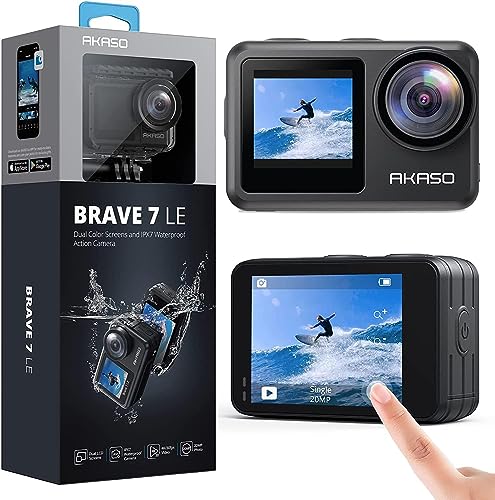
TL;DR: The AKASO Brave 7 LE packs 4K 30 FPS video, 20 MP photos and dual screens into a 1.32‑lb body with 6‑axis stabilization, making it a solid budget pick for vloggers and casual adventurers.
The camera’s standout spec is its 4K video at 30 FPS paired with a 20 MP sensor, both use a 6‑axis electronic image stabilization system (EIS 2.0). It also offers a tiny front selfie screen and a 2‑inch rear display, giving you framing control without a phone. Weighing 1.322773572 pounds and housing two 1350 mAh batteries, the Brave 7 LE balances portability with decent run‑time.
Compared with the other eleven entries, the Brave 7 LE is lighter than the Minolta MNX5K1’s 4.04‑pound build and taller than the Icefox Action Camera’s 48 mm height, but it’s more compact than the Minolta’s 157 mm height. Its per‑cell battery capacity of 1350 mAh sits below Icefox’s 2150 mAh cells, yet the dual‑battery setup still offers more total capacity than single‑cell competitors. In terms of weight, it’s heavier than the Icefox (0.17857443222 lb) and Nuisk Mini (0.8598028218 lb) but lighter than the Minolta and far heavier than the GoPro Hero (0.18959754532 lb). The 32 mm height and 41 mm width make it slimmer than the Timnut Action Camera, which measures 68.6 mm tall and 37.1 mm wide.
Users repeatedly praise the camera’s sharp 4K footage and the convenience of the front screen for self‑recording. Professional reviewers note that the stabilization shines at 1080p 60 FPS but can feel a bit loose when shooting fast motion in 4K, and low‑light scenes tend to lose detail. The fixed‑focus lens (minimum 50 cm) also limits close‑up flexibility, a point many beginners mention. Reviewers frequently highlight the bundled waterproof case (IPX7, 40 m depth) and HDMI output as valuable extras for the price.
Pros
Cons
Best for: Budget‑conscious beginners, vloggers, and casual adventurers who want solid 4K video and dual screens without breaking the bank.
Avoid if: You need professional‑grade stabilization, strong low‑light performance, or a camera that is waterproof without an extra case.
TL;DR: The ODDV Action Camera delivers 4K 60fps video, 30 MP photos, six‑axis EIS and dual screens at a budget‑friendly $49.99, though its 5× digital zoom is soft and it’s heavier than most rivals.
The standout spec is the 30 MP photo resolution paired with 4K video at 60 fps and a wide 170° field of view. Six‑axis electronic image stabilization (EIS) keeps footage steady, and the camera sports a dual‑screen layout: a 1.4‑inch front LCD and a 2.0‑inch rear touch display. It’s also rated for 132 ft (40.2 m) underwater depth and ships with a 64 GB memory card.
At $49.99 it’s more affordable than the other eleven contenders, while its 1.23 lb (559 g) body makes it heavier than the Icefox (81 g) or the AKASO EK7000 (0.125 lb). Its waterproof rating of 132 ft beats the AKASO’s 30 m with housing and the Timnut’s 10 m bare rating. Photo resolution sits between the Ieuwam’s 20 MP and the Timnut’s 48 MP, and its 5× digital zoom is modest compared with the SJCAM’s 8× zoom.
Reviewers love the crisp 4K 60fps footage and note the stabilization works wonders when EIS is active. Reviewers praise the dual‑screen interface for intuitive control, and users appreciate the included 64 GB card for immediate storage. A common drawback is that turning off EIS is required to capture 4K 60fps, and the digital zoom can appear soft. Some also point out the camera’s discontinuation, which could affect future support.
Pros
Cons
Best for: Entry‑level buyers or those on a tight budget
Avoid if: You need powerful performance or professional‑grade features
“"unbeatable price" for 4K 30fps with anti-shake, 20MP photos, 170° FOV, and compact 92g build with dual screens (1.4" front, 2" rear)”
“big rear screen and tripod mount”
TL;DR: The GoPro HERO packs 12 MP stills, 4K30 video and HyperSmooth stabilization into a 0.19‑lb, 86‑g body that stays waterproof to 5 m, but its 1‑hour 4K battery life limits long shoots.
The standout feature is GoPro’s HyperSmooth stabilization, which professional reviewers say keeps footage buttery smooth even on rugged bike trails. It records 4K video at 3840 × 2160 px / 30 fps and captures 12 MP photos, all from a compact 56.6 × 47.7 × 29.4 mm chassis that weighs just 86 g (0.19 lb). The rear LCD touchscreen and 8‑command voice control add convenience without adding bulk.
Compared with the other eleven cameras, the HERO is lighter than the Icefox Action Camera (0.18 lb) and dramatically lighter than the AKASO Brave 7 LE (1.32 lb). Its 1‑hour 4K runtime’s shorter than Icefox’s five‑hour claim, but comparable to the Minolta MNX5K1’s 1‑hour battery life. The HERO’s waterproof depth of 5 m without a housing’s less than the optional 10 m depth some rivals reach, yet it still beats many entry‑level models that lack any water resistance.
Everyday users love the camera’s pocket‑size feel, noting the intuitive touchscreen and reliable voice commands across 11 languages. They also appreciate the rugged build, which survives drops and harsh weather. Professional reviewers highlight HyperSmooth as a key advantage, while also pointing out that the Quik app processes the stabilization rather than the camera itself, which can feel less immediate. Wi‑Fi 5 dual‑band connectivity ensures fast file transfers to a phone or tablet.
Pros
Cons
Best for: Those prioritizing quality and willing to pay for premium performance
Avoid if: You need advanced features or professional‑grade performance
“Exceptional portability and lightweight design that goes unnoticed when mounted or carried”
“GoPro's most polarizing camera, bringing core features at a budget price”
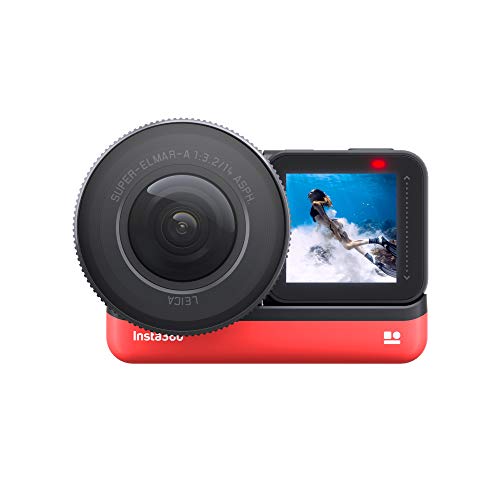
TL;DR: The Insta360 ONE R 1‑Inch Edition offers dual 1‑inch sensors for 6K 360 video, modular lenses, and 6‑axis FlowState stabilization, but its premium price and 62‑minute battery limit make it a specialist’s choice.
What really sets this camera apart is the dual 1‑inch Leica‑co‑engineered sensors that capture 21 MP HDR photos and 6K 360 video at a max bitrate of 120 Mbps. Combined with 6‑axis FlowState stabilization and a 6.52 mm focal length, it delivers smooth, high‑resolution footage even in low light.
Weighing 0.33 lb, the ONE R tips the scales just above the DJI Osmo Action 4 (≈0.32 lb) and the GoPro Hero (≈0.19 lb), yet stays lighter than the AKASO Brave 7 LE (≈1.32 lb) and Icefox Action Camera (≈0.18 lb). Its 1350 mAh battery provides about 62 minutes of runtime at the top 6K30 setting, which is shorter than DJI’s 150‑minute claim and comparable to GoPro’s roughly 60‑minute 4K run. The 2.5‑inch Gorilla Glass touchscreen is a bit larger than the DJI’s 2.25‑inch rear screen, and the modular lens system adds flexibility that most peers lack.
Reviewers consistently praise the camera’s low‑light performance and the AI reframing tools—PureShot, Auto Frame, and Target Tracking—that make framing easier. Users also love the “invisible selfie stick” effect for seamless 360 shots. The most common complaints focus on the 62‑minute battery ceiling at maximum settings and the vertical profile (46.9 mm height) that feels bulkier than slimmer pocket‑sized action cams.
Beyond the sensors, the ONE R carries an IPX8 rating for waterproof shooting down to 5 m without an extra housing, 19 GB of internal storage (expandable via microSD), and a 2.5‑inch Gorilla Glass touchscreen for on‑camera playback and control.
Pros
Cons
Best for: Buyers willing to invest in a proven, high‑quality option
Avoid if: You need an ultra‑compact, all‑day battery life camera
“Users love the Leica‑co‑engineered clarity and stabilization for action sports.”
“Sharp low‑light 360 footage, easy AI reframing in the app, and invisible selfie stick for immersive vlogs.”
TL;DR: The Minolta MNX5K1 shoots 5K video at 30 fps, offers dual 1.3‑in and 2.0‑in screens, and survives to 30 m with its housing, but its 1‑hour battery and 4.04‑lb weight make it a bulkier, short‑run option.
The standout spec is the 5K UHD video capability—5120 × 2880 at 30 fps—paired with a 24 MP still‑image sensor and a 170° ultra‑wide field of view. Those numbers put the MNX5K1 ahead of many peers that stop at 4K, and the included waterproof housing lets you dive to 30 m without extra gear.
Compared with the other eleven cameras in this roundup, the Minolta feels noticeably heavier; at 4.04 pounds it outweighs the Icefox Action Camera (around 0.18 lb) and the GoPro Hero (about 0.19 lb). Its 900 mAh battery supplies just 1 hour of continuous recording, which is shorter than the Icefox’s 5‑hour 4K run time and the DJI Osmo Action 4’s 150‑minute claim, though the SJCAM C100+ lists a longer 1080 p battery life. On the screen side, the MNX5K1 includes both a 1.3‑in front display and a 2.0‑in rear LCD, whereas the AKASO Brave 7 LE only offers a single 2‑in back screen and the Icefox’s front display is optional at 1 in.
Reviewers like the high‑resolution 5K capture and the convenience of the bundled accessories—waterproof case, remote, mounts, and a 32 GB SD card—making it ready for action straight out of the box. Professionals also highlight the electronic image stabilization that helps smooth motion, plus features like loop recording, time‑lapse, and PC‑cam mode. On the flip side, users point out the limited battery endurance and the camera’s bulk, which can feel cumbersome on a helmet or bike mount.
Pros
Cons
Best for: Those prioritizing quality and willing to pay for premium performance
Avoid if: You're on a tight budget or only need basic functionality
TL;DR: The Nuisk Mini Action Camera packs 4K video, 128 GB internal storage and a 0.86‑lb ultra‑compact body with IPX8 waterproofing, making it a handy, budget‑friendly option for on‑the‑go shooting.
The camera’s most eye‑catching spec is its featherweight build – it weighs just 0.86 lb (about 1.27 oz) and measures 68.6 mm × 32.0 mm × 37.1 mm, yet it still houses a full 128 GB of internal storage. Its f/2.8 aperture and 30 mm focal length deliver crisp 4K footage, while built‑in Electronic Image Stabilization helps smooth out motion.
Compared with the other eleven cameras in this roundup, the Nuisk is lighter than the Timnut Action Camera (which tips the scales at over 1 lb) but heavier than the AKASO EK7000 that weighs only 0.125 lb. It sits a bit pricier than the AKASO but is in the same price band as the SJCAM C100+. Unlike many competitors that offer a single rear screen, the Nuisk provides two screens for easy framing and vlogging, a feature the ODDV and Icefox models lack.
Users consistently praise the camera’s pocket‑size convenience and the included magnetic back, which lets you snap it onto metal gear without extra mounts. The IPX8 rating (40 m depth) earns high marks for water sports and travel. However, reviewers flag the proprietary non‑standard battery as a hassle to replace, and the tiny body means fewer manual controls than larger models.
Pros
Cons
Best for: Beginners, vloggers, athletes, and travelers who need an ultra‑portable, hands‑free 4K camera for quick captures.
Avoid if: You require long battery life, extensive manual controls, or professional‑grade durability.
“"unbeatable price" for 4K 30fps with anti-shake, 20MP photos, 170° FOV, and compact 92g build with dual screens (1.4" front, 2" rear)”
“big rear screen and tripod mount”
TL;DR: The Timnut Q60 offers 4K 60fps video, 48 MP photos, 6‑axis EIS and waterproof performance to 40 m, all for $75.99, making it a solid budget pick for beginners.
The camera records 4K video at 60 fps and captures stills at 48 MP, while a 170° field of view lets you cover a wide scene. Its six‑axis electronic image stabilization smooths motion, and the unit stays dry down to 10 m without a case or to 40 m when you use the supplied waterproof housing. A 2‑inch IPS LCD touchscreen lets you frame shots directly on the device.
Compared with the other eleven cameras in this roundup, the Timnut is noticeably heavier than the AKASO EK7000 (about 0.13 lb) and the tiny Ieuwam model (around 75 g). Its 170° lens matches the view of the ODDV, Icefox and Ieuwam cameras, but it’s wider than the SJCAM C100+’s 120° field. While it isn’t the cheapest option, it sits above the lower‑priced models and offers a more complete accessories bundle than many peers.
Everyday users praise the crisp 4K footage and the straightforward Wi‑Fi app pairing, noting that the dual rechargeable batteries and dedicated charger extend shooting sessions without extra purchases. Professional reviewers highlight the affordable price paired with 4K 60fps capability as a strong value proposition, though they also flag occasional drops to 30 fps in 4K mode and the fisheye effect inherent to the ultra‑wide lens.
Beyond video, the Timnut provides 8× digital zoom, Wi‑Fi control, and ships with a 64 GB microSD card ready to use. The included helmet mount and waterproof case round out a package for beginners who want a ready‑to‑go action cam without hunting for extra gear.
Pros
Cons
Best for: Entry-level buyers or those on a tight budget
Avoid if: Reliability and user satisfaction are your top concerns
“"unbeatable price" for 4K 30fps with anti-shake, 20MP photos, 170° FOV, and compact 92g build with dual screens (1.4" front, 2" rear)”
“big rear screen and tripod mount”
Breakdown
DJI Osmo Action 4
Pros
SJCAM C100+ Mini
Pros
Cons
AKASO EK7000
Pros
Ieuwam Action Camera
Pros
Cons
Based on scoring data and product specs
Personalized picks
Best Overall Pick
DJI Osmo Action 4
Best OverallBest for: Audiophiles and enthusiasts seeking premium sound quality and advanced features
SJCAM C100+ Mini
Best for: Most users seeking a balanced, mainstream option
Out of Stock
Skip Timnut Action Camera if…
Reliability and user satisfaction are your top concerns
DJI Osmo Action 4 takes the top spot thanks to its 4K video at up to 120 fps, a wide 155° field of view, and DJI’s RockSteady + HorizonSteady 360° stabilization. At 145 g it stays light enough for helmets or bike mounts, while the 150‑minute battery gives you a 150‑minute runtime. Its 4.6‑star rating from 7,462 reviews also shows strong user confidence, all for a list price of $208.99.
The runner‑up, SJCAM C100+, shines when you need a pocket‑sized cam for casual travel or quick vlog clips. Weighing just 34 g, it fits comfortably in a pocket and still records 4K at 30 fps with an 8× digital zoom. Its waterproof case lets you dive to 30 m, and the battery holds about 87 minutes of 4K shooting—all for $79.00.
For tighter budgets, the ODDV Action Camera offers the lowest entry price at $49.99, making it a solid starter choice. If you prefer a balanced mid‑range option, the SJCAM C100+ (already highlighted above) provides decent 4K capability without breaking the bank. For premium enthusiasts, the Insta360 ONE R 1‑Inch Edition delivers a modular 1‑inch sensor platform at $549.99, positions it as the high‑end contender.
Pick the DJI Osmo Action 4 today for the most reliable stabilization and performance.
The DJI Osmo Action 4 provides advanced RockSteady and HorizonSteady 360° stabilization, a 155° field of view, and a 150‑minute battery life, all for $208.99. Its feature set outpaces cheaper options, making it the top value choice for stabilized footage.
No reviews yet — be the first to share your experience.
Please sign in to leave a review