⚡ Quick Answer
When you need an action cam that won’t quit mid‑run, battery life becomes the make‑or‑break factor. The review compared nine cameras, from the $20.88 Xilecam Action Camera up to the $426.00 DJI Osmo Action 6, examining how long each records and what trade‑offs come with that endurance. The DJI Osmo Action 4, for example, is listed at 150 minutes on a single charge and carries a strong 4.6/5 rating from more than 7,000 reviewers, while the RunCam Helmet Camera pushes the runtime to a full 7 hours.
The lineup spans three price tiers. The budget tier (Xilecam, Timnut, AKASO EK7000) keeps entry costs low, with the Timnut offering 240 minutes of continuous recording for $42.99. Mid‑range options (RunCam Helmet, Icefox, AKASO Brave 7 LE) balance price and performance; Icefox advertises 5 hours (300 minutes) of 4K capture at $109.99. The premium tier (RunCam ScopeCam2, DJI Osmo Action 4, DJI Osmo Action 6) delivers the longest runtimes and the most advanced features, such as the ScopeCam2’s 240‑minute 1080p@60fps mode at $197.99.
Below you’ll find a deeper look at each camera’s battery specs, usability and value, so you can match endurance to your adventure style.

DJI Osmo Action 4
Battery Capacity of 1770 mAh gives the DJI Osmo Action 4 a longer run time than many rivals, supporting extended shooting sessions.

Xilecam Action Camera
Ideal for tight‑budget shoppers, the Xilecam Action Camera costs $20.88—about $188 cheaper than the DJI Osmo Action 4.
AKASO Brave 7 LE
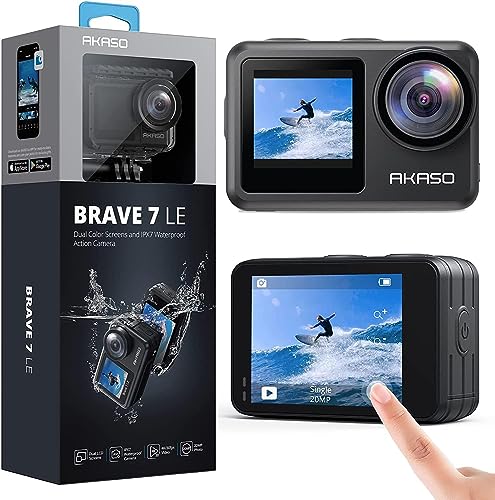
The AKASO Brave 7 LE adds a 2‑inch rear screen, letting you review footage on‑camera—a feature the DJI and Xilecam lack.
Also considered
Score Analysis
Key score advantages vs. runner-up (Xilecam Action Camera)
Price Range
DJI Osmo Action 4
$208.99
Xilecam Action Camera
$20.88
AKASO Brave 7 LE
$139.99

AKASO EK7000
$52.99

RunCam Helmet Camera
$79.99

RunCam ScopeCam2
$209.99

DJI Osmo Action 6
$426.00

Timnut Action Camera
$46.59

Icefox Action Camera
Out of Stock
Spec Comparison
TL;DR: The DJI Osmo Action 4 packs a 1/1.3‑inch sensor, 4K / 120 fps video and 155° FOV into a 0.32‑lb, 2.5‑hour battery package, delivering bright dual screens and rugged waterproof performance.
The standout feature is its 1/1.3‑inch CMOS sensor paired with a maximum video resolution of 3840×2160 at 120 fps and a 10‑bit D‑Log M color profile. Combined with a 155° field of view, the camera captures detailed, wide‑angle footage even in challenging lighting, while the ISO range of 100–12,800 supports low‑light shooting.
At 0.32 lb (145 g), the Osmo Action 4 is lighter than the AKASO Brave 7 LE and comparable in weight to the RunCam ScopeCam2. Its 150‑minute (2.5 hour) battery life is shorter than the ScopeCam2’s 240‑minute runtime at 1080 p, but still respectable for a 4K‑capable unit. The price point sits above budget‑oriented models like the Timnut Action Camera, positioning it in the premium‑value tier.
Users praise the camera’s ruggedness: it’s waterproof to 18 m without a case and the magnetic quick‑release system makes mounting effortless. However, reviewers consistently mention a stiff battery door that can be annoying after repeated swaps, and they note that image noise becomes more apparent above ISO 1600 in very dark scenes. Professional reviewers also point out the absence of RAW video and 8K support, which may matter to high‑end creators.
Beyond the sensor, the Osmo Action 4 offers RockSteady and HorizonSteady 360° electronic stabilization, ensuring smooth footage when the action gets rough. The dual touchscreens—1.4 in front and 2.25 in rear—deliver 750 cd/m² brightness, so you can frame shots even under bright sunlight.
Pros
Cons
Best for: Buyers willing to invest in a proven, high‑quality option
Avoid if: You're on a tight budget or only need basic functionality
“dropped from 1m, no dent or scratch”
“hard-to-open battery door”
TL;DR: The Xilecam X200 packs a 45 g, 40000 mm waterproof body, 1080p video and a 50.8 mm screen for just $20.88, but its modest battery and occasional frame‑rate hiccups keep it in the budget lane.
The camera’s most eye‑catching spec is its waterproof depth of 40000 mm, meaning you can submerge it to roughly 40 m without a separate housing. It also stays feather‑light at 45 g (about 0.10 lb) and sports a 50.8 mm LCD that lets you frame shots without a phone.
Compared with the eight other action cams in this roundup, the Xilecam is the lightest—far lighter than Timnut’s 458 g unit and even lighter than AKASO EK7000’s 74 g body. Its dual 900 mAh batteries give a lower capacity than Timnut’s 1050 mAh cells, AKASO’s 1050 mAh, and Icefox’s 2150 mAh packs, which translates to shorter shooting windows. Memory‑wise, the X200 tops out at 32 GB, while Icefox supports up to 128 GB and RunCam ScopeCam2 can handle 256 GB. In practice, the X200’s modest battery and storage make it a true entry‑level option.
Users consistently praise the camera’s pocket‑size portability and the fact that it arrives with essential accessories, cutting down on extra spend. The waterproof claim earns frequent nods from both consumers and professional reviewers, who note the reliable seal to 40 m. However, many reviewers flag video lag when recording at the full 1080p 30 fps setting, often dropping to 720p for smoother playback. The limited battery capacity also shows up in complaints about “short shooting time.” Professional reviewers echo this, saying the X200 delivers acceptable 1080p quality for its price but falls short for longer or higher‑intensity shoots.
Beyond video, the X200 records in AVI format with AAC audio, includes built‑in speakers and a timer, and forgoes Wi‑Fi altogether. These features keep the unit simple and affordable, but they also mean you’ll need a separate device to transfer footage or stream live.
Pros
Cons
Best for: Shoppers on a tight budget who want the most for their money
Avoid if: Reliability and user satisfaction are your top concerns
“satisfied with this purchase for the price”
TL;DR: The AKASO Brave 7 LE packs a 4K 30 FPS sensor, 20 MP photos and dual screens into a rugged, IPX7‑rated body, but its weight and modest stabilization keep it in the mid‑range camp.
The standout spec is the 2‑inch rear LCD paired with a tiny front selfie screen, letting you frame shots from both angles without a phone. With a 20 MP sensor and 4K 30 FPS video, it delivers the resolution you expect from higher‑priced models while staying under $140.
At 1.3228 pounds (600 g), the Brave 7 LE is heavier than every other camera in this nine‑product lineup, from the feather‑light Icefox at roughly 0.18 pounds to the RunCam Helmet Camera at about 0.66 pounds. Its 1350 mAh batteries (two included) sit between the 1050 mAh cells of the AKASO EK7000 and the 2150 mAh packs used by the Icefox, giving it a respectable runtime without the bulk of larger battery packs.
Reviewers consistently praise the camera’s value‑for‑money bundle – the waterproof case, dual charger and remote arrive right out of the box – and the front screen earns a nod from vloggers who need to see themselves while filming. Professional reviewers, however, point out that the 6‑axis electronic image stabilization (EIS 2.0) loses a step in 4K heavy motion, and low‑light scenes can appear blurry due to the fixed‑focus lens.
Pros
Cons
Best for: Most users looking for a well‑reviewed, reliable mainstream option
Avoid if: You need advanced features or professional‑grade performance
TL;DR: The AKASO EK7000 offers 4K video, 20 MP photos and a 30 m waterproof housing in a feather‑light 0.125‑lb body, but its battery lasts only about 1.5 hours per charge.
The camera’s most eye‑catching spec is its ability to record 4K video at up to 30 fps while still fitting in a 58 × 41 × 28 mm cube that weighs just 0.125 pounds (74 g). It ships with two 1050 mAh batteries, each delivering roughly 1.5 hours of use, and a 2‑inch TN screen for framing shots.
Compared with the eight other action cams in this roundup, the EK7000 is lighter than the RunCam Helmet Camera, Timnut Action Camera, Icefox Action Camera, RunCam ScopeCam2, DJI Osmo Action 4 and DJI Osmo Action 6, and only a bit heavier than the ultra‑light Xilecam (45 g). Its battery life is shorter than the 7‑hour RunCam, the 4‑hour Timnut, the 5‑hour Icefox and the 4‑hour DJI Action 6, so endurance becomes a clear trade‑off.
Everyday users repeatedly mention how the ultra‑light design and the included waterproof housing make helmet and snorkel mounts effortless, and professional reviewers note the solid build that reliably reaches 30 m underwater. The downside that shows up in both groups is the upscaled, noisy 4K footage and the absence of any image stabilization, which makes fast‑moving scenes look shaky. They also point out the weak built‑in microphone and the lack of a touchscreen for quick menu navigation.
Beyond video, the EK7000 provides a fixed 170° field of view, loop recording, and time‑lapse intervals of 3 s, 5 s and 10 s. Wi‑Fi reaches up to 10 m (about 32 ft), and the package includes a 2.4 GHz wireless wrist remote, multiple mounts and the waterproof housing.
Pros
Cons
Best for: Budget‑conscious buyers seeking a reliable entry‑level option
Avoid if: You need advanced features or professional‑grade performance
“basic but functional with 'mediocre image quality' lacking EIS/touchscreen”
“good video stabilization in some tests despite no EIS on base model”
TL;DR: The RunCam Helmet Camera records 1080p @ 60 fps for up to 7 hours on a single charge, with a flexible bendable tube for adjustable mounting and Wi‑Fi preview via a mobile app.
The standout spec is its 7‑hour battery life, which dwarfs the 90‑minute runtime of the AKASO EK7000 and even exceeds the 5‑hour limit of the Icefox Action Camera. Coupled with a 155° diagonal field of view and a 1/2.9" sensor, it delivers smooth 1080p @ 60 fps video in a compact 50 mm × 28 mm × 167 mm package.
At roughly 0.66 lb, the RunCam's noticeably heavier than the feather‑light Xilecam (≈0.10 lb) and the AKASO EK7000 (≈0.13 lb), yet it remains lighter than the AKASO Brave 7 LE (≈1.32 lb) and the RunCam ScopeCam2 (≈0.32 lb). Its battery endurance is the longest among the nine contenders, beating the Timnut’s 4‑hour claim and the ScopeCam2’s 4‑hour 1080p runtime.
Reviewers appreciate the hands‑free flexibility of the bendable tube and the convenience of real‑time preview through the built‑in Wi‑Fi app. However, users note the lack of 4K recording and the absence of manual ISO or shutter controls, which some consider a drawback. The 3.9‑star rating from 85 reviews reflects a mixed reception, with praise for endurance and criticism for limited resolution options.
Technical details include a 1/2.9" image sensor, MP4 video format, USB‑C charging, and vibration alerts for power and low‑battery warnings. The camera draws 400 mA at 5 V, lists its net weight as 110 g, and its overall device weight as 299 g.
Pros
Cons
Best for: Hobbyists and enthusiasts who need long‑duration hands‑free POV recording with easy smartphone preview.
Avoid if: You require 4K video, manual exposure controls, or a higher‑rated, more universally praised camera.
TL;DR: The RunCam ScopeCam2 packs interchangeable 25 mm, 40 mm and 3.6 mm lenses, 4X digital zoom and a 1400 mAh battery into a 0.3196702799‑pound, IP64‑rated body for premium‑grade action capture.
The standout feature is the interchangeable lens system – a 25 mm lens at 12° FOV, a 40 mm lens at 8.2° FOV, and a ultra‑wide 3.6 mm lens at 150° FOV. This lets you switch from tight, zoomed‑in shots to expansive scenery without swapping cameras. The camera also offers 4X digital zoom and flashback recording of 5‑15 seconds, so you can capture the moment before you hit record.
In a lineup that includes the DJI Osmo Action 4, AKASO Brave 7 LE and Icefox Action Camera, the ScopeCam2 matches the DJI’s 0.3196702799‑pound weight but is heavier than the ultra‑light Icefox (81 g) and lighter than the AKASO Brave 7 LE (1.322773572 pounds). Its price point sits at the premium end of the range, so it's pricier than many budget‑focused options, yet it offers more specialized lens flexibility than the single‑lens designs of most peers.
People consistently praise the single‑button control with built‑in vibration feedback and the 2.4 GHz Wi‑Fi app preview, describing the camera as “easy to use” on the field. Professional reviewers note the 25 mm lens as a versatile sweet spot for both close‑quarters and medium‑range footage, while the 40 mm lens shines for documenting sniper‑style shots. The 1400 mAh battery and support for up to 256 GB microSD give you plenty of room for extended sessions, and the IP64 rating lets it handle rain or dust without a housing.
Pros
Cons
Best for: Those prioritizing quality and willing to pay for premium performance
Avoid if: You're shopping on a tight budget — it's priced at $197.99
“ease of use and intuitive controls—simply pushing the record button forward activates recording with vibration and LED indicator feedback”
TL;DR: The DJI Osmo Action 6 packs a 1.4‑inch front screen, 2.25‑inch rear screen, 4‑hour battery and 4K / 60 fps video into a 149 g, cold‑resistant body for creators who value flexibility over price.
The standout feature is the dual‑screen layout: a 1.4‑inch front display lets you frame yourself while a 2.25‑inch rear touchscreen offers full‑screen playback and settings control. Under the hood, the camera records 4K video at up to 60 fps and can hit 240 fps at 1080p, giving you both cinematic smoothness and ultra‑slow‑motion options. Its 145° field of view and a variable f/2.0–f/4.0 aperture on a 1/1.1" CMOS sensor provide a wide, bright capture area, while digital image stabilization helps smooth out handheld motion.
Compared with the other eight cameras in this roundup, the Osmo Action 6 offers the longest listed battery life at 4 hours, outlasting the Osmo Action 4’s 150‑minute runtime and the RunCam ScopeCam2’s 240‑minute 1080p record time. It's slightly heavier than the Osmo Action 4 (0.33 lb vs. 0.32 lb) but still lighter than bulkier options like the AKASO Brave 7 LE. Price-wise, it sits at a premium tier, so it's pricier than most peers while delivering a richer feature set, especially the larger rear screen and built‑in 50 GB storage.
Users consistently praise the ease of USB‑C file transfer and the front screen’s usefulness for vloggers and helmet mounts. Professional reviewers highlight the solid 4K / 60 fps capture and the cold‑resistant design for winter adventures. The most common criticisms focus on the digital‑only stabilization, which feels less fluid than hybrid systems, and the sensor’s performance in low‑light scenes, where noise becomes noticeable.
Beyond the dual screens, the camera supports a USB‑C microphone input, built‑in Wi‑Fi for wireless control, and a rugged design that can handle cold environments. With a 145° lens, 300 ppi front display and 325 ppi rear display, you get sharp framing and playback. Expandable microSD storage lets you swap cards for longer shoots, while the 90‑minute charging time means you’ll be back on the trail fairly quickly.
Pros
Cons
Best for: Buyers willing to invest in a proven, high-quality option
Avoid if: You need advanced features or professional‑grade performance
“dropped from 1m, no dent or scratch”
“hard-to-open battery door”
TL;DR: The Timnut 16‑pro packs a 170° ultra‑wide lens, 20 MP photos and dual 1050 mAh batteries delivering about 4 hours of 4K/30fps video, all for $42.99, but its heavier build and limited 4K frame rate may deter power users.
What really stands out is the dual‑battery system: two 1050 mAh cells give roughly 4 hours of continuous recording, a rare amount for a camera in this price range. Coupled with a 170° field of view and 20 MP stills, the Timnut shoots 4K video at 30 fps while offering 720p slow‑motion at 120 fps for high‑speed moments.
Compared with the other eight cameras, the Timnut is heavier than most budget models such as the Xilecam (45 g) and AKASO EK7000 (74 g), yet it’s lighter than the higher‑end AKASO Brave 7 LE (around 600 g). Its 4‑hour battery life matches the RunCam ScopeCam2 and DJI Osmo Action 6, outlasting the AKASO EK7000’s 1.5 hours but falling short of the RunCam Helmet Camera’s 7‑hour runtime and Icefox’s 5‑hour record time. The 40 m (131 ft) waterproof rating equals the Xilecam’s depth and exceeds the AKASO EK7000’s 30 m rating, while the 170° ultra‑wide view is wider than the RunCam Helmet Camera’s 155° diagonal and the DJI Osmo Action 4’s 155° field.
Users highlight the convenience of the included waterproof housing, remote control and helmet mount, as well as the reliable 4‑hour runtime that lets beginners capture full outings without swapping batteries. Reviewers note the fisheye distortion that comes with the ultra‑wide lens and wish for higher frame rates in 4K, while many appreciate the external microphone input, electronic image stabilization with a 3‑axis gyro, and bundled 64 GB microSD card. Features like loop recording, time‑lapse, driving mode and the ability to flip the image for front‑mount use round out its versatility.
Pros
Cons
Best for: Entry-level buyers or those on a tight budget
Avoid if: You want the best value‑per‑dollar in its price range
“satisfied with this purchase for the price”
TL;DR: The Icefox Action Camera packs dual 2150 mAh batteries for up to 5 hours of 4K video, a 170° ultra‑wide lens, and IP68 waterproofing in a lightweight 0.18‑lb package for under $110.
The standout spec is its dual 2150 mAh removable batteries, which together deliver five hours of continuous 4K recording—a rare endurance level in this price range. Coupled with a 170° field of view and 20 MP photo capability, the camera aims to capture wide, detailed footage without sacrificing portability.
At roughly 0.18 lb (81 g), the Icefox sits lighter than the AKASO Brave 7 LE (≈1.32 lb) and the RunCam Helmet Camera (≈0.66 lb), but it’s a bit heavier than the AKASO EK7000 (≈0.13 lb) and the Xilecam model (≈0.10 lb). Its five‑hour 4K runtime outlasts the EK7000’s 90‑minute per‑battery limit, the Timnut’s 240‑minute claim, the RunCam ScopeCam2’s 240‑minute 1080P run, and the DJI Osmo Action 4’s 150‑minute battery life, while still beating the RunCam Helmet’s seven‑hour claim that isn’t tied to 4K mode.
Everyday users praise the camera’s clear daylight footage and the convenience of an extra battery plus a full accessory bundle that includes a waterproof case, mounts, and a remote. Professional reviewers note the 4K 60FPS mode frame‑duplicates and that electronic image stabilization drops out at 4K, leading to shakier clips during fast motion. The optional 1‑inch front display and 2‑inch rear LCD make framing easy, and the Snap‑Pro app lets you edit and transfer files over 2.4 GHz Wi‑Fi.
Pros
Cons
Best for: Budget‑conscious beginners and casual adventurers who want 4K video, waterproof capability to 40 m, and extra battery flexibility.
Avoid if: You need professional‑grade stabilization or true native 4K 60FPS smoothness for high‑speed action.
“satisfied with this purchase for the price”
Breakdown
DJI Osmo Action 4
Pros
Xilecam Action Camera
Pros
Cons
AKASO Brave 7 LE
Pros
AKASO EK7000
Pros
Cons
Based on scoring data and product specs
Personalized picks
Best Overall Pick
DJI Osmo Action 4
Best ValueBest for: Buyers willing to invest in a proven, high-quality option
Xilecam Action Camera
Best for: Shoppers on a tight budget who want the most for their money
$20.88-$188.11 vs winner
Skip Icefox Action Camera if…
You need advanced features or professional-grade performance
The DJI Osmo Action 4 takes the top spot thanks to its 150‑minute battery life backed by a 1770 mAh cell, a solid 4.6‑star rating from 7,462 reviewers, and a price of $208.99 that undercuts many competitors while still delivering 4K video at 120 fps and a 155° field of view.
The Xilecam Action Camera lands as the runner‑up, perfect for anyone who needs a super‑light, ultra‑budget option for casual 1080p shooting. Weighing just about 0.10 lb, it records 1080p 30 fps video, runs on two 900 mAh rechargeable batteries, and has a waterproof rating of 40 000 mm—all for $20.88.
For other budgets, consider these picks:
Grab the DJI Osmo Action 4 now for the best mix of battery endurance, performance, and value.
The Icefox Action Camera lists a battery life of 5 hours (300 minutes) of continuous 4K recording, which outlasts the other models that top out at around 4 hours or less for 4K.
No reviews yet — be the first to share your experience.
Please sign in to leave a review