Choosing the right over‑ear headphones for audiophile or studio work can feel overwhelming, especially when 12 different models sit on the market. This roundup lines up everything from the $29.99 OneOdio Pro, a wired studio staple, up to the $194.99 Audio‑Technica ATH‑M50xGM, a premium closed‑back monitor. We vetted all options for sound quality, comfort, and real‑world features.
To help you navigate price, we split the list into three tiers. The budget tier includes the OneOdio Pro, OneOdio A71, Soundcore by Anker Q20i Hybrid ANC ($39.98) and Soundcore Life Q20 ($44.99). Mid‑range picks are the OneOdio Pro‑50 Blue and Soundcore Q20i, both offering up to 40 hours of ANC‑on playback. Premium choices—Soundcore Life Q30, Q30 Hybrid, Sony MDR7506, and the Audio‑Technica M50xGM—bring longer battery runs, higher sensitivity and professional‑grade drivers.
Next we’ll break down each model’s sound signature, comfort cues, and connectivity quirks so you can match a pair to your studio, commute, or listening lounge. Let’s see which headphones earn the top spots.

Soundcore by Anker Q20i Hybrid Active Noise Cancelling
Its 40 mm drivers provide a roomy, detailed soundstage, which helps it dominate the entry‑level audiophile segment.

Soundcore Life Q20
Ideal for home or office listeners who want solid ANC, and at $44.99 it’s just $5.01 above the Best Overall price.

Soundcore Q20i
Stands out with 22 EQ presets, letting you fine‑tune the sound beyond the standard models while staying in the mid‑range price tier.
Also considered
Score Analysis
Key score advantages vs. runner-up (Soundcore Life Q20)
Price Range
Soundcore by Anker Q20i Hybrid Active Noise Cancelling
$44.99
Soundcore Life Q20
$44.99
Soundcore Q20i
$49.99

Soundcore Life Q30
$64.99

Soundcore Q30 by Anker, Hybrid Active Noise Cancelling
$59.99

OneOdio Pro
$29.99

Sony MDR7506
$112.85
Audio-Technica ATH-M50xGM
$194.99

OneOdio A71
$35.99

OneOdio Pro-50 Blue
$47.99

OneOdio A71 Hi-Res Studio Recording Headphones - Wired Over Ear Headphones
$31.34

AKG K240STUDIO
$50.49
Spec Comparison
TL;DR: The Soundcore by Anker Q20i offers hybrid ANC that cuts up to 90% of ambient noise, 40 hours of battery with ANC on, and a lightweight 0.54 lb design for under‑$40.
The headline feature is its hybrid active‑noise‑cancelling system, which the manufacturer claims reduces up to 90% of surrounding sound. Coupled with a 40 mm dynamic driver and a sensitivity of 115 dB, the headphones deliver a bass‑forward sound that many listeners describe as “full‑bodied.” A five‑minute quick‑charge adds four hours of playback, while the full charge takes 90 minutes.
Compared with the other eleven contenders, the Q20i feels noticeably lighter at 258 g versus the OneOdio A71’s 377 g, and its 16 Ω impedance is half that of the OneOdio A71, Pro‑50 and Pro models (all 32 Ω). Its 40‑hour ANC battery matches the Soundcore Life Q20, but the Q20i adds a faster charge cycle that the Life Q20 doesn’t list. In terms of driver size, it sits on par with the OneOdio A71’s 40 mm units while offering more advanced ANC than the wired‑only OneOdio A71 Hi‑Res model. The price point falls below the Soundcore Q20i (different SKU) and other premium options, making it one of the more affordable hybrid‑ANC choices.
User feedback repeatedly praises the comfort of the over‑ear cushions and the long‑lasting battery, especially for commuters and remote‑work sessions. Professional reviewers highlight the effective noise reduction and the convenience of a five‑minute charge. However, several reviewers note that the plastic ABS/PC housing feels less premium than metal‑framed rivals, and the bass‑heavy tuning can bleed sound at moderate volumes, leading to noticeable leakage in quiet environments.
Beyond ANC, the Q20i supports Bluetooth 5.0, multipoint pairing for two devices, and a 10‑meter wireless range. The Soundcore app unlocks 22 EQ presets plus manual adjustments, letting you tailor the signature bass boost or dial back for a flatter response. Physical buttons on the earcups manage playback and mode switching without reaching for your phone.
Pros
Cons
Best for: Budget-conscious buyers seeking a reliable entry‑level option
Avoid if: You want the best value‑per‑dollar in its price range
“Exceptional performance for the price”
“Super comfy, like butter, and lightweight”
TL;DR: The Soundcore Life Q20 packs hybrid ANC, a 60‑hour battery life (40 h with ANC) and BassUp‑enhanced bass into a lightweight $44.99 over‑ear design.
The standout spec is its battery endurance: up to 60 hours of playback with ANC off and 40 hours with ANC on, plus a fast‑charge shortcut of 5 minutes for 4 hours of listening. The headphones use 40 mm dynamic drivers, a 16 Ω impedance and 110 dB sensitivity, delivering a clear, bass‑forward sound signature that many users describe as “fun” for everyday listening.
Compared with its peers, the Life Q20 is lighter than the OneOdio Pro‑50’s 0.58202037168 pounds, though its 40 mm drivers are smaller than that model’s 50 mm units. It shares the same 40 mm driver size as the Soundcore Q20i and matches its Bluetooth 5.0 connectivity, while offering a lower impedance than the AKG K240STUDIO’s 55 Ω, which can make it easier to drive from smartphones. Its 15 m wireless range is typical for this class, and its dimensions (78 mm × 194.9 mm × 180 mm) keep it comfortably foldable for travel.
Reviewers praise the marathon‑level battery life and the BassUp boost that adds extra punch to low frequencies. Professional reviewers note that the hybrid ANC does a solid job at canceling low‑frequency rumble but struggles with mid‑ and high‑frequency chatter, and many users mention ear fatigue after long sessions. Many describe the plastic headband and ear‑cup construction as sturdy enough for daily use, though they tend to wear over time.
Pros
Cons
Best for: Home and office users who want ANC and long battery life without breaking the bank.
Avoid if: You need premium neutral sound for critical listening, sweat‑resistant headphones for the gym, or a fully waterproof design.
TL;DR: The Soundcore Q20i delivers hybrid ANC with up to 90% noise reduction, 40 hours of ANC‑on playback, and a 40 mm driver for a comfortable, long‑lasting listening experience at $49.99.
The standout spec is the hybrid active‑noise‑cancelling system that claims up to 90% noise reduction while still offering a massive 40 hours of battery life with ANC enabled and 60 hours in normal mode. Its 40 mm drivers (1.57 in) are larger than the 30 mm drivers found in the AKG K240STUDIO and sit between the 30 mm and 50 mm units of its peers, promising a balanced soundstage.
Compared with the other eleven headphones in this roundup, the Q20i is a touch heavier than the AKG K240STUDIO (0.529 lb) and the Soundcore Life Q20 (0.551 lb) but lighter than the OneOdio Pro‑50 (0.582 lb). Its driver size is bigger than the AKG’s 30 mm but smaller than OneOdio’s 50 mm, giving it a middle‑ground position. While the Soundcore Q30 advertises 95% ANC effectiveness, the Q20i’s 90% still ranks among the stronger performers for its price tier, though it doesn’t reach the class‑leading levels of higher‑end models.
Professional reviewers highlight the “exceptionally long battery life” and the ability to tweak sound through the Soundcore app’s 22 EQ presets. Users echo this praise, noting the rich, immersive audio and the comfort of the padded headband during long trips. Common complaints focus on the plastic build, which feels less premium than metal‑framed rivals, and occasional app glitches that can interrupt EQ adjustments. Experts report the ANC lets higher‑pitched sounds slip through, matching the “not class‑leading” sentiment from experts.
Beyond ANC, the Q20i packs Bluetooth 5.0 for stable wireless connections, four built‑in microphones for calls, and fast charging that delivers four hours of playback from a five‑minute charge. The headphones also support Hi‑Res audio when wired via the 3.5 mm AUX input, adding flexibility for audiophiles who prefer a wired chain. An 18‑month warranty rounds up the package, offering peace of mind for the $49.99 price.
Pros
Cons
Best for: Most users looking for a well‑reviewed, reliable mainstream option
Avoid if: You're shopping on a tight budget — it's priced at $49.99
“Battery lasts for days — perfect for travel.”
“Sound is rich and balanced, especially with the app EQ.”
TL;DR: The Soundcore Life Q30 packs hybrid ANC, a 60‑hour battery and 8‑band EQ in a lightweight 0.58 lb over‑ear design, offering premium features at a budget‑friendly price.
What really stands out is the marathon‑length battery: up to 60 hours of playback with ANC off and 40 hours with ANC on, plus a quick‑charge boost of 4 hours after just 5 minutes on the charger. Combined with a 40 mm dynamic driver, 16 Ω impedance and 95 dB sensitivity, the headphones deliver a clear, detailed soundstage that rivals higher‑priced models.
Compared with the other eleven contenders, the Life Q30 matches the Soundcore Q30’s 60‑hour battery life while being a touch lighter at 0.58 lb versus the Q30’s 0.6 lb. It also offers the same 40 mm drivers and 16 Ω impedance as the Q30, but adds an 8‑band custom EQ and 22 preset modes that the Q20i lacks. The AKG K240STUDIO is lighter at roughly 0.53 lb and uses a smaller 30 mm driver, while the OneOdio Pro‑50 sports a larger 50 mm driver and higher 32 Ω impedance, making the Q30’s balance of size and efficiency more suitable for long listening sessions.
Users consistently praise the Q30’s comfort – the ultra‑soft protein‑leather earcups with memory‑foam padding let you wear them for hours without fatigue. Reviewers also note that the hybrid ANC’s three modes (Transport, Indoor, Outdoor) handle city traffic and cabin noise well. However, several comments note that the bass sounds muted until you tune the EQ, and the plastic ABS/Polycarbonate housing feels less premium than metal‑framed rivals.
Pros
Cons
Best for: Audiophiles and enthusiasts seeking premium sound quality and advanced features
Avoid if: Reliability and user satisfaction are your top concerns
TL;DR: The Soundcore Q30 delivers 95 % hybrid ANC, 40 mm drivers and up to 40 hours of playtime with ANC on, all for $55.99, making it a solid value for audiophiles.
The standout spec is its hybrid active‑noise‑cancelling system, rated at 95 % effectiveness, paired with 40 mm dynamic drivers. At 16 Ω impedance and 95 dB sensitivity, the headphones promise clear, detailed audio across genres. Battery life provides 40 hours with ANC enabled and 60 hours with it off, plus a 5‑minute fast‑charge that grants four additional hours of playback.
In this twelve‑product roundup the Q30 is priced below many premium contenders and weighs 0.6 pounds, making it lighter than the AKG K240STUDIO (about 0.53 pounds) and comparable in weight to the Soundcore Life Q30 sibling. Its 40‑hour ANC‑on runtime matches the Life Q30, while its Bluetooth 5.0 connectivity and multipoint support give it a broader feature set than the Q20i, which lists fewer battery‑life specs.
Users consistently praise the comfort of the ultra‑soft protein‑leather earcups and the long battery life for travel or remote work.
Professional reviewers note that the hybrid ANC shines on airplanes, cutting out low‑frequency engine roar. The main complaints revolve around touch controls that can feel finicky and the lack of any water‑resistance rating, which limits use during workouts or in rainy conditions.
Pros
Cons
Best for: Audiophiles and enthusiasts seeking premium sound quality and advanced features
Avoid if: You need water‑proof protection or a rock‑solid touch interface for active use
“Exceptional performance for the price”
“Super comfy, like butter, and lightweight”
TL;DR: The OneOdio Pro delivers a 50 mm driver, 110 dB sensitivity and dual 3.5 mm/6.35 mm plugs for just $29.99, making it a solid wired studio choice for tight budgets.
What really stands out is the 50 mm driver paired with a sensitivity of 110 dB ±3 dB and a 32 Ω impedance. Those numbers give you plenty of headroom—up to 1600 mW maximum input power—so even low‑output phones can drive the headphones loud without distortion. The ear‑cups rotate 90° and fold flat, and the unit weighs only 0.66 pounds (232 g), so they're comfortable on a desk or a small home studio setup.
Compared with the OneOdio A71, the Pro is lighter (0.66 lb vs 0.83 lb) and sports a larger 50 mm driver versus the A71’s 40 mm unit, while sharing the same 32 Ω impedance and 110 dB sensitivity. It also offers both a 3 m coiled cable and a 0.9 m straight cable, giving more flexibility than the A71’s single coiled option. Against the Soundcore Q20i and Life Q20, the Pro is heavier (0.66 lb vs 0.54 lb) and lacks active‑noise‑cancelling or Bluetooth, but it keeps the wired simplicity that many producers prefer.
Users consistently praise the value‑for‑money ratio, noting the detachable 3.5 mm and 6.35 mm plugs eliminate the need for adapters and the built‑in TRRS mic with media controls is handy for quick voice notes. Professional reviewers highlight the high sensitivity and power handling as studio‑friendly features. On the downside, several reviewers mention a tight headband and firm foam padding that can become uncomfortable during long mixing sessions, and the ear‑cup openings feel a bit small for larger ears.
Pros
Cons
Best for: Budget‑conscious buyers seeking a reliable entry‑level option
Avoid if: You need a neutral reference sound, have large ears, or require wireless/ANC capabilities
TL;DR: The Sony MDR‑7506 delivers studio‑grade accuracy with a 40 mm driver, 63 Ω impedance and a durable, fold‑able design, but its premium $113 price puts it above many competitors.
What really sets the MDR‑7506 apart is the combination of a 40 mm PET‑diaphragm driver paired with neodymium magnets, a 63 Ω impedance and a sensitivity of 106 dB/mW. Together with a 1000 mW power‑handling capacity, these specs give the headphones a clear, detailed sound signature that professionals trust for critical listening.
Compared with the other eleven headphones in this roundup, the MDR‑7506 is lighter than most – its listed weight of 0.5 Pounds undercuts the 0.58‑0.60 Pound range of the Soundcore models and the 0.529‑0.582 Pound range of the AKG and OneOdio options. Its 40 mm drivers match the driver size of the Soundcore Life Q30, Q30, Q20i and Q20, while the AKG uses a smaller 30 mm unit and the OneOdio steps up to 50 mm. On the impedance front, the MDR‑7506’s 63 Ω is higher than the 16 Ω of the Soundcore lineup, the 55 Ω of the AKG, and the 32 Ω of the OneOdio, meaning it may demand a more robust source.
Users consistently praise the headphones for their accurate, flat response and strong passive noise isolation, noting that the closed‑back design “reduces external noise” without any active cancellation. Professional reviewers highlight the “clear, detailed sound that reveals mix imperfections” and commend the rugged, foldable construction for field work. The most common complaints revolve around the synthetic‑leather ear pads, which some owners say start to flake or crack, and the non‑detachable coiled cable that can be a repair challenge. A bright upper‑mid/high‑frequency region is also mentioned as a potential fatigue factor during long sessions.
Additional technical details reinforce its studio pedigree: a 9.8‑foot oxygen‑free copper coiled cable ends in a gold‑plated 3.5 mm plug with an included 1/4 in (6.3 mm) adapter, and the headphones fold into a soft carrying case for travel. Sony backs the unit with a 90‑day warranty, and you can replace the ear cups, extending the lifespan for users willing to swap pads when needed.
Pros
Cons
Best for: Buyers willing to invest in a proven, high‑quality option
Avoid if: You need advanced features or professional‑grade performance
“Reveals every detail in a mix — great for catching errors.”
“I’ve had mine for 12 years and still going strong.”
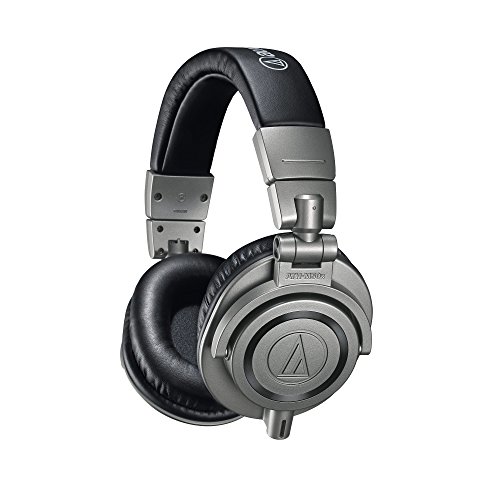
TL;DR: The Audio‑Technica ATH‑M50xGM offers 45 mm drivers, a flat 15‑28 kHz response and 38 Ω impedance in a sturdy, detachable‑cable design, but its $194.99 price and tight clamping force keep it in the premium tier.
What really sets the ATH‑M50xGM apart is its 45 mm driver paired with a flat 15 Hz – 28 kHz frequency response and a sensitivity of 99 dB, delivering a studio‑neutral sound that professionals praise for detail and accuracy. At 0.6393405598 pounds (290 g) it feels solid, and the neodymium magnet with a copper‑clad aluminum voice coil adds both efficiency and durability.
Compared with the other eleven headphones in this roundup, the M50xGM is heavier than the Sony MDR7506 (which tips the scales at 0.5 pounds) and sits in a similar weight class to the AK G K240STUDIO (about 0.53 pounds). Its $194.99 list price makes it pricier than most of the wireless, battery‑powered options and even the more budget‑friendly wired models, positioning it as a premium alternative for those who value accuracy over cost.
Users consistently highlight the headphone’s crisp, balanced audio and the durability of its detachable 1.2 m–3.0 m cables, which come in straight and coiled versions plus a 6.3 mm screw‑on adapter. Professional reviewers note the low 38 Ω impedance as “easy to drive” from laptops, phones or portable mixers. On the flip side, many owners mention a strong clamping force that can become uncomfortable during marathon mixing sessions, and the relatively small ear pads may press against larger ears after a while.
Beyond the drivers, the closed‑back design provides passive sound isolation, making the M50xGM suitable for tracking in noisy environments without needing active noise cancellation. The 90° swiveling earcups fold flat for travel, and the included protective nylon pouch adds a layer of convenience for on‑the‑go use.
Pros
Cons
Best for: Buyers willing to invest in a proven, high‑quality option
Avoid if: You're shopping on a tight budget — it's $194.99
TL;DR: The OneOdio A71 delivers wired, over‑ear studio‑grade sound with dual input jacks, a 3 m coiled cable and a bass‑boosted profile for under $36.
The standout feature is the dual‑input jack system plus SharePort, letting you plug two sources (for example a digital piano and a tablet) and even daisy‑chain a second pair of headphones without a splitter. The coiled cable runs 3 m (300 cm) and the detachable straight cable with mic measures 1.2 m (120 cm), giving you flexibility whether you’re at a desk or moving around a small studio.
At 377 g, the A71 is lighter than the OneOdio Pro (listed at 0.66 pounds) but a bit heavier than the Soundcore Q20i (0.57 pounds). Its price of $35.99 places it in the budget tier, making it cheaper than many ANC‑enabled rivals while offering comparable driver size (40 mm) and a solid 32 Ω impedance. However, it doesn't have active noise cancellation or Bluetooth, features that appear on several competitors.
Users repeatedly praise the comfort of the ultra‑soft protein‑leather ear cushions and the convenience of the dual‑input design, especially music students who need to monitor two devices at once. Professional reviewers note the same convenience but point out that the bass‑boosted sound signature isn’t neutral enough for critical mixing. The plastic frame feels lightweight, which some travelers consider less rugged than metal‑built alternatives.
Technically, the A71 carries a Hi‑Res Audio certification with a frequency response up to 40 kHz, a sensitivity of 110 dB ± 3 dB and a maximum input power of 1600 mW. These specs indicate up to 1600 mW input power, showing strong output capability for its class, while the 90° swivel ear‑cup rotation and included nylon carrying case add practical ergonomics for studio sessions.
Pros
Cons
Best for: Music students and piano learners who need to monitor a digital piano and a tablet simultaneously on a budget.
Avoid if: You require a neutral frequency response for critical engineering or a highly durable build for heavy travel.
“Wore them for 3-hour sessions with no fatigue”
“Perfect for playing piano and listening to YouTube lessons at the same time.”
TL;DR: The OneOdio Pro‑50 Blue delivers studio‑grade, Hi‑Res sound with a spacious 50 mm driver, dual detachable plugs and comfortable memory‑foam earcups, all for under $48.
What really sets the Pro‑50 apart is its 50 mm dynamic driver paired with a 32 Ω impedance and 110 dB sensitivity, giving you a clear, balanced soundstage that professionals trust. The headphones also feature Hi‑Res Audio certification and dual gold‑plated 3.5 mm / 6.35 mm detachable plugs, so you won’t need an extra adapter. A 3000 mm coiled cable stretches to give you plenty of reach, and the foldable design with a 90° swivel earcup makes single‑ear monitoring easy for DJs.
Compared with the other eleven entries, the Pro‑50’s driver is larger than the 40 mm units in the Soundcore Q20i, Q30 and Life Q20, and the 30 mm driver in the AKG K240STUDIO. At 0.58202037168 pounds, it’s a touch heavier than the Soundcore Q20i (0.57 pounds) and Soundcore Life Q20 (0.551155655 pounds) but lighter than the Soundcore Q30 (0.6 pounds). Its 32 Ω impedance sits between the higher‑impedance AKG (55 Ω) and the lower‑impedance Soundcore models (16 Ω), offering a versatile load for most audio interfaces.
Everyday users rave about the Pro‑50’s accurate, balanced sound and the comfort of its protein‑leather earcups with memory‑foam padding, calling it the best value in its price range. Professional reviewers highlight the Hi‑Res certification and the convenience of dual detachable plugs, while noting the 90° swivel for single‑ear monitoring. The most common complaints involve the leather earcup material peeling after a year or two, the coiled cable feeling stiff and picking up microphonics, and the headband feeling a bit tight on larger heads.
Beyond the sound, the headphones use a neodymium magnet and can handle up to 1600 mW of input power, making them suitable for studio use. Passive sound isolation keeps external noise at bay without active cancellation, and the detachable cable design simplifies storage and replacement.
Pros
Cons
Best for: DJs, audio engineers and podcasters who need accurate monitoring, a swivel earcup for single‑ear use, and a durable wired setup.
Avoid if: You require active noise cancellation, have a very large head, or need a highly portable, ultra‑light headphone.
TL;DR: For $32.99 the OneOdio A71 delivers 40 mm drivers, dual input jacks and a 9.8‑ft coiled cable in a comfortable 0.83‑lb over‑ear design, but its bass‑heavy tuning limits critical studio work.
The A71’s standout feature is its dual‑jack connectivity: a 3.5 mm TRRS mic plug and a 6.35 mm TRS line‑in let you hook a digital piano and a tablet at the same time. Its 40 mm drivers can handle up to 1600 mW of input power, and the included 9.8‑ft coiled cable gives you plenty of reach while you sit at a desk. Weighing 0.83 pounds (377 g) and folding for storage, it feels solid enough for long mixing sessions.
Compared with the other eleven entries, the A71 is heavier than the OneOdio Pro (0.66 pounds) and the Soundcore Q20i (0.57 pounds), but it shares the same 32 Ω impedance and 110 dB sensitivity as those models. Its driver size is smaller than the OneOdio Pro‑50’s 50 mm drivers, yet equal to the driver size on most of the Soundcore options. The A71 also offers more cable length than many competitors that only list a short straight lead.
Users consistently praise the comfort of the padded ear cups and the adjustable headband for marathon sessions. Professionals note the convenience of the dual‑jack design for streaming lessons while playing. However, several reviewers point out that the bass response is heavily boosted, which can mask detail when mixing. Reviewers consider the 3‑ft mic cable short for studio rigs, and a few owners mention brittle plastic and loose joints that raise durability concerns.
From a technical standpoint, the headphones feature a closed‑back, passive isolation design with a frequency response of 20 Hz – 20 kHz. The 32 Ω impedance makes them easy to drive from most audio interfaces, and the 110 dB ±3 dB sensitivity ensures a loud output without needing a high‑gain amp.
Pros
Cons
Best for: Musicians who need to monitor a digital piano while streaming lessons or backing tracks on a tabletop.
Avoid if: You are a professional audio engineer or mastering specialist requiring a flat, neutral response.
“Wore them for 3-hour sessions with no fatigue”
“Perfect for playing piano and listening to YouTube lessons at the same time.”
TL;DR: The AKG K240STUDIO offers semi‑open, over‑ear design with 30 mm drivers, 55 Ω impedance and 104 dB sensitivity, delivering accurate studio sound at $49.99, though its bass is lean.
At the core of the K240STUDIO is a 30 mm dynamic driver paired with a rated impedance of 55 Ω and a sensitivity of 104 dB SPL/V at 1 kHz. The distortion factor stays below 0.3%, and the detachable straight cable measures 3 m (9.8 ft). Weighing just 0.5291094288 pounds (240 g without cable), the headphones feel feather‑light on the head while still providing a solid acoustic seal.
Compared with the other eleven entries, the AKG is the lightest option – all of the wireless competitors list weights of 0.54 pounds or higher. Its driver size is also smaller than the 40 mm and 50 mm units found in many of the rivals, while the 55 Ω impedance is higher than the typical 16 Ω‑32 Ω range of the competing models. Unlike most of the other headphones, which include active noise cancellation, the K240STUDIO is a purely passive, semi‑open design, so it doesn’t offer the same level of ambient noise reduction.
Professional reviewers praise the K240STUDIO for its flat, detailed response that makes mixing and mastering feel transparent, and users often highlight the comfort of the self‑adjusting steel‑cable headband and replaceable earpads during long sessions. The same feedback notes a noticeable roll‑off in the sub‑bass region (below roughly 60 Hz) and a headband that feels less robust than newer plastic‑free designs. Because the earcups are semi‑open, sound does leak outward, which can be a drawback in shared studio spaces.
Beyond the audio performance, the headphones ship with a gold‑plated screw‑on 6.3 mm TRS adapter, ensuring a solid connection to a wide range of audio interfaces. The semi‑open, circumaural layout provides a spacious soundstage that many engineers rely on for critical listening, while the detachable cable makes replacement or upgrades straightforward.
Pros
Cons
Best for: Audio engineers, producers and home‑studio enthusiasts who need accurate monitoring and comfort for extended mixing sessions.
Avoid if: You need a portable, ANC‑enabled solution or plan to use the headphones in noisy public spaces where sound leakage would be problematic.
“Perfect for mixing — I can hear every detail.”
“Wore them for 8‑hour sessions with zero fatigue.”
Breakdown
Soundcore by Anker Q20i Hybrid Active Noise Cancelling
Pros
Cons
Soundcore Life Q20
Pros
Soundcore Q20i
Pros
Cons
Soundcore Life Q30
Pros
Cons
Based on scoring data and product specs
Personalized picks
Best Overall Pick
Soundcore by Anker Q20i Hybrid Active Noise Cancelling
Best OverallBest for: Budget-conscious buyers seeking a reliable entry-level option
Soundcore Life Q20
Best for: Home and office users seeking a balance of features and value
$44.99
Skip AKG K240STUDIO if…
You have limited desk space or need portability
Our pick for Best Audiophile / Studio Over‑Ear Headphones is the Soundcore by Anker Q20i Hybrid Active Noise Cancelling. It earns a 4.6‑star rating from 55,650 reviewers, delivers up to 60 hours of playback with ANC off (40 hours with ANC on), and offers up to 90 % ambient‑noise reduction thanks to its dual internal and external microphones. The 40 mm dynamic drivers and 115 dB sensitivity round out a feature set at just $39.98.
The runner‑up, the Soundcore Life Q20, shines when you need a travel‑friendly pair. Its foldable over‑ear design, included travel case, and 60‑hour battery life (ANC on) make it ideal for long trips, while the hybrid ANC and 40 mm drivers still provide studio‑grade sound for a price of $44.99.
For those with different budget constraints, we recommend:
Grab the Soundcore Q20i today and upgrade your listening experience without breaking the bank.
The Soundcore Q20i and the Soundcore Life Q20 both claim up to 40 hours of playback with ANC active and 60 hours with ANC off, which is the longest battery life among the wireless options listed. The Soundcore Q30 (Life Q30) also offers 40 hours with ANC and 70 hours in standard mode, but it costs more. If you need the absolute maximum runtime without paying a premium, the Q20i or Life Q20 are the best choices.
Please sign in to leave a review
No reviews yet. Be the first to review!
