⚡ Quick Answer
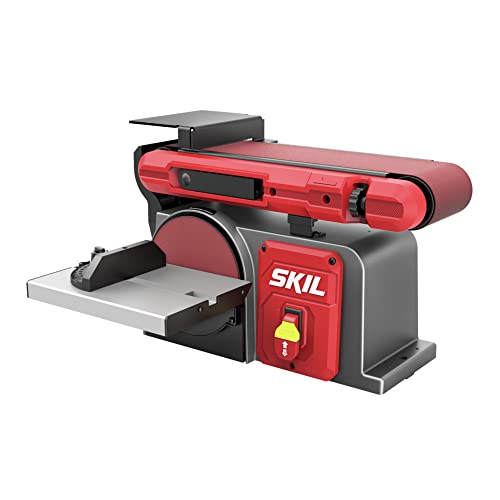
We’ve lined up 11 belt‑and‑disc sanders, spanning a price range from $90.55 for the entry‑level WEN 6515T up to $442.82 for the heavyweight Jet J‑41002. The selection is split into three clear tiers: budget models like the WEN 6515T, Bucktool 1x30, Woodskil and WEN 6502T; mid‑range options such as the Bucktool BD4603 and the KFMK 2x42; and premium machines including the SKIL BB9504, Bucktool BD4801, Bucktool BD4802, and Jet J‑41002. Ratings cluster around 4.5‑4.7 stars, with the Bucktool BD4603 pulling a solid 4.6/5 from 901 reviewers.
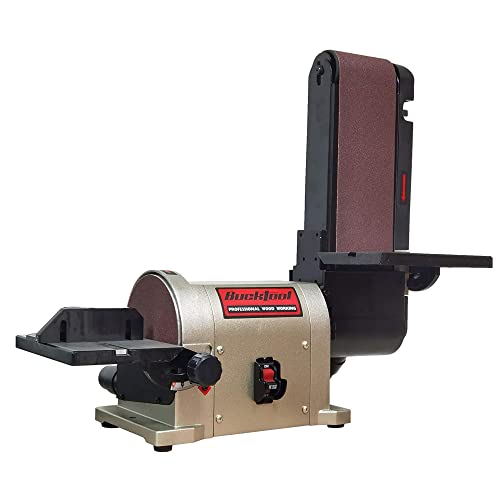
The Bucktool BD4603 catches the eye with a listed price of $143.98, a robust 35.49‑pound build, and a belt table that tilts from 0° to 90°, giving you the flexibility to sand flat, vertical or curved workpieces. Its 6‑inch disc and direct‑drive motor combine industrial‑grade power with a compact benchtop footprint, positioning it squarely between the cheaper hobbyist units and the pricier professional rigs.
Below we break down each model’s strengths, key specifications, and who they’re best suited for, so you can match the right sander to your workshop needs.
Bucktool BD4603
Its Belt Table Tilt Range of 0°‑90° lets you tackle angled sanding while keeping value and rating high.
WEN 6515T 30-inch
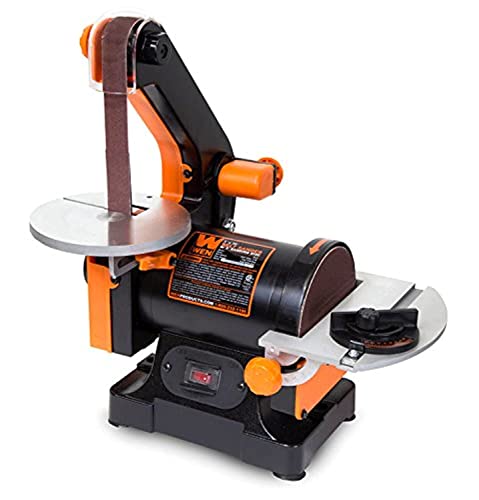
Ideal for budget‑conscious DIYers, the WEN 6515T costs $90.55—about $53 less than the Bucktool BD4603—while still delivering a fast 3160 FPM belt speed.

Bucktool BD4801
Stands out with a 25% motor efficiency gain and dual dust ports, delivering cleaner operation at the same 2,161 FPM belt speed as the mid‑range model.
Also considered
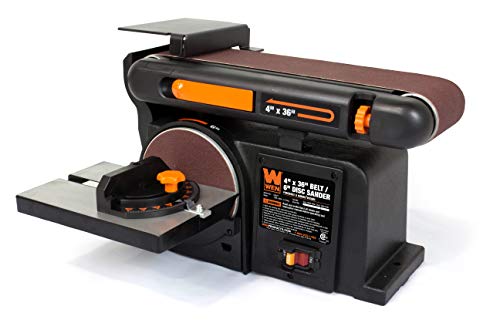
TL;DR: The WEN 6502T 36‑inch benchtop sander packs a 4 × 36‑inch belt, 0°‑90° tilt and a 1/2 HP motor into a solid 41‑lb cast‑iron base for reliable, budget‑friendly sanding.
The standout spec is the 4 × 36‑inch belt that tilts from 0° to 90°, paired with a belt speed of 1900 FPM and a 6‑inch disc spinning at 3600 RPM. A 1/2 HP motor draws 4.3 A at 120 V, giving enough torque for hobby‑level prep work while keeping the unit compact at 12.5 inches tall, 22.0 inches long and 11.0 inches wide.
Compared with the other ten sanders in this roundup, the WEN is one of the heavier options at 41 lbs—heavier than the Woodskil (25 lbs) and Bucktool 1x30 (19.7 lbs) but still lighter than the KFMK 2x42’s 34.25 lb rating when accounting for its solid cast‑iron base. Its 22.0‑inch length exceeds the Bucktool BD4603’s 21‑inch length and the Woodskil’s 16.9‑inch length, giving a larger work envelope, while its 11.0‑inch width is narrower than the SKIL BB9504’s 14.5‑inch width, making it a good fit on tighter benches.
Professional reviewers praise the sturdy cast‑iron base for minimizing vibration, and users frequently mention the quick tension‑release lever and tracking knob as convenient for belt changes. However, many owners note that removing the belt still requires loosening three Phillips‑head bolts and an Allen‑wrench bolt, which can feel cumbersome. Dust extraction is another common gripe; the single 2.25‑inch dust port does the job but isn’t as robust as the double ports found on some competitors, so users often add an external collector.
Additional context: the sander is UL listed, comes with an 80‑grit belt and a miter gauge, and sports a 6‑foot power cord for decent reach in a workshop. The non‑variable speed range (1900 ft/min minimum to 3600 OPM maximum) keeps operation simple for beginners.
Pros
Cons
Best for: Budget-conscious buyers seeking a reliable entry-level option — the WEN 6502T 36-inch offers Belt Speed: 1900 FPM
Avoid if: You want the best value‑per‑dollar in its price range
TL;DR: The WEN 6515T 30‑inch benchtop sander packs a 3160 FPM belt speed and 5‑inch disc into a 16‑lb, compact unit, delivering solid performance for hobbyists at a budget price.
The standout spec is its belt speed of 3160 FPM paired with a 3450 RPM disc, both driven by a 2.3 A motor at 120 V. A 0° belt tilt and a 0‑45° table tilt give you straightforward control, while the 1 × 30‑inch belt and 5‑inch disc cover most small‑shop sanding tasks.
At 16 lb, the WEN 6515T is noticeably lighter than the Bucktool BD4603 (about 35.5 lb) and the Woodskil model (25 lb), and it’s also slimmer than the Bucktool 1x30, which measures roughly 14.6 in in length compared to this unit’s 14 in. While some peers list variable‑speed options, the 6515T runs at a fixed speed, which keeps the price lower but limits fine‑tuning for delicate woods.
Reviewers consistently praise the fast material removal, easy setup, and the dual dust ports that keep the workspace cleaner. Common complaints focus on the plastic belt housing flexing under heavy pressure, occasional belt tracking adjustments, and a bit of vibration during extended use. Professional reviewers note the heavy‑duty cast‑aluminum base does a good job of minimizing movement.
Technical details include a 0‑45° table tilt range, belt and disc dust ports sized for standard vacuum adapters, and a full set of starter accessories: a miter gauge, an 80‑grit sanding disc, and a 100‑ or 120‑grit sanding belt. The unit draws 2.3 A at 60 Hz, which aligns with typical shop outlets.
Pros
Cons
Best for: Budget‑conscious buyers seeking a reliable entry‑level option — the WEN 6515T 30‑inch offers Belt Speed: 3160 FPM
Avoid if: You need variable speed control or a tool built for heavy professional production environments
“Super easy to set up and belt changes are a breeze”
“Great for small projects like knife making or trim—removes material fast without bogging down”
TL;DR: The Bucktool BD4801 packs a 3/4 HP direct‑drive motor, 2,161 FPM belt speed and an 8‑inch disc into a sturdy 42.33‑lb benchtop unit, delivering industrial‑grade power at a mid‑range price.
The standout feature is the motor’s 25% efficiency gain, thanks to a direct‑drive induction motor that eliminates belt‑tension adjustments. It drives a 4 × 36 in belt at 2,161 FPM and an 8‑inch disc at 3,450 RPM, giving you both belt and disc sanding in one compact footprint.
At 42.33 lb, the BD4801 is heavier than the SKIL BB9504 (28 lb) and the KFMK 2x42 (34.25 lb), and also outweights the Bucktool BD4603 (35.49 lb). It’s only a pound or so heavier than the WEN 6502T (41 lb), but still sits above most peers in the lineup, which can translate to a more solid feel during heavy sanding passes.
Users praise the quick‑release hook‑and‑loop belt system and the dual‑function layout for saving workshop space. Professional reviewers note the 25% efficiency boost and the aluminum dust outlet that resists melting during metal work. The most common complaints point to the 3/4 HP motor struggling with dense hardwoods or metals, noticeable vibration despite rubber feet, and the 8‑inch disc being small for large‑area sanding.
Additional technical details include a 0–90° belt angle adjustment, 0–45° belt and disc table tilts, and two aluminum dust ports for external collection. The base is cast aluminum, and the work tables feature metal dual miter gauges, reinforcing the tool’s durability for hobbyist projects.
Pros
Cons
Best for: Buyers willing to invest in a proven, high‑quality option — the Bucktool BD4801 offers Belt Speed: 2,161 FPM
Avoid if: You're on a tight budget, need only basic functionality, or require a tool for high‑volume industrial production
“Great value for the price—two machines in one”
“Direct-drive motor is maintenance-free and efficient”
TL;DR: The Bucktool BD4603 packs a 3/4 HP direct‑drive motor, 25% efficiency boost and a 0°‑90° belt‑table tilt into a 35.49 lb benchtop combo that outperforms many pricier rivals on core sanding specs.
What really sets this unit apart is its 3/4 HP fully enclosed induction motor that runs direct‑drive, delivering a claimed 25% efficiency increase over traditional belt sanders. The belt runs at 2161 FPM and the belt table tilts from 0° to 90°, letting you attack bevels without extra jigs. A 6‑inch disc spins at 3450 RPM and tilts 0°‑45°, giving you both belt and disc capability in one compact footprint.
At 35.49 lb, the BD4603 is heavier than the Woodskil model’s 25.0 lb frame but lighter than the WEN 6502T’s 41 lb chassis, landing it squarely in the mid‑range weight class. Its belt speed of 2161 FPM beats the WEN 6502T’s 1900 FPM yet trails the KFMK’s 4480 FPM, so it offers solid performance without the high‑speed noise of the fastest units. The 6‑inch disc matches the disc size of the WEN 6502T and SKIL BB9504, while the 0°‑90° belt‑table tilt mirrors the range found on both the WEN 6502T and Woodskil, giving it comparable flexibility.
Reviewers consistently praise the quick‑release belt system and the “silent power” of the direct‑drive motor, noting that setup is straightforward and the unit feels sturdy on a workshop bench. The inclusion of a CSA certification and maintenance‑free design adds confidence for hobbyists and light‑shop use. On the downside, a few users point out that the 6‑inch disc can feel restrictive on large, flat panels, and the dust ports sometimes need adapters to fit standard shop vacuums. Those trade‑offs are typical for a combo sander that balances price and capability.
Pros
Cons
Best for: Home and office users seeking a balance of features and value — the Bucktool BD4603 offers Belt Speed: 2161 FPM
Avoid if: You need to sand large flat surfaces or require an 8‑inch disc for broader material removal
TL;DR: The Woodskil BD4602 delivers a 3/4 HP motor, 3600 RPM belt speed and 0‑90° table tilt for $129.48, offering solid power and flexibility for DIY projects while staying lightweight at 25 lb.
The standout spec is the 3/4 HP motor paired with a belt speed of 3600 RPM (1800 FPM), which lets you tackle wood shaping and light metal work without bogging down. The work table tilts from 0‑90°, and the auxiliary table from 0‑45°, giving you a wide range of bevel angles right out of the box.
Compared with the other ten sanders in this roundup, the Woodskil is lighter than the Bucktool BD4603 (which weighs about 35.5 lb) and shorter than its 21‑inch length, yet it packs more horsepower than the 16‑lb WEN 6515T. It also costs less than the Bucktool model, making it a tighter budget choice while still offering a steel base and a 4 × 36‑inch belt.
In practice, users praise the motor’s ability to handle heavy sanding jobs and appreciate the dual dust ports that keep their shop cleaner. Reviewers also note the transparent PC guard as a safety win because you can see the belt while it runs. The only recurring complaint is that the two included 80‑grit sandpapers wear out quickly under aggressive use, and the lack of variable speed means you can’t dial down for delicate finishes.
Pros
Cons
Best for: Budget-conscious buyers seeking a reliable entry-level option — the Woodskil Belt Sander offers Table Tilt Range: 0-90 degrees
Avoid if: You want the best value-per-dollar in its price range
“Most cost-effective Amazon option with impressive quality”
TL;DR: The Bucktool BD4802 packs a 1 HP direct‑drive motor, 8‑inch disc and 2161 FPM belt speed into a solid cast‑aluminum bench sander, delivering industrial‑grade power at a mid‑range price.
At the heart of the BD4802 is a direct‑drive 1 HP motor that provides a manufacturer‑claimed 25% efficiency gain over belt‑driven designs. Combined with a belt speed of 2161 FPM and an 8‑inch sanding disc turning at 3450 RPM, the unit can tackle both metal removal and fine wood sanding without sacrificing torque. The belt size of 4 × 36 inches and a glass platen further expand its versatility for flat‑knife grinding and polishing tasks.
When you line it up against the other ten sanders in this roundup, the BD4802 sits toward the heavier end at 36.38 lb, outweighing the SKIL BB9504 and Einhell TC‑US 380, but it’s lighter than the Bucktool BD4801’s 42.33 lb frame. Its 8‑inch disc outpaces the 6‑inch discs on the SKIL, Einhell and Bucktool BD4603 models, giving it a larger grinding surface. Belt speed sits mid‑range; the KFMK 2x42 offers a faster 4480 FPM, while the WEN 6502T runs slower at 1900 FPM, so the BD4802 balances speed with torque.
User feedback highlights the machine’s quiet operation and the ease of swapping hook‑and‑loop belts and discs. Reviewers praise the sturdy cast‑aluminum base and the two dust‑collection ports that keep the workspace cleaner. On the flip side, several users note that the mounting holes don’t always match standard bench clamps, and the belt seam can introduce a noticeable bump when working with fine grits above 150, which limits ultra‑fine finishing. Professional reviewers also point out the lack of built‑in variable speed, though a VFD option is available separately.
Pros
Cons
Best for: Those prioritizing quality and willing to pay for premium performance — the Bucktool BD4802 offers Belt Speed: 2161 FPM
Avoid if: You're on a tight budget or only need basic functionality
“Quiet but powerful direct-drive; no belts to replace”
“Versatile and powerful for metal/wood; loves 1HP motor, aluminum outlet, knife accessories”
TL;DR: The SKIL BB9504 offers a 4.5‑amp induction motor, 3,600 RPM no‑load speed, and 0‑90° belt angle adjustment, delivering solid benchtop performance for hobbyists at $199.
The standout feature is the 0‑90° belt angle adjustment, letting you tilt the belt up to a full right angle for edge work and shaping. Coupled with a 4.5 Amp induction motor that spins at a fixed 3,600 RPM, the sander provides steady power without the need for speed changes. Its 6‑inch disc and 4 × 36‑inch belt give you enough coverage for most DIY projects while keeping the unit compact.
At 28 lb, the BB9504 is heavier than the Woodskil Belt Sander’s 25 lb frame but noticeably lighter than the Bucktool BD4801, which tips the scales at 42.33 lb. The 6‑inch disc matches the size found on the WEN 6502T and the Bucktool BD4603, placing it squarely in the middle of the field for disc capacity. While some competitors list larger belt dimensions, the SKIL’s belt size is adequate for hobby‑level material removal.
Users consistently praise the tool‑free quick‑release lever that lets you swap belts in seconds, and the induction motor is lauded for running cool and quietly during extended sessions. Professional reviewers note the solid stability that the 28‑lb weight brings to benchtop use. On the downside, the fixed speed can feel limiting when you need a slower finish, and a few owners mention that belt tracking may drift after heavy use, requiring occasional manual adjustment. The dust cover also tends to loosen, which some users find inconvenient.
Pros
Cons
Best for: Most users seeking a balanced, mainstream option — the SKIL BB9504 offers Motor Power: 4.5 Amps
Avoid if: You're shopping on a tight budget — it's priced at $199.00
“Super easy to set up and use—belt change takes seconds”
“Great for small projects like trimming dowels or smoothing edges”
TL;DR: The Einhell TC‑US 380 delivers a 380 W motor, 292 m/min belt speed and a 90° swivel belt in a sturdy 30 lb frame, but its premium price and 20% duty cycle make it better suited for hobby workshops than nonstop professional use.
What really stands out is the 90° belt swivel range paired with a 0°‑to‑60° tiltable aluminum table, letting you angle the sanding surface for tight corners and bevels. The machine runs on a 380 W induction motor that pushes the 914 × 100 mm K80 belt up to 292 m/min, while the 150 mm disc spins at 1500 rpm for finer work. Integrated vibration‑damping rubber feet and a 36 mm dust‑extraction port keep the workspace tidy and the unit stable.
Compared with the other ten contenders, the Einhell is heavier than the SKIL BB9504’s 25.57 lb frame but lighter than the Bucktool BD4802 at 36.38 lb. Its table tilt stops at 60°, which is narrower than the 90° tilt offered by the Bucktool BD4603 and the SKIL model. The belt speed of 292 m/min is lower than the high‑speed FPM figures listed for some competitors, placing it in the mid‑range for productivity. Overall, it sits in a higher price tier while packing more industrial‑grade features than the budget‑oriented options.
Reviewers appreciate the easy Velcro belt change and the ability to swivel the belt both horizontally and vertically, calling the tool “user‑friendly” for DIY projects. However, the S6 20% operating mode—meaning only 20% of a 10‑minute cycle can be loaded—has been noted as a limitation for anyone needing prolonged, heavy‑duty sanding. The 4.1‑star rating from 425 users reflects a mix of praise for build quality and criticism of the duty‑cycle restriction.
Pros
Cons
Best for: Those prioritizing quality and willing to pay for premium performance — the Einhell TC‑US 380 offers Table Tilt Range: 0° to 60°.
TL;DR: The JET J‑41002 pairs a 3/4 HP motor with a 42‑inch × 2‑inch belt and an 8‑inch disc, delivering solid power and precision in a cast‑iron, 60‑lb workstation.
At the heart of the J‑41002 is a 3/4 HP single‑phase motor that drives the 42‑inch belt at 3,100 sfpm and the 8‑inch disc at 3,450 rpm. The machine offers a 45‑degree table tilt range and a 5/8‑inch slot, letting you angle cuts without moving the workpiece. Its 10‑inch × 6‑inch belt table and 10.75‑inch × 7.5‑inch disc table give you generous support for larger panels, while the removable platen lets you sand curves and odd shapes.
Compared with the ten other belt sanders in this roundup, the JET is the heaviest at 60 lbs, out‑weighing the Einhell (≈30 lbs), Bucktool BD4802 (≈36 lbs) and the KFMK (≈34 lbs). It also sits at the higher end of the price spectrum, making it a premium‑tier choice. Its belt speed of 3,100 sfpm sits between the slower Bucktool BD4802 (2,161 FPM) and the faster KFMK (4,480 FPM), offering a balanced removal rate without sacrificing control.
Users rate the J‑41002 at 4.4 stars across 251 reviews, noting the sturdy cast‑iron and heavy‑duty steel construction that dampens vibration on the shop floor. Professional reviewers highlight the removable platen and the deluxe miter gauge, which locks at 45 degrees left and right for precise angled sanding. A recurring complaint involves occasional quality‑control hiccups that have led some buyers to return the unit, though many report that replacements resolve the issue.
Beyond power, the J‑41002 includes an adjustable dust deflector and two 1.5‑inch dust chutes, helping keep the workspace cleaner. The 2‑inch belt width matches common 2 × 42 belts, and the 8‑inch disc accommodates a range of sanding discs for finishing work. With a 45‑degree table tilt and a robust miter gauge, you can tackle both straight and beveled cuts without extra accessories.
Pros
Cons
Best for: Those prioritizing quality and willing to pay for premium performance — the JET J‑41002 Belt and Disc Sander offers Table Tilt Range: 45 degrees
Avoid if: You're shopping on a tight budget — it's priced at $442.82
TL;DR: The Bucktool 1x30 Bench Belt Sander packs a 1/3 HP direct‑drive motor, 3300 FPM belt speed and a 25% efficiency boost into a solid 19.7‑lb, compact unit for hobby‑level sanding.
This sander’s standout spec is its direct‑drive motor delivering 1/3 HP at 3590 RPM, which translates to a belt surface speed of 3300 FPM. The manufacturer claims this design gives a 25% increase in sanding efficiency over traditional belt‑driven models, and the all‑metal construction adds a sturdy, low‑vibration feel.
At roughly 19.7 lb, it sits between the lighter WEN 6515T (16 lb) and the heavier Woodskil model (25 lb), while being far lighter than the large‑format WEN 6502T (41 lb). It also undercuts the pricier Bucktool BD4603, which weighs about 35.5 lb, and is more compact than the KFMK 2x42 (34.25 lb) and SKIL BB9504 (28 lb). The 1 × 30‑inch belt and 5‑inch disc give it a focused footprint compared with the 6‑inch discs found on several peers.
Reviewers repeatedly praise the one‑button belt cover release for quick belt changes and note the solid metal frame makes the tool feel “built like a truck.” Professional reviewers echo the efficiency claim, while everyday users appreciate the straightforward 0‑45° table tilt for shaping angles. The most common complaint is the 3590 RPM speed, which many say is too high for delicate knife‑sharpening work, and the 5‑inch disc is seen as limiting for larger sanding jobs.
Pros
Cons
Best for: Entry-level buyers or those on a tight budget — the Bucktool 1x30 Bench Belt Sander offers Motor Power: 1/3 HP
Avoid if: You need powerful performance or professional‑grade features
“super easy... half a turn”
TL;DR: The KFMK 2x42 Belt Sander packs a 1/2 HP motor and 4480 FPM belt speed into a sturdy combo unit, ideal for aggressive sanding but a bit heavy for frequent moves.
The standout spec is the belt speed of 4480 FPM, driven by a 1/2 HP induction motor that spins at a no‑load 3450 RPM. That combination lets the sander remove material quickly, which professional reviewers praise for knife‑making and metal‑working tasks.
Compared with the other ten tools in this roundup, the KFMK sits toward the heavier end. It weighs 34.25 lb (gross 39.9 lb), which is heavier than the SKIL BB9504 and Woodskil models that tip the scales around 25 lb, but lighter than the Bucktool BD4801 at over 42 lb. Its price of $179.98 places it in the mid‑range tier—more expensive than some entry‑level benches yet still below the top‑priced industrial units.
User feedback repeatedly highlights the motor’s ability to tackle metal and wood without stalling, and the quick‑release belt tension system makes belt changes swift. The same reviews note that the fixed speed limits finesse work, and the unit’s bulk can be a drawback for shop‑floor mobility. The sander also comes with a 0‑90° belt angle adjustment, a 45° disc tilt, and a direct‑drive layout, all certified to CSA standards for added reliability.
Pros
Cons
Best for: Most users seeking a balanced, mainstream option — the KFMK 2x42 Belt Sander offers Belt Speed: 4480 FPM.
Breakdown
Bucktool BD4603
Pros
WEN 6515T 30-inch
Pros
Bucktool BD4801
Pros
WEN 6502T 36-inch
Pros
Cons
Based on scoring data and product specs
Personalized picks
Best Overall Pick
Bucktool BD4603
Best Mid-Range PickBest for: Home and office users seeking a balance of features and value — the Bucktool BD4603 offers Belt Speed: 2161 FPM
WEN 6515T 30-inch
Best for: Budget-conscious buyers seeking a reliable entry-level option — the WEN 6515T 30-inch offers Belt Speed: 3160 FPM
$90.55-$71.43 vs winner
Skip Bucktool 1x30 Bench Belt Sander if…
You need powerful performance or professional-grade features
The Bucktool BD4603 takes the top spot with a solid 4.6/5 rating from 901 reviews, a 3/4 HP fully enclosed induction motor and a belt speed of 2161 FPM—all for $143.98. Its 4 × 36‑in belt, cast‑aluminum base with rubber feet and quick‑release belt system give it industrial‑grade precision, while the 35.5 lb build feels sturdy without being unwieldy.
The WEN 6515T 30‑inch earns runner‑up honors, especially if you need a lightweight, budget‑friendly sander for occasional DIY projects. Weighing just 16 lb and priced at $90.55, it offers a fast 3160 FPM belt speed, 3450 RPM disc speed, and comes with a miter gauge and 80‑grit sanding disc, making setup a breeze.
If you’re pinching pennies, the WEN 6515T 30‑inch remains the best budget option, delivering solid performance for under $100. For a premium, industrial‑grade machine, the JET J‑41002 Belt and Disc Sander justifies its $442.82 price tag with heavy‑duty construction and professional‑level power.
Grab the Bucktool BD4603 today and get industrial power without the premium price.
The BD4603 packs a 3/4 HP fully enclosed induction motor that runs the belt at 2161 FPM and the disc at 3450 RPM, delivering industrial‑grade power. Its cast‑aluminum base with rubber feet, quick‑release 4 × 36 in belt and separate dust ports add durability and user comfort, all for $143.98.
No reviews yet — be the first to share your experience.
Please sign in to leave a review