⚡ Quick Answer
When you need a belt sander that can handle everything from quick edge trims to full‑size bevels, the market offers a surprising spread of options. In this roundup we compared 11 models, ranging from the $35.08 entry‑level WEN 6307 up to the $399.59 Bucktool BD61000. All carry solid user approval, with the WEN 6502T, DEWALT DCW220B, and Makita 9404 each earning a 4.6‑star rating from hundreds of reviewers. The selection is neatly divided into budget (four models), mid‑range (two models) and premium (four models) so you can spot the right price‑point at a glance.
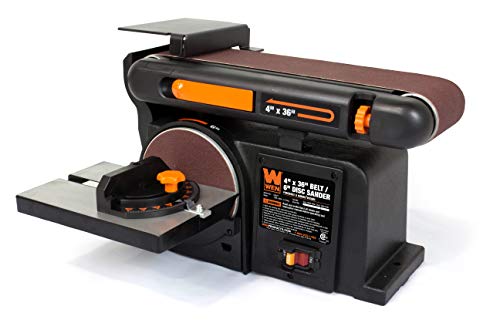
The WEN 6502T 36‑inch belt sander lands in the premium tier, yet its $139.00 list price keeps it well within reach of most hobbyists. It pairs a 1900 FPM belt speed with a 0°‑to‑90° tilt range, letting you tackle flat sanding and steep bevels without swapping tools. A cast‑iron base adds stability, while the quick‑release tension lever speeds up belt changes—features that echo higher‑end machines but without the premium markup.
Below we break down each model’s strengths, quirks, and ideal use cases, so you can match the right sander to your workshop and budget.
WEN 6502T 36-inch
Belt Bed Tilt of 0° to 90° lets you sand flat or angled surfaces, delivering versatile coverage.
WEN 6515T 30-inch
Perfect for DIY hobbyists who need a compact 30‑inch sander; at $90.55 it’s roughly $48 cheaper than the 36‑inch WEN 6502T.

Makita 9404
Its 84 dB noise level keeps the workshop quieter, a benefit the other WEN models don’t highlight.
Also considered
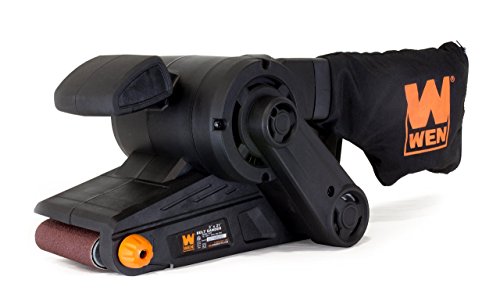
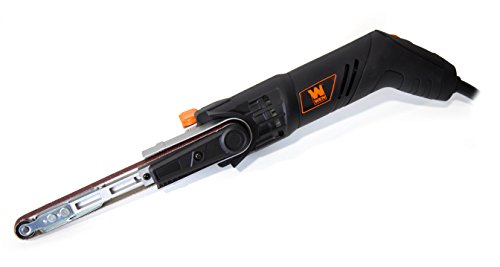
TL;DR: The WEN 6307 packs a 55° pivoting 1/2‑x‑18‑in belt, variable 1080‑1800 FPM speed and auto‑tracking into a 2.4‑lb, $35 tool that’s ideal for light‑duty sanding in tight spaces.
The standout feature is its auto‑tracking belt system combined with tool‑free belt changes, letting you swap 80, 120 or 320‑grit belts without fiddling with tension. With a pivot angle of 55 degrees, the belt can swing into corners that larger sanders can’t reach, while the variable speed range of 1080 to 1800 FPM lets you dial in the right aggression for wood, paint or light metal work.
Compared with the other ten sanders in this roundup, the 6307 is markedly lighter at 2.4 lbs versus the 6.2‑lb WEN 6321 and the 9.6‑lb Jellas model. Its 17.5‑in length also exceeds the 12.0‑in length of the WEN 6321, giving you a longer work surface without adding bulk. In terms of belt speed, the 6307’s 1080‑1800 FPM range outpaces the 820 FPM of the WEN 6321 but sits below the 3260 FPM offered by the EX Electronix mini sander, positioning it solidly in the mid‑range for hobby‑level tasks.
Users consistently praise the sander’s compact footprint (3.5 in × 3.5 in × 3.5 in) and the convenience of the built‑in dust port, which many reviewers say keeps their work area cleaner when attached to a shop vac. Professional reviewers highlight the auto‑tracking and variable speed as time‑savers, while everyday users love the light weight that makes it easy to maneuver inside engine bays. The main criticism is the 2‑amp motor; several owners note that the tool “bogs down” on steel or other heavy materials, confirming that it’s best suited for light sanding and deburring rather than aggressive grinding.
Technically, the sander runs on a 120‑volt, 2‑amp motor and draws power through a 6‑foot cord, giving you enough reach for most DIY workshops. The included abrasive belts (80, 120, 320 grit) cover a range of finishing needs right out of the box, and the ETL safety listing adds a layer of confidence for home users.
Pros
Cons
Best for: Budget-conscious buyers seeking a reliable entry-level option — the WEN 6307 offers Pivot Angle: 55 degrees
Avoid if: You need advanced features or professional‑grade performance
“it will remove steel... but not at a super powerful pace”
“cheap tool that... works a lot better than I had thought”
TL;DR: The WEN 6502T offers a 4 × 36‑inch tilting belt, 1/2 HP motor and cast‑iron base for stable, versatile sanding at a budget‑friendly $139 price.
The standout spec is the 4 × 36‑inch belt combined with a 0° to 90° tilt range, letting you tackle wide panels and full‑angle bevels without swapping tools. A 1/2 HP motor draws 4.3 A at 120 V, delivering a steady 1900 FPM belt speed and 3600 RPM disc speed, while the 6‑foot cord gives you plenty of reach on a typical workshop bench.
Compared with the ten other sander options, the 6502T is noticeably heavier at 41 lb, outclassing the 16 lb WEN 6515T and the sub‑7 lb Craftsman model. Its 36‑inch belt also dwarfs the 21‑inch belts on the Jellas units and the 3‑inch belt on the Craftsman, giving you more surface area per pass. While the DEWALT DCW220B offers variable speed, the 6502T sticks with a fixed 1900 FPM minimum, which many hobbyists find sufficient for light‑to‑medium wood prep.
Professional reviewers praise the cast‑iron base for minimizing vibration, and users consistently note the quick‑release tension lever and tracking knob make belt changes easier—once the belt is off. However, several owners report that removing the belt still requires loosening three Phillips‑head bolts and an Allen‑wrench bolt, a step that can feel cumbersome. The 12.5‑inch table height limits workpiece thickness to roughly 9 inches, and the open design means dust can escape without an external collection system.
Additional technical context includes a UL listed safety rating, a single 2.25‑inch dust port, and a sturdy 6‑inch disc for finer finishing tasks. The unit’s 4.3 A draw and 1/2 HP motor place it squarely in the mid‑range power category, delivering reliable performance for DIY woodworkers without the premium price of larger industrial models.
Pros
Cons
Best for: Buyers willing to invest in a proven, high-quality option — the WEN 6502T 36-inch offers Belt Speed: 1900 FPM
Avoid if: You need advanced features or professional‑grade performance
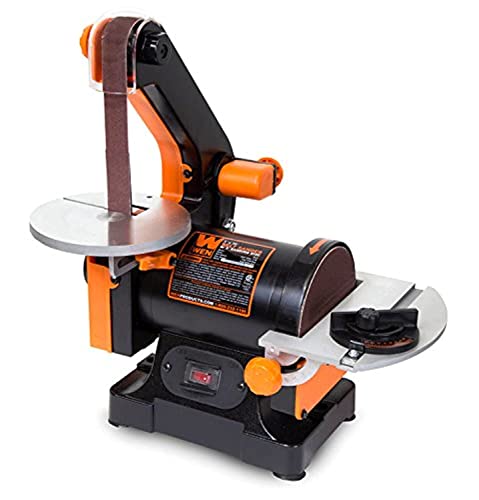
TL;DR: For $90.55 the WEN 6515T delivers a 1 × 30‑inch belt at 3160 FPM and a 5‑inch disc, earning a 4.6‑star rating while staying compact enough for most hobby workshops.
The standout spec is its belt speed of 3160 FPM, which professional reviewers note provides “excellent material removal rates for beginners.” Coupled with a 5‑inch disc spinning at 3450 RPM, the unit tackles both edge sanding and flat‑surface finishing without needing a separate tool.
Compared with the other ten sanders in this roundup, the 6515T is heavier than the Craftsman CMEW213 (6.64 lb) and the EX Express Mini (12.25 lb) but far lighter than the WEN 6502T 36‑inch (41 lb). Its belt speed outpaces the Craftsman’s 800 FPM and the WEN 6321’s 820 FPM, while sitting just below the EX Mini’s 3260 FPM. The dual dust ports—1.7 in (outer) / 1.5 in (inner) for the belt and 2.25 in / 2 in for the disc—give it an edge in workshop cleanliness, a point frequently praised by everyday users.
Users repeatedly mention how easy the tool is to set up, thanks to the included miter gauge, an 80‑grit sanding disc, and a starter belt. The cast‑aluminum base is highlighted for reducing vibration, which keeps the unit from “walking” during operation. However, several reviewers flag the plastic belt housing as a durability concern and note the lack of variable speed control limits fine‑tuning on softer woods.
Pros
Cons
Best for: Hobbyists, DIYers, and small‑space woodworkers who want a well‑reviewed, fast‑belt sander without breaking the bank.
Avoid if: You need variable speed control, professional‑grade durability, or a ultra‑light portable unit.
“Super easy to set up and belt changes are a breeze”
“Great for small projects like knife making or trim—removes material fast without bogging down”
TL;DR: The WEN 6321 delivers a 3 × 21‑inch belt at 820 FPM with a 7‑amp motor for just $38.79, making it a lightweight, budget‑friendly choice for DIY woodwork and light refinishing.
The standout spec is its 3 in. × 21 in. belt paired with a fixed 820 FPM speed. That combination gives you enough material‑removal power for typical home‑shop projects while keeping the tool’s footprint modest—its height measures 6.5 inches, length 12 inches, and width 6 inches.
When you line it up against the other ten belt sanders, the 6321 is notably more affordable than the Jellas 3 × 21‑Inch model, which carries a higher price tag. It also weighs less than the Jellas units (9.6 lb and 9.7 lb) but is a bit heavier than the ultra‑light WEN 6307 at 2.4 lb. Its 6‑foot cord matches the WEN 6307’s reach while exceeding the shorter cords of some competitors. The belt speed of 820 FPM sits just below the Craftsman’s 800 FPM rating, yet it outpaces the EX Electronix’s 3,260 FPM—though that model targets a different market segment.
Consumers repeatedly praise the 6321’s value proposition: the low price, the “lightweight” feel at 6.2 pounds, and the detachable dust bag that helps keep workspaces tidy. Professional reviewers echo these points, noting the 7‑amp motor supplies sufficient torque for deburring and paint stripping. The main complaints revolve around the single‑speed design, which some users find limiting for delicate sanding, and a dust‑collection system that isn’t as robust as vacuum‑ported alternatives. The housing is also described as bulkier than the more ergonomically shaped premium models.
From a technical standpoint, the sander runs on 120 V, 60 Hz power and draws 7 Amp, meeting the ETL safety listing. A 2‑year warranty backs the build, and the fixed‑speed belt reduces mechanical complexity, which can be a plus for beginners. The included detachable dust bag offers a simple way to manage debris without needing a separate shop vac.
Pros
Cons
Best for: Budget-conscious buyers seeking a reliable entry-level option — the WEN 6321 Belt Sander offers Belt Speed: 820 FPM
Avoid if: you need variable speed control or heavy‑duty industrial sanding performance
“great economical option”
“gets the job done well for the price point”
TL;DR: The Craftsman CMEW213 delivers a 3‑by‑21‑inch belt at a steady 800 FPM, weighs 6.64 lb, and includes tool‑free belt changes and an on‑board dust bag for solid value.
At the heart of the CMEW213 is a fixed 800 FPM sanding speed paired with a 3 in. × 21 in. angled belt, letting you strip paint or trim stock quickly. The belt cover offers two positions, and a tool‑free lever lets you swap belts without reaching for a wrench. An on‑board dust bag and a lock‑on on/off switch round out the ergonomics.
Compared with the other ten sanders, the Craftsman sits in the middle of the weight range: it’s lighter than the 16‑lb WEN 6515T but a touch heavier than the 6.2‑lb WEN 6321. Its 800 FPM speed is slower than the 1,900 FPM of the WEN 6502T and the 3,260 FPM of the EX Mini, yet it’s on par with the 820 FPM of the WEN 6321, making it a modest‑speed workhorse. The 6‑ft cord matches the WEN 6321’s length but is shorter than the 10‑ft cord on the Jellas 3x21 model.
Professional reviewers note the angled belt reaches close to adjoining surfaces, and users appreciate the quick, tool‑free belt changes and effective dust capture. The fixed speed, however, draws criticism for limiting finesse on delicate finishing, and the 6‑ft cord often necessitates an extension in larger workshops. The brushed 7‑amp motor is reliable but may feel less efficient than newer brushless designs.
Pros
Cons
Best for: DIYers or light professionals needing fast stock removal on wood, seams, or paint/varnish stripping — the Craftsman CMEW213 offers Belt Cover Positions: Two-position
Avoid if: Precision finishing tasks that require variable speed control
TL;DR: The Bucktool BD61000 packs a 1.5 HP direct‑drive motor, 1836 FPM belt speed and a 6 × 48‑inch belt, delivering 25 % more sanding efficiency, but its 98.8 lb weight and $399.59 price put it in the premium tier.
What really sets the BD61000 apart is its 1.5 HP copper‑wire induction motor paired with a direct‑drive system that claims 25 % higher sanding efficiency than traditional belt‑driven models. The belt runs at 1,836 FPM on a generous 6 × 48‑inch belt, and the 10‑inch disc spins at 2,510 RPM, giving you plenty of power for both stock removal and fine finishing.
Compared with the other ten sanders in this roundup, the Bucktool is noticeably heavier at 98.8 lb—more than double the 41‑lb weight of the WEN 6502T. Its price of $399.59 also sits above the WEN’s $139.00 and the DEWALT’s $235.00, making it a premium‑priced option. Belt speed lands it above the Makita 9404’s top 1,440 FPM and the Craftsman’s 800 FPM, yet it trails the WEN 6515T’s 3,160 FPM and the EX Electronix’s 3,260 FPM.
Reviewers consistently praise the BD61000’s power and the quick‑release belt tension lever, noting that the tool‑free belt changes save time on the shop floor. The all‑metal construction and graphite board belt guide earn compliments for durability, while the maintenance‑free motor is highlighted as a hassle‑free feature. Some users do mention the unit’s bulk and the 6 × 48‑inch belt limiting very large workpieces, which aligns with the “not ideal for heavy industrial use” warning.
Beyond raw numbers, the BD61000 offers a dust port for a collector, a nonslip rubber foot base, and a 0°–90° belt angle adjustment that lets you tackle a range of angles without extra accessories. The included aluminum miter gauge adds a touch of versatility for precise cuts, and the 7.5 × 6.3‑inch belt table gives you a stable platform for sanding larger panels.
Pros
Cons
Best for: Buyers willing to invest in a proven, high‑quality option — the Bucktool BD61000 offers Belt Speed: 1836 FPM
Avoid if: You're shopping on a tight budget — it's priced at $399.59
“Powerful and versatile for woodworking and metal; quick belt changes save time.”
“Stable, quiet operation; easy setup.”
TL;DR: The DEWALT DCW220B delivers brushless power, a 3‑inch × 21‑inch belt and 95% dust‑collection efficiency for $235.00, but it comes as a tool‑only package and weighs 9.26 lb.
What sets this sander apart is its brushless motor, which the manufacturer claims provides up to 22% more power than a comparable corded model. Coupled with a 3" × 21" belt that adds 16.7% more sanding surface area than a leading competitor, you get a wide contact zone for large flat jobs. The unit also reaches a maximum speed of 4,200 OPM and offers a variable 25‑speed dial for precise control, all within a compact 8.66‑inch height, 13.39‑inch length and 6.69‑inch width package.
Compared with the other ten belt sanders in this roundup, the DCW220B is pricier than the WEN 6502T and WEN 6515T models, yet it is significantly lighter than the 41‑lb WEN 6502T and the 98.8‑lb Bucktool. While the WEN units ship with batteries, the DEWALT is sold tool‑only, which can add to the overall cost if you don’t already own a 20V MAX XR battery. Its 95% dust‑collection efficiency and AirLock‑compatible chute give it an edge over models like the Craftsman CMEW213, which lists no dust‑collection rating.
Professional reviewers highlight the brushless motor’s corded‑level performance and the high dust‑capture rate as major strengths for carpenters and remodelers. Users also appreciate the quick‑release, tool‑free belt‑change system and the wireless tool‑control option for vacuums. The most common criticism is the need to purchase a battery and charger separately, plus the 9.26 lb weight, which some find tiring during extended overhead sanding.
Pros
Cons
Best for: Buyers willing to invest in a proven, high-quality option — the DEWALT DCW220B offers Dust Collection Efficiency: 95%
Avoid if: You're shopping on a tight budget — it's priced at $235.00
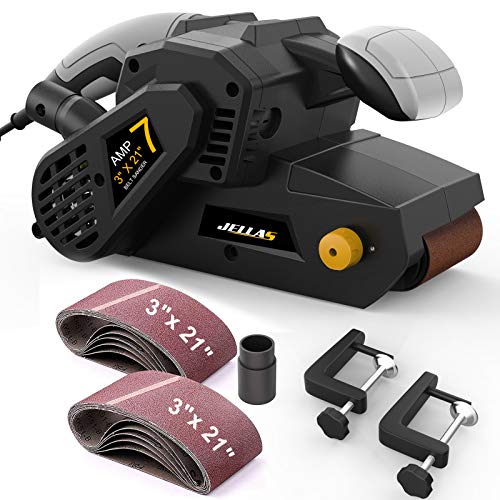
TL;DR: The Jellas 3 × 21‑inch belt sander packs a 7 Amp copper‑wound motor, variable speed and a 10‑foot cord, offering solid stock‑removal power at a budget‑friendly price, though its 9.6‑lb weight can tire you during extended handheld use.
At the heart of this unit is a 7 Amp motor with copper winding, paired with a 3 × 21‑inch sanding area that handles most woodworking stock‑removal tasks. The speed dial offers a range of 120‑400 rpm across six separate knobs, letting you fine‑tune the belt for different materials. A quick‑release lever and lock‑on trigger make belt changes and continuous sanding straightforward, while two metal C‑clamps let you mount the sander on a bench for added stability.
Weighing in at 9.6 pounds, the Jellas is heavier than the ultra‑light WEN 6307 at 2.4 pounds and the Craftsman CMEW213 at 6.64 pounds, but lighter than the EX Electronix Express Mini at 12.25 pounds and the WEN 6515T at 16.0 pounds. Its 10‑foot cord outstretches the 6‑foot cables on the WEN 6321 and WEN 6307, reducing the need for extension cords in a workshop. The 3 × 21‑inch belt is larger than the 1/2 × 18‑inch belt found on the WEN 6307, giving you a broader sanding surface, though the speed range sits below the high‑speed 3260 FPM belt of the EX Electronix.
Users consistently praise the generous set of ten sanding belts (P40, P60, P80, P120, P180) and the pre‑installed 80‑grit belt, saying it saves time and extra purchases. The detachable dust bag and included 2‑in‑1 vacuum adapter also earn kudos for keeping the workspace cleaner. On the flip side, reviewers note that the 9.6‑pound weight can cause fatigue during long handheld sessions, and the manual belt‑tracking knob sometimes needs frequent tweaks if the belt drifts.
Additional technical details include the copper winding motor for durability, a benchtop‑mounting capability via the C‑clamps, and a quick‑release lever that speeds up belt swaps. The lock‑on trigger lets you maintain continuous sanding without repeatedly pulling the trigger, and the dust bag’s exhaust holes work well with the vacuum adapter for effective dust extraction.
Pros
Cons
Best for: Budget-conscious buyers seeking a reliable entry-level option — the Jellas 3 × 21‑inch Belt Sander offers Belt Size: 3 × 21 inches
“great deal compared to Harbor Freight's Bauer model due to included belts”
“heavy-duty cord, easy belt swap, and dual-use mounting as standout”
TL;DR: The Makita 9404 delivers a 690–1,440 ft./min belt speed, auto‑tracking and variable control in a compact 10.3‑lb package, but its premium $387.80 price may deter budget‑focused buyers.
The standout spec is the variable belt speed range of 690–1,440 ft./min, paired with an 8.8 AMP motor that keeps the belt moving consistently under load. Auto‑tracking eliminates the need to manually realign the belt, and the double‑insulated housing helps keep the unit cool during extended use. At 6.2 in tall, 13.13 in long and 5.63 in wide, the sander fits comfortably on a workbench while still handling a 4 × 24 in belt.
Compared with the other ten sanders in this roundup, the Makita sits near the middle of the weight spectrum: it’s heavier than the DEWALT DCW220B at 9.26 lb and the Craftsman CMEW213 at 6.64 lb, yet far lighter than the Bucktool BD61000’s massive 98.8 lb frame and the WEN 6502T’s 41 lb bulk. Its belt speed is lower than the WEN 6515T’s 3,160 FPM and the EX Electronix’s 3,260 FPM, but it outpaces the Craftsman’s 800 FPM and matches the DEWALT’s variable range. Noise-wise, the Makita runs at 84 dB, which professionals note is quieter than many belt sanders that typically exceed the low‑90 dB range.
Reviewers consistently praise the electronic speed control for maintaining a steady pace when sanding delicate finishes, and the auto‑tracking system is highlighted as a time‑saver for both seasoned woodworkers and hobbyists. The included dust bag and a spare 4 × 24 in belt add immediate value out of the box. On the downside, a few users point out that the 8.8 AMP motor, while solid, can feel modest on very aggressive stock‑removal jobs, and the corded design ties you to a power outlet, limiting mobility on larger job sites.
Pros
Cons
Best for: Buyers willing to invest in a proven, high-quality option — the Makita 9404 offers Belt Speed: 690–1,440 ft./min.
Avoid if: You're shopping on a tight budget — it's priced at $387.80
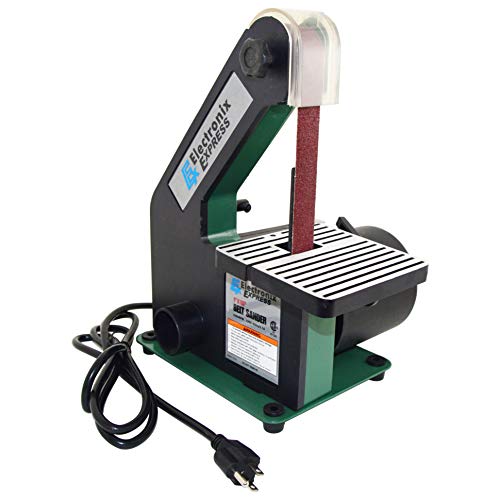
TL;DR: The EX Electronix Express Mini Belt Sander packs a 1/3 HP motor, 3260 FPM belt speed and a tilting 0°‑45° table into a 12.25 lb benchtop for hobby‑level projects at $69.99.
This mini sander’s most eye‑catching spec is its 3400 RPM motor that drives a 1‑inch × 30‑inch belt at 3260 FPM. Combined with a variable‑speed control, the tool can handle both rough stock removal and finer finish work without changing belts. The die‑cast aluminum housing adds rigidity, while the removable back plate and rubber‑foot vibration damping keep the unit stable on a workbench.
When you line it up against the other ten belt sanders in our roundup, it feels heavier than the Jellas 3‑inch models that sit around 9.6 lb, yet it’s lighter than the WEN 6515T, which tips the scales at 16 lb. Its 10 in × 14.5 in footprint is larger than the ultra‑compact WEN 6307 (3.5 in × 17.5 in) but shorter than the WEN 6515T’s 15.5 in height. In short, it lands in the middle of the size spectrum while offering a full‑size 1‑inch belt that many smaller competitors lack.
Reviewers consistently praise the sander’s solid construction and the convenience of the 0°‑45° tilting table for angled cuts. Users also note that the built‑in dust port (1‑3/4 in diameter) helps keep the shop cleaner, a feature usually reserved for pricier models. On the downside, the 5 in × 5 in work table limits the size of pieces you can comfortably sand, and the corded design means you need an outlet within reach.
Professional reviewers highlight that the belt speed of 3260 FPM is “typical and practical for efficient stock removal,” positioning this unit as a solid value alternative in the small‑workshop segment. The 360 Watt power draw and 3.0 AMP draw keep electricity use modest while still delivering the torque needed for hobby‑grade tasks.
Pros
Cons
Best for: Budget-conscious buyers seeking a reliable entry-level option — the EX Electronix Express Mini Belt Sander offers Belt Speed: 3260 FPM
TL;DR: The Jellas 3×21‑inch Belt Sander packs a 7 Amp motor, variable speed up to 400 rpm and a 10‑ft cord into a compact 9.7‑lb unit, plus ten grit‑varied belts and dust‑bag/vacuum collection for versatile DIY sanding.
The standout spec is the 7 Amp motor paired with a 400 rpm maximum speed and a 6‑dial variable‑speed knob that lets you dial in anywhere between 120 rpm and 400 rpm. Combined with a 3 × 21‑inch belt and a belt speed of 13 feet per second, the tool can handle heavy stock removal while still offering fine‑grit control. Its ergonomic two‑handed grip and lock‑on trigger make handheld use comfortable, and the included metal C‑clamps let you convert it to a bench sander in seconds.
Compared with the other ten belt sanders in this roundup, the Jellas sits in the middle of the weight range: at 9.7 lb it’s lighter than the EX Electronix Express Mini’s 12.25 lb build, but heavier than the ultra‑light WEN 6307 at 2.4 lb and the WEN 6321 at 6.2 lb. Its 10‑ft power cord outpaces the 6‑ft cords on the WEN 6321 and WEN 6307, giving you more reach on larger projects. While the Craftsman CMEW213 and WEN 6515T both use smaller 3‑inch belts, Jellas offers the larger 3 × 21‑inch belt for broader coverage, a spec not listed for many of the compact peers.
User feedback repeatedly praises the “easy setup” and the generous assortment of ten aluminum‑oxide sanding belts (2 each of 40, 60, 80, 120 and 180 grit). Reviewers also like the dual dust‑collection system—a detachable bag plus a 2‑in‑1 vacuum adapter (32 mm and 35 mm)—which keeps workspaces cleaner. Professional reviewers note the powerful motor’s ability to handle demanding wood‑removal tasks, while some users mention that belt tension may need occasional tweaking and that the 120 V rating could be a mismatch for regions using 230 V mains.
Pros
Cons
Best for: Budget-conscious buyers seeking a reliable entry‑level option — the Jellas 3x21 Belt Sander offers Motor Power: 7 Amp
Breakdown
WEN 6502T 36-inch
Pros
WEN 6515T 30-inch
Pros
Makita 9404
Pros
Cons
WEN 6307
Pros
Based on scoring data and product specs
Personalized picks
Best Overall Pick
WEN 6502T 36-inch
Best ValueBest for: Buyers willing to invest in a proven, high-quality option — the WEN 6502T 36-inch offers Belt Speed: 1900 FPM
WEN 6515T 30-inch
Best for: Most users looking for a well-reviewed, reliable mainstream option — the WEN 6515T 30-inch offers Belt Speed: 3160 FPM
$90.55-$48.45 vs winner
Skip Bucktool BD61000 if…
You're shopping on a tight budget — it's priced at $399.59
Our top pick is the WEN 6502T 36‑inch benchtop belt and disc sander. It earns a 4.6‑star rating from 5,381 reviewers, comes with a 4 × 36‑inch belt and a 6‑inch disc, and runs a 1/2 HP motor at a steady 1,900 ft/min belt speed. At $139.00 it also offers a sturdy 41‑lb cast‑iron base and a quick‑release tension lever, giving you professional‑grade capability without breaking the bank.
The runner‑up, the WEN 6515T 30‑inch model, shines when you need a lighter, more compact sander for smaller workshops. Weighing just 16 lb, it fits on tighter benches, yet still delivers a fast 3,160 ft/min belt speed and a 1 × 30‑inch belt for quick material removal. Priced at $90.55 and backed by the same 4.6‑star rating (2,698 reviews), it’s a solid choice for DIYers who value portability.
Looking beyond the top two, the WEN 6307 is the best budget option at $35.08, giving entry‑level users a functional sander for occasional projects. For a mid‑range pick, the WEN 6515T (already highlighted above) balances price and performance at $90.55. If you want premium features and are willing to invest, the Bucktool BD61000 stands out at $399.59, offering high‑end build quality for professional shops.
Pick the WEN 6502T today and get a workshop‑ready sander that delivers power, versatility, and value in one package.
The 6502T costs $139.00, which is $48.45 more than the 6515T’s $90.55 price, but it adds a professional‑grade 1/2 HP motor and a 4 × 36‑inch belt that handles larger surfaces. Its cast‑iron base and quick‑release tension lever also give a sturdier, more ergonomic experience for serious woodworking.
No reviews yet — be the first to share your experience.
Please sign in to leave a review