⚡ Quick Answer
Smart locks have gone from novelty to necessity, and this roundup pits 11 contenders against each other. Prices span from a modest $55.55 for the Veise VE017 up to $199.99 for eufy’s premium Video Smart Lock E330 3‑in‑1, giving you budget, mid‑range, and premium options to fit any doorway and wallet.
Among the budget tier, the Veise VE017 dazzles with a 0.2‑second fingerprint read and a 12‑month battery life, while the Wyze Bolt v2 earns a solid 4.7‑star rating for its Wi‑Fi connectivity. Mid‑range choices like the Kwikset Halo Touch (4.0‑star rating) and Wyze Palm Lock (4.5‑star rating) add features such as 100‑fingerprint capacity and palm‑vein recognition. The premium segment packs heavy‑duty specs: eufy’s Smart Lock S230 boasts 250,000 durability cycles and a 10000 mAh battery, Ultraloq’s Bolt supports Matter over Wi‑Fi, and the eufy FamiLock E34 offers 99.9 % biometric accuracy with a 0.6‑second recognition time.
We’ll break down each model’s strengths, quirks, and ideal use cases so you can match the lock that fits your home, your tech ecosystem, and your budget.

eufy Smart Lock S230
Its 10000 mAh battery capacity ensures long‑term operation without frequent recharges.

Veise VE017
Ideal for budget‑conscious homeowners, the Veise VE017 delivers reliable entry‑level security at $55.55—about $104 less than the eufy Smart Lock S230.

Ultraloq Bolt
Stands out with capacity for up to 50 access codes and two mechanical keys, offering flexible user management not found in the eufy or Veise models.
Also considered
TL;DR: The Ultraloq Bolt costs $169.99, offers a 360° fingerprint sensor, up to 50 access codes, IP65 protection, and a 3.4‑lb build, earning 4.3‑star ratings from 2,485 reviewers.
The standout feature is its 360° fingerprint ID paired with an anti‑peep keypad and the capacity for up to 50 access codes, all housed in a compact 2.96 in × 2.96 in × 1.35 in zinc‑alloy body. It also supports Matter over Wi‑Fi and Thread, letting you control the lock through Apple Home, Google Home, Alexa and SmartThings without a separate hub. The lock’s IP65 rating means it can handle dust and water exposure, and it runs on eight AA alkaline batteries at 12 V.
At 3.4 lb, the Ultraloq Bolt is lighter than the eufy FamiLock E34, the eufy S230, the Kwikset Halo Touch, and the eufy Video Smart Lock, but noticeably heavier than the Wyze Palm Lock, which tips the scales at 1.9 lb. Its 2.96‑inch depth makes it considerably shallower than the eufy S230’s 220 mm depth, giving it a more streamlined fit on most doors.
Reviewers consistently praise the built‑in Wi‑Fi and the seamless Apple Home integration that lets you lock or unlock with Siri or the U‑home app. Professional reviewers note the efficient power management via Thread, which extends battery life on standard AA cells. A common complaint is the lock’s reliance on a 2.4 GHz Wi‑Fi network, which can limit advanced features for users whose routers are set to 5 GHz only. Some users also mention that installing the separate deadbolt and knob can be a bit more involved than a single‑piece unit.
Additional technical details include ANSI/BHMA A156.36 Grade 1 certification, 128‑bit AES encryption, a lifetime mechanical guarantee, and an 18‑month electronic warranty. The lock’s Bluetooth Low Energy (BLE) connectivity and the ability to receive door‑status alerts round out its smart‑home readiness.
Pros
Cons
Best for: Buyers willing to invest in a proven, high-quality option — the Ultraloq Bolt offers Access Codes Capacity: Up to 50
Avoid if: You're on a tight budget or only need basic functionality
“Built-in WiFi, app remote control, and door alerts.”
TL;DR: The eufy Smart Lock S230 delivers fast 0.3‑second fingerprint access, IP65 weatherproofing and a 12‑month battery life for $159.99, all in a DIY‑friendly 10‑15 minute install.
The lock’s standout spec is its 0.3‑second fingerprint recognition speed, backed by an AI self‑learning sensor that unlocks the door in just 1 second after verification. It’s also BHMA‑certified for 250,000 lock/unlock cycles and carries an IP65 rating, meaning it can handle rain, dust and extreme temperatures from –30 °C to 70 °C.
At roughly 3.64 pounds, the S230 is lighter than the Kwikset Halo Touch (3.88 lb) but a bit heavier than the Wyze Palm Lock (1.9 lb). Its depth of 220 mm and height of 245 mm sit between the Ultraloq Bolt’s 2.96‑inch depth and the Philips Smart Lock with Handle’s 1.5‑inch height, giving it a solid but not oversized profile for most standard doors.
Users consistently praise the lock’s swift fingerprint response and the intuitive eufy Security app for remote management. Professionals note the local storage of fingerprint data with AES‑128 encryption as a strong privacy feature. On the downside, reviewers report occasional hiccups with the 2.4 GHz‑only Wi‑Fi, and some find the real‑world battery life falls short of the advertised 12‑month claim, requiring more frequent charging. Rental hosts also mention the lack of native Airbnb integration as a missing convenience.
Beyond speed and durability, the S230 offers multiple access methods—fingerprint, keypad, mobile app and physical key—plus offline functionality, auto‑lock sensing, forced‑entry alarm and tamper alerts. The 10,000 mAh rechargeable battery, combined with a micro‑USB emergency port, aims to keep the lock powered for a year under normal use.
Pros
Cons
Best for: Homeowners who want fast biometric entry and robust weatherproofing — the eufy Smart Lock S230 offers Installation Time: 10-15 minutes
Avoid if: You run a vacation rental that relies on automated Airbnb guest codes or need a lock that works on 5 GHz Wi‑Fi networks.
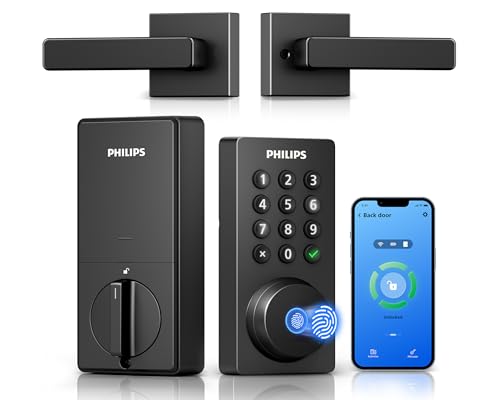
TL;DR: The Philips Smart Lock delivers built‑in Wi‑Fi and Bluetooth, a 0.3‑second fingerprint scan with 99% accuracy, and remote control for $79.98, making it a solid budget entry‑level option.
What really sets this lock apart is its dual‑connectivity: both Wi‑Fi (2.4 GHz) and Bluetooth are built in, so you never need a separate hub. The fingerprint sensor reads a print in just 0.3 seconds and boasts a 99% recognition rate, while the deadbolt weighs only 1.4 pounds and fits a backset of 2‑3/8 inch or 2‑3/4 inch.
At the same $79.98 price point as the Wyze Bolt v2, the Philips model adds Wi‑Fi capability that Wyze lacks, though it is taller than Wyze’s 17.3 mm external assembly height. It’s also noticeably lighter than the Kwikset Halo Touch, which tips the scales at 3.88 pounds, giving Philips a portability edge in the mid‑tier crowd.
Professional reviewers highlight the lock’s rapid fingerprint response and the convenience of remote access via the Philips Home Access app, and the 4.4‑star rating from 689 reviewers suggests most owners are satisfied. Users appreciate the AES128 encryption and the ability to lock automatically anywhere between 10 and 180 seconds after closing.
Beyond the biometric features, the lock supports Alexa and Google Assistant, offers three operating modes (Manual, Auto, Away Security), and stores entry logs locally. It can operate in temperatures from –35 °C to 66 °C and humidity up to 95%, making it suitable for most residential climates.
Pros
Cons
Best for: Budget-conscious buyers seeking a reliable entry‑level option — the Philips Smart Lock offers Fingerprint Capacity: 20
TL;DR: The Wyze Palm Lock delivers palm‑vein biometric entry, Wi‑Fi integration and IP53 weather resistance for $129.98, installing in about 20 minutes and weighing 1.9 lb, making it a solid mid‑range smart‑lock choice.
At the heart of the Wyze Palm Lock is its palm‑vein biometric sensor, which reads the unique vascular pattern of your hand for contactless entry. The lock also supports PIN codes, a touchscreen, the Wyze app, voice assistants and a physical key, giving you multiple ways in. It can store up to 50 guest codes, each protected by anti‑peep technology, and the built‑in gyroscope automatically engages auto‑lock when the door swings shut. With an IP53 rating it resists splashes, and the unit weighs 1.9 lb, making it sturdy yet manageable for most doors.
Compared with the other ten locks in this roundup, the Palm Lock sits in the middle of the weight range – it’s lighter than Kwikset Halo Touch (3.88 lb) and the eufy S230 (about 3.64 lb), but heavier than the Philips Smart Lock (1.4 lb). Its 20‑minute DIY installation is a bit longer than the eufy S230’s 10‑15 minute claim, yet still quicker than many bolt‑type models that require more extensive fitting. Feature‑wise, it outpaces the eufy C33, which lacks biometric authentication, and offers more guest‑code capacity than the Ultraloq Bolt’s 50‑code limit, while matching the Philips Smart Lock’s voice‑assistant support. Overall, it provides a richer biometric experience without the bulk of the heavier deadbolt‑style options.
Professional reviewers point out that palm‑vein scanning is harder to spoof than traditional fingerprint readers, giving the lock a security edge. Users appreciate the contactless convenience and the dual‑battery system – a removable main pack lasting six months and a backup that holds charge for two weeks. The most common complaint is that the USB‑C emergency charging cable isn’t bundled, so you’ll need to source one separately if the batteries run out.
The lock runs on Wi‑Fi and plugs directly into the Wyze ecosystem, so you can control it from the Wyze app, Alexa or Google Assistant without an extra hub. Its millimeter‑wave radar only powers the presence sensor when someone approaches, helping conserve battery life. The BHMA3 certification shows it’s been tested against repeated slams, twists and splashes, reinforcing its durability for everyday family use.
Pros
Cons
Best for: Most users seeking a balanced, mainstream option — the Wyze Palm Lock offers Installation Time: 20 minutes
Avoid if: You need advanced features or professional‑grade performance
TL;DR: The eufy Video Smart Lock E330 3‑in‑1 packs a 2K camera, 0.3‑second fingerprint unlock and a built‑in doorbell into a weather‑proof deadbolt that weighs 3.62 lb and costs $199.99.
What really sets the E330 apart is the 2K (2560 × 1440) camera with an f/1.6 aperture and color day/night night vision, all tucked behind the lock body. Pair that with a 0.3‑second fingerprint response and you get instant, keyless entry without sacrificing visual security. The unit also includes a doorbell button with auto‑light, motion detection out to 5.2 m, and local 8 GB eMMC storage plus a microSD slot for up to 128 GB.
Compared with the other ten biometric locks in this roundup, the E330 is heavier than the Ultraloq Bolt (3.4 lb) but lighter than the eufy FamiLock E34 (3.70 lb) and the Kwikset Halo Touch (3.88 lb). Its depth of 221 mm makes it deeper than the Ultraloq’s 2.96 in design and the FamiLock’s 167.9 mm profile. Fingerprint capacity matches the eufy FamiLock and Ultraloq at 50 users, though it falls short of the Kwikset’s 100‑fingerprint limit. Price‑wise, the E330 sits at a premium $199.99, higher than most peers in the set.
Users love the all‑in‑one concept: reviewers repeatedly praise the clear 2K video for package monitoring and the convenience of never needing a separate doorbell or camera. However, many note that the battery—despite a 10 000 mAh rechargeable Li‑ion cell—drains faster than the advertised 3‑12 month range, leading to frequent recharges. The touchscreen keypad and doorbell button are also described as dim in low light, which can confuse visitors after dark. Professional reviewers highlight the lock’s AES128 + ECC encryption, IP65 rating, 100,000 durability cycles, 2000 N pressure resistance, and 72‑hour salt‑spray resistance as solid security fundamentals.
Pros
Cons
Best for: Those prioritizing quality and willing to pay for premium performance — the eufy Video Smart Lock E330 3‑in‑1 offers Fingerprint Capacity: 50
Avoid if: You're shopping on a tight budget — it's priced at $199.99
“battery killer”
“remarkably sleek and compact”
TL;DR: The Philips Smart Lock with Handle offers hub‑free 2.4 GHz Wi‑Fi, a 0.3‑second fingerprint scanner, and flexible PIN and voice controls for $115.99, earning a solid 4.5‑star rating.
The lock’s standout feature is its built‑in 2.4 GHz Wi‑Fi, so you never need a separate hub to control it remotely. Inside, the fingerprint sensor registers a print in just 0.3 seconds with a 99% success rate, and all data is protected by AES128 encryption stored locally. Its compact footprint—1.5 inches high, 6.0 inches long, and 2.2 inches wide—fits most standard doors without crowding the entryway.
At $115.99, the Philips model sits in the mid‑range of this roundup. It’s cheaper than the Kwikset Halo Touch and the eufy S230, yet pricier than the eufy C33 and Wyze Bolt v2. Dimensionally, it’s shorter than the eufy C33 (which measures 7.24 inches in length) and far more compact than the Kwikset Halo Touch’s 9.82‑inch height. Fingerprint capacity is limited to 20 users, which is lower than Kwikset’s 100‑fingerprint offering, but still adequate for many households.
Reviewers consistently praise the lock’s quick fingerprint entry and the convenience of hub‑free Wi‑Fi, noting that the Philips Home Access app and voice‑assistant integration (Alexa, Google Assistant) make remote access feel effortless. Families like the ability to generate unlimited one‑time PINs for guests, while the auto‑lock timer (10‑180 seconds) helps prevent forgotten doors. On the downside, users report that the eight AA batteries drain faster when Wi‑Fi is active and that there’s no emergency power backup. Professional reviewers also point out that the ANSI/BHMA Grade 3 rating may fall short for high‑security needs.
The lock operates in extreme conditions, handling temperatures from –35 °C to 66 °C and humidity up to 95 %. Security‑focused features include low‑battery, wrong‑entry‑limit, jam, and away‑mode alarms, plus a master PIN option for added control. Auto‑lock can be set anywhere between 10 and 180 seconds, giving you flexibility to match your routine.
Pros
Cons
Best for: Value‑conscious buyers seeking quality at $115.99 — the Philips Smart Lock with Handle offers Fingerprint Capacity: 20
Avoid if: You need high‑security commercial‑grade protection or more than 20 fingerprint users
TL;DR: The Veise VE017 delivers 0.2‑second fingerprint entry, eight smart‑access options and IP55 protection for just $55.55, making it a solid budget smart‑lock.
The lock’s standout spec is its 0.2‑second fingerprint recognition speed, powered by an on‑device AI chip that learns each user’s print. It also carries an IP55 rating, meaning it can handle dust and splashes, and it supports both Bluetooth and Wi‑Fi through the Veise KK Home app. Physically, the deadbolt measures 68.6 mm deep, 76.2 mm high and 147.3 mm wide, and it weighs about 2.25 pounds.
Compared with the other ten locks in this roundup, the Veise sits in the middle of the weight range—lighter than the Kwikset Halo Touch (3.88 pounds) and the Wyze Palm Lock (1.9 pounds), but heavier than the Philips Smart Lock (1.4 pounds). Its price point lands it in the budget tier, undercutting many peers while still offering more unlock methods than the Philips Smart Lock’s basic set. The inclusion of Wi‑Fi puts it ahead of the Wyze Bolt v2, which lists only Bluetooth.
User feedback highlights how quickly the fingerprint sensor opens the door and how straightforward the installation feels. Reviewers also appreciate the two mechanical keys and two NFC cards that come in the box. On the downside, several owners note the lack of long‑term durability data, and the 12‑month battery life (four AA alkaline cells) means you’ll need to replace the cells annually.
Technical extras include an emergency USB‑C port for power loss, ANSI Grade 3 and BHMA certification for security, and voice‑assistant compatibility with Alexa and Google Assistant via the G1 Gateway. Veise backs the lock with a two‑year warranty and 24/7 email support, adding peace of mind for budget shoppers.
Pros
Cons
Best for: Budget‑conscious buyers seeking a reliable entry‑level option — the Veise VE017 offers Depth: 68.6 mm
Avoid if: You need proven long‑term durability or an officially certified weather‑proof rating
“impressive for a technological lock”
TL;DR: The eufy Smart Lock C33 costs $99.99, offers adaptive fingerprint entry, integrated Wi‑Fi and a 15‑minute no‑drill install, making it a solid budget option for families and renters.
The C33 measures 7.24 inches long, 6.06 inches wide and 5.12 inches high, giving it a substantial presence on the door jamb. Its adaptive fingerprint sensor learns each user’s grip, while the built‑in Wi‑Fi lets you lock or unlock from the app without any bridge. At $99.99 it lands squarely in the budget tier, and the package includes eight AA alkaline batteries that the manufacturer says last 8‑12 months.
Compared with other contenders, the C33 is noticeably larger than the Philips Smart Lock with Handle (6.0 inches long, 2.2 inches wide, 1.5 inches high) and the standard Philips Smart Lock (6 inches long, 2 inches wide, 1.5 inches high). It also out‑sizes the Wyze Bolt v2, whose external dimensions are under an inch tall. Price‑wise, the C33 sits below the $115.99 Philips Smart Lock with Handle but above the $79.98 Wyze Bolt v2, giving it a middle ground in the price spectrum. Its 4.1/5 star rating trails some higher‑scoring rivals, which is reflected in the 730 user reviews.
Everyday owners praise the hassle‑free 15‑minute, no‑drill setup and the back‑lit anti‑peeping keypad that hides extra digits when you type. Professional reviewers highlight the fingerprint‑handle integration as a standout for families who need quick, one‑handed entry. The lock also offers a privacy mode that blocks exterior access and flashes a red indicator, plus real‑time notifications and an event history through the app. The BHMA Grade 3 certification provides a baseline of mechanical security, and the IP53 rating means it can handle light rain or splashes.
Pros
Cons
Best for: Entry-level buyers or those on a tight budget — the eufy Smart Lock C33 offers Height: 5.12 inches
Avoid if: You need advanced features or professional‑grade performance
TL;DR: The Wyze Bolt v2 delivers AI‑driven fingerprint entry in 0.3‑0.5 seconds, a 15‑minute install and solid weather protection for just $79.98.
What really stands out is the AI self‑learning fingerprint scanner that unlocks the door in 0.3‑0.5 seconds and supports up to 50 access codes. The lock’s tempered‑glass keypad adds anti‑peep and anti‑glare protection, while the hardware‑encrypted local storage keeps your credentials safe.
Compared with the other ten entries, the Wyze Bolt v2 is lighter than the Kwikset Halo Touch (3.88 pounds) but a bit heftier than the Philips Smart Lock (1.4 pounds). Its 15‑minute installation beats the Wyze Palm Lock’s 20‑minute setup, and it sits at a similar price point to the Philips Smart Lock while offering built‑in Wi‑Fi that the eufy Smart Lock C33 requires a separate bridge for. The backset options (2‑3/8" or 2‑3/4") match those of the Philips models, ensuring a drop‑in fit for most US doors.
Everyday owners rave about the lock’s reliable fingerprint entry and the convenience of remote access via the Wyze app, noting that the 8‑month battery life on eight AA cells lasts longer than many competing deadbolts. Professional reviewers highlight the AI scanner’s ability to adapt to cold or sweaty hands, and the BHMA Grade 2 certification adds peace of mind. The main trade‑offs are an auto‑lock that doesn’t detect a closed door, the need for eight AA batteries, and Wi‑Fi limited to 2.4 GHz networks.
On the technical side, the lock offers Bluetooth 5.3, a 16‑ft setup range, and an IP53 rating that protects against splashing water. An emergency USB‑C power port ensures you won’t be locked out if the batteries run low, and the compact external dimensions (156.5 mm × 72 mm × 17.3 mm) keep the hardware unobtrusive.
Pros
Cons
Best for: Entry-level buyers or those on a tight budget — the Wyze Bolt v2 offers Installation Time: 15 minutes
Avoid if: You want the best value‑per‑dollar in its price range
TL;DR: The Kwikset Halo Touch packs Wi‑Fi, 100‑fingerprint capacity and Grade AAA security into a solid 3.88‑lb deadbolt for $142.79, though it skips a door sensor and Apple HomeKit.
The standout spec is its biometric capacity: the lock stores up to 100 fingerprints and 50 user profiles, all kept locally for privacy. Combined with built‑in Wi‑Fi, you can manage access from the Kwikset app without a separate hub, and the SmartKey Security mechanism meets ANSI/BHMA Grade AAA standards.
Compared with the other ten entries, the Halo Touch is heavier than the 1.9‑lb Wyze Palm Lock but sits close to the eufy S230 at roughly 3.64 lb and the Ultraloq Bolt at 3.4 lb. It also carries a higher price tag than the Wyze model, while its dimensions (9.82 in H × 4.18 in L × 5.39 in W) are larger than the compact units that list millimeter measurements.
Users praise the quick fingerprint unlock and the straightforward Wi‑Fi setup, noting that families appreciate the ability to add many members without re‑keying. Professional reviewers highlight the SmartKey anti‑bump technology and the Microban antimicrobial coating as strong security plus hygiene benefits. The most common complaint is the missing door sensor, which can make the auto‑lock feature feel unreliable.
Pros
Cons
Best for: Most users seeking a balanced, mainstream option — the Kwikset Halo Touch offers Fingerprint Capacity: 100 fingerprints
Avoid if: Reliability and user satisfaction are your top concerns
TL;DR: The eufy FamiLock E34 delivers 99.9% palm‑vein accuracy in 0.6 seconds, packs a 10 000 mAh primary battery and IP65 protection, but carries a premium price tag.
The standout feature is its palm‑vein biometric system, which the manufacturer claims hits 99.9% accuracy and unlocks the door in just 0.6 seconds. It stores up to 50 vein profiles locally, keeping biometric data on the lock itself.
At $179.98, the FamiLock sits a bit pricier than the Ultraloq Bolt and is heavier than the Wyze Palm Lock, though its weight of about 3.70 lb is comparable to the eufy Smart Lock S230. Unlike several peers, it carries an IP65 rating, giving it superior resistance to dust and water, and it supports Matter over Thread for broader smart‑home compatibility.
Users repeatedly praise the quick, reliable vein scan and the hassle‑free DIY screw‑in installation that requires no drilling. Reviewers also note the reassurance of an 8‑month battery life backed by a 10 000 mAh primary cell and a 750 mAh backup battery that keeps the lock functional during power loss. Professional reviewers point out that the biometric function is limited to unlocking only, which some find restrictive.
Technically, the lock is ANSI/BHMA Grade 1 certified and integrates directly with Apple Home, Google Home, Alexa and SmartThings via built‑in Wi‑Fi. There’s no monthly subscription fee, and the dual‑battery design ensures continuous operation even when the primary battery is swapped.
Pros
Cons
Best for: Tech‑forward homeowners who want cutting‑edge biometric security and robust smart‑home integration — the eufy FamiLock E34 offers IP Rating: IP65
Breakdown
eufy Smart Lock S230
Pros
Veise VE017
Pros
Ultraloq Bolt
Pros

eufy Video Smart Lock E330 3-in-1
Pros
Cons
Based on scoring data and product specs
Personalized picks
Best Overall Pick
eufy Smart Lock S230
Best OverallBest for: Audiophiles and enthusiasts seeking premium sound quality and advanced features — the eufy Smart Lock S230 offers Installation Time: 10-15 minutes
Veise VE017
Best for: Budget-conscious buyers seeking a reliable entry-level option — the Veise VE017 offers Depth: 68.6 mm
$55.55-$94.44 vs winner
Skip eufy Smart Lock C33 if…
You need advanced features or professional-grade performance
The eufy Smart Lock S230 earns the top spot with a solid 4.3 / 5 rating backed by 1,940 reviews, a 12‑month rechargeable battery, and fingerprint recognition that unlocks in just 0.3 seconds. Its IP65 rating means it can handle harsh weather, and at $159.99 (list price $199.99) it offers premium features at a competitive price.
Runner‑up Veise VE017 shines when you need a highly versatile lock on a tight budget. It supports an 8‑in‑1 access suite—including fingerprint, app, RFID cards and voice—while delivering a swift 0.2‑second fingerprint scan. With an IP55 rating and a $55.55 price tag, it’s a compelling choice for renters or first‑time smart‑lock buyers.
For those looking beyond the top two, the best budget option remains the Veise VE017 for its feature richness at under $60. The mid‑range pick is Kwikset Halo Touch at $142.79, offering reliable BHMA certification without breaking the bank. If you want the most premium experience, the eufy Video Smart Lock E330 3‑in‑1 at $199.99 adds video monitoring and a 3‑in‑1 design for ultimate convenience.
Choose the eufy Smart Lock S230 now and lock in fast, reliable biometric security.
The S230 blends fast AI‑self‑learning fingerprint recognition (0.3 seconds) with AES‑128‑bit encryption and an IP65 rating, so it stays reliable in wet or dusty conditions. Its 12‑month lithium‑rechargeable battery and built‑in Alexa and Google Assistant support add convenience without extra hubs. At $159.99 it offers a strong feature set for a price that undercuts many premium rivals.
No reviews yet — be the first to share your experience.
Please sign in to leave a review