⚡ Quick Answer
Choosing a blade coffee grinder can feel overwhelming, especially when you’re looking at 11 different models that span a price range from $19.95 for the Hamilton Beach Fresh Grind up to $49.95 for the KitchenAid BCG111ER. All of the units we compared earned at least 4.2 stars, and they cluster into three price tiers: budget options like the Fresh Grind and Black+decker One Touch, mid‑range picks such as the Cosori Espresso Grinder and Secura Electric Grinder, and premium choices including the Hamilton Beach Custom Grind and Krups Electric Grinder.
When you weigh the specs, a few patterns emerge. The Fresh Grind delivers 125 W of power in a compact 1.3‑lb body for under $20, while the Cosori Espresso Grinder pushes 200 W and can grind fine espresso in about 15 seconds, weighing 1.65 lb. The Bodum Bistro stands out with a 480 W motor and an 84 g bean capacity, yet it still fits on a small countertop. If you need a heavier, feature‑rich unit, the Hamilton Beach Custom Grind offers 150 W, a 28‑oz chamber, and a 2.0‑lb frame.
Below we break down each grinder’s performance, durability, and ease of use so you can match the right tool to your brewing routine.

Hamilton Beach Fresh Grind
Its 117 mm cord length lets you place the grinder wherever you need without hunting for an outlet.

Cosori Espresso Grinder
Ideal for espresso enthusiasts who want a dedicated grinder, though it sits about $10 higher than the Hamilton Beach Fresh Grind.
Black+decker One Touch
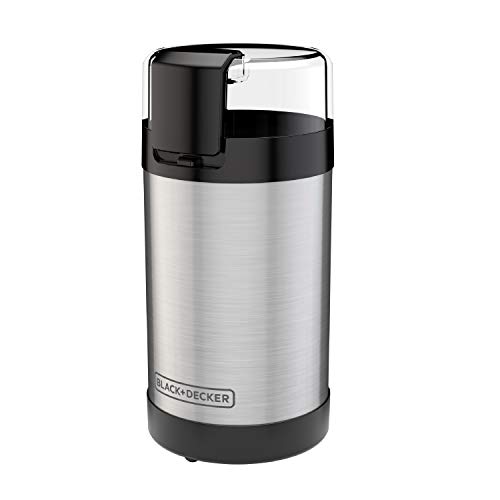
With a 3.5‑inch depth, it provides a larger bean chamber than the other two, making it suited for frequent brewing without frequent refills.
Score Analysis
Key score advantages vs. runner-up (Cosori Espresso Grinder)
Price Range
Hamilton Beach Fresh Grind
$21.95
Cosori Espresso Grinder
$29.99
Black+decker One Touch
$25.99

Bodum Bistro
$29.99

KitchenAid BCG111ER Blade Coffee Grinder
Out of Stock

Hamilton Beach Custom Grind
$29.95

Secura Electric Coffee Grinder
$27.50

Krups Electric Coffee Grinder
$33.92

SHARDOR Electric Super Silent Coffee Grinder
$32.39
Cuisinart DCG-20BKN Black
$24.95

Hamilton Beach Electric Coffee Grinder
$43.95
Spec Comparison
TL;DR: The Hamilton Beach Fresh Grind offers a 125 W motor, 9 tbsp (12‑cup) capacity, and one‑touch operation for $19.95, making it a solid entry‑level blade grinder for everyday drip coffee.
At 125 W, this grinder packs enough power for quick grinding while staying compact at 95 mm deep, 181 mm tall and 90 mm wide. It weighs 590 g (1.3 lb) and fits a 9 tbsp bean chamber, which the manufacturer says yields up to 12 cups of coffee. The hide‑away cord (117 mm) and see‑through lid with measurement markings add convenience without taking up extra counter space.
Compared with the other ten models, the Fresh Grind is lighter than the Bodum Bistro (724 g) but heavier than the Secura unit (71 g). Its 181 mm height sits between the Cuisinart’s 7.0 in (≈178 mm) and the Cosori’s 190 mm, while the 90 mm width matches the Cosori and exceeds the Bodum’s 88 mm. Power-wise, its 125 W motor is modest next to the 150–200 W range of most competitors, yet it still outperforms the low‑power Secura (200 W) in efficiency for basic grinding tasks.
Reviewers consistently praise the one‑touch press‑and‑release operation and the dishwasher‑safe stainless‑steel grinding bowl, noting how easy you can clean it after grinding beans, spices, or herbs. On the downside, users mention that the blade‑type grinding can produce uneven particle sizes, which limits the grinder’s suitability for espresso or French‑press brewing, and there’s no adjustable grind setting or timer to fine‑tune the result.
Pros
Cons
Best for: Budget‑conscious buyers seeking a reliable entry‑level option
Avoid if: You need advanced features or professional‑grade performance
TL;DR: The Cosori Espresso Grinder packs a 200 W copper‑wired motor into a 1.65‑lb, 90 mm‑square body, delivering fine espresso grounds in about 15 seconds, though it can be noisy and holds only 70 g of beans.
The heart of this grinder features a 200 W copper‑wired motor paired with a food‑grade stainless‑steel single blade. The pulse‑type one‑touch control produces fine espresso‑grade grounds in roughly 15 seconds, while a coarse setting finishes in about 5 seconds. Its 70 g bean capacity fits a typical single‑serve routine, and the transparent lid lets you watch the grind in progress.
Compared with the other ten grinders in this roundup, the Cosori is noticeably heavier than the ultra‑light Secura (around 0.16 lb) and the Black+decker model, yet lighter than the SHARDOR unit that tips the scales at over 2 lb. Its footprint of 90 mm depth and width is more compact than the Bodum Bistro’s 166 mm depth, putting it among the smaller‑sized options. While its price sits above the budget‑focused Secura, it offers more features than many of its peers.
Reviewers consistently praise the speed of the 200 W motor and the uniformity of the fine grind, noting that the dishwasher‑safe grinding chamber and blades simplify cleanup. On the downside, users report that the grinder is louder than comparable blade models, and the single‑blade pulse system can feel imprecise when dialing in a coarse grind. The lid’s lock mechanism is reliable, but a few owners mention the lid can be a bit tricky to remove after grinding.
The unit also includes overheat protection that shuts down the motor at 200 °F, and a safety lock that prevents operation unless the lid is securely closed. These safety features, combined with a two‑year manufacturer warranty, add peace of mind for daily use.
Pros
Cons
Best for: Solo coffee drinkers, small households (1‑4 people), beginners, and anyone needing fast fine grinds.
Avoid if: You're shopping on a tight budget — it's priced at $29.99.
TL;DR: The Black+decker One Touch grinder delivers quick 10‑15 second grinds with a 150 W motor, 4 oz capacity, and stainless‑steel blades, all for $25.99, making it a solid budget choice for single‑serve coffee.
The grinder’s 150 W motor powers double stainless‑steel blades that can pulverise beans, spices, nuts and seeds in just 10‑15 seconds on a medium setting, while the 2/3‑cup (≈4 oz) bowl fits the needs of one‑to‑two cups of coffee.
At 1.43 lb, it’s lighter than the Cuisinart DCG‑20BKN (1.57 lb) and the Bodum Bistro (≈1.60 lb) but heavier than the Secura Electric Coffee Grinder (0.16 lb). Its 4 oz bean capacity is larger than the Cuisinart’s 2.5 oz and the Secura’s 2.5 oz, yet smaller than Bodum’s 5.8 oz. Power‑wise, 150 W sits between the lower‑powered Cuisinart (130 W) and the higher‑powered Bodum (480 W), offering a balanced performance for a budget‑tier grinder.
Professional reviewers note the “up to 30 % better grinding uniformity” claim, and everyday users praise the quiet operation and the ease of cleaning the stainless‑steel interior. Many users praise the single‑touch pulse control for speed, though several point out that the lack of preset grind sizes makes fine‑grind consistency harder to achieve. The removable power cord without a built‑in wrap also draws occasional complaints.
Additional technical details include a lid‑locking safety mechanism, easy‑to‑clean stainless‑steel bowl and blades, and a 2‑year manufacturer‑limited warranty. The grinder’s compact footprint—3.5 in depth, 7.28 in height and 3.4 in width—fits comfortably on a small kitchen counter or dorm desk.
Pros
Cons
Best for: Budget-conscious buyers seeking a reliable entry-level option
Avoid if: You need advanced features or professional‑grade performance
TL;DR: The Bodum Bistro offers a 480 W motor, 84 g bean capacity, and five grind settings in a compact stainless‑steel body, making it a solid budget entry for casual coffee drinkers.
The grinder packs a 480 W motor behind a brushed stainless‑steel shell that measures 166 mm deep, 96 mm high and 88 mm wide. Its 84 g (about 5.8 oz) bean capacity feeds up to 12 cups, and five preset grind settings let you switch from coarse to fine with a simple pulse button.
Compared with the other models in this roundup, the Bistro is heavier than the Black+decker One Touch (650 g) and the Hamilton Beach Fresh Grind (590 g), but its 480 W motor dwarfs the 130 W motor of the Cuisinart DCG‑20BKN and the 150 W motor of the Black+decker. It also holds more beans than the Cuisinart’s 70 g capacity, giving it a modest edge in batch size while still fitting on a small countertop.
Professional reviewers highlight the stainless‑steel blade and strong motor for daily use, and everyday users love the transparent lid that shows grinding progress. The most common complaints revolve around the blade‑type grind’s inconsistency and occasional wear on the plastic components after repeated use, which can be a drawback for espresso‑focused brewers.
Pros
Cons
Best for: Budget-conscious buyers seeking a reliable entry-level option
Avoid if: You want the best value‑per‑dollar in its price range
“Inconsistent fineness (e.g., black/off-white finishes), durability issues over time.”
TL;DR: The KitchenAid BCG111ER Blade Coffee Grinder offers a sturdy stainless‑steel 4 oz bowl, one‑touch operation, and a bright Empire Red design, but its limited capacity and blade‑style grind may not satisfy espresso purists.
The standout spec is the removable 4 oz stainless‑steel bowl, marked for 4, 8, 10 and 12‑cup servings, letting you gauge how much coffee you’re grinding. The unit measures 4.2 in deep, 8.7 in tall and 3.9 in wide, and it weighs 2.3 lb, making it compact enough for a countertop without feeling feather‑light.
Compared with the other ten grinders in this roundup, the KitchenAid sits in the middle of the size spectrum. It’s slightly heavier than the Hamilton Beach Electric model (2.27 lb) but lighter than the Krups grinder (1.08 lb) and considerably heavier than the Secura unit (0.16 lb). Its 4 oz bowl holds less than the Hamilton Beach Electric’s 10‑oz chamber and far less than the Custom Grind’s 28‑oz capacity, so it’s best for smaller batches. In height, it’s taller than the Krups (6.69 in) and shorter than the SHARDOR’s 20‑in profile, while its width is narrower than the Hamilton Beach Electric’s 4.5 in but wider than the Krups at 3.23 in. The 2.5‑ft power cord is longer than the Krups’s 0.7 m cord, giving you a bit more reach on the kitchen counter.
Users appreciate the one‑touch push‑to‑start button that spins the blade instantly, and the clear plastic top lets you watch the beans tumble. Reviewers also note the stainless‑steel bowl feels durable and the Empire Red finish adds a pop of color. On the downside, the blade‑style grinding can yield uneven particle sizes, which some coffee aficionados say affects flavor consistency. The 4 oz bowl also limits you to about a dozen cups per grind, so it isn’t ideal for large households or espresso‑centric brewing. The grinder runs on a corded electric source and comes with a 2.5‑ft cord and a 3‑prong plug, and it has a Prop 65 certification.
Pros
Cons
Best for: Beginners or casual coffee drinkers who need a quick, easy way to grind beans for 4–12 cup batches.
Avoid if: You’re an espresso enthusiast, pour‑over purist, or need large‑batch grinding with highly uniform particle size.
TL;DR: The Hamilton Beach Custom Grind delivers a roomy 28 oz (4‑14 cups) capacity, 150 W motor and hands‑free one‑button operation in a compact 203 mm tall, 102 mm wide unit.
Its 28 oz bean chamber comfortably handles up to 14 cups of coffee per batch. The 150 W stainless‑steel blade motor sits inside a 203 mm tall, 102 mm wide and deep plastic housing, while you can clean the removable stainless‑steel grinding chamber in the dishwasher for quick clean‑up.
Weighing in at 2.0 lb, the Custom Grind is lighter than the SHARDOR’s 2.29 lb build but noticeably heavier than the Krups at 1.08 lb and the Black+decker model at roughly 1.43 lb. Its 28 oz capacity dwarfs the 2.5‑oz chambers of SHARDOR, Krups, Cosori and Secura, giving you far more coffee per grind than those competitors. Power-wise, its 150 W rating sits between the 200 W motors of Krups, Cosori and Secura, offering solid performance without the higher energy draw of the 200 W units.
Everyday users love the intuitive one‑press, hands‑free grinding cycle that automatically shuts off; they say it makes daily coffee prep a breeze. Professional reviewers highlight the removable stainless‑steel chamber for easy cleaning, and the five grind‑setting dial lets you tweak coarseness for drip, French press or espresso. The most common complaint is that the hidden snap‑open cord storage can be fiddly at first, and, as with most blade grinders, the grind can be less uniform than a burr‑type grinder.
Pros
Cons
Best for: Casual home coffee drinkers who need fresh grounds for 4‑14 cups daily, such as drip brewers or French‑press enthusiasts.
Avoid if: You require professional‑grade consistency or advanced features beyond a basic blade grinder.
TL;DR: The Secura SP‑7412 blends a lightweight 0.16 lb design, 200 W motor, and dual stainless‑steel bowls for versatile grinding at $27.50, though its modest rating hints at occasional user concerns.
The standout feature is its two removable stainless‑steel bowls—one for coffee beans, the other for spices or nuts—paired with smart overheat protection that automatically shuts off the motor if it gets too hot. At just 0.16 lb (71 g) and a compact footprint of 119.4 mm depth, width, and 195.6 mm height, the grinder sits easily on a kitchen counter without crowding the workspace.
Compared with the other ten grinders, Secura is dramatically lighter than the Black+decker One Touch, which tips the scales at about 1.43 lb. Its 200 W motor matches the power of the Cosori Espresso Grinder and the Krups model, outpacing the lower‑wattage Black+decker (150 W), Cuisinart (130 W), and Hamilton Beach (125 W) units. The 2.5‑ounce (70 g) grinding capacity aligns with mid‑range peers such as Cuisinart and Cosori, while the Bodum Bistro offers a larger 84 g bean capacity. Secura sits in the middle of the price‑to‑feature spectrum, offering a solid balance of power and size.
Reviewers consistently praise the grinder’s versatility: the separate bowls prevent flavor crossover, and the quiet, quick operation makes daily grinding hassle‑free. Professional reviewers note the sturdy all‑stainless‑steel construction and the overheat protection as durability boosters. Users also appreciate the simple on/off switch, safety‑lock lid, and cord‑wrap base that keep the countertop tidy.
Technical details round out the picture: the unit runs on 120 V mains power, draws 200 W, and includes a safety lock lid and an on/off switch for straightforward control. Secura backs the grinder with a two‑year limited warranty, underscoring confidence in its build quality.
Pros
Cons
Best for: Value‑conscious buyers seeking quality at $27.50
Avoid if: You have limited desk space or need portability
TL;DR: The Krups Electric Coffee Grinder packs a 200 W motor, 3 oz bean chamber and one‑touch operation into a compact 6.69‑in‑high, 1.08‑lb body for quick, quiet grinding of up to 15 cups.
What really stands out is the 200 W motor paired with twin stainless‑steel cutting blades, delivering fast grinding for a full 3 oz (85 g) load—enough beans for 12‑15 cups in a single burst. The grinder’s oval shape sits at just 6.69 in tall, 3.86 in long and 3.23 in wide, and the 0.7 m power cord keeps it tidy on any countertop.
At $33.62 the Krups sits in the middle of the price range: cheaper than the taller, bulkier SHARDOR and Hamilton Beach models, but pricier than the more budget‑friendly Cosori, Secura, Black+Decker and Cuisinart units. Weighing only 1.08 lb, it’s lighter than most competitors—except the ultra‑light Secura at 0.16 lb—making it easy to store or move. Its 3 oz capacity outstrips the typical 2.5 oz chambers found in the SHARDOR, Secura, Black+Decker and Cuisinart grinders, though it’s still far smaller than the 28‑oz chamber of the Hamilton Beach model.
Reviewers consistently praise the grinder’s speed and ease of use, noting that the one‑touch button and lid‑activated safety switch make daily coffee prep a breeze. Professional reviewers highlight the powerful 200 W motor that “grinds beans from coarse to fine in seconds,” while everyday users love the quiet operation—advertised as five times quieter than earlier Krups models. The main complaints focus on the blade‑based grinding, which can produce uneven particles for espresso lovers, and the lack of multiple grind‑size settings.
Beyond performance, the grinder offers practical touches: a dishwasher‑safe stainless‑steel grinding cup, a 0.7 m cord that stays out of the way, and a 2‑year limited warranty for peace of mind. The combination of power, capacity and compact design makes it a solid all‑rounder for most households.
Pros
Cons
Best for: Most users looking for a well‑reviewed, reliable mainstream option
Avoid if: You need advanced features or professional‑grade performance
TL;DR: The SHARDOR Electric Super Silent Blade Coffee Grinder delivers ultra‑quiet 60‑63 dB grinding in a compact 20‑inch tall, 2.29 lb package, but its 2.5 oz capacity limits batch size.
This grinder’s standout spec is its noise level of just 60‑63 dB, which professional reviewers call “ultra‑quiet” and makes early‑morning grinding bearable. The unit measures 20 in tall, 15 in long and 10 in wide, and weighs 2.29 lb, giving it a solid countertop presence without being overly bulky.
Compared with the other ten models, the SHARDOR is heavier than the Krups (1.08 lb) and the Cosori (1.65 lb) but matches the Hamilton Beach Electric’s 2.27 lb weight. Its 20‑inch height far exceeds the Krups (6.69 in) and Cosori (7.48 in), so it occupies more vertical space than most competitors. Capacity‑wise, the 2.5 oz (≈70 g) cup equals the Secura’s limit but is far smaller than the Hamilton Beach Custom’s 28 oz chamber.
Users consistently praise the quiet operation and the removable stainless‑steel cup that’s dishwasher safe, noting the timing knob with second‑markings offers fine grind control. However, consumers also report occasional overheating that triggers the E2 error code, and many mention the blade mechanism can produce uneven particles compared with burr grinders. Users also highlight the included 2‑in‑1 coffee spoon/brush and hidden cord storage as convenient extras.
Pros
Cons
Best for: Small households, apartment dwellers, and early risers who value a quiet, easy‑to‑clean grinder for daily coffee or spice needs.
Avoid if: You need to grind large quantities at once or require the uniformity of a burr grinder for espresso.
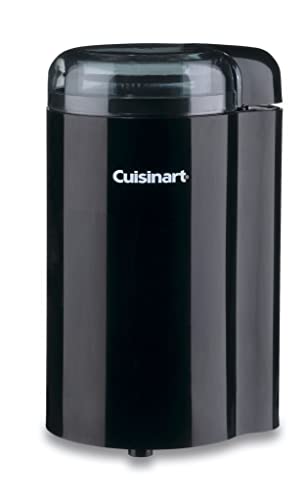
TL;DR: The Cuisinart DCG-20BKN offers a sturdy stainless‑steel blade grinder at $24.95, with a compact 4.25 × 3.5 × 7 in footprint, 2.5 oz capacity, and 130 W motor, ideal for casual home use.
The standout spec is its 130 W heavy‑duty motor paired with a stainless‑steel bowl and blades, delivering reliable grinding for small batches of beans, spices, or herbs. Its hopper holds up to 2.5 oz (70 g), enough for roughly a dozen cups of drip coffee, and the unit weighs 1.57 lb, making it easy to move around the kitchen.
Compared with the other ten grinders, the Cuisinart weighs a bit more than the Black+decker One Touch (1.43 lb) but heavier than the Secura model, which weighs only 0.16 lb. Its 130 W motor is less powerful than Bodum’s 480 W motor and Krups’s 200 W unit, placing it in the lower‑power tier of the group. However, its price point matches the budget range of the Bodum Bistro and Black+decker, while offering a solid stainless‑steel construction that some competitors only list as plastic or mixed materials.
Users consistently praise the grinder’s compact footprint—4.25 in depth, 3.5 in width, and 7 in height—so it fits comfortably on small countertops. Reviewers highlight the safety interlock and BPA‑free build as reassuring features for families. On the downside, reviewers note the blade‑based mechanism can yield uneven grind size and the lack of adjustable settings limits precision for espresso enthusiasts.
Pros
Cons
Best for: Budget‑conscious buyers seeking a reliable entry‑level option
Avoid if: You need advanced features or professional‑grade performance
TL;DR: The Hamilton Beach Electric Coffee Grinder offers a 10 oz stainless‑steel bowl, five adjustable grind settings and an automatic shutoff, but its blade‑type grinding can be uneven and it sits at a premium $43.95 price point.
What really sets this grinder apart is the combination of a removable stainless‑steel grinding bowl that’s dishwasher‑safe and five distinct grind settings that you can adjust on the fly. The hidden cord compartment keeps the countertop tidy, while the automatic shutoff adds a safety layer you won’t find on every budget blade grinder. At 4.7 in deep, 8.0 in high and 4.5 in wide, it still offers a 10 oz (about 4‑14 cups) capacity.
Compared with the other ten models in the roundup, the Hamilton Beach unit is heavier than the Krups (1.08 lb) and the Cosori (1.65 lb), but a touch lighter than the SHARDOR (2.29 lb). Its 10 oz bowl dwarfs the 3 oz capacity of the Krups and the 2.5 oz cup of the SHARDOR, giving you more room for beans or spices. In terms of footprint, it’s deeper than the KitchenAid’s 4.2 in depth and taller than the KitchenAid’s 8.7 in height, yet still more compact than the SHARDOR’s 20 in height. Weight‑wise it sits just above the KitchenAid’s 2.30 lb and the Hamilton Beach Custom Grind’s 2.00 lb, making it a solid‑feeling countertop companion.
Reviewers consistently praise the ease of cleaning the stainless‑steel bowl and the convenience of the hidden cord storage. Professional reviewers note the automatic shutoff as a welcome safety feature. The downside that keeps popping up is the typical blade‑grinder inconsistency – users report uneven particle size that can affect brew quality, especially for espresso lovers. The $43.95 price tag also nudges it into the premium tier, which some casual users find steep for a blade‑type grinder.
Pros
Cons
Best for: Buyers willing to invest in a proven, high‑quality option
Avoid if: You're on a tight budget or only need basic functionality
Breakdown
Hamilton Beach Fresh Grind
Pros
Cosori Espresso Grinder
Pros
Cons
Black+decker One Touch
Pros
Cons
Bodum Bistro
Pros
Cons
Based on scoring data and product specs
Personalized picks
Best Overall Pick
Hamilton Beach Fresh Grind
Best OverallBest for: Budget-conscious buyers seeking a reliable entry-level option
Cosori Espresso Grinder
Best for: Most users looking for a well-reviewed, reliable mainstream option
$29.99+$8.04 vs winner
Skip Hamilton Beach Electric Coffee Grinder if…
You're on a tight budget or only need basic functionality
Hamilton Beach Fresh Grind takes the top spot with a rock‑bottom $19.95 price, a 4.5‑star rating from 62,939 reviewers, and a 9 tbsp (12‑cup) capacity that fits most home brewing needs. Its 125 W motor and stainless‑steel blade keep grinding fast while the removable dishwasher‑safe bowl makes cleanup a breeze.
The runner‑up, Cosori Espresso Grinder, shines if you need espresso‑ready grounds on demand. A single stainless‑steel blade delivers a fine grind in about 15 seconds, and the built‑in safety lock plus 200 °F overheat protection give you confidence during those quick, repeatable bursts.
For shoppers looking beyond the winner, the Fresh Grind itself serves as the best budget‑friendly alternative, so we skip that tier. The mid‑range pick is the Cosori Espresso Grinder, which offers speedy grind times and safety features. The premium option is the KitchenAid BCG111ER Blade Coffee Grinder, which carries the KitchenAid brand cache and a higher‑priced, premium‑feel build.
Pick the Hamilton Beach Fresh Grind today and start grinding great coffee without breaking the bank.
The Hamilton Beach Fresh Grind measures 95 mm deep, 181 mm high and 90 mm wide, giving it the most compact footprint among the listed models. Larger units like the SHARDOR (508 mm high) would quickly dominate limited counter space.
No reviews yet — be the first to share your experience.
Please sign in to leave a review
Also considered
$29.99
