⚡ Quick Answer
At just $79.98, the Bosch ROS10 packs a 5‑in pad, a fixed 12,000 RPM no‑load speed and a low‑vibration design that feels more like a professional tool than a budget‑price sander. Its canister dust collection and built‑in pad brake help keep the work area clean and the finish swirl‑free, while the 1.59 kg weight keeps it comfortable for extended sanding sessions. With a 4.4‑star rating from 1,379 reviewers, it offers a solid mix of power and ergonomics without breaking the bank.
Our roundup compares eight random orbital sanders across three price tiers. The budget tier includes the ROS10, the cordless GEX12V‑5N and the ROS20VSK, each offering 5‑in pads and either fixed or variable speed control. Mid‑range options are the cordless GEX18V‑5N with a variable 10,000 RPM range and bag/vacuum dust collection, and the larger‑pad GEX33‑6N. Premium contenders feature the high‑amperage GET65‑5N, the 3‑in GEX12V‑77N with an 8,000 RPM brushless motor, and the 4‑in GEX12V‑32N for precision spot work.
Next, we’ll break down how each model’s specs, weight and user feedback stack up, so you can see which sander aligns best with your projects.
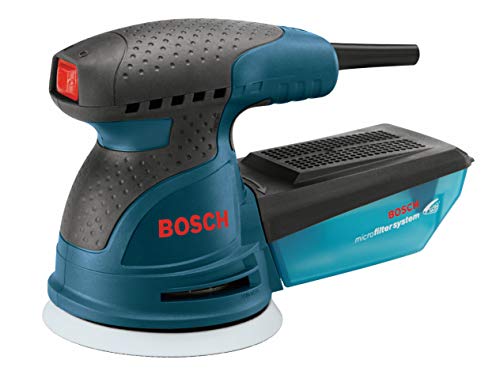
Bosch ROS10
Its 5‑inch pad delivers ample sanding area, making it a solid value for budget‑focused projects.

Bosch GEX18V-5N
Ideal for DIYers who want cordless freedom, it costs about $60 more than the ROS10, offering extra mobility without sacrificing the familiar 5‑inch pad.

Bosch GET65-5N
Its taller 5.5‑inch profile lets you tackle larger surfaces, a step up from the 4.3‑inch GEX18V-5N and the compact ROS10.
Also considered
TL;DR: At $79.98, the Bosch ROS10 delivers a 5‑inch pad, 12,000 OPM orbit and low‑vibration comfort, making it a solid budget sander for fast, swirl‑free sanding.
The standout spec is its fixed 12,000 OPM orbit speed paired with a 5‑inch sanding pad, giving you rapid material removal without sacrificing finish quality. The tool’s 2.5 A motor runs on 120 V and the built‑in pad dampening brake helps keep swirl marks to a minimum, while the low‑vibration rating adds comfort during longer sessions.
In the context of the eight‑product roundup, the ROS10 lands in the middle of the weight spectrum—heavier than the ultra‑light cordless GEX12V‑5N but lighter than the bulkier GET65‑5N. Its 5‑inch pad matches most competitors, and the 2.5 mm orbit diameter is on par with the larger models, giving it comparable finish capability without the premium price tag.
Users consistently praise the smooth, swirl‑free results and the effectiveness of the built‑in microfilter dust canister, especially when paired with a shop vacuum. Professional reviewers highlight the high‑speed orbit and the integral dampening system as key reasons for its “first‑class” stock removal. The main criticism is the single‑speed operation, which some find limiting for delicate, low‑speed sanding tasks.
Additional technical details include a 1.2 mm eccentric offset, a 2.44 m cord for ample reach, and a soft‑grip top that reduces hand fatigue. The hook‑and‑loop disc attachment and eight‑hole disc design make disc changes quick, and the included vacuum adapter expands dust‑extraction options.
Pros
Cons
Best for: Budget‑conscious buyers seeking a reliable entry‑level option — the Bosch ROS10 offers Pad Size: 5 inch
Avoid if: You need precise low‑speed control or a highly portable cordless solution
TL;DR: The Bosch ROS20VSK delivers a 5‑inch pad, variable 7,500‑12,000 OPM speed and solid dust collection for $109.99, making it a strong, ergonomically‑designed choice for DIY sanding projects.
The standout spec is the 7,500‑12,000 OPM speed range paired with a 5‑inch pad, letting you dial in aggression from light finish work to aggressive stock removal. A built‑in microfilter canister plus a vacuum adapter keep dust down, while the soft‑grip handle reduces fatigue during long sessions.
At 3.5 lb, the ROS20VSK is heavier than the 1.8‑lb GEX12V‑5N and the 2.4‑lb GEX18V‑5N, matches the 3.5‑lb ROS10, and is lighter than the 5.3‑lb GET65‑5N. Its 120 V corded power beats the 12 V and 18 V battery models in raw voltage, and its 7,500‑12,000 OPM range exceeds the 6,000‑10,000 OPM range of both GEX12V‑5N and GEX18V‑5N, while offering the same orbit diameter (2.5 mm) as the GEX18V‑5N.
Professional reviewers highlight the integral pad‑dampening system for virtually swirl‑free finishes and praise the low vibration feel of the soft‑grip handle. Everyday users echo this sentiment, noting the tool feels powerful yet comfortable, and they rarely report dust or vibration issues.
Technically, the 3/64‑inch (1.2 mm) eccentric offset and 3/64‑inch (1.25 mm) orbit radius work together to randomize the sanding path, reducing visible swirl marks. Variable speed control lets you match the tool to the material, and the 2.5 A motor provides enough torque for most woodworking tasks.
Pros
Cons
Best for: Budget-conscious buyers seeking a reliable entry-level option — the Bosch ROS20VSK offers Pad Size: 5 inches
Avoid if: You want the best value‑per‑dollar in its price range
TL;DR: The Bosch GET65-5N packs a 5‑inch pad, 3× turbo stock‑removal mode and solid 5.3 lb build for professional‑grade sanding, but its weight and cord limit long‑hand use.
What really sets the GET65‑5N apart is its dual‑mode system: a standard random‑orbit action plus a turbo direct‑drive mode that delivers “3X faster stock removal” than the regular setting. The 5‑inch soft‑microcellular hook‑and‑loop pad works with an orbit radius of 0.09 in, while the no‑load orbit speed spans 3300‑7800 OPM, giving you both aggressive material removal and fine finishing in one tool.
Compared with the other seven sanders in this roundup, the GET65‑5N sits toward the premium end. It’s heavier than the lightweight cordless models like the GEX12V‑5N (around 1.8 lb) and the GEX18V‑5N (about 2.4 lb), and it carries a higher price tag than the budget‑friendly ROS10. However, it offers more robust construction and a richer feature set than those lighter tools, aligning it more with the higher‑spec GEX33‑6N and the professional‑grade ROS20VSK.
Professional reviewers highlight the integral pad‑dampening system as a key factor in preventing swirl marks, and users repeatedly praise the turbo mode for shaving hours off stock‑removal tasks. On the flip side, the 5.3‑lb weight shows up in feedback about fatigue during extended overhead sanding, and the lack of an electric brake means the disc winds down more slowly after you flip the switch.
Additional technical details reinforce its pro‑oriented design: constant speed under load, dual‑bearing pad mount for vibration reduction, and a built‑in dust‑collection port with adapters for 35 mm, 1‑1/4 in and 1‑1/2 in hoses. The tool runs on 120 V at 6.5 A, and the variable speed control lets you dial in the perfect RPM within the 200‑480 RPM range for precise work.
Pros
Cons
Best for: Buyers willing to invest in a proven, high‑quality option — the Bosch GET65‑5N offers Pad Size: 5 inches and professional‑grade performance.
Avoid if: You need a lightweight, cordless sander for extended overhead work or prioritize instant disc stop for safety.
TL;DR: The Bosch GEX18V-5N delivers 18 V brushless power with a 5‑inch pad and a 6,000‑10,000 OPM speed range, offering professional‑grade material removal in a lightweight, ergonomic cordless sander.
What really sets this sander apart is its brushless 18 V motor paired with a variable speed range of 6,000‑10,000 OPM and a no‑load speed of 10,000 RPM. Combined with a 5‑inch backing pad, the tool can tackle both finish sanding and aggressive stock removal without the bulk of a corded unit.
Compared with the seven other Bosch sanders in this roundup, the GEX18V‑5N sits in the mid‑weight tier at 2.4 lb—heavier than the 1.8 lb GEX12V‑5N but lighter than the 5.3 lb GET65‑5N. Its 5‑inch pad matches the ROS20VSK and ROS10, while the orbit diameter of 2.5 mm mirrors the ROS20VSK’s figure. Speed‑wise, the GEX18V‑5N’s 6,000‑10,000 OPM range is a notch below the ROS20VSK’s 7,500‑12,000 OPM but identical to the GEX12V‑5N. Voltage‑wise, it outpaces the 12 V GEX12V‑5N and matches the 18 V ROS20VSK, giving it a clear power advantage over the lower‑voltage models.
Professional reviewers praise the brushless motor for “high material removal rates equivalent to corded sanders,” and users echo the ergonomic palm‑grip design, noting less tilting and reduced downward pressure during long sessions. The variable speed control lets you dial in the right aggressiveness for different woods, while built‑in vibration dampening keeps fatigue at bay. The only notable trade‑off is that the unit ships as a bare tool, so you’ll need to buy an 18 V battery and charger separately, and long‑term reliability data is still limited.
The sander also includes soft‑start technology for smooth kick‑off, an 8‑hole hook‑and‑loop backing pad for quick disc changes, and a dust‑bag/vacuum collection system that keeps the work area tidy. Its AMPShare™ battery compatibility means the same 18 V pack can power other Bosch tools, adding flexibility to a growing cordless ecosystem.
Pros
Cons
Best for: Professionals and contractors who need cordless convenience without sacrificing stock‑removal power—especially when a 5‑inch pad is required.
Avoid if: You have limited desk space or need the lightest possible sander for tight‑fit jobs.
TL;DR: The Bosch GEX12V-5N delivers a lightweight 12 V brushless motor, variable 6,000‑10,000 OPM speed and a 5‑inch 8‑hole pad, making it a precise, cordless option for detail sanding on a modest budget.
This sander’s most distinctive spec is its 12 V brushless motor paired with a variable speed range of 6,000‑10,000 OPM. At just 1.8 pounds, the tool feels light enough for overhead work, yet it still packs a 5‑inch, 8‑hole pad that accepts standard hook‑and‑loop discs. The ergonomic palm‑grip and soft‑start function help you control the tool when sanding tight corners or contoured surfaces.
Compared with the other seven models in this roundup, the GEX12V-5N is considerably lighter than the ROS20VSK and ROS10, both listed at 3.5 pounds. It is a bit heavier than the ultra‑light GEX12V‑32N, which weighs 1.1 pounds, but it offers a larger 5‑inch pad versus the 3‑inch pad on the GEX12V‑77N. Its speed range matches the GEX18V‑5N (6,000‑10,000 OPM) while remaining more compact than the GET65‑5N, which is a bulkier 5.5‑inch‑high unit.
Professional reviewers praise the brushless motor for maintaining consistent speed under load and note the integrated dust‑bag/vacuum system as a clean‑work‑site advantage. Users also highlight the palm‑grip design for improved maneuverability in cramped areas. The tool is sold as a bare unit, so you’ll need a compatible 12 V battery and charger separately, and it does not work with the VAC002 vacuum adapter.
Technical context: The orbit diameter measures 3/32 inch (2.5 mm) with a 3/64 inch (1.25 mm) radius, delivering the random‑orbit action that reduces swirl marks. The dust collection combines a built‑in bag and a vacuum hose interface, helping keep your workspace tidy.
Pros
Cons
Best for: Entry-level buyers or those on a tight budget — the Bosch GEX12V-5N offers Pad Size: 5 inches
Avoid if: You want the best value-per-dollar in its price range
TL;DR: The Bosch GEX33-6N delivers a 6‑inch sanding disc, variable 4,500–12,000 OPM speed and a 1/2‑micron microfilter, but its 5.2 lb weight makes it heftier than most rivals.
What really sets the GEX33-6N apart is its 6‑inch disc paired with a 4.0 mm orbit diameter and a variable speed range of 4,500 to 12,000 orbits per minute. The tool also sports a dual‑bearing pad mount and an integral pad‑dampening system that together curb vibration, while a 1/2‑micron microfilter captures fine dust for cleaner finishes.
Compared with the seven other sanders in this roundup, the GEX33‑6N is heavier at 5.2 lb, whereas most competitors sit between 1.8 lb and 3.5 lb. Its 6‑inch disc is larger than the 5‑inch pads found on the other models, and the 4.0 mm orbit is wider than the typical 2.5 mm found elsewhere. Speed-wise, it offers a broader variable range than the 6,000–10,000 OPM band of several peers, matching the high‑end 12,000 OPM ceiling of the ROS10 while still allowing lower speeds for delicate work.
Professional reviewers praise the multi‑hole backing pad for accepting virtually any brand of 6‑inch sandpaper, and users appreciate the microfilter’s ability to trap particles as small as 1/2 micron. The dual‑bearing mount and die‑cast aluminum housing are noted for reducing hand fatigue. On the downside, the 5.2 lb weight can feel cumbersome during overhead sanding, and the tool arrives without a dedicated carrying case, which some users miss.
Pros
Cons
Best for: Most users seeking a balanced, mainstream option — the Bosch GEX33-6N offers Amperage: 3.3 A
Avoid if: Reliability and user satisfaction are your top concerns
TL;DR: The Bosch GEX12V‑77N 3‑in. random orbital sander packs an 8,000 RPM brushless motor into a 1.3‑lb, 12 V cordless tool, delivering precise spot sanding with variable speed and dust‑extraction capability, albeit at a premium price.
This model’s standout spec is its 8,000 RPM brushless motor paired with a 2.5 mm orbit diameter, which translates to fast material removal on a compact 3‑in. sanding pad. The pad features an 8‑hole configuration for vacuum dust collection, and the tool offers variable speed control via a speed dial and trigger. Powered by a 12 V battery system, it also includes a lock‑on switch, timed auto shut‑off, and an on‑board battery status indicator.
Compared with the other seven sanders in the roundup, the GEX12V‑77N is a bit heavier than the 4‑in. Bosch GEX12V‑32N, which weighs 1.1 lb, but it is noticeably lighter than the 5‑in. Bosch ROS10 at 3.5 lb and the 1.8‑lb Bosch GEX12V‑5N. Its 3‑in. pad is smaller than the 5‑in. pads found on most peers, positioning it squarely for spot‑work rather than large‑area finishing.
Users consistently praise the sander’s compact shape, balanced center of gravity, and palm‑grip ergonomics, noting that it feels comfortable for one‑handed use in tight spaces. Professional reviewers highlight the high power‑to‑size ratio and the brushless motor’s efficiency, while also pointing out a runtime of roughly 10 minutes on a 2 Ah battery and slightly higher vibration than bulkier competitors. The rear rubber resting pad adds stability when the tool is set down between passes.
Pros
Cons
Best for: Those prioritizing quality and willing to pay for premium performance — the Bosch GEX12V‑77N 3 inch offers Pad Size: 3 inches
Avoid if: You're on a tight budget or only need basic functionality
“Great performance in a small footprint”
“Removed pencil marks in 2 minutes on one workbench half”
TL;DR: The Bosch GEX12V-32N is a 12 V brushless, 4‑inch cordless random orbital sander that packs an aggressive 5 mm orbit and 8,000 RPM into a lightweight 1.1 lb body, but its small pad and premium $469 price limit it to detail work.
What truly sets this sander apart is its 5 mm (0.2 in) orbit combined with a variable‑speed motor that can reach up to 8,000 RPM. That orbit is larger than the 2.5 mm orbits found on most of the other Bosch sanders in this roundup, giving it a higher material‑removal rate for tight‑spot sanding.
Compared with the seven peers, the GEX12V-32N is the lightest among the 12 V models that weigh 1.3 lb (GEX12V‑77N) or more, and dramatically lighter than the 5‑inch sanders that tip the scales at 1.8 lb, 2.4 lb, or even 5.3 lb. Its 32 mm (1.3 in) sanding pad is also the smallest, out‑sized by the 3‑inch pad on the GEX12V‑77N and the 5‑inch pads on the other models, which means it excels at detail work but isn’t suited for large‑area sanding.
Users consistently praise the tool’s smooth, low‑vibration operation and the ability to reach cramped automotive or furniture repairs. Professional reviewers highlight the brushless motor’s strong performance and the ergonomic balance that keeps fatigue at bay during extended use. The main complaints revolve around the limited runtime when paired with lower‑capacity batteries and the 32 mm pad, which restricts the sander to spot‑sand tasks rather than full‑sheet prep.
Additional technical notes: the GEX12V‑32N offers tool‑free pad swaps for both adhesive and hook‑and‑loop pads, supports wet and dry sanding, and features a variable‑speed trigger paired with an on‑board HMI for precise speed control. Bosch backs the unit with a three‑year limited warranty, underscoring its premium positioning.
Pros
Cons
Best for: Those prioritizing quality and willing to pay for premium performance — the Bosch GEX12V-32N 4 inch offers Weight: 1.1 lbs
Avoid if: You're on a tight budget, need a large‑area sander, or require extended runtime without swapping batteries
“Feels balanced with center of gravity at pad”
“Good runtime efficiency (~10.5 min on 2 Ah)”
Breakdown
Bosch ROS10
Pros
Cons
Bosch GEX18V-5N
Pros
Bosch GET65-5N
Pros
Cons

Bosch ROS20VSK
Pros
Cons
Based on scoring data and product specs
Personalized picks
Best Overall Pick
Bosch ROS10
Best Budget PickBest for: Budget-conscious buyers seeking a reliable entry-level option — the Bosch ROS10 offers Pad Size: 5 inch
Bosch GEX18V-5N
Best for: Most users looking for a well-reviewed, reliable mainstream option — the Bosch GEX18V-5N offers Pad Size: 5 inches
$159.00+$79.02 vs winner
Skip Bosch GEX12V-32N 4 inch if…
You're on a tight budget or only need basic functionality
We’re naming the Bosch ROS10 the clear winner of our random orbital sander roundup. It’s a corded 120 V tool that pulls 2.5 A, spins at a fixed 12 000 RPM and holds a 5‑inch pad. The built‑in canister dust collector and low‑vibration design keep your workspace clean and comfortable, all for a lightweight 1.59 kg package.
The runner‑up is the Bosch GEX18V‑5N, ideal if you need cordless freedom for on‑the‑go jobs. Its 18 V battery lets you work without a cord, the variable‑speed control adapts to different materials, and a soft‑start feature eases the tool into motion. At just 1.09 kg it’s easy to maneuver around tight spots.
Looking beyond the top two, you still have solid choices:
Pick the Bosch ROS10 today for professional‑grade sanding without breaking the bank.
The ROS10 uses a built‑in canister microfilter, while the GEX18V‑5N offers a bag or vacuum option. The canister keeps dust contained on the tool, whereas the cordless model lets you attach a vacuum hose or use a dust bag.
No reviews yet — be the first to share your experience.
Please sign in to leave a review


