⚡ Quick Answer
When you’re hunting for a benchtop belt and disc sander, the market can feel crowded. This roundup lines up 9 options across three price tiers: budget choices like the SI Fang Mini ($45.07) and Jellas 3×21 ($69.99), mid‑range models such as the WEN 6502T ($139.00) and Bucktool BD4603 ($143.98), and premium contenders including the KFMK 2×42 ($179.98) and SKIL BB9504 ($199.00). All of them carry solid user ratings, with the SKIL edging slightly higher at 4.7/5 from 208 reviews.
The WEN 6502T stands out with a 36‑inch belt capacity, a 6‑inch disc, and a cast‑iron base that adds 41 lb of stability. Its belt table tilts from 0° to 90°, and the motor runs at 1900 FPM belt speed and 3600 RPM disc speed, delivering the kind of power usually seen in pricier units. Even with a list price of $139.00, it matches or exceeds many premium features while staying firmly in the mid‑range bracket.
Next, we’ll break down how each model stacks up on performance, ergonomics, and value, so you can spot the tool that fits your workshop without guessing.
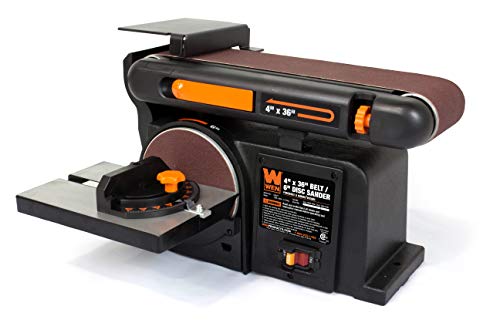
WEN 6502T 36-inch
Its 0° to 90° belt‑bed tilt lets you sand flat surfaces or angled edges, and the 6‑inch disc handles a range of tasks.
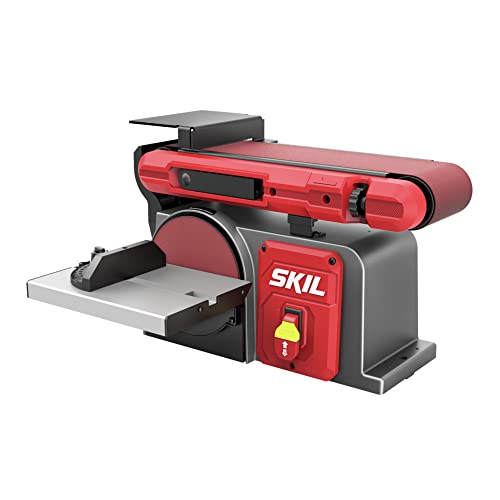
SKIL BB9504
If you need premium performance and are willing to spend more, the SKIL BB9504’s 4.5 A motor justifies its $199 price—about $60 above the Best Overall.
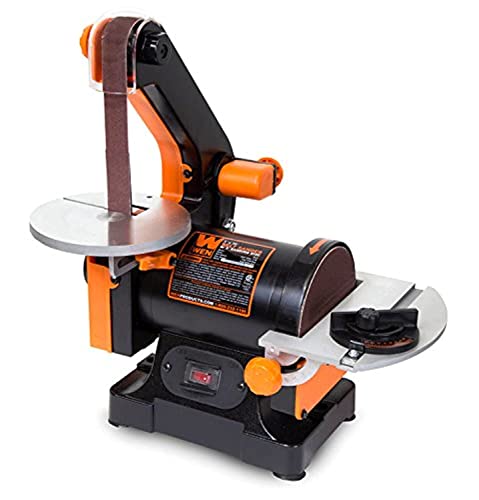
WEN 6515T 30-inch
The WEN 6515T’s 3160 FPM belt speed delivers faster material removal, while its 30‑inch size and $90.55 price keep it compact and affordable for entry‑level users.
Also considered
TL;DR: The WEN 6502T 36‑inch benchtop belt and disc sander packs a 1/2 HP motor, 0°‑90° belt tilt and a sturdy cast‑iron base for reliable hobby‑level sanding at a $139 price point.
The standout feature is its 0° to 90° tilting belt table paired with a 4 × 36‑inch belt, letting you tackle bevels without extra jigs. A 6‑inch disc adds versatility, while the 1/2 HP motor (120 V, 60 Hz, 4.3 A) delivers a consistent 1900 FPM belt speed and 3600 RPM disc speed. The cast‑iron base, listed as UL‑listed, helps keep vibration low during longer sanding sessions.
Compared with the eight other sanders in this roundup, the WEN is the heaviest at 41 lb, out‑weighing the Bucktool BD4603 (≈35.5 lb) and the KFMK 2×42 (≈34.3 lb). It also offers a larger belt than the Proxxon BS, whose 330 × 10 mm belt translates to a much narrower sanding width. While the KFMK advertises a faster 4480 FPM belt speed, the WEN’s 1900 FPM is still ample for most DIY projects, and its non‑variable speed simplifies operation. Its 2.25‑inch dust port is a single port, whereas some competitors list larger or multiple ports, so dust extraction may require an external hose.
Professional reviewers praise the solid cast‑iron construction for minimizing chatter and the quick‑release tension lever for faster belt swaps. Users echo this, noting the machine feels stable on a workbench and the 0‑90° tilt expands its usefulness. However, several owners mention that changing the belt still involves loosening three Phillips‑head bolts and an Allen‑wrench bolt, which can be fiddly. Belt tracking adjustments are also described as a common hiccup, and the 12.5‑inch table height limits the size of workpieces you can sand without removing the belt.
Pros
Cons
Best for: Hobbyists and DIY woodworkers who want a well‑reviewed, versatile benchtop sander with a tilting 36‑inch belt and solid build quality at a budget‑friendly price.
Avoid if: You need industrial‑grade power, advanced dust‑collection systems, or a lightweight unit for frequent transport.
TL;DR: The WEN 6515T 30‑inch benchtop sander delivers a fast 3160 FPM belt speed and 5‑inch disc in a compact, cast‑aluminum package for under $100, making it a solid entry‑level choice for hobbyists.
What really sets this unit apart is its 1 × 30‑inch belt combined with a belt speed of 3160 FPM and a 5‑inch disc that spins at 3450 RPM. The belt tilt sits at a fixed 0°, while the table can tilt from 0‑45°, giving you enough angle for most edge‑sanding tasks without the complexity of variable speed controls. The base is cast aluminum, and the whole machine weighs 16 lbs, making it sturdy enough for steady work yet easy to move.
Compared with the other eight sanders in this roundup, the 6515T lands in the middle of the weight range—heavier than the Jellas 3x21 (9.7 lb) and the SI Fang Mini (4.27 lb), but far lighter than the WEN 6502T (41 lb) and the Bucktool BD4603 (≈35.5 lb). Its belt speed of 3160 FPM outpaces the WEN 6502T’s 1900 FPM, though it doesn’t reach the KFMK’s 4480 FPM. The table tilt range is narrower than the 0‑90° offered by both the WEN 6502T and the Bucktool, and the overall footprint (14 × 11.5 × 15.5 in) is more compact than the longer 22‑inch length of the WEN 6502T.
Users consistently praise the quick material removal enabled by the high belt speed and the convenience of the included miter gauge, 80‑grit disc, and starter belts. Reviewers also note that the dual dust ports—1.7 in outer/1.5 in inner for the belt and 2.25 in outer/2 in inner for the disc—work well with shop vacs, keeping the workspace cleaner. On the downside, several owners mention that the plastic belt housing flexes under heavy pressure and that belt tracking can require frequent tweaks. Professional reviewers echo the lack of variable speed as a limitation for fine‑tuning delicate work.
Pros
Cons
Best for: Budget‑conscious buyers seeking a reliable entry‑level option — the WEN 6515T 30‑inch offers Belt Speed: 3160 FPM.
Avoid if: You want the best value‑per‑dollar in its price range.
“Super easy to set up and belt changes are a breeze”
“Great for small projects like knife making or trim—removes material fast without bogging down”
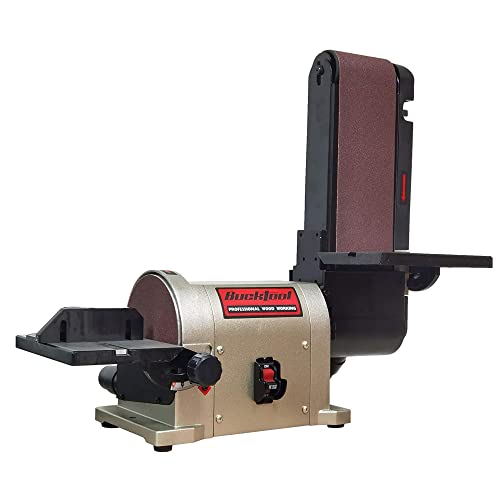
TL;DR: The Bucktool BD4603 offers a 3/4 HP direct‑drive motor, 25 % efficiency gain, and a 4 × 36‑inch belt on a sturdy cast‑aluminum frame for under $150.
The standout spec is its 3/4 HP fully enclosed induction motor, which the manufacturer says delivers a 25 % efficiency increase over traditional belt sanders. Paired with a belt speed of 2161 FPM and a disc speed of 3450 RPM, the unit provides solid power for most hobby‑level woodworking tasks. Its 4 × 36‑inch belt and 6‑inch disc give you the flexibility to tackle both belt‑and‑disc jobs without swapping tools.
At 35.5 lb, the Bucktool sits a bit heavier than the KFMK 2x42’s 34.25 lb frame but lighter than the WEN 6502T’s 41 lb bench sander. Its belt speed of 2161 FPM is quicker than the WEN 6502T’s 1900 FPM yet slower than the KFMK’s 4480 FPM, placing it solidly in the mid‑range performance band. The 6‑inch disc matches the disc size of the WEN 6502T and SKIL BB9504, though it’s smaller than the 8‑inch discs some heavier‑duty models offer.
User feedback highlights an easy setup, strong motor performance, and good overall value. Reviewers frequently mention the quick‑release belt mechanism and the adjustable 0°‑90° belt table tilt as practical time‑savers. Professional reviewers note the silent, direct‑drive design and the CSA certification as signs of reliable, shop‑grade safety. On the downside, the 6‑inch disc can feel limiting on large flat surfaces, and a few owners point out a basic build quality compared with industrial‑grade competitors. The separate dust ports sometimes require adapters to fit standard shop vacuums.
Pros
Cons
Best for: Most users looking for a well‑reviewed, reliable mainstream option — the Bucktool BD4603 offers Belt Speed: 2161 FPM.
Avoid if: You need advanced features or professional‑grade performance, especially a larger disc for big flat surfaces.
TL;DR: The Jellas 3×21 Belt Sander packs a 7 Amp motor, 400 rpm variable speed and 10‑foot cord into a 9.7‑lb, $69.99 tool that converts from handheld to bench, earning a solid 4.4‑star rating from 832 users.
This belt sander’s standout spec is its 7 Amp motor paired with a maximum speed of 400 rpm and a belt speed of 13 feet per second, giving you plenty of power for stock‑removal tasks while staying in a compact 6.3‑inch height and 5.9‑inch length package. The variable‑speed knob offers six positions, so you can dial in the right speed for anything from rough sanding to fine finishing.
At 9.7 pounds, the Jellas is lighter than the 16‑pound WEN 6515T 30‑inch model and far lighter than the heavyweight 41‑pound WEN 6502T 36‑inch bench sander, making it easier to move around a small workshop. It’s also heavier than the ultra‑light 4.27‑pound SI Fang Mini, but that trade‑off brings a larger 3 × 21‑inch belt and a more robust motor. Compared with the other eight sanders in this roundup, it lands in the budget tier while still offering a full‑size belt and bench‑conversion capability.
Users consistently praise the quick setup thanks to the included metal C‑clamps, the variety of grit belts (two each of 40, 60, 80, 120 and 180) and the effective dust‑bag plus 2‑in‑1 vacuum adapter. The ergonomic two‑handed grip and lock‑on trigger make prolonged sanding comfortable. Some reviewers note that belt tension can require a bit of tweaking after the first few uses, and the manufacturer doesn’t list detailed portability dimensions beyond height, length and width.
Additional technical touches include a directional‑arrow belt‑tracking guide, a 6‑dial speed control knob, and a 10‑foot power cord that keeps the tool reachable from most workstations. The dust‑collection system works with either the built‑in bag or a standard vacuum using 32 mm or 35 mm adapters, helping keep your workspace cleaner.
Pros
Cons
Best for: Budget-conscious buyers seeking a reliable entry-level option — the Jellas 3x21 Belt Sander offers Motor Power: 7 Amp
Avoid if: You want the best value‑per‑dollar in its price range
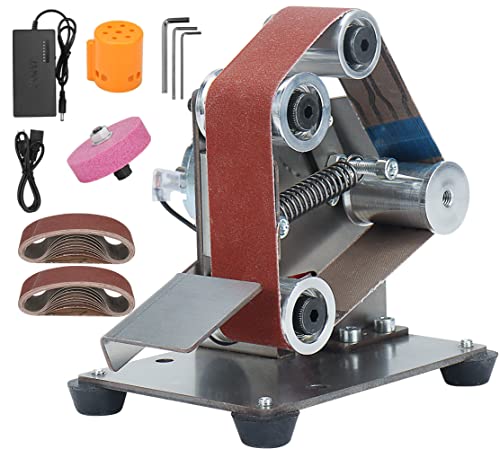
TL;DR: The SI Fang Mini Belt Sander packs a 96 W 7‑speed motor, 20 assorted sanding belts, and a stainless‑steel body into a 4.27‑lb, compact unit, making it a budget‑friendly option for hobbyist projects.
At the heart of this tool is a 96 W 775 brushed motor with a 7‑speed adjustable control, letting you dial in the exact sanding speed you need. The motor runs forward and reverse, and its no‑load speed ranges from 4000 to 9000 RPM. A stainless‑steel 304 housing keeps the unit resistant to rust and wear, while the compact dimensions—130 mm (5.12 in) high, 120 mm (4.72 in) long, and 100 mm (3.94 in) wide—keep it easy to store on a small workbench.
Compared with the other eight bench sanders in this roundup, the SI Fang is dramatically lighter. It weighs 4.27 lb, whereas the Jellas 3x21 model tips the scales at about 9.7 lb and the WEN 6502T 36‑inch bench sander weighs a hefty 41 lb. Its height of roughly 5.1 in also makes it shorter than the Jellas’s 6.3 in and far shorter than the 12.5 in profile of the WEN 6502T. Those size and weight advantages translate into a tool you can move around more easily, though you’ll sacrifice the massive belt capacity and industrial‑grade power of the larger units.
Reviewers consistently praise the 7‑speed speed control and the forward/reverse rotation for giving precise handling on delicate projects. The inclusion of 20 sanding belts covering grits from 120 to 1000, three wrenches, a dust‑proof cover, and a grinding wheel adds real value right out of the box. On the downside, several users note that the 96 W motor can feel under‑powered when tackling tougher hardwoods or larger metal pieces, and the 80 dB noise level is noticeable in a quiet workshop. The compact chassis also limits the size of workpieces you can comfortably sand.
Pros
Cons
Best for: Shoppers on a tight budget who want the most for their money — the SI Fang Mini Belt Sander offers Sanding Belts Included: 20 pcs (Grits: 120, 320, 600, 800, 1000)
Avoid if: You have limited desk space or need portability
TL;DR: The SKIL BB9504 offers a 4 × 36‑in belt, 6‑in disc, 0‑90° belt angle and a 3,600 RPM induction motor in a solid 28‑lb benchtop unit, earning a 4.7‑star rating.
The standout spec is the 0‑90° belt‑angle adjustment paired with a 4 × 36‑in belt and a 6‑in disc, letting you tackle both flat sanding and angled work without extra accessories. An induction motor rated at 4.5 Amps delivers a steady 3,600 RPM no‑load speed, while the tool‑free quick‑release lever makes belt swaps a matter of seconds. The unit also includes an 80‑grit belt, an 80‑grit disc, and a miter gauge right out of the box.
Compared with the eight other sanders in this roundup, the SKIL sits toward the heavier end: it weighs 28 lb, which is considerably more than the Ryobi BD4601G’s listed 0.000625 lb and far heavier than the Proxxon’s 3.94 lb or Jellas’s 9.7 lb. At the same time, it’s lighter than the WEN 6502T’s 41 lb, giving it a balanced footprint for a home workshop. Belt size matches the Ryobi’s 4 × 36‑in offering, while the 6‑in disc mirrors the disc diameters on Ryobi, Bucktool, and WEN models. Its dust‑port diameter of 2‑1/2 in is essentially the same as WEN’s 2.25‑in port, providing comparable dust‑extraction capability.
Users consistently highlight the quick, tool‑free belt changes and the machine’s stability on a bench, noting that the 28‑lb mass keeps the sander from wobbling during use. Professional reviewers praise the induction motor for running cool and maintaining a constant 3,600 RPM, which translates to reliable material removal on small projects. The most common complaints revolve around the fixed‑speed design, which limits fine‑finish work, and occasional belt‑tracking drift after prolonged sanding—issues that typically require a manual adjustment. A few owners mention that the dust cover can be finicky and doesn’t stay securely in place.
Beyond the core specs, the SKIL’s 0‑45° disc‑table tilt adds another layer of flexibility for angled sanding tasks, and the 2‑1/2 in dust port makes it easy to attach a shop vac. The inclusion of a miter gauge further expands its utility for precise cuts, while the 120 V corded power source ensures you won’t run out of juice mid‑project.
Pros
Cons
Best for: Those prioritizing quality and willing to pay for premium performance — the SKIL BB9504 offers Motor Power: 4.5 Amps
Avoid if: You're on a tight budget or only need basic functionality; the fixed speed and heavier build make it less suited for light‑duty or portable use.
“Super easy to set up and use—belt change takes seconds”
“Great for small projects like trimming dowels or smoothing edges”
TL;DR: The KFMK 2x42 Belt Sander packs a 1/2 HP motor and a 4,480 FPM belt speed into a sturdy bench‑top unit, but its fixed speeds and 39.9 lb gross weight limit portability.
The KFBD6242’s standout spec is its 1/2 HP induction motor that pushes a 2‑by‑42 belt at 4,480 FPM, while the no‑load speed reads 3,450 RPM. This high‑speed belt lets you remove material quickly, and the quick‑release tension and tracking systems make belt changes almost effortless.
At $179.98 it lands in the mid‑range of this nine‑product bench‑sander roundup, a shade pricier than the Ryobi BD4601G but less costly than the SKIL BB9504. Weighing 34.25 lb, it is heavier than the SKIL’s 25.57 lb frame and considerably heftier than the Jellas (9.70 lb) or SI Fang (4.27 lb) models, yet lighter than the WEN 6502T, which tips the scales at about 41 lb. Its belt speed of 4,480 FPM also outpaces the WEN 6502T’s 1,900 FPM, giving the KFMK an edge for aggressive sanding tasks.
Reviewers frequently commend the motor’s ability to tackle metalworking and knife‑making projects, echoing professional notes that the 1/2 HP motor “effectively handles aggressive sanding.” The quick‑release belt system and a belt‑angle range of 0‑90° are regularly highlighted as convenient features. On the downside, users note the fixed‑speed design limits finesse work, and the 39.9 lb gross weight can make relocating the unit a bit of a chore in tighter shop spaces.
The unit is CSA‑certified, runs on standard 120 V/60 Hz power, and employs a direct‑drive architecture that reduces vibration. It offers a generous work surface that comfortably fits the 2‑by‑42 belt, and a disc wheel that aligns with common sanding accessories, while the disc‑angle adjustment provides a 45° tilt for added versatility.
Pros
Cons
Best for: Those prioritizing quality and willing to pay for premium performance — the KFMK 2x42 Belt Sander offers Belt Speed: 4480 FPM
Avoid if: Reliability and user satisfaction are your top concerns
TL;DR: The Ryobi BD4601G packs a 4 × 36‑inch belt, 6‑inch disc and a heavy cast‑iron base into a 36‑inch‑long benchtop sander that scores 4.4 / 5 stars for stability and ease of belt changes.
What really sets this unit apart is its 36.0 in. overall length combined with a 4 in. × 36 in. sanding belt, giving you a generous working surface for larger panels. The belt arm swings from 0° to a full 90°, while the work table tilts from 0° to 45°, letting you tackle both horizontal and vertical sanding tasks without swapping tools. A tool‑free belt tension release and an integrated dust‑collection port add convenience to the heavy cast‑iron construction.
Compared with the other eight sanders in our roundup, the Ryobi is noticeably longer than the 22.0 in. WEN 6502T and the 18.5 in. SKIL BB9504, and its 22.2 in. width exceeds the 11.0 in. width of the WEN model. While the Jellas 3x21 sits at about 9.7 lb, the Ryobi’s cast‑iron base feels substantially heavier, a trait shared with the 41‑lb WEN 6502T. Its 120 V induction motor matches the voltage of most peers, but unlike the Proxxon BS, the Ryobi does not list a specific power rating.
Reviewers consistently praise the unit’s rock‑solid stability, noting that the heavy base “keeps it from vibrating” during extended sanding sessions. Users also highlight the quick, tool‑free belt changes as a major time‑saver. Professional reviewers echo these points, calling the belt‑changing process “streamlined.” The main criticism is that the full 90° belt angle is rarely needed for typical hobby projects, and the lack of disclosed RPM or horsepower figures makes it harder to compare raw power against higher‑end models.
Pros
Cons
Best for: Those prioritizing quality and willing to pay for premium performance — the Ryobi BD4601G offers Disc Size: 6 in.
Avoid if: You're on a tight budget or only need basic functionality
TL;DR: The Proxxon BS is a compact, 3.94‑lb belt sander with a 60° grinding arm, 100 W DC motor and infinitely variable speed, ideal for precision hobby work at a mid‑range price.
The standout feature is the 60° grinding arm adjustment paired with a die‑cast aluminum head, which gives the unit solid torque resistance while you tackle tight contours. Its overall dimensions—115 mm high, 350 mm long and 200 mm wide—make it easy to slip into cramped workstations, and the included 330 × 10 mm belt fits both 80 and 180 grit aluminum‑oxide or silicon‑carbide belts.
When you line it up against the other eight bench sanders, the Proxxon is dramatically lighter than the Bucktool BD4603 (which tips the scales at about 35.5 lb) and far lighter than the WEN 6502T’s 41 lb mass. It also undercuts the heft of the KFMK 2×42 (around 34 lb) and the SKIL BB9504 (about 28 lb). On the price side, it sits above the entry‑level Jellas and SI Fang models, which run under $70, but it’s still competitive with the higher‑priced Ryobi and Bucktool units that sit near $180.
Reviewers consistently praise the Proxxon for its feather‑light feel and the ease of maneuvering it in confined spaces. Professional reviewers note the die‑cast aluminum head as a “high stability” element that keeps torque steady during delicate sanding. On the flip side, users point out that the 100 W motor can feel modest when you need to strip thicker material, and the 10 mm belt width limits how quickly you can finish larger surfaces.
Technically, the sander delivers a belt speed range of 225‑450 m/min with an infinitely variable, full‑wave electronic control, letting you dial in the perfect speed for everything from fine finish work to moderate material removal. The DC special motor, running on 110‑120 V AC at 60 Hz, is purpose‑built for micromot precision tools, reinforcing its niche as a precision‑oriented bench sander.
Pros
Cons
Best for: Hobbyists and modelers who need precise sanding in tight spaces — the Proxxon BS offers a 60° grinding arm adjustment.
Avoid if: You need heavy‑duty material removal or broad surface finishing.
Breakdown
WEN 6502T 36-inch
Pros
SKIL BB9504
Pros
WEN 6515T 30-inch
Pros
Cons
Bucktool BD4603
Pros
Based on scoring data and product specs
Personalized picks
Best Overall Pick
WEN 6502T 36-inch
Best OverallBest for: Most users looking for a well-reviewed, reliable mainstream option — the WEN 6502T 36-inch offers Belt Speed: 1900 FPM
SKIL BB9504
Best for: Those prioritizing quality and willing to pay for premium performance — the SKIL BB9504 offers Motor Power: 4.5 Amps
$199.00+$60.00 vs winner
Skip Ryobi BD4601G if…
You're on a tight budget or only need basic functionality
We’re naming the WEN 6502T 36‑inch as the clear winner. Its 4 × 36‑inch belt gives you a generous sanding surface, while the 1/2 HP motor delivers a steady 1 900 FPM belt speed and 3 600 RPM disc speed. The cast‑iron base and UL listing add confidence in durability, and the unit ships with an 80‑grit belt and a miter gauge. With a 4.6‑star rating from 5 381 reviewers, it balances power, build quality, and price at $139.00.
The SKIL BB9504 earns the runner‑up spot, especially if you value quick, tool‑free belt changes and a compact footprint. Its 0‑90° belt angle adjustment and 0‑45° disc table tilt let you tackle a variety of angles, and at 25.57 lb it’s lighter than many larger sanders. A 4.7‑star rating from 208 reviews backs its performance, and the included 80‑grit belt and disc round out the package for $199.00.
For tighter budgets, the SI Fang Mini Belt Sander stands out at $45.07 as the most affordable option. If you need a solid mid‑range choice, the Bucktool BD4603 offers reliable performance at $143.98. And for those willing to stretch a bit further, the KFMK 2×42 Belt Sander provides premium features for $179.98.
Pick the WEN 6502T 36‑inch and get a powerful, well‑built bench sander without paying a premium.
The WEN 6502T is priced at $139.00 versus $199.00 for the SKIL BB9504, giving a $60.00 savings. It also includes a quick‑tension release lever, a cast‑iron base, an 80‑grit belt and a miter gauge, while offering the same 4 × 36 in belt and 6 in disc sizes. Those extra accessories and the lower price give it a clear value edge.
No reviews yet — be the first to share your experience.
Please sign in to leave a review