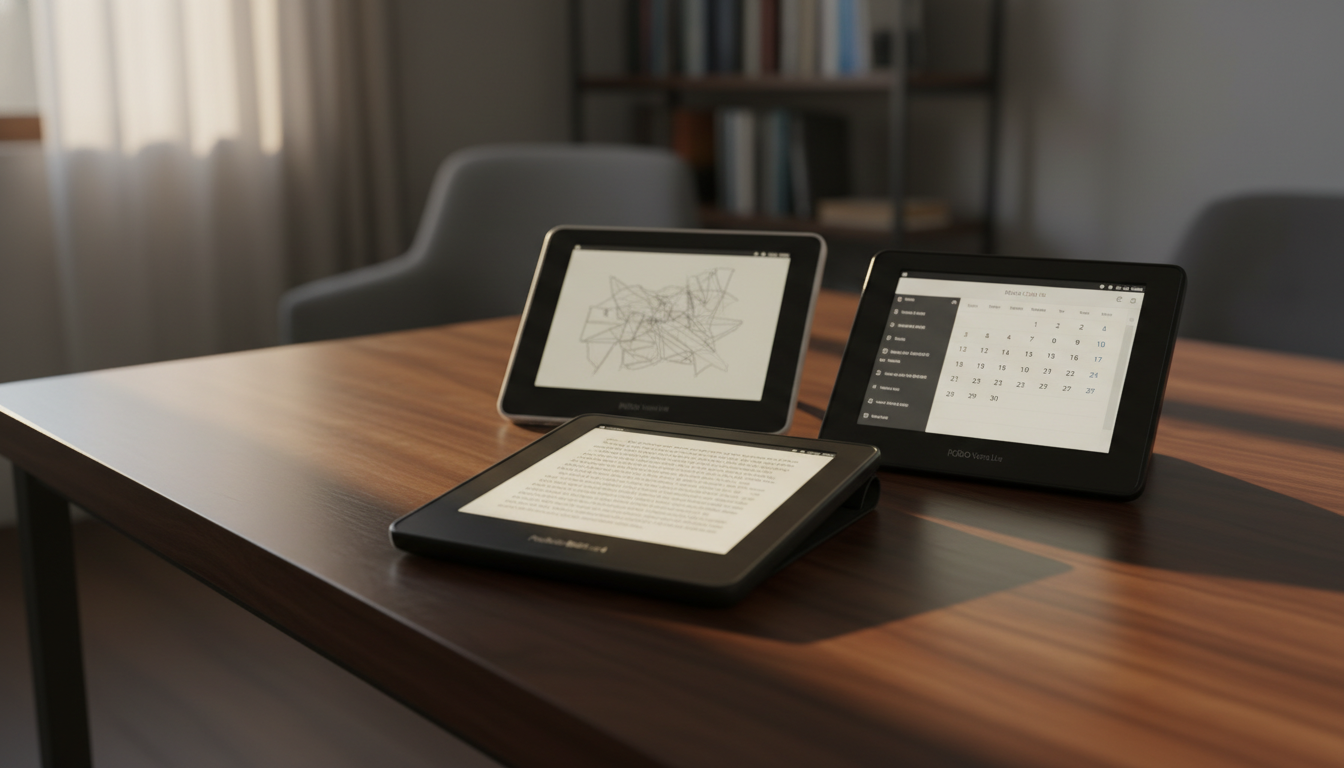
A sub‑$90 model matching the screen dimensions of premium contenders like the Bigme B6 Color ($184.97, 5.0‑star rating) reminds us that price isn’t the only driver of core specs. While its 2.4‑star rating from two reviews isn’t stellar, the Gowenic E‑Reader at $85.38 still carries a full‑size 6‑inch display, a size you normally see on devices that cost $150 or more.
We grouped the nine options into three tiers. The budget bucket (Gowenic, Ashata Paperwhite, PocketBook Basic Lux 4) keeps prices under $130 and offers lightweight builds and basic front‑lighting. Mid‑range picks (Musnap Neo C, PocketBook Verse Lite, Y‑BEN) add features such as color e‑ink or larger RAM at a modest price jump. Premium models (Kobo Clara BW, Kobo Clara Colour, Bigme B6 Color) push the envelope with higher pixel densities, Bluetooth audio, and extended battery life. With all these choices on the table, we’ll explore the details to see which device aligns best with your reading habits.
PocketBook Basic Lux 4
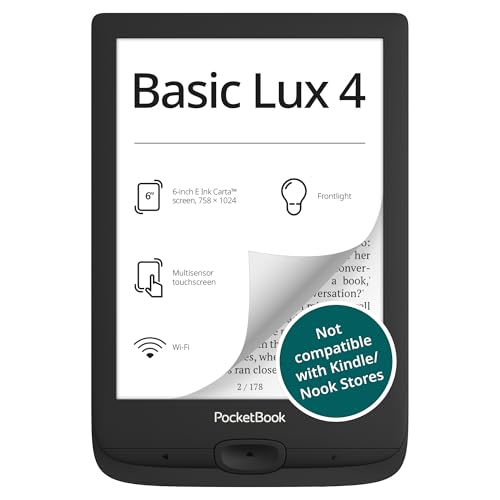
Its 212 PPI display delivers crisp text and provides the best visual clarity in this price range.

PocketBook Verse Lite
Ideal for readers who want a slightly larger screen without breaking the bank, it sits just $6 above the Basic Lux 4.

Kobo Clara BW
At just 9.2 mm thick, the Clara BW is slimmer than the PocketBooks, offering a sleek feel for on‑the‑go reading.
Also considered
Score Analysis
Key score advantages vs. runner-up (PocketBook Verse Lite)
Price Range
PocketBook Basic Lux 4
$119.00
PocketBook Verse Lite
$125.00
Kobo Clara BW
$139.99

Musnap Neo C
$199.00

Bigme B6 Color
$184.97
Kobo Clara Colour
$159.99

Ashata Paperwhite
$104.53

Gowenic E-Reader
$85.38

Y-BEN E-Reader
$129.90
Spec Comparison
TL;DR: The PocketBook Basic Lux 4 offers a 6‑inch E Ink Carta screen, 212 PPI clarity, and a month‑long battery at a $119 price, making it a solid ultra‑light budget e‑reader.
The standout feature is its 6 in E Ink Carta display delivering 212 PPI sharpness, paired with a fixed‑brightness frontlight for reading in low light. Weighing just 155 g and housing a 1300 mAh battery, the device promises up to a month of active reading on a single charge.
When you line it up against the other eight readers, the Basic Lux 4 is a touch heavier than the Musnap Neo C (145 g) but far lighter than the PocketBook Verse Lite (328 g). Its 1300 mAh battery is smaller than the Neo C’s 1800 mAh and Ashata Paperwhite’s 2300 mAh cells, yet still ample for a month‑long reading stint. The 6‑inch screen matches most peers, though the Ashata Paperwhite stretches to 7 in, offering a larger viewing area.
Readers consistently applaud the feather‑light build and the 1300 mAh battery, noting that the device feels “super‑lightweight and compact” for travel. Professional reviewers highlight the “razor‑sharp text and fonts” thanks to the recessed screen design, while also pointing out a minor screen flicker when adjusting the fixed frontlight and some ghosting in dark mode. The Linux‑based OS, dual‑core 1 GHz processor, 512 MB RAM, and support for 25 file formats (plus microSD expansion up to 32 GB) round out a capable, budget‑focused package.
Pros
Cons
Best for: Entry-level buyers or those on a tight budget
Avoid if: You need adjustable warm light, a color display, or high‑performance specs for heavy multitasking
TL;DR: The PocketBook Verse Lite offers a 6‑inch E‑Ink Carta touchscreen, 212 ppi, 8 GB storage and a battery that can last up to two months, all for $125.
The Verse Lite’s standout spec is its 6‑inch E Ink Carta touchscreen with a 212 ppi pixel density and a SmartLight that provides adjustable cold front‑lighting. Under the hood you’ll get a dual‑core 1 GHz processor, 512 MB RAM and 8 GB of internal storage, while the 1000 mAh battery lasts up to two months of reading. At 328 g (0.72 lb) the device feels light enough for a bag‑sized reader.
Compared with the other eight e‑readers in this budget roundup, the Verse Lite is heavier than the Musnap Neo C (145 g), Y‑BEN E‑Reader (100 g), PocketBook Basic Lux 4 (155 g) and Kobo Clara BW (174 g), but lighter than Gowenic E‑Reader (461 g). Its 1000 mAh battery capacity has a lower capacity than most rivals—Musnap Neo C (1800 mAh), PocketBook Basic Lux 4 (1300 mAh), Kobo Clara BW (1500 mAh), Ashata Paperwhite (2300 mAh) and Bigme B6 Colour (2100 mAh)—yet the manufacturer claims up to two months of use. The 6‑inch screen size matches the majority of the lineup, while the 512 MB RAM sits between the low‑end 512 MB devices and the higher‑end 4 GB models like Musnap Neo C and Ashata Paperwhite.
Readers consistently praise the Verse Lite’s portability and its month‑long battery life, noting that the 8 GB internal storage comfortably holds a modest library. Professional reviewers highlight the broad 25+ format support and the SmartLight’s adjustable brightness as eye‑friendly features. On the downside, users miss a warm‑light option for low‑light reading, and the lack of a microSD slot means storage can’t be expanded. The 212 ppi display also appears dated compared with the 300 ppi screens found on several competitors, and the device doesn’t offer waterproofing or Bluetooth connectivity.
Pros
Cons
Best for: Budget‑conscious beginners, casual readers and frequent travelers who want a pocket‑sized e‑reader with long battery life.
Avoid if: You need a high‑resolution 300 ppi display, warm‑light front‑lighting, waterproofing, Bluetooth audio or expandable storage.
TL;DR: The Kobo Clara BW packs a crisp 6‑inch 300 PPI E Ink Carta 1300 HD screen, waterproof body and 1500 mAh battery into a lightweight 174 g package for under $200.
This model’s standout spec is the 6‑inch glare‑free E Ink Carta 1300 display with a 1448 × 1072 resolution and 300 PPI density, plus ComfortLight PRO that reduces blue light. At 9.2 mm thick and weighing just 174 g (about 0.38 lb), it feels comfortable for one‑handed reading and fits easily in a pocket.
Compared with the eight other readers in the roundup, the Clara BW is heavier than the ultra‑light Y‑BEN (0.22 lb) but lighter than PocketBook Verse Lite (0.72 lb). Its 1500 mAh battery outpaces Y‑BEN’s 350 mAh cell and PocketBook’s 1000 mAh, yet sits below Musnap Neo C’s 1800 mAh pack. Internal storage of 16 GB also tops the 4 GB found in Y‑BEN, while the 512 MB RAM matches most competitors.
Reviewers consistently praise the device’s lightweight feel, waterproof IPX8 rating (up to 2 m for 60 minutes) and the smooth touchscreen navigation. Professional reviewers note the sharper contrast and 25 % faster page turns versus older models. Common complaints focus on the lack of tactile page‑turn buttons and a front‑light that isn’t as bright as some users expect, especially when the light is used heavily.
Pros
Cons
Best for: Buyers seeking a proven, high‑quality e‑ink reader with a sharp display, waterproof build and solid storage for a wide range of e‑books.
Avoid if: You need a color screen for comics or manga, or you require the lowest possible price point.
TL;DR: The Musnap Neo C packs a 6‑inch 4096‑color Kaleido 3 e‑ink screen, 4 GB RAM and 64 GB storage for $122, making it a vibrant yet slightly pricey choice for comic lovers.
The Neo C’s standout is its 6‑inch E Ink Kaleido 3 colour e‑paper, capable of showing 4096 colors at a resolution of 1072×1448 pixels. You can adjust the front‑light for brightness and colour temperature, and the recessed screen helps keep glare and dust down while you read.
At 145 g the device is lighter than most rivals, like the PocketBook Verse Lite (328 g) and Kobo Clara BW (174 g); only the Y‑BEN model (100 g) is lighter. Its 1800 mAh battery outpaces the Verse Lite’s 1000 mAh battery and the Basic Lux’s 1300 mAh, though Ashata and Bigme offer larger capacities. With 4 GB RAM it dwarfs the typical 512 MB in the PocketBook line‑up and the 1 GB in the Kobo Clara Colour, while the 64 GB internal storage eclipses Y‑BEN’s 4 GB, Gowenic’s 8 GB, and even the Basic Lux’s expandable 32 GB option.
Users love the vivid colour output for comics and manga, and they appreciate the smooth multitasking thanks to the quad‑core 2.0 GHz processor and generous RAM. Professional reviewers highlight the Kaleido 3 display as a standout feature, but they also note the 30 Hz refresh rate can feel sluggish when scrolling or using non‑reading apps. The premium price and the lack of waterproofing or a stylus frequently draw criticism.
Beyond the display, the Neo C runs Android 10 with full Google Play access, includes Bluetooth, Wi‑Fi 4 and a USB‑C port, and comes with a built‑in microphone and speaker for basic audio needs. The adjustable front‑light lets you tune colour temperature for day or night reading, and the device ships with a charging cable, user manual and warranty card.
Pros
Cons
Best for: Buyers in the mid price range seeking the best quality at that price point
Avoid if: You prefer products with extensive real‑world feedback and proven track records
“gotta be patient”
“Fast for ebooks/comics, portable, app versatility”
TL;DR: The Bigme B6 Color combines a 6‑inch Kaleido 3 color E Ink screen, Android 14 OS, 4 GB RAM and a 2100 mAh battery for versatile reading at $184.97.
The standout feature is its 6‑inch color E Ink (Kaleido 3) panel that offers 150 PPI in color and 300 PPI in black‑and‑white, backed by 36 adjustable front‑light levels and an octa‑core 2.2 GHz CPU. With 4 GB of RAM, 64 GB of internal storage (expandable to 1 TB) and Android 14, you get full access to the Google Play Store, AI‑driven voice translation, text‑to‑speech and a virtual button interface that keeps the screen uncluttered.
Compared with the other eight readers, the B6’s 2100 mAh battery capacity tops the Kobo Clara Colour and Clara BW (both 1500 mAh) and the Musnap Neo C (1800 mAh), while far exceeding the Y‑BEN’s 350 mAh pack. At 176 g, its weight sits alongside the Kobo models (174 g) and is lighter than the PocketBook Verse Lite (328 g) but heavier than the Y‑BEN (100 g). The 64 GB internal storage matches the Musnap Neo C and dwarfs the Kobo Clara’s 16 GB, and the 4 GB RAM equals the Musnap and Ashata Paperwhite, beating the Kobo’s 1 GB.
Reviewers have given it a perfect 5‑star rating across three reviews, applauding the Android ecosystem for installing any reading or productivity app and the AI translation that works on the fly. The virtual button layout also earns praise for maximizing usable screen space. The main criticisms focus on the 150 PPI color resolution, which looks softer than the 300 PPI B&W rendering, and the lack of waterproof protection and a 3.5 mm headphone jack.
Additional technical perks include an adjustable‑temperature frontlight with 36 brightness steps, built‑in speaker and microphone for media playback and voice commands, and dual‑band Wi‑Fi plus Bluetooth for easy connectivity.
Pros
Cons
Best for: Comic and manga fans who want a color E Ink display with Android flexibility.
Avoid if: You need waterproof protection or a headphone jack, and you’re on a tight budget — it’s priced at $184.97.
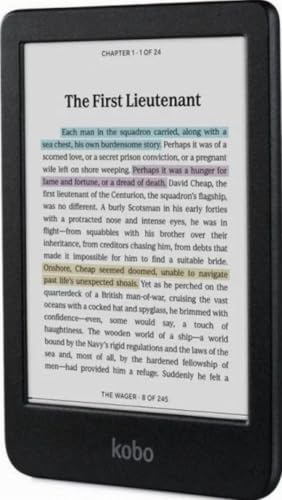
TL;DR: The Kobo Clara Colour packs a 6‑inch 4096‑colour E Ink Kaleido 3 screen, IPX8 waterproofing and a 42‑day battery life into a feather‑light 0.38‑lb body for $159.99.
The standout feature is its colour‑rich E Ink Kaleido 3 panel, delivering 4096 colours with 30 % higher saturation and a colour resolution of 150 PPI on a 6‑inch screen. Coupled with ComfortLight PRO and blue‑light reduction, the display stays readable in bright or dim settings. The device also has an IPX8 rating, meaning it can survive 60 minutes at 2 m depth.
In the budget lineup, the Clara Colour shares the same 0.38375‑lb weight and 1500 mAh battery capacity as the Kobo Clara BW, but it's a touch lighter than the Bigme B6 Color (176 g) and noticeably lighter than the PocketBook Verse Lite (0.72 lb). It's heavier than the Musnap Neo C (145 g) and the PocketBook Basic Lux 4 (0.34 lb), yet still far lighter than the Gowenic E‑Reader (1.02 lb). Its $159.99 price places it above the sub‑$100 options, positioning it as the premium pick among the nine under‑$200 contenders.
User feedback praises the ultra‑light 174 g chassis and the marathon‑length battery that can stretch to 42 days on a single charge. Reviewers also highlight the vivid colour rendering for graphic novels and cookbooks, noting that the dual‑core 2.0 GHz processor and 16 GB of internal storage keep page turns instant and store thousands of titles. However, many point out that the 6‑inch screen feels cramped for detailed colour content, and the lack of tactile page‑turn buttons or stylus support can be a drawback for those who prefer physical controls.
Pros
Cons
Best for: Casual readers who want a compact, portable colour e‑reader for graphic novels, comics, or cookbooks.
Avoid if: You need a larger display for detailed colour content, physical page‑turn buttons, or stylus input.
TL;DR: The Ashata Paperwhite packs a 7‑inch 300 ppi E Ink Carta Plus screen, 2.4 GHz octa‑core CPU, 4 GB RAM and 64 GB storage for $104, but its low 1‑star rating signals mixed user satisfaction.
What really stands out is the 7‑inch E Ink Carta Plus display delivering 300 ppi sharpness on a 1680 × 1264 pixel panel, paired with a 2.4 GHz octa‑core processor and 4 GB of RAM. Those hardware choices give it the feel of a small tablet while still using e‑ink technology.
Compared with the other eight readers in this budget roundup, the Paperwhite is thinner than the PocketBook Basic Lux 4’s 8 mm chassis and offers a larger screen than the typical 6‑inch models like the Musnap Neo C or Kobo Clara BW. Its 2300 mAh battery capacity exceeds most peers (e.g., PocketBook Basic Lux 4’s 1300 mAh and Kobo Clara BW’s 1500 mAh) and its 64 GB internal storage dwarfs the 8 GB that the Gowaney E‑Reader offers.
Users consistently praise the 195 g weight and physical page‑turn buttons for comfortable one‑handed reading, while professional reviewers note the premium front‑light (Warm/cold CTM or MOON Light 2) and Android 11 flexibility for apps and audio. The downside is a higher power draw from Android, which reviewers say shortens battery endurance, and the plastic chassis can show wear without a case.
Beyond the screen, the device runs Android 11, supports Wi‑Fi 802.11 b/g/n/ac, Bluetooth 5.0/5.1, and a USB‑C port with OTG/audio capability, giving it broader connectivity than many dedicated e‑ink readers. It also handles a wide range of file formats (TXT, DOC, PDF, EPUB, MOBI, etc.), making it a versatile option for heavy document collections.
Pros
Cons
Best for: Android power users who need extensive file‑format support, note‑taking capability, and audio functions.
Avoid if: Reliability and user satisfaction are your top concerns.
“feels super light”
“super light... significant reduction”
TL;DR: The Gowenic E‑Reader offers a 6‑inch 800×600 E‑ink screen, 512 MB RAM and up to 32 GB microSD expansion for $85.38, but its heavy chassis and low 2.4‑star rating make it a modest choice for tight budgets.
At the heart of the Gowenic is a 6‑inch E‑ink display with an 800 × 600 pixel matrix, delivering clear text for most ebook formats. The device uses an E200 processor with 512 MB of RAM and ships with 8 GB of internal storage, which you can boost to a maximum of 32 GB via microSD. Weighing 461 g (about 1.02 lb), the reader feels solid, and the ABS‑plastic body comes in black or clear. It includes a protective case and a screen‑film protector right out of the box.
Compared with the eight other budget e‑readers, the Gowenic weighs the most at 461 g, outmatching the PocketBook Basic Lux 4 (155 g), Musnap Neo C (145 g), Y‑BEN (100 g) and others that sit between 174 g and 328 g. Its 6‑inch screen matches most rivals, though the Ashata Paperwhite steps up to 7 inches and the Y‑BEN drops down to 4.7 inches. Storage‑wise, the 8 GB base is modest, but the 32 GB microSD ceiling rivals the PocketBook Basic Lux 4’s expandable limit.
Customer sentiment is lukewarm: only two reviews have been posted, averaging a 2.4‑out of 5 rating. Reviewers point out that the price‑to‑value ratio feels off compared with similarly priced competitors, and the modest 512 MB RAM can feel sluggish when handling larger PDFs. The manufacturer doesn’t list battery capacity, so endurance remains unclear.
Beyond reading, the Gowenic supports a broad file list—PDF, TXT, DOC, FB2, EPUB, RTF, PRC and MOBI—so most ebook libraries will load without conversion. Navigation relies on mechanical buttons, which some users appreciate for tactile feedback. The device runs on the uCOS operating system, a lightweight platform suited to basic ebook tasks.
Pros
Cons
Best for: Entry‑level buyers or those on a tight budget
Avoid if: You need powerful performance or professional‑grade features
TL;DR: The Y‑Ben 4.7‑inch E‑Ink reader packs a 300 PPI display, weighs just 0.22 lb, and offers basic offline reading for $129.90, but it lacks front‑lighting and wireless connectivity.
The standout spec is its ultra‑compact 4.7‑inch E Ink Carta screen with a crisp 300 PPI density, housed in a body that measures only 7.1 mm thick, 134.6 mm long and 74.9 mm wide. At 0.22 lb (about 100 g), it’s lighter than any other model in this budget roundup, making it genuinely pocket‑sized.
When you line it up against the other eight readers, the Y‑Ben is the smallest and lightest, while most competitors sport 6‑inch or larger screens. Its 350 mAh battery also has the lowest capacity, far below the 1,000 mAh in the PocketBook Verse Lite or the 1,800 mAh in the Musnap Neo C. The price tag of $129.90 puts it in the mid‑tier of the budget segment, but you’ll pay a premium for the extreme portability it provides.
Users consistently praise how easy it is to slip the device into a pocket or travel bag and appreciate the reliable handling of PDFs and other formats. Professional reviewers highlight the sturdy construction and the tactile page‑turn buttons as a plus for distraction‑free reading. A downside that surfaces in both consumer and expert feedback is the absence of a front‑light, which forces reliance on external illumination, and the modest 350 mAh battery that may require frequent charging for heavy users.
Under the hood, the reader runs on a 600 MHz single‑core RK2818 processor, backed by 512 MB of RAM and 4 GB of internal storage. It supports a wide array of file types—including PDF, EPUB, TXT, DJVU, HTML, RTF, FB2, DOC, MOBI, CHM, PRC and PDB—yet it offers no Wi‑Fi, Bluetooth or expandable storage, and connects via a micro‑USB port.
Pros
Cons
Best for: Ultralight travelers and minimalist readers who value offline, distraction‑free reading on a truly portable device.
Avoid if: You need front‑lighting, wireless syncing, or a highly rated, feature‑rich e‑reader.
Breakdown
PocketBook Basic Lux 4
Pros
PocketBook Verse Lite
Pros
Kobo Clara BW
Pros
Musnap Neo C
Pros
Based on scoring data and product specs
Personalized picks
Best Overall Pick
PocketBook Basic Lux 4
Best OverallBest for: Entry-level buyers or those on a tight budget
PocketBook Verse Lite
Best for: Most users seeking a balanced, mainstream option
$125.00+$6.00 vs winner
Skip Y-BEN E-Reader if…
Reliability and user satisfaction are your top concerns
The PocketBook Basic Lux 4 takes the top spot thanks to its crisp 6‑inch E Ink Carta display at 212 PPI, a solid up‑to‑1‑month battery life, and a feather‑light 155 g chassis that’s easy to hold for hours. At $119.00 it stays well under the $200 ceiling, and its 4.0‑star rating from 428 reviewers shows broad approval.
The runner‑up, PocketBook Verse Lite, shines when you need extra endurance and lighting control – it offers up to two months of battery life and a SmartLight front‑light that lets you dial brightness up or down. Priced at $125.00 and backed by a 4.5‑star rating from 67 users, it’s a solid choice for night‑time reading or long trips.
Pick the PocketBook Basic Lux 4 today and get a reliable, feature‑rich e‑ink tablet without breaking the bank.
The Kobo Clara BW stands out for outdoor use thanks to its glare‑free E Ink Carta 1300 HD panel and an IPX8 rating that protects it from splashes. Its 300 PPI resolution also delivers crisp text even in direct light, while the PocketBook models lack waterproofing and have lower pixel density.
No reviews yet — be the first to share your experience.
Please sign in to leave a review
