⚡ Quick Answer
The most surprising find in our look at external SSDs under $150 is the $30.99 SSK 128 GB Portable SSD, which still carries a solid 4.5‑star rating from 661 reviewers. It’s a reminder that a tiny price tag doesn’t always mean a compromise in user satisfaction. Meanwhile, the Kingston XS1000 pushes the upper price ceiling at $149.99 yet has the highest rating of 4.6‑stars from over 9,200 reviews, showing that premium pricing can also translate into strong approval.
Eight models span the three price tiers defined by the market: budget options like the SSK 128 GB, Seagate One Touch 500 GB Black ($89.95) and Orico 1 TB Portable SSD ($114.69); mid‑range picks such as the Buffalo 1 TB SSD ($119.99) and Crucial X9 Pro ($121.01); and premium contenders including the Crucial X9 ($125.47), Kingston XS1000 and the SSK 1 TB Portable SSD ($149.99). This spread includes sequential read speeds from 400 MB/s up to 1,050 MB/s, weights as low as 27 g, and drop resistance up to 7.5 ft. The following sections break down how each drive stacks up for everyday use, travel, and creative work.

Crucial X9 Pro
Its 7.5 ft (2 m) drop resistance gives solid protection, making it a reliable, well‑reviewed choice for most users.

Kingston XS1000
Ideal for power users who need a proven, high‑quality drive, and it sits about $29 higher than the Crucial X9 Pro.

Crucial X9
Stands out with an ultra‑thin 10 mm profile yet still offers 7.5 ft (2.3 m) drop protection, delivering premium portability that the other picks lack.
Also considered
Score Analysis
Key score advantages vs. runner-up (Kingston XS1000)
Price Range
Crucial X9 Pro
$132.79
Kingston XS1000
$184.99
Crucial X9
$142.19
Seagate One Touch 500GB Black
$89.95

SSK Portable SSD
$149.99

SSK 128GB Portable SSD
$30.99

Orico 1TB Portable SSD
$139.99

Buffalo External SSD 1TB
$149.99
Spec Comparison
TL;DR: The Crucial X9 Pro packs 1 TB of TLC NAND in a 38 g, IP55‑rated, credit‑card‑sized shell, delivering up to 1,050 MB/s via USB 3.2 Gen 2 for $121.01.
The standout spec is its ultra‑lightweight chassis at just 38 g while still offering an IP55 dust‑, water‑ and sand‑resistant rating and a 7.5 ft (2 m) drop tolerance. Those durability numbers pair with a full‑size 1 TB Micron TLC NAND drive and a Silicon Motion SM2320 ASIC controller, giving the advertised sequential read and write speeds of up to 1,050 MB/s.
Compared with the seven peers, the X9 Pro matches the top‑end 1,050 MB/s read speed of the Kingston XS1000 and SSK Portable SSD, and it outpaces the Buffalo’s 600 MB/s and Orico’s 1,000 MB/s read rates. It’s lighter than Buffalo’s 68 g unit but a touch heavier than Kingston’s 28.7 g drive, placing it comfortably in the sub‑50 g sweet spot for on‑the‑go creators. Its IP55 rating also gives it a durability edge over models that lack an explicit IP rating.
Reviewers consistently praise the “ultra‑lightweight 1.3 oz chassis” (about 38 g) and the seamless plug‑and‑play experience on Macs, noting the pre‑configured firmware that works flawlessly with Apple devices. The only recurring critique is that the sequential write speed trails some high‑end rivals by roughly 45 MB/s, which matters if you need the absolute fastest writes for large video renders.
Pros
Cons
Best for: Creative professionals and Mac users who need fast, portable storage for 4K/8K video editing, photography, and on‑the‑go workflows.
Avoid if: You require the absolute fastest sequential write speeds or the highest dust‑water protection rating (IP65).
TL;DR: The Kingston XS1000 1TB external SSD fits in a 13.5 mm thick, 28.7 g case and delivers up to 1,050 MB/s read and 1,000 MB/s write speeds, offering a premium‑grade portable storage solution.
The standout feature is its ultra‑compact footprint—13.5 mm high, 69.54 mm long and 32.58 mm wide—making it one of the smallest 1 TB drives on the market. At 0.09 pounds (28.7 g), it feels featherlight in the hand, yet it still packs sequential read speeds of 1,050 MB/s and sequential write speeds of 1,000 MB/s, with real‑world sequential reads measured around 919.3 MB/s.
Compared with the other seven SSDs in this roundup, the XS1000 weighs slightly more than the SSK Portable SSD (0.066 lb) and the Crucial X9 (0.071 lb), but weighs less than the Orico 1TB Portable SSD (0.13 lb). Its 13.5 mm height exceeds the SSK’s 12 mm and the Crucial X9’s 10 mm, while its 32.58 mm width is narrower than the SSK’s 37 mm. Speed‑wise, it matches the SSK and Crucial X9’s advertised 1,050 MB/s reads, though some rivals claim marginally higher sequential numbers.
Reviewers consistently praise the drive’s pocket‑size convenience and the ease of slipping it into a camera bag or laptop sleeve. Professional reviewers note the solid real‑world read performance of roughly 919 MB/s and commend the five‑year limited warranty plus free technical support. The drive supports USB 3.2 Gen 2, works across Windows, macOS, Linux, Chrome OS, Android and iOS/iPadOS, and operates between 0 °C and 40 °C, with storage tolerance from –20 °C to 85 °C.
Pros
Cons
Best for: Travelers, photographers, and mobile professionals who need a tiny, fast SSD that fits in a pocket.
Avoid if: You’re on a tight budget, need rugged shock protection, or require the absolute fastest sequential speeds.
“fits comfortably in palm, take files anywhere”
“pocket-sized portability”
TL;DR: The Crucial X9 1 TB SSD packs 1050 MB/s read/write speeds into a 65 × 50 × 10 mm, 32 g body with 7.5 ft drop protection, making it a fast, ultra‑portable option under $150.
The X9’s headline spec is its advertised sequential read and write speed of 1050 MB/s, delivered over a USB 3.2 Gen 2 (10 Gb/s) interface. Its drop‑proof design survives falls from up to 7.5 ft (2.3 m), and the tiny 65 mm × 50 mm × 10 mm footprint fits easily in a pocket or laptop bag.
At 32 g, the drive weighs less than the Buffalo (68 g) and Orico (60 g) models, yet a bit more than the Kingston XS1000 (28.7 g) and SSK Portable SSD (30 g). It costs $125.47, so it’s comfortably within the under‑$150 budget range while delivering a full 1 TB of storage—more than the 500 GB Seagate option and comparable to higher‑capacity rivals.
Reviewers consistently note the X9’s pocket‑size convenience and plug‑and‑play compatibility with Windows, macOS, Android, iOS, iPadOS, Linux, Xbox, PlayStation and ChromeOS. Professional reviewers highlight real‑world read speeds that hover near the 1050 MB/s claim, though some mention sustained write speeds trailing a bit behind the fastest competitors. The package comes with a USB‑C‑to‑C cable and three‑month subscriptions to Mylio Photos Plus and Acronis True Image, adding value for creators.
Pros
Cons
Best for: Mobile professionals, content creators, gamers, and frequent travelers who need a pocket‑sized, high‑speed SSD.
Avoid if: You need a rugged, water‑dust‑proof drive for harsh field conditions or the absolute fastest sustained write performance.
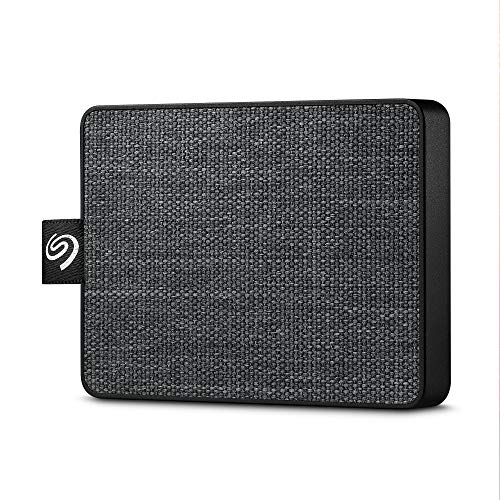
TL;DR: The Seagate One Touch 500 GB Black delivers a credit‑card‑sized, 70 g SSD with up to 400 MB/s reads and bundled backup apps for $89.95, making it a solid entry‑level portable drive.
The drive’s most eye‑catching spec is its ultra‑compact footprint—75 mm × 55.6 mm × 10 mm—and a weight of just 0.15 lb (70 g), which lets it slip into any pocket. It advertises sequential reads of up to 400 MB/s, while real‑world writes sit between 275 MB/s and 305 MB/s.
Compared with the seven other SSDs in this roundup, the One Touch is heavier than the Orico 1 TB (0.13 lb) and the Crucial X9 Pro (0.08 lb), but about the same as the Buffalo 1 TB (0.15 lb). It's lighter than the SSK 128 GB (27 g) and the Kingston XS1000 (0.09 lb). In speed terms, its 400 MB/s read ceiling trails the Orico’s 1,000 MB/s, Buffalo’s 600 MB/s, and the 1,050 MB/s reads of the Crucial X9 Pro, Crucial X9, Kingston, and SSK Portable SSD. Its write performance (275–305 MB/s) also lags behind the 800 MB/s writes of Orico and the 600 MB/s of Buffalo, as well as the 1,050 MB/s writes of the higher‑priced peers.
User sentiment repeatedly praises the pocketable size and the “plug‑and‑play” experience on both Windows and macOS, noting that the included Mylio Create and Adobe CC Photography subscriptions add real value for photographers. Professional reviewers highlight the SSD’s small profile and its 400 MB/s read speed, but they also flag the slower sustained writes and a plastic housing that feels less rugged than metal‑cased rivals.
Beyond speed, the One Touch connects via USB 3.0 with UASP support, streams video directly, and requires no reformat for Windows or macOS out of the box (only a Time Machine reformat). The 500 GB capacity is ideal for daily transfers, and the three‑year warranty adds peace of mind.
Pros
Cons
Best for: Budget‑conscious buyers seeking a reliable entry‑level option
Avoid if: You want the best value‑per‑dollar in its price range
“small, lightweight, and reasonably fast”
TL;DR: The SSK Portable SSD delivers up to 1050 MB/s reads, 1000 MB/s writes, a rugged aluminum case, and a feather‑light 30 g build for $149.99, making it a fast yet premium‑priced 1 TB option.
The drive’s headline spec is its sequential performance – up to 1050 MB/s read and up to 1000 MB/s write when paired with a USB 3.2 Gen 2x2 port. Its 12 mm thin profile, 68 mm length, 37 mm width, and 30 g aluminum alloy shell give it a premium feel while staying compact enough to slip into a pocket.
Compared with the seven other SSDs in this roundup, the SSK is the lightest at roughly 0.07 lb, beating Kingston’s 0.09 lb, Crucial X9’s 0.07 lb, Orico’s 0.13 lb, and Buffalo’s 0.15 lb. Its height of 12 mm sits between Kingston’s 13.5 mm and Crucial X9’s 10 mm, while its width of 37 mm is narrower than Crucial’s 50 mm but wider than Kingston’s 32.58 mm. In speed, SSK matches the top‑tier 1050 MB/s read of Kingston and Crucial X9, and its 1000 MB/s write outpaces Kingston’s 813.7 MB/s, Orico’s 800 MB/s, and Buffalo’s 600 MB/s.
Users praise the plug‑and‑play simplicity, the included protective pouch, and the blue LED that signals activity. Reviewers note the drive’s “near‑NVMe” performance for 4K video editing on the go. However, specs indicate a noticeable drop in sustained write speed once the ~24 GB pSLC cache is exhausted, and the unit can get warm during long transfers. The maximum advertised speeds require a USB 3.2 Gen 2x2 connection; on standard Gen 2 ports the advantage narrows.
Pros
Cons
Best for: Mobile professionals, content creators, and travelers who need fast, pocket‑sized storage for high‑resolution media.
Avoid if: You’re on a tight budget or require sustained high‑write performance for large continuous workloads.
“Plug-and-play ease across devices (PC/Mac/Android/iOS)”
“High‑res photos and videos transfer in seconds, feels premium in hand”
TL;DR: The SSK 128 GB Portable SSD packs a 9.9 mm thin, 27 g aluminum body with up to 550 MB/s read speeds for a $30.99 price that fits in any pocket.
What really stands out is its ultra‑compact chassis – just 9.9 mm tall, 67.6 mm long and 67.3 mm wide, and weighing only 27 g. Despite the tiny footprint, it still delivers the advertised sequential read speed of up to 550 MB/s and write speed of up to 500 MB/s over a USB 3.2 Gen 2 (NVMe) interface, and it comes with both USB‑C‑to‑C and USB‑C‑to‑A cables.
Compared with the other seven SSDs in this roundup, the SSK is the lightest (peers range from 32 g to 70 g) and one of the thinnest (most competitors sit at 10 mm or thicker). Its length of 67.6 mm is shorter than the Orico’s 131.8 mm and comparable to Buffalo’s 68.58 mm, while its width of 67.3 mm is wider than the Crucial X9 Pro’s 50 mm but still slimmer than the Seagate One Touch’s 55.6 mm. Capacity-wise, 128 GB is modest next to the 1 TB options from Orico, Buffalo, and the Crucial models, but the price point is far lower.
Users love how easily the drive slips into a pocket or small bag, calling it “pocket‑size convenience” and praising its reliable data transfers across PCs, Macs, Android phones, iPhones, PS5 and Xbox. However, several reviewers note that real‑world speeds sometimes fall short of the 550 MB/s claim, and the lack of an IP rating means it isn’t protected against water or dust. Professional reviewers also highlight the sturdy aluminum alloy construction, which adds a solid feel despite the featherlight weight.
The SSD runs on the USB 3.2 Gen 2 (NVMe) protocol, offering fast, plug‑and‑play operation without driver installation. An LED indicator blinks during data transmission, and the drive supports SMART monitoring and TRIM technology for health tracking and longevity.
Pros
Cons
Best for: Budget-conscious buyers seeking a reliable entry-level option
“Plug-and-play ease across devices (PC/Mac/Android/iOS)”
“High‑res photos and videos transfer in seconds, feels premium in hand”
TL;DR: The Orico 1TB Portable SSD packs a 1000 MB/s read rating, 60 g aluminum‑alloy body, and a handy hanging hole into a $114.69 budget‑friendly package.
The drive’s standout spec is its advertised sequential read speed of up to 1000 MB/s and write speed of up to 800 MB/s, both delivered over a USB 3.2 Gen 2 (10 Gbps) Type‑C interface. At just 0.13 lb (60 g) and measuring 131.8 × 33.8 × 18.8 mm, it’s light enough to slip into a laptop bag without adding bulk.
Compared with the seven other SSDs in this roundup, Orico is lighter than the Buffalo stick (0.15 lb) but heavier than the ultra‑light Crucial X9 Pro (0.08 lb). Its read speed outpaces Buffalo’s 600 MB/s claim, yet trails the Crucial X9 series that list 1050 MB/s. The write speed sits between Buffalo’s modest figures and the higher‑end 1050 MB/s of the Crucial X9 models, giving it a solid middle‑ground performance.
Professional reviewers note the slim aluminum‑alloy plus ABS construction and the integrated hanging hole as big wins for durability and travel convenience. Everyday users echo this, praising the SSD’s featherweight feel and fast backup times, while some mention the 132 mm length can feel long in tight pockets and that real‑world transfers sometimes dip below the peak specs.
Pros
Cons
Best for: Budget‑conscious buyers seeking a reliable entry‑level option
Avoid if: You have limited desk space or need ultra‑compact portability
“Plug-and-play ease across devices (PC/Mac/Android/iOS)”
“High‑res photos and videos transfer in seconds, feels premium in hand”
TL;DR: The Buffalo 1 TB External SSD packs a rugged stick‑form factor, 600 MB/s USB 3.2 Gen 2 speed and broad console compatibility for $119.99, making it a solid budget pick despite slower transfer rates than some rivals.
At just 10.16 mm tall, 68.58 mm long and 22.86 mm wide, the Buffalo SSD‑PUT1.0U3B feels like a thumb‑sized stick, yet it offers a full 1 TB of storage. The drive weighs 0.14991433816 lb (68 g) and delivers up to 600 MB/s transfer speed over a USB 3.2 Gen 2 interface, which is fast enough for most game saves and media backups.
Compared with the other seven SSDs in this roundup, Buffalo’s speed trails the Crucial X9 Pro, Crucial X9, Kingston XS1000, SSK Portable SSD and Orico 1 TB Portable SSD, all of which list sequential read speeds of around 1 050 MB/s or up to 1 000 MB/s. It’s also heavier than most of those rivals, with only the Seagate One Touch 500 GB edging it out in weight. Dimensionally, its length is similar to Kingston’s 69.54 mm and SSK’s 68 mm, while its height matches the 10 mm profile of the Crucial X9 and Seagate models.
Users consistently praise the drive’s drop‑protected, retractable design and its compatibility with PS4, PS5, Windows and macOS. Professional reviewers note that, after applying a required firmware update, the advertised 600 MB/s speed makes large photo and video transfers painless, and the single‑port USB‑C/‑A combo is handy for console gaming. However, several reviewers point out that the speed ceiling feels modest next to the 1 000 MB/s class drives, and the need for a firmware update can be a hassle for less‑tech‑savvy buyers.
Pros
Cons
Best for: Users who want a well‑reviewed, rugged 1 TB SSD for console gaming and portable media storage without breaking the bank.
Avoid if: You need the absolute fastest read/write speeds, built‑in hardware encryption, or multiple simultaneous USB connections.
Breakdown
Crucial X9 Pro
Pros
Kingston XS1000
Pros
Cons
Crucial X9
Pros
Seagate One Touch 500GB Black
Pros
Cons
Based on scoring data and product specs
Personalized picks
Best Overall Pick
Crucial X9 Pro
Best OverallBest for: Most users looking for a well-reviewed, reliable mainstream option
Kingston XS1000
Best for: Buyers willing to invest in a proven, high-quality option
$184.99+$52.20 vs winner
Skip Buffalo External SSD 1TB if…
You have limited desk space or need portability
We’re naming the Crucial X9 Pro the clear winner of our Best Budget External SSDs roundup. It ships for $121.01, carries a solid 4.5‑star rating from 4,752 reviewers, and hits up to 1,050 MB/s on both sequential read and write. Add a 5‑year limited warranty, IP55 resistance and a 7.5‑ft drop rating, and you’ve got a fast, rugged drive that stays comfortably light at 38 g.
The Kingston XS1000 takes the runner‑up spot, especially if you need a pocket‑sized SSD that plays nicely with older USB‑A ports. Priced at $149.99 it delivers up to 1,050 MB/s sequential read and 1,000 MB/s write, plus 871.4 MB/s random read and 787.2 MB/s random write. Its metal‑plus‑plastic case is only 13.5 mm thick, 28.7 g in weight, and includes a USB‑A‑to‑C adapter for maximum compatibility.
For tighter budgets, the SSK 128 GB Portable SSD at $30.99 offers the lowest entry price while still providing portable flash storage. If you want a mid‑range option, the Orico 1TB Portable SSD at $114.69 balances capacity and price nicely. For those who prefer a premium feel, the SSK Portable SSD at $149.99 gives a higher‑end design and performance edge.
Pick the Crucial X9 Pro today and enjoy fast, reliable storage without breaking the bank.
The Crucial X9 Pro stands out with 256‑bit AES hardware encryption, an IP55 rating, 7.5 ft drop resistance, and full USB 3.2 Gen 2 Type‑C performance, all for $121.01, making it a strong value compared with the other options.
No reviews yet — be the first to share your experience.
Please sign in to leave a review