⚡ Quick Answer
It’s surprising that the $25.99 GAOMON S620, the cheapest tablet in our list, carries a 4.4‑star rating from 17,015 reviewers—almost as high as the more premium models. That strong approval shows you don’t have to spend a lot to get a tablet that users trust for everyday drawing, note‑taking, or even rhythm‑gaming.
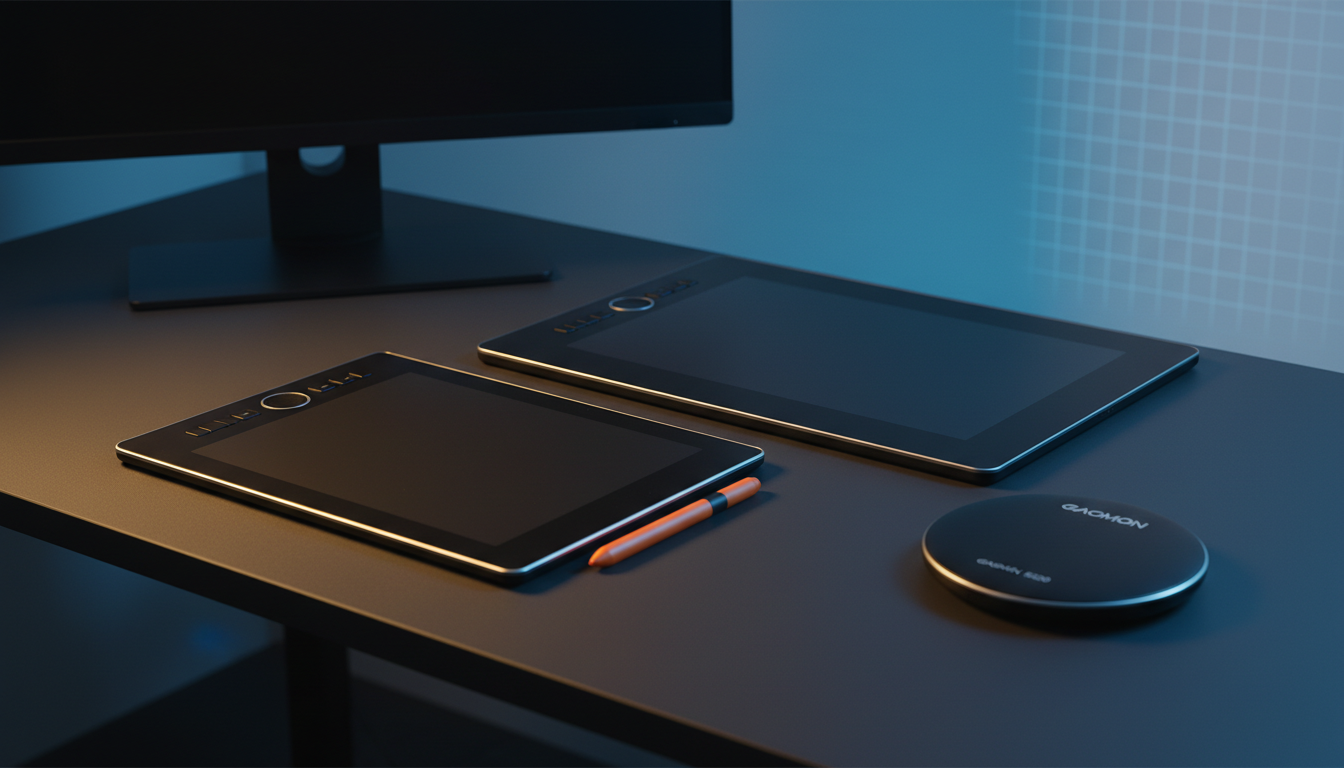
Nine graphics tablets under $50 span three price tiers. The budget tier features the GAOMON S620, Huion Inspiroy H640P and XP‑Pen StarG640. Mid‑range options include the XP‑Pen IT640, GAOMON M10K and the XP‑Pen Deco 01 V3, which offers a 10 × 6.25‑inch active area and eight customizable shortcut keys. Premium‑tier picks—Huion HS610, Huion Inspiroy H1060P and Huion Inspiroy H950P—push the price up to $49.89 while adding extra programmable keys and tilt support. Across the board you’ll see pressure sensitivity ranging from 8,192 to 16,384 levels and tablet thicknesses around 8 mm, making even the larger models easy to transport.
Below we’ll break down each model’s strengths and the creative scenarios they fit best, so you can zero in on the right tablet for your budget.

XP-Pen Deco 01 V3
Its ultra‑thin 8 mm profile gives a sleek, space‑saving drawing surface, contributing to its top‑rated value and popularity.
GAOMON S620
Ideal for budget‑conscious beginners, the GAOMON S620 delivers reliable entry‑level performance at $25.99—about $18 less than the Top Pick.

GAOMON M10K
Stands out with a larger 359.9 mm length, offering extra drawing real‑estate that the shorter Deco 01 V3 and S620 don’t provide.
Also considered
Score Analysis
Key score advantages vs. runner-up (GAOMON S620)
Price Range
XP-Pen Deco 01 V3
$44.99
GAOMON S620
$25.99
GAOMON M10K
$39.99

Huion HS610
$47.99

Huion Inspiroy H640P
$27.99

XP-Pen IT640
$29.99
Huion Inspiroy H1060P
$44.99

Huion Inspiroy H950P
$49.89
XP-Pen StarG640
$29.99
Spec Comparison
TL;DR: The XP‑Pen Deco 01 V3 offers a large 10 × 6.25‑in active area, 16,384 pressure levels and a battery‑free stylus for $43.99, but its 2.2‑lb weight makes it heftier than many ultra‑light budget tablets.
What really stands out is the 16,384‑level pressure sensitivity paired with ±60° tilt and a reported accuracy of ±0.01 inch. The tablet’s active area measures 10 × 6.25 in (254 × 159 mm), giving beginners plenty of space to sketch, while eight customizable round shortcut keys let you keep your most‑used commands within reach.
At 1000 g (2.20462262 pounds), the Deco 01 V3 is heavier than the ultra‑light options like the XP‑Pen StarG640 (170 g) or Huion H640P (272 g), but it still fits on a typical desk. It also outweighs the Huion HS610 (600 g) and Huion H1060P (770 g), positioning it toward the sturdier end of the sub‑$50 segment.
Reviewers consistently praise the battery‑free stylus for “unlimited drawing time,” and the high pressure sensitivity makes line work feel responsive. With a report rate of 200 pps and a resolution of 5080 LPI, the tablet delivers smooth strokes, and the 10 mm reading height ensures the pen stays comfortably above the surface.
Pros
Cons
Best for: Beginners, hobbyists and mobile artists who want a spacious drawing surface and high pressure sensitivity without breaking the $50 barrier.
Avoid if: You’re on a tight budget or need the lightest possible tablet for travel.
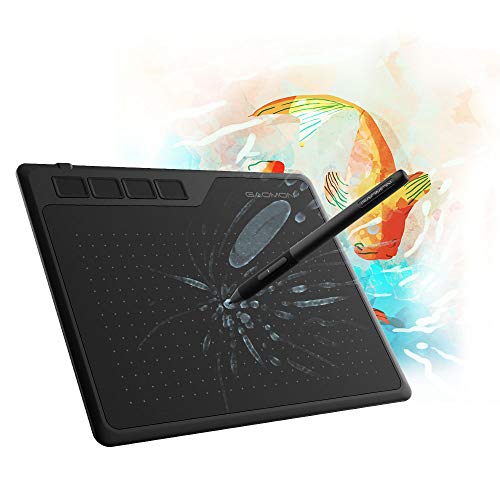
TL;DR: The GAOMON S620 delivers 8192 pressure levels, a thin 8 mm profile and four shortcut keys for just $25.99, making it a portable, budget‑friendly starter tablet.
The tablet offers 8192 pressure‑sensitivity levels paired with a 5080 LPI pen resolution, letting beginners achieve smooth line variation. At only 8 mm thick and weighing 249 g (0.551155655 lb), it’s feather‑light in hand, and the included AP32 battery‑free stylus adds another 12 g of weightlessness.
Compared with the eight other entries, the S620 is heavier than the ultra‑thin XP‑Pen StarG640 (0.3747858454 lb) but lighter than the Huion Inspiroy H640P (0.6 lb). Its 8 mm thickness matches the H640P while the StarG640 sits at a slimmer 2 mm. With four programmable express keys, it offers more shortcut options than the StarG640 and H640P, though fewer than models like the XP‑Pen IT640 (8 keys) or GAOMON M10K (10 keys).
Reviewers consistently praise the tablet’s portability and the battery‑free AP32 stylus, noting the smooth tapering of lines and the lag‑free experience thanks to a report rate of >266 PPS. Users also like the built‑in express keys for quick tool swaps during sketching or OSU! rhythm gaming. However, the active drawing area of 165.1 × 101.6 mm can feel cramped for detailed work, and the mandatory Micro‑USB tether limits true wireless mobility. Professional reviewers highlight the ±0.3 mm accuracy and 60° tilt support as solid for an entry‑level device.
Pros
Cons
Best for: Budget-conscious buyers seeking a reliable entry‑level option
Avoid if: You need advanced features or professional‑grade performance
TL;DR: The GAOMON M10K offers a generous 10 × 6.25‑inch active area, 8192 pressure levels and 10 programmable keys for $42.99, making it a solid budget tablet with solid build and battery‑free pen.
The tablet’s standout spec is its 10 × 6.25‑inch active drawing surface paired with a battery‑free stylus that delivers 8192 pressure levels and ±60° tilt. Ten customizable shortcut keys and a multifunctional touch‑ring give you quick access to brushes, zoom or scroll without leaving the canvas.
At 695 g, the M10K is lighter than the XP‑Pen Deco 01 V3 (which weighs about 1000 g) but noticeably heavier than ultra‑light options like the XP‑Pen IT640 and StarG640 (each around 170 g). It also out‑numbers the Deco 01 V3’s 8 express keys and the IT640’s 8 soft keys, while offering double the programmable keys of the GAOMON S620’s 4‑key layout.
Users repeatedly praise the tablet’s spacious drawing area and the fact that it arrives ready to use with a pen loop, nib pack, pen case and quick‑start guide. Professional reviewers note the smooth textured surface and the natural feel of the 8192‑level pressure curve, though they flag the driver software as only satisfactory and occasionally finicky. Some artists also mention the pen’s weight and grip as a minor comfort issue.
Technical details add confidence: a resolution of 5080 LPI and a report rate of 266 PPS ensure low‑latency response, while the ±60° tilt support lets you angle strokes naturally. The tablet works with Windows 7+, macOS 10.12+, and Android 11‑14, and it’s compatible with popular apps like Photoshop, Krita and OneNote.
Pros
Cons
Best for: Most users looking for a well‑reviewed, reliable mainstream option
Avoid if: You need advanced features or professional‑grade performance
“amazing for the price and lightweight compared to Wacom Intuos Pro.”
“screaming at people to get this.”
TL;DR: The Huion HS610 packs an 8192‑level battery‑free pen, 28 programmable keys, and a 10 × 6.25 in active area into a lightweight 600 g tablet, making it a solid budget choice for on‑the‑go creators.
The standout feature is its 8192 pressure‑sensitivity levels combined with ±60° tilt support, all powered by a battery‑free PW100 stylus. The tablet measures just 8 mm thick and weighs 600 g (≈1.32 lb), while offering a 158.8 mm × 254 mm active area for desktop work.
At 600 g, the HS610 is lighter than the Huion Inspiroy H950P (1.76 lb) and the XP‑Pen Deco 01 V3 (2.20 lb), yet heavier than the ultra‑light XP‑Pen IT640 (170 g) and StarG640 (0.37 lb). Its 28 programmable keys (12 hard + 16 soft) outnumber the 8 keys on the Deco 01 V3, the 10 keys on the GAOMON M10K, and the 4 keys on the GAOMON S620, giving artists more shortcuts without adding bulk.
Reviewers consistently praise the tablet’s comfortable, battery‑free pen and the solid build that shows little flex despite the slim profile. Users love the plug‑and‑play Micro‑USB connection, but many note the missing eraser button and the lack of any Bluetooth option as minor annoyances. Professional reviewers highlight the tablet’s premium feel and the larger active area compared with similarly priced competitors.
The sensor accuracy lists ±0.3 mm, with a report rate of over 220 PPS and a sensing height of 10 mm, together providing smooth strokes for detailed illustration work.
Pros
Cons
Best for: Digital artists, illustrators, and animators who want a portable, feature‑rich tablet without breaking the bank.
Avoid if: You need Bluetooth connectivity, a built‑in pen eraser, or a larger active area for smartphone drawing.
“has very little flex for its weight and definitely nails the premium feel”
“only around half an inch larger in active area but possesses four extra expressed keys”
TL;DR: The Huion Inspiroy H640P packs 8192 pressure levels, 6 express keys, and a feather‑light 0.6 lb body for under $30, making it a solid entry‑level tablet for on‑the‑go creators.
The standout spec is the PW100 stylus’s 8192 pressure‑sensitivity levels paired with a 5080 LPI pen resolution, delivering fine‑grained control despite the tablet’s compact size. At just 0.6 pounds (272 g) and 8 mm thick, it’s genuinely portable enough to slip into a laptop bag.
Compared with the other eight tablets, the H640P sits in the middle of the weight range: it’s heavier than the ultra‑light XP‑Pen StarG640 (≈0.37 lb) and GAOMON S620 (≈0.55 lb) but considerably lighter than the GAOMON M10K (≈1.53 lb) and the XP‑Pen Deco 01 V3 (≈2.20 lb). Its six programmable express keys outnumber the S620’s four keys while falling short of the M10K’s ten, giving a balanced shortcut set for beginners.
Reviewers often praise the tablet’s feather‑light feel and the battery‑free PW100 pen, noting how the pen never needs charging and the slim profile frees up desk space. The same users point out that the active drawing area feels cramped for detailed artwork, and the lack of tilt detection limits brush dynamics. Professional reviewers highlight the ±0.3 mm accuracy and 233 PPS report rate as solid performance for the price tier.
Additional technical notes include a 10 mm sensing height, left‑handed support, a glare‑free surface, and a Micro‑USB connection, which some users find dated compared with newer USB‑C offerings. The tablet includes two side buttons on the pen for quick erasing or switching tools.
Pros
Cons
Best for: Budget‑conscious buyers seeking a reliable entry‑level option
Avoid if: You need advanced features or professional‑grade performance
“thinner than a cellphone, lighter than a magazine”
TL;DR: The XP‑Pen IT640 packs a 16 × 9 cm active area, 16,384 pressure levels and 60° tilt into a 7.7 mm‑thin, 170 g tablet for under $30, making it a portable starter choice.
The standout spec is the 16,384 pressure‑sensitivity levels combined with 60° tilt support, letting you vary line weight and angle with fine granularity. Its 5080 LPI resolution and a report rate of ≥220 RPS promise smooth strokes, which reviewers often praise for lag‑free drawing.
At 170 g, it matches the weight of the StarG640 and is noticeably lighter than the Huion H640P (0.6 lb) and GAOMON S620 (0.55 lb). Its 7.7 mm thickness makes it slimmer than most rivals, which sit at 8 mm or more, though the StarG640 is even thinner at 2 mm. While its 16 × 9 cm active area is compact, many competitors offer larger surfaces, so space‑constrained users will appreciate the portability.
User feedback highlights the tablet’s ultra‑slim profile and responsive stylus as ideal for on‑the‑go sketching and OSU! gaming. The battery‑free pen, eight soft shortcut keys and USB‑C connection keep the setup simple, but the constant cable requirement and the modest active area draw criticism from artists who need a bigger canvas.
Pros
Cons
Best for: Most users looking for a well-reviewed, reliable mainstream option
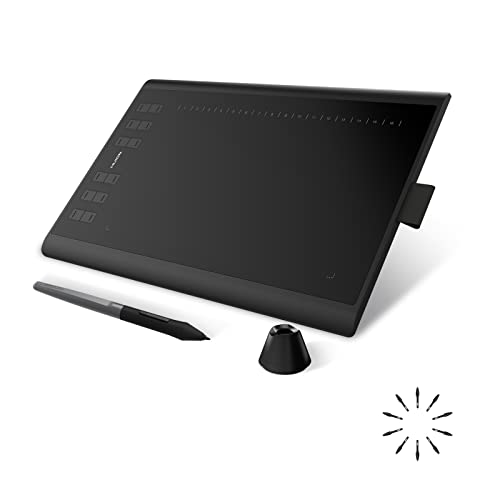
TL;DR: The Huion Inspiroy H1060P packs 28 programmable keys, 8192 pressure levels and ±60° tilt into a compact 360 × 240 × 10 mm tablet for under $50, but its plastic chassis and occasional driver hiccups may bother power users.
The standout spec is the 28 express keys – offering the highest count among the nine budget tablets – letting you map shortcuts for brushes, layers or undo without lifting your hand. Coupled with 8192 pressure‑sensitive levels and ±60° tilt, the H1060P delivers fine‑grained line control that beginners and hobbyists often praise.
Compared with its peers, the H1060P is heavier than the GAOMON M10K (which tips the scales at about 695 g) yet lighter than the XP‑Pen Deco 01 V3 (around 1 kg). Its 360 mm length and 240 mm width give a slightly larger footprint than the Huion H640P (254 mm × 152 mm) while still fitting comfortably on a small desk. The tablet also offers more shortcut keys than the XP‑Pen StarG640 and the Huion H640P, both of which provide only a handful of soft keys.
Users consistently highlight the battery‑free stylus and the smooth, lag‑free strokes enabled by the 5080 LPI pen resolution and a report rate of >220 PPS. Professional reviewers say the tilt support genuinely boosts shading work. On the flip side, several owners report driver installation quirks on macOS and Windows, and some express that the plastic body feels cheap and that a few of the hard keys wobble under heavy use. The tablet doesn't have multi‑touch or wireless connectivity, which some modern workflows expect.
Technical details round out the picture: the active area on a PC measures 254 × 158.8 mm, while the Android active area is 99.3 × 158.8 mm. The pen itself is 14.5 mm in diameter, 163.6 mm long and weighs just 13 g, making it comfortable for long drawing sessions. The device rates accuracy at ±0.3 mm, and it ships with a pen holder, eight replacement nibs and a USB cable.
Pros
Cons
Best for: Beginner to intermediate digital artists who want a feature‑rich tablet with plenty of shortcuts at a sub‑$50 price.
Avoid if: You need a wireless or multi‑touch tablet, or you’re looking for a premium‑grade build without driver quirks.
“thinner than a cellphone, lighter than a magazine”
TL;DR: The Huion Inspiroy H950P offers an ultra‑slim 8 mm tablet with 8192 pressure levels, eight shortcut keys, and a battery‑free stylus for $49.89, though its 221 × 138 mm active area feels tight for larger projects.
The standout spec is the tablet’s 8 mm overall thickness combined with a compact 221 × 138 mm active drawing area, eight programmable keys, and a battery‑free PW100 pen that delivers 8192 pressure‑sensitivity levels and ±60° tilt support. Accuracy lists ±0.3 mm, and the pen’s resolution reaches 5080 LPI, giving fine‑grained control for sketching and illustration.
At 1.76 pounds, it’s heavier than ultra‑light options like the XP‑Pen IT640 (≈0.37 lb) and the Huion H640P (0.6 lb), but it’s lighter than the XP‑Pen Deco 01 V3 (≈2.20 lb). Its 8 mm thickness matches the Huion HS610 and the Deco 01 V3, while it’s slimmer than the GAOMON M10K, which is 10.5 mm thick. Compared with peers, the H950P balances a modest weight increase for a sturdier feel without sacrificing portability.
Reviewers consistently praise the tablet’s portability and the convenience of a battery‑free pen, noting that the eight shortcut keys streamline workflow. However, many users point out that the 221 × 138 mm active area feels cramped for detailed illustration or photo‑retouching, and the lack of multi‑touch gestures limits quick zoom and pan actions. Professional reviewers also mention the missing eraser button as a small but noticeable drawback.
Under the hood, the tablet reports at 233‑260 PPS, ensuring responsive pen tracking. The 5 V power supply powers the device via a Micro‑USB connection, and the sensing height of 10 mm accommodates a range of pen angles. Left‑handed support adds flexibility for a broader audience.
Pros
Cons
Best for: Beginners, hobbyists, students and mobile creatives who need a lightweight, affordable tablet for on‑the‑go drawing.
Avoid if: You need a large drawing surface, multi‑touch gestures, or professional‑grade features such as an integrated eraser button.
“thinner than a cellphone, lighter than a magazine”
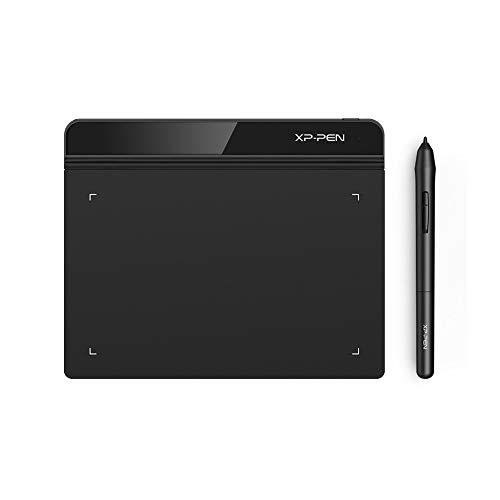
TL;DR: The XP‑Pen Star G640 packs a 6 × 4 in active area, 8192‑level battery‑free pen and an ultra‑slim 2 mm profile into a 0.37‑lb, $27.99 tablet that’s ideal for on‑the‑go beginners.
The tablet’s most eye‑catching spec is its 2 mm thickness combined with a lightweight 170 g (≈0.37 lb) body, making it easy to slip into a backpack. It also delivers 8192 pressure‑sensitivity levels on a battery‑free electromagnetic stylus that weighs just 11 g.
Compared with the other eight entries, the Star G640 is lighter than the Huion Inspiroy H640P (0.6 lb) and matches the weight of the XP‑Pen IT640 (both 170 g). Its 6 × 4 in active area is smaller than the Deco 01 V3’s 10 × 6.25 in workspace, but the compact size wins points for portability. Like most peers, it lacks tilt support and any programmable express keys.
Users consistently praise the tablet’s portability and the included 20 extra nibs, calling it a solid companion for travel, e‑learning and casual OSU! rhythm gaming. Professional reviewers say the 266 RPS report rate gives a technical edge for fast‑draw applications, while noting the absence of tilt and shortcut keys limits advanced illustration work.
Technical context: The Star G640 reads at a line resolution of 5080 LPI and reports up to 266 RPS, ensuring smooth strokes in Photoshop, Krita, GIMP and other supported software. The USB‑only wired connection means you’ll need a free USB port, which some users find intrusive during drawing.
Pros
Cons
Best for: Beginners, casual digital artists, OSU! rhythm gamers, students, and anyone needing a reliable entry‑level tablet on a budget.
Avoid if: You need a larger drawing surface, tilt sensitivity, or extensive shortcut keys for professional illustration work.
Breakdown
XP-Pen Deco 01 V3
Pros
GAOMON S620
Pros
GAOMON M10K
Pros
Cons
Huion HS610
Pros
Cons
Based on scoring data and product specs
Personalized picks
Best Overall Pick
XP-Pen Deco 01 V3
Best OverallBest for: Buyers willing to invest in a proven, high-quality option
GAOMON S620
Best for: Budget-conscious buyers seeking a reliable entry-level option
$25.99-$19.00 vs winner
Skip XP-Pen StarG640 if…
You have limited desk space or need portability
The XP-Pen Deco 01 V3 takes the top spot in the under‑$50 segment. It delivers a spacious 10 × 6.25‑inch active area, 16,384 pressure‑sensitivity levels, and eight customizable round express keys, so you can map shortcuts exactly where you need them. With ±0.01‑inch accuracy and a 200 pps report rate, the tablet feels responsive and precise. A 4.5‑star rating from 14,217 reviewers and a list price of $43.99 underline its strong value.
The GAOMON S620 lands as the runner‑up, perfect if you need a compact tablet for a cramped desk or on‑the‑go sketching. Priced at $25.99, it slides into any laptop bag, and its 165.1 × 101.6 mm active area provides enough space for detailed work. Four programmable shortcut keys and 8,192 pressure levels keep the workflow smooth, while tilt support up to 60° and a report rate of over 266 pps add extra control. Its 4.4‑star rating from 17,015 users confirms reliable performance at a bargain.
Pick the XP‑Pen Deco 01 V3 today and you'll get the most capable tablet for under $50.
Both the XP‑Pen Deco 01 V3 and the GAOMON M10K provide the biggest workspace at 10 × 6.25 inches, which is larger than the active areas of the Huion HS610, H950P, and the smaller‑area models. If you need the most surface for detailed work, those two are the clear leaders in this price range.
No reviews yet — be the first to share your experience.
Please sign in to leave a review