⚡ Quick Answer
Finding a full‑room audio setup that stays under $300 can feel like hunting for a needle in a haystack, but we've narrowed the field to nine contenders. They span three price tiers – budget options like the $33.99 Riowois Sound Bar and $125.00 Polk T15, mid‑range picks such as the $209.00 Polk Monitor XT60 and $219.00 Sonos Era 100, and premium choices including the $242.99 Marshall Acton III and $279.00 Bose TV Speaker.
Ratings hover in the high‑fourths, with the Marshall Acton III leading at 4.8 / 5 from 2,111 reviews and the Bose TV Speaker close behind at 4.3 / 5 across 13,792 reviews. Power and output vary widely – the Yamaha R‑S202 can push a maximum 140 W, while the Riowois bar offers a modest 50 W RMS. Bluetooth reach also differs, from the Bose’s 9 m range to the Audioengine A2+’s 30 m coverage.
Next, we break down each tier, highlighting which specs matter most for small apartments, bedroom setups, or a first‑time home‑theater build, so you can match the right system to your space and budget.

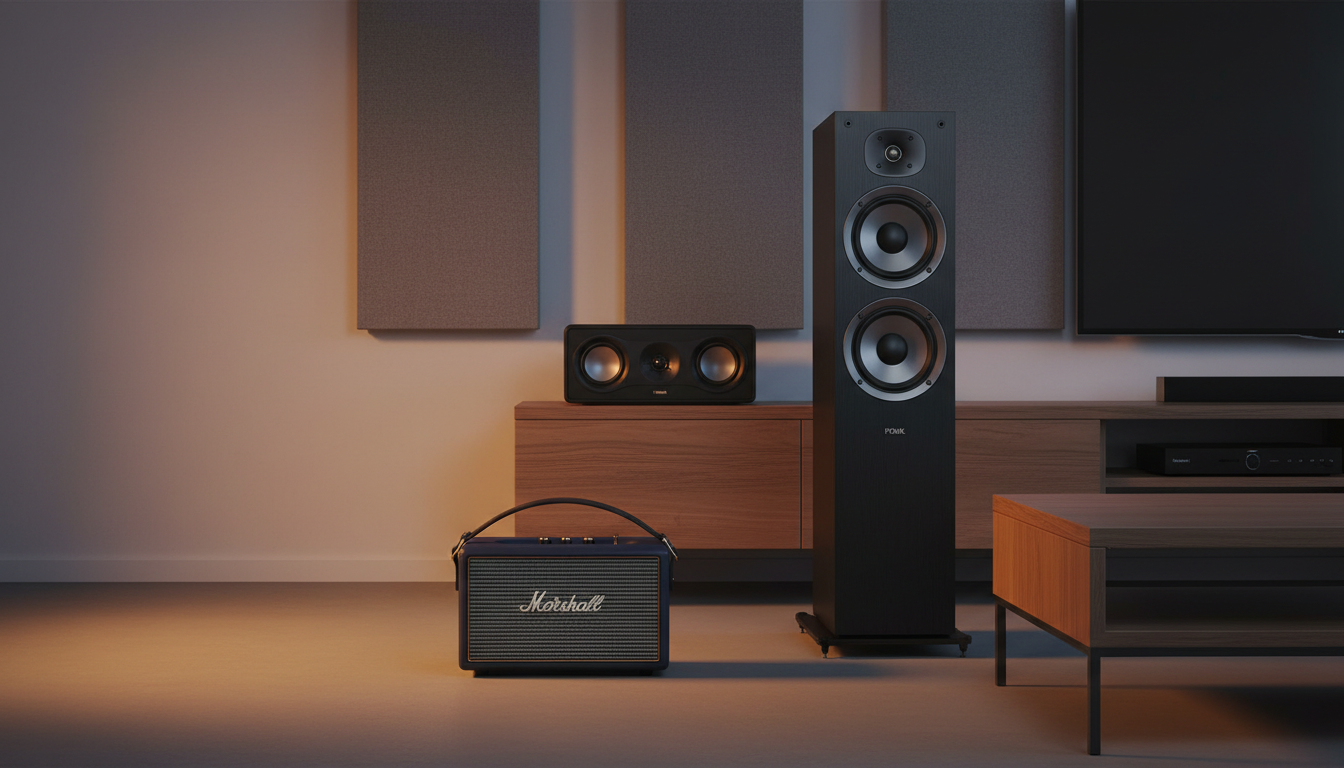
Marshall Acton III Midnight Blue 3.5 mm
Its 95 dB maximum SPL delivers clear, room‑filling sound, giving the best value for a proven, high‑quality speaker.
Polk Monitor XT60 Midnight Black
Ideal for listeners who want a solid mainstream system without breaking the bank, it comes in at $209, about $34 less than the top‑ranked Acton III.

Yamaha R-S202
Stands out with 125 W high‑dynamic power at 16 Ω, offering stronger bass response for larger rooms where the Acton III and Monitor XT60 may feel less punchy.
Also considered
Score Analysis
Key score advantages vs. runner-up (Polk Monitor XT60)
Price Range
Marshall Acton III Midnight Blue 3.5 mm
$199.99
Polk Monitor XT60 Midnight Black
$229.00
Yamaha R-S202
$199.95

Bose TV Speaker
$199.00

Sony STRDH190
$248.00

Riowois Sound Bar
$33.99

Polk Audio T15 Black
$149.00

Sonos Era 100
$219.00

Audioengine A2+
$279.00
Spec Comparison
TL;DR: The Marshall Acton III delivers 60 W of room‑filling sound with a 95 dB peak SPL, 10 m Bluetooth range and tactile bass/treble knobs, all for $242.99.
The Acton III packs a 60 W Class D amplifier and a 45–20 000 Hz frequency range, giving it a maximum SPL of 95 dB. Its 19 mm tweeter and 101.6 mm woofer sit behind a bass‑reflex cabinet, while Dynamic Loudness and Placement Compensation help keep the tone balanced at any volume. You also get a 3.5 mm aux input and Bluetooth 5.2 with a 10 m range, plus physical knobs for volume, bass and treble plus app‑based EQ.
At 6.28 lb, the Acton III is heavier than the Sonos Era 100 and the Riowois Sound Bar, but lighter than the Polk Monitor XT60, Yamaha R‑S202, Sony STRDH190, Bose TV Speaker and Polk Audio T15. Its Bluetooth range of 10 m matches the Bose TV Speaker’s roughly 9 m reach but falls short of the Audioengine A2+’s 30 m claim. The 60 W output is solid for a bookshelf‑style unit, though it’s below the 140 W maximum of the Yamaha and the 100 W per channel of the Sony model. Driver‑size wise, the Acton III’s 19 mm tweeter is larger than the Sonos’s 13 mm tweeter and comparable to the Audioengine’s 0.75‑in driver, while its 101.6 mm woofer aligns with the Sonos’s 102 mm woofer and is smaller than the Polk Monitor’s 165 mm driver.
Professional reviewers praise the Acton III for its “room‑filling stereo sound” and note that outward‑angled tweeters create a wider soundstage. Everyday owners echo that sentiment, noting the balanced bass and clear treble, plus the convenience of tactile knobs and the Marshall app’s EQ controls. Users highlight the need for constant AC power, which rules out true portability, and the lack of any water or dust resistance, which makes it unsuitable for kitchens or outdoor use.
Pros
Cons
Best for: Buyers willing to invest in a proven, high‑quality option
Avoid if: You're on a tight budget or only need basic functionality
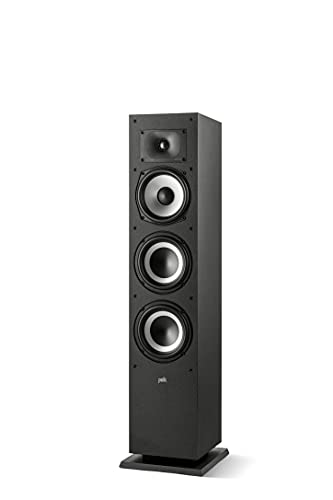
TL;DR: The Polk Monitor XT60 Midnight Black delivers deep, detailed sound with a 6.5‑inch passive radiator and 38 Hz–40 kHz range for $209, but its 20‑lb weight makes it a solid‑floor‑standing option rather than a portable one.
What sets the XT60 apart is its combination of a 6.5 in passive radiator and a 2200 Hz crossover, giving it a frequency response that stretches from 38 Hz all the way up to 40 000 Hz. The 1 in Terylene dome tweeter and 6.5 in bi‑laminate woofer work together to produce a smooth high‑frequency lift while the passive radiators add low‑end impact without needing a larger enclosure. Sensitivity sits at 86 dB (1 W @ 1 m), and the speakers are rated for 25 – 200 W per channel, so a modest amp can drive them comfortably.
At $209 the XT60 costs just above the Yamaha R‑S202 ($201.99) and a touch below the Marshall Acton III ($242.99), placing it in the mid‑range of this roundup. It weighs 20 lb, making it noticeably heavier than the Sonos Era 100 (≈4.45 lb) and the Bose TV Speaker (≈8.2 lb), but lighter than the Sony STRDH190’s 17.1 lb cabinet. Its 36.4 in height and 9.09 in depth make it taller than the compact Audioengine A2+ and Bose TV Speaker, yet it still fits comfortably in a 150‑300 sq ft living room.
Reviewers consistently praise the XT60’s “effortless deep bass” that comes from the passive radiators, noting that the low end feels energetic even on modest amplification. Professional reviewers highlight the “dynamic, full‑range sound” and the clarity of highs up to 40 kHz, which makes movie soundtracks and music feel immersive. On the flip side, many owners comment that the 20‑lb mass feels heavier than advertised, and a few mention occasional distortion when owners push the speakers to very high volumes.
Beyond the drivers, the XT60 offers a 5‑year warranty, Hi‑Res Audio, Dolby Atmos, DTS:X, and Auro 3D certifications, and a 1/4‑20 threaded insert for wall‑mounting or a keyhole hanger. Binding posts feature 5‑way nickel‑plated contacts, providing a secure connection for your amp. The cabinet’s low‑resonance construction and removable precision‑fit grille round out a design that delivers both performance and durability.
Pros
Cons
Best for: Budget‑conscious users building a 5.1/7.1 home‑theater or stereo system in a medium‑sized room who want high‑resolution sound and Atmos support.
Avoid if: You need ultra‑light speakers for easy relocation or are chasing the deepest bass from dual‑woofer towers.
TL;DR: The Yamaha R‑S202 delivers 100 W RMS stereo power, a wide 10 Hz‑100 kHz frequency response and Bluetooth streaming in a compact 12.63‑inch‑deep chassis for under $300.
The standout spec is its 100 W RMS stereo output paired with a low 0.2% total harmonic distortion, giving clean volume for bedroom or small‑room listening. Its frequency response spans 10 Hz to 100 kHz, so you’ll hear deep bass and crisp highs without noticeable roll‑off.
Compared with the eight peers, the R‑S202 is lighter than the Sony STRDH190 (17.1 lb) and the Polk Monitor XT60 (20 lb) yet heavier than the Sonos Era 100 (4.45 lb). It sits deeper than Sony’s 11.0‑inch chassis but is shallower than the Polk’s 9.09‑inch depth, offering a balanced footprint. Its RMS power matches Sony’s 100 W per channel figure, while its THD of 0.2% is slightly higher than Sony’s 0.09% but still well within audiophile‑acceptable limits.
Everyday owners praise the dependable Bluetooth connection (SBC/AAC) and the handy 40‑preset FM/AM tuner, calling the sound “natural” and “musically rich.” Professional reviewers note the optimized circuit layout that places the power transformer near the amp, boosting the signal‑to‑noise ratio to 100 dB. Reviewers cite the main drawbacks: lack of Wi‑Fi or dedicated streaming apps and spring‑clip speaker terminals, which some users find less secure than binding posts.
Additional technical notes include a 47 kΩ input impedance that accommodates a range of source devices, a modest 0.5 W standby draw for energy‑saving, and front‑panel bass/treble controls plus an included remote for easy adjustments.
Pros
Cons
Best for: Most users looking for a well‑reviewed, reliable mainstream option
Avoid if: You have limited desk space or need portability
TL;DR: The Bose TV Speaker delivers clear dialogue with a dedicated tweeter, fits under most TVs at 2.2 in height, and offers Bluetooth streaming up to 9 m for $279.
The Bose TV Speaker is a compact 3‑channel soundbar that packs two full‑range drivers and a center tweeter, plus a Bass Boost button and Dialogue mode for vocal clarity. It measures just 2.21 in high, 4.02 in deep, and 23.38 in wide, while weighing 8.2 lb, making it easy to slip beneath a TV without crowding the cabinet.
Compared with the other eight entries, the Bose sits heavier than the Audioengine A2+ (6.0 lb) and the Marshall Acton III (6.28 lb), but it’s lighter than the Polk Monitor XT60 (20.0 lb) and the Yamaha R‑S202 (14.77 lb). Its 9 m Bluetooth range falls short of the Audioengine A2+’s 30 m range, yet it still covers a typical living‑room distance. In the weight department it’s almost identical to the Polk Audio T15 (8.25 lb) while it is far bulkier than the ultra‑light Riowois bar (2.44 lb).
Reviewers consistently praise the ease of Bluetooth pairing and the noticeable improvement in speech intelligibility, especially when Dialogue mode is enabled. Professional reviewers note the slim chassis and the convenient HDMI ARC or 5‑ft optical cable (included) for a quick plug‑and‑play setup. The main criticisms focus on the limited bass—there’s no built‑in subwoofer and the optional wired subwoofer is the only way to add depth—and the absence of Dolby Atmos or Wi‑Fi, which keeps the system from offering immersive or multi‑room capabilities. The remote is featherlight at 1.12 oz, and the unit includes a 1‑year warranty.
Pros
Cons
Best for: Buyers willing to invest in a proven, high-quality option
Avoid if: You're on a tight budget or only need basic functionality
“Best budget sound bar for 2025”
“Easy pairing and music streaming via Bluetooth from phones”
TL;DR: The Sony STR‑DH190 delivers 100 W per channel, a built‑in phono stage, and Bluetooth streaming in a compact 17.1‑lb chassis, making it a solid entry‑level stereo receiver under $300.
At the heart of the STR‑DH190 is a 100 W per channel RMS amplifier built in Class AB, delivering clean power while keeping distortion down to 0.09 % and a signal‑to‑noise ratio of 96 dB. The unit also includes a dedicated phono stage with an 80 dB SNR, so you can hook up a turntable without an external preamp. Bluetooth streaming works on the 2.4 GHz band, letting you send music from a phone or tablet.
Weighing 17.1 lb, the Sony sits heavier than the compact Yamaha R‑S202 (about 14.77 lb) and much lighter than the larger Polk Monitor XT60 (around 20 lb). Unlike many of the speakers in this group, the STR‑DH190 provides A/B speaker switching for up to four speakers, a feature not listed for the Yamaha or the Sonos Era 100. Its Bluetooth capability is comparable to the Marshall Acton III, which specifies a 10 m range, though Sony’s exact range isn’t listed.
User reviews repeatedly praise the built‑in phono input for making vinyl setups straightforward, and professional reviewers note the balanced frequency response that stays fatigue‑free even at higher volumes. However, several owners mention that the high‑frequency response can feel thin when cranked up, and occasional Bluetooth dropouts occur.
The receiver offers 30 FM preset stations, an auto‑standby mode, and a 2‑hour sleep timer, adding convenience for casual listening. With a 1‑year warranty and a reinforced chassis, the unit feels sturdy enough for a bedroom or small living‑room stereo system.
Pros
Cons
Best for: Budget‑conscious buyers seeking a reliable entry‑level option
Avoid if: You want the best value‑per‑dollar in its price range
“amazing sound from a versatile receiver”
“very balanced”
TL;DR: The Riowois 17‑inch sound bar delivers clear stereo sound, Bluetooth 5.0 and a full set of wired inputs for just $33.99, making it the most affordable compact audio upgrade in this lineup.
This unit packs a 17‑inch wide, 3.5‑inch deep chassis that weighs only 2.44 pounds, so it slides easily onto a TV stand or onto a wall‑mount kit without crowding a small room. It drives two full‑range dynamic drivers with a Bass Reflex port, delivering a rated 50 W RMS output and a frequency response that reaches up to 20 kHz. The Bluetooth 5.0 module promises a stable 10 m range, and the included remote lets you toggle three DSP sound modes (Movie, Music, News) without leaving the couch.
When you line it up against the other eight contenders, the Riowois is dramatically lighter than the Polk T15 (8.25 lb), Sony STRDH190 (17.1 lb) and even the Bose TV Speaker (8.2 lb). Its 3.5‑mm AUX, optical and coaxial inputs give it more wired versatility than many higher‑priced models that rely on fewer connection types. While it lacks the heft of premium speakers, that lightness translates into easier wall‑mounting and a lower profile on cramped furniture.
User feedback repeatedly praises the straightforward setup, the remote‑controlled mode switching, and the clarity of dialogue—especially for movies and news. Reviewers also note that the Bluetooth range holds up in typical apartment layouts. On the downside, several users mention that the bass feels modest for bass‑heavy tracks and that the 2.0‑channel layout doesn’t provide the surround immersion some expect from a home‑theater bar. Professional reviewers echo these points, calling out the limited bass depth and the absence of HDMI‑ARC as notable trade‑offs. The sound bar carries a 3‑year warranty, which adds peace of mind for a budget‑focused purchase.
Pros
Cons
Best for: Shoppers on a tight budget who want the most for their money
Avoid if: you need deep, impactful bass, true multi‑channel surround, or a larger room that demands higher volume
TL;DR: The Polk Audio T15 Black delivers clear mids, bright highs and surprisingly punchy bass from a compact 5.25‑inch woofer and 0.75‑inch tweeter pair, all for $125.
What really sets the T15 apart is its 5.25 in woofer paired with a 0.75 in silk‑dome tweeter, delivering a frequency response that reaches 20 kHz and a sensitivity of 89 dB. The speakers handle up to 150 W of power and present a nominal 8 Ω impedance that can dip to 6 Ω, meaning even modest amplifiers can push decent volume. Users have praised the high sensitivity, noting it lets the speakers “fill a small room” without needing a beefy amp.
In this nine‑product roundup the T15 is lighter than the Sony STRDH190 (17.1 lb) and Yamaha R‑S202 (about 14.8 lb), yet a bit heavier than the Riowois sound bar (2.44 lb) and Sonos Era 100 (4.45 lb). Its 10.7 in height and 7.3 in depth are more compact than the Polk Monitor XT60’s 36.4 in height and 9.09 in depth, while still offering a taller profile than the Audioengine A2+ (6 in high) and Bose TV Speaker (2.21 in high). Power‑handling-wise, the T15’s 150 W ceiling exceeds the 100 W per‑channel output of the Sony model and the 140 W maximum of the Yamaha, giving it a bit more headroom for lively playback.
Everyday owners love the “surprising bass” and “clear mids” that the vented cabinet and front‑firing port provide, especially in apartments or home offices. Professional reviewers have highlighted the vented design for its solid bookshelf performance and the 89 dB sensitivity for strong output on modest gear. However, the bass does roll off around 65 Hz, so many recommend adding a subwoofer for deep low‑end, and the impedance dip to 6 Ω can challenge very low‑output amplifiers. The speakers also include magnetic shielding to keep nearby electronics interference‑free, gold‑plated 5‑way binding posts for secure connections, and a keyhole hanger for easy wall mounting. Polk backs the pair with a 5‑year parts‑and‑labor warranty.
Pros
Cons
Best for: Budget-conscious buyers seeking a reliable entry-level option
Avoid if: You need advanced features or professional‑grade performance
TL;DR: The Sonos Era 100 packs dual tweeters, a 4‑in woofer and Trueplay tuning into a compact 7.22‑in tall speaker for $219, delivering rich stereo sound but demanding a wall outlet.
What really sets the Era 100 apart is its driver array: two 0.5‑in angled tweeters teamed with a 4‑in mid‑woofer, which three Class‑D digital amplifiers power. The combination yields an 84 dB sensitivity and a 90 Hz – 20 kHz frequency response, so even a modest bookshelf can produce clear highs and surprisingly deep bass.
In the context of this nine‑product roundup, the Era 100 is lighter than the 20‑lb Polk Monitor XT60 and the 14.77‑lb Yamaha R‑S202, yet it occupies a smaller footprint than the bulkier Marshall Acton III. Its $219 price tag sits above many of the other entries, making it pricier than the majority of the lineup while still under the $300 ceiling.
Consumers repeatedly praise the speaker’s stereo imaging and the ease of adding it to an existing Sonos multi‑room system. Professional reviewers note the “finely tuned stereo sound” and the benefit of the quad‑core ARM Cortex‑A55 processor (1.9 GHz) with 2 GB DDR4 RAM and 8 GB eMMC storage that powers Trueplay auto‑tuning. The downside most users mention is the need for constant AC power via the included 6‑ft cable, which limits placement to spots near an outlet.
Beyond the drivers, the Era 100 supports AirPlay 2, Bluetooth 5.0, Wi‑Fi, a USB‑C port and Alexa integration. The 1‑year warranty rounds out a feature set that feels more premium than its price suggests, though it lacks a built‑in battery and isn’t waterproof.
Pros
Cons
Best for: Most users looking for a well‑reviewed, reliable mainstream option
Avoid if: You need advanced features or professional‑grade performance, or you require a portable, battery‑operated or waterproof speaker
TL;DR: The Audioengine A2+ packs a dual‑class AB amp, 15 W RMS per channel and ~30 ms Bluetooth latency into a 4‑inch‑wide, 6‑pound desktop speaker that sounds big for its size.
Bluetooth latency of ~30 ms combined with a 30 m range lets you stream video‑games or movies without noticeable lip‑sync issues. Powered by a dual class‑AB amp, each driver delivers 15 W RMS, and the system handles a frequency response of 65 Hz – 22 kHz ± 2 dB, giving you clear mids and crisp highs in a compact package.
At 6.0 pounds, the A2+ is lighter than the Bose TV Speaker (8.2 pounds) but a touch heavier than the Sonos Era 100 (≈4.45 pounds). Its 5.25‑inch depth is shallower than the Sonos (7.0 in) and the Marshall Acton III (≈10.2 in), so it fits nicely on a crowded desk. The 30 m Bluetooth range also outstrips the Bose (≈9 m) and Marshall (10 m) models, giving you more flexibility around a small office or bedroom.
Reviewers consistently praise the “big, clear sound” and the ease of pairing via aptX‑HD, while noting that the bass rolls off around 65 Hz, leaving low‑end impact thin for bass‑heavy tracks. Professional critics note the low distortion (<0.05% THD+N) and high signal‑to‑noise ratio (>95 dB), confirming the audiophile‑grade build. Many complain about the lack of an included subwoofer or dedicated stands, but the USB DAC (48 kHz sample rate, 24‑bit support) and 10 kΩ input impedance makes it a solid choice for computer‑based listening.
Pros
Cons
Best for: Buyers willing to invest in a proven, high-quality option
Avoid if: You're shopping on a tight budget — it's priced at $279.00
“nice detail and punch for their size”
“CNET calls the stereo imaging unmatched by single wireless speakers”
Breakdown
Marshall Acton III Midnight Blue 3.5 mm
Pros
Polk Monitor XT60 Midnight Black
Pros
Yamaha R-S202
Pros
Bose TV Speaker
Pros
Cons
Based on scoring data and product specs
Personalized picks
Best Overall Pick
Marshall Acton III Midnight Blue 3.5 mm
Best ValueBest for: Buyers willing to invest in a proven, high-quality option
Polk Monitor XT60 Midnight Black
Best for: Most users looking for a well-reviewed, reliable mainstream option
$229.00+$29.01 vs winner
Skip Audioengine A2+ if…
You're shopping on a tight budget — it's priced at $279.00
The Marshall Acton III Midnight Blue 3.5 mm takes the top spot. Its 60 W power output and 45–20000 Hz frequency range deliver room‑filling sound, while the 4.8‑star rating from 2,111 reviewers shows strong approval. At $242.99 it fits comfortably under the $300 ceiling, and the Bluetooth 5.2 with a 10 m range adds modern convenience.
Polk’s Monitor XT60 Midnight Black lands as the runner‑up, ideal if you need a floor‑standing speaker that can fill a larger living room. The 38 Hz–40,000 Hz response and 86 dB sensitivity pair well with its recommended 25–200 W per‑channel amplifier power, and the 5‑year warranty backs its durability. Priced at $209.00, it offers high‑resolution audio without breaking the bank.
For tighter budgets, the Riowois Sound Bar at $33.99 gives a compact, entry‑level solution. If you prefer a mid‑range set‑up, the Polk Monitor XT60 (already noted) remains a solid choice at $209.00. If you want premium features under $300, the Bose TV Speaker at $279.00 delivers a sleek design and TV‑optimized sound.
Pick the Marshall Acton III today and you’ll enjoy premium sound without overspending.
The Marshall Acton III Midnight Blue offers Bluetooth 5.2, a 3.5 mm aux input, and app‑based EQ controls, giving you both high‑quality wireless streaming and a reliable wired option. The Polk Monitor XT60, by contrast, relies on speaker‑level connections and has no built‑in Bluetooth, making the Marshall the more versatile choice.
No reviews yet — be the first to share your experience.
Please sign in to leave a review