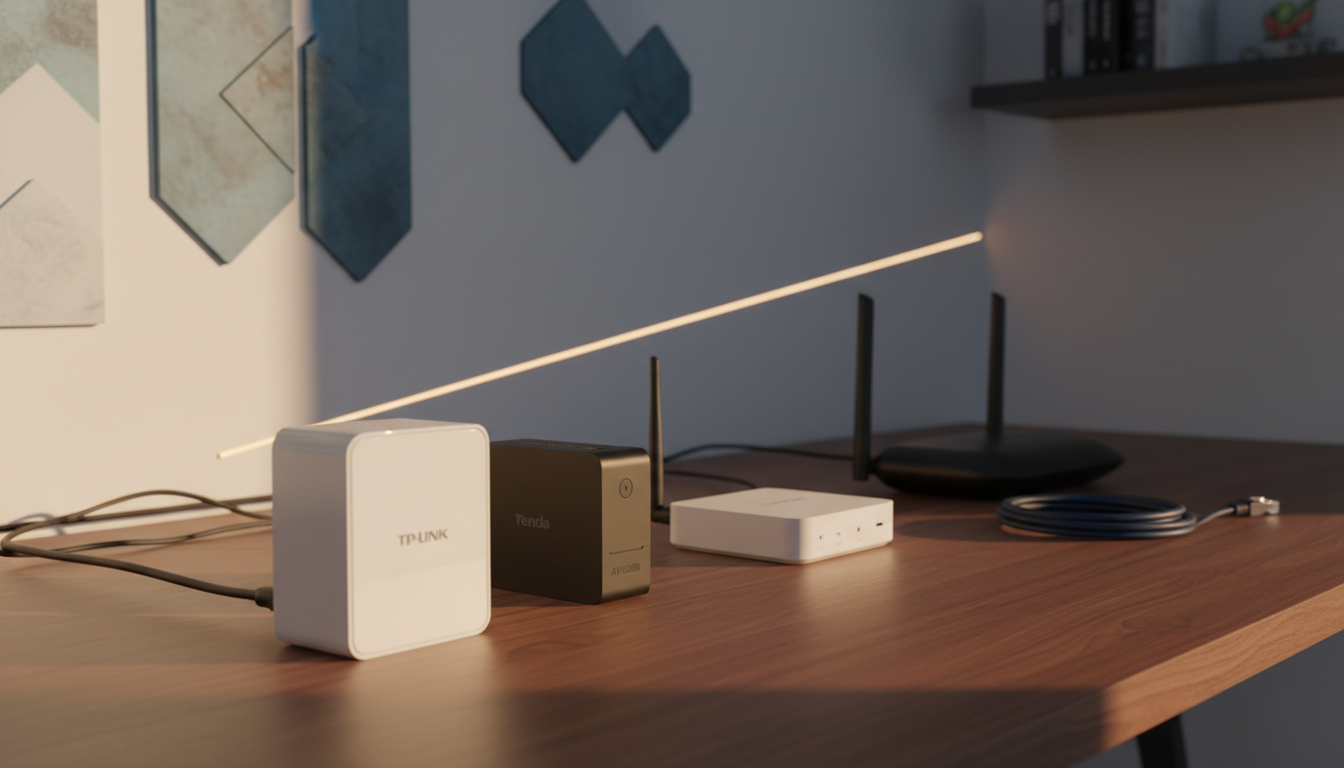
If you’re trying to stretch a wired connection without hunting for Ethernet cable, powerline adapters can turn any wall outlet into a network bridge. In this roundup we compared 5 options that sit under $100, split across three price tiers: the budget picks (TP‑Link AV1000 at $26.99 and TP‑Link Wi‑Fi Extender at $44.99), the mid‑range Tenda AV1000 at $45.99, and the premium offerings from Linksys ($69.99) and Actiontec ($89.99). All models use HomePlug AV2 technology, but they differ in speed, extra features and power draw, so you can match the kit to your home’s layout and internet plan.
For example, the TP‑Link AV1000 offers a maximum powerline speed of 1000 Mbps, a 4.2‑star rating from 11,267 reviews, and a compact nano form that fits flush into an outlet. The Tenda kit delivers the same 1000 Mbps ceiling but lists a real‑world speed of about 256 Mbps and a low standby draw of 0.36 W. Linksys limits powerline speed to 200 Mbps but adds Wi‑Fi for a combined 500 Mbps throughput, while the Actiontec pair focuses on reliability with 128‑bit AES security for modest 500 Mbps links. In the sections that follow, we’ll break down each adapter’s strengths, power usage and ideal use cases so you can pick the right solution for your network.

TP-Link AV1000 Powerline
Its shallow 65.0 mm depth makes it easy to plug in without blocking other outlets.

Tenda AV1000 Powerline
Ideal for users who want a slightly larger adapter for stable connections, and it’s about $19 more than the TP‑Link best‑overall model.

Linksys Powerline AV Wireless
Offers built‑in Wi‑Fi plus a 3.27 in depth, delivering wireless extension that the TP‑Link and Tenda adapters lack.
Also considered
Score Analysis
Key score advantages vs. runner-up (Tenda AV1000 Powerline)
Price Range
TP-Link AV1000 Powerline
$26.99
Tenda AV1000 Powerline
$45.99
Linksys Powerline AV Wireless
$69.99

TP-Link Powerline Wi-Fi Extender
$44.99

Actiontec Powerline 500
$89.99
Spec Comparison
TL;DR: For $26.99, the TP‑Link TL‑PA7017 delivers up to 1000 Mbps over existing wiring, packs a nano‑sized design, and offers energy‑saving operation, making it the cheapest solid HomePlug AV2 kit.
This kit advertises a theoretical maximum Powerline speed of 1000 Mbps and can reach up to 300 meters through your home’s electrical wiring. At just 65.0 mm deep, 50.8 mm high and 52.07 mm wide, it sits flush in the outlet and weighs about 0.60 lb, so it won’t dominate the wall.
Priced at $26.99, it costs far less than the four other options in this roundup, and its weight makes it the heaviest of the group (the others range from roughly 0.22 lb to 0.55 lb). While the competing TP‑Link Powerline Wi‑Fi Extender adds Wi‑Fi, it still costs more, and the Tenda, Linksys and Actiontec units are all lighter.
Reviewers praise the plug‑and‑play setup, the 128‑bit AES encryption and the OFDM modulation that keep a stable gigabit Ethernet link in homes with clean wiring. Energy‑saving mode cuts power use by up to 85 % when idle, with a maximum consumption of 2.7 W and a typical draw of 2.3 W (0.5 W standby). However, users note that real‑world speeds often fall short of the 1000 Mbps ceiling, the adapter blocks the outlet, and pairing can be finicky.
Pros
Cons
Best for: Users who need a quick, wired gigabit extension in modern homes with clean electrical circuits, especially for single‑room setups like a smart TV or gaming console.
Avoid if: Your home has outdated or noisy wiring, you need the outlet to stay free, or you require guaranteed gigabit throughput for professional‑grade networking.
TL;DR: The Tenda AV1000 Powerline adapter offers up to 1000 Mbps theoretical speed, a compact 3.25‑inch design, and low‑power consumption for reliable wired networking under $50.
What really stands out is the advertised Powerline Speed of up to 1000 Mbps combined with a transmission range of up to 300 meters, letting you extend gigabit‑class Ethernet through existing wall outlets. The unit measures just 3.25 inches tall, 2.5 inches long and 1.5 inches wide, and it weighs only 0.220462262 pounds, making it one of the lightest adapters in this group.
Compared with the four other adapters in the roundup, the Tenda's lighter than the TP‑Link Powerline Wi‑Fi Extender (0.44 lb), the TP‑Link AV1000 (0.59965735264 lb), the Linksys model (0.551155655 lb) and the Actiontec unit (0.4 lb). It also stays smaller than the TP‑Link extender’s 124 mm height and the Linksys’s 6.65 inches height. However, the Tenda lacks built‑in Wi‑Fi that the TP‑Link extender and the Linksys provide, and it does not include a passthrough socket, which some users find limiting.
Users consistently praise the plug‑and‑play auto‑pairing button and the low idle draw of 0.36 W, with professional reviewers noting the Broadcom chipset’s reliability. The downside that appears in many reviews is the real‑world throughput of roughly 256 Mbps, far below the 1000 Mbps ceiling, and occasional pairing hiccups on older wiring. Energy‑saving mode can cut consumption by up to 85 % when the adapters are idle.
Pros
Cons
Best for: Most users seeking a balanced, mainstream option
Avoid if: You need Wi‑Fi coverage, a passthrough outlet, or expect the full 1000 Mbps in everyday use
TL;DR: The Linksys PLWK400 delivers up to 200 Mbps over powerline and 300 Mbps Wi‑Fi, packs two adapters in a compact 3.27‑in‑deep, 0.55‑lb design, and offers plug‑and‑play setup for dead‑zone coverage.
This kit’s standout spec is its combined throughput: a theoretical 200 Mbps powerline link plus a 300 Mbps wireless bridge, giving a total advertised 500 Mbps capacity. The adapters sit at 3.27 in depth, 6.65 in height and 9.49 in width, and the whole package weighs just 0.55 lb, making it easy to slip into any outlet without crowding the wall.
Compared with the four other contenders, the Linksys unit is heavier than the Actiontec Powerline 500 (0.4 lb) and the ultra‑light Tenda AV1000 (0.22 lb), but about the same as the TP‑Link AV1000 (0.60 lb). Its 200 Mbps powerline speed falls short of the 1000 Mbps claims from the Tenda and TP‑Link models, and its 300 Mbps Wi‑Fi is slower than the AC1200 (up to 867 Mbps on 5 GHz) that the TP‑Link Wi‑Fi extender offers.
Users consistently praise the plug‑and‑play experience: the quick install guide and WPS button let you get online without extra cables. Professional reviewers note the kit’s usefulness for basements or garages where Wi‑Fi struggles, and they appreciate WPA2 security and QoS support. The downside most users mention is that real‑world speeds often dip when the home’s electrical wiring is old or complex, and each adapter only provides a single Fast Ethernet (100 Mbps) port, limiting wired performance.
Technical details round out the package: HomePlug AV, AV2 and AV500 standards, built‑in power‑saving modes, and LED indicators for power, link and wireless status. Setup software comes on a CD, and the kit includes a quick install guide. WPA2 encryption handles security, and QoS helps prioritize traffic across devices.
Pros
Cons
Best for: Those prioritizing quality and willing to pay for premium performance
Avoid if: You need gigabit‑speed wired connections or have very old electrical wiring that may hinder powerline performance
“Easy setup with simple instructions and software.”
“Reduces lag spikes and improves inconsistent speeds.”
TL;DR: The TP‑Link TL‑WPA7617‑KIT delivers up to 1000 Mbps over HomePlug AV2 powerline and AC1200 dual‑band Wi‑Fi, but it's higher power draw and price make it a solid but not the cheapest choice.
This kit’s headline spec is a theoretical Powerline Speed of up to 1000 Mbps, paired with AC1200 Wi‑Fi (1200 Mbps total) that splits into 300 Mbps on 2.4 GHz and 867 Mbps on 5 GHz. It also offers a range of up to 300 meters through existing wiring, and the manufacturer lists its maximum power consumption at 11 W with a typical draw of 6.5 W.
Compared with the four other adapters in the roundup, the TL‑WPA7617‑KIT sits in the middle of the size spectrum: it is taller than the Tenda AV1000 (3.25 in) but shorter than the Linksys model (6.65 in), and its 124 mm (≈4.9 in) height exceeds the TP‑Link AV1000’s 50.8 mm (≈2.0 in). Weighing 0.44 lb, it outweighs the Tenda unit (0.22 lb) yet is lighter than the TP‑Link AV1000 (≈0.60 lb). In terms of raw speed, it matches the Tenda and TP‑Link AV1000’s 1000 Mbps powerline ceiling, while far outpacing the Linksys adapter’s 200 Mbps limit. However, its 11 W peak draw is considerably higher than Tenda’s sub‑3.2 W full‑load consumption and TP‑Link AV1000’s 2.7 W maximum.
Reviewers consistently note that the device provides stable, high‑speed connectivity suitable for HD streaming, online gaming, and large file transfers. Professional assessments note the reliable HomePlug AV2 performance and the convenience of EasyMesh compatibility, plus 128‑bit AES powerline encryption and WPA‑PSK/WPA2‑PSK Wi‑Fi security. Users also appreciate the Pair button and the tpPLC app for quick setup, though several mention that the price feels a bit steep for the value compared with lighter, lower‑consumption rivals.
Beyond the headline speeds, the kit includes a Gigabit Ethernet port, LED indicators for power, powerline, Ethernet and Wi‑Fi status, and a Wi‑Fi Clone button that copies existing network credentials. Its typical power consumption of 6.5 W keeps it reasonable for continuous operation, while the 300‑meter theoretical range makes it a practical solution for multi‑story homes that rely on existing electrical circuits.
Pros
Cons
Best for: Entry-level buyers or those on a tight budget
Avoid if: You want the best value‑per‑dollar in its price range
TL;DR: The Actiontec Powerline 500 costs $89.99, weighs 0.4 lb, offers a theoretical 500 Mbps HomePlug AV+ link, 128‑bit AES security and plug‑and‑play setup, but its 10/100 Mbps Ethernet port and lack of a pass‑through outlet limit high‑speed use.
Actiontec advertises a 500 Mbps HomePlug HD powerline connection and backs it with 128‑bit AES push‑button security, so you get encrypted data without extra software. The kit is compact enough to sit flush on a wall outlet and the plug‑and‑play design means you simply plug the adapters in and start using Ethernet right away.
At 0.4 lb, this adapter is heavier than the Tenda AV1000 Powerline but lighter than the Linksys Powerline AV Wireless, the TP‑Link Powerline Wi‑Fi Extender and the TP‑Link AV1000 Powerline. Its advertised 500 Mbps speed sits between the Linksys’s 200 Mbps rating and the 1000 Mbps claims of the other three rivals, making it a mid‑range option. It is also pricier than the Tenda and the TP‑Link AV1000 models, though it carries the Actiontec brand confidence.
Reviewers consistently praise the easy, software‑free setup and the reliable streaming performance for modest internet plans, noting smooth playback up to about 20 Mbps. Professional testers echo this, calling the unit “solid” for basic use. However, the single Ethernet port limits speeds to 10/100 Mbps, which clashes with the 500 Mbps powerline claim and makes gigabit transfers impossible. Users also report that real‑world speeds often fall well under the advertised maximum—frequently below 100 Mbps—and the absence of a pass‑through outlet reduces the number of usable sockets at the installation point. The manufacturer doesn’t list power‑consumption figures.
Pros
Cons
Best for: Users with modest internet speeds who need a reliable wired extension and value built‑in security.
Avoid if: You have a tight budget, need gigabit LAN performance, or require a pass‑through outlet for additional devices.
“rock solid for years”
“full speed delivery for modest connections”
Breakdown
TP-Link AV1000 Powerline
Pros
Tenda AV1000 Powerline
Pros
Linksys Powerline AV Wireless
Pros
TP-Link Powerline Wi-Fi Extender
Pros
Cons
Based on scoring data and product specs
Personalized picks
Best Overall Pick
TP-Link AV1000 Powerline
Best OverallBest for: Users with specific technical requirements or compatibility needs
Tenda AV1000 Powerline
Best for: Most users seeking a balanced, mainstream option
$45.99+$19.00 vs winner
Skip Actiontec Powerline 500 if…
You're on a tight budget or only need basic functionality
TP-Link AV1000 Powerline takes the top spot with a solid 4.2‑star rating from 11,267 reviewers, a listed maximum powerline speed of 1000 Mbps, and a 2‑year manufacturer warranty—all for just $26.99. Its 128‑bit AES encryption and three LED indicators (Power, Powerline, Ethernet) give you confidence that the connection is both secure and active, while the included 6.5‑ft Ethernet cable makes setup a breeze.
The runner‑up, Tenda AV1000 Powerline, shines when you need a sturdier, fire‑retardant design and a longer warranty. Its V0‑class housing and 3‑year warranty provide extra peace of mind, and the built‑in power‑saving mode can cut consumption by up to 85 %. With real‑world speeds around 256 Mbps, it’s a solid choice for a small‑office or apartment where a bit more protection is worth the $45.99 price tag.
Grab the TP‑Link AV1000 Powerline today and enjoy reliable wired speed without breaking the bank.
Both the TP‑Link AV1000 Powerline and the Tenda AV1000 Powerline list a maximum speed of 1000 Mbps, and the TP‑Link Powerline Wi‑Fi Extender also advertises up to 1000 Mbps over the electrical wiring. The Linksys Powerline AV Wireless is limited to 200 Mbps, and the Actiontec Powerline 500 does not specify a speed.
No reviews yet — be the first to share your experience.
Please sign in to leave a review
