⚡ Quick Answer
At just $33.99, the Teeho TE001 packs a 4.6‑star rating from nearly 23 000 reviewers, an oval satin‑nickel finish, and capacity for 20 user codes—all without needing Wi‑Fi or a smartphone app. Its compact 5.12 × 2.95 × 1.3‑inch form fits a standard 2‑1/8‑inch door hole, and the 1.76‑pound deadbolt offers auto‑lock and a mute mode for noisy homes. Those specs give it premium‑grade convenience at a true budget price.
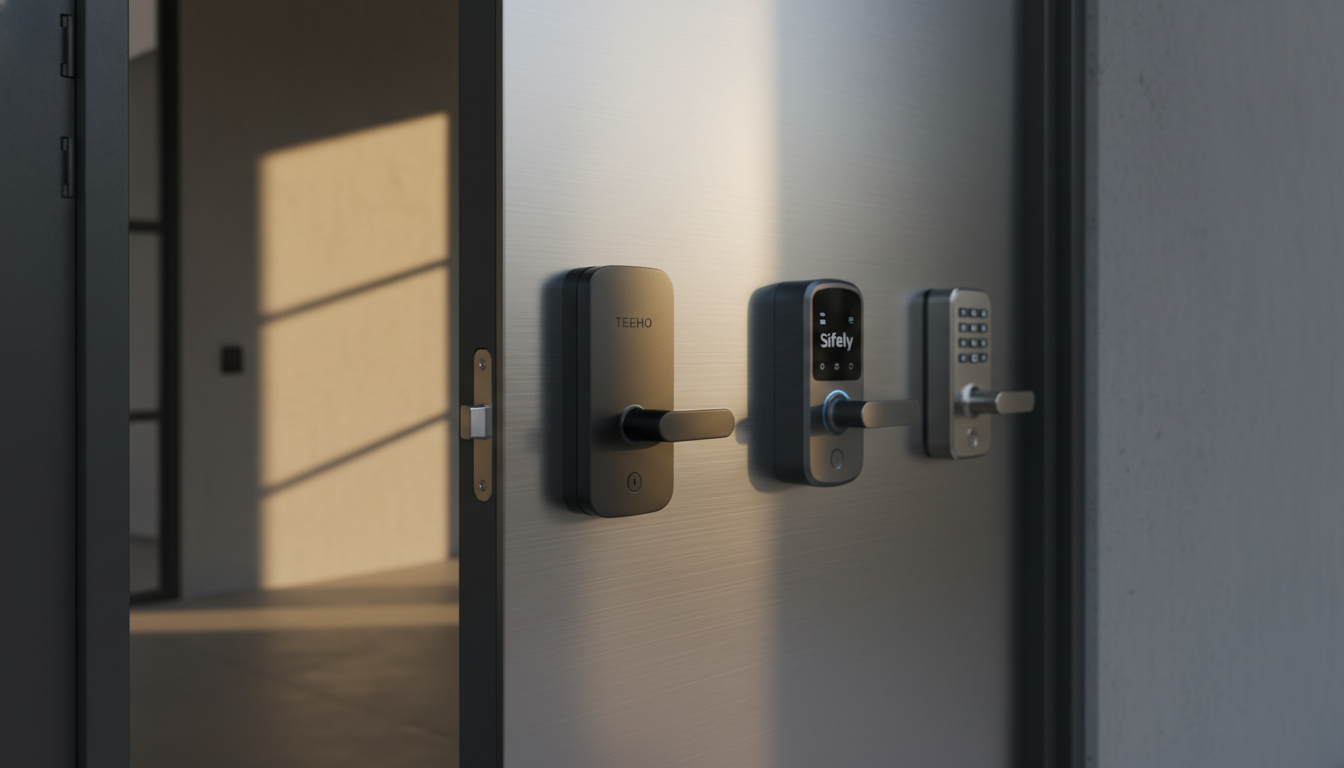
Our roundup compares eight smart locks across three price tiers: budget options (Teeho, Yamiry, Ultraloq), mid‑range choices (Sifely at $67.97 and Wyze at $79.98), and premium models (Kwikset at $89.48, Schlage at $90.00, and eufy at $98.48). Ratings range from 4.3 to 4.5 stars, and weights vary from 1.5 to 4.5 pounds, reflecting different installation styles and feature sets. Expect a mix of fingerprint, keypad, and app unlock methods, plus auto‑lock features on several units.
Next, we’ll break down how each lock’s capabilities line up with everyday scenarios so you can pinpoint the right fit for your door.

Teeho TE001
Its slim 1.3‑inch height keeps the lock low‑profile on any door, delivering a discreet look at a budget price.

Sifely Smart Lock
Ideal for tech‑savvy renters who want fingerprint, keypad and app access; it costs roughly $34 more than the Teeho budget option.

Wyze Bolt
Stands out with a quick 20‑minute DIY install, letting you secure a door fast without the longer setup some competitors require.
Also considered
TL;DR: For $33.99 the Teeho TE001 delivers a compact 5.12 × 2.95 × 1.3‑inch deadbolt, 20 user codes and solid weather protection, making it the strongest budget pick for simple keyless entry.
The lock’s dimensions—5.12 inches long, 2.95 inches wide and just 1.3 inches high—fit neatly on most standard exterior doors, and at 1.76 pounds it feels sturdy without being bulky. Its anti‑peeping password, back‑lit touch keypad, mute mode and one‑touch auto‑lock (press any key for 2 seconds) give you a smooth, low‑noise experience.
Compared with the seven other locks in this roundup, the TE001 is noticeably lighter than the Ultraloq, Sifely, Wyze and Kwikset options, and its 5.12‑inch length is slightly shorter than the Yamiry Smart Knob’s 5.5‑inch length. While many competitors list Bluetooth, Wi‑Fi or fingerprint features, the TE001 stays app‑free, which keeps the price low and the installation simple.
Users consistently praise the easy setup, reliable keyless access and durability in rain or snow—thanks in part to its IP54 rating and an operating temperature range from –22 °F to 158 °F. Professional reviewers highlight the long battery life (up to 1 year on four AA cells) and the low‑battery red‑light indicator as practical touches for everyday use.
Pros
Cons
Best for: Budget-conscious buyers seeking a reliable entry‑level option — the Teeho TE001 offers Height: 1.3 inches
Avoid if: You need remote smartphone control, real‑time activity logs, or built‑in Wi‑Fi/Bluetooth connectivity.
TL;DR: The Sifely Smart Lock costs $67.97, holds up to 200 fingerprints and 150+ passcodes, auto‑locks, and installs in under 20 minutes, making it a solid mid‑range choice for interior doors.
The standout spec is its high‑capacity biometric system – it stores 200+ fingerprints and more than 150 passcodes, far exceeding the 50‑fingerprint limits seen in many rivals. Auto‑lock works out of the box, and the lock’s anti‑peeping keypad overlay adds an extra layer of privacy.
Compared with the other seven locks in this roundup, the Sifely is heavier than the Ultraloq U‑Bolt 5‑in‑1 (3.0 lbs) and the Wyze Bolt (2.75 lbs) but lighter than the Kwikset SmartCode 955 (4.5 lbs). Its fingerprint capacity dwarfs the 50‑fingerprint caps of both Wyze and eufy Smart Lock C220, while its lever‑style handle differs from the deadbolt designs of Ultraloq and Kwikset. The bore diameter of 2 1/8 inches matches the door‑hole size of the Teeho TE001, and its 3.6 lb weight sits between the lightweight Schlage Plymouth (1.5 lb) and the bulkier Kwikset model.
Homeowners praise the lock’s easy DIY install – no drilling and just a Phillips screwdriver are needed, with most users finishing in 10–20 minutes. Families like the multiple unlock options (fingerprint, keypad, fob, card, app, key) and the inclusion of two physical keys for emergencies. Professional reviewers note the zinc‑alloy construction feels sturdy, and the white‑box encryption keeps credentials safe. The main complaints focus on fingerprint scans slowing down when fingers are wet or greasy, and the lack of an explicit weather‑proof rating means it’s best kept on sheltered entryways.
Pros
Cons
Best for: Most users looking for a well‑reviewed, reliable mainstream option — the Sifely Smart Lock offers Fingerprint Capacity: 200
Avoid if: You need a lock for fully exposed exterior doors in harsh climates or require flawless fingerprint performance under wet conditions.
“much better than expected for the price”
“love the fingerprint unlock indoors; it becomes a habitual, quick method”
TL;DR: The Kwikset SmartCode 955 offers commercial‑grade durability, a backlit keypad and SmartKey rekeying at a $89 price point, delivering 30 user codes and 500,000 cycles for property managers.
The standout spec is its 500,000‑cycle durability, meaning the lock is built for heavy‑use environments. It also supports up to 30 customizable user codes, more than many residential competitors. The backlit, motion‑activated keypad adds convenience in low‑light areas, and SmartKey technology lets you rekey the lock without removing it from the door.
At 4.5 pounds, the SmartCode 955 is heavier than the Schlage Plymouth (1.5 pounds) and the Teeho TE001 (1.76 pounds), yet lighter than a typical commercial deadbolt that can exceed 5 pounds. Its depth of 3.87 inches is notably shallower than the eufy Smart Lock C220’s 7.67 inches, making it a more compact fit for standard door preparations. In terms of code capacity, Kwikset’s 30 slots beat the Schlage Plymouth’s 19 total codes and the Teeho’s 20‑code limit.
Reviewers consistently praise the BHMA certification and the quick‑rekey feature, calling the lock “reliable for multi‑unit properties.” Users also like the illuminated keypad for nighttime entry. The most common drawback mentioned is the reliance on a single 9 V battery, which some find less convenient than AA/AAA options. A handful of buyers note that the manufacturer doesn’t list detailed installation dimensions, which can complicate planning.
Pros
Cons
Best for: Buyers willing to invest in a proven, high‑quality option — the Kwikset SmartCode 955 offers Depth: 3.87 inches
Avoid if: You're on a tight budget or only need basic functionality
TL;DR: The Schlage Plymouth delivers a metal, satin‑chrome lever lock with a 4.42‑inch grip, auto‑lock after 5 seconds, LED keypad and 3‑year battery life, but its 9‑V battery and 19‑code limit keep it in the premium‑price tier.
This lock’s standout spec is the 4.42‑inch lever grip, giving you a comfortable handle while the auto‑lock feature re‑engages the deadbolt 5 seconds after the door closes. It stores up to 19 user codes and runs on a single 9‑Volt battery that the manufacturer rates for three years of operation.
Compared with the other seven locks in our roundup, the Plymouth is lighter than the Kwikset SmartCode 955 (4.5 pounds) yet heavier than the eufy Smart Lock C220 (2.5 pounds). Its overall depth of about 3 inches is shallower than eufy’s 7.67‑inch depth, making it a good fit for tighter door frames. Unlike many peers, it offers no Bluetooth or Wi‑Fi integration, positioning it as a straightforward, non‑smart alternative.
Reviewers consistently praise the auto‑lock function and the LED‑backlit keypad for nighttime convenience, and they note the silicone‑rubber button material feels solid. On the downside, users mention the bulky 9‑V battery can be inconvenient to replace, and the 19‑code limit feels restrictive for larger households. The 10‑second timed entry window also draws criticism for being too short in some scenarios.
From a technical standpoint, the lock is built from metal with a satin‑chrome finish and carries an ANSI/BHMA Grade 2 security rating. It fits doors 1.375‑1.75 inches thick, with an adjustable backset of 2.375‑2.75 inches and a cross‑bore diameter of 2.125 inches. The latch throw is 1 inch, and the unit operates from –31 °F to 150.8 °F, covering most climate conditions.
Pros
Cons
Best for: Buyers willing to invest in a proven, high‑quality option — the Schlage Plymouth offers Lever Grip Length: 4.42 Inches
Avoid if: You're on a tight budget or only need basic functionality
TL;DR: The eufy Smart Lock C220 offers hub‑free Wi‑Fi, six unlock methods and sub‑0.3‑second fingerprint access, but its $98.48 price and AA‑battery upkeep make it a premium‑tier choice.
What really stands out is the built‑in Wi‑Fi that lets you skip a separate bridge, plus six ways to get in—including a self‑learning AI fingerprint that opens in <0.3 seconds. Auto‑lock works with a door sensor, and the lock can also be controlled by app, voice, passcode, physical key, or the lock/unlock button.
Compared with the other seven locks, the C220 sits at the higher end of the price range and weighs about 2.5 lb, making it heavier than the Schlage Plymouth (1.5 lb) but lighter than the Kwikset SmartCode 955 (4.5 lb). It’s also a bit bulkier than the Wyze Bolt, whose overall length is listed as 6.8 in, while the C220’s depth is 7.67 in. Its 6‑method unlock suite outpaces the Teeho TE001, which offers fewer user‑code options.
Users consistently praise the “zero lockout anxiety” provided by the physical key backup and the quick, accurate fingerprint that improves over time. The 15‑minute, no‑drill installation gets frequent mentions for being hassle‑free. On the downside, reviewers note that the lock runs on eight AA batteries, meaning you’ll be swapping them every few months—a point that many wish could be solved with a rechargeable option.
From a technical standpoint, the lock carries a BHMA Grade 3 rating and can withstand 2000 N of pressure, while the zinc‑alloy and stainless‑steel frame is rated IP53 for dust and splash protection. Encryption uses AES128 + ECC, and the unit tolerates temperatures from –22 °F to 158 °F, making it suitable for most climates.
Pros
Cons
Best for: Buyers willing to invest in a proven, high-quality option — the eufy Smart Lock C220 offers Installation Time: 15 minutes
“triumph of form and function”
“arguably the best lock in its class”
TL;DR: The Yamiry Smart Knob packs a 100‑fingerprint capacity, six unlock methods and a compact 5.5‑inch body into a $64.50 DIY lock that’s easy to install but needs a separate Wi‑Fi gateway for remote access.
This lock’s standout spec is its fingerprint capacity of 100 entries, the highest among the budget‑tier rivals listed. It also supports six distinct unlock methods – fingerprint, keypad code (6‑9 digits), IC card, smartphone app, mechanical key, and Alexa voice – all managed through the TTLock or Nice DiGi apps. The exterior assembly measures 0.79 inches high, 5.5 inches long and 2.95 inches wide, giving it a sleek matte‑black profile that fits standard American front doors.
Compared with the seven other locks in this roundup, the Yamiry is shorter than the Sifely Smart Lock’s 7.0‑inch length and slimmer than the Ultraloq U‑Bolt’s unspecified dimensions but comparable to the Teeho TE001’s 5.12‑inch length. Its fingerprint storage of 100 beats the Wyze Bolt’s 50 and sits below the Sifely’s 200, while the eufy C220 lists six unlock methods like Yamiry. Unlike the Ultraloq and Kwikset models, Yamiry does not include native Wi‑Fi and relies on a separate gateway for remote access, a trade‑off shared by a few peers.
Users praise the convenience of having a fingerprint slot that reliably recognizes kids’ prints and appreciate the anti‑peep keypad that hides the PIN behind random digits. Installation is frequently described as straightforward because it requires only a screwdriver and no extra drilling, though several reviewers note that the square latch must be perfectly aligned or the lock can bind. Bluetooth pairing hiccups also appear in the feedback, with some owners needing to restart the app to reconnect.
Additional technical touches include a privacy mode that blocks non‑admin access from the outside, an app‑based battery indicator, and a micro‑USB 5 V emergency power input for temporary power. The handle direction is adjustable for left‑ or right‑handed doors, and the package ships with 2 IC cards, 2 mechanical keys, a punch diagram, 4 screws and a user manual, making the first‑time setup smoother.
Pros
Cons
Best for: Budget‑conscious buyers seeking a reliable entry‑level option — the Yamiry Smart Knob offers Fingerprint Capacity: 100.
“Fingerprint feature works perfectly... great for older kids”
“several different ways to open including remotely from phone”
TL;DR: The Wyze Bolt delivers a 16‑ft Bluetooth range, 50‑fingerprint slots, and a 20‑minute DIY install for $79.98, making it a solid mid‑range choice for keyless entry.
What really stands out is the combination of a 16 ft Bluetooth range and local storage for up to 50 fingerprints, plus a backlit anti‑peep keypad. The lock auto‑locks on a customizable schedule and reports door‑jam events straight to the app, while the fingerprint unlock speed is listed as under 1 second.
At 2.75 lb, the Wyze Bolt is heavier than the Schlage Plymouth’s 1.5 lb body but considerably lighter than Kwikset SmartCode 955’s 4.5 lb unit. Its exterior footprint (2.6 in H × 3.0 in W × 6.8 in L) is more compact than the eufy Smart Lock C220’s 4.41 in H × 4.49 in W, yet it still offers more fingerprint slots than the Sifely Smart Lock’s 200‑capacity rival that weighs 3.6 lb. Installation time is a quick 20 minutes, faster than the 15‑minute claim for eufy and on par with most competitors.
Users repeatedly praise the straightforward installation and the convenience of sharing access with up to 50 users via the app. The backlit keypad and reliable fingerprint reader earn frequent compliments, while reviewers note occasional hiccups when the Bluetooth connection drops beyond the 16‑ft limit. Battery life of 10‑12 months on four AA cells is generally well‑received, though a few users report faster drain if they rely heavily on the keypad.
Professional reviewers highlight the BHMA certification and UL 20‑minute fire rating as strong safety credentials, and the IPX5 rating assures protection against splashes, though it’s not meant for full outdoor exposure. The lock stores event history locally, keeping your access logs private without a cloud subscription.
Pros
Cons
Best for: Most users looking for a well‑reviewed, reliable mainstream option — the Wyze Bolt offers Installation Time: 20 minutes.
Avoid if: You need advanced features or professional‑grade performance, such as Wi‑Fi remote access or higher weather resistance.
TL;DR: The Ultraloq U‑Bolt 5‑in‑1 Black packs 120‑fingerprint slots, IP65 weather protection and up to a year of battery life for $66.49, delivering solid value in the budget smart‑lock segment.
What really stands out is the 360° capacitive fingerprint sensor that stores up to 120 fingerprints, paired with a backlit anti‑peep keypad that holds up to 60 PIN codes. The lock also supports Matter‑over‑Thread, Bluetooth LE, NFC (Apple Home Key) and Z‑Wave Plus, giving you a wide range of smart‑home integrations without a dedicated hub.
Compared with the other seven locks in this roundup, the Ultraloq is lighter than the Sifely Smart Lock (3.6 lbs) but a bit heavier than the Wyze Bolt (2.75 lbs). Its fingerprint capacity of 120 exceeds the 50 slots on Wyze and eufy, yet falls short of Sifely’s 200. In terms of size, the 2.96 × 2.96 × 1.23 in exterior footprint is more compact than Kwikset’s 9.49‑inch height, but taller than the Teeho TE001’s 1.3‑inch profile.
Users frequently praise the hands‑free unlock for grocery trips and the seamless Matter integration that removes the need for extra hubs. Professional reviewers note the refreshed auto‑unlock geofencing and the configurable auto‑lock timer ranging from 10 seconds to 5 minutes. A common complaint is that remote status features often require an optional Wi‑Fi or Z‑Wave bridge, and the lock’s 8 AA battery requirement can be higher than some rivals.
Pros
Cons
Best for: Budget-conscious buyers seeking a reliable entry-level option — the Ultraloq U‑Bolt 5‑in‑1 Black offers Weight: 3.0 lbs
Avoid if: Reliability and user satisfaction are your top concerns
Breakdown
Teeho TE001
Pros
Sifely Smart Lock
Pros
Cons
Wyze Bolt
Pros
Cons

Kwikset SmartCode 955
Pros
Based on scoring data and product specs
Personalized picks
Best Overall Pick
Teeho TE001
Best Budget PickBest for: Budget-conscious buyers seeking a reliable entry-level option — the Teeho TE001 offers Height: 1.3 inches
Sifely Smart Lock
Best for: Most users looking for a well-reviewed, reliable mainstream option — the Sifely Smart Lock offers Fingerprint Capacity: 200
$79.99+$44.00 vs winner
Skip Schlage Plymouth if…
You're on a tight budget or only need basic functionality
The Teeho TE001 wins the keyless entry lock roundup. At just $33.99 it undercuts every competitor, yet it still earns a strong 4.6‑star rating from 22,971 reviewers. It supports 20 unique user codes, offers an anti‑peeping password keypad with backlit keys, and its IP54 rating means it can handle the damp conditions of most entry doors.
The Sifely Smart Lock takes the runner‑up spot, making it a solid choice if you need a lock that blends biometric convenience with smart‑home integration. It features auto‑lock, a 200‑fingerprint capacity, and unlock options that include fingerprint, keypad, key fob, card, app and traditional key. Plus, it works with Amazon Alexa and Google Assistant, and its battery life lasts about a year.
For those looking beyond the budget champion, the Wyze Bolt stands out as the best mid‑range pick at $79.98, delivering reliable keyless entry without breaking the bank. If you’re willing to spend a bit more for premium features, the eufy Smart Lock C220 at $98.48 offers a higher‑end experience with robust build quality and advanced connectivity.
Pick the Teeho TE001 today and enjoy secure, keyless access without paying a premium.
The Teeho TE001 costs $33.99, which is about $33.98 cheaper than the Sifely Smart Lock’s $67.97 price tag, and it carries a higher user rating of 4.6 versus 4.3. Despite the lower price, Teeho still offers anti‑peeping password entry, one‑time codes, and a mute mode, giving you premium features without the premium cost.
No reviews yet — be the first to share your experience.
Please sign in to leave a review