⚡ Quick Answer
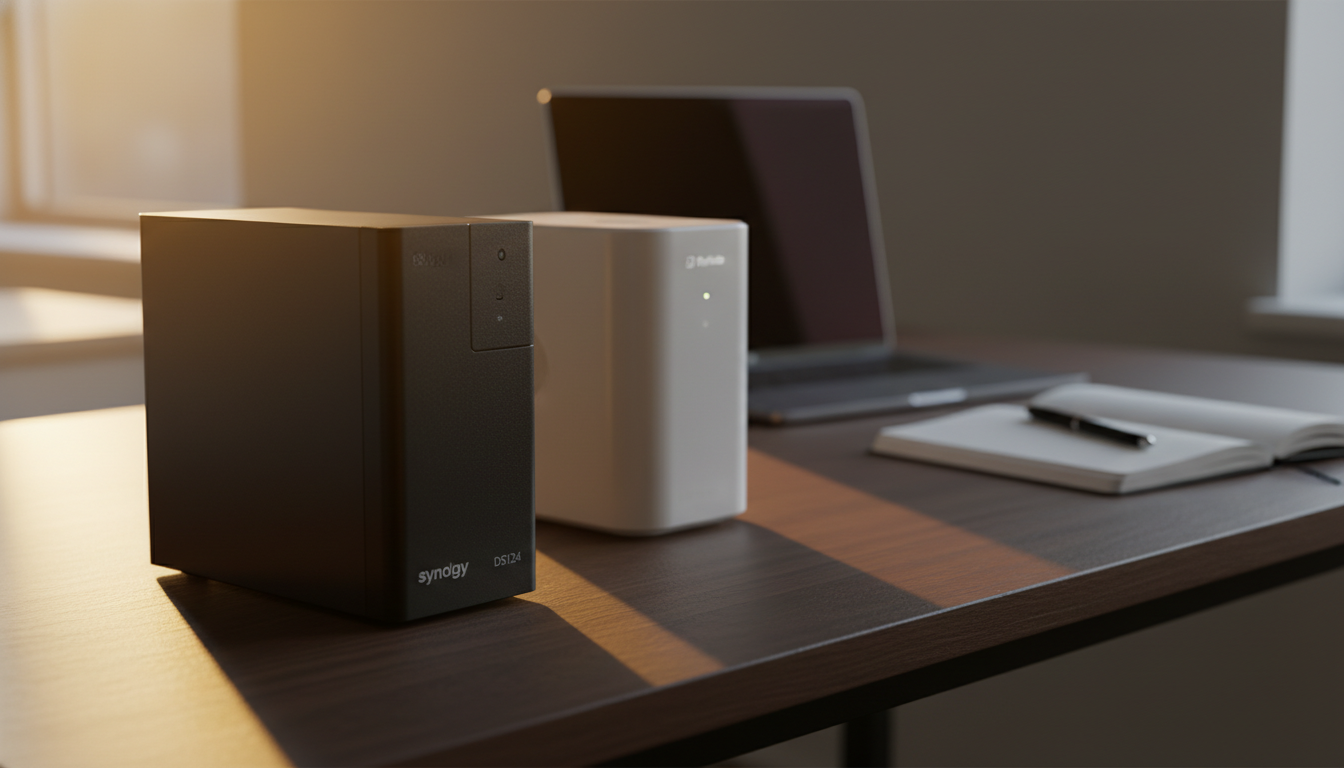
If you’re hunting a compact NAS that won’t break the bank, the Synology DS124 stands out. At $143.99 it carries a solid 4.5‑star rating from 838 reviewers, runs a 1.7 GHz quad‑core Realtek CPU, and packs 1 GB DDR4 memory—all inside a chassis that whispers at just 19.0 dB(A). Its 10.69 W power draw keeps electricity costs low, and the 2.75‑lb unit slides easily onto a desk or shelf, making it a practical choice for home offices or small‑scale media libraries.
Our roundup compares eight models across three price tiers. The budget tier includes the Synology DS124, the ultra‑light Synology BeeDrive, and the pocket‑sized SSK Portable NAS. Mid‑range options are the Qnap TS‑133‑US 2GB and Amber X Smart Personal Cloud, while the premium tier features the Buffalo LinkStation 210, SSK Portable SSD, and the higher‑capacity Synology DS223j. Below we’ll walk through each device’s strengths and who they suit best, so you can match a NAS to your budget and needs.

Synology DS124
Its ultra-quiet operation at just 19.0 dB(A) makes the DS124 ideal for home offices or bedroom setups where noise matters.
Synology DS223j
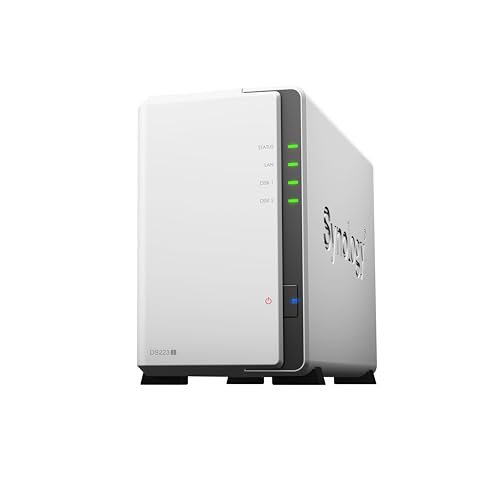
Designed for buyers who want a proven Synology experience, the DS223j costs $51 more than the DS124, offering extra capacity for growing media libraries.
Buffalo LinkStation 210
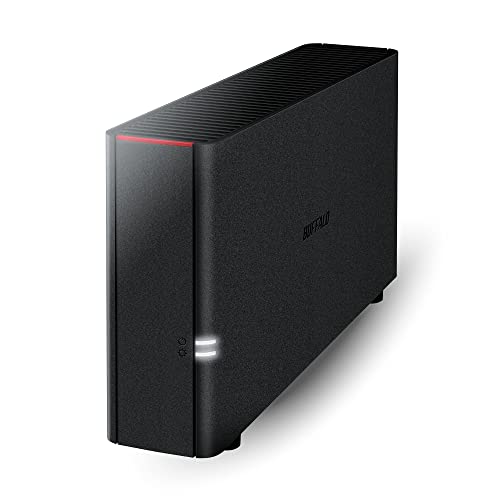
The LinkStation 210 stands out with a larger 8.67‑in (220 mm) height, catering to users who prefer a bulkier chassis and benefit from its strong brand popularity.
Also considered
Score Analysis
Key score advantages vs. runner-up (Synology DS223j)
Price Range
Synology DS124
$141.99
Synology DS223j
$194.99
Buffalo LinkStation 210
$192.99

Qnap TS-133-US 2GB
$113.50
SSK Portable NAS
Out of Stock

SSK Portable SSD
$179.99

Synology BeeDrive
Out of Stock

Amber X Smart Personal Cloud Storage
$249.00
Spec Comparison
TL;DR: The Synology DS124 delivers a solid entry‑level NAS with a 1.7 GHz quad‑core CPU, 1 GB RAM, and up to 108 TB capacity for under $150, earning a 4.5‑star rating from 838 users.
The standout spec is its massive 108 TB maximum single‑volume size, paired with a 1.7 GHz Realtek quad‑core processor and a built‑in hardware encryption engine for data protection. At just 19.0 dB(A) noise and a compact 71 mm depth, it stays quiet enough for a home office while weighing 2.75 pounds (1248 g).
Compared with the other seven picks, the DS124 is noticeably shallower than the Qnap TS‑133 (71 mm vs 157 mm) but louder than that model’s 2‑6 dB noise floor. It also feels considerably heavier than the ultra‑light Synology BeeDrive (1248 g vs 43 g) and the SSK Portable NAS (295 g). Unlike the SSK, the DS124 offers a wired 1 GbE port and two USB 3.2 Gen 1 connections, which provide more reliable network throughput.
Reviewers like the intuitive DSM software, the integrated encryption, and the selectable fan‑speed modes that keep power draw down to 10.69 W during access. Users like its easy setup for home backups and media streaming, though the single‑bay design means you can’t hot‑swap drives.
Pros
Cons
Best for: Budget‑conscious buyers seeking a reliable entry‑level option
Avoid if: You have limited desk space or need portability
TL;DR: The Synology DS223j delivers near‑silent operation at 18.2 dB, consumes just 16.31 W while active, and offers two drive bays for up to 108 TB of personal storage at a sub‑$200 price.
The standout spec is its ultra‑quiet design, measuring only 18.2 dB(A) and making it ideal for home offices or living‑room setups. Power draw stays low at 16.31 W during access and drops to 4 W when drives hibernate, helping keep electricity bills modest. With a Realtek RTD1619B 4‑core 1.7 GHz CPU, 1 GB DDR4 RAM, and support for up to 108 TB across two 3.5″ or 2.5″ drives, the unit balances modest performance with generous capacity.
Compared with the other seven entries, the DS223j is lighter than the Buffalo LinkStation 210 (2.43 lb) but heavier than the Synology BeeDrive (0.09 lb). Its 165 mm depth sits a touch deeper than the Qnap TS‑133‑US (157 mm) while its 100 mm width is considerably narrower than that Qnap’s 157 mm width, giving it a compact desktop footprint. The unit’s single 1 GbE port mirrors the network setup of the Qnap and has fewer ports than the multiple ports found on higher‑end models, keeping the price competitive.
Users consistently praise the DS223j for its silent operation and energy efficiency, noting that it runs unobtrusively in a bedroom or study. Professional reviewers highlight the limited 1 GB RAM as a bottleneck for multitasking or running many apps, and the single gigabit Ethernet link can feel slow when moving large media libraries. Nonetheless, the intuitive DiskStation Manager (DSM) software and features like power recovery, scheduled power on/off, and a full suite of RAID options make everyday backups and modest media streaming hassle‑free.
Pros
Cons
Best for: Home users or beginners who want reliable, quiet storage for personal backups and modest media streaming.
Avoid if: You need high‑speed transfers, heavy multitasking, or 4K video transcoding for multiple concurrent users.
TL;DR: The Buffalo LinkStation 210 packs a 4 TB hard drive, 800 MHz ARM processor and SSL‑protected personal cloud into a 2.43 lb, 8.67‑in‑tall box for under $200, but its slower USB 2.0 and modest RAM keep it in the entry‑level lane.
The LinkStation 210 includes a pre‑installed 4 TB SATA drive, an 800 MHz dual‑issue ARM processor, and 256 MB DDR3 memory. It draws up to 24 W and connects via a single Gigabit Ethernet port, while a USB 2.0 Type‑A port tops out at 480 Mbps. Its compact chassis measures 8.67 in × 9.45 in × 3.31 in and weighs 2.43 lb, fitting easily on a home desk or bookshelf.
The LinkStation 210 stands taller than the 0.83‑in profile of the SSK Portable SSD and longer than that SSD’s 5.20‑in length. It also outweighs the sub‑pound Amber X Smart Personal Cloud (≈0.66 lb). Storage‑wise, its 4 TB capacity doubles the 2 TB offered by both the SSK Portable SSD and the SSK Portable NAS. However, the 800 MHz CPU lags behind the 1.8 GHz processor in the Qnap TS‑133‑US and the 1.7 GHz chips found in Synology’s DS223j and DS124 models. Likewise, 256 MB DDR3 RAM is modest next to the 2 GB DDR4 in the Qnap and the 1 GB DDR4 in Synology devices. The USB 2.0 speed of 480 Mbps is also slower than the up‑to‑6 Gbps wired speed advertised for the SSK Portable SSD, and its 24 W power draw exceeds the 10.69 W access consumption of the Synology DS124.
Professional reviewers praise the subscription‑free WebAccess cloud feature and the built‑in SSL encryption for secure remote file access on iOS and Android. Home users appreciate the generous 4 TB drive and the two‑year warranty, noting that the closed‑system design adds a layer of protection against unauthorized access. On the downside, many report that initial setup can be unintuitive—especially on mesh networks or with Windows 11 security settings—and that transfer speeds feel sluggish, a symptom of the modest processor and USB 2.0 interface. The device also lacks RAID support, limiting redundancy options for those who need extra data safety.
Pros
Cons
Best for: Home users or small households that want a simple, secure way to centralize backups and enjoy free personal cloud access.
Avoid if: You need high‑speed transfers, RAID redundancy, or a more expandable solution for power‑user or small‑business scenarios.
“great unit for price”
TL;DR: The QNAP TS‑133‑US offers a fast 1.8 GHz quad‑core ARM CPU, 2 GB RAM and ultra‑quiet 2‑6 dB operation in a compact 157 mm cube for $159, making it a solid entry‑level NAS.
The standout hardware is its 1.8 GHz quad‑core ARM Cortex‑A55 processor paired with 2 GB DDR4 memory, a combination that reviewers call the most powerful among 1‑bay NAS devices in this price tier. Its dimensions—157 mm depth, 188 mm height and 157 mm width—give it a low‑profile footprint that fits easily on a desk or shelf, while the noise level of just 2‑6 dB keeps it whisper‑quiet during backups.
Compared with the other seven options, the TS‑133‑US is quieter than the Synology DS124, which lists a noise level of 19.0 dB. Its 188 mm height also makes it more compact than the DS124’s 224 mm chassis. On the performance side, the 1.8 GHz CPU runs slightly faster than the 1.7 GHz processors found in the Synology DS124 and DS223j, and the 2 GB RAM outpaces the 1 GB found in those models. While its single 1 GbE Ethernet port is fewer than the multiple‑port setups on some peers, the unit still delivers solid single‑drive speeds for everyday backups and media streaming.
Professional reviewers note the device’s broad QTS app ecosystem, AI acceleration support and iSCSI LUN capability for up to 256 LUNs, making it versatile for file sharing, surveillance and light virtualization. Users appreciate the quiet operation and straightforward entry into the QNAP environment, though they frequently mention the fixed 2 GB RAM and lack of RAID redundancy as limiting factors for future expansion or data protection. The unit ships with a 2‑year warranty and includes both USB 2.0 (480 Mbps) and USB 3.0 (5 Gbps) ports for local connectivity.
Pros
Cons
Best for: Value-conscious buyers seeking quality at $159.00
Avoid if: You have limited desk space or need portability
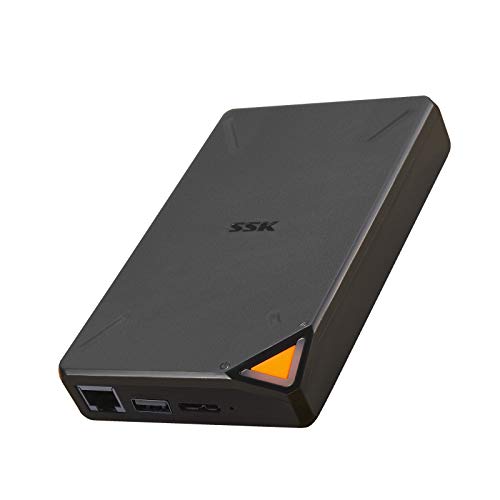
TL;DR: The SSK Portable NAS packs a 2 TB HDD, 3800 mAh battery and Wi‑Fi hotspot into a 295 g, 130 × 80 × 20 mm case for on‑the‑go personal cloud storage at $145.99.
The standout feature is its built‑in 3800 mAh Li‑polymer battery, which not only powers the NAS but also works as a power bank for other devices. At just 295 g and measuring 130 mm long, 80 mm wide and 20 mm high, it’s one of the smallest and lightest options in this lineup.
Compared with the other seven devices, the SSK is markedly lighter than the Synology DS124 (≈1248 g) and the Buffalo LinkStation 210 (≈1.1 kg), and only marginally heavier than the Amber X unit (≈300 g). Its 20 mm height is far slimmer than the DS124’s 224 mm and the Qnap TS‑133‑US’s 188 mm, putting it among the most pocket‑friendly choices. Lengthwise it matches the Amber X’s 124 mm and the BeeDrive’s 130 mm, while its width of 80 mm is narrower than the DS124’s 166 mm but wider than the BeeDrive’s 65 mm.
Users praise the convenience of a wireless, battery‑powered personal cloud that can also charge phones or tablets, and they appreciate the one‑key backup and multi‑user sharing features in the SSKCloud app. Reviewers note the compact form factor as a strong plus. The most common criticism targets the modest real‑world transfer speed—about 5–10 MB/s despite a 300 Mbps Wi‑Fi rating—and the below‑average 3.4‑star rating, which suggests some users encounter reliability hiccups.
It supports Samba and DLNA for smart‑TV and laptop streaming, offers P2P remote access without geographic limits, and includes USB 3.0 plus an optional RJ45 port for wired connections. A one‑year warranty rounds out the package.
Pros
Cons
Best for: Entry-level buyers or those on a tight budget
Avoid if: Reliability and user satisfaction are your top concerns
TL;DR: The SSK Portable SSD packs 2 TB of SSD storage, up to 10 Gbps wired speeds, a 4‑ft drop‑resistant aluminum case, and a built‑in Wi‑Fi hotspot, all for $179.99.
The standout spec is its wired performance: the USB‑C 3.2 Gen2 port can reach up to 10 Gbps (1050 MB/s read, 1000 MB/s write), which rivals desktop‑class SSDs while staying pocket‑sized at just 0.83 in high, 5.20 in long and 3.58 in wide. The device also includes a 4‑ft (48 in) drop‑resistance rating and a 2‑hour battery when the Wi‑Fi hotspot is active.
Compared with the other seven NAS contenders, the SSK is dramatically more compact than the Buffalo LinkStation 210’s 8.67‑in height and the Synology DS223j’s 226 mm height. Its 10 Gbps wired throughput dwarfs Buffalo’s 480 Mbps USB speed and the Qnap TS‑133‑US’s 100 MB/s Ethernet link, giving it a clear edge for fast local transfers. While most peers focus on stationary rack‑mount designs, the SSK adds a built‑in Wi‑Fi hotspot (up to 300 Mbps) and a USB host port for expanding storage on the go.
User sentiment praises the convenience of an auto‑SSID personal cloud, the ability to charge phones via the power‑bank feature, and the plug‑and‑play setup across iOS, Android, Windows and macOS. Professional reviewers note the “versatility for on‑the‑go creatives” but flag the limited 2‑hour hotspot battery and the modest 5‑10 MB/s wireless transfer rate as drawbacks. The device also supports auto‑backup, P2P encrypted transmission, Samba & DLNA, and remote access, and a one‑year warranty backs it.
Pros
Cons
Best for: Those prioritizing quality and willing to pay for premium performance
Avoid if: Reliability and user satisfaction are your top concerns
TL;DR: The Synology BeeDrive delivers 1 TB of fast USB‑C 3.2 Gen 2 storage at 1050 MB/s read/write in a 43 g, 15 mm‑thin package for just $120.40.
What really sets the BeeDrive apart is its sequential read and write speed of 1050 MB/s, matching the top end of USB‑C 3.2 Gen 2 performance. It plugs straight into a computer’s USB‑C port, draws power from the bus, and starts backing up automatically without any extra software install.
Compared with the other seven contenders, the BeeDrive is dramatically lighter than the Synology DS124 (2.75 lb) and the Buffalo LinkStation 210 (2.43 lb), and its 15 mm depth is slimmer than the Qnap TS‑133‑US (157 mm) and the SSK Portable NAS (20 mm height but larger footprint). Its 1 TB capacity is smaller than the 2 TB offered by the SSK Portable NAS and the Amber X Smart Personal Cloud, but it wins on size and portability.
Users love the built‑in BeeDrop feature, which lets you wirelessly push photos from an iOS or Android device to a Windows PC without a cloud service. Professional reviewers note the high speed and cool operation during extended transfers. The main criticism is the limited 1 TB space, which can fill quickly for heavy media libraries, and the fact that the AI‑driven backup tools only work with newer PCs that meet specific GPU and RAM requirements.
Additional technical notes: the drive operates between 0 °C and 45 °C, can be stored from –40 °C to 85 °C, and carries certifications including RoHS, FCC, CE, and others. Synology backs it with a three‑year warranty, and the unit measures 65 mm × 65 mm × 15 mm.
Pros
Cons
Best for: Entry-level buyers or those on a tight budget
Avoid if: You need powerful performance or professional‑grade features
TL;DR: The Amber X packs a 6‑core ARM Cortex‑A55 CPU, 2 GB DDR4 RAM and up‑to‑2 TB SSD in a 124 mm‑tall, 0.66‑lb case, delivering fast, AI‑driven backup for under $150.
The standout spec is the built‑in SSD storage that can be configured up to 2 TB while the device stays under 300 g (0.66 lb). Coupled with a 64‑bit 6‑core ARM Cortex‑A55 processor and 2 GB DDR4 RAM, it offers SSD‑level transfer speeds and smooth AI photo organization, all from a footprint of just 124 mm × 38 mm.
Compared with the other seven entries, Amber X is lighter than the Synology DS124 (2.75 lb) and the Buffalo LinkStation 210 (2.43 lb), yet a bit heavier than the ultra‑light Synology BeeDrive (0.09 lb). Its height of 124 mm makes it taller than the ultra‑slim SSK Portable NAS (20 mm) but its 38 mm width is noticeably narrower than that same NAS’s 80 mm. Unlike most peers, Amber X adds HDMI 2.0 4K output and a dedicated SD‑card reader, features you won’t find on the Qnap TS‑133‑US or the Synology DS223j.
Reviewers consistently praise the device’s speed and the convenience of AI‑driven photo categorization, noting that the SSD core “makes file transfers feel instant.” Professional outlets highlighted the combination of Gigabit Ethernet, USB 3.1 and HDMI as “awesome flexibility for creators.” However, users also point out that the advertised SSD capacity shrinks after formatting and that the maximum internal storage of 2 TB may force external expansion for larger libraries.
Pros
Cons
Best for: Photographers and home creators who want fast, AI‑enhanced backup in a compact, HDMI‑ready box.
Avoid if: You need enterprise‑grade RAID, multi‑terabyte redundancy, or an extended warranty beyond one year.
“"awesome" flexibility for photographers and content creators who need to quickly back up and organize media from multiple sources.”
Breakdown
Synology DS124
Pros
Synology DS223j
Pros
Buffalo LinkStation 210
Pros
Qnap TS-133-US 2GB
Pros
Based on scoring data and product specs
Personalized picks
Best Overall Pick
Synology DS124
Best Budget PickBest for: Budget-conscious buyers seeking a reliable entry-level option
Synology DS223j
Best for: Buyers willing to invest in a proven, high-quality option
$194.99+$53.00 vs winner
Skip Amber X Smart Personal Cloud Storage if…
You have limited desk space or need portability
Synology DS124 takes the top spot as the best budget NAS under $200. It packs a 4‑core 1.7 GHz Realtek RTD1619B CPU, 1 GB DDR4 memory and a single 1 GbE LAN port for reliable connectivity, all for $143.99. Reviewers have given it a solid 4.5 / 5 rating across 838 reviews, and its 19.0 dB(A) fan keeps noise low while the unit weighs 2.74916440714 pounds, making it easy to fit on a desk.
The runner‑up, Synology DS223j, shines when you need more drive capacity and RAID flexibility. It offers two 3.5″/2.5″ bays and supports Synology Hybrid RAID, Basic, JBOD, RAID 0, and RAID 1, giving you options for redundancy or performance. At $194.99 it still earns a 4.5 / 5 rating from 1,436 reviewers, and its 18.2 dB(A) fan and white chassis make it a quiet, stylish addition to a home office.
For those on an even tighter budget, the Synology BeeDrive at $120.40 delivers essential NAS features at the lowest price point. If you’re after a compact mid‑range solution, the Qnap TS‑133‑US 2GB costs $159.00 and offers a tidy desktop form factor for light home use. When premium features matter, the DS223j provides two bays and flexible RAID options for a more robust setup.
Pick the Synology DS124 today and you’ll get a reliable, low‑noise NAS that fits comfortably within a modest budget.
The DS124 costs about $144, while the DS223j is close to $195, giving a price gap of roughly $51. For a lower price it still offers solid performance, but the DS223j adds a second drive bay and more RAID options, which may justify the extra cost for users needing extra redundancy.
No reviews yet — be the first to share your experience.
Please sign in to leave a review