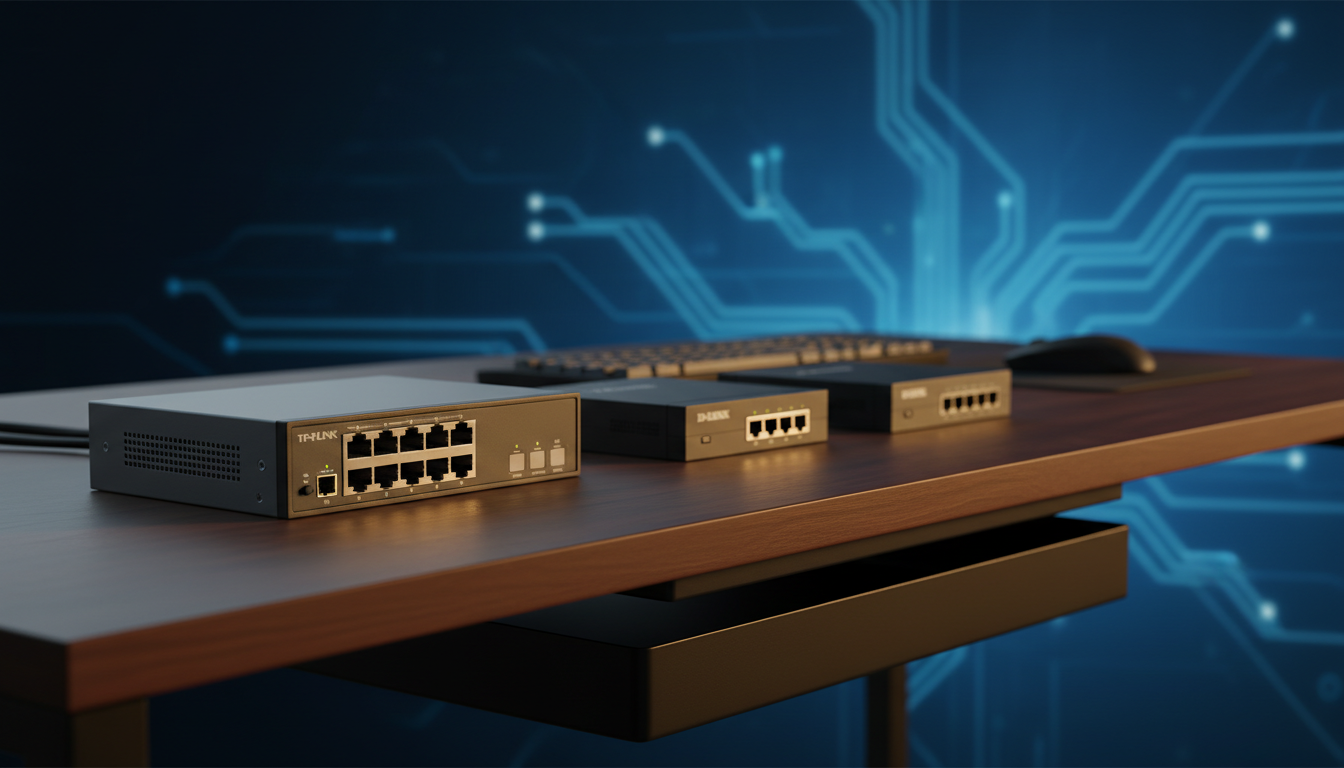
Finding a reliable network hub that won’t break the bank can feel like hunting for a needle in a haystack. Eight models under $25 were compared, with prices ranging from $7.99 for the TP‑Link TL‑SF1005D up to $22.99 for the TRENDnet 8‑Port Switch Black. All of them carry solid user approval, and the TL‑SG108, Netgear 5‑Port Managed Switch and D‑Link DGS‑105 Black each earned a 4.7/5 rating from thousands of reviewers.
The lineup splits neatly into three tiers. Budget picks – the TL‑SF1005D ($7.99), Tenda SG105 ($8.99) and Tenda SG108 ($11.39) – give you basic plug‑and‑play connectivity and low power draw. Mid‑range options – the TP‑Link TL‑SG108 at $16.99 (8 Gigabit ports, 16 Gbps switching capacity) and Netgear’s 5‑Port Managed Switch at $17.98 – add a bit more headroom and a metal chassis. Premium choices – the TL‑SG105E Black ($19.99), D‑Link DGS‑105 Black ($21.99) and TRENDnet 8‑Port Switch Black ($22.99) – bring managed features or fanless metal builds for noiseless, high‑throughput environments.
Below you’ll find a side‑by‑side look at each hub’s strengths, so you can match the right price tier and feature set to your home or small‑office network.

TP-Link TL-SG108
Its low 25 mm height gives a slim profile while delivering full 8‑port performance, earning top value and rating.

TP-Link TL-SG105E Black
Ideal for small office setups needing a rugged, unmanaged switch, and it sits $3 higher than the Best Overall.

D-Link DGS-105 Black
Its 100 mm length fits tighter spaces, and the all‑metal build secures the highest user rating despite a slightly higher price.
Also considered
Score Analysis
Key score advantages vs. runner-up (TP-Link TL-SG105E Black)
Price Range
TP-Link TL-SG108
$16.98
TP-Link TL-SG105E Black
$19.99
D-Link DGS-105 Black
$21.99

TP-Link TL-SF1005D
$7.99

Netgear 5-Port Managed Switch
$17.98

Tenda SG105
$8.99

Tenda SG108
$11.39

TRENDnet 8-Port Switch Black
$22.99
Spec Comparison
TL;DR: The TP‑Link TL‑SG108 delivers eight gigabit ports, 16 Gbps non‑blocking capacity and fanless silent operation at a budget‑friendly $16.99, making it a solid, energy‑saving choice for home or small‑office networks.
The switch’s headline spec is its 16 Gbps switching capacity, which ensures full‑duplex gigabit performance across all eight RJ45 ports without bottlenecking traffic. It also supports jumbo frames up to 15 KB, a size larger than the 9 KB frames found in several rivals, and its Green Technology claims up to 80% power savings. Housed in a metal case, the unit weighs 600 g (about 1.32 lb) and measures 158 mm deep, 25 mm high and 100 mm wide, while staying fanless for completely silent operation.
Compared with the other seven switches in this roundup, the TL‑SG108 is heavier than the Netgear 5‑Port Managed Switch (0.55 lb) and the D‑Link DGS‑105 (0.6 lb), but lighter than the TRENDnet 8‑Port Switch (0.84 lb). Its depth of 158 mm is deeper than Netgear’s 94 mm and TRENDnet’s ultra‑slim 26 mm, giving it a sturdier desktop footprint. The 16 Gbps switching capacity outpaces the Netgear and D‑Link models, both listed at 10 Gbps, and matches the TRENDnet’s 16 Gbps while offering a larger jumbo‑frame size. Power draw sits at 4.6 W, higher than the ultra‑low 1.9 W of the TL‑SF1005D but still modest for an eight‑port gigabit device.
User feedback consistently praises the silent, fanless design and the noticeable drop in electricity use thanks to the 80% energy‑saving claim. Reviewers also note the convenience of plug‑and‑play auto‑MDI/MDIX and the handy loop‑prevention button. The most common drawback reviewers mention is the need for an external 9 VDC power adapter, which adds a small bulk to the otherwise compact unit. Because the switch is unmanaged, it lacks VLAN, QoS and other advanced features that power users might expect.
Pros
Cons
Best for: Most users looking for a well‑reviewed, reliable mainstream option
Avoid if: You have limited desk space or need portability
TL;DR: The TP‑Link TL‑SG105E offers five gigabit ports, a web‑based management UI and solid metal construction for $19.99, making it a reliable, budget‑friendly managed switch.
The switch’s most eye‑catching spec is its 7.4 Mpps forwarding rate, paired with a 1 MB packet buffer that helps keep traffic flowing smoothly even under load. Its five 10/100/1000 Mbps ports are backed by port‑based QoS, 802.1p and DSCP priority, and you can set up to 32 VLANs through the free web interface.
Compared with the other seven picks, the TL‑SG105E weighs roughly 0.95 lb, noticeably more than the D‑Link DGS‑105 (about 0.6 lb) and the Netgear 5‑Port Managed Switch (about 0.55 lb), but lighter than the TP‑Link TL‑SG108 (around 1.32 lb). Its depth of 170.18 mm also exceeds the compact Netgear model’s 94 mm depth, giving it a sturdier footprint. While some rivals list higher switching capacities, the TL‑SG105E’s forwarding rate matches the Netgear’s 7.4 Mpps, and its metal, fanless chassis feels more premium than the plastic housings of the Tenda units.
Users consistently reward the unit with a 4.7‑star average from over 13,000 reviews, praising the intuitive web UI and the quiet, fanless operation that keeps a home office or small lab noise‑free. TP‑Link’s limited‑lifetime warranty reassures buyers that the company stands behind the hardware.
From a technical standpoint, the switch supports IGMP snooping (V1‑V3) for multicast traffic and offers a 2.82 W maximum power draw at 5 VDC, keeping energy use modest. Its 2K MAC address table and 32‑VLAN limit make it suitable for modestly sized networks without overwhelming the device.
Pros
Cons
Best for: Buyers willing to invest in a proven, high‑quality option
Avoid if: You're on a tight budget or only need basic functionality
TL;DR: The D-Link DGS-105 offers five Gigabit ports, a fanless metal case and 10 Gbps switching capacity for $21.99, making it a solid, silent choice for small‑office networks.
The switch’s most eye‑catching spec is its 10 Gbps switching capacity paired with five 10/100/1000 Mbps ports, all housed in a metal, fanless chassis that weighs 0.6 pounds. Its compact dimensions – 28 mm high, 100 mm long and 98 mm wide – let it sit neatly on a desk or be wall‑mounted with the included rubber feet and keyhole slots.
Compared with the other seven options, the DGS-105 sits in the middle of the size and weight spectrum. It’s heavier than the Netgear 5‑Port Managed Switch (0.55 lb) and the ultra‑light Tenda SG105 (0.12 lb), yet lighter than the TP‑Link TL‑SG105E (0.95 lb) and the TRENDnet 8‑Port Switch (0.84 lb). Its height matches the Netgear unit at 28 mm but is taller than the TP‑Link TL‑SG108 (25 mm) and the Tenda models, which are under 23 mm. Width‑wise it’s a shade narrower than the TP‑Link TL‑SG105E (104.14 mm) and a touch wider than the TRENDnet (97 mm), giving it a balanced footprint.
Users repeatedly praise the silent, plug‑and‑play experience – the fanless metal case keeps the office quiet, and auto‑negotiation means you don’t need to configure anything. Professional reviewers note the sturdy metal chassis looks sleek and feels solid. Reviewers criticize the five‑port limit; they say it feels cramped once you add a printer, NAS or extra workstations.
Beyond the basics, the DGS‑105 includes smart QoS prioritization with 802.1p traffic classes, which can help voice, video or gaming traffic stay smooth. Auto MDI/MDIX removes the need for crossover cables, and the limited‑lifetime warranty adds peace of mind for a budget‑friendly price point.
Pros
Cons
Best for: Buyers willing to invest in a proven, high‑quality option
Avoid if: You're on a tight budget or only need basic functionality
TL;DR: The TP‑Link TL‑SF1005D is a 5‑port Fast Ethernet desktop switch that delivers 200 Mbps bandwidth, 68 % power‑saving Green Ethernet, and plug‑and‑play simplicity for under $8.
At the heart of the TL‑SF1005D is a five‑port Fast Ethernet design with a listed bandwidth of 200 Mbps and a switching capacity of 1 Gbps. The unit measures 22 mm in height, 103.5 mm in length and 69.5 mm in width, and it weighs about 0.22 lb (100 g). A Green Ethernet power‑saving rating of 68 % highlights energy efficiency, and the maximum power draw is only 1.9 W, making it a silent, fanless addition to any desk.
Compared with the other seven switches in this roundup, the TL‑SF1005D sits in the middle of the size and weight spectrum. It's heavier than the Tenda SG105 (which weighs roughly 0.12 lb) but considerably lighter than the TP‑Link TL‑SG108 (about 1.32 lb). Its 103.5 mm length exceeds the 82 mm length of the Tenda SG105, while its 22 mm height is shorter than the 28 mm height of the Netgear 5‑Port Managed Switch. In short, it offers a compact footprint without being the smallest or lightest option.
User feedback repeatedly praises the plug‑and‑play nature and low power consumption, noting the device lights up instantly with power and per‑port LEDs for easy troubleshooting. Professional reviewers also point out the non‑blocking architecture and store‑and‑forward transmission as reliable features for basic networking. The most common complaints focus on the 10/100 Mbps port limit, which caps total full‑duplex throughput at 200 Mbps, and the lack of any management interface for advanced setups.
Technical details reinforce it's suitable for simple home or small‑office networks. Auto‑MDI/MDIX and auto‑negotiation mean you can connect any Ethernet cable without worrying about crossover types. The switch supports 2 KB jumbo frames and maintains a 1 K‑entry MAC address table, enough for typical consumer traffic. Its non‑blocking design ensures that packets are forwarded at full wire‑speed, and the store‑and‑forward method checks each frame for errors before passing it on.
Pros
Cons
Best for: Budget‑conscious buyers seeking a reliable entry‑level option
Avoid if: You need advanced features or professional‑grade performance
TL;DR: The Netgear 5‑Port Managed Switch packs five Gigabit ports, a 10 Gbps non‑blocking capacity and fanless metal durability for $17.98, making it a solid, quiet choice for home or small‑office expansion.
At the heart of this switch is a 10 Gbps switching capacity and a forwarding rate of 7.4 Mpps, backed by five 10/100/1000 Mbps Ethernet ports and support for jumbo frames up to 9 KB. The metal housing stays silent thanks to its fanless design, and Auto MDI/MDIX means you never need a crossover cable.
Compared with the other seven options, the Netgear unit is lighter than the TP‑Link TL‑SG108 (1.32 lb) and TL‑SG105E (0.95 lb) but heavier than the ultra‑light Tenda SG105 (0.12 lb). Its 10 Gbps capacity trails the 16 Gbps found in the TL‑SG108 and TRENDnet 8‑Port Switch, yet matches the D‑Link DGS‑105. The 9 KB jumbo‑frame limit sits between the TL‑SG108’s 15 KB and the TRENDnet’s 9 KB, offering a middle ground for large‑packet traffic.
Professional reviewers highlight the metal case and fanless operation as delivering reliable, silent performance for basic network setups. Users echo this, praising the plug‑and‑play ease and sturdy feel, while noting the bright LED indicators can be distracting in dark rooms and that the unit may feel warm during prolonged heavy traffic. Reviewers also note the lack of advanced features such as VLANs or QoS as a limitation for more complex environments.
The switch runs on a 12 V, 1 A adapter and supports IEEE 802.3az Energy Efficient Ethernet, keeping power draw low. It operates from 0 °C to 40 °C and comes with a three‑year limited warranty, adding confidence for long‑term use.
Pros
Cons
Best for: Most users looking for a well‑reviewed, reliable mainstream option
Avoid if: You're shopping on a tight budget — it's priced at $17.98
“added 4 more Ethernet ports... all fast connections”
“900+ down... grandson loves new speed”
TL;DR: The Tenda SG105 is a 5‑port Gigabit Ethernet hub that packs a 10 Gbps switching capacity into a 54 g, 22 mm‑high super‑mini case for under $9.
This switch’s standout spec is its 10 Gbps switching capacity combined with a 15 KB jumbo‑frame size, which far exceeds the 1 Gbps capacity of the TP‑Link TL‑SF1005D. Its buffer holds 2,000 entries, double what many budget hubs provide, helping keep traffic smooth even when multiple devices stream video.
In size and weight, the SG105 outpaces several rivals. At 82 mm long and 54 g, it’s shorter than the TL‑SF1005D’s 103.5 mm length and lighter than its 100 g weight. Compared with the TP‑Link TL‑SG108, which weighs about 0.295 lb, the Tenda remains the lightest option in the lineup, and its 22 mm height matches the TL‑SF1005D while staying slimmer than the Netgear 5‑Port Managed Switch’s 28 mm height.
Users repeatedly praise the plug‑and‑play setup and the tiny footprint that fits behind a monitor or on a dorm wall. Professional reviewers note the zero‑packet‑loss claim and full‑wire‑speed forwarding as enterprise‑class traits, while everyday buyers appreciate reliable gigabit links for laptops, printers, and IP cameras. The only trade‑off is lacking management features like VLAN or QoS, which limits use in more complex network environments.
Pros
Cons
Best for: Budget‑conscious buyers seeking a reliable entry‑level option
Avoid if: Reliability and user satisfaction are your top concerns
TL;DR: The Tenda SG108 delivers eight Gigabit ports, zero‑packet loss and a compact 0.30 lb design for just $11.39, making it a solid, plug‑and‑play choice for home or small‑office networks.
The standout spec is its eight 10/100/1000 Mbps ports paired with a store‑and‑forward transmission mode that reports 0% packet loss. At 4.88 in long, 0.9 in high and 2.32 in wide, the switch weighs only about 0.30 lb, so it sits easily on a desk or can be wall‑mounted without crowding a workspace.
Compared with the other seven switches in this roundup, the SG108 offers more ports than the 5‑port models such as the Tenda SG105 and TP‑Link TL‑SF1005D. It’s heavier than those two (which weigh roughly 0.12 lb and 0.22 lb) but lighter than the metal‑cased TP‑Link TL‑SG108 and the Netgear 5‑Port Managed Switch, both of which tip the scales above 0.55 lb. Its plastic housing keeps the unit compact, a contrast to the bulkier metal designs that dominate the higher‑priced tier.
Users consistently praise the plug‑and‑play setup, noting that the single power LED and eight port LEDs make connection status obvious. Professional reviewers highlight the zero‑packet‑loss claim and 7 × 24 operation as reliable for HD streaming or small‑studio workflows. A recurring complaint is that the RJ45 ports feel a bit small for larger connectors, and some reviewers wonder about long‑term durability versus premium brands. The switch carries an IP55 rating for dust and water resistance, runs on an external 240 V adapter and comes with a three‑year warranty.
Pros
Cons
Best for: Budget‑conscious buyers seeking a reliable entry‑level option
Avoid if: Reliability and user satisfaction are your top concerns
“Great product... very reliable... easy to set up and works great”
“Amazing product... very fast... easy to access ports”
TL;DR: The TRENDnet TEG‑S82G offers eight gigabit ports, a 16 Gbps switching capacity, fanless metal housing and GREENnet technology that cuts power use by up to 70 % for under $25.
The switch’s standout spec is its 16 Gbps switching capacity paired with a 9 KB jumbo‑frame size, letting you move large files across a home or small‑office network without bottlenecks. Its metal case runs completely silent at 0 dB and GREENnet technology can reduce power draw by up to 70 % based on link status and cable length.
Compared with the other seven hubs, the TRENDnet delivers a higher switching capacity than the D‑Link and Netgear models, which top out at 10 Gbps. It shares the 16 Gbps figure with the TP‑Link TL‑SG108 but weighs more than the lightweight Tenda units (around 0.12–0.30 lb) while still being lighter than the TL‑SG108’s 1.32 lb. Its 148 mm height is noticeably taller than D‑Link’s 28 mm and Netgear’s 28 mm, giving it a more substantial presence on a desk or wall mount.
User feedback consistently highlights the silent operation and noticeable energy savings, with many reviewers calling the metal chassis “sturdy” and appreciating the limited‑lifetime warranty. The main complaints focus on the lack of management features—no VLANs or QoS—and the eight‑port limit for anyone planning a larger network.
Technical details include auto‑MDIX support, a data RAM buffer of 192–256 KB, a MAC address table of 4K–8K entries, and an MTBF of 104,375 hours. The unit's CE, FCC, LVD and NDAA/TAA certifications reinforce its suitability for both residential and small‑business environments.
Pros
Cons
Best for: Buyers who need silent, energy‑efficient gigabit connectivity for a small office or home network and appreciate a metal, lifetime‑warrantied device.
Avoid if: You require advanced management features, more than eight ports, or the absolute lowest‑cost switch.
Breakdown
TP-Link TL-SG108
Pros
TP-Link TL-SG105E Black
Pros
D-Link DGS-105 Black
Pros
TP-Link TL-SF1005D
Pros
Cons
Based on scoring data and product specs
Personalized picks
Best Overall Pick
TP-Link TL-SG108
Best OverallBest for: Most users looking for a well-reviewed, reliable mainstream option
TP-Link TL-SG105E Black
Best for: Buyers willing to invest in a proven, high-quality option
$19.99+$3.01 vs winner
Skip TRENDnet 8-Port Switch Black if…
Reliability and user satisfaction are your top concerns
TP-Link TL‑SG108 wins as the best budget network hub under $25. It offers eight 10/100/1000 Mbps RJ45 ports in a sturdy metal case, and its energy‑saving technology claims up to 80 % lower power use. With a switching capacity of 16 Gbps, a max power draw of just 4.6 W, and a 4.7‑star rating from 176,229 reviewers, it balances performance and value nicely at $16.99.
The runner‑up, TP-Link TL‑SG105E Black, shines when you need basic management features without breaking the bank. Its web interface provides port mirroring, QoS priority queues, and VLAN support for up to 32 networks—useful for a small home office or a hobbyist lab. At $19.99 it still carries a 4.7‑star rating from 13,064 reviews and a limited‑lifetime warranty.
For tighter budgets, the TP-Link TL‑SF1005D at $7.99 delivers a simple plug‑and‑play 5‑port gigabit switch—ideal for a dorm room or a starter setup. If you’re willing to stretch a bit for premium features, the TRENDnet 8‑Port Switch Black at $22.99 offers a higher‑end build and extra ports for expanding home networks.
Pick the TL‑SG108 today and get reliable, energy‑efficient networking without overspending.
The TP‑Link TL‑SG108 provides eight Gigabit ports, a sturdy metal case and energy‑saving technology, making it a solid all‑round choice for a home office with multiple devices.
No reviews yet — be the first to share your experience.
Please sign in to leave a review
