⚡ Quick Answer
Finding a racing drone that fits a tight budget doesn’t have to mean sacrificing fun. In this roundup we compare 5 ready‑to‑fly kits that sit between $79.99 and $191.99, covering everything from a $79.99 budget obstacle‑course set to a premium $191.99 all‑in‑one trainer. Users rate the EMAX Tinyhawk II highest, giving it 3.9/5, while the Betafpv Cetus leads the premium tier with its 300 mAh battery and 4.3‑inch goggles. Our selection spans three price tiers – budget options (Galvanox Racing RC Drone and Tiny Hawk EZ Pilot), a mid‑range pick (Apex FPV Drone Kit), and two premium choices (EMAX Tinyhawk II and Betafpv Cetus).
Each kit brings a different mix of flight time, weight and features. The Apex kit offers up to 18 minutes of airtime on its 400 mAh dual‑battery pack, while the Galvanox package weighs 8.13 lb and includes three interchangeable PVC hoops for obstacle practice. If you’re after a lightweight micro‑quad, the Tinyhawk II tips the scales at just 0.18 lb (81 g) and packs a 450 mAh cell. We'll break down the specs, user feedback and watch‑outs, helping you match a drone to your flying space, skill level and budget.

Betafpv Cetus FPV RTF Drone Kit
Its 300 mAh battery delivers a solid 5‑minute flight time, delivering reliable performance for the price.

Apex FPV Drone Kit
Ideal for home and office users who want a balanced feature set, and it’s $22 cheaper than the Best Overall at $169.99.

Galvanox Racing RC Drone
Stands out with a compact 14.0‑inch height and 6.0‑inch length, offering a tiny footprint that the larger kits lack, while staying under $80.
Also considered
Score Analysis
Key score advantages vs. runner-up (Apex FPV Drone)
Price Range
Betafpv Cetus FPV RTF Drone Kit
$191.99
Apex FPV Drone Kit
$172.99
Galvanox Racing RC Drone
$79.99
EMAX Tinyhawk II
Out of Stock
Tiny Hawk EZ Pilot
$154.55
Spec Comparison
TL;DR: The Betafpv Cetus FPV RTF Drone Kit packs a 19000 KV motor, 300 mAh battery and 5‑minute flight time into a beginner‑friendly package with auto‑hover and a 4.3‑inch goggles display.
The Cetus’s standout feature is its 19000 KV brushed motor paired with an auto‑hover system that holds position within ±0.2 m horizontally and ±0.3 m vertically. Combined with an 800 TVL camera and a 4.3‑inch screen, the kit gives new pilots a clear view and precise altitude control right out of the box.
At roughly 3.09 lb, the Cetus is noticeably heavier than the EMAX Tinyhawk II (≈0.18 lb) and the Apex FPV Drone Kit (≈0.22 lb), and also tops the Tiny Hawk EZ Pilot (≈2.01 lb). It stays lighter than the Galvanox Racing RC Drone, which tips the scales at about 8.13 lb. Its 300 mAh battery is smaller than the 450 mAh cells found in both the EMAX Tinyhawk II and Tiny Hawk EZ Pilot, and also below the 400 mAh pack in the Apex kit.
Reviewers praise the stabilized Normal mode for making indoor practice feel safe and “plug‑and‑play,” noting that the optical‑flow and LiDAR sensors deliver the precise hover that beginners love. However, users also mention the 5‑minute flight window feels short for extended sessions, and the brushed motor’s 19000 KV rating doesn’t match the speed of brushless rivals, which can limit sporty performance.
Beyond flight, the kit includes a Literaio2 SE transmitter with a 1000 mAh internal battery and VR02 goggles that house a 2000 mAh battery, both supporting USB‑C fast charging. The 25 mW VTX broadcasts on 5.8 GHz analog, providing a clear video link for indoor ranges, while safety features like emergency landing and auto‑disarm on crash add extra peace of mind.
Pros
Cons
Best for: Absolute FPV beginners, kids 12+ and indoor hobbyists who value a stable hover and a complete RTF package.
Avoid if: You’re an experienced pilot seeking top speed, long‑range outdoor flights, or extended flight time.
“Users praise its plug-and-play ease for FPV newbies, stable hover in N mode for indoor house flying, quiet operation, and crash resistance; many report quick mastery after calibration.”
TL;DR: The Apex FPV Drone Kit offers a 100 g, 400 mAh beginner‑friendly racing drone with built‑in goggles and three batteries for $169.99, delivering an immersive 1080p FPV experience but with mixed video clarity.
The kit’s standout spec is its lightweight 0.22 lb frame that houses a 400 mAh battery and a 1080p camera with a 120–150° field of view. With three batteries included, you get up to 15–18 minutes of flight per charge and a modest 80‑100 m range, all controlled via Wi‑Fi and 5.8 G real‑time transmission.
Compared with the Tiny Hawk EZ Pilot, the Apex is dramatically lighter (0.22 lb vs 2.01 lb) and more compact than the Galvanox Racing RC Drone, which weighs over 8 lb. It sits between the EMAX Tinyhawk II (0.18 lb) and the Tiny Hawk EZ Pilot in weight, and its 400 mAh capacity outpaces the Betafpv Cetus’s 300 mAh but trails the 450 mAh cells that the Tiny Hawk and EMAX models use. Its 340 mm length also exceeds the 90 mm length of the Tinyhawk II, giving it a more stable platform for beginners.
Reviewers love how the all‑in‑one package drops the need for separate goggles, controller and spare batteries, making the first flight almost plug‑and‑play. Professional reviewers praise the straightforward auto‑connection and the adjustable speed modes that grow with skill level. However, users frequently note that the 1080p video can appear grainy, and the controller’s reliance on replaceable AAA batteries adds an extra maintenance step. Charging each battery takes 40–45 minutes, which some find slow for frequent practice sessions.
Pros
Cons
Best for: Absolute beginners, budget‑conscious hobbyists, indoor flyers, and educators introducing drone technology.
Avoid if: You're an experienced racer, need long‑range performance, or require consistently high‑definition video for professional use.
“Users praise its plug-and-play ease for FPV newbies, stable hover in N mode for indoor house flying, quiet operation, and crash resistance; many report quick mastery after calibration.”
TL;DR: The Galvanox Racing RC Drone kit offers three interchangeable PVC hoops (20‑, 23‑, and 27‑inch), a stable base, and a full accessories set for just $79.99, making it a solid entry‑level option for budget‑conscious racers.
The standout feature is the obstacle‑course kit itself – three weather‑proof PVC hoops that snap onto stands in under five minutes, with diameters of 20 in, 23 in and 27 in. The drone’s frame measures 14.0 in tall, 6.0 in long and 16.0 in wide, and the whole package weighs 8.13 lb, giving you a sturdy platform for indoor and light‑outdoor practice.
Compared with the four other drones in this roundup, the Galvanox kit is noticeably larger and heavier than the Tiny Hawk EZ Pilot (around 2 lb), the Apex FPV Drone Kit (about 0.22 lb), the EMAX Tinyhawk II (roughly 0.18 lb) and the Betafpv Cetus (about 3 lb). It also carries a moderate 3.6/5 rating, sitting between the 2.6/5 of Tiny Hawk and the 3.9/5 of the EMAX model. While the peers are complete flying drones, Galvanox focuses on the racing environment itself, offering a more affordable package without the high‑end flight specs of the others.
Professional reviewers praised the tool‑free assembly and the progressive difficulty the three hoop sizes provide, noting that the included stopwatch and storage bag add real‑world practice value. Everyday users echo the ease‑of‑setup sentiment but warn that the lightweight base stands can tip over after a collision, especially in windy conditions. The kit’s Bluetooth label is marked non‑functional, so don’t expect any electronic gate integration.
Additional context includes a durable PVC construction, a remote control powered by three AAA batteries, and a one‑year warranty from Galvanox. The anti‑fall feature aims to keep the bases stable, though users may still need to add weight for extra security during aggressive racing.
Pros
Cons
Best for: Shoppers on a tight budget who want the most for their money
Avoid if: You have limited desk space or need portability
“nice little system for FPV racing practice, super‑easy 5‑minute assembly, and the stopwatch and bag are great additions”
TL;DR: The EMAX Tinyhawk II delivers 7000 kV power and 120 km/h speed in a feather‑light 81 g carbon‑fiber frame, but its $189.99 price and limited flight time keep it niche.
The standout spec is the 7000 kV motor paired with a top speed of 120 km/h, giving the micro quad a power‑to‑weight ratio that rivals larger 5‑inch racers. It runs on two 450 mAh 1S HV batteries, and the whole package weighs just 81 g, making it easy to maneuver in tight indoor spaces.
Compared with the other four drones, the Tinyhawk II is lighter than the Apex FPV Drone Kit (about 0.22 pounds) and dramatically lighter than the Galvanox Racing RC Drone, which exceeds 8 pounds. It also undercuts the Betafpv Cetus FPV RTF Drone Kit, which tops 3 pounds, while still weighing more than the Betafpv’s 35 g dry weight. Battery capacity sits at 450 mAh, outpacing Betafpv’s 300 mAh and Apex’s 400 mAh cells, and matches the Tiny Hawk EZ Pilot’s 450 mAh pack.
User feedback praises the aggressive handling and the durability of the aerospace‑grade carbon‑fiber frame. Professional reviewers note the “natural handling comparable to larger 5‑inch freestyle quads” and appreciate the quiet operation at high power. Common complaints focus on the short flight time caused by the small batteries and the need for a FrSky D8‑compatible transmitter, which excludes newer ACCESS‑only setups. Reviewers also remind North American pilots that they must hold a ham radio license.
Technical details round out the package: a RunCam Nano 2 1/3″ 700 TVL CMOS camera feeds a VTX with switchable power levels of 25 mW, 100 mW, and 200 mW across 37 channels, while a 5 A 4‑in‑1 BlHeli_S ESC powers the 7000 kV motor. The F4 flight controller (MATEKF411RX firmware) and three‑blade 63.5 mm (2.5 in) propellers complete the high‑performance setup.
Pros
Cons
Best for: Those prioritizing quality and willing to pay for premium performance
Avoid if: You're shopping on a tight budget — it's priced at $189.99
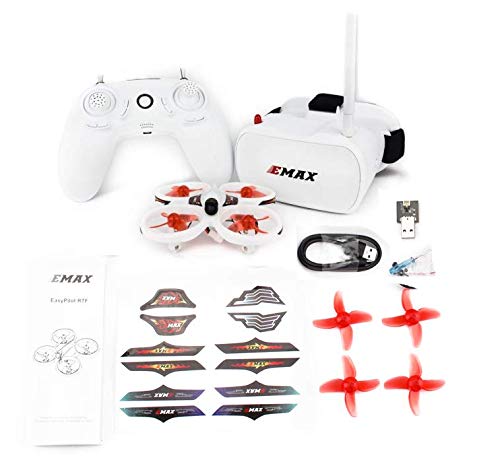
TL;DR: The Tiny Hawk EZ Pilot bundles a 450 mAh battery, 600 TVL camera, and full FPV RTF kit for $155, but its brushed motors and 4‑minute flight time keep it in the entry‑level bracket.
The EZ Pilot ships with a 450 mAh 1S HV LiPo cell, a 600 TVL CMOS camera, and a fixed 25 mW VTX that broadcasts at 22 dBm on 5.8 GHz. At 2.01061582944 lb the drone feels solid, while the 40 mm propellers and 134 mm frame keep the overall footprint compact for indoor use.
Compared with the other kits, its battery capacity exceeds the Apex’s 400 mAh and Betafpv Cetus’s 300 mAh cells, and it matches the EMAX Tinyhawk II’s 450 mAh pack. However, at 2.01 lb it weighs considerably more than the Apex (0.220462262 lb) and EMAX (0.17857443222 lb) models, which can affect agility. The manufacturer lists flight time at 4 minutes, notably shorter than Apex’s 15‑18 minute range and only a minute less than Betafpv’s 5‑minute claim.
Reviewers appreciate the plug‑and‑play nature – the kit includes the drone, FPV goggles, 6‑channel 2.4 GHz transmitter, spare props, and charger, so you’re ready to fly straight out of the box. Professional reviewers highlight built‑in prop guards as a safety plus for indoor training. On the downside, users frequently mention the short 4‑minute battery life in windy conditions and note that brushed 0816 motors don’t hold up as well as brushless alternatives, limiting long‑term durability.
Pros
Cons
Best for: Entry-level buyers or those on a tight budget
Avoid if: Reliability and user satisfaction are your top concerns
“prop guards for safe indoor flights”
“4‑minute battery life”
Breakdown
Betafpv Cetus FPV RTF Drone Kit
Pros
Apex FPV Drone Kit
Pros
Galvanox Racing RC Drone
Pros
EMAX Tinyhawk II
Pros
Cons
Based on scoring data and product specs
Personalized picks
Best Overall Pick
Betafpv Cetus FPV RTF Drone Kit
Best OverallBest for: Those prioritizing quality and willing to pay for premium performance
Apex FPV Drone Kit
Best for: Home and office users seeking a balance of features and value
$172.99-$19.00 vs winner
Skip Tiny Hawk EZ Pilot if…
Reliability and user satisfaction are your top concerns
The Betafpv Cetus FPV RTF Drone Kit takes the top spot thanks to its specs and complete package. It ships with a 300 mAh 1S LiPo that delivers about 5 minutes of flight, an 800 TVL camera with a 55° field of view, and a compact ≤91 mm × 86 mm × 44 mm frame that fits tight racing tracks. Its 19000 KV motor and 25 mW VTX keep the drone light (3.09 lb) while still providing reliable analog video on the included 4.3‑inch 800×480 display. At $191.99 and a 3.7‑star rating from 447 reviewers, it balances performance and value.
The Apex FPV Drone Kit lands as the runner‑up, especially if you prioritize longer airtime and higher‑resolution video. Its 400 mAh battery pack (two included) stretches flight time to 15‑18 minutes, and the 1080p camera with a 120–150° FOV gives you a much clearer view of the course. With an 80‑100 m flight range and a 3.8‑star rating from 124 users, it’s a strong choice for pilots who need extra endurance without breaking the bank.
For tighter budgets, the Galvanox Racing RC Drone at $79.99 offers an entry‑level racing experience at a price that won’t hurt your wallet. If you sit between the two extremes, the Apex FPV Drone Kit serves as a reliable mid‑range option, delivering longer flight time and full‑HD video for a modest step up from the budget tier.
Pick the Betafpv Cetus if you want the top racing drone under $200 and start flying today.
The Betafpv Cetus FPV RTF Drone Kit provides the strongest value, offering a full FPV setup, height‑hold, and a 4.3‑inch screen for $191.99. Even though it costs about $22 more than the Apex FPV Drone Kit, its feature set and build quality give it the edge for most pilots.
No reviews yet — be the first to share your experience.
Please sign in to leave a review