⚡ Quick Answer
Random orbital sanders are the workhorse behind smooth, swirl‑free finishes, whether you’re refinishing a kitchen cabinet or prepping a deck. We evaluated 9 models that span the full price spectrum—from the budget‑friendly Hychika and SKIL options, through mid‑range choices like the Ryobi and Bosch, up to premium contenders such as Makita, DeWalt’s 20 V MAX, and Porter‑Cable. This spread lets you see how features and performance shift across tiers.
The Makita BO5030K catches the eye with a solid 120 V corded motor drawing 3 A, a lightweight 1.3 kg build, and a brisk 12,000 RPM no‑load speed. Its 5‑inch pad and 3.18 mm orbit diameter deliver both aggressive stock removal and fine finishing, while the rubber‑sealed switch and bag‑type dust collection keep the workspace clean. With a 4.8/5 rating from over 3,000 reviewers and a list price of $99, it balances power, ergonomics, and dust control in a way that appeals to both pros and serious DIYers.
Below we break down each tier’s strengths, compare key specs like voltage, amperage, and dust‑collection methods, and help you pinpoint the model that fits your project budget and performance needs.

Makita BO5030K
Its 5‑inch abrasive disc with 8‑hole design delivers smooth, fast material removal, earning it the top spot.

SKIL SR211601
Ideal for budget‑conscious DIYers, the SKIL SR211601 includes a cyclonic dust box and costs about $62 less than the Makita.

DEWALT DWE6423
Features a soft‑start motor and pad‑brake system, offering smoother starts and quicker stops—capabilities the Makita and SKIL lack.
Also considered
TL;DR: The DEWALT 20V MAX Orbital Sander packs a brushless motor, 8,000–12,000 OPM speed range and a 5‑inch pad into a compact 2.0‑lb tool that delivers solid dust control for finish work.
What really stands out is the combination of a 20 V MAX brushless motor and a variable speed range of 8,000–12,000 OPM, letting you dial in the right aggressiveness for wood, trim or delicate finishing. The sander measures 8.813 in long, 6.375 in wide and 5.75 in high, and at 2.0 lb it feels sturdy yet light enough to carry around a job site.
Compared with the other eight sanders in this roundup, the DEWALT sits in the middle of the weight spectrum—it’s lighter than the Bosch ROS10 at 3.5 lb and the Makita BO5030K at about 2.87 lb, but a touch heavier than the Ryobi One+ which tips the scales at 2.7 lb. Its price matches the Makita unit, yet it offers a brushless motor that the Ryobi and Porter‑Cable models lack.
Reviewers consistently praise the tool’s portability and the strong, consistent sanding power that the brushless motor provides. Users also highlight the low‑profile shape (8.813 × 6.375 × 5.75 in) for getting into tight corners, and the 1.25‑in dust‑collection port that works well with a bag or vacuum. The most common complaint is that the sander is sold tool‑only, so you’ll need to buy a 20 V battery separately.
Additional technical details reinforce its professional appeal: an 8‑hole hook‑and‑loop 5‑in pad swaps out quickly, the dust‑sealed switch protects the internals, and the included dust bag helps keep your workspace clean. The variable‑speed control lets you stay in the sweet spot for each material, while the low‑profile design keeps the motor close to the work surface for a smoother finish.
Pros
Cons
Best for: Buyers willing to invest in a proven, high‑quality option — the DEWALT 20V MAX Orbital Sander offers Speed Range: 8,000–12,000 OPM
Avoid if: You're on a tight budget or only need basic functionality
“Solid bare-tool addition despite initial skepticism”
TL;DR: The SKIL SR211601 delivers 7,000‑13,000 OPM with a cyclonic dust collector in a lightweight 3.44‑lb package, making it a solid budget choice for DIY sanding.
The standout feature is the X‑Flow cyclonic dust collection system, paired with a transparent dust box that’s included right out of the box. Combined with a 5‑inch pad and a 2.7 mm orbit diameter, the sander provides a smooth finish while keeping debris under control. Its 2.8 A motor runs on 120 V and offers a variable speed range of 7,000‑13,000 OPM, giving you enough power for wood, metal, or plastic.
Compared with the other eight models in this roundup, the SKIL is positioned as the most affordable corded option. It’s lighter than the DEWALT DWE6423 and Bosch ROS10, yet a bit heavier than the ultra‑light ZFE Air Sander. While it lacks the multiple speed settings of the Hychika or the battery freedom of the Ryobi One+, its single‑speed variable dial still beats many entry‑level tools that only offer a fixed speed.
Users consistently praise the clean operation and the soft‑rubber grip that makes longer sanding sessions comfortable. Professional reviewers note the motor’s ability to reach the top of its speed range, but they also point out that the 8‑hole pad must be aligned precisely for the dust extraction to work properly. Some owners have reported the motor slowing down under very heavy loads, which aligns with the “motor bogging” comment in expert feedback.
Pros
Cons
Best for: Budget-conscious buyers seeking a reliable entry-level option — the SKIL SR211601 offers Included Dust Box: Yes
Avoid if: You need heavy‑duty production sanding or advanced multi‑speed control
“emphasizes aligning 8-hole pads for dust suction, implying ease of use when done correctly but potential frustration otherwise”
TL;DR: The Makita BO5030K delivers 12,000 OPM with a 1/8‑inch orbit, a 4‑13/16″ pad, and a dust‑bag system, but its fixed‑speed corded design comes at a $99 price.
The standout spec is the 12,000 orbits‑per‑minute rate paired with a 1/8 inch orbit diameter, which gives you aggressive material removal while still finishing smooth. A built‑in pad control system tempers the start‑up speed, helping prevent the sudden kick‑back that can catch beginners off‑guard.
At roughly 2.87 lb, the Makita sits heavier than the DEWALT 20V MAX (about 2.16 lb) and the Ryobi One+ (2.7 lb), but it’s lighter than the Bosch ROS10 (3.5 lb) and the DEWALT DWE6423 (3.4 lb). Its 4‑13/16″ sanding pad is a touch smaller than the 5‑inch pads found on most rivals, yet the pad‑control feature compensates by giving you finer control at the same high speed. The 3 A motor draws 120 V and puts out 300 W, matching the power levels of the higher‑priced competitors while keeping the tool in the premium‑tier price bracket.
Professional reviewers praise the rubber‑sealed on/off switch and the through‑the‑pad dust‑bag system for keeping the work area cleaner. Users echo this, noting that the dust collection feels “effective” during long sanding sessions. The main drawback highlighted in both expert and consumer feedback is the lack of a variable‑speed dial, which limits adaptability when switching between delicate trims and heavy‑stock wood.
Pros
Cons
Best for: Woodworkers and finish carpenters who need precise, high‑speed sanding with a reliable dust‑collection system — the Makita BO5030K offers Pad Size: 4‑13/16 inch.
Avoid if: You're shopping on a tight budget — it's priced at $99.00.
TL;DR: The DEWALT DWE6423 delivers variable‑speed sanding with a 5‑inch hook‑and‑loop pad, solid 120 W output and dust‑bag collection, earning a 4.7‑star rating for reliable, everyday use.
The standout feature is its variable speed range of 8,000–12,000 OPM, letting you dial in the right aggressiveness for everything from soft pine to hardwood. A 5‑inch hook‑and‑loop pad matches the most common sandpaper sizes, while the dust‑sealed switch and one‑handed locking bag keep debris out of your breathing zone.
Compared with the eight other sanders in this roundup, the DWE6423 is a shade lighter than Bosch’s 3.5‑pound model but heavier than the cordless DEWALT 20V MAX that weighs about 2 lb. Its 5‑inch pad matches Bosch’s size, while Makita’s pad is slightly smaller. The orbit diameter of 2.6 mm is a touch larger than Bosch’s 2.5 mm and Ryobi’s 2.38 mm, giving a smoother finish than some competitors that list smaller orbits.
Users consistently praise the smooth ramp‑up from the soft‑start system and the low‑vibration counterweight design, noting less hand fatigue during extended jobs. The 4.7‑star average from 3,506 reviews shows strong overall satisfaction. Professional reviewers point out that the brushed 3‑amp motor can run hotter and may feel under‑powered for heavy‑duty sanding, a trade‑off for its lower price point.
Pros
Cons
Best for: Most users looking for a well‑reviewed, reliable mainstream option — the DEWALT DWE6423 offers Pad Size: 5 inches (125 mm)
Avoid if: You need heavy‑duty professional sanding or a brushless‑motor design
TL;DR: The Porter‑Cable PCCW205B delivers 12,000 OPM with a 5‑inch pad, low‑profile ergonomics and a detachable dust‑bag/vacuum port for cordless sanding at $99.99.
This sander’s headline spec is its 12,000 OPM sanding speed, which professional reviewers cite as “efficient for fast material removal.” Coupled with a 5‑inch hook‑and‑loop pad and a low‑profile design, it reaches tight corners while still covering a generous sanding area. The tool runs on a 20 V MAX brushed motor and weighs 907 g, making it light enough for extended handheld use.
Compared with the eight other sanders in our roundup, the Porter‑Cable sits at the lighter end of the spectrum (about 2 lb versus the Makita’s 2.87 lb and Bosch’s 3.5 lb). Its 5‑inch pad matches the DEWALT, Bosch and Ryobi models, but it’s larger than Makita’s 4‑13/16‑inch pad. Speed‑wise, it ties the DEWALT, Makita and Bosch at 12,000 OPM, outpacing the Ryobi’s 10,000 OPM. Unlike the corded Makita, this unit is cordless and sold bare‑tool, so you’ll need a compatible 20 V battery. Its dust‑collection system includes a detachable bag and a 1‑1/4‑inch vacuum port, whereas the DEWALT only bundles a dust bag.
User feedback consistently praises the fast sanding action and the comfortable rubberized grip, especially for DIY projects around the house. Reviewers also note the convenience of cordless operation, but they flag the brushed motor as less efficient than newer brushless designs and mention that dust extraction works best when hooked up to a vacuum. The tool carries a CSA certification and a 3‑year limited warranty, adding confidence for light‑professional use.
Pros
Cons
Best for: Buyers willing to invest in a proven, high‑quality option — the Porter‑Cable PCCW205B offers Pad Size: 5 inches
Avoid if: You're shopping on a tight budget — it's priced at $99.99
“collects quite a bit”
“effective but basic performance”
TL;DR: The Hychika OS300W delivers a 3.8 A motor, up to 13,000 RPM and six speed settings in a compact, 5‑inch pad design, all for under $35, making it a strong budget choice for wood and metal sanding.
What really stands out is the 3.8 Amp (450 W equivalent) motor that pushes the sanding pad to a maximum speed of 13,000 RPM. Six variable‑speed settings let you dial the speed between 6,000 and 13,000 OPM, giving precise control whether you’re removing material quickly or finishing a delicate surface. The sander’s dimensions—5.16 inches high, 9.17 inches long and 6.61 inches wide—keep it short enough for tight spots while still offering a comfortable palm grip.
Compared with the eight other models in this roundup, the Hychika is notably more affordable and packs a respectable speed range despite a lower top speed than the ZFE’s 15,000 RPM. Its 5‑inch sanding pad matches the Ryobi and DEWALT units, but the Hychika’s height of 5.16 inches is shorter than the SKIL’s 140 mm height and the Bosch’s 76 mm height, giving it a slightly lower profile. While premium options like the Makita BO5030K boast a 12,000 OPM orbit and a heavier build, the Hychika’s lighter‑feel construction (weight not listed) feels more manageable for DIY projects.
Users consistently praise the tool’s strong material‑removal power and the comfort of its textured rubber over‑mold grip. Reviewers also highlight the high‑efficiency dust bag, which claims up to 80 % dust collection, keeping workspaces cleaner. However, several owners note that the corded design can limit mobility on larger jobs, and extended sanding sessions sometimes lead to arm fatigue. Professional reviewers echo these points, noting the precision counterweight reduces vibration but also mentioning the plastic housing feels basic compared with higher‑end metal‑body sanders.
The included accessories add real value: a high‑efficiency dust bag with micro‑filtration, a vacuum adapter for shop vac integration, and 12 hook‑and‑loop sandpapers (4×80, 4×120, 4×240 grit). The random orbital mechanism and six‑speed dial make it adaptable for wood, metal and plastic, though the tool isn’t recommended for drywall or plaster, where its aggressive action could cause damage.
Pros
Cons
Best for: Budget-conscious buyers seeking a reliable entry-level option — the Hychika Random Orbital Sander offers Sandpapers Included: 12 pieces (4x80, 4x120, 4x240 grit)
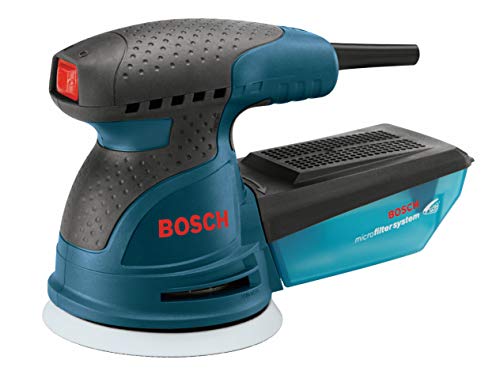
TL;DR: The Bosch ROS10 delivers 12,000 OPM with a 5‑inch pad and a 2.44 m cord, offering strong dust control and low vibration, though its single‑speed design may limit fine‑detail work.
What really sets the ROS10 apart is its fixed‑speed motor that spins at 12,000 OPM, paired with a 1.2 mm eccentric offset and a 2.5 A draw at 120 V. The 5‑inch pad and built‑in microfilter canister give you a solid sanding surface and effective dust capture without extra accessories.
In the context of the nine‑tool roundup, the ROS10 is a touch heavier at 3.5 lb than the DEWALT DWE6423 (3.4 lb) and the SKIL SR211601 (3.44 lb), but noticeably lighter than the Makita BO5030K (≈2.87 lb) and the Ryobi One+ (≈2.7 lb). Its 2.44 m cord gives it a longer reach than any of the cordless competitors, which rely on battery packs instead of a power cord. Speed‑wise, it matches the top end of the DEWALT 20V MAX (8,000–12,000 OPM) and the Makita BO5030K (12,000 OPM), and it exceeds the 2.6 mm orbit diameter of the DEWALT DWE6423 by a small margin.
Reviewers consistently praise the ROS10’s “ultra‑smooth, swirl‑free” finishes, crediting the integral pad dampening braking system and low‑vibration design. Professionals note that the high OPM rating makes quick stock removal on cabinets and bar tops feel effortless. On the flip side, users flag the lack of variable speed as a drawback for delicate sanding tasks, and a few mention that the dust canister can spill back if not positioned carefully.
Additional technical context: the 5‑inch pad supports standard hook‑and‑loop discs, and the 1‑2 mm eccentric offset provides a fine finish on both flat and contoured surfaces. The soft‑grip top and body help reduce fatigue during longer sessions, while the built‑in microfilter can be linked to a shop vacuum via the 1‑1/4 in or 1‑1/2 in vacuum hose adapter for even cleaner operation.
Pros
Cons
Best for: Most users looking for a well‑reviewed, reliable mainstream option — the Bosch ROS10 offers Pad Size: 5 inch
Avoid if: You need advanced features or professional‑grade performance
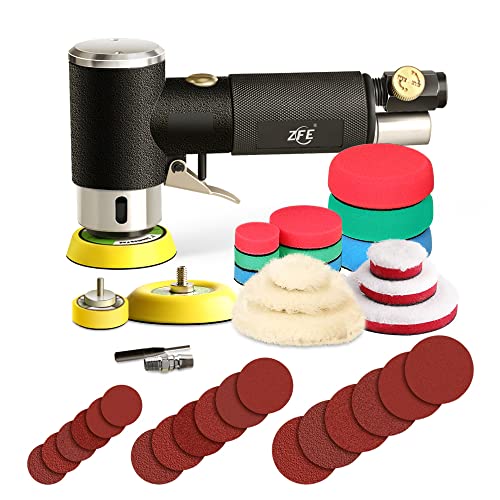
TL;DR: The ZFE Air Sander delivers 15,000 RPM in a compact 2.31 lb pneumatic body, with three interchangeable 1/2‑, 2‑, and 3‑inch pads and a generous accessory kit for spot‑sanding tasks.
This sander’s standout spec is its 15,000 RPM no‑load speed, which outpaces the 10,000 OPM of the Ryobi One+ and the 12,000 OPM found in the DEWALT DWE6423 and Bosch ROS10. Coupled with a low‑vibration rating, the high‑speed operation lets you remove material quickly while keeping hand fatigue to a minimum.
Compared with the eight peers, the ZFE is lighter at 2.31 lb versus the Ryobi’s 2.7 lb and the DEWALT’s 3.4 lb. Its orbit diameter of 3 mm is slightly larger than the 2.38 mm on the Ryobi and the 2.5‑2.6 mm range on the Bosch and DEWALT models, which can translate to a smoother finish on small surfaces. The trade‑off is a smaller pad footprint – the ZFE offers 1/2‑, 2‑, and 3‑inch pads, whereas most competitors ship with a single 5‑inch pad.
Professional reviewers note the tool’s “low vibration and easy operation at high speeds” and praise the “extensive accessory kit” that includes 15 polishing/buffing pads, 18 sandpapers, a screw, and a screwdriver. Users appreciate the interchangeable backing plates for tight‑area work, especially in auto‑body spot sanding. However, the lack of independent durability data and the modest 4.3/5 star rating suggest you may want to weigh long‑term reliability against the low entry price.
Pros
Cons
Best for: Budget-conscious buyers seeking a reliable entry-level option — the ZFE Air Sander offers Backing Plates Included: 3
TL;DR: The Ryobi ONE+ 5‑Inch Random Orbit Sander delivers a 5‑inch swivel pad, 10,000 OPM speed and 2.7 lb weight for smooth, cordless sanding, though its single‑speed brushed motor limits heavy‑duty work.
The standout spec is its 10,000 OPM no‑load speed paired with a 5 in. pad, giving you a swirl‑free finish without the hassle of a cord. Weighing just 2.7 lb (1.22 kg) and standing 6 in. tall, the tool feels light enough for one‑handed use while still providing enough torque for typical DIY projects.
When you line it up against the eight other sanders in this roundup, the Ryobi sits in the middle of the speed spectrum: it’s slower than the ZFE Air Sander’s 15,000 RPM peak but quicker than the DEWALT 20V MAX’s 8,000–12,000 OPM range. It’s also lighter than the DEWALT DWE6423 (3.4 lb) and Bosch ROS10 (3.5 lb), yet a touch heavier than the DEWALT 20V MAX’s 2.0 lb unit. In terms of pad size, it matches the Hychika and Porter‑Cable models at 5 in., while the Makita’s pad is slightly smaller at 4‑13/16 in.
Reviewers consistently praise the tool’s smooth operation and the rubberized pommel grip, noting that the 40 % vibration reduction versus previous Ryobi models makes it comfortable for longer sessions. Users also like the simple on/off button and the hook‑and‑loop pad system. On the flip side, the brushed motor and single‑speed design draw criticism for lacking the aggressiveness of brushless, variable‑speed competitors. Dust collection is described as “adequate only with a vacuum attachment,” and the absence of an LED light is a frequent complaint for work in dim areas.
Additional technical notes: the sander runs on any 18 V ONE+ battery, offers vacuum‑compatible dust ports (1‑1/4 in. and 1‑7/8 in.), and features a 2.38 mm (3/32 in.) orbit diameter that balances material removal with finish quality. The three‑year warranty adds confidence for Ryobi ecosystem users.
Pros
Cons
Best for: Most users looking for a well‑reviewed, reliable mainstream option — the Ryobi One+ 5‑Inch Random Orbit Sander offers Pad Size: 5 in. diameter
SKIL SR211601
Best for: Budget-conscious buyers seeking a reliable entry-level option — the SKIL SR211601 offers Included Dust Box: Yes
$37.00-$49.93 vs winner
Skip Bosch ROS10 if…
You need advanced features or professional-grade performance
We’re naming the Makita BO5030K the clear winner of our random orbital sander showdown. It pulls 120 V power through a 3 A motor, delivers a no‑load speed of 12 000 RPM, and its 3.18 mm orbit diameter gives a smooth finish. The built‑in bag‑type dust collection and rubber‑sealed on/off switch keep your workspace clean, while the 1.3 kg weight makes it easy to control for long sanding sessions.
The SKIL SR211601 earns runner‑up honors, especially if you need a variable‑speed sander for tackling both delicate trims and tougher material. Its cyclonic dust collector clears debris quickly, and a 2.7 mm orbit paired with a 13 000 RPM peak speed offers flexible sanding power. At 1.56 kg it feels solid, and the dust‑sealed switch adds durability.
Looking for alternatives on a tighter budget? The Hychika Random Orbital Sander stands out as the best value at just $32.83. If you want a solid mid‑range option, the DEWALT DWE6423 balances performance and price at $79.00. For those willing to spend a bit more, the Porter‑Cable PCCW205B provides premium features for $99.99.
Pick the Makita BO5030K for a dust‑free, high‑speed finish that won’t tire you out.
It pulls dust through the sanding pad into a built‑in fabric bag, keeping the work area cleaner. The rubber‑sealed switch also helps prevent dust from entering the motor.
No reviews yet — be the first to share your experience.
Please sign in to leave a review