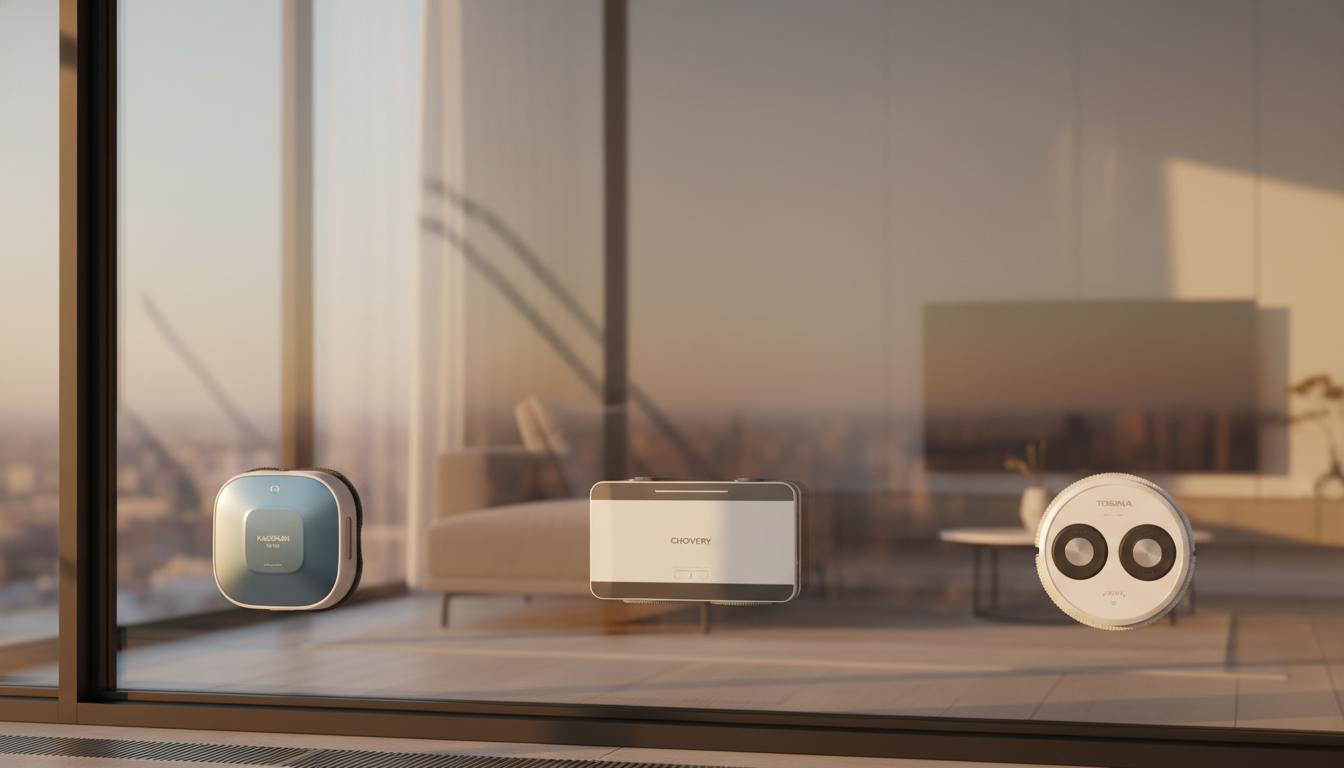
Window‑cleaning robots have finally become a realistic option for anyone who’d rather skip the ladder. In this roundup we evaluated six models that sit under the $200 ceiling, spanning three price tiers: two budget picks, two mid‑range contenders, and two premium options. The list includes the Kadskan Window Cleaning Robot, Chovery CL3, Tosima W2, Fmart T9Pro, Hobot HOBOT‑298, and Miupwula Window Cleaning Robot.
The budget tier starts at $84.99 and tops out at $89.99, offering solid suction—up to 5600 Pa on the Kadskan—and a full remote control package. Mid‑range devices like the Chovery CL3 ($105.99) and Tosima W2 ($129.20) add longer battery backup (30 minutes on the Chovery) and AI‑driven path planning. Premium models such as the Fmart T9Pro ($149.79) and Hobot HOBOT‑298 ($199.00) bring app control, larger safety ropes, and advanced AI routing, though the Hobot’s rating sits at 3.4/5 compared with the Tosima’s 4.3/5.
Below you’ll find a side‑by‑side look at each robot’s specs, user feedback, and where they shine, so you can decide which hands‑free cleaner fits your windows and wallet.

Kadskan Window Cleaning Robot
Its compact 68.6 mm height lets it glide under low‑profile sills, delivering top value and performance for budget buyers.

Chovery CL3
Great for buyers seeking a well‑rounded robot without cutting corners, the Chovery CL3 costs $105.99—about $16 more than the $89.99 Kadskan.

Tosima W2
The Tosima W2 stands out with a compact 203.2 mm length, fitting tighter window frames that the longer Kadskan and Chovery models can’t reach.
Also considered
Score Analysis
Key score advantages vs. runner-up (Chovery CL3)
Price Range
Kadskan Window Cleaning Robot
$89.99
Chovery CL3
$105.99
Tosima W2
$129.20
Fmart T9Pro
$149.79

Hobot HOBOT-298
$199.00
Miupwula Window Cleaning Robot
$69.99
Spec Comparison
TL;DR: The Kadskan HCR-10 offers 5600 Pa suction, a 300 lb safety‑rope capacity and an ultra‑thin 68.6 mm chassis for $89.99, making it a solid budget pick for hands‑free window cleaning.
The standout spec is its 5600 Pa suction power combined with a safety‑rope load capacity of 300 lb, which professional reviewers note keeps the robot firmly attached to vertical glass. Its chassis measures just 68.6 mm in height, letting it slip into narrow edges that bulkier units miss, and it comes with a remote, edge detection and both automatic and manual water‑spray modes.
Compared with the other five robots, Kadskan matches Miupwula’s 5600 Pa suction but out‑performs Tosima and Fmart, which list 3800 Pa. Its 68.6 mm height is slimmer than Chovery (74.9 mm) and Tosima (88.9 mm) yet thicker than Hobot’s 40.4 mm profile. The AI‑driven 3.0 path planning sits alongside Miupwula’s AI 5.0 and Tosima’s AI 3.0, while all competitors offer edge detection and remote control.
However, reviewers frequently mention a short power cord that can limit reach on large panes, a modest water‑tank that requires frequent refills, and manufacturers don't list a smartphone app or battery backup time, which raises questions about cordless operation and long‑term durability.
Pros
Cons
Best for: Entry-level buyers or those on a tight budget
Avoid if: You need powerful performance or professional‑grade features
TL;DR: The Chovery CL3 offers dual‑side auto spray, edge detection, and a 30‑minute battery backup at $105.99, making it a solid mid‑range window‑cleaning robot for most homes.
The CL3 packs a dual‑side automatic water spray and edge‑detection sensors, features a triple safety system that includes a safety rope and backup battery. It can cover up to 30 sqm per session and runs for 30 minutes on its internal battery. Its remote control lets you start, stop, and steer the unit without climbing a ladder.
Compared with the other five robots, the CL3 is slightly taller than the Kadskan (74.9 mm vs 68.6 mm) and a bit wider (149.9 mm vs 139.7 mm), while sharing remote control and edge detection. Its 30‑minute battery life outlasts the Miupwula and Fmart models, both of which list 20‑minute runtimes. The Tosima W2 is taller (88.9 mm) but shorter in length, and the Hobot‑298 is far more compact at 40.4 mm high. Unlike Hobot and Fmart, the CL3 doesn't list app control, so you’ll rely on the handheld remote.
Reviewers consistently praise the robot’s lightweight feel and the streak‑free results from the dual spray, noting that the device stays securely attached to glass thanks to its suction system. The AI‑driven navigation and reliable no‑slip performance on large panes are highlighted. The main complaint is the dependence on a power cord, which limits true cordless freedom despite the 30‑minute backup, and users mention the water‑spray volume can run low on longer jobs.
Pros
Cons
Best for: Homeowners, apartment dwellers, or anyone with tall, hard‑to‑reach windows, mirrors or tiled vertical surfaces.
Avoid if: You need fully cordless operation for very large or multiple‑room cleaning sessions, or you require app‑based control.
“Lightweight at under 1kg, easy to handle and position”
TL;DR: The Tosima W2 packs 3800 Pa suction and AI 3.0 path planning into a compact 88.9 mm‑high robot, offering solid cleaning for windows and mirrors at a mid‑range price.
The standout spec is its 3800 Pa variable suction, which reviewers say keeps the unit firmly attached while scrubbing fingerprints and stubborn spots. Coupled with AI 3.0 intelligent path planning, the W2 maps each pane and adjusts its route on the fly. Its dimensions – 88.9 mm tall, 203.2 mm long and wide – let it slip onto most residential glass surfaces without crowding the frame.
Compared with the other five robots, the W2 matches the Fmart T9Pro’s 3800 Pa suction but falls short of the 5600 Pa power that the Kadskan and Miupwula models deliver. It’s heavier than the Hobot‑298, which tips the scales at 2.82 pounds, yet lighter than the Fmart T9Pro’s 4.54 pounds. While it carries a higher price tag than the sub‑$100 options, its feature set—remote control, edge detection, anti‑fall sensors—places it solidly in the middle of the price‑performance curve.
User sentiment highlights the robot’s reliable grip and the convenience of remote operation. Reviewers repeatedly note that the 3800 Pa suction prevents accidental drops, and the AI‑driven navigation reduces the need for manual repositioning. The limited battery runtime of roughly 20–25 minutes per charge makes it best suited for single‑pane or small‑area jobs before a recharge is required.
Running on a brushless DC motor and a HEPA‑type filter, the W2 delivers a suction range of 2400–3800 Pa. A 5 m safety rope (as cited in user reviews) adds an extra layer of protection, and the included remote lets you start, pause, or direct the unit without touching the glass. Edge detection and anti‑fall sensors work together to keep the robot from slipping off narrow frames.
Pros
Cons
Best for: Homeowners, apartment dwellers and small‑office users who need hands‑free cleaning of hard‑to‑reach windows, mirrors or doors.
Avoid if: You have large façade cleaning tasks or require longer than a 20‑minute runtime per charge.
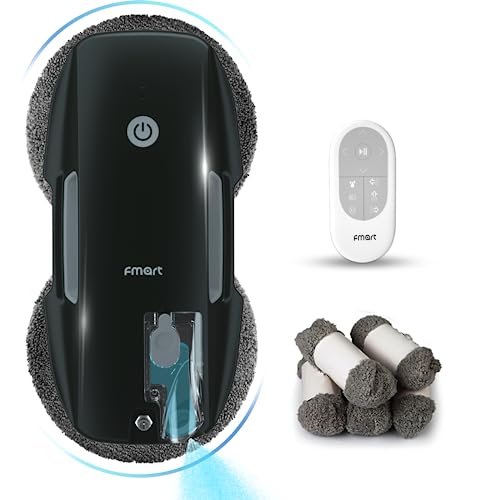
TL;DR: The Fmart T9Pro offers 3800 Pa suction, ultrasonic misting and a 5 m safety rope for $149.79, making it a solid mid‑range choice if you can overlook a thin manual and occasional streaks.
The standout spec is the 5,029 mm safety rope, which lets the robot tackle high‑rise windows without fear of a fall. Coupled with 3800 Pa suction and an ultrasonic atomization spray, it promises a deep clean that reaches into grime without the usual streaks of a cloth wipe. The unit weighs about 4.54 lb (2 058 g) and fits comfortably in a small hand‑bag, while the 25 ml water tank supplies just enough mist for most residential panes.
Compared with the other five robots, the T9Pro sits in the middle of the price band – pricier than the Chovery CL3 and Kadskan models, but cheaper than the Hobot HOBOT‑298. Its suction matches the Tosima W2 (both 3800 Pa) yet falls short of the 5 600 Pa power of Kadskan and Miupwula. Battery life is 20 minutes, which is shorter than Chovery’s 30‑minute run but equal to Miupwula’s. The 5 m rope outstretches Hobot’s 4.57 m and Miupwula’s 4 m tether, giving it an edge on taller installations.
Professional reviewers applaud the robot’s suction and the ultrasonic spray for reducing streaks, while everyday users love the remote and app controls for hands‑free operation. The most common gripe is a sparse user manual that forces a trial‑and‑error setup, and several owners note visible streaks when cleaning under direct sunlight. Reviewers describe the noise as moderate; it's acceptable for most indoor settings but might be noticeable on quiet evenings.
Pros
Cons
Best for: Those prioritizing quality and willing to pay for premium performance
Avoid if: You need advanced features or professional‑grade performance
“Instructions are sparse with missing details, requiring user interpretation.”
“May leave visible streaks or residue revealed in sunlight, despite initial good appearance.”
TL;DR: The Hobot‑298 uses AI route planning and ultrasonic mist to clean large windows, but its $199 price puts it at the top of the budget range.
The Hobot‑298’s standout feature is its AI Smart Route Planning paired with an ultrasonic water spray, which the manufacturer says mimics a human breath for even mist distribution. The robot carries a 4572 mm safety rope and weighs just 2.82 lb, making it easy to mount and remove. Its 9.5 × 9.5 in cleaning cloth and auto‑adjustable pneumatic pad aim for streak‑free results on panes as thin as 3 mm.
Compared with the other five contenders, the Hobot‑298 is noticeably lighter than the Fmart T9Pro (≈4.54 lb) and the Tosima W2 (≈4.0 lb). Its safety rope is a bit shorter than the Fmart’s 5029 mm length, yet still long enough for most high‑rise installations. While the Kadskan and Chovery models list suction power or water‑spray coverage, the Hobot‑298 is the only one in the set that advertises ultrasonic mist, giving it a unique cleaning approach. Unlike several peers, Hobot does not list a battery backup time, so you’ll rely on continuous power during operation.
Everyday owners rave about the robot’s quiet operation and the streak‑free shine it delivers on big windows, crediting the mist technology for the clean finish. Professional reviewers highlight the advanced AI routing and the square chassis that covers large, frameless panes efficiently. Common complaints focus on the need to add detergent for heavily soiled glass, the extra effort of anchoring the safety rope, and occasional hiccups with the Bluetooth app.
Additional technical details include a minimum cleaning area of 13 × 13 in, edge detection to avoid drops, and both app and remote control options for flexible operation. The device also features an auto‑adjustable pneumatic pad that conforms to glass surfaces, helping maintain suction across varied window shapes.
Pros
Cons
Best for: Those prioritizing quality and willing to pay for premium performance
Avoid if: You're shopping on a tight budget — it's priced at $199.00
TL;DR: The Miupwula Window Cleaning Robot offers AI‑driven edge detection, 5600 Pa suction and a 35 ml spray tank for $84.99, making it the most affordable entry‑level option despite a modest 2.9‑star rating.
What really sets this robot apart is its 5600 Pa suction power, the same level found in higher‑priced rivals, paired with AI 5.0 path planning and edge detection that aim to keep the unit from falling off narrow frames. The built‑in 35 ml water tank automatically sprays during cleaning, so you don’t have to pause for manual misting.
Compared with the other five models, Miupwula matches Kadskan’s suction strength but offers a shorter 4000 mm safety tether than Hobot and Fmart, whose tethers exceed 4500 mm. Its 20‑minute battery backup equals Fmart’s runtime but falls short of Chovery’s 30‑minute claim. The water tank holds more than Fmart’s 25 ml capacity, though it’s smaller than the larger tanks some premium units provide. The manufacturer lists AI path planning as version 5.0, a step up from Tosima’s AI 3.0, and includes remote control like the other models.
Users appreciate the hands‑free convenience, especially in high‑rise apartments where reaching upper panes is a hassle. Professional reviewers note the edge‑detection algorithm delivers reliable frame coverage, and the automatic spray produces streak‑free results. However, several owners report the companion app crashes intermittently, and the 20‑minute runtime can feel limiting on larger windows, requiring frequent recharges or water refills.
Pros
Cons
Best for: Entry-level buyers or those on a tight budget
Avoid if: Reliability and user satisfaction are your top concerns
Breakdown
Kadskan Window Cleaning Robot
Pros
Chovery CL3
Pros
Tosima W2
Pros
Cons
Fmart T9Pro
Pros
Based on scoring data and product specs
Personalized picks
Best Overall Pick
Kadskan Window Cleaning Robot
Best OverallBest for: Entry-level buyers or those on a tight budget
Chovery CL3
Best for: Most users seeking a balanced, mainstream option
$105.99+$16.00 vs winner
Skip Miupwula Window Cleaning Robot if…
Reliability and user satisfaction are your top concerns
The Kadskan Window Cleaning Robot takes the top spot as the best budget window cleaner under $200. It’s priced at $89.99 and carries a solid 4.2‑star rating from 113 reviews, showing strong user approval. Its 5600 Pa suction power and a 300 lb safety‑rope load capacity give it the muscle to cling securely to glass, while edge detection and a double‑spiral cleaning head keep edges spotless.
Runner‑up honors go to the Chovery CL3, especially if you need a robot that can handle larger panes with a longer run time. It offers a 30‑minute battery backup and a 30 sqm water‑spray coverage area, plus dual‑side auto spray and edge detection to reach both sides of the glass. The triple safety system adds peace of mind for high‑rise windows.
For shoppers eyeing other price tiers, the Miupwula Window Cleaning Robot is the cheapest pick at $84.99, making it the best budget option. The Chovery CL3 remains the strongest mid‑range choice at $105.99, thanks to its dual‑side spray and solid battery life. If you’re willing to stretch to $199.00, the Hobot HOBOT‑298 stands out as the premium contender in this segment.
Grab the Kadskan Window Cleaning Robot today and let it do the dirty work for you.
The Kadskan Window Cleaning Robot stands out as the best value, priced at $89.99 and offering strong suction (5600 Pa), edge detection, and a full remote set. Its combination of features and low price gives it a clear advantage over the higher‑priced options.
No reviews yet — be the first to share your experience.
Please sign in to leave a review