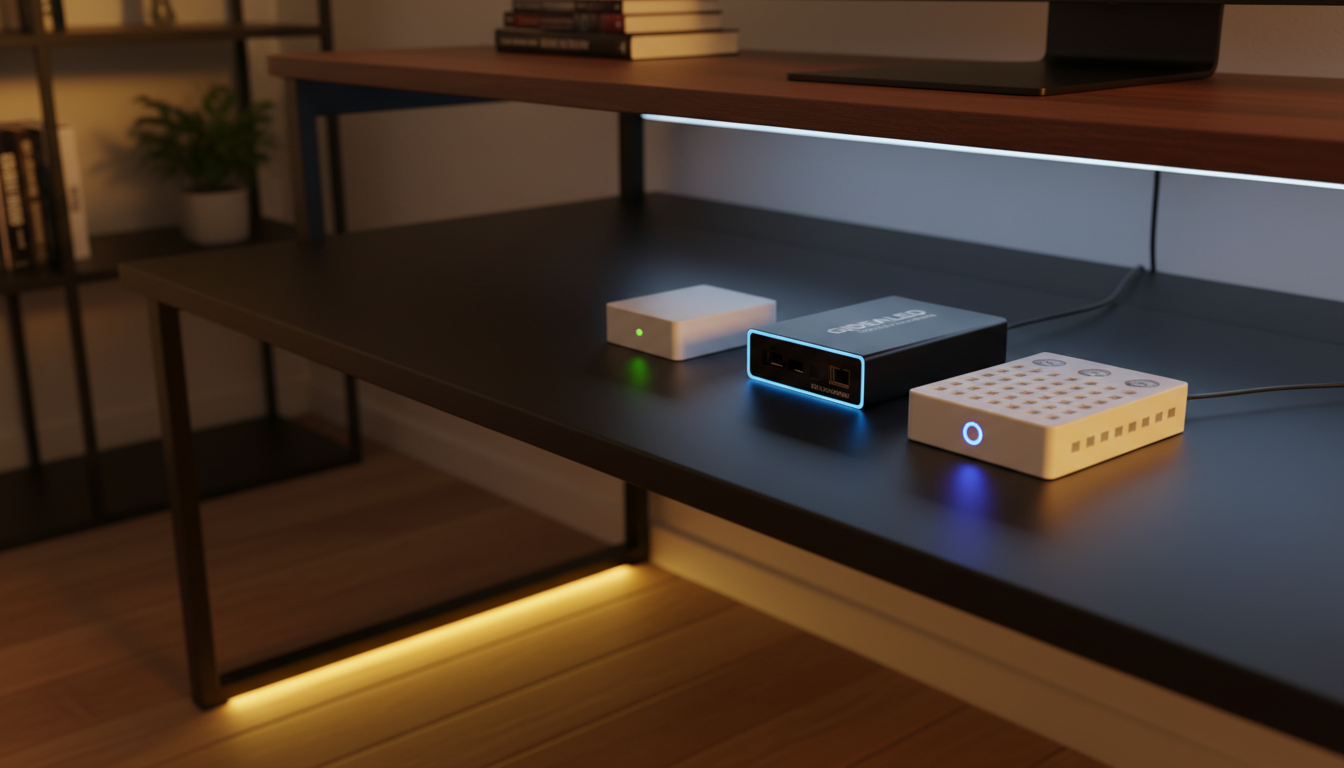
It might feel odd, but the priciest controllers in our set don’t necessarily earn the highest marks. The BTF‑LIGHTING DR03W sits at $24.99 yet carries a 4.2‑star rating, while the $15.99 RGBZONE WiFi LED Controller pushes a 4.4‑star score from 596 reviewers. That gap shows price isn’t the sole predictor of satisfaction, especially when you consider we compared a total of 10 options.
We’ve grouped the lineup into three price tiers. The budget bucket holds four models under $16: GIDEALED Smart WiFi RGBW at $13.99, iNextStation and Aubric both at $14.99, and the RGBZONE at $15.99. Mid‑range picks sit around $18–$21, featuring the GIDEALED Zigbee 3.0 ($18.89) and GIDERWEL ($20.99). The premium tier clusters the $24.99 contenders—BTF‑LIGHTING C01Z, C03W, DR03W, and Goldwin—each offering higher power or advanced protocol support.
Below, we’ll walk through each controller’s strengths, quirks, and the scenarios where they shine, so you can match the right smart lighting brain to your space.

RGBZONE WiFi LED Controller
It delivers a solid 100 W max output while staying lightweight at 63.5 g, giving the best value and reliability for a budget controller.

BTF-LIGHTING C03W
Ideal for buyers ready to spend a bit more on a proven, high‑quality controller; at $24.99 it’s $9 higher than the $15.99 RGBZONE.

GIDEALED Zigbee 3.0 LED Controller Pro
Stands out with a 5 A maximum output current in a compact 59 g package, catering to users who need precise current control unlike the watt‑focused rivals.
Score Analysis
Key score advantages vs. runner-up (BTF-LIGHTING C03W)
Price Range
RGBZONE WiFi LED Controller
$14.23
BTF-LIGHTING C03W
$24.99
GIDEALED Zigbee 3.0 LED Controller Pro
$20.99

iNextStation Smart RGB WiFi LED Controller
$14.99

Aubric Smart WiFi LED Controller
$14.99

GIDERWEL Smart Zigbee 3.0 LED Controller
$20.99

BTF-LIGHTING DR03W
$24.99

Goldwin LED Controller
$24.99

BTF-LIGHTING C01Z
$20.99

GIDEALED Smart WiFi RGBW LED Controller
$13.99
Spec Comparison
TL;DR: The RGBZONE Wi‑Fi LED Controller offers 100 W of output, dual Wi‑Fi/app and IR remote control, and 16 million colors for $15.99, making it a solid budget pick for basic smart‑lighting setups.
The standout spec is its 100 W maximum output power paired with a 2.0 × 10.6 × 15.8‑inch housing that fits most LED strip projects. You get both Wi‑Fi app control (up to 60 m range) and a 24‑key IR remote (5‑8 m range), plus built‑in music synchronization that reacts to ambient sound.
Weighing 0.14 pounds (63.5 g), the RGBZONE unit outweighs the Aubric controller (≈0.075 lb) and the Goldwin model (0.04 lb) but stays lighter than the GIDEALED Zigbee Pro (≈0.13 lb). Its 100 W output falls short of Aubric’s 144 W and the GIDEALED Zigbee’s 270 W, placing it in the mid‑range of power among the ten‑product lineup while staying well under the $25 budget ceiling.
Reviewers consistently praise the flexibility of both app and remote options, and many note the fun of microphone‑driven light shows. A common complaint is that the controller omits the required DC power supply, so you’ll need to buy a compatible 5‑24 V adapter separately. Users also note the limited IR remote range (5‑8 m), especially in larger rooms.
Pros
Cons
Best for: Budget‑conscious buyers seeking a reliable entry‑level option
Avoid if: You have limited desk space or need portability
TL;DR: The BTF‑Lighting C03W delivers 6 A per RGB channel (15 A total) with dual Wi‑Fi/Bluetooth connectivity and 16 million colors, making it a solid budget pick for DIY smart‑home projects.
Professional reviewers note a “negligible color shift” on 10 m runs. Each color channel can handle up to 6 A, and the unit tops out at 15 A total, letting you drive long, high‑density RGB FCOB strips without noticeable voltage drop.
At 0.0875 pounds, the C03W is heavier than the Goldwin LED Controller (0.04 lb) but lighter than the BTF‑Lighting DR03W (0.1499 lb). Its 80 mm width also exceeds Goldwin’s 24 mm width, while its 28 mm height sits between Goldwin’s 10 mm and the DR03W’s 22 mm. Unlike some peers that list only Wi‑Fi or only Bluetooth, the C03W uses a dual‑module design that defaults to Wi‑Fi and falls back to Bluetooth if the network drops, adding reliability for home automation.
Users repeatedly praise the controller’s easy strip‑cutting, strong adhesive backing, and the wide operating temperature range of –20 °C to +45 °C. The built‑in auto‑synchronization and 30‑meter transmission range also receive high marks in everyday use. On the downside, reviewers consistently mention the need for a separate DC power supply and note that the unit only supports RGB (no native RGBW or CCT), which can limit color‑temperature projects.
Technical details round out the package: the controller runs on a PWM protocol, offers 16 million RGB colors, and integrates with Alexa and Google Home via the Tuya Smart or Smart Life apps. Features such as countdown timers, sleep/wakeup plans, and group control let you set granular automation without extra hubs.
Pros
Cons
Best for: Buyers willing to invest in a proven, high-quality option
Avoid if: You're on a tight budget or only need basic functionality
TL;DR: The GIDEALED Zigbee 3.0 LED Controller Pro costs $18.89, handles up to 270 W at 5 A, and works with major Zigbee hubs for indoor RGBW lighting.
This controller’s standout spec is its 270 W maximum power output while staying under 0.13 lb (59 g). It accepts a wide DC range of 12‑54 V, so you can power most residential RGBW, RGBWW or RGBCCT strips without needing an extra driver.
Compared with the other nine contenders, it delivers more power than the BTF‑LIGHTING C01Z’s 180 W (12 V) limit and the GIDERWEL’s 120 W ceiling, yet its 5 A current cap is lower than the C01Z’s 15 A channel rating. At 0.13 lb it weighs more than the GIDERWEL’s 0.09 lb unit but less than the RGBZONE WiFi controller’s 0.14 lb. Unlike the Wi‑Fi‑only models, it relies on Zigbee, so you’ll need a compatible hub such as a Tuya Smart Hub, Philips Hue Bridge, SmartThings, or an Echo Plus.
Reviewers appreciate the broad voltage range and the fact that the device doubles as a Zigbee mesh repeater, extending signal coverage across a room. The 16 million‑color palette and 1‑100 % brightness dimming receive frequent praise for creating vivid ambience. The main complaints focus on its indoor‑only rating and the 5 A current ceiling, which can limit very high‑power installations or outdoor projects.
Additional technical notes: the plastic housing tolerates temperatures from –20 °C to +60 °C, making it suitable for most indoor environments. Voice control works through Alexa‑compatible Echo devices, and the Tuya/Smart Life apps provide full color, temperature and brightness adjustments.
Pros
Cons
Best for: Most users seeking a balanced, mainstream option
Avoid if: You need outdoor lighting, very high‑current strips, or dual‑strip control
TL;DR: The iNextStation Smart RGB WiFi LED Controller offers hub‑free, voice‑enabled control of 12 V RGB strips, fits in a compact 36.1 mm × 160.0 mm × 71.1 mm chassis, and ships for just $14.99.
What really sets this controller apart is its tiny footprint—36.1 mm tall, 160.0 mm long and 71.1 mm wide—while still delivering over 16 million color options plus white shades. It connects to a 2.4 GHz Wi‑Fi network, remembers your last scene after a power loss, and runs without any external hub.
Compared with the other nine controllers in this budget roundup, the iNextStation is longer than the Aubric’s 100 mm length and slimmer than the RGBZONE’s 2.0‑inch height. It also stays smaller than the Zigbee‑based GIDEALED Pro, which measures 89 mm × 48 mm × 23.5 mm. Unlike the GIDEALED Zigbee model that needs a compatible hub, iNextStation works straight out of the box. Its two output ports match the basic functionality of many peers while keeping the design simple.
Users consistently praise the QR‑code setup that finishes in under two minutes and the intuitive Magic Home Pro/Tuya apps. Voice commands through Alexa, Google Assistant, or IFTTT feel reliable, and the built‑in microphone gives a responsive music‑sync experience. On the downside, reviewers note the strict 2.4 GHz Wi‑Fi requirement can be a blocker for 5 GHz‑only routers, and the lack of detailed power ratings leaves high‑draw LED strips a bit uncertain.
Technically, the controller supports 12 V and 24 V strips via a 4‑pin (RGB + 12 V DC) connector and works with popular SMD 3535, 5050 and 2835 LEDs. You can choose from static, dimming, flash or breathing modes, set timers, and let the device store your favorite scene for the next power cycle. The Magic Home Pro or Tuya/Smart Life apps manage all of this, making it a solid entry‑level smart lighting hub.
Pros
Cons
Best for: Entry‑level buyers or those on a tight budget
Avoid if: You need powerful performance or professional‑grade features
TL;DR: The Aubric Smart WiFi LED Controller packs 144 W of power, 16 million colors and a metal housing into a 100 mm, 34 g unit for just $14.99, but you’ll need to buy a power adapter separately.
The standout spec is its 144 W maximum output, which lets you drive fairly long RGB strips while still staying under the $25 budget ceiling. It offers 16 million color options, five custom scenes and a 20 m RF remote range, all sit in a durable metal shell measuring just 100 mm long and weighing 34 g.
When you line it up against the other nine budget controllers, Aubric’s power rating tops the RGBZONE unit’s 100 W and matches the GIDEALED controller’s 144 W. Its 100 mm body is shorter than iNextStation’s 160 mm length, making it easier to tuck away, and at 34 g it’s lighter than RGBZONE’s 63.5 g, though a bit lighter than GIDEALED’s 41 g. The metal construction also feels more solid than the plastic housings of several peers.
Users repeatedly praise the hassle‑free Wi‑Fi setup and the Magic Home app’s intuitive color picker, plus the convenience of Alexa and Google Assistant voice commands. Professional reviewers highlight the music‑sync mode as a fun party feature. The most common complaint is that the required 5.5 × 2.1 mm power adapter doesn’t come with the unit, so you’ll need to buy one separately. Reviewers also note the lack of an IP rating, which makes outdoor or humid‑room use risky, and some experience occasional drops on congested 2.4 GHz Wi‑Fi networks.
Beyond raw power, the controller supports a wide voltage range (5‑24 V DC), five custom scenes, group control, timers and a hotspot mode that lets you operate strips even without a home Wi‑Fi network. This flexibility makes it a solid choice for DIY lighting projects and occasional party lighting.
Pros
Cons
Best for: DIY lighting enthusiasts, smart‑home beginners and party hosts who want a budget‑friendly, voice‑controlled controller.
Avoid if: You need a waterproof unit, want a fully bundled kit with an included power supply, or require rock‑solid connectivity in a congested Wi‑Fi environment.
TL;DR: The GIDERWEL Smart Zigbee 3.0 LED Controller delivers 16 million colors, full‑range dimming and up to 120 W output, fitting right into Hue, Tuya or Echo Plus ecosystems for under $25.
The controller’s standout spec is its 0‑100% dimmable range paired with a 5 A max output current and a 120 W maximum power rating, enough to drive long RGBWW strips. It supports 16 million colors and a tunable white range from 2700 K to 6500 K, all managed through Zigbee 3.0 hubs such as Philips Hue, Tuya or Echo Plus. At just 0.09 pounds (41 g) and a compact 48 mm × 89 mm × 24 mm footprint, the unit is light enough to sit unobtrusively behind any indoor strip.
Compared with the nine other controllers in this $25‑under roundup, the GIDERWEL sits in the middle of the pack on size—its dimensions match the GIDEALED Zigbee 3.0 Pro’s 89 × 48 mm footprint but it’s taller than the BTF‑LIGHTING C03W’s 28 mm height and longer than its 35 mm length. It’s lighter than the GIDEALED Pro’s 59 g and the BTF‑LIGHTING DR03W’s 68 g, yet a bit heavier than the Goldwin’s 18 g unit. Power‑wise, its 120 W ceiling is higher than the RGBZONE WiFi controller’s 100 W and lower than the BTF‑LIGHTING C01Z’s 180 W (12 V) / 360 W (24 V) and the GIDEALED Pro’s 270 W, giving it solid mid‑range capability without the higher‑current demands of those models.
Users who already own a Zigbee hub appreciate the direct Alexa voice control and the fact that the controller can act as a Zigbee mesh repeater, extending network range in larger homes. Review notes highlight the convenience of the built‑in timer and the 4 W per meter power draw, which keeps consumption modest. The main trade‑off is the requirement for a compatible Zigbee hub—there’s no Wi‑Fi‑only control, and the IP20 rating limits placement to dry indoor locations.
Pros
Cons
Best for: Existing Zigbee ecosystem owners who want full‑color, tunable‑white control with mesh‑network benefits.
Avoid if: You lack a Zigbee hub, need waterproof/outdoor lighting, or prefer a Wi‑Fi‑only solution.
TL;DR: The BTF‑LIGHTING DR03W is a Wi‑Fi‑enabled RGB SPI controller that handles up to 720 addressable LEDs, offers app, voice and RF remote control, and costs $24.99.
What really sets the DR03W apart is its ability to drive up to 720 addressable pixels while providing 44 built‑in dynamic modes and more than 10 custom scenes through the Tuya app. Multi‑zone control lets you segment strips, and the included 2.4 GHz RF remote reaches roughly 30 m, giving you flexibility whether you’re on the couch or across the room.
In the $25‑price tier, the DR03W is noticeably longer than the BTF‑LIGHTING C03W’s 35 mm chassis and also heavier than the C03W’s 40 g weight, sitting at 107.6 mm length and 68 g. Compared with the Goldwin LED Controller, the DR03W is taller (22 mm vs 10 mm) and heavier (about 0.15 lb vs 0.04 lb). It also out‑sizes the GIDERWEL Zigbee unit, which measures 48 mm in height, while still fitting comfortably in most DIY enclosures.
Users have given the unit a 4.2‑star average across 103 reviews, praising the breadth of control options—Wi‑Fi, Bluetooth, Alexa, Google Home, and the long‑range RF remote. Professional reviewers highlight the 15 A maximum output current as generous for most residential projects, though the 12 A input current ceiling can bite when you try to power very large strips. The product’s incompatibility with standard PWM RGB/RGBW strips is a recurring note in user feedback.
The DR03W runs on 2.4 GHz Wi‑Fi and supports Bluetooth as a backup, delivering a 5 V SPI signal to the strip. Its adjustable pixel range spans RGB (20‑720 ICs), RGBW (20‑700 ICs) and RGBCCT (20‑450 ICs), giving you room to grow as your lighting ideas expand. The lack of a built‑in timer or group‑control feature means you’ll rely on the Tuya app for scheduling.
Pros
Cons
Best for: DIY LED enthusiasts who need high pixel capacity and want voice or remote control flexibility.
Avoid if: You're shopping on a tight budget — it's priced at $24.99.
TL;DR: The Goldwin LED Controller packs Wi‑Fi and Bluetooth control, voice‑assistant support and music sync into a 0.04‑lb, 90‑W unit that’s tiny enough for tight spaces, though its Wi‑Fi can be flaky.
At just 0.39 in tall, 2.09 in long and 0.94 in wide, this controller is one of the most compact options in the $25‑budget segment. It weighs only 0.04 lb (18 g) and can drive up to 90 W of single‑color LED strips, with a maximum output current of 5 A. The tiny footprint makes it easy to hide behind furniture or inside a ceiling cavity.
When you line it up against the nine other contenders, Goldwin is the lightest of the lot – the next lightest, the Aubric Smart Wi‑Fi controller, comes in at about 0.07 lb. Its height of 0.39 in also undercuts the BTF‑LIGHTING C03W (28 mm) and the GIDERWEL Zigbee unit (48 mm). In terms of power, however, it trails behind several peers: the BTF‑LIGHTING C01Z can push 180 W, GIDEALED tops out at 270 W, and the RGBZONE Wi‑Fi model reaches 100 W. So while Goldwin wins on size, it offers less headroom for very high‑draw strips.
Users appreciate the dual‑connectivity setup – the built‑in Bluetooth backs up Wi‑Fi, and voice commands work with Alexa, Google Home and Siri. The integrated microphone enables music‑sync lighting, a feature praised in reviews. On the flip side, many owners report frequent Wi‑Fi pairing hiccups that force a reset or router tweak, and reviewers flag the sparse build‑quality documentation as a concern.
Beyond the hardware, the Goldwin unit runs the Magic Home Pro app, supports group control, timers and brightness tweaking, and works with a range of LED chip types (5050, 5630, 5730, 3528, 2835, 3014, 4014). Its 12‑24 V input range and 5 A max current make it suitable for most residential single‑color strips, but it isn’t the best match for projects that demand more than 5 A.
Pros
Cons
Best for: DIY homeowners and hobbyists who want voice control, music sync and a tiny controller for single‑color LED strips.
Avoid if: You need rock‑solid Wi‑Fi reliability, higher than 5 A current capacity, or a heavily documented build quality.
TL;DR: The BTF‑Lighting C01Z delivers up to 360 W of power over a 30 m Zigbee range, supports DC5‑24V strips, and integrates with major smart hubs for reliable monochrome lighting control.
One of the standout specs is the controller’s maximum output power of 360 W at 24 V, paired with a total output current of 15 A. The dual‑channel design splits the load into two 7.5 A streams, which helps keep high‑power strips running safely. It also reaches a control range of 30 m, so you can place the controller away from the strip without losing signal.
By contrast, the GIDERWEL controller tops out at 120 W, and the Goldwin unit limits output to 90 W, making the C01Z’s 360 W capability a clear advantage. Even the GIDEALED Pro, with a maximum power of 270 W, falls short of the C01Z’s output. The BTF‑Lighting C03W also supports a total current of 15 A, but its focus on 12 V operation means its power ceiling is lower than the C01Z’s 360 W at 24 V. Several Wi‑Fi‑based peers, such as the RGBZONE model, offer a 60 m app range but cap at 100 W, while the Aubric controller delivers 144 W. In terms of control protocol, the C01Z’s Zigbee 3.0 matches the GIDERWEL and GIDEALED, whereas the Wi‑Fi controllers rely on a different network.
Customers frequently mention the straightforward wiring and the strong Zigbee signal, noting that the 30 m range holds up even through walls. Professional reviewers praise the dual‑output layout for safer high‑power use and the ultra‑low idle draw of 0.06 W. On the flip side, users without an existing Zigbee hub report being unable to control the strip, and a few have run into compatibility issues with non‑Tuya hubs.
The controller accepts DC5‑24V input, covering most single‑color PWM strips like FCOB, COB, 5630, 5730, 5050 SMD, and 3528 SMD. The same Zigbee bridge supports Alexa, Google Home, and HomeKit, and the Tuya Smart app provides automation scenes like biorhythm, sleep, and do‑not‑disturb timers.
Pros
Cons
Best for: Those prioritizing quality and willing to pay for premium performance
Avoid if: You're on a tight budget or only need basic functionality
“Easy setup with Tuya/Smart Life apps, strong signal for long strips (30m+ via relaying), and reliable dimming/voice control with Echo Plus or Hue.”
TL;DR: The GIDEALED Smart WiFi RGBW LED Controller delivers 144 W of indoor lighting power for $13.99, offering Wi‑Fi, RF remote and voice control in a compact 41 g package.
This controller’s standout spec is its 144 W output capacity while supporting up to 150 RGBW LEDs across one or two 5‑pin strips, meaning you can light a full 16.5‑ft (or 32‑ft) roll without a separate driver. It runs on a 12 V DC input and requires an external 3 A adapter with a 5.5 mm × 2.5 mm socket, a detail that shows up frequently in user comments.
Compared with the nine other budget controllers in the roundup, GIDEALED sits in the middle of the weight range: it’s heavier than the Aubric unit (34 g) but lighter than the RGBZONE model (63.5 g) and the Zigbee‑based Pro version (59 g). Its 144 W output matches Aubric’s power rating, outstripping RGBZONE’s 100 W, yet falls short of the Zigbee Pro’s 270 W and the BTF‑LIGHTING C01Z’s 180 W limit.
Reviewers appreciate the flexibility of three control methods—Magic Home Pro app, a 24‑key 2.4 GHz RF remote, and Alexa/Google voice integration—making it easy to switch moods without reaching for a phone. The dual 5‑pin ports also earn praise for allowing separate zones or longer strips. On the downside, users repeatedly note the need for a separate power brick adds clutter, and the lack of any waterproof rating means it’s strictly for indoor use. The 3.7‑star average reflects mixed experiences, with some owners citing occasional connectivity hiccups.
Pros
Cons
Best for: Entry-level buyers or those on a tight budget who want indoor RGBW lighting with voice, app and remote control.
Avoid if: You need powerful performance, outdoor‑ready hardware, or a fully integrated power solution.
Breakdown
RGBZONE WiFi LED Controller
Pros
BTF-LIGHTING C03W
Pros
GIDEALED Zigbee 3.0 LED Controller Pro
Pros
iNextStation Smart RGB WiFi LED Controller
Pros
Based on scoring data and product specs
Personalized picks
Best Overall Pick
RGBZONE WiFi LED Controller
Best OverallBest for: Budget-conscious buyers seeking a reliable entry-level option
BTF-LIGHTING C03W
Best for: Buyers willing to invest in a proven, high-quality option
$24.99+$10.76 vs winner
Skip GIDEALED Smart WiFi RGBW LED Controller if…
You need powerful performance or professional-grade features
The RGBZONE WiFi LED Controller takes the top spot as the best overall budget smart lighting controller. At just $15.99 it delivers a solid 4.4‑star rating from 596 reviewers, and its built‑in microphone lets you sync lights to music straight from the app. The controller also reaches up to 60 meters with its Wi‑Fi app and supports the full 16 million‑color palette, making it a versatile choice for most homes.
Runner‑up honors go to the BTF‑LIGHTING C03W, especially if you need voice control and reliable multi‑zone automation. It pairs with Alexa and Google Home, offers a 30‑meter auto‑transmitting range, and even falls back to Bluetooth when Wi‑Fi drops, ensuring your lights stay responsive. With a 4.3‑star rating from 725 reviews and a price of $24.99, it’s a solid step up for smart‑home enthusiasts.
For shoppers focused on specific budgets, the GIDEALED Smart WiFi RGBW LED Controller is the cheapest pick at $13.99, delivering basic Wi‑Fi control at the lowest price point. The GIDEALED Zigbee 3.0 LED Controller Pro stands out in the mid‑range at $18.89, offering the highest rating among the alternatives. If you’re willing to stretch to a premium option, the BTF‑LIGHTING DR03W at $24.99 provides the most advanced feature set in this lineup.
Pick the RGBZONE WiFi LED Controller today and enjoy reliable, feature‑rich lighting without breaking the bank.
The RGBZONE WiFi LED Controller includes a built‑in microphone for music synchronization and offers an app control range of up to 60 meters, making it ideal for larger rooms. Its dynamic mode and speed adjustment let you fine‑tune the visual effects to match the beat.
No reviews yet — be the first to share your experience.
Please sign in to leave a review
Also considered
$24.99