⚡ Quick Answer
Finding the right space heater can feel like a puzzle, especially when you balance room size, noise tolerance, and energy costs. We lined up 7 models that span budget, mid‑range, and premium categories, so you can see how each option stacks up. The Dreo heater catches attention with a mix of smart controls, robust safety features, and an ECO mode that promises noticeable energy savings.
At $44.97 and a 4.6‑star rating, the Dreo covers up to 200 sq ft, runs at 34 dB, offers five heat settings, a 12‑hour timer, remote control, oscillation and a 12‑year warranty. The Amazon Basics model costs $25.19, heats 150 sq ft, peaks at 43 dB, provides three heat settings and no remote. The Comfort Zone baseboard, priced at $47.64, also reaches 200 sq ft, operates silently, includes a 12‑hour timer but only a one‑year warranty. Premium options—Dr. Infrared ($81.71), Heat Storm Tradesman ($83.08) and Cadet Com‑Pak ($115.99)—offer higher BTU outputs or wall‑mount designs for larger or specialized spaces.
Next we’ll walk through each model’s heating performance, safety suite, and convenience features so you can match a heater to your exact needs.
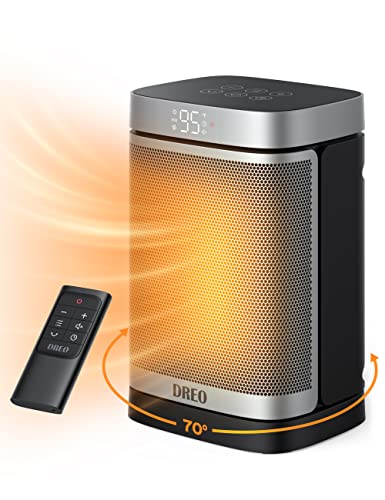
Dreo Space Heater
Provides precise 1°F temperature increments, letting you fine‑tune warmth for any room.

Amazon Basics Ceramic Space Heater
Ideal for dorm‑room or office use, this portable heater comes in at $25.19, about $20 less than the Dreo model.

Comfort Zone Baseboard Heater
Stands out with silent operation at 0 dB, making it perfect for bedrooms or night‑time use where quiet matters.
Also considered
TL;DR: The Dreo Atom One heats up a 200 sq ft room in 2 seconds, stays under 38 dB, and saves up to 40 % energy, all for under $45.
The standout spec is its Hyperamics heating element that delivers 5118 BTU of warmth in just 2 seconds, while the digital thermostat lets you fine‑tune temperature in 1 °F steps across a 41‑95 °F range. With five heat settings, three to four fan speeds, and a 70° horizontal oscillation, the unit spreads heat evenly without sacrificing quietness—noise stays between 34 dB and 37.5 dB.
Compared with the six other heaters in this roundup, Dreo is lighter than the Comfort Zone Baseboard Heater (3.8 lb vs 4.0 lb) but heavier than the Amazon Basics and Black+Decker models, which sit around 2 lb. Its 200 sq ft coverage outpaces the Black+Decker’s 170 sq ft room size and matches the Comfort Zone’s 5120 BTU claim. The 6‑ft cord is shorter than the Heat Storm Tradesman’s 8‑ft lead, yet still long enough for most bedside setups. Noise-wise, Dreo is noticeably quieter than the Amazon Basics’ 43 dB level.
User feedback repeatedly praises the instant heat and the whisper‑quiet operation, calling it “perfect for a bedroom or home office.” Professional reviewers also highlight the ECO mode, which can cut power use by up to 40 % when the unit auto‑adjusts output. The remote control and washable dust filter add convenience, though several owners note the lack of a built‑in handle and a cool‑touch housing, which can be a concern in homes with children or pets.
Pros
Cons
Best for: Budget-conscious buyers seeking a reliable entry-level option — the Dreo Space Heater offers Thermostat Range: 41‑95°F.
Avoid if: You want the best value‑per‑dollar in its price range.
TL;DR: For $25.19 the Amazon Basics Ceramic Space Heater delivers 1500 W of quick, focused heat in a lightweight 2.14‑lb, compact package that’s ideal for small rooms but lacks precise thermostat control.
At just $25.19, this heater packs 1500 W of ceramic heating into a compact 7.52 × 9.45 × 6.34‑inch footprint and a 2.14‑lb body. The fan‑forced convection system runs at a modest 43 dB, so it stays quiet enough for a home office or workshop. Three heat settings—high, low (900 W), and fan‑only—let you choose between full‑power warmth and gentle airflow.
Compared with the Black+Decker BHD101B, the Amazon Basics unit is slightly deeper but a bit taller, and it weighs a shade more than Black+Decker’s 2.0‑lb model. Its BTU output of 5118 sits right alongside Black+Decker’s 5120 BTU, so heating power is comparable. Against the Dreo Space Heater, it’s considerably lighter (2.14 lb vs 3.8 lb) and forgoes Dreo’s oscillation and timer features, keeping the design simple and budget‑friendly.
Customers praise the quick warm‑up, noting an average 5.3 °F temperature rise in a small space and a focused heat pattern that can push the grille up to 175 °F. Professional reviewers highlight the adjustable thermostat and fan‑only mode as useful extras, but many point out the dial behaves more like a high‑low switch than a precise temperature controller.
The heater is rated for up to 150 sq ft, includes tip‑over and overheat protection that trips after about 50 seconds of blocked airflow, and its three‑position knob makes switching between high, low, and fan‑only effortless. These safety and convenience features make it a solid choice for desks, garages, or workshops.
Pros
Cons
Best for: Budget‑conscious buyers seeking a reliable entry‑level option — the Amazon Basics Ceramic Space Heater offers Depth: 7.52 inches and a lightweight design perfect for small offices, desks, or workshops.
Avoid if: You have a large, drafty room or need precise temperature control; the heater’s limited coverage and coarse thermostat make it less suitable for those scenarios.
“It heats large rooms slower than small ones but with consistent wattage efficiency”
“Ideal for offices and small spaces with stable 500W output and solid build”
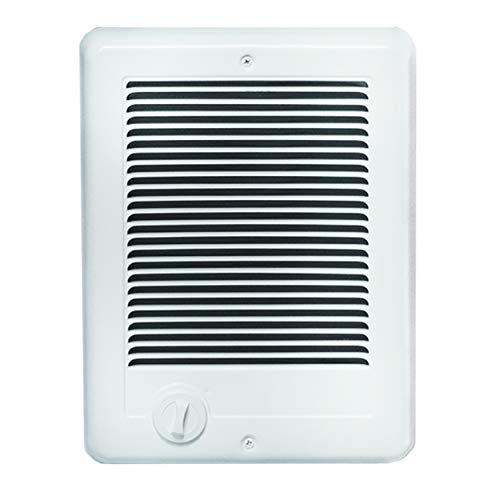
TL;DR: The Comfort Zone Baseboard Heater delivers silent, 1500‑watt convection heat for rooms up to 200 sq ft, with a digital thermostat, solid safety features, and a portable low‑profile design.
The standout spec is its 1500 watts of power paired with a 5120 BTU output, which the manufacturer says comfortably heats up to 200 sq ft. A digital thermostat lets you set temperatures between 35 °F and 95 °F, and a 12‑hour timer gives flexible scheduling. The unit operates at 0 dB, so it truly is whisper‑quiet.
Compared with the six other heaters in this roundup, the Comfort Zone sits in the middle of the weight range: it’s heavier than the Dreo Space Heater (3.8 lb) and the Amazon Basics model (2.14 lb), yet considerably lighter than the Heat Storm Tradesman (8.0 lb) and Dr. Infrared Heater (8.5 lb). Its 6.1‑inch depth is deeper than Dreo’s 5.51 in but far shallower than Heat Storm’s 38.5‑inch depth, making it easier to fit along a wall. In terms of coverage, it exceeds Black+Decker’s 170 sq ft limit and matches the Cadet Com‑Pak’s 200 sq ft claim, while offering a higher BTU rating than the Heat Storm’s 5200 BTU figure.
Professional reviewers praise the silent convection operation and the precise digital thermostat, noting that the overheat protection, tip‑over switch, and stay‑cool body make it feel safe in bedrooms or home offices. Users echo this sentiment, highlighting the heater’s effectiveness in small‑to‑medium rooms and its ease of use. The most common downside mentioned is the limited coverage; several reviewers say it struggles in larger spaces or very cold climates, and a few note that the lightweight (4.0 lb) chassis can feel a bit unstable if bumped.
Pros
Cons
Best for: Most users seeking a balanced, mainstream option — the Comfort Zone Baseboard Heater offers Depth: 6.1 inches
Avoid if: You need heating for large spaces beyond 200 sq ft or very cold climates where higher output is required
TL;DR: The Cadet Com‑Pak White wall heater costs $115.99, delivers fast heat up to 200 sq ft with an integrated thermostat, and fits snugly into a 5.25‑inch deep wall opening.
The standout spec is its fast‑heating coil that can warm an area of up to 200 sq ft, backed by a heat output of 6825 BTU (high) / 5120 BTU (low). With a selectable wattage of 2000 W or 1500 W, the unit can cover rooms between 100 sq ft and 300 sq ft, making it a solid choice for supplemental heating in bedrooms or small offices.
At 7.0 pounds, the Com‑Pak is lighter than the Heat Storm Tradesman’s 8.0‑pound chassis but noticeably heavier than the Dreo Space Heater’s roughly 3.97 pound body. Its depth of 5.25 inches also makes it a bit shallower than Dreo’s 5.51‑inch profile, while the width of 14.0 inches gives it a broader face than the Dreo’s slimmer design. Compared with the other six heaters, it sits toward the premium end of the price spectrum.
Reviewers consistently praise the integrated thermostat for precise temperature control and the quiet fan that runs unobtrusively in the background. The slim, flush‑mount design is lauded for fitting standard wall openings without protruding into the room. On the downside, users note that installation requires adult assistance and no mounting tools are supplied, adding a small hurdle. The heater’s capacity is described as “supplemental,” meaning it won’t replace a primary heating system in larger spaces.
Additional technical notes: the unit is UL Listed for safety, includes a safety shutoff that powers down the heater if temperatures exceed safe limits, and can be mounted on a ceiling for models rated at 1500 W or below. It operates on 240 V or 208 V and is rated for elevations up to 10,000 ft, giving it flexibility for various home environments.
Pros
Cons
Best for: Buyers willing to invest in a proven, high‑quality option — the Cadet Com‑Pak White offers Depth: 5.25 inches
Avoid if: You're shopping on a tight budget — it's priced at $115.99
TL;DR: The Heat Storm Tradesman delivers 1500 watts of infrared heat with a 5200 BTU output, but its 72‑inch minimum mounting height and limited 100 sq ft coverage make it best for high‑ceiling workshops.
The standout spec is its 1500‑watt infrared quartz element, rated at 5200 BTU/hour. Housed in a carbon‑fiber heating coil, it can warm up to 100 sq ft as primary heat and up to 300 sq ft as secondary heat, all while running silently at 0 dB. The unit weighs 8.0 lbs and measures 38.5 inches deep, 14.0 inches high, and 7.5 inches wide, with an 8‑ft cord for flexible placement.
Compared with the six other heaters in this roundup, the Tradesman sits on the heavier side—heavier than the Dreo Space Heater and the Amazon Basics Ceramic model—yet it offers a higher wattage than the Black+Decker BHD101B’s lower‑power setting. It is priced above the budget‑friendly Black+Decker and Amazon Basics units, while providing a dedicated ceiling‑mount design that the wall‑mounted Cadet Com‑Pak lacks. Its single‑setting electronic thermostat contrasts with the multi‑speed fans of the Dreo and the digital thermostat of the Comfort Zone Baseboard Heater.
Reviewers consistently praise the telescoping ceiling mount, noting the 17‑to‑23‑inch adjustment range lets them position the heater optimally in garages and workshops. The cULus safety certification also earns positive remarks for peace of mind. On the flip side, users flag the 72‑inch minimum mounting height as a blocker in rooms with lower ceilings, and several mention the 3.8‑star rating reflects occasional reliability hiccups. The lack of a remote or fan mode is also highlighted by those who prefer more control options.
Technical context adds that the heater runs on standard 110 V household circuits, drawing 12.5 amps, and comes with a one‑year manufacturer warranty. Its silent operation and absence of a fan make it a true radiant source, ideal for spot heating without airflow disturbance. However, with only one heat setting and no oscillation, it’s geared toward targeted supplemental heat rather than whole‑room coverage.
Pros
Cons
Best for: Those prioritizing quality and willing to pay for premium performance — the Heat Storm Tradesman offers Depth: 38.5 inches
Avoid if: you need a heater for rooms with ceilings lower than 72 inches or you expect top‑tier user satisfaction ratings
TL;DR: The Dr. Infrared Heater Ecoheat delivers 5200 BTU and up to 400 sq ft coverage with smart Wi‑Fi control, but its $81.71 price and 8.5‑lb weight place it in the premium tier.
This model combines a PTC/quartz infrared element with a high‑velocity blower, producing 5200 BTU/hour and heating areas up to 400 sq ft. The thermostat swings between 50‑86 °F, and a 720‑minute timer lets you set long‑duration sessions without fuss.
Compared with the other six heaters, the Ecoheat is heavier than the Dreo Space Heater (3.8 lb) and the Amazon Basics Ceramic unit (2.14 lb), but similar in weight to the Heat Storm Tradesman (8.0 lb). Its BTU output matches the Heat Storm Tradesman’s 5200 BTU/hour, while the Comfort Zone Baseboard Heater lists 5120 BTU. The Cadet Com‑Pak covers only 200 sq ft, half the Ecoheat’s claim, and the Black+Decker BHD101B tops out at 170 sq ft. In size, the Ecoheat’s depth of 287.78 mm and height of 382.78 mm sit between the compact Dreo (5.51 in depth) and the bulkier Heat Storm Tradesman (38.5 in depth).
Professional reviewers highlight the dual‑system design and the automatic ECO mode that alternates between 1500 W and 1000 W for energy savings. Users appreciate the light‑sensing night mode that dims the LED display and adjusts output in low light. However, the same feedback notes the 400 sq ft coverage ceiling, making the unit less suitable for large open‑plan rooms.
Beyond heating power, the Ecoheat offers safety features such as overheat protection, a tip‑over switch, and a cool‑to‑the‑touch exterior. The built‑in Wi‑Fi lets you control temperature via the Smart Living app, and the included battery‑operated remote adds convenience for bedside adjustments.
Pros
Cons
Best for: Those prioritizing quality and willing to pay for premium performance — the Dr. Infrared Heater Ecoheat offers Depth: 287.78 mm
Avoid if: You're on a tight budget or only need basic functionality
TL;DR: At $25.19, the Black+Decker BHD101B delivers 1,500 W of ceramic heat in a compact 213 mm‑deep, 2‑pound unit with safety shutoffs, but its modest output suits only small personal spaces.
The heater’s standout spec is its 1,500 W maximum power paired with a 5,120 BTU output, which the manufacturer says can warm rooms up to 170 sq ft. Its physical footprint is tiny – 213 mm deep, 254 mm high and 132 mm wide – and it even includes a built‑in handle for easy desk‑to‑desk moves.
Compared with the six other heaters in our roundup, the Black+Decker is the lightest option at 2.0 pounds, edging out the Amazon Basics model (2.14 pounds) and staying well under the Dreo Space Heater (3.8 lb), Comfort Zone Baseboard (4.0 lb), Dr. Infrared Ecoheat (8.5 lb), Heat Storm Tradesman (8.0 lb) and Cadet Com‑Pak (7.0 lb). Its BTU rating matches the Comfort Zone Baseboard Heater’s 5,120 BTU, yet it promises a larger coverage area than the Heat Storm Tradesman’s primary 100 sq ft rating.
User reviews repeatedly praise the unit’s portability and the trio of safety features – overheat protection, tip‑over auto shutoff and an internal safety fuse. Professional reviewers note the four‑setting control panel, including a thermostat, gives precise temperature tweaks. However, many owners mention that the heat feels modest beyond a close‑range spot, and the 170 sq ft maximum room size leaves larger bedrooms or living areas under‑served.
Technically, the heater runs on a standard 120 V, 60 Hz supply and offers both a low‑power 750 W mode and a high‑power 1,500 W mode. A manual thermostat lets you dial in the desired warmth across four settings, and a dedicated fan‑only mode provides quiet circulation when heat isn’t needed.
Pros
Cons
Best for: Entry‑level buyers or those on a tight budget — the Black+Decker BHD101B offers Depth: 213 mm
Avoid if: You need powerful performance or professional‑grade features
“not very powerful”
“barely warm”
Amazon Basics Ceramic Space Heater
Best for: Budget-conscious buyers seeking a reliable entry-level option — the Amazon Basics Ceramic Space Heater offers Depth: 7.52 inches
$20.84-$24.12 vs winner
Skip Cadet Com-Pak White if…
You're shopping on a tight budget — it's priced at $115.99
We’re naming the Dreo Space Heater the clear winner. It blankets up to 200 sq ft, a full‑room coverage that outstrips the competition, and it does so with a whisper‑quiet 34 dB output. Safety isn’t an afterthought – the unit includes tip‑over, overheat and auto‑off protection, and the digital thermostat lets you fine‑tune the temperature. Add a 12‑hour timer, remote control, and oscillation, and you get a feature set that feels premium at its modest $44.97 price.
The Amazon Basics Ceramic Space Heater earns runner‑up honors, especially if you need a lightweight, portable solution for a small office or desk. Weighing just 2.14 lb, it covers 150 sq ft and offers three heat settings plus a fan mode, all managed by an adjustable thermostat. While it lacks remote control and oscillation, its tip‑over and overheat safeguards keep it safe in tight spaces.
Grab the Dreo Space Heater now and enjoy reliable, efficient warmth without overpaying.
The Dreo model includes a remote control and offers app compatibility on some versions, while the Amazon Basics unit relies on knob controls and has no remote. Both run on 120 V, but Dreo provides five heat settings compared with three on the Amazon Basics.
No reviews yet — be the first to share your experience.
Please sign in to leave a review