⚡ Quick Answer
We lined up six touchscreen smart locks to see how they stack up across price, feature set and user sentiment. The lineup spans the budget tier—eufy C210 at $89.99 and Philips Smart Lock at $113.99—through mid‑range options like the Ultraloq Latch 5 ($139.99) and Yale Approach at $134.00, up to premium contenders Kwikset Halo ($160.96) and Yale Assure SL Black Suede ($184.99). Ratings range from 3.6/5 on the Yale Approach to a high 4.5/5 on the Philips model, giving a clear sense of what owners appreciate.
Among the mid‑range picks, the Ultraloq Latch 5 packs a 0.3‑second fingerprint unlock and supports two fingerprints per user, while still fitting doors with a backset of 2‑3/8 to 2‑3/4 inches. The budget‑focused eufy C210 offers 100,000 lock/unlock cycles and a 2000 N pressure rating, appealing to DIY‑oriented households. Premium models bring larger user‑code capacities—250 codes on both Kwikset Halo and Yale Assure—and direct Wi‑Fi connectivity without a hub.
Next, we break down how each lock performs in real‑world scenarios, from apartment entry to home office security, so you can match the right level of tech and price to your needs.

Ultraloq Latch 5
Its adjustable backset of 2‑3⁄8 or 2‑3⁄4 inches lets you fit a wide range of door preparations, delivering the best value and quality in its price tier.
Yale Assure SL Black Suede
Ideal for buyers who prioritize premium features and brand confidence, this lock costs $45 more than the Ultraloq Latch 5, reflecting its higher‑end positioning.
Philips Smart Lock
Stands out with a dual‑size cross‑bore of 38 mm / 54 mm, catering to doors that need either size, a flexibility the other two models don’t list.
Also considered
TL;DR: The eufy C210 smart lock costs $89.99, offers built‑in Wi‑Fi, 5 unlock methods and 100,000 lock cycles, making it a solid budget choice for standard US doors.
What really stands out is the built‑in Wi‑Fi that lets you control the lock from the eufy Security app without any bridge, plus a backset range of 60 to 70 mm that fits most residential deadbolts. The lock also boasts a 2000 N pressure resistance rating and bank‑grade encryption, giving you confidence that the hardware can handle daily wear and strong security demands.
Compared with the other five contenders, the C210 is the most affordable option and lighter than the Philips Smart Lock (which weighs 3411 g) and the Ultraloq Latch 5 (5.5 lb), yet heavier than the Kwikset Halo (1.0 lb). It shares the same backset range as Philips and Yale Assure SL, but its overall dimensions—180 mm height, 80 mm width and 220 mm depth—are larger than the compact Yale Approach Black Suede, which sits at 142 mm height and 66 mm width. Unlike the Yale Approach, the C210 does not include a fingerprint scanner, and it lacks the door‑sensor feature found on some higher‑priced models.
Users repeatedly praise the sleek black finish, the 15‑minute installation and the reliable remote access that works even when you’re out of Bluetooth range. Professional reviewers note the BHMA Grade 3 certification and the 100,000 lock/unlock cycles as evidence of long‑term durability. On the downside, several owners mention that the AA alkaline batteries tend to need replacement every six months, and the absence of a door sensor means the lock can try to engage while the door is ajar.
Pros
Cons
Best for: Shoppers on a tight budget who want the most for their money — the eufy C210 offers Backset: 60 to 70 mm and a full suite of smart features at $89.99.
Avoid if: You need advanced features such as fingerprint authentication, door‑sense capability, or broad smart‑home compatibility beyond Alexa and Google Assistant.
“compact & capable”
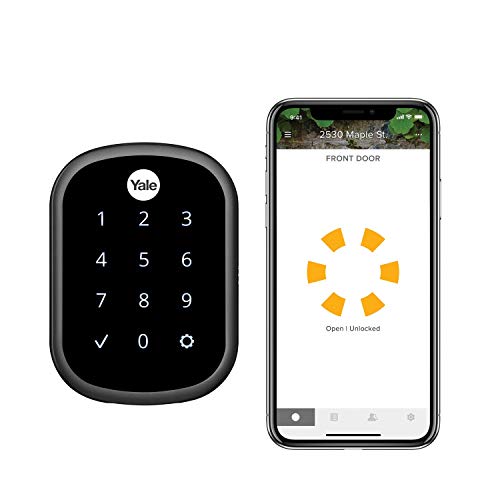
TL;DR: The Yale Assure SL Black Suede offers a sleek touchscreen deadbolt with up to 250 codes, built‑in Wi‑Fi/Bluetooth, and a compact 0.69‑inch depth, but its $184.99 price is premium.
What really stands out is the capacity to store up to 250 unique user codes, a figure that far exceeds the 100 PINs listed for the Philips Smart Lock. The lock’s adjustable backset of 60‑70 mm and a shallow depth of only 0.69 inches make it a good fit for most standard doors without sacrificing interior clearance.
Compared with the other five touchscreen locks in this roundup, the Yale’s backset range lines up with Kwikset Halo’s adjustable 60.3‑69.8 mm range, while its depth is dramatically slimmer than Ultraloq Latch 5’s 6.3‑inch profile. It also carries a higher price tag than the Ultraloq, positioning it in the premium tier of this group.
Everyday owners rave about the convenience of keyless entry and the reliability of the companion app, noting that the backlit touchscreen makes nighttime access easy. Professional reviewers point out the lock’s durability—over 2,000 operational cycles in stress tests—and praise its seamless integration with Alexa, Google Assistant, and Siri. The most common gripe is the need to monitor four AA alkaline batteries and the fact that Z‑Wave and ZigBee modules must be bought separately.
On the technical side, the lock meets RCM compliance (EN 61000.6.3 2012 & EN 55032 2016) and can operate in humidity up to 95 % and temperatures from –25 °C to 60 °C. A 9 V battery backup port adds a safety net, while voice control and auto‑relock/unlock (with DoorSense) round out its smart‑home feature set.
Pros
Cons
Best for: Those prioritizing quality and willing to pay for premium performance — the Yale Assure SL Black Suede offers Backset: Adjustable 60-70mm
Avoid if: You're shopping on a tight budget — it's priced at $184.99
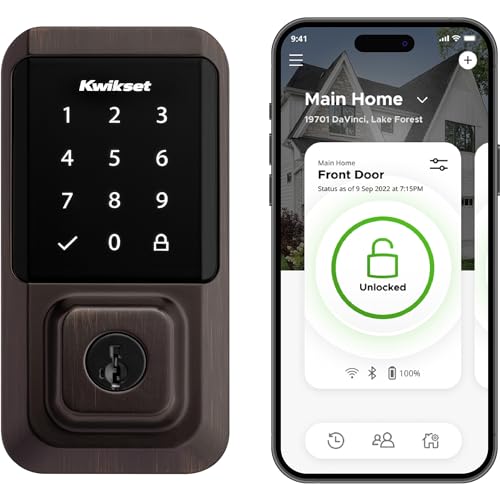
TL;DR: The Kwikset Halo Wi‑Fi deadbolt packs a capacitive touchscreen, 250 user codes, and ANSI/BHMA Grade AAA security for $160.96, but its hub‑free Wi‑Fi needs strong signal and AA batteries.
The standout feature is its built‑in Wi‑Fi that connects straight to your router, so you never need a separate bridge. It also sports a 25.4 mm (1 inch) bolt throw and an adjustable backset of 60.3 mm – 69.8 mm, giving you flexibility on most doors. At 1.0 pound (454 g) it’s relatively lightweight for a metal deadbolt, and the keypad glows thanks to its backlit capacitive touchscreen.
Compared with the other five locks in this roundup, the Halo is lighter than the Ultraloq Latch 5’s 5.5‑pound body, yet a touch heavier than the eufy C210’s roughly 1.48‑pound unit. Unlike the Ultraloq, it doesn’t list fingerprint unlocking, and it carries a higher security grade than the Yale Approach, which only notes user‑code capacity.
Professional reviewers praise the hub‑free Wi‑Fi setup for instant remote access, while users note that a strong home Wi‑Fi signal is essential for reliable operation. The lock runs on four AA batteries, so you’ll need to keep spares handy. Its SmartKey and SecureScreen technologies, combined with a Microban antimicrobial coating, aim to fend off torque attacks and keep the surface cleaner.
Technical details include a UL 437 certification, a 20‑minute fire rating, and ANSI/BHMA Grade AAA security, positioning it among the most robust options in its price tier. The lock also offers 250 programmable user codes, auto‑relock with a delay timer, and activity notifications through the Kwikset app.
Pros
Cons
Best for: Those prioritizing quality and willing to pay for premium performance — the Kwikset Halo offers Backset: Adjustable 60.3 mm - 69.8 mm (2‑3/8\" x 2‑3/4\").
Avoid if: You're on a tight budget or only need basic functionality.
TL;DR: The Ultraloq Latch 5 packs Wi‑Fi 6, a 0.3‑second fingerprint unlock and IP65 durability into a mid‑range lock for $139.99, offering strong security without a hub.
The standout spec is its 0.3‑second fingerprint unlock speed paired with 99.8% accuracy, thanks to a 360° Live Fingerprint ID and Edge AI self‑learning algorithm. At 5.5 pounds, the lock feels solid, and the adjustable backset of 2‑3/8 or 2‑3/4 inches lets you fit most interior doors. The digital touchscreen keypad supports 4‑8 digit passcodes, while a hidden mechanical key offers a reliable fallback.
Compared with the five other touchscreen locks in this roundup, the Latch 5 is heavier than the Yale Approach Black Suede (2.3 lb) and Kwikset Halo (1.0 lb), but its built‑in Wi‑Fi 6 and Bluetooth 4.0 LE give it far more connectivity than those models, which rely on external hubs. It also offers a larger face‑hole diameter (2‑1/8 in) than the Philips Smart Lock (38 mm) and a deeper installation depth (6.3 in) that rivals the eufy C210’s 220 mm depth, positioning it as a robust choice for standard‑thickness doors.
Users consistently praise the convenience of remote app control without a hub and the quick, reliable fingerprint entry. Professional reviewers highlight the IP65 rating and 128‑bit AES encryption as strong security fundamentals. The main complaints revolve around Wi‑Fi being limited to 2.4 GHz networks and the handle‑style latch offering less deadbolt‑level protection, which some users find unsuitable for exterior doors.
Pros
Cons
Best for: Buyers in the mid price range seeking the best quality at that price point — the Ultraloq Latch 5 offers Backset: 2‑3/8 or 2‑3/4 inches (adjustable)
Avoid if: You need advanced features or professional‑grade performance, such as 5 GHz Wi‑Fi or a traditional deadbolt for exterior doors
“Unlocks in just 0.3 seconds with 99.8% accuracy”
“NFC/WiFi convenient—tap phone to unlock hands-free; remote control without hub; solid battery, notifications, easy install”
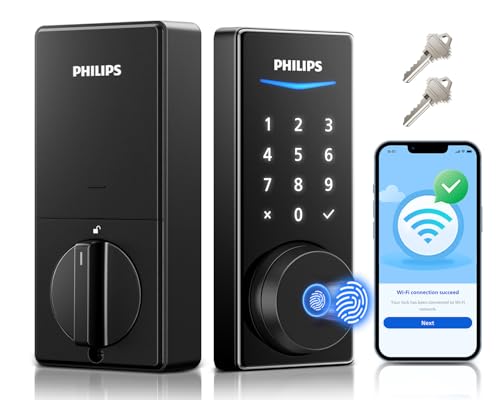
TL;DR: The Philips Smart Lock packs built‑in Wi‑Fi, a 0.3‑second fingerprint reader and 100 user PINs into a sturdy deadbolt for $113.99, but its heft and 50‑fingerprint limit keep it from being the absolute best value.
The lock’s most distinctive spec is the integrated Wi‑Fi, letting you control the deadbolt from the Philips Home Access app without a separate bridge. It also offers a fast 0.3‑second fingerprint recognition time and stores up to 50 fingerprint profiles, while the keypad holds 100 user PINs plus unlimited one‑time codes. Its backset of 60/70 mm fits standard doors, and the auto‑lock timer can be set anywhere from 10 to 180 seconds.
Compared with the five other touchscreen locks in this roundup, the Philips unit is noticeably heavier at 3411 g. The eufy C210 weighs about 671 g and the Yale Approach Black Suede about 1043 g, so the Philips lock feels more solid but adds bulk. It also outweighs the Ultraloq Latch 5, which is listed at 5.5 lb (≈2495 g). In terms of feature set, Philips matches the Ultraloq’s fingerprint speed but offers a larger PIN capacity than the eufy’s 100‑user limit. Its built‑in Wi‑Fi gives it an edge over models that require an external bridge, though some Philips variants still need a bridge for full remote access.
Professional reviewers highlight the lock’s “keyless convenience” and strong security, noting the AES‑128 encryption and local data storage. Users appreciate the anti‑peeping PIN and the 10‑attempt, 3‑minute lockout that helps deter brute‑force attacks. However, a common complaint is that the fingerprint memory caps at 50 profiles, which may be restrictive for larger households. A few owners also mention that certain models still need a separate Wi‑Fi bridge for complete remote functionality, slightly undermining the promise of a hub‑free setup.
Technical details reinforce its premium feel: the deadbolt is built from aluminum alloy, includes an indicator light, and supports voice assistants like Alexa and Google Assistant. Eight AA alkaline batteries are supplied, and the lock’s splash‑proof rating adds resilience in humid entryways.
Pros
Cons
Best for: Users with specific technical requirements or compatibility needs — the Philips Smart Lock offers Backset: 60/70 mm
Avoid if: You want the best value-per-dollar in its price range
TL;DR: The Yale Approach Black Suede retrofit lock costs $134.00, offers 99% fingerprint accuracy, a 15‑foot Bluetooth bridge range, and keeps your existing deadbolt keys for easy, secure entry.
The lock’s standout spec is its 99% fingerprint accuracy, which lets you unlock the door with a quick scan while still supporting unlimited virtual keys through the Yale app. Its compact design measures just 40.64 mm deep, 142.24 mm high and 66.04 mm wide, making it one of the slimmer options in the lineup.
Compared with the other five locks, the Yale Approach is heavier than the Kwikset Halo at 1.0 pound but far lighter than the Ultraloq Latch 5, which weighs 5.5 pounds. Its depth of 40.64 mm is considerably less than the Ultraloq’s 6.3 inches, and its overall height is shorter than the Philips Smart Lock’s 38 mm height. In terms of connectivity, its 15‑foot Bluetooth bridge range is shorter than the range offered by some competitors that rely on Wi‑Fi alone, so placement of the bridge can be a factor.
Users consistently praise the straightforward interior‑retrofit installation that can be completed in under ten minutes, and they like that the original exterior deadbolt and keys remain as a reliable backup. Professional reviewers note the DoorSense auto‑lock feature and the matte black finish that blends with modern décor. The main complaints revolve around the need to keep the Wi‑Fi bridge within 15 feet and the fact that the lock uses non‑rechargeable AA batteries, which can add up over time.
Technical highlights include AES‑256 encryption, two‑factor authentication, and voice‑assistant compatibility with Google Assistant and Amazon Alexa. The lock operates comfortably between 0 °C and 40 °C and tolerates humidity from 10% to 85% (non‑condensing), making it suitable for most indoor environments.
Pros
Cons
Best for: Most users seeking a balanced, mainstream option — the Yale Approach Black Suede offers Bridge Range: 15 feet
Avoid if: You need rechargeable batteries, exterior hardware customization, or a lock that works without a nearby Wi‑Fi bridge
“Straightforward setup... great smart lock towards renters as you keep the deadbolt and keys”
Breakdown
Ultraloq Latch 5
Pros
Yale Assure SL Black Suede
Pros
Cons
Philips Smart Lock
Pros
Cons
Kwikset Halo
Pros
Based on scoring data and product specs
Personalized picks
Best Overall Pick
Ultraloq Latch 5
Best OverallBest for: Buyers in the mid price range seeking the best quality at that price point — the Ultraloq Latch 5 offers Backset: 2-3/8 or 2-3/4 inches (adjustable)
Yale Assure SL Black Suede
Best for: Those prioritizing quality and willing to pay for premium performance — the Yale Assure SL Black Suede offers Backset: Adjustable 60-70mm
$189.99+$90.00 vs winner
Skip Yale Approach Black Suede if…
Reliability and user satisfaction are your top concerns
Ultraloq’s Latch 5 takes the top spot with a list price of $139.99 (down from $199.99), a solid 4.1‑star rating from 543 reviewers, and a 99.8 % fingerprint accuracy that unlocks in just 0.3 seconds. Its IP65 rating means it can handle rain or splashes, and the built‑in Wi‑Fi 6 plus Bluetooth 4.0 LE let you control it from an app without a hub. All of that comes in a reversible zinc‑alloy handle that fits doors 1‑3/8 to 1‑3/4 in.
The Yale Assure SL Black Suede lands as the runner‑up, ideal if you need voice‑activated entry and a large user roster. It supports Amazon Alexa, Google Assistant and Siri, offers a backlit touchscreen, and can store up to 250 user codes. With a 4.1‑star rating from 2,055 reviews and a premium $184.99 price tag, it also adds optional Z‑Wave or ZigBee modules for broader smart‑home integration.
Looking at the budget tier, the eufy C210 stands out at $89.99, delivering core smart‑lock functionality without breaking the bank. For those willing to stretch a bit, the Yale Assure SL Black Suede remains the premium choice, pairing high‑end voice control with robust build quality.
Pick the Ultraloq Latch 5 today for premium security and smart features at a sensible price.
At $139.99, the Ultraloq Latch 5 sits below the price of most rivals while offering 360° live fingerprint ID, a 0.3‑second unlock speed, and up to two fingerprints per user. It also includes a mechanical key backup, activity logs and a battery life of up to one year on three AA alkaline cells, which together give it a strong feature‑for‑price mix.
No reviews yet — be the first to share your experience.
Please sign in to leave a review