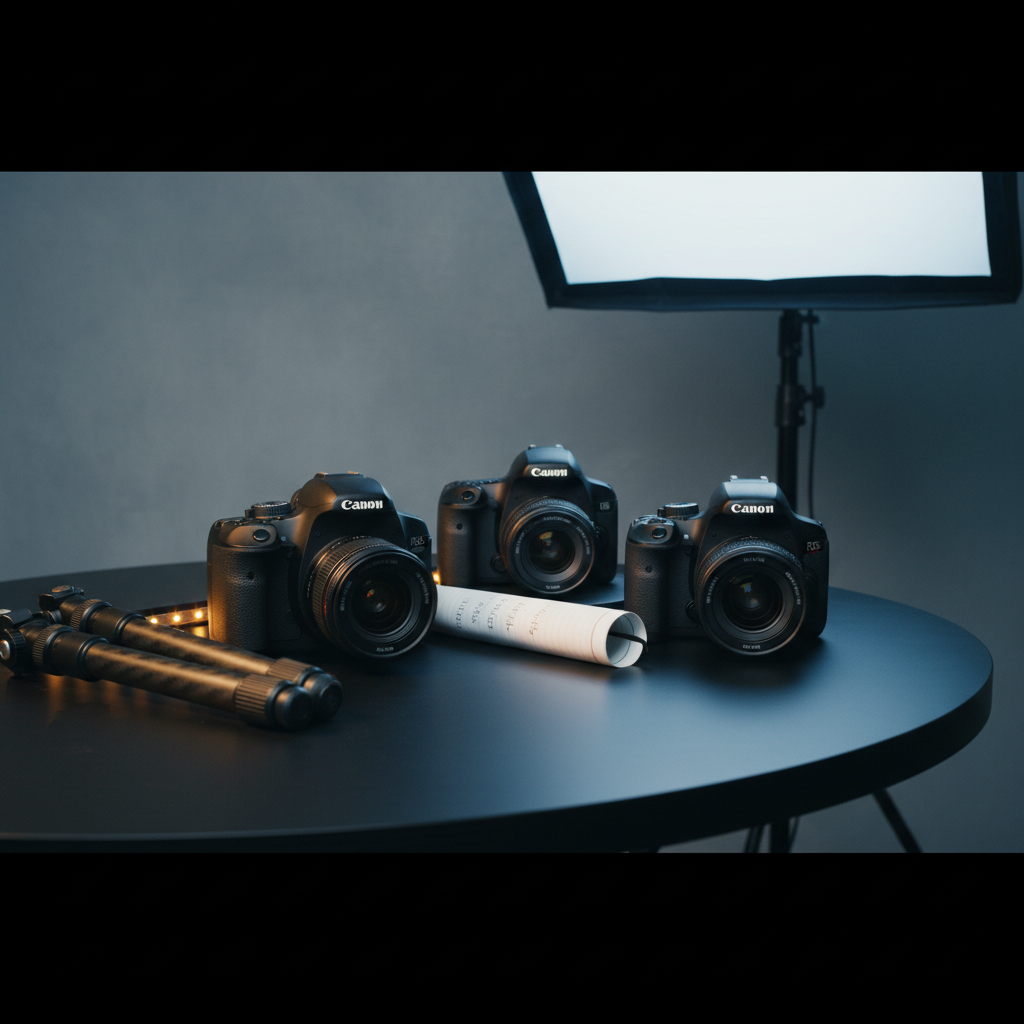
Choosing a Canon EF DSLR can feel overwhelming, but this roundup narrows the field to four solid options. We’ve lined up the entry‑level Canon EOS 2000D (Rebel T7) as the premium pick, the Rebel T6 kit as the mid‑range choice, the older Rebel XSi as the budget‑friendly model, and the legacy Rebel XTi for those who prefer a lightweight classic. Each camera’s core specs, user ratings and price points help you see which fits your shooting style.
The 2000D leads with a 4.7/5 rating from 178 reviews, a 24.1 MP APS‑C sensor and a list price of $439.00, offering the highest resolution and longest battery life among the group for new photographers. The T6 follows at $325.33 with a 4.5/5 score, an 18.0 MP sensor and 500‑shot battery life, providing strong value for hobbyists on a tighter budget. The XSi, priced at $249.00, offers a 3.0‑inch LCD and 3.5 fps shooting, targeting budget‑conscious starters. Meanwhile, the XTi provides a lightweight body and a 1,100‑shot maximum battery life for those who prefer legacy ergonomics. The following sections break down each model’s strengths, drawbacks and ideal use cases.

Canon EOS 2000D / Rebel T7 DSLR Camera w/EF-S 18
Its 9‑point autofocus system provides reliable focus across the frame, supporting its high rating and popularity.

Canon EOS Rebel T6 Digital SLR Camera Kit
Ideal for home or office photographers who want solid features at a lower cost—about $115 cheaper than the Best Overall model.

Canon EOS Rebel XTi
Stands out with a maximum of 1,100 shots per charge, giving you far more shooting endurance than the other two models.
Score Analysis
Key score advantages vs. runner-up (Canon EOS Rebel)
Price Range
Canon EOS 2000D / Rebel T7 DSLR Camera w/EF-S 18
$439.00
Canon EOS Rebel T6 Digital SLR Camera Kit
$364.99
Canon EOS Rebel XTi
-$0.01
Canon EOS Rebel XSi
$269.00
Spec Comparison
TL;DR: The Canon EOS 2000D (Rebel T7) packs a 24.1 MP APS‑C sensor, 3 fps burst and 500‑shot battery life into a lightweight 1.05‑lb body for $439, making it a solid entry‑level DSLR for new shooters.
The standout spec is the 24.1 MP effective resolution, featuring a 3.72 µm pixel size on an APS‑C CMOS sensor. Coupled with the DIGIC 4+ processor, it delivers detailed stills and decent low‑light performance up to ISO 6400 (expandable to 12 800). The rear LCD offers 920,000 dots on a 3.0‑inch screen, giving a clear preview of your shots.
Compared with the other three cameras in this roundup, the T7 is lighter than the Rebel T6’s 2.04 lb body and carries a higher resolution than the T6’s 18.0 MP sensor. Its continuous shooting speed of 3 fps matches the T6 and XTi, but trails the XSi’s 3.5 fps. Battery life delivers 500 shots per charge, equal to the T6 and XSi, and far above the XTi’s minimum of 500 shots (though the XTi can reach 1,100 shots under optimal conditions).
Reviewers consistently praise the sharp 24 MP images and the reliable battery that lets you shoot a full day without swapping cells. Users also like the built‑in Wi‑Fi and NFC for quick sharing. On the downside, professional reviewers note the older DIGIC 4+ processor feels slower than newer models, and the 9‑point AF system can be sluggish in live view. The lack of a touchscreen or flip‑out screen limits self‑recording, which aligns with user complaints about video flexibility.
Additional context: the camera provides 95 % viewfinder coverage at 0.80× magnification, a useful feature for composing shots through the optical viewfinder. The kit lens offers a 28.8‑88 mm equivalent focal range, suitable for everyday photography, while the 3‑shot AEB and ±5 EV exposure compensation give extra creative control.
Pros
Cons
Best for: Beginners and hobbyists who want an affordable DSLR with solid image quality and easy wireless sharing.
Avoid if: You need 4K video, continuous AF during video, or a flip‑out touchscreen for vlogging.
TL;DR: The Canon EOS Rebel T6 offers an 18 MP APS‑C sensor, 3.0 fps burst, 500‑shot battery and built‑in Wi‑Fi for $325.33, making it a solid entry‑level DSLR for beginners.
The standout spec on the T6 is its 18.0 MP APS‑C CMOS sensor paired with the DIGIC 4+ processor, delivering detailed stills that hold up well in good light. The 3.0‑inch LCD packs a sharp 920,000‑dot resolution, far exceeding the 230,000‑pixel screen that the older XSi uses.
When you line it up with the other three cameras, the T6 is heavier at 2.04 lb compared with the XSi’s 1.156 lb, the 2000D’s roughly 1.05 lb, and the XTi’s 1.23 lb. Its continuous‑shooting speed of 3.0 fps matches the XTi but trails the XSi’s 3.5 fps. Battery life sits at 500 shots per charge, identical to the XSi and 2000D and well below the XTi’s maximum of 1,100 shots.
Reviewers consistently praise the camera’s ease of use and reliable Wi‑Fi/NFC pairing, noting that the 500‑shot battery lets you shoot a full day without a recharge. At the same time, professional testers flag the DIGIC 4+ processor as dated, which limits high‑speed shooting and precludes 4K video. Users also miss a touchscreen or articulating LCD, and the 9‑point AF system feels modest for fast‑action subjects.
Pros
Cons
Best for: Beginner photographers and hobbyists who want a traditional DSLR feel without breaking the bank.
Avoid if: You need fast autofocus, 4K video, weather sealing, or a more modern feature set for advanced shooting.
TL;DR: The Canon EOS Rebel XTi delivers 10.1 MP stills, a responsive 2.5‑inch LCD, and up to 1,100 shots per charge, making it a lightweight, entry‑level DSLR for beginners.
At the heart of the XTi is a 10.1 MP APS‑C CMOS sensor paired with Canon’s DIGIC II image processor. The camera offers a 9‑point autofocus system, with the centre point being cross‑type, and a 2.5‑inch LCD that renders about 230,000 pixels. This combination gives beginners a clear view of composition and detail captured at 10.1 MP resolution straight out of the sensor.
Compared with the other three DSLRs in this roundup, the XTi’s continuous‑shooting speed of 3 fps sits just below the XSi’s 3.5 fps, while its LCD is smaller than the XSi’s 3.0‑inch screen. The XTi’s body weight without battery is 522 g, a hair lighter than the XSi’s listed 525 g, but a bit heavier than the T6’s overall 2.04 pounds (including battery). Where the XTi shines, its maximum battery capacity reaches 1,100 shots per charge, roughly double the 500‑shot limits reported for both the XSi and T6.
User sentiment leans toward the XTi’s image quality; reviewers repeatedly note sharp results at low ISO settings and appreciate the lightweight feel of the 1.23‑pound body. The 4.2‑star average from 991 reviews reflects a generally positive experience, though several owners call out the missing top‑status LCD and the built‑in flash’s inconsistent output, especially when the flash recycles slowly.
The camera provides up to 27 JPEG frames in a single burst and supports exposure compensation of ±2 stops in 1/3‑stop increments. Its ISO range tops out at 1,600, and the kit 18–55 mm lens offers a maximum aperture of f/3.5‑5.6 with a minimum focus distance of 280 mm (11.4 in). The viewfinder delivers 0.8× magnification with a 21 mm eyepoint, making manual focusing straightforward.
Pros
Cons
Best for: Beginners and hobbyists who want a lightweight DSLR with solid still‑image quality and straightforward controls.
Avoid if: Professional‑grade ISO performance, video recording, or a more rugged, weather‑sealed body are required.
TL;DR: The Canon EOS Rebel XSi packs a 12.2 MP APS‑C sensor, 3.5 fps burst shooting and a bright 3.0‑inch LCD while staying under $250, making it a solid entry‑level DSLR for beginners.
The XSi’s standout spec is its 12.2 MP CMOS sensor paired with a DIGIC III image processor, delivering sharp, low‑noise photos at ISO 100‑1600. Continuous shooting runs at 3.5 fps and the internal buffer holds up to 53 JPEG frames, while the 500‑shot CIPA‑rated battery lets you shoot for a full day of stills. The fixed 3.0‑inch LCD offers 230,000 pixels and 100 % coverage, so framing is clear even in bright light.
Compared with the other three cameras in this roundup, the XSi is lighter than the Rebel T6 (which tips the scales at 2.04 lb) and a touch heavier than the 2000D’s 1.05 lb, placing it in a comfortable middle ground. Its 12.2 MP resolution sits below the 2000D’s 24.1 MP and the T6’s 18.0 MP, but the XSi shoots faster than both – 3.5 fps versus the T6’s 3.0 fps and the XTi’s 3 fps. Battery life matches the T6 and 2000D at roughly 500 shots, though the XTi can reach a maximum of 1,100 shots under ideal conditions. The XSi also offers a larger JPEG burst depth (53 frames) than the XTi’s 27‑frame limit.
Reviewers consistently praise the camera’s colour‑accurate, sharp images and the bright, fixed LCD that makes composition easy. Reviewers highlight the ergonomically enlarged rubberised grip as comfortable for extended handheld shooting. Professional reviewers note the fast 3.5 fps burst and solid noise control up to ISO 1600, but they also point out a modest feature set, a menu that can feel inconsistent, and a spot‑metering area limited to 4 % of the frame. Users mention that the battery drains quickly when using Live View or flash, and indoor white balance can appear a bit warm.
Technically, the XSi includes a 9‑point TTL phase‑detection AF system with a centre cross‑type sensor, a 0.87× viewfinder magnification covering 95 % of the scene, and a flash sync speed of 1/200 s. Shutter speeds range from 30 seconds to 1/4000 second, and the camera records 14‑bit RAW files for greater tonal flexibility. The built‑in AF‑assist beam works via the flash, and the EOS Integrated Cleaning System helps keep the sensor dust‑free.
Pros
Cons
Best for: Entry-level buyers or those on a tight budget
Avoid if: You need advanced features or professional‑grade performance
Breakdown
Canon EOS 2000D / Rebel T7 DSLR Camera w/EF-S 18
Pros
Canon EOS Rebel T6 Digital SLR Camera Kit
Pros
Canon EOS Rebel XTi
Pros
Cons
Based on scoring data and product specs
Personalized picks
Best Overall Pick
Canon EOS 2000D / Rebel T7 DSLR Camera w/EF-S 18
Best OverallBest for: Audiophiles and enthusiasts seeking premium sound quality and advanced features
Canon EOS Rebel T6 Digital SLR Camera Kit
Best for: Home and office users seeking a balance of features and value
$364.99-$74.01 vs winner
Skip Canon EOS Rebel XSi if…
You need advanced features or professional-grade performance
The Canon EOS 2000D / Rebel T7 takes the top spot thanks to its 24.1 MP APS‑C sensor, a solid 4.7/5 rating from 178 reviewers, and a battery that delivers up to 500 shots per charge. Its 9‑point AF system, built‑in Wi‑Fi and NFC, and a 3.0‑inch 920 k‑dot LCD round out a well‑balanced package for $439.00.
The Canon EOS Rebel T6 is the runner‑up and shines when you want a ready‑to‑shoot starter kit with image‑stabilised lens optics. It pairs an 18.0 MP sensor with the EF‑S 18‑55 mm f/3.5‑5.6 IS II kit lens, offers the same 3 fps burst rate, and carries a 4.5/5 rating from 1,014 reviews—all for $325.33.
Pick the Canon EOS 2000D / Rebel T7 today and step into DSLR photography with confidence.
The Canon EOS 2000D is generally regarded as the stronger performer, thanks to a higher user rating and a newer DIGIC 4+ processor that supports a 24.1 MP sensor. It does cost about $113 more than the Rebel T6, but it also adds features like NFC and a slightly larger LCD resolution.
Please sign in to leave a review
No reviews yet. Be the first to review!
