⚡ Quick Answer
Cold‑water pressure washers have become essential for keeping driveways, decks, and vehicles spotless without the hassle of gas engines. In this roundup we examined 8 electric models that span three price tiers: budget options like the $69.99 Slenjadfin Cordless and the $107.99 Senix 1700 PSI, mid‑range choices such as the $139.98 Foting 5000 PSI and the $188.09 Greenworks GPW2003, and premium units ranging up to $399.86 for the WEN PW3000E. All eight carry solid user feedback, with ratings from 4.0 to 4.6 stars across more than 1,500 reviews for the top‑rated Greenworks.
The Greenworks GPW2003 draws attention with a 2000 PSI, 1.2 GPM output packed into a 27.78‑lb chassis, giving it an impressive power‑to‑weight ratio for a mid‑range price. Its 25‑ft hose and 1.2‑gallon onboard soap tank let you tackle cars, patios, and siding in one pass, while a smart shut‑off feature conserves energy when the trigger is released. With a 4.5‑star rating from 1,559 reviewers, it blends professional‑grade performance with homeowner‑friendly convenience.
Next we’ll break down each model’s strengths, quirks, and ideal use cases so you can match the right washer to your cleaning needs.

Greenworks GPW2003
Its 25 ft hose provides ample reach for typical residential cleaning, balancing power and convenience.

Westinghouse ePX3050
Ideal for budget‑conscious homeowners, the Westinghouse ePX3050 saves about $79 compared with the Greenworks mid‑range model while delivering three versatile nozzles.

WEN PW3000E
Stands out with a 203 fl oz detergent tank and five nozzles, suiting heavy‑duty cleaning where extended run‑time and spray options matter.
Also considered
TL;DR: The Westinghouse ePX3050 packs 2100 PSI and a 1.76 GPM flow into a 17.0‑lb, corded unit with a 35‑ft power cord, making it a portable, budget‑friendly choice for light‑to‑medium cleaning.
The standout spec is its 2100 PSI maximum pressure combined with a 1.76 GPM max flow rate, delivering 2160 CU of cleaning power from a compact 25.8‑in‑high, 12.4‑in‑long chassis. Its 20‑ft nylon‑braided hose and 35‑ft GFCI‑protected power cord give you ample reach around a typical driveway or patio without dragging a heavy extension.
Compared with the seven other washers in this roundup, the ePX3050 sits near the light end of the weight spectrum at 17.0 pounds—heavier than the Senix’s 14.3–14.6 lb but considerably lighter than the Foting (28.0 lb), Sun Joe (37.0 lb), Greenworks (27.78 lb), Westinghouse WPX3400 (70.0 lb) and WEN PW3000E (54.0 lb). Its hose length matches the Senix’s 20 ft but falls short of Greenworks’ 25 ft, a trade‑off for its lower price point. The 20‑oz soap tank outpaces the Senix’s 15‑oz capacity, though it’s smaller than Greenworks’ 1.2‑gallon tank.
User sentiment repeatedly praises the unit’s portability and the convenience of the detachable soap applicator. Professional reviewers note the axial‑cam pump’s “maintenance‑free, auto‑stop” feature, which shuts the motor off when trigger pressure drops—an ergonomic plus during long cleaning sessions. The 5‑in never‑flat wheels and built‑in handle further reinforce its ease of maneuverability in tight spaces.
Pros
Cons
Best for: Budget‑conscious homeowners who need a reliable, lightweight pressure washer for regular driveway, deck or vehicle cleaning.
Avoid if: You require professional‑grade power, a longer hose reach, or a wider selection of nozzle sizes for heavy‑duty tasks.
TL;DR: The Greenworks GPW2003 delivers PWMA‑certified 2000 PSI power with a 25‑ft hose and a 1.2‑gal soap tank, but its 27.78 lb weight makes it less portable than lighter electric rivals.
The standout spec is the 2000 PSI pressure rating backed by PWMA certification, paired with a 1.2 GPM flow rate and 2400 cleaning units, giving you solid medium‑duty cleaning power while staying on cold water. Its 25 ft hose and 35 ft power cord let you reach a full‑size driveway without tripping over cords, and the 8‑inch wheels roll over grass and gravel with ease.
At 27.78 lb, the GPW2003 is heavier than the 17.0‑lb Westinghouse ePX3050 but lighter than the 37.0‑lb Sun Joe SPX4800, placing it in the middle of the weight spectrum for this roundup. Its hose is longer than the 20‑ft hose on the Westinghouse ePX3050 and the 23‑ft hose on the Foting 5000 PSI model, giving it an edge for larger outdoor jobs.
Users frequently praise the push‑button start and the built‑in 1.2‑gal soap tank for hassle‑free detergent application on cars and patios. Professional reviewers note that the induction motor’s 14 AMP draw delivers the advertised 2000 PSI reliably, while the auto shut‑off helps protect the motor during extended use.
Pros
Cons
Best for: Most users looking for a well‑reviewed, reliable mainstream option — the Greenworks GPW2003 offers Hose Length: 25 ft.
Avoid if: You have limited storage space, need ultra‑light portability, or require heavy‑duty commercial pressure or hot‑water cleaning above 104 °F.
“Powerful, compact, and low maintenance”
“Handles hard, stuck-on grime effectively with the 0° nozzle”
TL;DR: The WEN PW3000E delivers a 3000‑psi, 2.0‑GPM performance with a brushless motor and 25‑ft hose, but its 47‑lb weight and corded design make it best for stationary home use.
What really sets the PW3000E apart is its 3000 PSI peak pressure paired with a 2.0 GPM maximum flow rate, backed by a 14.8‑amp brushless motor. The unit also scores 2695 cleaning units, a figure that tops the 2400 CU reported for the Greenworks GPW2003.
Compared with the seven other models in this roundup, the WEN sits in the middle of the weight spectrum: it’s heavier than the Sun Joe SPX4800 (37 lb) and the ultra‑light Slenjadfin (3 lb), but lighter than the heavyweight Westinghouse WPX3400 (70 lb). Its 25‑ft reinforced hose matches the longer hoses of Westinghouse WPX3400 and Greenworks GPW2003, while exceeding the 20‑ft hoses on Sun Joe, Westinghouse ePX3050, and Senix. With five quick‑connect nozzles, it offers the same nozzle count as Westinghouse WPX3400 and Sun Joe, and more than the four‑nozzle Foting model.
Professional reviewers note the brushless motor’s durability and the unit’s superior cleaning units, while also pointing out that the rated pressure of 2450 PSI and rated flow of 1.1 GPM are lower than the maximum claims, which can confuse users. Consumers appreciate the trigger safety lock‑out and the generous 203 fl oz detergent tank, but the corded power source limits portability, making it less suitable for jobs far from an outlet.
Pros
Cons
Best for: Those prioritizing quality and willing to pay for premium performance — the WEN PW3000E offers Nozzle Count: 5
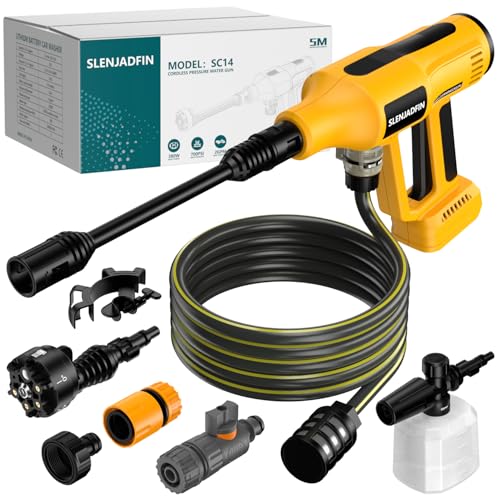
TL;DR: A lightweight, battery‑powered washer delivering 700 PSI and 4.5 L/min through a 5 m hose, ideal for quick, portable cleaning tasks on a tight budget.
The Slenjadfin Cordless Pressure Washer’s standout feature is its cordless operation paired with a 5,000 mm hose and a max pressure of 700 PSI. Weighing just 3.0 lb (1360 g), the unit feels almost like a handheld drill, and the 4.5 L/min flow rate gives a steady spray without the bulk of a corded system.
When you line it up against the seven other models in this cold‑water roundup, the Slenjadfin is dramatically lighter than the Senix (over 14 lb) and far lighter than the Greenworks GPW2003 (about 27.78 lb). Its pressure of 700 PSI is also lower than the 1,700 PSI minimum of the Senix and the 2,500 PSI floor of the Foting unit, positioning it as a true portable cleaner rather than a heavy‑duty washer. The price point is the most affordable of the group, making it the budget‑friendly choice.
Reviewers consistently praise the handheld convenience and the built‑in foam cannon, noting that it makes car washes and bike clean‑ups painless. The 6‑in‑1 nozzle set (0°, 15°, 25°, 40°, fan, shower) is highlighted for handling both pinpoint spots and broader surfaces. On the flip side, users flag the 10‑20 minute runtime as a limitation for larger jobs, and the 700 PSI output is often called “insufficient” for stubborn grime that higher‑pressure models tackle with ease. Professional reviewers echo these points, calling the unit “perfect for spot cleaning” but “not a replacement for a full‑size pressure washer.”
Technically, the washer runs on DeWalt 20V MAX lithium‑ion batteries (not included) and draws 380 W from the motor. The self‑priming water intake eliminates the need for pre‑filling a reservoir, and the 3/4‑inch connection port accepts standard garden hoses. Combined with the foam cannon and filter that come standard, the package offers a surprisingly complete toolkit for on‑the‑go cleaning.
Pros
Cons
Best for: Shoppers on a tight budget who want the most for their money — the Slenjadfin Cordless Pressure Washer offers Max Flow Rate: 4.5 L/min
Avoid if: Reliability and user satisfaction are your top concerns
“great for quick jobs where you can't get a hose”
TL;DR: The Senix 1700 PSI Pressure Washer delivers residential‑grade cleaning power in a lightweight 14‑lb package, with a 20‑ft hose, 15 oz soap tank, and a safety‑focused Total Stop System for under $108.
At the heart of the Senix unit is a 13‑amp universal motor paired with an axial‑cam pump that provides a rated 1700 PSI and a maximum of 2100 PSI, while moving water at 1.2 GPM. The machine’s 20‑foot kink‑resistant high‑pressure hose and 35‑foot power cord let you reach distant corners of a driveway or patio without constantly moving the unit. A built‑in Total Stop System automatically shuts off the pump when the trigger is released, conserving electricity and extending motor life.
When you line it up against the other seven models in this cold‑water roundup, the Senix stands out for its portability. Weighing just 14.3–14.6 lbs, it’s lighter than the Westinghouse ePX3050 (17 lbs) and dramatically lighter than the Greenworks GPW2003 (about 27.8 lbs) or the Sun Joe SPX4800 (37 lbs). Its hose length matches the Westinghouse’s 20 ft but falls short of the Greenworks’ 25 ft reach. The 15 oz soap tank is smaller than Westinghouse’s 20 oz capacity, meaning you’ll refill a bit more often, but it’s still ample for typical residential jobs.
Customer feedback consistently highlights the unit’s ease of transport—thanks to the integrated carry handle and modest weight—and the convenience of the Total Stop System, which many reviewers say “prevents the motor from running idle.” On the flip side, users note the 15 oz soap tank fills quickly during larger cleaning sessions and that the 1700 PSI rating positions the washer squarely in the entry‑level tier, making it less suitable for heavy‑duty contractor work.
Technical details round out the picture: the washer runs on standard 120 V, 60 Hz household power and includes inline GFCI protection for added safety. It ships with a turbo nozzle, a 15° nozzle, and a quick‑connect system, giving you flexibility for different spray patterns. The black‑finished unit carries a three‑year limited warranty, reinforcing the brand’s confidence in its durability.
Pros
Cons
Best for: Entry-level buyers or those on a tight budget — the Senix 1700 PSI Pressure Washer offers Soap Tank Capacity: 15 fl. oz.
Avoid if: You want the best value-per-dollar in its price range
TL;DR: The Foting 5000PSI Pressure Washer delivers a peak 5000 PSI with an 8‑level touchscreen control, 23‑ft hose and a 500 ml foam cannon for DIY cleaning projects, all for $139.98.
What really stands out is the advertised 5000 PSI maximum pressure and a selectable range from 2500 to 5000 PSI across eight pressure levels. The LED touchscreen lets you dial in the exact pressure you need, while the included 500 ml foam cannon (about 16.9 fl oz) makes car washing and paint‑safe cleaning feel effortless. At 28.0 pounds, the unit sits on a wheeled trolley and an ergonomic upright frame that keeps it stable during use.
Compared with the other seven models, the Foting is heavier than the Westinghouse ePX3050 (17 lb) and the Senix 1700 PSI (around 14.5 lb) but lighter than the Sun Joe SPX4800 (37 lb). Its 23‑ft hose outmatches the 20‑ft hoses on both Westinghouse and Senix, though the Greenworks GPW2003 reaches a longer 25 ft. The 16‑ft power cord is shorter than Westinghouse’s 35‑ft cord, so you may need an extension for far‑flung tasks. With four quick‑connect nozzles, it offers more spray options than the three‑nozzle Westinghouse unit.
Users consistently praise the intuitive touchscreen and the foam cannon’s effectiveness on vehicle paint, noting a smooth learning curve. However, several reviewers point out that the real‑world pressure often feels lower than the 5000 PSI claim, typically sitting between 2500 and 4000 PSI during normal use. The hose and cord lengths also draw criticism when tackling larger yards, and a few owners report foam‑cannon clogs if the tank isn’t cleaned after each session. Professional reviewers echo these points, highlighting the Total Stop System (TSS) that shuts off the pump when the trigger is released, which helps protect the motor during intermittent work.
Pros
Cons
Best for: Home and office users seeking a balance of features and value — the Foting 5000PSI Pressure Washer offers Nozzle Count: 4
“Touchscreen is game-changer, quick nozzles swap fast”
“Blasted driveway clean in minutes; 8 levels perfect for delicate/ tough jobs.”
TL;DR: The Sun Joe SPX4800 delivers up to 3200 PSI and 1.3 GPM, packing a 14.9‑amp brushless motor and a 1‑gal detergent tank into a 37‑lb unit for demanding residential cleaning.
The standout spec is its 3200 PSI maximum pressure, backed by a 14.9‑amp brushless induction motor that runs cooler and quieter than typical universal motors. It pushes 1.3 GPM of water while a 1‑gal detergent tank lets you apply soap continuously, and the 34‑inch extension wand reaches high places without a ladder.
Compared with the other seven models, the SPX4800 is noticeably heavier than the ultra‑light Westinghouse ePX3050 and carries a premium price tag versus the more budget‑friendly Greenworks GPW2003. Its 5‑nozzle set matches the Westinghouse WPX3400 and WEN PW3000E, and it out‑pressurizes the Senix 1700, which is limited to 2100 PSI. The detergent capacity also exceeds the 20‑oz tank on the Westinghouse ePX3050, giving you far more soap on a single fill.
Reviewers consistently praise the brushless motor for its durability and reduced maintenance, and they note that the 3200 PSI output tackles stubborn grime on driveways and siding with ease. The downside that surfaces in user feedback is the corded design, which ties you to an outlet, and the 37‑lb weight that makes moving the unit around a yard a bit of a workout. Professional reviewers also point out the built‑in Total Stop System, which automatically shuts off the pump when trigger pressure drops, adding safety and conserving power.
Pros
Cons
Best for: Those prioritizing quality and willing to pay for premium performance — the Sun Joe SPX4800 offers Nozzle Count: 5
Avoid if: You need a lightweight, cordless unit or hot‑water capability for your cleaning tasks
TL;DR: The Westinghouse WPX3400 delivers 3400 PSI and 2.6 GPM with a 15‑inch surface cleaner, but its 70‑lb weight and $369 price place it in the premium, heavy‑duty segment.
The standout spec is the 3400 PSI pressure rating paired with a 2.6 GPM flow rate, driven by a 212cc OHV engine. A 15‑inch surface cleaner and a 0.42‑gal (1.6 L) soap tank let you tackle driveways or decks quickly, and the five‑nozzle set—including a 0° pinpoint tip—covers everything from gentle rinses to concentrated blasts.
Compared with the other seven models, the WPX3400 is heavier than the Greenworks GPW2003 (about 27.8 lb) and the Sun Joe SPX4800 (37 lb), but it also out‑pressurizes the Sun Joe’s 3200 PSI and the Senix’s 2100 PSI. Its 2.6 GPM flow exceeds the WEN PW3000E’s 2.0 GPM and far surpasses the 1.3 GPM of the Sun Joe, giving it a clear edge for large‑area jobs. The hose length matches the Greenworks and WEN at 25 ft, while its 5‑nozzle count matches most peers but adds a dedicated soap applicator.
Reviewers consistently praise the raw cleaning power and the convenience of the included surface cleaner, noting that it “makes large flat surfaces streak‑free and five times faster.” Professionals highlight the machine’s reliability straight out of the box, while everyday users mention that the recoil starter can feel stiff and that regular oil checks and spark‑plug gap checks (0.024–0.032 in) are part of ownership. The thermal relief valve that discharges at 125°F helps protect the pump during extended use.
Pros
Cons
Best for: Those prioritizing quality and willing to pay for premium performance — the Westinghouse WPX3400 offers Nozzle Count: 5
Avoid if: You're shopping on a tight budget — it's priced at $369.00
Breakdown
Greenworks GPW2003
Pros
Westinghouse ePX3050
Pros
WEN PW3000E
Pros

Foting 5000PSI Pressure Washer
Pros
Cons
Based on scoring data and product specs
Personalized picks
Best Overall Pick
Greenworks GPW2003
Best Mid-Range PickBest for: Most users looking for a well-reviewed, reliable mainstream option — the Greenworks GPW2003 offers Hose Length: 25 ft
Westinghouse ePX3050
Best for: Budget-conscious buyers seeking a reliable entry-level option — the Westinghouse ePX3050 offers Nozzle Count: 3
$109.00-$40.99 vs winner
Skip Sun Joe SPX4800 if…
Reliability and user satisfaction are your top concerns
Greenworks GPW2003 takes the top spot, thanks to a solid 2000 PSI maximum pressure, 2400 cleaning units and a generous 25‑ft hose that lets you tackle far‑reaching grime without stretching a cord. At 27.78 lb it balances power and portability, while the 1.2‑gallon soap tank and push‑button start keep the job moving smoothly. Its 4.5‑star rating from 1,559 reviewers backs up the specs.
The Westinghouse ePX3050 earns runner‑up status if you need a lighter, quick‑grab unit for driveway or patio clean‑ups. Weighing just 17.0 lb, it’s easy to maneuver, yet still delivers 2100 PSI peak pressure and 2160 cleaning units, with a 20‑ft hose that reaches most outdoor surfaces. Users also note the 4.6‑star rating from 2,351 reviews.
For tighter budgets, the Slenjadfin Cordless Pressure Washer shines at $69.99, offering cordless convenience for occasional light jobs. If you’re after a premium experience, the WEN PW3000E stands out at $399.86 with high‑end build quality and features aimed at serious enthusiasts.
Choose the Greenworks GPW2003 now and enjoy professional‑grade cleaning power without the bulk.
The GPW2003 pairs a 2000 PSI rating with a relatively light 27.78 lb frame, giving it a strong power‑to‑weight balance. It also adds homeowner‑friendly features like an auto shut‑off, push‑button start, and a generous 1.2‑gallon soap tank, which many competitors lack.
No reviews yet — be the first to share your experience.
Please sign in to leave a review