⚡ Quick Answer
Immersive gaming thrives on a screen that wraps your vision and keeps motion buttery smooth. In this roundup we compared 11 curved desktop displays, from entry‑level 24‑inch panels to premium 34‑inch ultrawides, so you can match a monitor to your setup and budget.
At the budget end, the Sceptre C248W dazzles with a 1 ms response, 100 Hz refresh and a $78.97 price tag, while Samsung’s Essential S3 and LG’s 32MR50C‑B offer similar 27‑ to 31‑inch sizes for under $180. Mid‑range contenders like the Alienware AW3425DWM bring a 34‑inch panel, 180 Hz refresh and a 4.5‑star rating for $299.99, and Xiaomi’s 34‑inch model matches that refresh rate at a comparable price. Premium choices – LG’s 34WR55QK‑B, HP’s P34HC G4, Alienware’s AW3425DW and the EIZO FlexScan – push prices above $500 and add features such as HDR, USB‑C docking or a 60 Hz IPS panel with a built‑in webcam.
We’ll break down each model’s ergonomics, refresh rates, and connectivity so you can see which curve fits your gaming rig, whether you chase 180 Hz frame‑rates or need a work‑friendly dock.

Alienware AW3425DWM
Its compact depth of 232.00 mm keeps the curved panel close to your eyes, delivering immersive gaming without taking up excessive desk space.

Sceptre C248W
Ideal for budget‑conscious gamers, the Sceptre C248W delivers 100 Hz refresh and 1 ms response at just $78.97—about $221 cheaper than the mid‑range Alienware.

Alienware AW3425DW
The premium Alienware AW3425DW stands out with a deep 805.43 mm chassis and 12.99 kg build, offering a larger, more immersive field for audiophiles and high‑end enthusiasts.
Also considered
Score Analysis
Key score advantages vs. runner-up (Sceptre C248W)
Price Range
Alienware AW3425DWM
$349.99
Sceptre C248W
$79.97
Alienware AW3425DW
$729.99

EIZO FlexScan
$1,325.59

Samsung LC27F390
$194.00

HP P34HC G4
$489.00
LG 32MR50C-B
$179.99

Xiaomi Curved Gaming Monitor
Out of Stock

LG 34WR55QK-B
$349.99

Samsung Essential S3
$129.99

MSI MAG 244C
$99.99
Spec Comparison
TL;DR: The Alienware AW3425DWM delivers a 34‑inch 1500R curved ultrawide experience with a blistering 180 Hz refresh rate, VA panel, and extensive ergonomic tweaks at a mid‑range price.
The standout spec is its 180 Hz refresh rate paired with a 3440 × 1440 WQHD resolution on a 34 in VA panel, giving fast‑paced titles buttery‑smooth motion. A 1500R curvature wraps the display around you, while the 0.23 mm pixel pitch keeps the image sharp across the ultrawide field. Ergonomics are generous: the stand lifts 0–110 mm, tilts from –5° to +21°, and pivots ±5°, letting you dial in a comfortable viewing angle.
Compared with the other ten monitors in this roundup, the AW3425DWM sits toward the premium end of the price spectrum but offers more features than budget options like the MSI MAG 244C. It’s heavier at 20.97 pounds (9,515 g) than the LG 34WR55QK‑B (15.2 pounds) and the Samsung LC27F390 (13.0 pounds), yet its deeper chassis (232.00 mm) outpaces the Xiaomi’s 8.27‑inch depth, indicating a sturdier build. Its 85 W maximum power draw is higher than the typical 38.4 W of the LG 34WR55QK‑B, reflecting the high‑refresh VA panel.
Users repeatedly praise the monitor’s ultra‑smooth gameplay and immersive curvature, noting that the 180 Hz panel “makes competitive shooters feel fluid.” Professional reviewers also highlight the extensive adjustability and HDMI 2.1 support for next‑gen consoles. On the downside, the lack of built‑in speakers or a headphone jack forces reliance on external audio, and the VA panel’s absence of local dimming can limit contrast in dark scenes—issues that color‑critical creators flag.
Beyond the core display, the monitor packs a solid connectivity suite: 1 × DisplayPort 1.4, 2 × HDMI 2.1, 2 × USB‑A (one with 1.2 A charging), and a USB‑B upstream port, plus a joystick control and security lock slot. Power consumption stays modest at 32 W during use and 0.3 W in standby, earning it an Energy Class G rating.
Pros
Cons
Best for: Enthusiast gamers who crave an immersive ultrawide experience with high frame‑rate titles.
Avoid if: You need built‑in audio, require precise color accuracy for professional work, or have limited desk space.
TL;DR: The Sceptre C248W delivers a 24‑inch 1500R curved VA panel with 100 Hz refresh, 1 ms response and built‑in speakers for just $78.97, making it a solid budget entry for casual gamers.
The standout feature is the 1500R curvature on a 24‑inch LED‑VA screen, paired with a 100 Hz refresh rate and a 1 ms response time. Adaptive Sync (AMD FreeSync) helps keep motion smooth, while the panel claims 98‑100 % sRGB coverage. The monitor also includes blue‑light shift eye‑care and flicker‑free backlighting, which are useful for long sessions.
At $78.97 it undercuts the MSI MAG 244C’s $99.99 price tag and is far cheaper than the Samsung Essential S3’s $164.49 list. Its 100 Hz panel matches the Samsung Essential S3’s refresh but falls short of the MSI’s 180 Hz and the Xiaomi Curved Gaming Monitor’s 180 Hz. Physically, the C248W’s 533 mm width, 404 mm height and 193 mm depth make it more compact than the 27‑inch Samsung LC27F390, which measures 622.9 mm wide and 462.5 mm tall. Compared with the heavier MSI (10.4 pounds) and Alienware (20.97 pounds), the Sceptre feels lighter on a desk, though its exact weight isn’t listed.
Reviewers consistently praise the immersive feel of the 1500R curve and the smooth 1080p gameplay that the 100 Hz/Adaptive Sync combo provides. Professional reviewers note the value proposition for entry‑level gamers, while everyday users appreciate the narrow bezels and the convenience of built‑in speakers. However, several users point out that the speakers sound thin and that measured color coverage sits around 74 % sRGB, well below the advertised 98‑100 %. The tilt‑only stand (‑5° to +20°) also draws criticism for lacking height or swivel adjustments.
Pros
Cons
Best for: Budget‑conscious buyers seeking a reliable entry‑level option
Avoid if: You need high‑refresh (144 Hz+) performance, accurate color for photo work, or extensive ergonomic adjustments
“responsive visuals and minimizes blur”
“solid for budget gamers”
TL;DR: The Alienware AW3425DW delivers a 34.2‑inch 1800R curved QD‑OLED display with a 48‑240 Hz range, 0.03 ms response and a 1,500,000:1 contrast ratio, but its premium price and lack of built‑in speakers may limit casual buyers.
The Gen 2 QD‑OLED panel serves as the monitor’s standout feature, offering a 34.2‑inch curved screen, 3440 × 1440 resolution and a contrast ratio of 1,500,000:1. Combined with a 48‑240 Hz variable refresh rate and a 0.03 ms response time, it promises ultra‑smooth motion and deep blacks that few competitors can match.
At 20.04 pounds, the AW3425DW is lighter than the HP P34HC G4 (23.17 pounds) but noticeably heavier than the LG 34WR55QK‑B (15.2 pounds). Its 240 Hz ceiling also outpaces the 180 Hz limit of the Xiaomi Curved Gaming Monitor and the 180 Hz of the Alienware AW3425DWM, while sharing the same 110 PPI pixel density as the HP model.
User comments point out the absence of built‑in speakers as a downside, and the 20.04‑pound weight can strain a desk mount. An Energy Efficiency Class F rating signals higher power draw.
Additional technical perks include VESA DisplayHDR TrueBlack 400 support, anti‑reflection coating on a matte panel, AMD FreeSync Premium Pro plus NVIDIA G‑SYNC compatibility, KVM support and an anti‑theft stand lock for added security.
Pros
Cons
Best for: Competitive PC gamers and esports enthusiasts who demand ultra‑fast refresh rates, low latency and top‑tier color performance.
Avoid if: You’re on a tight budget, need built‑in audio, or prioritize low power consumption.
TL;DR: The EIZO FlexScan EV3450XC‑WT delivers a 34.1‑inch curved IPS panel with a built‑in 5 MP webcam, 94 W USB‑C docking and premium ergonomics, but its $1,373 price tags it as a high‑end choice.
The standout feature is the 34.1‑inch ultrawide IPS screen with a 3440 × 1440 resolution, offering a spacious workspace for multitasking. It also packs a 5 MP integrated webcam with Windows Hello, plus a noise‑canceling microphone and built‑in speakers, making video calls a breeze.
At 26.68 lb, the FlexScan is noticeably heavier than the LG 34WR55QK‑B (15.2 lb) and the Alienware AW3425DW (20.04 lb), and even the HP P34HC G4 (23.17 lb) feels lighter in comparison. Its depth of 3.937 in also feels more compact than the Alienware AW3425DW’s 805.43 mm chassis. However, its 60 Hz refresh rate lags behind the 180 Hz panels found in the Alienware AW3425DWM and the Xiaomi Curved Gaming Monitor, which may matter to fast‑paced gamers.
Professional reviewers highlight the Auto EcoView and flicker‑free hybrid brightness control as eye‑comfort boosters during long sessions, while the USB‑C port supplies 94 W power delivery and even LAN connectivity, turning the monitor into a docking hub. Users appreciate the KVM switch and Picture‑by‑Picture capability for managing two computers on a single screen. Reviewers note the downside is the sRGB‑only color gamut, which limits accuracy for photo‑editing, and a modest 300 cd/m² peak brightness that can feel dim in bright rooms.
Under the hood, the panel uses IPS with W‑LED backlight, delivering 1000:1 contrast ratio and 16.77 million colors. The 5 ms gray‑to‑gray response time keeps motion blur low for most games, and the monitor offers 35° upward tilt, 5° downward tilt, 90° swivel and a 195 mm height‑adjustment range for ergonomic positioning.
Pros
Cons
Best for: Those prioritizing quality and willing to pay for premium performance
Avoid if: You're shopping on a tight budget — it's priced at $1373.42
TL;DR: The Samsung LC27F390 delivers a 27‑inch 1800 mm curved VA panel with 3000:1 contrast and AMD FreeSync for $199.99, but its 1080p resolution and 60 Hz refresh keep it in the budget‑gaming tier.
The monitor’s most distinctive spec pairs a 1800 mm curvature radius with a 27‑inch VA panel that offers a static contrast ratio of 3000:1. That combination creates deep blacks and a noticeably immersive field of view, especially for movies or a multi‑monitor workstation.
At 13.0 pounds, the LC27F390's heavier than the Samsung Essential S3 (8.4 lb) and the MSI MAG 244C (4,717 g), but lighter than the Alienware AW3425DWM (9,515 g). It also outweighs the LG 32MR50C‑B, which ships at 8.53 kg. Brightness sits at a typical 250 cd/m², matching the LG and Essential S3 models, yet its 60 Hz refresh rate trails the 100 Hz of the Essential S3 and the 180 Hz panels that Xiaomi, Alienware, MSI, and Sceptre offer. The resolution of 1920 × 1080 on a 27‑inch screen is lower than the 34‑inch competitors, and the monitor only provides HDMI and VGA inputs, whereas many peers list additional HDMI ports or DisplayPort.
Reviewers consistently praise the deep curvature for making games and videos feel more enveloping, and professional testers highlight the 3000:1 contrast as a strong point for a VA panel. Users also appreciate the built‑in Eye Saver Mode and Flicker‑Free technology that reduce eye strain during long sessions. On the downside, the 1080p panel on a 27‑inch size leads to blurry text for some, and the 60 Hz limit can feel restrictive for fast‑paced shooters. A few owners mention stand wobble and modest brightness in bright rooms, while the lack of DisplayPort or USB‑C leaves future‑proofing a concern.
Beyond the screen, the monitor supports AMD FreeSync to smooth out tearing at its native 60 Hz, draws a maximum of 25 W (Energy Class A), and comes with a 1.5 m power cable, HDMI cable, VGA cable, and even a mouse pad—the quick‑setup guide outlines these accessories. The matte finish helps keep reflections low, and the 3.5 mm audio out lets you connect headphones without extra adapters.
Pros
Cons
Best for: Value-conscious buyers seeking quality at $199.99
Avoid if: You need advanced features or professional‑grade performance
TL;DR: The HP P34HC G4 delivers a 34‑inch 1500R curved VA panel with 3440 × 1440 resolution, 48‑100 Hz refresh and 65 W USB‑C power, but its $518 price and modest 250‑nit brightness may deter budget gamers.
This monitor’s standout spec is its 34‑inch 1500R curvature, which pairs with a VA panel that offers a static contrast ratio of 3500:1 and a dynamic contrast of 5,000,000:1. The 3440 × 1440 resolution sits at a 21:9 aspect ratio, while the 110 PPI pixel density and 0.231 mm pixel pitch keep images sharp. With a backlight life of 30,000 hours and a 5 ms GtG response, it aims for long‑term reliability and smooth motion at its 48‑100 Hz refresh range.
Compared with its peers, the HP weighs 23.17 lb, making it heavier than the LG 34WR55QK‑B (15.2 lb) and the Alienware AW3425DWM (20.97 lb). Its depth of 4.41 in is shallower than LG’s 10.2 in depth and comparable to the Alienware’s 232 mm depth. Brightness sits at 250 nits, which is lower than LG’s 300 cd/m² and Xiaomi’s 350 nits. The refresh ceiling of 100 Hz also trails the 180 Hz offered by both Alienware models and the Xiaomi Curved Gaming Monitor.
Users appreciate the monitor’s immersive ultrawide size for replacing dual screens, the built‑in 2 × 3 W speakers, and the integrated USB‑C hub that delivers 65 W power delivery alongside four USB‑A 5 Gbps ports. Professional reviewers highlight the low‑blue‑light TÜV certification, flicker‑free operation, and the 5,000,000:1 dynamic contrast as strong points for productivity and casual gaming. Common complaints include the modest 250‑nit brightness, limited picture‑in‑picture options, and a base that can wobble under heavy use.
Additional technical touches include a 3‑year manufacturer‑limited warranty, ENERGY STAR, TCO Certified Edge, and EPEAT Gold certifications, a detachable height‑adjustable stand, and a 100 × 100 mm VESA mount. The 3‑sided micro‑edge bezel and anti‑glare coating round out a design that focuses on both ergonomics and desk aesthetics.
Pros
Cons
Best for: Those prioritizing quality and willing to pay for premium performance
Avoid if: You're shopping on a tight budget — it's priced at $518.00
“just the right size”
“considering a second unit”
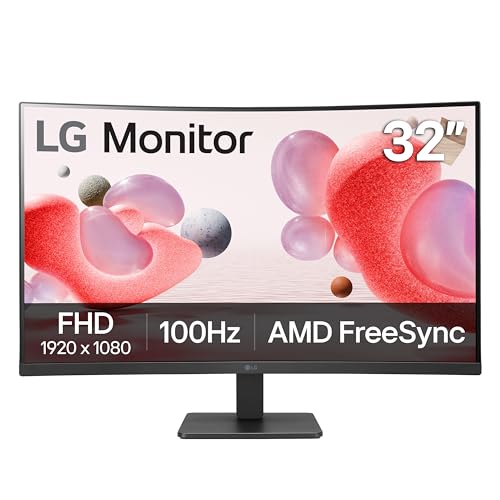
TL;DR: The LG 32MR50C‑B offers a 31.5‑inch 1500R curved VA panel with 100 Hz refresh, AMD FreeSync and eye‑care features at a budget‑friendly price, though its Full HD resolution feels soft on the large screen.
The monitor’s standout spec is its 1500R curvature combined with a 31.5‑inch VA panel, delivering a 3000:1 contrast ratio and deep blacks that make gaming feel immersive. It runs at a variable 48‑100 Hz refresh rate and a 5 ms response time, while AMD FreeSync helps keep motion smooth.
At 11.3 lb the unit’s heavier than the 8.4 lb Samsung Essential S3, but its 31.5‑inch screen also out‑sizes the S3’s 27‑inch panel. Both displays share a 100 Hz peak refresh, yet the LG stops short of the MSI MAG 244C’s 180 Hz, and the MSI MAG 244C weighs only 10.4 lb. These relative differences place the LG in the middle of the size‑and‑performance spectrum for this roundup.
Professional reviewers highlight the suite of eye‑care tools—Black Stabilizer, Flicker Safe, Reader Mode and Dynamic Action Sync—as useful for long gaming sessions. User sentiment notes the immersive curve and smooth motion, while also pointing out that the 1920 × 1080 resolution on a 31.5‑inch screen can look less sharp, and the typical brightness of 250 cd/m² may feel modest in bright rooms.
Additional technical details include 16.7M‑color depth, an anti‑glare matte surface, and VESA‑mount compatibility (100 × 100 mm). The monitor ships with two HDMI ports and a VGA port, plus a headphone out, covering most connectivity needs without built‑in speakers.
Pros
Cons
Best for: Budget‑conscious buyers seeking a reliable entry‑level option
Avoid if: You need advanced features or professional‑grade performance
TL;DR: The Xiaomi 34‑inch Curved Gaming Monitor delivers a 1500 mm curvature, 180 Hz refresh and 1 ms response at $274.99, offering vivid colors and smooth play, though HDMI limits full performance.
The standout feature is the 1500 mm curve radius paired with a 34‑inch VA panel that runs at 180 Hz and 1 ms response time. With a contrast ratio of 4000:1 and brightness of 350 nits, the screen can display deep blacks and bright highlights. Factory‑calibrated color accuracy reaches ΔE < 2, covering 95% DCI‑P3 and 100% sRGB, which is rare at this price tier.
Compared with the other ten monitors in the roundup, this model sits at a higher price point than the Samsung Essential S3 and the MSI 23.6‑inch offering, while offering a much wider ultrawide format that the smaller screens lack. It also provides more advanced variable‑refresh tech than the LG 32‑inch entry‑level model, though it doesn’t include the USB‑3.0 hub found on some competitors.
User feedback consistently praises the smooth 180 Hz gameplay and the vivid color reproduction, calling it a high‑value purchase for competitive gamers. Professional reviewers note the notable 4000:1 contrast ratio and the near‑92% DCI‑P3 coverage, while also pointing out that the full 180 Hz refresh requires a DisplayPort connection. The monitor lacks built‑in speakers and USB‑3.0 ports, which some power users miss, and HDMI 2.0 cannot reach the maximum resolution and refresh rate.
Pros
Cons
Best for: Competitive gamers and content creators who want an ultrawide, high‑refresh display with accurate colors without breaking the bank.
Avoid if: You need built‑in audio, extensive USB‑3.0 connectivity, or rely solely on HDMI for 180 Hz performance.
TL;DR: The LG 34WR55QK-B delivers a 34‑inch 21:9 UltraWide VA panel with 100 Hz refresh, HDR10 and a 65 W USB‑C hub, making it a solid choice for multitasking and casual gaming.
The standout spec comes from its 34‑inch curved screen with a native 3440 × 1440 resolution and a 1800R curvature, offering a truly immersive field of view. Weighing 15.2 lb, the monitor is lighter than the Alienware AW3425DWM’s 20.97 lb chassis, yet its 31.9‑inch width (810 mm) matches the broader footprint of many 34‑inch rivals.
Compared with the other ten monitors in this roundup, the LG sits in the middle of the size spectrum—wider than the Samsung Essential S3’s 24.5 in width but slightly narrower than the Alienware’s 805.45 mm width. Its 100 Hz maximum refresh rate trails the 180 Hz of both the Alienware and Xiaomi Curved Gaming models, and it’s slower than the Samsung Essential S3’s 100 Hz, but it still exceeds the 60 Hz baseline of many budget displays. Depth‑wise, the 10.2‑in chassis measures deeper than the Samsung Essential S3’s 9.2 in but shallower than the Xiaomi monitor’s 8.27‑in profile, giving it a balanced footprint for desk setups.
Review sentiment highlights the monitor’s strong multitasking capability, thanks to Picture‑by‑Picture (PBP) and a 21:9 aspect ratio that lets multiple windows sit side‑by‑side without sacrificing clarity. Users also appreciate the USB‑C port that delivers up to 65 W power delivery, simplifying cable management for laptops. However, the 5 ms GtG response and 100 Hz ceiling are less aggressive than the higher‑refresh IPS panels favored by competitive gamers, which aligns with the “not ideal for esports” note in the editorial summary.
Pros
Cons
Best for: Those prioritizing quality and willing to pay for premium performance
Avoid if: You need advanced features or professional‑grade performance
TL;DR: The Samsung Essential S3 offers a 27‑inch 1800R curved VA panel with 100 Hz refresh and TÜV‑certified eye‑comfort features at a budget‑friendly $164.49 price.
The standout spec is the 1800R curvature on a 27‑inch screen, which creates a more immersive field of view and helps reduce eye strain during long gaming or work sessions. Coupled with a VA panel that delivers a 3000:1 static contrast ratio and 95% sRGB coverage, the monitor can show deep blacks and fairly accurate colors for casual media consumption.
Compared with the other ten monitors in this roundup, the Essential S3 is lighter than the LG 32MR50C‑B (11.3 lb) and the Samsung LC27F390 (13.0 lb), yet it sits in the same weight class as many mid‑range displays. Its 27‑inch size is smaller than the 31.5‑inch LG and the 34‑inch Xiaomi and Alienware models, making it a better fit for desks with limited space. The 100 Hz refresh rate matches the Sceptre C248W but falls short of the 180 Hz panels that the MSI MAG 244C, Xiaomi Curved Gaming Monitor, and Alienware AW3425DWM use. Input options are also more limited – only an HDMI 1.4 port and a VGA port are available, whereas the LG offers two HDMI ports and other models include DisplayPort.
Professional reviewers praise the monitor’s curvature and the smooth motion from its 100 Hz panel, noting that Game Mode and the 4 ms response time keep motion blur low for casual shooters and fast‑action movies. Users consistently highlight the eye‑comfort suite – Eco Saving Plus, Flicker‑Free, and TÜV‑certified blue‑light reduction – as a major plus for marathon work or gaming sessions. The main criticism is the Full HD (1920 × 1080) resolution on a 27‑inch panel, which can appear pixelated for text and fine detail. Reviewers also point out the stand’s limited tilt‑only adjustment, which restricts ergonomic positioning.
Pros
Cons
Best for: Budget‑conscious buyers seeking a reliable entry‑level option
Avoid if: You need advanced features or professional‑grade performance
TL;DR: The MSI MAG 244C delivers a 23.6‑inch curved VA panel with 180 Hz refresh, 1 ms MPRT response and HDR Ready features, all for a budget‑friendly $99.99 price tag.
At the heart of the MAG 244C is a 23.6‑inch VA panel that curves at 1500R, paired with a 180 Hz refresh rate and a 1 ms (MPRT) response time. AMD FreeSync helps keep motion smooth, while the HDR Ready label promises brighter highlights.
That 180 Hz refresh outpaces the 100 Hz panels found in the Sceptre C248W and Samsung Essential S3, and matches the high‑refresh class of the Xiaomi Curved Gaming Monitor, though the latter is a larger 34‑inch screen. Weighing 10.4 pounds, the MAG 244C is lighter than the Alienware AW3425DWM’s 20.97 pounds but heavier than the Samsung Essential S3’s 8.4 pounds.
Consumers repeatedly praise the ultra‑smooth gameplay and the AI Vision engine that brightens dark scenes, while professional reviewers highlight the deep blacks from its static 3000:1 contrast ratio. The most common gripe is the Full HD 1920 × 1080 resolution on a 23.6‑inch display, which can look less sharp for productivity work, and the stand only offers tilt adjustment.
Brightness sits at 250 cd/m² and the monitor supports HDR Ready, with a dynamic contrast ratio that can reach up to 100,000,000:1. Color coverage spans roughly 105 % sRGB, 84 % DCI‑P3 and 87 % Adobe RGB, and built‑in speakers plus a headphone jack round out the feature set. A 100 × 100 mm VESA mount gives you flexibility for wall‑mounting.
Pros
Cons
Best for: Entry‑level buyers or those on a tight budget
Avoid if: You'd want the best value‑per‑dollar in its price range
Breakdown
Alienware AW3425DWM
Pros
Sceptre C248W
Pros
Alienware AW3425DW
Pros
Cons
EIZO FlexScan
Pros
Cons
Based on scoring data and product specs
Personalized picks
Best Overall Pick
Alienware AW3425DWM
Best Mid-Range PickBest for: Home and office users seeking a balance of features and value
Sceptre C248W
Best for: Budget-conscious buyers seeking a reliable entry-level option
$79.97-$270.02 vs winner
Skip MSI MAG 244C if…
You want the best value-per-dollar in its price range
The Alienware AW3425DWM clinches the top spot with its 34‑inch WQHD panel, a blistering 180 Hz refresh rate and an industry‑leading 1 ms GTG response time in Extreme mode. Its 1500R curvature and VESA DisplayHDR 400 boost immersion, while a 4.5‑star rating from 390 reviewers signals strong user approval—all for $299.99.
The Sceptre C248W lands as the runner‑up, ideal if you need a compact, budget‑friendly monitor for casual or competitive gaming on a small desk. Its 24‑inch VA screen delivers a smooth 100 Hz refresh and a rapid 1 ms response, wrapped in a 1500R curve, and it’s priced at just $78.97.
For shoppers focused on price tiers: the best budget option remains the Sceptre C248W, offering solid performance at the lowest cost; the premium pick is the EIZO FlexScan, the most expensive model at $1373.42, offering top‑tier build quality and features for enthusiasts willing to invest.
Pick the Alienware AW3425DWM today for its 34‑inch WQHD panel, 180 Hz refresh, 1 ms GTG response, 1500R curvature and HDR400 support.
The AW3425DWM costs $299.99 versus $78.97 for the C248W, a $221 difference, but it delivers a 34‑inch 3440 × 1440 WQHD panel, 180 Hz refresh and a 1 ms GTG response that make fast‑paced titles feel smoother. It also adds a 1500R curvature, HDR 400 support and a dedicated console mode, which the budget‑friendly C248W lacks.
No reviews yet — be the first to share your experience.
Please sign in to leave a review