⚡ Quick Answer
We compared 9 curved monitors that span a price range from $89.99 for the Sansui Curved Gaming Monitor 24‑inch up to $299.99 for the Alienware AW3425DWM. The most surprising fact is that the $89.99 Sansui model still carries a solid 4.4 / 5 rating from 3,793 reviewers, a score that sits just shy of the 4.5 / 5 marks seen on many higher‑priced options. This shows you don’t always need to spend a lot to get a well‑rated, immersive screen.
We split the roundup into three price tiers. Budget‑friendly choices include the Sansui 24‑inch (160 Hz refresh), the Sceptre 27‑inch Prime (up to 100 Hz) and the Sansui 27‑inch (100 Hz). Mid‑range picks feature the Acer Nitro XZ270 (280 Hz), Samsung Essential S3 (100 Hz) and Asus VG32VQ1B (1500 mm width, 0.272 mm pixel pitch). Premium options cover the LG 32GS60QC (180 Hz, 31.5‑inch VA panel), Philips 346E2CUAE (34‑inch ultrawide, 110 PPI) and Alienware AW3425DWM (180 Hz, 34‑inch). Keep reading to see how each model’s specs, performance and value stack up for your next immersive setup.

LG 32GS60QC Ultragear
At a shipping weight of 17 lbs, this 32‑inch monitor balances size and portability while delivering the 4.5‑star rating that underpins its best‑value claim.

Sansui Curved Gaming Monitor 24-inch
Ideal for budget‑conscious gamers, this 24‑inch model comes in at $89.99—about $154.59 less than the LG best‑value pick, delivering reliable entry‑level performance.

Asus VG32VQ1B
It's ultra‑thin 0.33‑inch depth sets it apart, offering a sleek profile that the bulkier LG and Sansui models lack while maintaining a strong 4.5‑star rating.
Also considered
Score Analysis
Key score advantages vs. runner-up (Sansui Curved Gaming)
Price Range
LG 32GS60QC Ultragear
$239.82
Sansui Curved Gaming Monitor 24-inch
$89.99
Asus VG32VQ1B
$283.06
Sansui Curved Monitor 27-inch
$112.99

Acer Nitro XZ270 27-inch
$139.99

Sceptre Curved 27-inch Prime Monitor
$99.97

Philips 346E2CUAE
$279.99

Alienware AW3425DWM
$349.99

Samsung Essential S3
$129.99
Spec Comparison
TL;DR: The LG 32GS60QC Ultragear offers a 31.5‑inch 1000R curved QHD VA panel with 180 Hz refresh, 1 ms response and AMD FreeSync at a solid $244 price point.
The standout feature is its 1000R curvature that wraps around a 31.5‑inch screen, delivering a truly immersive field of view. Paired with a native QHD resolution and a VA panel, it produces deep blacks and strong contrast, while the 180 Hz refresh rate and 1 ms GtG response keep motion buttery smooth for fast‑paced games.
At 13 lbs with the stand, the LG sits lighter than the Asus VG32VQ1B (15.98 lbs) but heavier than the Samsung Essential S3 (8.4 lbs). Its 180 Hz refresh outpaces Samsung’s 100 Hz and Sceptre’s up‑to‑100 Hz, yet falls short of Acer’s 280 Hz. Response time matches Acer’s 1 ms and beats Samsung’s 4 ms and Sceptre’s 8 ms, giving it a clear edge in speed‑focused scenarios.
Reviewers consistently praise the monitor’s “impeccable visuals” and “lightning‑quick speed,” noting that the combination of high refresh, rapid response, and FreeSync makes fast titles feel fluid. Some users mention that the VA panel can show slight ghosting in dark scenes, and they describe the HDR10 implementation as basic, lacking the punch of higher‑end HDR solutions.
Beyond speed, the display covers 99% of the sRGB color space, offers a 3000:1 contrast ratio and a typical brightness of 300 cd/m², all behind an anti‑glare surface. AMD FreeSync helps eliminate tearing, and the unit draws about 24 W during typical use, with less than 0.3 W in sleep mode.
Pros
Cons
Best for: Budget‑conscious gamers who want an immersive curved QHD display with high refresh rates and FreeSync.
Avoid if: You need color‑critical professional accuracy or extensive ergonomic adjustments such as height or swivel.
TL;DR: The Sansui 24‑inch curved gaming monitor packs a 160 Hz VA panel, 1 ms MPRT response and HDR support for under $90, delivering smooth, immersive gameplay at a budget‑friendly price.
The monitor’s standout spec is its 160 Hz refresh rate paired with a 1 ms MPRT response time, which professional reviewers cite as delivering “silky smooth” FPS and racing action. Its 1500R curvature wraps the 24‑inch VA panel, and the 300 nits brightness combined with a 3000:1 contrast ratio gives deep blacks and bright highlights. With 110% sRGB coverage and HDR support, colors appear crisp and vibrant, while AMD FreeSync helps keep frames tear‑free. The unit measures 23.78 in wide, 15.55 in high and 4.69 in deep, and weighs 7.68 lb.
At 7.68 lb, the Sansui sits between the lighter Sceptre 27‑inch (5.5 lb) and the heavier Sansui 27‑inch (10 lb) and Acer Nitro (13.78 lb). Its 300 nits brightness matches the LG 32GS60QC and Philips 346E2CUAE, and exceeds the 250‑nits panels used by the Sceptre, Samsung Essential and Asus models. The 160 Hz refresh outpaces most budget peers—Sceptre, Sansui 27‑inch and Samsung all top out at 100 Hz—though it trails the high‑end Acer Nitro (280 Hz) and Alienware (180 Hz). The 1 ms response time matches the Acer and LG units and far outpaces the 8 ms Sceptre.
Consumers rate the monitor highly, praising the ultra‑fast refresh and vivid HDR visuals for an immersive gaming feel. Reviewers frequently mention the smooth motion and low input lag as a major win for competitive shooters and racers. The main complaints revolve around the lack of built‑in speakers, meaning you’ll need headphones or external speakers, and the limited ergonomics—tilt is the only adjustment, with no height or swivel options. Some users note the 1080p resolution feels dated for multitasking, but most gamers accept it as a trade‑off for the low price.
The ES‑G24C1L includes game‑specific presets for FPS, RTS, Movie and Standard modes, plus a crosshair overlay and game timer that help fine‑tune the experience. Low‑blue‑light mode reduces eye strain during long sessions, while black‑level adjustment lets you deepen shadows in dark titles. Connectivity covers HDMI 2.0, DisplayPort 1.4 and a 3.5 mm audio jack, giving you flexibility for consoles, PCs and external audio gear. A 1‑year warranty rounds out the package.
Pros
Cons
Best for: Budget‑conscious gamers seeking a reliable entry‑level option
Avoid if: You need built‑in speakers, extensive ergonomic adjustments, or a higher‑resolution display for productivity
“"best budget FHD 1ms monitor 2025" with "stunning clarity and lightning‑fast motion"”
“"strong colors in movie mode and low blue light for late‑night use, calling it \"budget‑friendly\" with good HDR on modern content"”
TL;DR: The ASUS VG32VQ1B offers a 31.5‑inch 1500R curved VA panel with a 165 Hz refresh rate, 1 ms MPRT response and HDR10 support, but its 250 cd/m² brightness and $219 price keep it from being a budget champion.
The standout spec is the 165 Hz refresh rate paired with a 1 ms MPRT response time, delivering ultra‑smooth motion for fast‑paced games. Its 31.5‑inch VA panel curves at 1500R, giving a truly immersive field of view, while the built‑in speakers add basic audio without extra peripherals.
Compared with the eight other monitors in this roundup, the VG32VQ1B is heavier than the Samsung Essential S3 (8.4 lb) and the Sansui Curved 27‑inch (10 lb) but lighter than the Alienware AW3425DWM (20.97 lb). Its 165 Hz refresh sits above Samsung’s 100 Hz and the Sceptre Prime’s 100 Hz, yet falls short of LG’s 180 Hz and Acer’s 280 Hz. The response time matches the fastest peers at 1 ms, while its weight of 15.98 lb is comparable to LG’s 13 lb and Acer’s 13.78 lb.
Reviewers consistently praise the large curved screen and the high refresh rate, noting that the monitor feels “engaging” in fast titles and that the low‑blue‑light mode eases eye strain during long sessions. However, reviewers frequently call out the typical brightness of 250 cd/m² as a limitation for HDR content, and a few users mention occasional VA‑panel ghosting in very fast scenes.
Beyond gaming, the VG32VQ1B supports HDR10, covers 90 % of the DCI‑P3 color gamut and 120 % of sRGB, and delivers a contrast ratio of 3000:1, which helps deepen blacks in dark scenes. The anti‑glare surface, VESA‑compatible 100 × 100 mm mount and adaptive‑sync/FreeSync Premium features round up a well‑equipped package for a mainstream gamer.
Pros
Cons
Best for: Most users looking for a well‑reviewed, reliable mainstream option
Avoid if: You're shopping on a tight budget — it's priced at $219.00
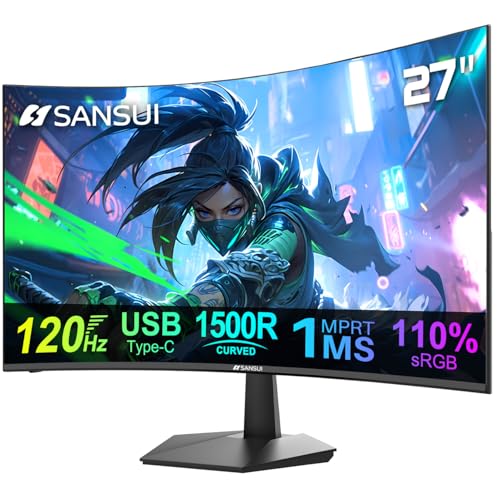
TL;DR: The Sansui ES-27C1‑CA offers a 1500R curved 27‑inch VA panel with 100 Hz refresh, 1 ms MPRT response and USB‑C docking for $115.99, but its 1080p resolution feels soft on a large screen.
The standout feature is the 1500R curvature on a 27‑inch screen, paired with a 100 Hz refresh rate and a 1 ms (MPRT) response time. Those numbers give casual gamers and multimedia fans a fluid visual experience, while the VA panel’s 4000:1 contrast ratio and 300 nits brightness keep blacks deep and colors vivid. The monitor also supports Adaptive Sync and HDR, and it covers 110 % of the sRGB color gamut.
Compared with the other eight monitors in this roundup, the Sansui is heavier than the Sceptre (5.5 lb) but lighter than the Acer Nitro (13.78 lb) and the Asus VG32VQ1B (15.98 lb). Its 8.31‑inch depth is much shallower than the Sceptre’s 15.09 inches and the Samsung Essential’s 9.2 inches, yet deeper than the Asus’s ultra‑thin 0.33 inches. Refresh‑rate wise, it matches the Sceptre and Samsung at 100 Hz but falls short of the Acer’s 280 Hz and the LG 32GS60QC’s 180 Hz. The 1 ms response beats the Sceptre’s 8 ms and Samsung’s 4 ms, and it ties with the Acer and LG on speed.
Reviewers repeatedly praise the smooth refresh and the convenience of a single USB‑C cable for video, power and data. Built‑in 2 W speakers and a 3.5 mm audio jack provide handy everyday use. However, shoppers note the Full HD (1080p) resolution on a 27‑inch panel results in a low pixel density that can look pixelated, especially for text work. The stand only tilts from –5° to 15°, so height adjustment isn’t available, and the low‑power speakers aren’t a substitute for dedicated audio.
Pros
Cons
Best for: Budget‑conscious buyers seeking a reliable entry‑level option
Avoid if: You want the best value‑per‑dollar in its price range
“"best budget FHD 1ms monitor 2025" with "stunning clarity and lightning‑fast motion"”
“"strong colors in movie mode and low blue light for late‑night use, calling it \"budget‑friendly\" with good HDR on modern content"”
TL;DR: The Acer Nitro XZ270 offers a 27‑inch 1500R curve, 280 Hz refresh and 1 ms response at a modest $139.99, delivering fast, immersive gaming while staying within a budget.
The standout spec is its 280 Hz refresh rate paired with a 1 ms VA panel response, which puts motion smoothness well above the 100 Hz of the Sansui and Samsung models and the 160 Hz of the smaller Sansui 24‑inch unit. Even the 180 Hz LG and Alienware monitors sit below Acer’s refresh ceiling, making fast‑paced shooters feel buttery.
At 13.78 lb (6.25 kg), the Nitro is heavier than the 10 lb Sansui, the 8.4 lb Samsung, and the 5.5 lb Sceptre, but lighter than the 15.98 lb Asus and comparable to the 13 lb LG. Its 27‑inch screen size matches the Sansui and Sceptre while offering a deeper 1500R curvature that many users say heightens immersion without demanding a larger desk footprint.
Reviewers consistently praise the monitor’s 100 million:1 contrast ratio for deep blacks and the HDR‑Ready support that adds punch to bright scenes. It's 250 nits brightness is on par with most peers, and the AMD FreeSync Premium sync helps keep tearing at bay. The main criticism centers on the Full HD (1920 × 1080) resolution on a 27‑inch panel, which some users’ll notice as pixelation when sitting close, especially compared to higher‑resolution competitors.
Pros
Cons
Best for: Competitive FPS and fighting game players who value ultra‑fast refresh and low input lag without breaking the bank.
Avoid if: You need a high‑pixel‑density display for content creation or have very limited desk space.
TL;DR: The Sceptre Curved 27‑inch Prime Monitor offers a 1500R curve, 100 Hz refresh and lightweight 5.5 lb build at a budget price, making immersive everyday use affordable.
This model’s standout feature is its 1500R curvature on a full‑size 27‑inch VA panel, paired with a refresh rate of up to 100 Hz and an 8 ms response time. At just 5.5 lb, the monitor's easy to reposition or mount on a VESA‑compatible arm, and it even includes built‑in speakers for basic audio.
Compared with the eight other monitors in the roundup, the Sceptre is lighter than most peers—including the Sansui and Acer options—while its 100 Hz refresh matches the Samsung Essential and Sansui 27‑inch but falls short of the higher‑refresh models like the Acer Nitro (280 Hz) and Sansui 24‑inch (160 Hz). Its 8 ms response time is slower than the 1 ms panels used by several competitors, and its 250 cd/m² brightness sits on par with many but below the 300‑nit displays of the Sansui and Philips units.
Users consistently praise the immersive feel of the 1500R curve and the monitor’s smooth motion for casual gaming and office work. Professional reviewers note the solid build quality and the eye‑care blue‑light reduction, but they also flag the rear control buttons as hard to reach in multi‑monitor setups and point out the lack of height or swivel adjustments. Gamers frequently complain that the base model doesn't include FreeSync, limiting tear‑free performance.
Pros
Cons
Best for: Budget-conscious buyers seeking a reliable entry-level option
Avoid if: You need advanced features or professional‑grade performance
TL;DR: The Philips 346E2CUAE offers a 34‑inch 1500R curved VA panel with 121% sRGB coverage, USB‑C power‑delivery docking and 100 Hz refresh, but its 300 cd/m² brightness and heavy stand keep the price premium.
The standout feature is the 34‑inch 1500R curvature paired with a 3440 × 1440 (1440p) resolution, delivering an ultra‑wide field of view that’s ideal for multitasking. The panel provides 121% sRGB colour gamut, a 3000:1 contrast ratio and a pixel pitch of 0.23175 mm (110 PPI), all backed by AMD FreeSync and HDR support.
Compared with the eight other monitors in this roundup, the Philips ranks among the largest at 34 inches—only the Alienware model matches that size. At roughly 17.3 lb (7.83 kg without stand) it’s heavier than the Samsung Essential S3 (8.4 lb) and Sceptre Prime (5.5 lb) but lighter than the Alienware (20.97 lb) and Asus VG32VQ1B (15.98 lb). Its 48‑100 Hz refresh rate falls short of the 180 Hz offered by Alienware and LG, and well below the 280 Hz found on the Acer Nitro, while its 4 ms GtG response time is slower than the 1 ms GtG on the LG model.
User feedback frequently praises the single‑cable USB‑C connection that supplies power and video, as well as the built‑in speakers for casual media. Professional reviewers note the USB‑C power‑delivery as a real productivity boost for CAD and finance work, but they also highlight that the 300 cd/m² peak brightness limits HDR impact in bright rooms. The monitor draws 31.81‑41.6 W during use, 0.3 W when off and 0.5 W in standby, earning an Energy Efficiency Class F rating.
Pros
Cons
Best for: Professionals and creators who value a wide, colour‑accurate workspace and appreciate USB‑C docking convenience.
Avoid if: You need high‑refresh‑rate gaming above 144 Hz, bright‑room HDR performance, or a lightweight monitor for frequent repositioning.
TL;DR: The Alienware AW3425DWM delivers a 34‑inch 1500R curved VA panel with a 180 Hz refresh rate and 1 ms response, but its premium price and lack of built‑in audio may limit budget‑focused buyers.
The standout feature is the 1500R curvature wrapped around a 34 in ultrawide screen, giving you a truly immersive field of view. Coupled with a 180 Hz refresh rate and an extreme 1 ms GTG response time, fast‑paced titles feel remarkably fluid, and the VA panel’s 0.23175 mm pixel pitch keeps the image sharp across the wide canvas.
Compared across the nine‑product roundup, the AW3425DWM is heavier than the Samsung Essential S3 (8.4 lb) and the LG 32GS60QC Ultragear (13 lb), yet lighter than the Asus VG32VQ1B (15.98 lb). Its 180 Hz panel matches the LG’s refresh speed but outpaces Samsung’s 100 Hz panel. While Acer’s Nitro XZ270 pushes a 280 Hz rate, it does so on a smaller 27‑in screen and at a lower price point, making the Alienware a premium‑tier choice for those prioritising size and curvature.
Reviewers consistently praise the buttery‑smooth motion and the ergonomic stand that offers 0–110 mm height travel, –5° to +21° tilt, and a ±5° pivot. Professional reviewers highlight the 180 Hz refresh as “exceptionally fluid” for competitive gaming, while noting the VA panel’s lack of local dimming can dull dark scenes. Reviewers also note the lack of built‑in speakers or a headphone jack, meaning you’ll need external audio solutions.
On the efficiency side, the monitor draws 32 W during normal use and peaks at 85 W, landing in Energy Class G. Connectivity includes a DisplayPort 1.4, two HDMI 2.1 ports, USB‑A and USB‑B hubs, a joystick control, and a security lock slot, giving you plenty of options for both PC and console setups.
Pros
Cons
Best for: Enthusiast gamers seeking an immersive 21:9 ultrawide experience with high refresh rates and extensive ergonomic adjustments.
Avoid if: You're shopping on a tight budget — it's priced at $299.99.
TL;DR: The Samsung Essential S3 delivers an immersive 1800R curved experience on a 27‑inch VA panel with a 100 Hz refresh rate and TÜV‑certified eye‑comfort features, all for a modest $164.49.
The standout feature is its 1800R curvature paired with a full‑size 27 in display, giving you a wrap‑around feel that Samsung markets as reducing eye strain during long sessions. The VA panel provides a 3000:1 static contrast ratio and 250 cd/m² brightness, while the 4 ms response time keeps motion blur low enough for casual gaming.
At 8.4 lb, the Essential S3 is lighter than the Acer Nitro XZ270 (about 13.78 lb) and the Asus VG32VQ1B (15.98 lb), but heavier than the Sceptre Curved 27‑inch Prime (5.5 lb). Its 100 Hz refresh rate lands in the middle of the pack—faster than the Sceptre’s “up to 100 Hz” and slower than the Acer’s 280 Hz and LG’s 180 Hz models. Response‑time wise, the 4 ms figure sits between the ultra‑fast 1 ms of Acer and Sansui and the slower 8 ms of Sceptre, offering a balanced experience for everyday use.
Reviewers consistently praise the monitor’s curvature for creating a more engaging viewing space and the Game Mode for smoother motion in games and videos. However, many note that the Full HD (1920 × 1080) resolution on a 27‑in screen can look pixelated, especially for text work. The limited connectivity—just one HDMI 1.4 port and a VGA input—also draws criticism, and the stand only tilts, lacking height or swivel adjustments.
Beyond the core specs, Samsung equips the S3 with Eco Saving Plus, Energy Star certification, and TÜV‑certified eye‑comfort technologies like Flicker‑Free and Eye Saver Mode. These features aim to cut fatigue during marathon work or streaming sessions, while the 95 % sRGB coverage and 16.7 M color support keep colors reasonably vibrant for everyday content.
Pros
Cons
Best for: Budget‑conscious home office workers, casual gamers, and streamers who value an immersive curve and eye‑comfort features.
Avoid if: You need high‑resolution detail for design work, extensive connectivity options, or a fully adjustable ergonomic stand.
Breakdown
LG 32GS60QC Ultragear
Pros
Sansui Curved Gaming Monitor 24-inch
Pros
Asus VG32VQ1B
Pros
Cons
Sansui Curved Monitor 27-inch
Pros
Cons
Based on scoring data and product specs
Personalized picks
Best Overall Pick
LG 32GS60QC Ultragear
Best ValueBest for: Audiophiles and enthusiasts seeking premium sound quality and advanced features
Sansui Curved Gaming Monitor 24-inch
Best for: Budget-conscious buyers seeking a reliable entry-level option
$89.99-$149.83 vs winner
Skip Samsung Essential S3 if…
You have limited desk space or need portability
LG 32GS60QC Ultragear takes the top spot as the best‑value curved monitor. Its 31.5‑inch VA panel delivers a rapid 180 Hz refresh and a 1 ms (GtG) response, while the 1000R curvature wraps the view for immersive gaming. A solid 4.5/5 rating from 13,370 reviewers and a list price of $244.58 reinforce its bang‑for‑buck.
The Sansui Curved Gaming Monitor 24‑inch earns the runner‑up title, especially if you need a compact, budget‑friendly screen for a tight desk or dorm room. At 24 inches it offers a 160 Hz refresh, 1500R curve and a 4.4/5 rating from 3,793 reviews for just $89.99.
Looking beyond the top two, here are the best picks for different budgets:
Pick the LG 32GS60QC Ultragear now and enjoy immersive gaming without breaking the bank.
The LG model costs $244.58 versus $89.99 for the Sansui, a $154.59 premium that brings a 2560 × 1440 resolution, 180 Hz refresh rate and HDR10 support. It also offers a tighter 1000R curvature, higher typical brightness of 300 cd/m² and a wider sRGB coverage of 99%, which give a noticeably richer and smoother visual experience. If those upgrades matter for immersive gaming or media, the higher price can be justified.
No reviews yet — be the first to share your experience.
Please sign in to leave a review