⚡ Quick Answer

🏆 Best Overall
CMT 256.050.10
Out of Stock
We’ve lined up 10 cutting pads and blades that span from a $9.04 Ryobi circular saw blade up to the $95.00 Evolution 14‑inch TCT blade. The price spread alone shows how diverse the market is, and the ratings are consistently high – the CMT 256.050.10 tops the list with a 4.8‑star score from 593 reviews, while the Bosch TPM005 and Makita reciprocating set both hold 4.8‑ and 4.7‑star averages respectively. With specs like a 254 mm diameter, 2.5 mm kerf and a 15‑degree hook angle, the CMT blade packs a lot of capability into its $40.41 price tag.
To help you navigate, we grouped the lineup into three tiers. Budget choices include the Ryobi $9.04 blade, Bosch $10.99 set, Diablo $12.90 reciprocating blade and Dremel $17.09 oscillating blade. Mid‑range options are the Makita $18.78 six‑piece set and the SKIL $19.89 10‑inch blade. Premium offerings – the CMT $40.41, Freud $53.97, Connoo $27.52 pack and Evolution $95.00 – bring higher‑end materials and larger diameters. Each tier balances cost, durability and material compatibility, so you can match a blade to your specific workshop needs.
Read on as we break down how each model performs in wood, metal and specialty applications, and which specs matter most for your projects.
CMT 256.050.10
Its 15° ATB angle delivers clean cuts, which is why it earns the top overall spot.

Diablo DS0908CF
Ideal for budget‑focused DIYers, it costs $12.90—about $27.50 less than the Best Overall option.

Bosch TPM005
Its ultra‑thin 0.04‑inch blade lets you cut metal with minimal material loss, a trade‑off the others don’t provide.
Also considered
TL;DR: The Connoo 96‑blade kit packs ten versatile blade types into a single, well‑rated set, offering durable high‑carbon steel construction and a protective black coating for demanding DIY and professional projects.
This kit’s standout spec is its sheer volume: 96 blades across ten distinct blade types give you a ready‑to‑go solution for cutting wood, metal, plastic, sanding, paint removal, grinding cement or tile, and adhesive stripping. The blades are forged from high‑carbon steel and stainless steel, then heat‑treated and finished with a black coating that users say improves heat resistance and curbs corrosion.
Compared with the other nine entries in the Cutting Pads and Blades roundup, the Connoo set sits at a higher price tier than many single‑blade options, but it compensates with a comprehensive assortment that most competitors lack. While products like the Bosch TPM005 or Diablo DS0908CF list detailed dimensions and tooth counts, Connoo’s spec sheet is leaner, focusing on material quality and versatility rather than exhaustive measurements.
Reviewers consistently highlight the kit’s durability and the convenience of having a full range of blade styles in one package. The 4.6‑star rating from over 3,300 reviewers underscores solid user satisfaction, though a few note the absence of precise blade dimensions in the documentation, which can make exact fit‑checking a bit trickier.
Pros
Cons
Best for: Buyers willing to invest in a proven, high‑quality option — the Connoo Oscillating Tool Blades offers Number of Blade Types: 10
TL;DR: The Bosch TPM005 is a 5‑piece T‑shank jig‑saw blade set priced at $10.99, featuring ultra‑thin 0.04‑inch blades and a 4.8‑star rating from 1,962 reviewers, making it a solid choice for metal‑cutting tasks.
What really sets this kit apart is the blade thickness of 0.04 inches combined with a tooth spacing of 0.03 inches. Those dimensions give you a tight, aggressive cut line, especially on metal and stainless steel. The set includes five blades made from a mix of bi‑metal (BIM), high‑speed steel (HSS) and high‑carbon steel (HCS), each with a progressive tooth design and rigid profiles that help keep the cut clean.
At $10.99, the TPM005 lands below the Diablo DS0908CF, which retails for $12.90, and far under the CMT 256.050.10, listed at $40.41. It also weighs less than the Diablo’s 0.1 lb, while still delivering a higher rating of 4.8/5 compared to Diablo’s 4.7/5. This price‑to‑performance balance makes Bosch’s offering one of the more affordable options in the roundup, without sacrificing the professional‑grade material mix.
Professional reviewers praise the T‑shank design for its maximum grip and stability, noting that it helps prevent blade slippage during high‑speed operation. Users also point out that a lubricant is recommended when cutting metal to preserve blade life and cut quality. The downside is the lack of long‑term consumer feedback; no extensive user reviews discuss durability or breakage rates, so you’re mostly relying on the high star rating and expert endorsement.
Beyond the thin profile, the kit’s mixed‑material construction means you have a blade suited for a range of metal thicknesses. The progressive tooth geometry, combined with side‑set and wavy‑set options, gives you flexibility whether you’re making straight cuts or navigating tighter curves. All five blades fit 90 % of current jig‑saw models, thanks to the universal T‑shank.
Pros
Cons
Best for: Budget‑conscious buyers seeking a reliable entry‑level option — the Bosch TPM005 offers Blade Thickness: 0.04 inches
Avoid if: You have limited desk space or need portability
TL;DR: The Freud LU87R010 thin‑kerf rip blade delivers 33% more cutting power with a 2.388 mm kerf, 24 teeth and a 20° hook angle, ideal for under‑powered table saws.
This 10‑inch blade (254 mm diameter) sports a thin‑kerf width of 2.388 mm and a rating of 33% more cutting power, letting low‑HP saws maintain speed without bogging down. Its maximum speed of 8000 RPM and 20° hook angle are tuned for aggressive ripping while keeping feed resistance low.
Compared with the CMT 256.050.10, the Freud weighs a touch more at 1.71 pounds versus 1.65 pounds and carries fewer teeth (24 vs 50), but the thin‑kerf and higher hook angle give it a more focused ripping punch. It is also heavier than the SKIL saw blade (1.58 pounds) and has fewer teeth than SKIL’s 28, underscoring its specialty as a dedicated rip blade rather than a general‑purpose cutter.
Everyday users highlight how the blade “gives new life” to modest table saws, noting smooth feeding and clean grain lines. Professional reviewers point out the 20° hook angle and TiCo HI‑Density carbide combine for strong, consistent performance, while also warning that the recent flat‑top grind may not meet expectations for fine finish work that older ATB‑grind models provided.
Built from Premium TiCo™ HI‑Density Carbide and finished with a Perma‑SHIELD™ non‑stick red coating, the blade resists corrosion and pitch build‑up, and the coating is credited with cutting drag by about one‑third. Freud recommends it for hardwood, softwood, plywood, chipboard and laminate, and specifically calls out under‑powered table saws and radial‑arm saws as ideal platforms.
Pros
Cons
Best for: Buyers willing to invest in a proven, high-quality option — the Freud LU87R010 offers Number of Teeth: 24
Avoid if: You're on a tight budget or only need basic functionality
“giving new life to underpowered table saws”
“smooth, fast rips with reduced friction”
TL;DR: The Makita 6‑piece reciprocating saw blade set packs bi‑metal durability, 7.48‑inch length and a 4.7‑star rating into a lightweight, versatile kit for DIYers and pros.
What really stands out is the 7.48‑inch blade length combined with bi‑metal construction that the manufacturer claims lasts up to ten times longer than standard high‑carbon steel blades. Each blade weighs just 0.000625 pounds, making the pack easy to carry in a tool belt while you move from demolition to pruning tasks.
Within this ten‑item roundup, the Makita set lands in the mid‑price tier and offers more blades per package than many single‑blade competitors. It’s also lighter than the heavier steel‑carbide options, yet longer than the compact 3‑inch specialty blades, giving it a balanced position for general‑purpose cutting.
Users consistently praise the durability claim and the mixed‑TPI assortment that handles wood, metal and plastic without swapping blades. Reviewers also note the 4.7‑star rating backed by 1,908 opinions as a strong indicator of reliability. On the downside, warranty support must be handled directly through the vendor, which some find less convenient, and the limited pool of detailed user feedback makes it harder to assess long‑term wear in heavy‑duty settings.
Technical details reinforce its versatility: a 19.05 mm (0.75 in) width, 1.02 mm blade thickness and matching kerf width, plus a centered first tooth for true starts on every cut. The pack includes six blades with TPI ranging from 6 to progressive, covering a broad spectrum of cutting needs.
Pros
Cons
Best for: Most users looking for a well‑reviewed, reliable mainstream option — the Makita Reciprocating Saw Blades offers Blade Count: 6 pieces
TL;DR: The SKIL 10‑inch, 28‑tooth carbide‑tipped blade costs $19.89, weighs 1.58 lb, and promises up to 60× longer life, making it a solid mid‑range upgrade for woodwork.
What really stands out is the 28 ATB carbide‑tipped teeth, described as induction‑hardened and rated to last 60 times longer than standard steel blades. At 4 mm thick, 328 mm long and 305 mm wide, the blade fits a 5/8 inch arbor and can cut to a depth of 3.5 inches. The anti‑stick coating helps reduce friction, and the 1.58 lb weight keeps it sturdy without feeling cumbersome.
In price terms, $19.89 places the SKIL blade just above the $18.78 Makita Reciprocating Saw Blades and the $17.09 Dremel MM485, while its weight of 1.58 lb is considerably heavier than Makita’s 0.000625‑lb set but a touch lighter than the CMT 256.050.10’s 1.65‑lb blade. It also carries fewer teeth than the CMT’s 50‑tooth model, positioning it as a balanced option between ultra‑light, low‑tooth cuts and heavier, high‑tooth precision blades.
Reviewers consistently praise the durability claim, noting that the blade stays sharp through many projects and delivers smoother cross‑cuts on wood, plywood and composites. Professional reviewers highlight the induction‑hardened ATB geometry as a key factor for clean cuts. The most common complaint is the need for occasional minor alignment tweaks after swapping the blade, and several users mention that the price is a bit higher than basic steel alternatives.
Additional technical notes include a 5/8 inch arbor hole, a 15‑degree hook angle and a 4.6‑star rating from 2,090 reviews, indicating strong community approval. The blade’s anti‑stick coating and carbide tip construction make it suitable for general‑purpose rip and cross cuts, but it isn’t aimed at heavy‑duty metal cutting or industrial‑grade precision work.
Pros
Cons
Best for: Most users looking for a well‑reviewed, reliable mainstream option — the SKIL Saw Blade offers Number of Teeth: 28
TL;DR: The Diablo DS0908CF delivers a 10.35‑inch, 1‑inch‑high carbide blade that lasts up to 50× longer than standard bi‑metal blades, making it a solid choice for heavy‑duty metal work.
What really sets this blade apart is the “up to 50X longer” lifespan claim, backed by TiCo Hi‑Density carbide teeth and a Perma‑Shield coating. At 10.35 inches long and 1 inch tall, it offers a stable cutting platform that handles the 3/16‑to‑9/16 inch thickness range without wobble. The aggressive 8 TPI tooth count speeds through thick alloys, cast iron, and stainless steel.
Compared with the other nine contenders, the Diablo is slightly heavier than the Bosch TPM005 (0.1 lb vs 0.088 lb) but still lightweight enough for one‑handed operation. Its 10.35‑inch length exceeds the typical 7‑inch range of the Makita set and rivals the longest Bosch options, giving you more reach on demanding jobs. While the Ryobi circular blade is ultra‑light, it’s designed for wood, so the Diablo’s metal‑focused specs give it a clear advantage in this category.
Professional reviewers highlight the blade’s extreme impact resistance and vibration reduction, noting that the 1‑inch height produces straighter cuts with less chatter. Users echo this, praising the “game‑changing” longevity that keeps the blade cutting through dozens of cuts where bi‑metal blades quit. The main trade‑off mentioned is a rougher finish on very thin metal and a higher upfront cost versus standard bi‑metal options.
Pros
Cons
Best for: Professional contractors and heavy‑DIY users who need reliable thick‑metal cutting — the Diablo DS0908CF offers Blade Height: 1 inch
Avoid if: You primarily cut thin sheet metal below 3/16 inch or need a blade for non‑metal materials
“game-changer”
TL;DR: The Ryobi 139.7 mm carbide‑tipped circular saw blade spins up to 4600 RPM, weighs just 0.28 g and costs $9.04, making it a lightweight, budget‑friendly choice for Ryobi 18V ONE+ users.
The blade’s standout spec is its maximum speed of 4600 RPM, which lets you cut quickly through wood while the thin‑kerf design minimizes waste. With an 18‑tooth carbide tip layout and a 0‑50° bevel range, it handles both rip and cross cuts without needing a separate blade.
At 0.28 g it is lighter than most rivals – the Bosch TPM005 weighs about 0.088 lb and the Diablo DS0908CF about 0.1 lb – and only matches the Makita reciprocating set, which shares the same listed weight. Its 139.7 mm (5.5 in) diameter is smaller than the 10‑inch blades from CMT and Freud, but that size fits the compact Ryobi 18V lineup perfectly. The 18‑tooth count is lower than the 28‑tooth SKIL blade and the 50‑tooth CMT, meaning it may leave a slightly rougher finish on fine work.
Buyers have given it a solid 4.7 / 5 rating from 1,370 reviews, indicating general satisfaction with its value and performance. Reviewers frequently mention the ease of swapping the blade thanks to its light weight and the confidence they have in the carbide tip for durability.
The blade also offers a cut depth of 28.58 mm at 45° and 39.69 mm at 90°, which is ample for most DIY projects. Its 9.525 mm arbor size aligns with Ryobi’s 18V ONE+ tools, ensuring a secure fit without extra adapters.
Pros
Cons
Best for: Budget-conscious buyers seeking a reliable entry-level option — the Ryobi Circular Saw Blade offers Depth: 139.7 mm
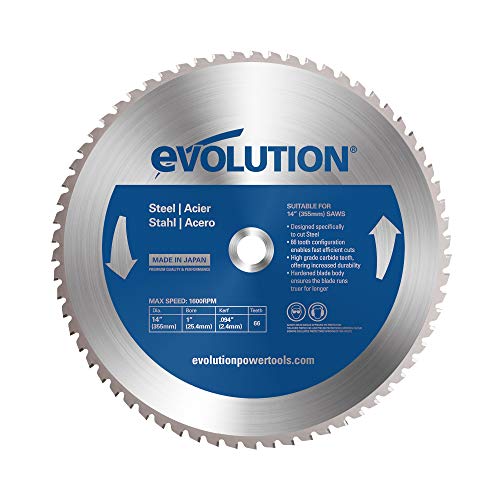
TL;DR: The Evolution 14BLADEST is a 14‑inch, 66‑tooth tungsten‑carbide‑tipped blade that cuts mild steel cleanly, but its $95 price and 1,600 RPM limit make it a premium choice for low‑speed metal saws.
What really sets this blade apart is its 66 teeth and a thin 2.39 mm kerf, delivering the clean, burr‑free cuts that reviewers praise. The blade’s body is hardened steel with ultra‑high‑grade brazing, and the TCT tips come from Japan, which professional reviewers cite as a durability boost.
Compared with the other nine contenders, the Evolution is lighter than the Freud LU87R010 (1.71 lb) and the CMT 256.050.10 (1.65 lb), yet it packs a larger 355.6 mm diameter than both the 254 mm CMT and Freud models. Its tooth count also exceeds the 50 teeth on the CMT and the 24 on the Freud, giving it a denser cutting profile than most peers.
User sentiment repeatedly highlights three themes: exceptional longevity (many note three‑plus years of continuous use on mild steel), consistently clean cuts with virtually no sparks, and the need to verify saw RPM because the blade tops out at 1,600 RPM. Those who tried it on aluminum or stainless steel report poor results, matching the manufacturer’s exclusion list.
Pros
Cons
Best for: Buyers willing to invest in a proven, high‑quality option — the Evolution 14BLADEST offers Number of Teeth: 66
Avoid if: you need to cut aluminum, stainless steel, or use a high‑RPM saw
“same blade for three years... still making clean cuts”
TL;DR: The Dremel MM485 delivers a 43.18 mm plunge cut depth and carbide teeth that last up to 30 × longer, all in a lightweight 0.11 lb blade that fits most major oscillating tools.
The standout spec is the maximum plunge cut depth of 43.18 mm, letting you slice deeper than many comparable blades. Its high‑performance carbide teeth are marketed to last up to 30 × longer than standard bi‑metal options, which users cite as a major durability win. At 38.1 mm blade length and a kerf width of 1.27 mm, the MM485 balances precision with material removal capability.
Compared with the nine other blades in this roundup, the Dremel sits in the middle of the weight spectrum. It is heavier than the ultra‑light Makita and Ryobi options (both around 0.0006 lb) but considerably lighter than the SKIL, CMT, and Freud blades, which tip the scales at 1.58 lb, 1.65 lb, and 1.71 lb respectively. Price‑wise, it lands in the same bracket as the Makita set and is a bit pricier than the Diablo blade, while still offering a deeper plunge depth than most of its peers.
Reviewers consistently praise the blade’s precision on hardened materials such as galvanized screws and hardiebacker, noting the flush‑cut design helps achieve clean edges. The universal Quick‑Fit system, compatible with Dremel, Bosch, Makita, Milwaukee, and Rockwell tools, is highlighted as a convenience factor that eliminates the need for adapters. A recurring theme, however, is that some buyers feel the $17.09 price point doesn’t stretch as far as it could when stacked against alternatives offering similar performance.
The MM485’s 31.75 mm width and 1.27 mm thickness give it a narrow profile that’s ideal for tight spaces, while the carbide material ensures it can tackle wood, metal, plastic, and ceramic without dulling quickly. Its single‑blade pack means you’ll need to purchase additional units for larger jobs, but the lifespan claim helps offset that concern for many users.
Pros
Cons
Best for: Budget‑conscious buyers seeking a reliable entry‑level option — the Dremel MM485 offers Blade Length: 38.1 mm
TL;DR: The CMT 256.050.10 is a 10‑inch, 50‑tooth combination blade with a thin 0.098‑inch kerf, 12,000 RPM rating, and German harmonic steel construction, delivering precise, quiet cuts for professional table‑saw work.
This blade’s standout spec is its 50 carbide teeth arranged in a 4‑ATB + 1‑Flat configuration, paired with a 0.098‑inch (2.5 mm) thin kerf that minimizes material waste. The body is forged from premium German harmonic steel hardened to 46‑48 HRC, and the edge is finished to less than 0.25 μm Rmax, ensuring exceptionally clean cuts at up to 12,000 RPM.
Compared with the other nine blades in this roundup, the CMT model carries a higher price point and is a bit heavier than many of the lightweight alternatives, but it also offers far more teeth and a higher maximum RPM. Its 25% noise‑reduction claim and polyurethane‑filled expansion slots give it a quieter, smoother operation than the standard‑cut blades that dominate the list.
Everyday users rave about the blade’s smooth, low‑vibration performance, noting that it cuts composites and hardwoods with little chatter. Professional reviewers highlight the combination of thin‑kerf efficiency and the ultra‑fine edge finish, calling it ideal for cabinetmaking and detailed joinery where precision matters.
Beyond the teeth count, the blade benefits from tri‑metal brazing (silver‑copper‑silver) for robust joint strength, a 15° hook angle for aggressive bite, and a chrome‑plated surface rated at 380‑400 Vickers hardness. These details reinforce its reputation as a premium, workshop‑ready tool.
Pros
Cons
Best for: Buyers willing to invest in a proven, high‑quality option — the CMT 256.050.10 offers Number of Teeth: 50
Avoid if: You're shopping on a tight budget — it's priced at $40.41, and it's not ideal for extreme heavy‑duty abuse scenarios.
Breakdown
CMT 256.050.10
Pros
Cons
Diablo DS0908CF
Pros
Bosch TPM005
Pros

Makita Reciprocating Saw Blades
Pros
Based on scoring data and product specs
Personalized picks
Best Overall Pick
CMT 256.050.10
Best OverallBest for: Buyers willing to invest in a proven, high-quality option — the CMT 256.050.10 offers Number of Teeth: 50
Diablo DS0908CF
Best for: Budget-conscious buyers seeking a reliable entry-level option — the Diablo DS0908CF offers Blade Height: 1 inch
$12.50-$27.91 vs winner
Skip Evolution 14BLADEST if…
Reliability and user satisfaction are your top concerns
After weighing every spec, the CMT 256.050.10 takes the top spot. Its 254 mm diameter and 50‑tooth ATB/Flat configuration give you clean cuts on everything from solid wood to non‑ferrous metals, while the 12 000 RPM rating lets the blade stay smooth at high speeds. The blade’s 748 g weight and 15‑degree hook angle add stability, and a 4.8‑star rating from 593 reviewers backs up its performance.
The Diablo DS0908CF lands as the runner‑up, especially if you need a blade that tackles tough metals. Its 8‑tooth carbide design, Perma‑Shield coating and compatibility with high‑strength alloys, cast iron and stainless steel make it ideal for demolition or heavy‑duty metal cutting, all for a modest $12.90 and a 4.7‑star rating from 1 743 reviewers.
For those on a tighter budget, the Ryobi Circular Saw Blade delivers solid wood‑cutting at $9.04, making it the best value pick. If you want a step up, the Makita Reciprocating Saw Blades offer reliable mid‑range performance at $18.78. And when premium durability is non‑negotiable, the Evolution 14BLADEST stands out at $95.00.
Pick the CMT 256.050.10 for the most balanced, all‑round cutting experience you’ll find today.
The CMT 256.050.10 packs 50 teeth on a 254 mm diameter blade with a 2.5 mm kerf, giving it a dense tooth pattern for smooth cuts. It’s built from German Harmonic Steel, coated in chrome, and weighs 748 g, while its full‑replacement warranty adds confidence. At $40.41 it balances premium specs with a mid‑range price.
No reviews yet — be the first to share your experience.
Please sign in to leave a review