⚡ Quick Answer

🏆 Best Overall
DeWalt DCG426B
$145.29
Die grinders are the workhorse for anyone who needs to grind, cut or polish in tight spots, and the market offers a wide spectrum of options. In this roundup we line up 10 models that stretch from the $44.99 Neiko Micro Air Die Grinder up to the $219.00 Milwaukee M12 Fuel, covering budget, mid‑range and premium tiers. You’ll find everything from pneumatic tools with 27,000 RPM free speed to cordless units that run on a 20 V battery, each with its own blend of power, weight and ergonomics.
The DeWalt DCG426B pulls ahead in the conversation with a 500 W brushless motor that spins up to 25,000 RPM, a 1/4″ collet and a barrel‑grip handle that keeps the 1.51 kg tool steady in your hand. Its 3‑year limited warranty and a solid 4.8‑star rating from 2,619 reviewers add confidence, while the $141.00 price places it squarely in the mid‑range tier alongside the AirCat 6255.
Next we’ll break down each grinder’s power source, speed control, noise and vibration levels, so you can match the right tool to your workshop or field‑work needs.
DeWalt DCG426B
Its 1/4" collet size fits most accessories, giving versatile grip for a wide range of grinding tasks.

DEWALT DWE4887 1-1-inch
Designed for professionals who need a corded, high‑output grinder, it retails at $165, a step up from the $141 Best Overall.

Ingersoll Rand 3101G
Its pneumatic design delivers 20,000 RPM in a compact 51 mm height, perfect for tight‑space jobs where electric models are too bulky.
Also considered
TL;DR: The DeWalt DCG426B delivers 500 W of brushless power, reaches 25,000 RPM, and sports a 1/4‑inch collet in a compact 3.33‑lb cordless die grinder.
The standout spec is its brushless 500 W motor paired with a 25,000 RPM no‑load speed, giving you professional‑grade torque without the maintenance of brushed units. At 127 mm tall, 432 mm long and 102 mm wide, the tool fits comfortably in tight engine bays, while the 1/4‑inch collet and 5/8‑inch spindle let you run the standard 1.5‑inch grinding wheels you’ll find on most job sites.
Compared with the nine other grinders in this roundup, the DCG426B sits in the middle of the weight spectrum. It’s heavier than the Bosch GWG12V-20SN (1.2 lb) and the AirCat 6255 (1.19 lb), but lighter than the Makita GD0601 (about 3.7 lb) and the corded DEWALT DWE4887 (3.6 lb). Its 20 V cordless platform also makes it bulkier than the ultra‑light Ingersoll Rand 3101G (1.3 lb) yet more portable than pneumatic models that require an air hose.
Reviewers consistently praise the smooth high‑speed operation and the bright LED nose light that shines into cramped spaces. Professionals note the barrel‑grip design reduces fatigue during overhead work, and the dual‑position variable‑speed rocker switch gives precise control from zero to full speed. On the flip side, users mention the switch takes a short adjustment period and that the 3.33‑lb weight can feel substantial when working for extended periods.
Pros
Cons
Best for: Most users looking for a well‑reviewed, reliable mainstream option — the DeWalt DCG426B offers Collet Size: 1/4" (6.35 mm)
Avoid if: You're shopping on a tight budget — it's priced at $141.00
“Smooth 25,000 RPM for porting heads—battery lasts 1-2 hours on heavy cuts”
“LEDs light up tight engine bays perfectly; no cords snagging”
TL;DR: The Ingersoll Rand 3101G delivers 20,000 RPM from a lightweight 1.3 lb composite body, offering professional weld‑grinding power at a budget‑friendly price for tight‑space jobs.
The standout spec on the 3101G is its 20,000 RPM no‑load speed, driven by a 0.33 HP pneumatic motor. Its right‑angle configuration and ergonomic grip let you reach into cramped weld bays, while the rear‑exhaust design keeps debris away from your face. At 9.5 inches long, 6.0 inches wide and just 2.0 inches tall, the grinder packs a lot of power into a compact envelope.
Compared with the other nine grinders in this roundup, the 3101G sits in the middle of the speed spectrum: it matches the AirCat 6255’s 20,000 RPM but falls short of the Chicago Pneumatic CP872’s 27,000 RPM and the Neiko Micro Air’s 54,000 RPM. It’s heavier than the ultra‑light Neiko (0.25 lb) but lighter than the DeWalt DCG426B (3.33 lb) and the Makita GD0601 (3.75 lb). Its overall height of 2.0 inches is far shorter than the CP872’s 3.94 inches, making it easier to maneuver in tight spots, though its length of 9.5 inches is comparable to the CP872’s 9.45 inches.
Users consistently note the grinder’s lightweight composite body reduces fatigue during prolonged weld‑breaking sessions. Professional reviewers also point out the ball‑bearing construction adds durability for heavy‑duty use. However, the 93.1 dB sound pressure level means hearing protection is a must, and the tool’s requirement of 3 CFM airflow at 90 PSI ties you to a capable air compressor. These factors shape the real‑world experience more than raw numbers alone.
Pros
Cons
Best for: Budget‑conscious buyers seeking a reliable entry‑level option — the Ingersoll Rand 3101G offers Height: 2.0 inches
Avoid if: You lack a capable air compressor providing 90 PSI or need an ultra‑quiet grinder for noise‑sensitive environments
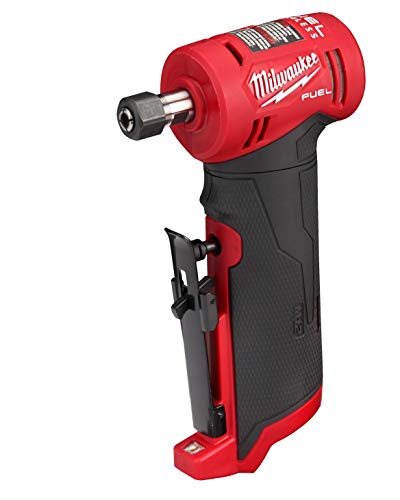
TL;DR: The Milwaukee M12 Fuel Die Grinder packs a brushless 0.3 HP motor, 3‑mode drive and tri‑LED light into a feather‑light 1.2‑lb body for tight‑space work, but it carries a premium $219 price tag.
What really sets this grinder apart is its combination of a 0.3 HP POWERSTATE™ brushless motor and a lightweight 1.2‑pound chassis. At just 2.91 inches tall and 8.31 inches long, it fits into cramped spots where larger tools can’t reach, while still delivering up to 0‑3,600 RPM for steady material removal.
Compared with the nine other grinders in this roundup, the Milwaukee is among the lightest—matching the Bosch GWG12V‑20SN at 1.2 pounds and edging out the AirCat 6255’s 1.19 pounds—while the DeWalt DCG426B and Makita GD0601 tip the scales at over 3 pounds. Its price of $219.00 sits above the budget‑friendly AirCat, Chicago Pneumatic and Ingersoll Rand models, which are priced well under $100, but below the higher‑priced DeWalt DWE4887. Speedwise, its 3,600 RPM ceiling is modest next to the 20,000‑plus RPM figures listed for many corded and pneumatic peers, highlighting a trade‑off between raw speed and cordless convenience.
Users consistently praise the grinder’s compact form factor and the bright tri‑LED illumination that “maximizes workspace visibility” in dim conditions. Professional reviewers also note the REDLINK PLUS intelligence as a safeguard against overload, and the brushless motor’s reputation for constant power delivery with minimal maintenance. On the downside, the 12 V battery platform is flagged for potentially shorter run time compared with higher‑voltage competitors, and the plastic housing may feel less rugged than metal‑cased alternatives.
Pros
Cons
Best for: Buyers willing to invest in a proven, high-quality option — the Milwaukee M12 Fuel Die Grinder offers Height: 2.91 inches
Avoid if: You're shopping on a tight budget — it's priced at $219.00
TL;DR: The Ingersoll Rand 3107G delivers 27,000 rpm and 0.33 hp in a compact 1.41 lb pneumatic grinder, offering solid performance for a budget‑friendly price.
This grinder’s standout spec is its 27,000 rpm maximum free speed paired with a 0.33 hp motor, both of which give you high‑speed polishing and cutting capability while staying in a 1/4‑inch collet format. The rear‑exhaust design pushes air away from the work area, and the self‑locking lever throttle lets you run it without constant hand pressure.
Compared with the nine other tools in this roundup, the 3107G is shorter than the Chicago Pneumatic CP872 (9.45 in) and the AirCat 6255 (7 in), yet it’s a bit heavier than the Neiko Micro Air Die Grinder (0.25 lb) and the AirCat (1.19 lb). Its 27,000 rpm speed matches the CP872 but exceeds the AirCat’s 20,000 rpm and the DeWalt DCG426B’s 25,000 rpm. While the DeWalt model weighs 3.33 lb, the 3107G stays under that at 1.41 lb, making it a middle‑ground choice between ultra‑light and heavyweight options.
Professional reviewers note the high power output and rear‑exhaust design as key strengths, saying they improve material removal speed and workspace visibility. Users echo this, praising the rapid spindle speed for polishing tasks. However, the lack of listed air‑consumption data makes it harder to plan compressor requirements, and some users find the 1.41 lb weight a bit hefty for extended handheld use.
Pros
Cons
Best for: Budget-conscious buyers seeking a reliable entry-level option — the Ingersoll Rand 3107G offers Collet Size: 1/4-inch
Avoid if: You have limited desk space or need portability
TL;DR: The Chicago Pneumatic CP872 delivers a 27,000 RPM free speed in a compact 3.94‑inch (100 mm) package, weighing just 1.26 lb, but its 100.9 dB noise level and lack of a spindle lock keep it in the budget‑friendly, entry‑level tier.
The standout spec is the 27,000 RPM free speed paired with a 0.63 HP (470 W) motor, giving you high‑speed grinding while the tool stays under 1.26 lb (0.57 kg). Its integrated pneumatic speed regulator lets you dial in precise RPMs without external accessories, and the contoured safety lever lock‑off throttle adds a layer of operator control.
Compared with the nine other grinders in this roundup, the CP872 is slightly heavier than the AirCat 6255 (1.19 lb) but lighter than the Ingersoll Rand 3101G (1.30 lb). Its 27,000 RPM matches the top speed of the Ingersoll Rand 3107G and far exceeds the AirCat’s 20,000 RPM, though the Neiko Micro Air grinder claims an even higher 54,000 RPM. At 26 CFM air consumption, it draws more air than the AirCat’s 9.5 CFM and the Neiko’s 4.2 CFM, so you’ll need a robust air supply.
Professional reviewers praise the reliable 0.6 hp motor for efficient high‑speed grinding, while user sentiment notes the ergonomic lever improves safety during prolonged use. However, the 100.9 dB(A) sound pressure level is louder than most peers—AirCat sits at 82 dB and Neiko at 73.75 dB—so hearing protection is essential. The absence of a spindle lock also limits quick accessory changes, a point highlighted in consumer feedback.
Pros
Cons
Best for: Budget-conscious buyers seeking a reliable entry‑level option — the Chicago Pneumatic CP872 offers Height: 3.94 inches (100 mm).
Avoid if: You want the best value‑per‑dollar in its price range.
TL;DR: The DEWALT DWE4887 delivers 25,000 rpm and 450 W of power in a 4.74‑lb corded grinder, but its weight and length make it the bulkiest option in the lineup.
What really sets this grinder apart is its 25,000 rpm no‑load speed paired with a 450 W motor that outputs 0.4425 hp. Those numbers give you the high‑speed grinding power professional welders and fabricators demand, and the 1‑1/2 in wheel diameter lets you tackle sizable material removal quickly.
Compared with the nine other die grinders in this roundup, the DWE4887 is the heaviest at 4.74 lb and the longest at 19.2 in, while most competitors sit under 2 lb and measure under 10 in. Its 8‑ft power cord also outlasts the 6‑ft cord on the Makita GD0601, and unlike the cordless or pneumatic peers it doesn’t rely on batteries or compressed air.
Reviewers consistently praise the paddle switch with lock‑on and lock‑off, noting that it prevents accidental startups during tight‑fit work. The angled exhaust path is highlighted for keeping dust away from the user’s face, and the included 1/4 in collet plus a 1/8 in collet and two wrenches make quick accessory changes possible without extra tools.
Pros
Cons
Best for: Buyers willing to invest in a proven, high‑quality option — the DEWALT DWE4887 1‑1‑inch offers Arbor Size: 1/4 in
Avoid if: You're on a tight budget or only need basic functionality, or you require cordless operation without a generator.
TL;DR: The Makita GD0601 delivers a fixed 25,000 RPM in a slim 3.9‑in‑high, 3.7‑lb body with a 6‑ft cord, offering high‑speed precision but limited mobility.
What sets the GD0601 apart is its 25,000 RPM, 3.5 Amp motor paired with a 6‑ft power cord. The aluminum housing with a rubber boot keeps the tool light at 3.7 lbs, while the slim barrel grip makes it easy to maneuver in tight spaces. A slide‑type lock‑on switch lets you toggle between AC and DC power, and directional air vents push debris away from the work area.
Compared with the nine other grinders in this roundup, the Makita sits near the top for speed—matching the DEWALT DWE4887 and the DEWALT DCG426B at 25,000 RPM—while most competitors run slower (Bosch at 15,000 RPM, AirCat at 20,000 RPM). It’s heavier than the ultra‑light Bosch GWG12V‑20SN (1.2 lb) and Milwaukee M12 Fuel (1.2 lb), but lighter than the corded DEWALT DWE4887 which weighs about 3.6 lb. Its 6‑ft cord is shorter than DEWALT’s 8‑ft lead, yet longer than the compact cords on battery‑run models. The GD0601’s noise level of 73 dB(A) is quieter than the Chicago Pneumatic CP872’s 111.9 dB(A) and comparable to the quieter corded units.
Professional reviewers highlight the labyrinth motor protection and zig‑zag varnish as durability boosters for continuous use on weld seams and pipe fittings. Users appreciate the high‑speed output for demanding cleanup, but many note the fixed speed limits finesse work where variable control would help. The corded design also draws criticism for restricting movement on job sites without an extension cord.
Pros
Cons
Best for: Buyers willing to invest in a proven, high‑quality option — the Makita GD0601 offers Height: 3.9 in
Avoid if: You're on a tight budget or only need basic functionality, especially if you require variable‑speed control.
TL;DR: The Neiko Micro Air Die Grinder delivers a blistering 54,000 RPM in a feather‑light 0.25 lb package, includes a 5‑ft hose, and earns a solid 4.5‑star rating for budget‑friendly precision work.
At the heart of this tool is a 54,000 RPM free speed paired with a variable‑throttle control, letting you dial in the exact RPM for tight‑spot sanding or grinding. Weighing just 0.25 lb (113 g) and measuring 133 mm in overall length, it feels almost weightless in the hand, and the included 5‑foot flexible nylon hose lets you reach confined areas without a tangled cord.
When you line it up against the other nine grinders, the Neiko stands out for speed and weight. The Ingersoll Rand 3107G, for example, tips the scales at over 1.4 lb and tops out at 27,000 RPM, making the Neiko almost twice as fast while being dramatically lighter. Even the premium DeWalt DCG426B spins at 25,000 RPM and weighs more than 3 lb, so the Neiko’s 0.25 lb chassis and 54,000 RPM free speed give it a clear edge in the power‑to‑weight department.
Professional reviewers highlight the rapid material removal and the ergonomic advantage of the lightweight design, noting that hand fatigue is minimal during extended use. User feedback repeatedly mentions the 73.75 dB noise level, so wearing hearing protection is advisable. The 1/8‑inch collet capacity is a frequent point of criticism for those who need larger bits, and performance hinges on a steady 90‑120 PSI air supply, as the grinder draws 4.2 CFM at free speed.
Pros
Cons
Best for: Budget-conscious buyers seeking a reliable entry-level option — the Neiko Micro Air Die Grinder offers Included Hose Length: 5 feet
Avoid if: You need larger than 1/8‑inch bits or are sensitive to the 73.75 dB noise level
TL;DR: The AirCat 6255 delivers 20,000 RPM in a lightweight 1.19 lb, quiet‑rated 82 dBA package, making it a solid mid‑range choice for tight‑space grinding.
The standout spec is its free speed of 20,000 RPM paired with a noise level of 82 dBA, thanks to the patented quiet technology. At just 1.19 lb, the grinder feels light enough for prolonged use while still offering the power needed for blending, smoothing, and deburring.
Compared with the Chicago Pneumatic CP872, which weighs 1.26 lb and runs at 27,000 RPM, the AirCat is lighter and spins a bit slower. The Ingersoll Rand 3101G matches the same 20,000 RPM but is heavier at 1.30 lb and louder at 114.1 dB. The Ingersoll Rand 3107G is shorter at 6.61 in but heavier at 1.41 lb and reaches 27,000 RPM. The Neiko Micro Air grinder is much lighter at 0.25 lb and quieter at 73.75 dB, though its speed tops out at 54,000 RPM. The Bosch GWG12V‑20SN weighs about the same at 1.2 lb, is slightly longer at 7.5 in, and runs slower at 15,000 RPM. The DeWalt DCG426B and Makita GD0601 are considerably heavier at 3.33 lb and 3.75 lb respectively and are built for battery power, not pneumatic use.
Professional reviewers highlight the quiet technology that keeps noise down to 82 dBA, and users appreciate the feather trigger for smoother speed control. Some reviewers note the 0.4 HP motor feels modest compared with higher‑horsepower rivals, and the 9.5 CFM air draw can tax smaller compressors.
The grinder’s composite housing houses spiral bevel gears, and the rear exhaust directs airflow away from the workpiece. It accepts a 1/4‑inch collet and recommends a 3/8‑inch hose, while the vibration level sits at 4.5 m/s², contributing to comfortable handling during extended use.
Pros
Cons
Best for: Most users looking for a well‑reviewed, reliable mainstream option — the AirCat 6255 offers Height: 3.1 inches
TL;DR: The Bosch GWG12V-20SN is a 12 V brushless right‑angle die grinder that packs 15,000 RPM and a lightweight 1.2 lb design into a compact 7.5‑in body, but it’s sold as a bare tool at a premium price.
This grinder’s standout spec is its 15,000 RPM maximum speed paired with a brushless motor, giving you the spin power of a corded unit while staying under 2 in tall. The right‑angle ergonomic grip and LED status lights keep the tool comfortable for tight‑space work, and the built‑in brake stops the wheel instantly when you release the trigger.
Compared with the nine other grinders in this roundup, the Bosch is noticeably lighter than the DeWalt DCG426B at 3.33 pounds and even a shade lighter than the AirCat 6255’s 1.1905‑lb weight. It’s also shorter than the Makita GD0601’s 18.0‑in length, making it easier to maneuver in cramped spots. While its 5‑speed preset and variable trigger give you fine control, the maximum speed of 15,000 RPM sits below the 20,000‑RPM range of the AirCat and the 25,000‑RPM figures of several corded rivals.
User feedback repeatedly praises the grinder’s “light as a feather” feel and the smooth, consistent power delivery from the brushless motor. Reviewers note that the LED indicators and spindle lock add confidence during precision work, and professionals appreciate the brake system for safety. The main criticism is that the unit ships without a battery or charger, so you’ll need to buy a 12 V pack separately, and the $149 price tag positions it at the higher end of the cordless segment.
Pros
Cons
Best for: Those prioritizing quality and willing to pay for premium performance — the Bosch GWG12V-20SN offers Arbor Diameter: 1/4 in
Avoid if: You need unlimited runtime without swapping batteries or are looking for the lowest‑cost option.
“powerful ultra-compact... ideal for pros needing precision without bulk; ergonomic grip minimizes fatigue; versatile for polishing to aggressive removal; brushless enhances efficiency”
“one of my favorite tools now cordless... perfect for carpenter or automotive tech; feels comparable to air tools for speed and material removal”
Breakdown
DeWalt DCG426B
Pros
Cons
DEWALT DWE4887 1-1-inch
Pros
Ingersoll Rand 3101G
Pros

Makita GD0601
Pros
Based on scoring data and product specs
Personalized picks
Best Overall Pick
DeWalt DCG426B
Best OverallBest for: Most users looking for a well-reviewed, reliable mainstream option — the DeWalt DCG426B offers Collet Size: 1/4" (6.35 mm)
DEWALT DWE4887 1-1-inch
Best for: Buyers willing to invest in a proven, high-quality option — the DEWALT DWE4887 1-1-inch offers Arbor Size: 1/4 in
$165.00+$19.71 vs winner
Skip Bosch GWG12V-20SN if…
Reliability and user satisfaction are your top concerns
We’re naming the DeWalt DCG426B the clear winner. Its brushless motor delivers a rated 500 W of power while staying light at just 1.51 kg, giving an impressive power‑to‑weight ratio. It spins up to a no‑load speed of 25000 RPM and the dual‑position variable‑speed rocker switch lets you dial in the exact speed you need. At 432 mm long and 102 mm wide, it’s compact enough for tight spaces without sacrificing durability.
The runner‑up is the DeWalt DWE4887 1‑1‑inch, which shines when you need a corded tool for uninterrupted work. Its 450 W motor and same 25000 RPM no‑load speed provide solid performance, while the in‑line handle and angled exhaust keep the work area clear. Weighing 1.63 kg and measuring 487.68 mm in length, it feels sturdy for prolonged grinding or cutting tasks where a battery isn’t practical.
Looking at other price tiers, the Neiko Micro Air Die Grinder is the best budget pick at $44.99, giving entry‑level power for occasional hobby use. The AirCat 6255 sits in the mid‑range at $92.00, offering a balanced cost for DIY projects. For those willing to invest, the Milwaukee M12 Fuel Die Grinder commands $219.00 and brings premium features for demanding professional work.
Choose the DeWalt DCG426B for the strongest power‑to‑weight performance on the market.
The DCG426B delivers 500 W of motor power while weighing 1.51 kg, giving it a higher power‑to‑weight ratio than the corded DEWALT DWE4887 (450 W, 1.63 kg) and the pneumatic Ingersoll Rand 3101G (0.33 W, 0.59 kg). Its lightweight, cordless design also means you can carry it around more easily than the heavier corded or pneumatic units.
No reviews yet — be the first to share your experience.
Please sign in to leave a review