⚡ Quick Answer
Choosing a DOCSIS 3.1 cable modem can feel overwhelming, especially with speeds climbing past 2 Gbps and prices ranging from $107.54 for the entry‑level Netgear CM1200 up to $299.99 for the high‑end Netgear CM3000. In this roundup we evaluated 6 models, grouping them into three price tiers that match typical budgets: the budget tier features the Netgear CM1200 and Arris SURFboard SB8200, the mid‑range tier houses the Hitron CODA56 and Motorola B12, and the premium tier includes the Netgear CM2050V and CM3000.
The Motorola B12, priced at $169.00, offers a 2.5 Gbps downstream rate and a 4.3‑star rating from 29,479 reviewers, making it a solid choice for multi‑gigabit plans in a compact 5.5 × 3.5 × 3.5‑inch form factor. Meanwhile, the Arris SB8200’s 607.8 g weight and dual‑Gigabit Ethernet ports keep it competitive at $142.99, while the Netgear CM1200 delivers a 2 Gbps maximum download speed for just $107.54, earning a 4.2‑star rating from 6,447 users. The premium options offer up to 1 Gbps upload and integrated voice features.

Motorola B12
Its compact 5.5‑inch height and 3.5‑inch length keep it easy to fit in tight spaces.
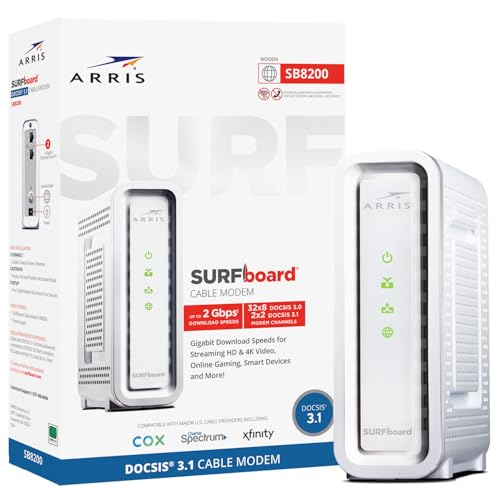
Arris SURFboard SB8200
Ideal for budget‑conscious households, the SB8200 comes in at $142.99—about $26 less than the Motorola B12—while still delivering solid entry‑level performance.

Netgear Nighthawk CM3000
With a 234.0 mm depth, the CM3000’s larger chassis hints at premium components that deliver higher performance than the more compact Motorola and Arris options.
Also considered
Score Analysis
Key score advantages vs. runner-up (Arris SURFboard SB8200)
Price Range
Motorola B12
$159.99
Arris SURFboard SB8200
$150.32
Netgear Nighthawk CM3000
$269.99

Netgear Nighthawk CM2050V
$249.99

Hitron CODA56
$159.99

Netgear Nighthawk CM1200
$107.54
Spec Comparison
TL;DR: The Motorola B12 costs $169.00, delivers up to 2.5 Gbps downstream on a single 2.5 Gbps Ethernet port, and packs a 4.3‑star rating into a compact 5.5‑×3.5‑×3.5‑inch chassis.
The standout spec is its 2.5 Gbps downstream data rate paired with a 2.5 Gbps (2500 Mbps) Ethernet LAN port, ensuring you won’t hit a bottleneck even with multi‑gigabit plans. Upstream capacity reaches 800 Mbps, and the modem supports DOCSIS 3.1 with a fallback to DOCSIS 3.0, so it works with both new and legacy cable networks.
In size, the B12’s 5.5‑inch height and 3.5‑inch square footprint are noticeably shorter than the Hitron CODA56’s 8.13‑inch height and far more compact than the Netgear Nighthawk CM1200, which stands 10.3 inches tall. At $169.00, it sits above the budget‑friendly Netgear CM1200 ($107.54) yet well below the premium Netgear CM3000 ($299.99), offering a middle‑ground price point in this six‑model roundup.
Reviewers consistently praise the modem’s plug‑and‑play simplicity: just connect coax, power, and Ethernet and you’re online. Professional editors note the reliable multi‑gigabit performance for 4K streaming and competitive gaming, while everyday users love the easy setup and solid build quality. The most common trade‑off mentioned is the lack of built‑in Wi‑Fi and the single Ethernet port, which means you’ll still need a router or switch for multiple wired devices.
Beyond raw speed, the B12 includes Active Queue Management to trim latency, QoS for traffic prioritization, and full IPv6 support. It’s certified for major US ISPs—including Comcast Xfinity, Cox (up to 2 Gbps), Spectrum, RCN, and Astound—so you won’t have to worry about compatibility when you switch providers.
Pros
Cons
Best for: Most users looking for a well‑reviewed, reliable mainstream option
Avoid if: You need multiple wired devices directly from the modem or want built‑in Wi‑Fi
“easy to set up! Works well.”
TL;DR: The Arris SURFboard SB8200 is a DOCSIS 3.1 modem with dual Gigabit Ethernet ports, a theoretical 10 Gbps downstream, and a solid 4.3‑star rating, though it runs hot and lacks built‑in Wi‑Fi.
The SB8200 supports DOCSIS 3.1 with backward compatibility to 3.0, delivering a maximum theoretical downstream rate of 10 Gbps and upstream up to 2 Gbps. It packs two 1 Gbps Ethernet ports, a depth of 44.45 mm, and a weight of 1.34 pounds (607.8 g), keeping it compact enough for most cable‑modem shelves.
The SB8200 weighs more than the Hitron CODA56 (1.02 pounds) and the Netgear CM1200 (1.22 pounds) but lighter than the high‑end Netgear CM3000 (2.45 pounds). Its weight also exceeds the Netgear CM2050V (1.09 pounds). While the peer models list dimensions in inches, the SB8200’s 44.45 mm depth and 130.30 mm width keep it on the slimmer side of the group.
Customers consistently praise the modem’s speed and straightforward setup, noting that it easily handles gigabit plans and works with major ISPs like Xfinity and Cox. Professional reviewers highlight the dual Ethernet ports as ideal for multi‑device wired setups. On the downside, many owners mention the unit runs hot during prolonged use, and a handful report occasional lag spikes that can affect gaming or video calls. The lack of built‑in Wi‑Fi or VoIP means you’ll need a separate router for wireless connectivity.
Pros
Cons
Best for: Households on cable plans up to 1 Gbps that need a reliable entry‑level option
Avoid if: You want the best value‑per‑dollar in its price range
TL;DR: The Netgear Nighthawk CM3000 delivers up to 2.5 Gbps download, 1 Gbps upload, and link‑aggregation on two 1 Gbps ports, but its premium $299.99 price and lack of built‑in Wi‑Fi make it a specialist’s choice.
This modem’s standout spec is the 2.5 Gbps Ethernet port paired with a combined 2 Gbps link‑aggregation speed across two 1 Gbps ports, letting you fully exploit multi‑gigabit cable plans. Its low‑power chip keeps energy draw modest, and the device weighs 2.45 pounds with a depth of 234.0 mm, height of 121.9 mm and width of 222.0 mm, fitting comfortably on a shelf or behind a TV.
Compared with the other five models in the roundup, the CM3000 is pricier than the Motorola B12 and heavier than the Hitron CODA56, yet it offers a native 2.5 Gbps port that the Netgear CM1200 doesn’t list. While the Arris SURFboard SB8200 and the CM2050V both provide solid DOCSIS 3.1 performance, the CM3000’s dual‑port aggregation and higher advertised upload ceiling give it a technical edge for power users.
Reviewers consistently praise the modem’s reliable high‑speed performance, noting that many see speeds close to the advertised 2.5 Gbps download in everyday use. Professional outlets highlight its “blazing‑fast” throughput for 4K streaming and smooth multi‑gig connections ideal for gaming and large file transfers. However, users also point out the absence of built‑in Wi‑Fi and the fact that it doesn’t support Xfinity Voice, which can be a deal‑breaker for households that rely on that service.
Pros
Cons
Best for: Tech‑savvy households with multi‑gigabit cable plans that need maximum wired throughput.
Avoid if: You need integrated Wi‑Fi, voice‑over‑IP service from your cable provider, or are looking for a budget‑friendly modem.
“"outstanding" for reliability”
TL;DR: The Netgear Nighthawk CM2050V is a DOCSIS 3.1 modem delivering up to 2.5 Gbps with built‑in Xfinity Voice, weighing 1.09 lb and priced at $240.96, ideal for high‑speed cable plans.
At the heart of the CM2050V is a 2.5 Gbps maximum throughput paired with 512 MB of RAM, giving it plenty of headroom for the fastest DOCSIS 3.1 plans. It also bundles two RJ‑11 telephone ports and automatic voice‑traffic prioritization, so you get phone service without a separate VoIP adapter.
Compared with the other five modems in this roundup, the CM2050V sits in the middle of the weight spectrum: it’s lighter than the Netgear CM3000 (which tips the scales at 2.45 lb) but a shade heavier than the Hitron CODA56 (about 1.02 lb). Its single 2.5 Gbps Ethernet port matches the 2.5 Gbps speed of modern routers, whereas some peers list link‑aggregation features that the CM2050V does not.
Customers have given the unit a solid 4.2/5 rating across 3,870 reviews, noting that the modem “handles my gigabit‑plus plan without hiccups.” Reviewers also appreciate the CD‑less installation and the built‑in voice features. Reviewers most commonly complain that a 2.5 Gbps‑compatible router is required for full speed and that the voice ports work only with Xfinity Voice, limiting flexibility for other VoIP services.
Technical details round out the picture: the modem supports 32 downstream channels, 8 upstream channels, and includes 2 OFDM and 2 OFDMA channels for efficient spectrum use. It ships with a power adapter, Ethernet cable, RJ‑11 telephone cable, and a quick‑install guide, all backed by a 1‑year warranty and 90 days of complimentary technical support.
Pros
Cons
Best for: Xfinity Voice subscribers who want a combined modem‑and‑phone solution and have a 2.5 Gbps‑capable router for maximum speed.
Avoid if: You don’t use Xfinity Voice, rely on a standard gigabit router, or are highly price‑sensitive.
“"outstanding" for reliability”
TL;DR: The Hitron CODA56 costs $159.99, delivers up to 2.5 Gbps with a 2.5 Gbps Ethernet port, and stays light at 1.02 lb, but it lacks built‑in Wi‑Fi.
The standout spec is its 2.5 Gbps Ethernet port, which matches the modem’s advertised maximum internet speed of 2.5 Gbps. Running on DOCSIS 3.1, it also offers a 6 Gbps downstream channel bandwidth and a DOCSIS 3.0 upstream rate of 320 Mbps, providing headroom for multi‑gigabit cable plans.
In size, the CODA56 (8.13 in H × 7.0 in L × 1.77 in W) is taller than the Motorola B12 but far narrower than the bulkier Netgear CM3000, and at 1.02 lb it’s lighter than the Arris SB8200 (1.34 lb), Netgear CM1200 (1.22 lb) and CM2050V (1.09 lb). Speed‑wise it ties with the top‑tier Netgear CM2050V at 2.5 Gbps, yet its 320 Mbps upstream is lower than Motorola’s 800 Mbps upstream capability.
Reviewers consistently praise the CODA56 for actually delivering the full speed of their multi‑gigabit cable subscriptions, especially for gaming and 4K streaming. The lack of any Wi‑Fi is a downside that keeps popping up, meaning you’ll need a separate router. Users also note that it only works with cable providers such as Comcast Xfinity or Spectrum, so it isn’t an option for DSL or fiber customers.
Pros
Cons
Best for: Cable subscribers with multi‑gigabit plans who already have a router and want a fast, wired‑only modem.
Avoid if: You need an all‑in‑one modem‑router with Wi‑Fi or you rely on non‑cable internet services.
TL;DR: The Netgear Nighthawk CM1200 delivers up to 2 Gbps download via link aggregation, packs four Gigabit Ethernet ports in a compact 1.22‑lb desktop chassis, and comes at a budget‑friendly $107.54.
The standout spec is the 2 Gbps maximum download speed, which you unlock by using link aggregation with a compatible router. Combined with four Gigabit Ethernet ports, the CM1200 can feed multiple high‑speed devices without a bottleneck. Its 2×2 OFDMA and built‑in QoS further help keep latency low for gaming or streaming.
Compared with the five other modems in this roundup, the CM1200 sits in the middle of the size spectrum: its 6.1‑inch depth and 10.3‑inch height are taller than the Arris SB8200’s shallow 44.45 mm profile, but it’s shorter than the bulkier Netgear CM3000, which weighs 2.45 pounds. At 1.22 pounds, it’s heavier than the Hitron CODA56’s 1.02‑pound body yet lighter than the Arris unit’s 1.34 pound weight. The CM1200 also offers more Ethernet ports than the single‑port Arris and Hitron models, matching the Netgear CM2050V’s four‑port layout while staying far cheaper than the premium CM3000.
User feedback repeatedly praises the modem’s ability to handle gigabit‑plus plans without needing a separate gateway. Professional reviewers highlight the future‑proof DOCSIS 3.1 standard, and OFDMA and QoS provide solid traffic‑management tools. On the downside, many users note the absence of built‑in Wi‑Fi, meaning a separate router is required for wireless coverage, and the 4.2‑star rating sits just below the highest‑rated peers.
Pros
Cons
Best for: Shoppers on a tight budget who want the most for their money
Avoid if: You need advanced features or professional‑grade performance
“"outstanding" for reliability”
Breakdown
Motorola B12
Pros
Arris SURFboard SB8200
Pros
Cons
Netgear Nighthawk CM3000
Pros
Cons
Netgear Nighthawk CM2050V
Pros
Cons
Based on scoring data and product specs
Personalized picks
Best Overall Pick
Motorola B12
Best OverallBest for: Most users looking for a well-reviewed, reliable mainstream option
Arris SURFboard SB8200
Best for: Budget-conscious buyers seeking a reliable entry-level option
$150.32-$9.67 vs winner
Skip Netgear Nighthawk CM1200 if…
You need advanced features or professional-grade performance
Motorola’s B12 takes the top spot thanks to its reliable DOCSIS 3.1 foundation, a downstream capacity of 2.5 Gbps and an upstream ceiling of 800 Mbps, and a hefty 4.3‑star rating from 29,479 reviewers. Its Active Queue Management helps keep latency low for gaming and video calls, while a 2‑year manufacturer warranty adds peace of mind—all for $169.00.
The Arris SURFboard SB8200 lands as the runner‑up, especially if you need a modem with dual Gigabit Ethernet ports for a home office or a small‑business setup. It supports DOCSIS 3.1, offers a theoretical downstream max of 10 Gbps and upstream max of 2 Gbps, and carries the same 4.3‑star rating (19,927 reviews) for $142.99.
For tighter budgets, the Netgear Nighthawk CM1200 delivers reliable DOCSIS 3.1 performance at $107.54, offering the best value. If you want top‑tier performance, the Netgear Nighthawk CM3000 commands $299.99 and targets households that demand the highest theoretical speeds for multiple 4K streams and heavy‑load gaming.
Choose the Motorola B12 today for a fast, dependable cable internet connection.
The Motorola B12 is a compact choice at $169.00 and provides one Gigabit Ethernet LAN port, which is sufficient for a single‑device setup. Its built‑in QoS and Active Queue Management also help keep gaming and streaming smooth in a limited space.
No reviews yet — be the first to share your experience.
Please sign in to leave a review