💚 Best Value
Nikon D5100
$736.46
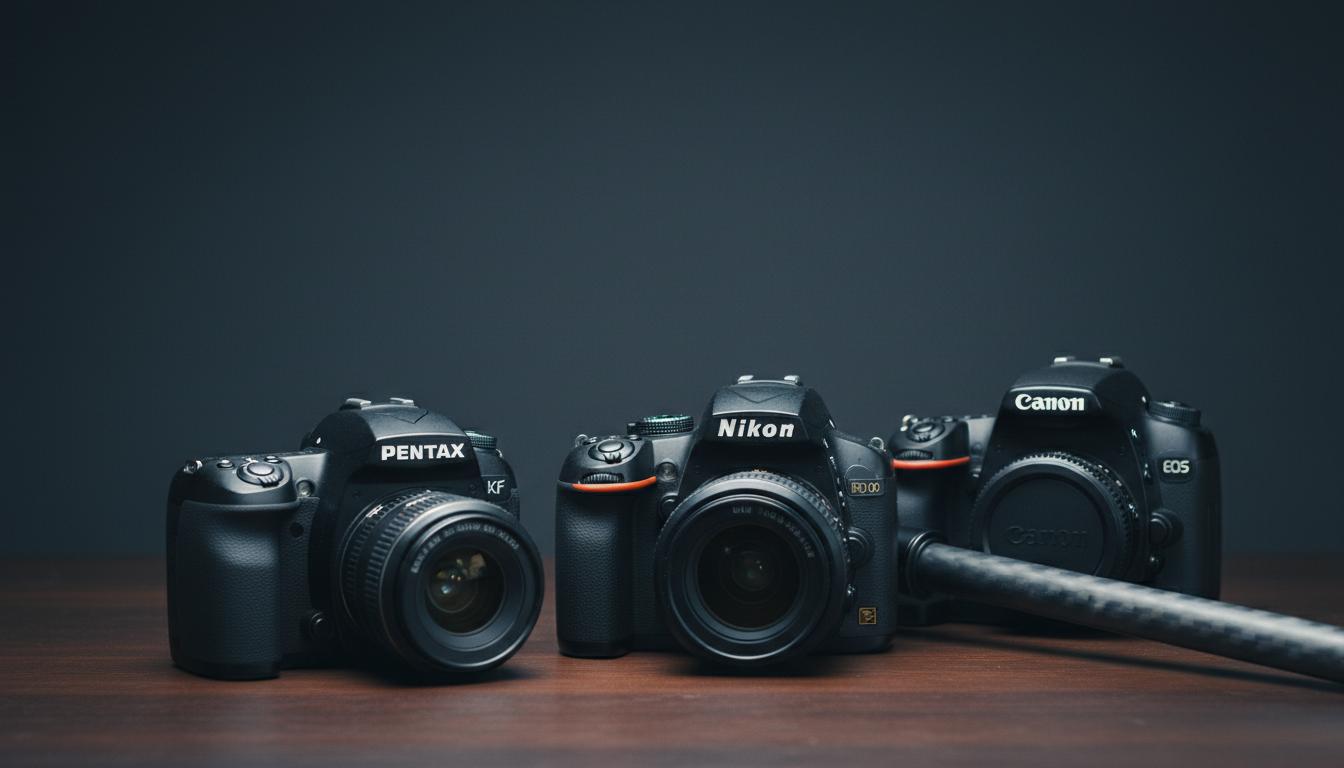
We’re looking at four DSLR cameras that cover a wide price spread—from the $196.98 Sony Alpha A200K at the budget end up to the $796.95 Pentax KF in the premium tier. All four sit comfortably in the 3‑ to 5‑star range, with the Pentax scoring a 4.7/5 from 62 reviewers and the Sony pulling a 3.9/5 from 134 voices. The lineup gives you options whether you want a lightweight starter or a rugged, weather‑sealed body for harsher conditions.
In the premium camp, the Pentax KF brings a 24.24 MP sensor, 6 fps burst shooting, and a weather‑sealed chassis that handles down‑to‑‑10 °C weather, while the Nikon D5100 offers a 16.2 MP sensor, 660+ shot battery life, and a 4 fps continuous rate for travel‑ready shooting. On the budget side, the Canon EOS Rebel T7 packs a 24.1 MP sensor, a 3.0‑inch LCD and weighs just 1.04 lb, making it easy to carry on a day trip, and the Sony A200K provides a 10.2 MP sensor, 3 fps shooting and a compact 2.7‑inch screen for those just stepping away from point‑and‑shoots.
Next, we’ll break down each model’s strengths, quirks and who will get the most mileage out of them.

Pentax KF
Its 6 fps max frame rate delivers smooth continuous shooting, reinforcing its reputation as the best‑value DSLR.
Nikon D5100
Ideal for buyers who want a proven, high‑quality DSLR, and it’s about $60 less than the Pentax KF.

Canon EOS Rebel T7
A compact 68.5 mm lens diameter (58 mm filter size) gives a smaller, lighter setup that the Pentax KF and Nikon D5100 don’t provide.
Score Analysis
Key score advantages vs. runner-up (Nikon D5100)
Price Range
Pentax KF
$796.95
Nikon D5100
$736.46
Canon EOS Rebel T7
$529.00

Sony Alpha A200K
$196.98
Spec Comparison
TL;DR: The Pentax KF packs a 24.24 MP AA‑filter‑free sensor, in‑body sensor‑shift stabilization and a 100 % optical viewfinder into a weather‑sealed DSLR that feels solid but carries a premium price tag.
What really sets the KF apart is its 24.24 MP APS‑C sensor that lacks an anti‑aliasing filter, delivering edge‑to‑edge sharpness. Coupled with sensor‑shift IBIS that offers up to 4.5 shutter‑step shake reduction, the camera can capture clean images in low light, thanks to an ISO range of 100‑102 400. The viewfinder covers the entire frame at 100 % and the 3‑inch fully articulated LCD shows 1,037,000 dots, giving you a clear preview from any angle.
Against the three other DSLR contenders, the KF leads in resolution (24.24 MP vs. 16.2 MP on the Nikon D5100 and 10.2 MP on the Sony Alpha A200K) and burst speed (6 fps versus 4 fps on the Nikon and 3 fps on the Sony). Its battery delivers about 410 CIPA‑rated shots, which's lower than the Nikon’s 660+ shots and the Canon EOS Rebel T7’s 500‑shot rating. At 625 g (about 1.38 lb), the body is heavier than the Nikon’s 560 g and Sony’s 552 g, though still lighter than the Canon’s total kit weight of 665 g.
Users consistently highlight the KF’s rugged build—dustproof and weather‑resistant down to –10 °C—as a major plus for outdoor shoots. The AA‑filter‑free sensor and in‑body stabilization earn kudos for producing highly detailed photos, especially with legacy K‑mount lenses. On the flip side, the 11‑point AF system can hunt in low light, and the camera tops out at Full HD video, lacking the 4K capability many newer models offer.
Pros
Cons
Best for: Outdoor enthusiasts, hikers, and photographers who already own Pentax K‑mount lenses and need a durable, high‑resolution DSLR.
Avoid if: You need fast continuous autofocus, 4K video, or a ultra‑light travel setup—plus the $796.95 price may feel steep for tighter budgets.
“reliable outdoor workhorse”
TL;DR: The Nikon D5100 packs a 16.2 MP APS‑C sensor, a 3‑inch vari‑angle LCD and 660‑shot battery into a lightweight 560 g body, delivering solid image quality for beginners and vloggers.
At the heart of the D5100 is a 16.2 MP APS‑C sensor paired with Nikon’s Expeed 2 processor, which reviewers note yields sharp, detailed photos even at higher ISO settings. The camera’s 3.0‑inch vari‑angle LCD offers 921,000 dots of resolution and a 170° viewing angle, so you can easily frame shots from low or high angles and review video clips on‑the‑go.
Compared with the three peers in this roundup, the D5100 weighs less than the Pentax KF (3.24 lb) and far less than the Sony Alpha A200K (4.45 lb), but it weighs a bit more than the Canon EOS Rebel T7 (1.04 lb). Its 4 fps continuous‑shooting speed sits between the Pentax’s faster 6 fps and Sony’s slower 3 fps burst rates. The D5100's battery endurance outperforms the Canon’s 500‑shot rating, with 660+ shots per charge, while the other two models don’t list a battery figure.
Professional reviewers praise the D5100’s image quality and the articulated screen, noting that the built‑in mic input makes it a strong entry‑level option for vloggers. Users echo this sentiment, highlighting the lightweight plastic body as easy to carry on travel trips, though many mention the plasticky feel and the lack of weather sealing as drawbacks. The camera’s viewfinder covers roughly 95 % of the frame and its ISO range runs from 100 to 6400 native, expandable to 12 800 (Hi‑0.3/0.7/1) and up to 25 600 boosted, giving flexibility in low‑light situations.
Pros
Cons
Best for: Beginners to intermediate photographers, travel enthusiasts, and vloggers who need a lightweight DSLR with solid image quality.
Avoid if: You need rugged, weather‑sealed construction, high‑speed burst shooting, or a professional‑grade workflow.
“Sharp images, easy handling for beginners, flip‑out screen for selfies/video, and good low‑light performance up to ISO 6400”
“Plastic build feels cheap and the autofocus is slow in live view”
TL;DR: The Canon EOS Rebel T7 packs a 24.1 MP APS‑C sensor, 920,000‑dot LCD and built‑in Wi‑Fi into a 1.04‑pound body, offering solid image quality for beginners at a modest price.
A standout spec is the 24.1 MP APS‑C CMOS sensor paired with a DIGIC 4+ processor, delivering detailed stills on a 3.0‑inch LCD that resolves 920,000 dots. The optical pentamirror viewfinder covers 95% of the frame, and the camera offers a native ISO range of 100‑6400 (expandable to 12800), giving you flexibility in low‑light situations.
Compared with its peers, the T7 is lighter than the Nikon D5100 (1.23 pounds) and far lighter than the Pentax KF (over 3 pounds) and Sony Alpha A200K (4.45 pounds). Its 500‑shot battery life trails the Nikon’s 660+ shots but matches the Sony’s unspecified endurance. Burst shooting tops out at 3 fps, which is slower than Nikon’s 4 fps and Pentax’s 6 fps, yet equal to Sony’s 3 fps. In terms of resolution, the T7’s 24.1 MP exceeds Nikon’s 16.2 MP and Sony’s 10.2 MP, and sits just shy of Pentax’s 24.24 MP.
User sentiment praises the camera’s lightweight design (475 g) and the ease of sharing photos via built‑in Wi‑Fi and NFC. Professional reviewers note the budget‑friendly price and solid image quality, while also calling out the older DIGIC 4+ processor, the modest 9‑point AF system (only one cross‑type), and the lack of 4K video or a touchscreen. The camera’s 3 fps continuous‑shooting speed and limited AF coverage can make fast‑action shooting a challenge.
Pros
Cons
Best for: Budget‑conscious buyers seeking a reliable entry‑level option
Avoid if: You need advanced features or professional‑grade performance
TL;DR: The Sony Alpha A200K packs a 10.2 MP APS‑C sensor, 3 fps burst, and 3.5‑stop sensor‑shift stabilization into a 552 g body for under $200, making it a lightweight entry‑level DSLR.
The standout feature is Sony’s Super SteadyShot sensor‑shift system, which delivers up to 3.5 stops of image stabilization—helpful for handheld low‑light shooting. Coupled with a 10.2 MP APS‑C Super HAD CCD sensor and the BIONZ image processor, the camera produces richer tones and better noise control than its predecessor.
Compared with the other three cameras in this roundup, the A200K is noticeably lighter than the Nikon D5100 (560 g) and the Pentax KF (625 g), and it also weighs less than the Canon EOS Rebel T7 kit (665 g). Its 2.7‑inch LCD (230K dots) is smaller than the 3‑inch screens on the Nikon, Canon, and Pentax models, and its 3 fps continuous‑shoot speed trails the Nikon’s 4 fps and Pentax’s 6 fps. However, the A200K’s battery can deliver roughly 750 shots per charge, outlasting the Canon’s 500‑shot rating and edging past the Nikon’s 660+ shots.
User feedback highlights the camera’s ease of handling, thanks to the sub‑600 g body and the quiet pop‑up flash. Reviewers praise the 9‑point Eye‑Start AF system for being about 40 % faster than the older A100, and they note the effective ISO range of 100‑3200 for decent flexibility in varied lighting. On the downside, many users point out the absence of live view, video recording, and a tilting screen, which limits modern shooting styles.
Pros
Cons
Best for: Entry-level buyers or those on a tight budget
Avoid if: You need advanced features or professional‑grade performance
Breakdown
Pentax KF
Pros
Cons
Nikon D5100
Pros
Canon EOS Rebel T7
Pros
Cons
Sony Alpha A200K
Pros
Cons
Based on scoring data and product specs
Personalized picks
Best Overall Pick
Pentax KF
Best ValueBest for: Audiophiles and enthusiasts seeking premium sound quality and advanced features
Nikon D5100
Best for: Buyers willing to invest in a proven, high-quality option
$736.46-$60.49 vs winner
Skip Sony Alpha A200K if…
You need advanced features or professional-grade performance
The Pentax KF takes the top spot thanks to its 24.24 MP effective sensor paired with an expansive ISO range of 100‑102400, giving you plenty of flexibility in low‑light situations. It also offers in‑body sensor‑shift stabilization and a fast 6 fps burst rate, while the fully articulated 3‑inch LCD (1,037,000‑dot) and 100 % pentaprism viewfinder make composition easy. With a 410‑shot CIPA‑rated battery and a solid 4.7‑star rating from 62 reviewers, it delivers strong value at $796.95.
The Nikon D5100 lands as the runner‑up, especially if you need a versatile entry‑level DSLR that handles both stills and video. It provides a 660‑plus‑shot battery life, 4 fps continuous shooting, and 1080p video recording, all shown on a vari‑angle 3‑inch screen with 921,000 dots. Its 11‑point AF system (including a cross‑type center sensor) and ISO range up to 6,400 native (expandable to 25,600) make it a solid choice for everyday shooting at $736.46.
Pick the Pentax KF if you’ve decided the group’s highest‑resolution sensor and fastest 6 fps burst rate are what you need, and start shooting today.
The Pentax KF is the only model that lists dustproof and weather‑resistant construction, making it the best choice for harsh conditions. The other three cameras (Nikon D5100, Canon EOS Rebel T7, Sony Alpha A200K) do not mention weather sealing.
No reviews yet — be the first to share your experience.
Please sign in to leave a review