If you want a tablet that blends AI‑driven transcription with a truly paper‑like feel, the Iflytek AINOTE Air 2 is hard to ignore. Priced at $499.00, it carries a solid 4.0‑star rating from 351 reviewers, an 8.2‑inch 293 PPI E‑Ink screen and a feather‑light 230 g chassis that slides into any bag. Its real‑time voice‑to‑text in up to 17 languages and 4,096‑level pressure stylus make it a compelling choice for multilingual professionals and students on the move.
Eight contenders span three price tiers. The budget tier offers the Geniatech Paperwhite at $279.99, the Kobo Elipsa 2E at $399.99, and the Amazon Kindle Scribe at $449.99, each delivering solid 300 PPI displays and ratings between 3.8 and 4.4 stars. Mid‑range picks include the Iflytek AINOTE Air 2 and the reMarkable 2 (both $499.00) with larger screens and premium build quality. The premium tier pushes up to $679.99 with the Kindle Scribe Colorsoft Fig, PocketBook InkPad Eo and VIWOODS AiPaper, all boasting color‑capable or ultra‑thin displays, higher battery capacities and richer stylus features.
The next section breaks down each tablet’s screen, battery life and stylus performance, helping you match the right device to your note‑taking workflow.
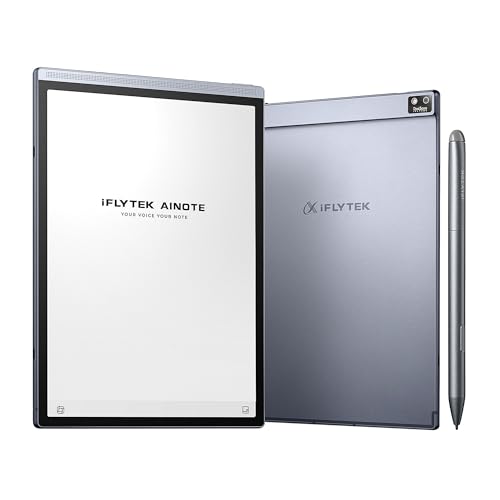
Iflytek AINOTE Air 2
Its 2600 mAh battery supports all‑day note‑taking, matching its premium feature set.

reMarkable 2
Ideal for users who value a proven brand and strong community support, it matches the $499 price of the Best Overall.

Amazon Kindle Scribe
Stands out with a feather‑light 14 g basic stylus and a $449.99 price tag, offering a lighter writing feel and a lower entry cost than the other two.
Also considered
Score Analysis
Key score advantages vs. runner-up (reMarkable 2)
Price Range
Iflytek AINOTE Air 2
$499.00
reMarkable 2
$499.00
Amazon Kindle Scribe
$449.99

Amazon Kindle Scribe Colorsoft Fig
$679.99
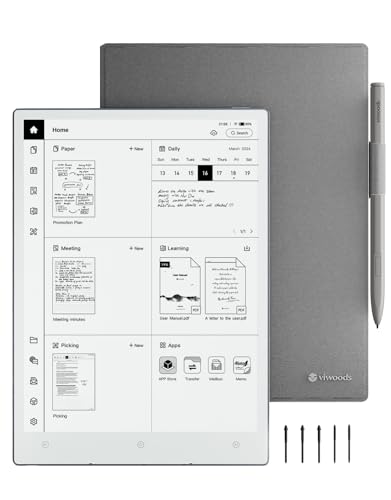
VIWOODS AiPaper
$549.99

PocketBook InkPad Eo
$499.00
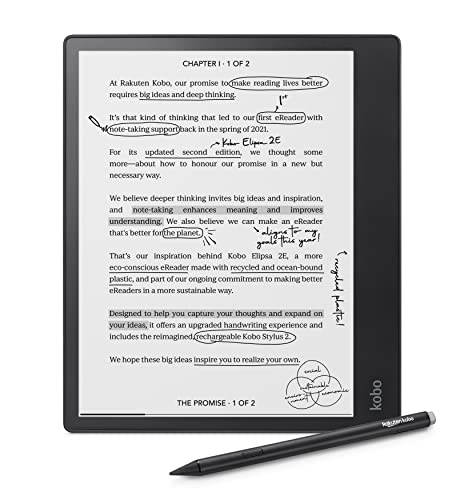
Kobo Elipsa 2E
$399.99

Geniatech Paperwhite
$279.99
Spec Comparison
TL;DR: The iFLYTEK AINOTE Air 2 packs an 8.2‑inch 293 PPI E‑Ink display, AI‑driven transcription and a 4,096‑level stylus into a feather‑light 230 g metal body, but its small screen and modest 2600 mAh battery may limit heavy‑duty use.
What really sets the AINOTE Air 2 apart is its built‑in ChatGPT AI integration, which powers real‑time voice transcription in 15‑17 languages and handwriting conversion for 83‑85 languages. The tablet also offers 4,096 pressure‑sensitive levels on a Wacom‑compatible stylus, delivering a paper‑like feel that reviewers call it “best in class.” Its 8.2‑inch E‑Ink panel delivers a crisp 293 PPI, and the device runs on a quad‑core 1.8 GHz CPU with 4 GB RAM and 32 GB internal storage.
Compared with the seven other tablets in this roundup, the Air 2 is the lightest at 230 g (0.51 pounds), noticeably lighter than the reMarkable 2, PocketBook InkPad Eo, Kindle Scribe, Kobo Elipsa 2E, Kindle Scribe Colorsoft and Geniatech Paperwhite. Its screen, however, ranks as the smallest—8.2 inches versus the 10‑plus‑inch displays of the competition—making large PDFs feel cramped. The 2600 mAh battery is also modest; peers such as the reMarkable 2 (5,030 mAh) and PocketBook InkPad Eo (4,000 mAh) offer larger capacities.
User sentiment highlights the tablet’s ultra‑portable metal chassis, the convenience of unlimited cloud backup, and the accuracy of AI transcription. Professional reviewers applaud the AI features and the tactile stylus, while everyday users love the “smooth unboxing” and the 24‑level front‑light. The most common complaints focus on the quick battery drain during Wi‑Fi use, the slim stylus grip that can slip, and the limited screen real estate for detailed document work.
The device rounds out its feature set with Wi‑Fi 6, Bluetooth 5.0, four microphones, a built‑in speaker, a rear 5 MP camera, and 24 reading‑light levels. The manufacturer lists all‑week battery life under typical note‑taking, though heavy AI or Wi‑Fi usage shortens that span.
Pros
Cons
Best for: Professionals who need real‑time multilingual transcription and AI‑enhanced note‑taking in a highly portable package.
Avoid if: You rely heavily on large‑format PDF annotation, need extended battery life without frequent charging, or prefer a larger screen for detailed work.
“nice portable size”
“smooth unboxing”
TL;DR: The reMarkable 2 offers an 11.8‑inch color Canvas E Ink screen with 20,000 colors, a 12 ms latency pen experience, and up to two weeks of battery life, but its 3.09‑lb weight makes it less portable than many rivals.
The standout hardware feature is the 11.8‑inch Canvas Color E Ink display, delivering 20,000 colors at 229 PPI and a 12 ms writing latency. The tablet’s textured glass surface and the included Marker Plus stylus aim to replicate the feel of real paper, while an adjustable front reading light cuts glare by about 15 %.
Compared with the seven other tablets in this roundup, the reMarkable 2’s screen is noticeably larger than the 8.2‑inch Iflytek AINOTE Air 2 and the 10.2‑inch Amazon Kindle Scribe, and its 5,030 mAh battery outpaces the 2,600 mAh battery in the Iflytek and the 4,000 mAh battery in the PocketBook InkPad Eo. However, at roughly 3.09 pounds, it’s heavier than the Kindle Scribe (0.95 lb), Kobo Elipsa 2E (0.85 lb), and the ultra‑light Iflytek (0.51 lb), which may affect one‑handed use on the go.
User sentiment repeatedly praises the natural writing feel and the long‑lasting battery, with many noting the device feels “like real paper.” Professional reviewers highlight the split‑screen mode for simultaneous document review and note‑taking, and they commend its low‑latency, paper‑like experience. Common complaints note the tablet’s heft, the 90‑minute charge time needed to reach 90 % capacity, and the limited software ecosystem that lacks a full web browser.
The reMarkable runs a Linux‑based OS, packs a 1.8 GHz processor, 2 GB LPDDR4 RAM, and supports handwriting‑to‑text conversion. Connectivity includes USB 2.0 Type‑C and dual‑band Wi‑Fi (2.4 GHz and 5 GHz). Nine built‑in writing tools give flexibility for sketches and annotations.
Pros
Cons
Best for: Professionals, students and creatives who want a distraction‑free, high‑quality digital notepad with a large color E Ink screen.
Avoid if: You prioritize ultra‑light portability, need a full web browser, or are looking for a lower‑cost, basic e‑ink device.
“like real paper”
TL;DR: The Kindle Scribe packs a 10.2‑inch 300 ppi glare‑free E Ink screen, battery‑free EMR stylus and up to 12 weeks of reading time in a solid 0.95‑lb, 64 GB device.
The standout feature is the 10.2‑inch, 300 ppi E Ink display that rivals paper with its glare‑free frontlight and 35 LEDs offering warm and cool tone adjustments. Coupled with a battery‑free EMR stylus that feels “paper‑like,” the device also promises 12 weeks of reading battery life and 3 weeks of writing battery life, all backed by 64 GB of internal storage for massive ebook and PDF libraries.
At 0.95 lb, the Scribe is lighter than the reMarkable 2’s 3.09 lb frame but heavier than the Iflytek AINOTE Air 2’s 0.51 lb build and the Kobo Elipsa 2E’s roughly 0.85 lb chassis. Its 10.2‑inch screen sits between the 8.2‑inch display of the AINOTE Air 2 and the 11.8‑inch panel of the reMarkable 2, while offering a higher resolution than the reMarkable’s 229 ppi and matching the PocketBook InkPad Eo’s 300 ppi grayscale sharpness.
Reviewers love the realistic feel of the EMR stylus and the ample storage, but they note that the screen can flex under heavy pressure and that you can't disable auto‑rotation, which can be annoying during note‑taking. Professionals point out the lack of disclosed CPU or RAM details, leaving performance expectations a bit vague.
Additional technical touches include an IPX8 waterproof rating, Bluetooth support, a USB‑C port, and an auto‑rotation sensor that flips the screen orientation automatically. The device’s sleek tungsten finish adds a premium look while keeping the footprint compact at 230 mm × 196 mm × 5.8 mm.
Pros
Cons
Best for: Readers, students or professionals who want a large, high‑resolution E Ink canvas for note‑taking and PDF annotation without worrying about frequent charging.
Avoid if: You need an ultra‑light device under 200 g, a lockable rotation feature, or a tablet with a more rigid screen for heavy stylus use.
TL;DR: The Kindle Scribe Colorsoft Fig offers an 11‑inch color e‑paper display, 64 GB storage, and an included Premium Pen, but its $679.99 price makes it a premium‑tier option.
The standout feature is the 11.01‑inch Colorsoft oxide‑based e‑paper screen with Kaleido 3 technology, delivering 300 PPI in black‑and‑white and 150 PPI in color. It ships with 64 GB of internal storage and a magnetic Premium Pen that never needs charging, complete with a customizable shortcut button and a screen‑sensitive eraser tip.
Compared with the other seven tablets, the Kindle Scribe is thicker than the VIWOODS AiPaper’s 4.5 mm design and the reMarkable 2’s 4.7 mm profile, while its 5.4 mm thickness sits between those and the slimmer 5.3 mm height listed for the device itself. It weighs 0.866 lb (400 g), making it lighter than the reMarkable 2’s 1400 g chassis but heavier than the Iflytek AINOTE Air 2’s 230 g and slightly heftier than the Kobo Elipsa 2E’s 386 g. Its dimensions (244 mm × 188 mm × 5.4 mm) give it a larger footprint than the VIWOODS AiPaper’s 177.8 mm length, yet it remains comparable to the PocketBook InkPad Eo’s 226 mm height.
Professional reviewers praise the paper‑like writing feel, low parallax and high friction of the Premium Pen, while noting the ultra‑thin bezels can lead to accidental taps and occasional smudging for users with larger hands. Reviewers highlight the adjustable warm front light and custom processor for smooth PDF markup and AI notebook features. The device delivers up to 8 weeks of reading and up to 2 weeks of daily 30‑minute writing sessions, all charged via a USB‑C port.
Pros
Cons
Best for: Those prioritizing quality and willing to pay for premium performance
Avoid if: You're shopping on a tight budget — it's priced at $679.99
TL;DR: The VIWOODS AiPaper packs a 300 PPI 1065.0‑in e‑ink display, 960 Hz stylus and Android 13 into a 4.5 mm, 370 g tablet, but it carries a premium $549.99 price tag.
The standout spec is the 300 PPI Carta 1300 screen, which the manufacturer lists as a 1065.0‑in panel, paired with a 0.75 mm pen‑to‑ink distance and a 960 Hz stylus report rate. Those numbers give you text at 300 PPI and a lag‑free writing feel that rivals many larger e‑ink devices.
At 370 g, the AiPaper is lighter than the reMarkable 2 (≈3.09 lb) and PocketBook InkPad Eo (≈1.04 lb) but a bit heavier than the Iflytek AINOTE Air 2 (0.51 lb). Its 4.5 mm thickness undercuts the reMarkable 2’s 4.7 mm and Kindle Scribe’s 5.8 mm, making it one of the thinnest in the group. Battery capacity sits at 4100 mAh, beating the Iflytek’s 2600 mAh and Kobo Elipsa 2E’s 2400 mAh, while falling short of the reMarkable’s 5,030 mAh. The 300 PPI display also outperforms the reMarkable’s 229 PPI and matches the Kindle Scribe’s 300 PPI, giving it a visual edge over several peers.
Professional reviewers highlight the sharp visuals and the flexibility of Android 13 with Google Play Store access, noting that you can run a full suite of note‑taking apps. Everyday users call the device “brilliant” after software updates, praising the metal back and ample 128 GB storage. The main criticisms focus on a chassis that feels less solid than rivals and slight edge‑to‑edge thickness variation, which some reviewers say detracts from the premium feel.
Under the hood, the tablet runs an octa‑core MediaTek MT8183 at 2.0 GHz, coupled with 4 GB LPDDR4X RAM and 128 GB eMMC storage. Bluetooth 5.0 and Wi‑Fi 802.11 a/b/g/n/ac round out the connectivity, while the included W2 Stylus Pro weighs just 16 g and offers a customizable button for quick shortcuts.
Pros
Cons
Best for: Mobile professionals, students and frequent travelers who need an ultra‑thin, lightweight e‑ink tablet with a high‑frequency stylus and full Android app support.
Avoid if: You prioritize maximum build rigidity or are shopping on a tight budget — it’s priced at $549.99.
“"Brilliant" after software updates (best e‑ink owned)”
TL;DR: The PocketBook InkPad Eo offers a 10.3‑inch Kaleido 3 color E‑ink screen, octa‑core 2.3 GHz processor, 4 GB RAM and 64 GB storage, but its $499 price and 470 g weight make it a premium, heftier option.
The standout feature is the 10.3‑inch E Ink Kaleido 3 color display, delivering 300 PPI grayscale sharpness and 4096‑color RGB depth, complemented by SMARTlight front‑light that lets you adjust brightness and color temperature. Under the hood sits an octa‑core 2.3 GHz Mediatek MT8768 processor, 4 GB RAM and 64 GB internal storage (expandable via microSD), all running Android 11 with full Google Play access.
Compared with the seven other e‑note tablets, the InkPad Eo is heavier than the Iflytek Air 2 (0.51 lb) and Kindle Scribe (0.95 lb) but lighter than the reMarkable 2 (3.09 lb). Its 4000 mAh battery outpaces the Air 2’s 2600 mAh and sits just below the reMarkable 2’s 5030 mAh, while matching the 4100 mAh packs in the Viwoods AiPaper and Geniatech Paperwhite. The 10.3‑inch screen is larger than the Air 2’s 8.2 inches, on par with the Kindle Scribe’s 10.2 inches and Kobo Elipsa 2E’s 10.3 inches, and a touch smaller than the reMarkable 2’s 11.8 inches. Its 300 PPI grayscale matches the Viwoods AiPaper and Kindle Scribe Colorsoft Fig, and the 150 PPI color panel aligns with the Colorsoft Fig’s color resolution.
Professional reviewers note the crisp Kaleido 3 panel and the smooth performance of the octa‑core CPU and 4 GB RAM for handwriting and app use. Consumers note the device feels bulkier than slimmer rivals and point out the lack of any waterproof rating, which limits use near water. The built‑in front‑facing camera, four microphones and stereo speakers add versatility for document capture and media playback, while the Wacom stylus support ensures precise input.
Pros
Cons
Best for: Those prioritizing quality and willing to pay for premium performance
Avoid if: Reliability and user satisfaction are your top concerns
TL;DR: The Kobo Elipsa 2E offers a 10.3‑inch E Ink Carta 1200 display, a 2.0 GHz dual‑core processor, and a lightweight 0.85‑lb design, making it a solid note‑taking e‑reader for students and professionals.
The standout feature of the Elipsa 2E is its large 10.3‑inch E Ink Carta 1200 touchscreen with a 1404 × 1872‑pixel resolution. Powered by a dual‑core 2.0 GHz MediaTek RM53 processor and 1 GB of RAM, the device handles PDF annotation and e‑book navigation without noticeable lag, according to professional reviewers who note a 45 % faster single‑core speed over previous models.
Compared with the other seven tablets in this roundup, the Elipsa 2E sits near the middle of the size spectrum: its screen is a fraction larger than the Kindle Scribe’s 10.2‑inch panel and matches the PocketBook InkPad Eo’s 10.3‑inch size, while the reMarkable 2 sports a bigger 11.8‑inch display. At 0.85 lb (0.85125 pounds), it's lighter than the Kindle Scribe (0.95 lb) and the reMarkable 2 (3.09 lb), but it's heavier than the Iflytek AINOTE Air 2 (0.51 lb) and the VIWOODS AiPaper (0.87 lb). Storage-wise, it offers 32 GB onboard, which is less than the Kindle Scribe’s 64 GB but matches the Iflytek and Geniatech models.
User sentiment highlights the generous 10.3‑inch glare‑free surface and the ComfortLight PRO system with adjustable white and amber LEDs as major comforts for long study sessions. Reviewers also praise the included Kobo Stylus 2, which is 25 % lighter than its predecessor and features a dedicated eraser. On the downside, customers point out the limited audiobook ecosystem—Kobo Audiobooks only—and the modest 1 GB of RAM, which can feel restrictive when juggling large PDFs or multiple note‑taking apps. Users report the 2400 mAh battery lasts several weeks, reinforcing the device’s suitability for on‑the‑go professionals.
Pros
Cons
Best for: Academic and professional note‑takers, large‑format readers, and hybrid reader/writer users who value a big, glare‑free screen and a comfortable stylus.
Avoid if: You want the best value‑per‑dollar in its price range or need a broader audiobook ecosystem.
“massive upgrade”
“solid iteration over its predecessor in the plus-sized eReader segment”
TL;DR: The Geniatech Paperwhite offers a 9.7‑inch e‑ink glass display, 4096‑level pressure stylus and 40‑hour battery for $279.99, making it a budget‑friendly note‑taking tablet with solid Android flexibility.
The standout hardware is its 9.7‑inch e‑ink glass screen at 150 dpi and a native resolution of 1200×825, paired with a 4096‑level pressure‑sensitive electromagnetic stylus. Under the hood sits a quad‑core Cortex‑A35 processor clocked at 1.5 GHz, 2 GB of LPDDR4 RAM and 32 GB of eMMC storage. The device weighs about 0.93 pounds (420 g) and houses a 4100 mAh battery; the manufacturer says it lasts up to 40 hours.
Compared with the other seven tablets, the Paperwhite is slightly heavier than the Kobo Elipsa 2E (≈0.85 lb) but a touch lighter than the Amazon Kindle Scribe (≈0.95 lb) and far lighter than the reMarkable 2 (≈3.09 lb). Its battery capacity of 4100 mAh exceeds the Kobo’s 2400 mAh and the Iflytek AINOTE Air 2’s 2600 mAh, and it tops the PocketBook InkPad Eo’s 4000 mAh, matching the VIWOODS AiPaper. The 9.7‑inch screen is smaller than the Kobo’s 10.3‑inch and Kindle’s 10.2‑inch panels, but larger than the Iflytek’s 8.2‑inch display. With 2 GB of RAM, it sits between Kobo’s 1 GB and the 4 GB found in both Iflytek and PocketBook models. Storage-wise, it aligns with Kobo and Iflytek at 32 GB, though it offers less than the Kindle’s 64 GB.
Professional reviewers praise the paper‑like feel of the 4096‑level stylus and note the tablet’s smooth, low‑lag annotation experience. Users repeatedly mention the eye‑friendly, glare‑free screen as a major plus for long reading or study sessions. However, the lack of a built‑in backlight means you’ll need external lighting in dim environments, and several reviewers flag occasional misalignment when zooming PDFs. The Android 8.1 operating system limits the app ecosystem to roughly 20 usable apps, which some users find restrictive for multitasking.
Beyond the display, the Paperwhite includes dual microphones, a single speaker, Wi‑Fi 2.4 GHz + 5 GHz, Bluetooth 4.2 and a USB‑C port that supports OTG and audio output. It ships with 39 pre‑set note templates, voice recording with speech‑to‑text conversion, and cloud sync for Google Drive, Dropbox and OneDrive.
Pros
Cons
Best for: Entry-level buyers or those on a tight budget
Avoid if: You want the best value‑per‑dollar in its price range
“Excellent experience, running very smooth”
“Good for annotations/PDFs”
Breakdown
Iflytek AINOTE Air 2
Pros
reMarkable 2
Pros
Amazon Kindle Scribe
Pros
Amazon Kindle Scribe Colorsoft Fig
Pros
Cons
Based on scoring data and product specs
Personalized picks
Best Overall Pick
Iflytek AINOTE Air 2
Best OverallBest for: Those prioritizing quality and willing to pay for premium performance
reMarkable 2
Best for: Buyers willing to invest in a proven, high-quality option
$499.00
Skip Geniatech Paperwhite if…
You want the best value-per-dollar in its price range
The Iflytek AINOTE Air 2 takes the top spot thanks to its crisp 8.2‑inch E‑Ink panel at 293 PPI, a 32 GB storage capacity paired with 4 GB RAM, and all‑week battery life from a 2600 mAh cell. It also packs a Wacom‑compatible stylus with 4096 pressure levels and AI‑powered ChatGPT integration, making note‑taking feel both fluid and smart. At $499.00 and a 4.0‑star rating from 351 reviewers, it balances performance and price nicely.
ReMarkable 2 lands as the runner‑up, ideal if you need a larger writing surface for detailed sketches or extensive document review. Its 11.8‑inch Canvas Color E‑Ink display offers 229 PPI and a 12 ms latency, while the 5,030 mAh battery promises up to two weeks of use. With a 4.3‑star rating from 1,427 reviewers, it’s a solid choice for creators who value a spacious canvas.
Pick the Iflytek AINOTE Air 2 today and enjoy a premium note‑taking tablet that won’t break the bank.
The Iflytek AINOTE Air 2’s 293 PPI 8.2‑inch display and metal body give it strong contrast in bright conditions, while the reMarkable 2 adds a 15 % glare‑reduction coating on its larger 11.8‑inch screen. Both are good outdoors, but the Air 2’s higher pixel density and AI‑driven features give it a slight edge.
No reviews yet — be the first to share your experience.
Please sign in to leave a review
