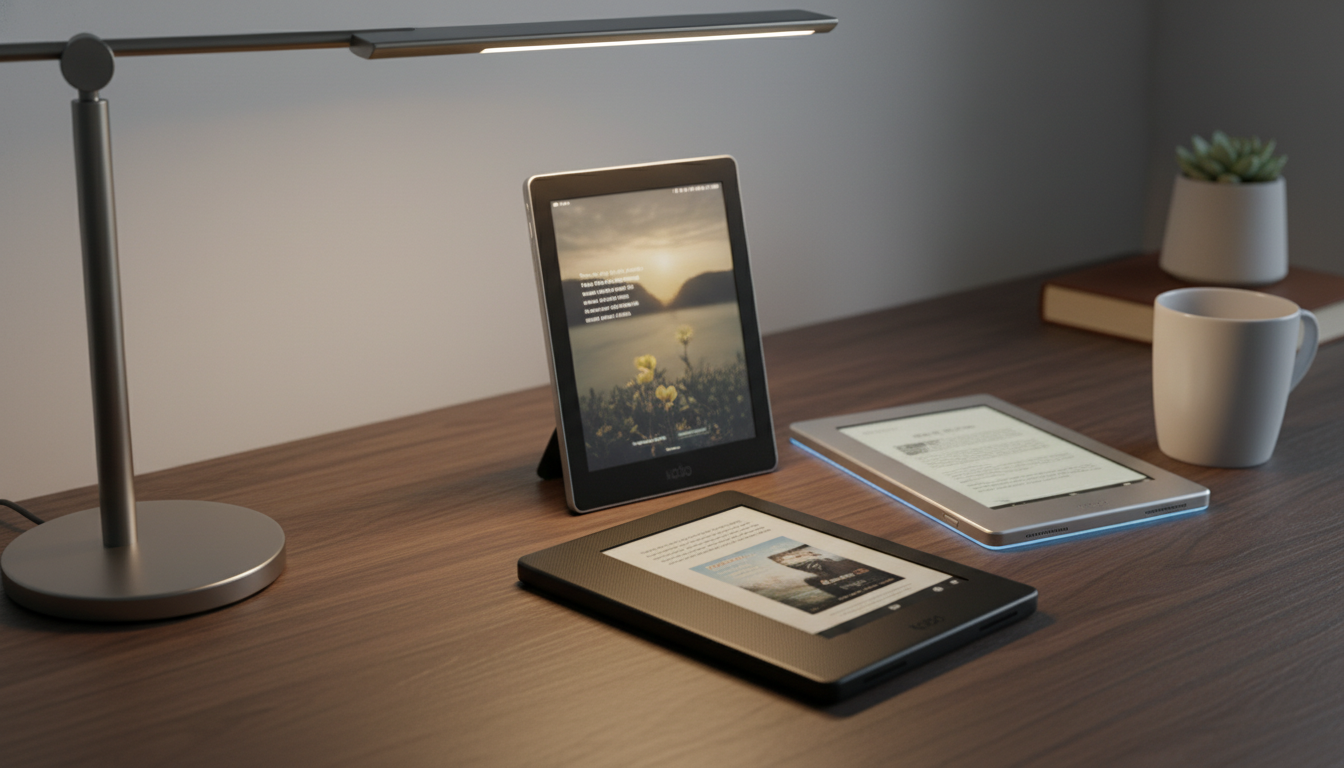
Choosing an e‑ink tablet with an adjustable front light can feel overwhelming, especially when the market now offers everything from pocket‑sized 6‑inch readers to 10‑inch note‑taking tablets. In this roundup we examined 12 options, sorting them into three price tiers: budget picks like the Kobo Clara BW at $139.99 and PocketBook Verse, mid‑range choices such as the PocketBook Era Stardust Silver for $249.00, and premium models including the PocketBook InkPad Color 3 at $345.00.
All the devices support front‑light tweaking, but they differ in screen size, battery capacity and extra features. The budget‑friendly Kobo Clara BW packs a 6‑inch E Ink display, weighs just 174 g, and holds a 4.4‑star rating from over 2,100 reviewers. Mid‑range contenders add larger 7‑inch panels and Bluetooth audio, while premium options bring color Kaleido displays, stylus support and up to 64 GB storage. We’ll break down each model’s strengths, drawbacks and ideal use‑cases so you can match a tablet to your reading habits.

Kobo Clara BW
Its ultra‑thin 9.2 mm profile keeps it lightweight and easy to hold, delivering solid value at $139.99.

PocketBook Era Stardust Silver
Ideal for avid readers who want a larger 7‑inch display, it retails at $249, about $109.01 more than the $139.99 Kobo Clara BW, making it a solid mid‑range choice.
PocketBook InkPad Color 3
With a 2900 mAh battery, the InkPad Color 3 outlasts the others, justifying its $345 price for users who demand premium endurance.
Also considered
Score Analysis
Key score advantages vs. runner-up (PocketBook Era Stardust)
Price Range
Kobo Clara BW
$139.99
PocketBook Era Stardust Silver
$249.00
PocketBook InkPad Color 3
$345.00

Onyx Go 7
$269.99

Bigme B6 Color
$184.97

PocketBook Verse Pro Color
$179.00

PocketBook Verse
$139.00

PocketBook InkPad Eo
$499.00
Kobo Elipsa 2E
$399.99

Amazon Kindle Scribe
$449.99

PocketBook InkPad 4
$299.00

Ashata Paperwhite
$104.53
Spec Comparison
TL;DR: The Kobo Clara BW offers a crisp 6‑inch 300 PPI E Ink Carta display, IPX8 waterproofing and Bluetooth audiobooks at a $139.99 price point, making it a lightweight, budget‑friendly e‑reader.
The standout feature is its 6‑inch E Ink Carta 1300 HD screen with 300 PPI density and ComfortLight PRO, which lets you adjust brightness while cutting blue light. The device also carries an IPX8 rating, so it survives a 60‑minute submersion to 2 m.
At 0.38375 pounds (174 g), the Clara BW is lighter than the PocketBook Verse (0.75 lb) and PocketBook Verse Pro Color (0.77 lb), and it matches the Bigme B6’s 176 g weight. Its 6‑inch screen is the same size as those two rivals but smaller than the 7‑inch displays on Ashata Paperwhite, PocketBook Era Stardust Silver and Onyx Go 7. The 300 PPI panel out‑shines PocketBook Verse’s 212 PPI, while the 1500 mAh battery matches the Verse but is modest compared with the 2300 mAh packs in Ashata, Bigme B6 and Onyx Go 7. Memory and storage sit at 512 MB RAM and 16 GB internal, matching the Verse Pro’s 1 GB RAM but falling short of the 4 GB found in Ashata and Onyx.
Reviewers praise the Clara BW’s featherlight feel and glare‑free readability in bright sunlight, noting the waterproof build and Bluetooth audiobook support as real‑world conveniences. Professional reviewers also highlight that the MediaTek MT8113L 1 GHz processor enables faster page turns. Users note the lack of tactile page‑turn buttons and a front‑light that can drain the modest 1500 mAh battery faster than expected.
Pros
Cons
Best for: Budget-conscious buyers seeking a reliable entry-level option
Avoid if: You need a color display for comics or manga, or you rely heavily on front‑light or audiobook playback
TL;DR: The PocketBook Era Stardust Silver offers a 7‑inch 300 ppi Carta 1200 display with SMARTlight, IPX8 waterproofing, and 1700 mAh battery, all wrapped in a sleek 228 g package.
The standout feature is its 7‑inch E Ink Carta 1200 screen delivering 300 ppi sharpness, paired with SMARTlight that lets you adjust both brightness and color temperature. A flush glass panel provides anti‑scratch protection, while physical side buttons and a built‑in mono speaker round out the reading experience. It carries an IPX8 rating, meaning it can survive up to 2 meters of water for an hour.
At 228 g, the Era is heavier than the 195 g Onyx Go 7 but lighter than the 265 g PocketBook InkPad 4 and considerably lighter than the 349 g Verse Pro Color and 420 g InkPad Color 3. Its 1 700 mAh battery sits between the 2,300 mAh of the Onyx Go 7 and the 2,900 mAh found in the InkPad 4, offering respectable endurance without matching the longest‑lasting models. It comes with a fixed 16 GB of storage, which is less than the 64 GB internal of the Onyx Go 7 and the expandable options of the InkPad 4, so you’ll need to manage your library carefully.
Professional reviewers praise the razor‑sharp fonts and the 15 % higher contrast of the Carta 1200 panel, calling the reading experience “glorious.” They also note the dual‑core 1 GHz processor and 1 GB RAM deliver smooth page turns, and they appreciate the inclusion of Bluetooth 5.1, a USB‑C port, and Text‑to‑Speech in 26 languages. Users enjoy the ergonomic side buttons and the G‑sensor that auto‑rotates the screen for one‑handed comfort on the commute.
Pros
Cons
Best for: Most users seeking a balanced, mainstream option
Avoid if: You need advanced features or professional‑grade performance
“Good e-Reader's hands‑on review praises the "razor sharp" 300 ppi fonts for a "glorious" experience, flush glass screen with anti‑scratch protection, fast dual‑core 1 GHz processor and 1 GB RAM, USB‑C, Bluetooth 5.1 audio, and TTS in 26 languages; notes confident durability for active use and two color/storage variants.”
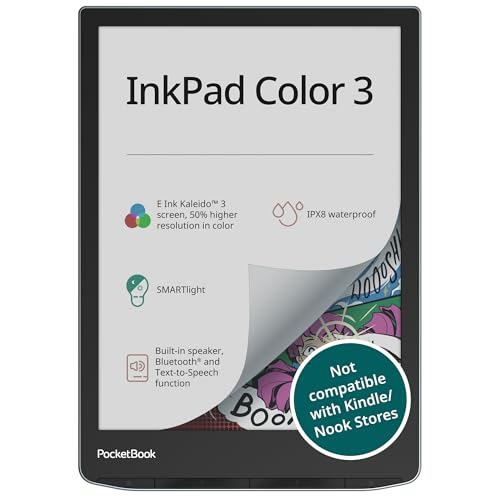
TL;DR: The PocketBook InkPad Color 3 packs a 7.8‑inch 4,096‑color E Ink Kaleido 3 screen, IPX8 waterproofing and a 30‑day battery life into a 0.93‑lb device, but it lacks expandable storage and high‑end performance.
The headline feature is its 4,096‑color E Ink Kaleido 3 display, paired with SMARTlight that lets you adjust color temperature. At 7.8 inches, the screen offers a comfortable reading area for comics and manga, and the 150 PPI color density delivers vivid hues while still providing 300 PPI in monochrome mode.
Compared with the other eleven entries, the InkPad Color 3 is heavier than the PocketBook InkPad 4 (265 g) and Kobo Elipsa 2E (386 g) but lighter than the PocketBook InkPad Eo (470 g). Its 2900 mAh battery matches the InkPad 4 and exceeds the Kobo Elipsa 2E (2400 mAh) and Onyx Go 7 (2300 mAh). The 7.8‑inch panel is the same size as the InkPad 4, larger than the Onyx Go 7’s 7‑inch screen, yet smaller than the 10‑plus‑inch displays on the Kobo Elipsa 2E and Kindle Scribe. Unlike the Onyx Go 7, this model has no microSD slot, so the built‑in 32 GB storage is the maximum you’ll get.
Users consistently praise the accurate color reproduction for illustrated books, the IPX8 waterproof rating, and the long‑lasting battery that can stretch up to a month between charges. Professional reviewers note the same strengths but flag the modest 1 GB RAM and 1.8 GHz quad‑core processor as limiting for anything beyond basic reading. The recessed screen design also draws comments about ergonomics, and heavy collectors frequently complain about the lack of a microSD slot.
Beyond the display, the device supports EPUB, PDF, JPEG, BMP, PNG and TIFF files, and comes with a suite of built‑in apps such as a browser, dictionary, notes and games. Cloud sync works with PocketBook Cloud, ReadRate, Dropbox and Send‑to‑PocketBook, and you can choose from 11 pre‑installed languages plus 42 downloadable packs. Connectivity includes Bluetooth, dual‑band Wi‑Fi and a USB‑C charging port, while the IPX8 rating means it’ll survive accidental splashes.
Pros
Cons
Best for: Comic and manga fans who want accurate color on a waterproof, long‑lasting e‑reader.
Avoid if: You need high‑performance hardware, expandable storage, or a tablet‑level multimedia experience.
“If you only use the ereader to read books, comics or manga, then I think this is a better buy”
TL;DR: The Onyx Go 7 packs a 7‑inch 300 PPI E‑Ink display, Android 13, 4 GB RAM and a 195 g chassis for under $300, delivering sharp text in a feather‑light package.
The Go 7’s standout feature is its 300 PPI monochrome E‑Ink Carta 1300 screen, which delivers paper‑like clarity on a 7‑inch panel. Powered by a Snapdragon 750G octa‑core processor and 4 GB of RAM, the tablet runs Android 13 with full Google Play access, and its 2,300 mAh battery keeps the device running through extended reading sessions.
At 195 g, the Go 7 is lighter than the PocketBook Era Stardust Silver (228 g) and the InkPad 4 (265 g), yet a touch heavier than the Bigme B6 Color (176 g) and Kobo Clara BW (174 g). Its 7‑inch screen matches the Era Stardust but is larger than the 6‑inch displays on the Bigme B6 and Kobo Clara, while falling short of the 7.8‑inch panels on the InkPad 4 and InkPad Color 3. Battery capacity sits between the Era Stardust’s 1,700 mAh and the InkPad 4’s and InkPad Color 3’s 2,900 mAh, offering a solid middle ground. With 4 GB RAM and 64 GB internal storage (46 GB usable), it outstrips the 1 GB RAM and 16‑32 GB storage of most peers, and its microSD slot supports up to 1 TB for massive libraries.
Reviewers consistently praise the Go 7’s feather‑light feel and razor‑sharp text, noting that the adjustable white‑and‑amber front light lets you fine‑tune color temperature for day or night reading. Professionals highlight its value‑for‑money proposition under $300 and the convenience of Android’s app ecosystem. However, users frequently mention that the 7‑inch display feels cramped for full‑page PDFs or academic papers, and the single built‑in speaker delivers modest audio, which can be a drawback for podcasts or audiobooks. The plastic casing, while sturdy, doesn't have the premium heft of higher‑end e‑ink tablets.
Beyond the display, the Go 7 offers Bluetooth 5.1, a USB‑C port with OTG support, and a suite of supported formats ranging from EPUB to PDF and MP3. The device’s G‑sensor and Hall‑Effect sensor enable auto‑orientation, and the built‑in microphone adds basic voice interaction capabilities.
Pros
Cons
Best for: Casual readers, commuters and travelers who want a portable, distraction‑free device for novels, news and lightweight apps.
Avoid if: You need a larger screen for PDFs, academic papers, or high‑fidelity audio playback.
TL;DR: The Bigme B6 Color packs a 6‑inch Kaleido 3 color E Ink screen, Android 14, 4 GB RAM and 36 adjustable front‑light levels into a lightweight 176 g device for around $185.
The standout feature is the adjustable‑temperature front‑light with 36 brightness levels, letting you shift from a warm reading glow to a cool workspace feel on the 6‑inch color E Ink display. The screen offers 300 PPI in black‑and‑white mode and 150 PPI in color, so text stays crisp while color graphics are softer.
Compared with the other eleven entries, the B6’s 2100 mAh battery matches the PocketBook Verse Pro Color’s capacity but exceeds the 1500 mAh packs found in the Kobo Clara BW and PocketBook Verse. At 176 g it is only a touch heavier than the Kobo Clara BW yet noticeably lighter than the PocketBook Verse and PocketBook Era Stardust Silver, which weigh 340 g and 228 g respectively. Its 6.98 mm thickness also beats the Era Stardust’s 10 mm profile.
User feedback highlights the Android 14 platform as a major plus, giving you full access to the Google Play Store for reading apps, comics, or light productivity tasks. Reviewers also appreciate the virtual button interface that keeps the screen area uncluttered. Professional reviewers note the octa‑core 2.2 GHz CPU paired with 4 GB RAM delivers smooth Android operation, while the 64 GB internal storage (expandable to 1 TB) provides ample room for large manga libraries.
Pros
Cons
Best for: Comic and manga fans who want a color E Ink display with Android flexibility for apps and cloud storage.
Avoid if: You want the best value‑per‑dollar in its price range.
TL;DR: The PocketBook Verse Pro Color packs a 6‑inch Kaleido 3 E‑ink panel with 4096 colors, 2100 mAh battery, and IPX8 waterproofing into a 0.77‑lb, 16 GB device for commuters who want color reading on a budget.
The standout feature is the 6‑inch E Ink Kaleido 3 display that can render 4096 colors and offers SMARTlight adjustable color temperature, letting you shift the hue for day or night reading.
Compared with other picks in this roundup, the Verse Pro Color is heavier than the Kobo Clara BW (which weighs 0.38 lb) and the Bigme B6 Color (176 g), but it carries a larger 2100 mAh battery versus the Kobo’s 1500 mAh cell. It also provides twice the internal storage of the standard PocketBook Verse (16 GB vs 8 GB) while keeping the same 6‑inch footprint that the Bigme shares.
Users and reviewers alike praise the device’s pocket‑sized chassis, IPX8 waterproof rating, and Bluetooth audio that supports MP3, OGG, and M4A files—it's great for listening to audiobooks on the go. Professional reviewers note the indented screen design can collect dust and that the 150 ppi color resolution feels low for richly illustrated content. The lack of a microSD slot also limits library expansion beyond the built‑in 16 GB.
Under the hood, a quad‑core 1.8 GHz processor paired with 1 GB RAM runs a Linux 4.9.56 OS, delivering smooth page turns and quick navigation. Sensors include a cover sensor and a G‑sensor for automatic rotation, while Adobe DRM support ensures most e‑book purchases work out of the box.
Pros
Cons
Best for: Ideal for commuters, travelers, and one‑handed readers who want a pocket‑sized color e‑reader with waterproofing and audio support.
Avoid if: You need high‑color fidelity for photo‑rich content, expandable storage via microSD, or a premium edge‑to‑edge glass display.
TL;DR: The PocketBook Verse offers a 6‑inch E Ink Carta display with adjustable SMARTlight, a month‑long battery, and solid format support for $139, making it a strong budget e‑reader despite its lower resolution and lack of waterproofing.
The standout feature is the adjustable SMARTlight front‑light, which lets you fine‑tune brightness for day or night reading on a 6‑inch E Ink Carta screen. The display runs at 212 PPI, and the 1500 mAh battery powers the device, with reviewers saying it can last about a month on a single charge. Weighing just 0.75 lb (340 g) and measuring 133 mm × 181 mm × 29 mm, it feels feather‑light enough for one‑handed use while commuting.
Compared with the other eleven readers in this roundup, the Verse shares the same 6‑inch screen size as the Kobo Clara BW but is noticeably heavier. Its 1500 mAh battery capacity matches the Kobo’s, yet the Verse’s 212 PPI resolution is lower than the 300 PPI panels found on several competitors, which can make small text appear less crisp. The lack of a waterproof rating and Bluetooth puts it behind models that tout those features.
Professional reviewers applaud the compact size, the tactile page‑turn buttons, and the month‑long battery life, noting that the dual‑core 1 GHz processor paired with 512 MB RAM can feel a bit sluggish when handling large libraries. Users love the extensive format support—25 file types, 11 pre‑installed dictionaries, and over 50 fonts—plus the ability to expand storage with a microSD card up to 128 GB. The G‑sensor adds automatic orientation detection, and the USB‑C port simplifies charging.
Pros
Cons
Best for: Entry-level buyers or those on a tight budget
Avoid if: You need powerful performance or professional‑grade features
TL;DR: The PocketBook InkPad Eo offers a 10.3‑inch color E Ink screen, Android 11, and a 4 GB/64 GB configuration, but its $499 price and bulkier build make it a premium‑tier choice.
The standout feature is the 10.3‑inch E Ink Kaleido 3 color display paired with SMARTlight, which lets you adjust both brightness and colour temperature for comfortable reading or note‑taking. Under the hood sits an octa‑core 2.3 GHz Mediatek MT8768 processor, 4 GB of RAM and 64 GB of internal storage (expandable via microSD), giving you Android 11 access to the Google Play Store.
Compared with the other eleven entries, the InkPad Eo sits at the higher end of the price spectrum and is noticeably heavier at 470 g (about 1.04 lb) and thicker at 7 mm. The Kindle Scribe, for example, weighs roughly 0.95 lb and is 5.8 mm thin, while the Kobo Elipsa 2E tips the scales at about 0.85 lb. Even PocketBook’s own InkPad 4 and InkPad Color 3 are lighter and slimmer, so the Eo feels bulkier than many of its peers.
Professional reviewers praise the device’s colour rendering and the smooth handwriting experience thanks to Wacom stylus support and the powerful processor. Consumer sentiment echoes the praise for the vivid display but flags the device’s weight and the lack of any water‑resistance rating as common drawbacks. The four built‑in microphones and stereo speakers add decent audio capability, though there’s no 3.5 mm jack.
Pros
Cons
Best for: Those prioritizing quality and willing to pay for premium performance
Avoid if: You're shopping on a tight budget — it's priced at $499.00
“If you only use the ereader to read books, comics or manga, then I think this is a better buy”
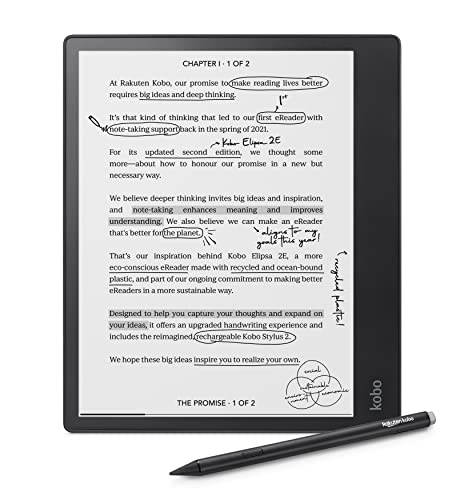
TL;DR: The Kobo Elipsa 2E offers a 10.3‑inch 227 PPI E Ink Carta 1200 display, 2400 mAh battery and a lightweight 0.85‑lb body, making it a solid premium e‑ink tablet for note‑taking and reading.
The standout feature is its 10.3‑inch glare‑free E Ink Carta 1200 touchscreen, delivering 227 PPI sharpness on a screen that feels like paper. ComfortLight PRO adds both white and amber LEDs, so you can dial the warmth up or down for day‑long reading. Kobo bundles the Stylus 2, advertised as 25 % lighter than its predecessor, with a dedicated eraser and USB‑C recharging.
At 0.85125 lb, the Elipsa 2E is lighter than the Kindle Scribe (0.95 lb) but heavier than the PocketBook InkPad 4 (≈0.58 lb). Its 10.3‑inch screen outclasses the 7.8‑inch displays of the InkPad Color 3 and InkPad 4, and it matches the InkPad Eo’s 10.3‑inch size while still being lighter than that 1.04‑lb device. Battery capacity sits at 2400 mAh, which is lower than the InkPad Color 3’s 2900 mAh and the InkPad Eo’s 4000 mAh, but higher than the Era Stardust’s 1700 mAh. Storage is 32 GB, the same as the InkPad Color 3 and InkPad 4, yet half of the InkPad Eo’s 64 GB. RAM is 1 GB, matching most peers but well below the InkPad Eo’s 4 GB.
Reviewers praise the large screen and the weeks‑long battery life, noting that the lighter Stylus 2 feels comfortable during long writing sessions. Professional reviewers highlight a 45 % faster single‑core processor that reduces stylus latency. On the flip side, users point out that the device only supports Kobo Audiobooks, limiting audiobook options, and that 1 GB of RAM can feel cramped when handling hefty PDFs or multitasking between note‑taking apps.
Pros
Cons
Best for: Academic and professional note‑takers who need a large, high‑resolution e‑ink screen and a comfortable stylus.
Avoid if: You have a tight budget, need a lightweight pure‑reading device, or require a broad audiobook ecosystem.
“massive upgrade”
“solid iteration over its predecessor in the plus-sized eReader segment”
TL;DR: The Kindle Scribe’s 10.2‑inch, 300 ppi E Ink screen with 35 warm‑and‑cool LEDs and a battery‑free EMR stylus makes note‑taking feel like paper, though the 433 g device is on the heavier side.
The standout feature is the 10.2‑inch glare‑free display at 300 ppi, illuminated by 35 front‑light LEDs that switch between warm and cool tones. Coupled with a battery‑free EMR stylus weighing just 14 g (basic) or 15 g (premium), writing feels remarkably paper‑like, and the stylus magnetically attaches for easy storage.
At 433 g, the Scribe is heavier than the PocketBook InkPad 4 (265 g) and PocketBook Era Stardust (228 g), but lighter than the PocketBook InkPad Eo (470 g). Its 64 GB of internal storage matches the high‑end Onyx Go 7 and exceeds the 32 GB found in most peers, while battery capacity isn’t listed; however, Amazon says it’ll last up to 12 weeks of reading and 3 weeks of writing, a duration that outstrips the “several weeks” noted for the Kobo Elipsa 2E.
Reviewers love the realistic feel of the EMR stylus and the ample storage for large PDF libraries, especially on long trips where the 12‑week reading battery shines. Professional reviewers note the screen can flex under heavy stylus pressure, and the auto‑rotation sensor doesn't offer a disable toggle, which some users find annoying. The device’s IPX8 rating means it'll survive submersion up to 2 m for an hour, and the auto‑adjusting light sensor keeps the front‑light comfortable in changing lighting.
Pros
Cons
Best for: Buyers willing to invest in a proven, high‑quality option
Avoid if: You need advanced features or professional‑grade performance
TL;DR: The PocketBook InkPad 4 offers a 7.8″ Kaleido 3 color E‑Ink screen, SMARTlight front‑light, 32 GB storage and waterproofing for $299, but its 0.58 lb weight makes it less pocket‑friendly than some smaller rivals.
The standout feature is the 7.8″ E Ink Kaleido 3 display that supports 4096 colors and a SMARTlight system with adjustable color temperature and a Dark mode, helping you read comics or PDFs comfortably day or night. Under the hood you get a quad‑core 1.8 GHz processor, 1 GB RAM and a roomy 32 GB of internal storage, all powered by a 2900 mAh battery.
Compared with the other 11 tablets in this roundup, the InkPad 4 sits in the middle of the price band – pricier than the compact Bigme B6 Color and the PocketBook Era Stardust Silver, yet cheaper than the larger Kobo Elipsa 2E. It’s heavier than the 176 g Bigme B6 and the 228 g PocketBook Era, but lighter than the 420 g PocketBook InkPad Color 3 and the 386 g Kobo Elipsa 2E. Its 3.9/5‑star rating trails the 4.2‑star Onyx Go 7 and the 4.3‑star PocketBook Era, indicating a more mixed reception.
Users consistently praise the built‑in speaker, Bluetooth audio support and text‑to‑speech engine for hands‑free audiobook listening on commutes. Professional reviewers highlight the vivid Kaleido 3 screen as a strong point for graphic‑heavy content and commend the SMARTlight with Dark mode for reducing eye strain during long sessions. A common complaint is the 0.58 lb (265 g) chassis, which feels bulkier than many 6‑inch competitors, and the lack of an external memory slot limits storage expansion beyond the fixed 32 GB.
Additional technical details include an IPX8 waterproof rating, dual‑band 2.4/5 GHz Wi‑Fi, Bluetooth 5.0/5.4, a USB‑C port, and sensors (G‑sensor and cover sensor) that enable auto‑wake and page‑turn detection. The device runs a Linux 4.9.56 operating system and comes with a suite of pre‑installed apps such as a browser, notes, calculator and cloud services.
Pros
Cons
Best for: Most users seeking a balanced, mainstream option
Avoid if: You need advanced features or professional‑grade performance
“If you only use the ereader to read books, comics or manga, then I think this is a better buy”
TL;DR: The Ashata Paperwhite packs a 7‑inch 300 ppi E Ink Carta screen, Android 11, 4 GB RAM and 64 GB storage in a 195 g, 6.4 mm‑thin body for about $104.
The standout hardware is the 7‑inch E Ink Carta Plus panel delivering 300 ppi, which rivals the clarity of higher‑priced readers while keeping the device light at just 195 g. Under the hood sits a 2.4 GHz octa‑core CPU and 4 GB of RAM, giving Android 11 enough headroom for note‑taking apps and audio playback.
Compared with the other eleven entries, the Paperwhite is lighter than most – the PocketBook Verse (340 g) and PocketBook Verse Pro (349 g) are noticeably heavier, while Kobo Clara (174 g) and Onyx Go 7 (195 g) match or undercut the weight. Its 2300 mAh battery capacity equals the top‑end Onyx Go 7 and exceeds the 1500 mAh cells used in the PocketBook Verse and Kobo Clara, so it sits at the high end of the battery spectrum in this group.
User sentiment highlights the super‑light feel and the tactile page‑turn buttons as real comforts for long reading sessions. Professional reviewers praise the thin 6.4 mm profile and the warm/cold CTM front‑light for adjustable brightness, yet they note the Android OS draws more power than Kindle‑style firmware, leading to shorter endurance.
The plastic chassis, while keeping costs low, shows scratches without a case, and the wider bezels draw occasional comments about grip.
Pros
Cons
Best for: Android‑savvy readers who want extensive format support, note‑taking and audio playback on a lightweight e‑ink tablet.
Avoid if: You need a simple, waterproof device with rock‑solid user satisfaction and long‑lasting battery life.
“feels super light”
“super light... significant reduction”
Breakdown
Kobo Clara BW
Pros
PocketBook Era Stardust Silver
Pros
PocketBook InkPad Color 3
Pros
Onyx Go 7
Pros
Based on scoring data and product specs
Personalized picks
Best Overall Pick
Kobo Clara BW
Best Budget PickBest for: Budget-conscious buyers seeking a reliable entry-level option
PocketBook Era Stardust Silver
Best for: Most users seeking a balanced, mainstream option
$249.00+$109.01 vs winner
Skip Ashata Paperwhite if…
Reliability and user satisfaction are your top concerns
We’re naming the Kobo Clara BW the clear winner of the best E Ink tablets with adjustable front light. At $139.99 it undercuts the competition, while its 4.4/5 rating from 2,115 reviews shows strong user approval. The 6‑inch Carta 1300 HD screen delivers a crisp 300 PPI, and ComfortLight PRO lets you fine‑tune brightness with blue‑light reduction. It also carries an IPX8 rating for water resistance and runs for weeks on a 1500 mAh battery.
The runner‑up is the PocketBook Era Stardust Silver, ideal if you need a larger display for PDFs or note‑taking. Its 7‑inch E Ink Carta 1200 panel also hits 300 PPI, and the SMARTlight front‑light adjusts both brightness and colour temperature. With up to one month of battery life, IPX8 water protection, and physical side page‑turn buttons, it makes a solid choice for extended reading sessions at $249.00.
For other budgets, the Ashata Paperwhite remains the best value at $104.53, while the PocketBook Era Stardust Silver serves as the top mid‑range pick thanks to its bigger screen and colour‑temperature control. If you’re after a premium experience, the PocketBook InkPad Eo stands out as the highest‑priced option at $499.00, offering a more advanced display for colour‑rich content.
Pick the Kobo Clara BW today and enjoy a budget‑friendly, feature‑rich e‑reading tablet.
The Kobo Clara BW costs $139.99 and includes ComfortLight PRO with blue‑light reduction, a 6‑inch 300 PPI display, and weeks of battery life, making it the most affordable option with a solid front‑light system. The PocketBook Era Stardust Silver is $249.00, offering a larger 7‑inch screen and SMARTlight, but the higher price means the Clara BW is the better value for most readers.
No reviews yet — be the first to share your experience.
Please sign in to leave a review
