⚡ Quick Answer
Finding an ergonomic keyboard that matches your workflow can feel like a hunt through endless options. Our roundup compared 12 keyboards, spanning a price range from $13.00 for the HP 150 up to $187.99 for Apple’s Magic Keyboard with Touch ID. Across budget, mid‑range and premium tiers, we looked at ratings that hover between 4.3 and 4.6 stars.
If you’re entrenched in the Apple ecosystem, the Magic Keyboard with Touch ID offers a full‑size layout, a 0.81 lb chassis and a 4.6‑star rating, plus a month‑plus battery life. Windows‑centric power users may gravitate toward Logitech’s MX Keys S, which promises up to five months of use without backlighting and carries a 4.4‑star score. For tight desks or limited budgets, the HP 150 delivers a full‑size numeric keypad at just $13.00 while still earning a 4.4‑star rating.
Each of these models brings a different balance of comfort, connectivity and cost. Below we break down the key strengths, potential drawbacks and ideal scenarios for every keyboard, so you can pinpoint the best ergonomic fit for your setup.

Apple Magic Keyboard with Touch ID Black
Its ultra‑thin 0.75 in (19.05 mm) profile delivers a sleek, low‑profile typing experience that many users prize.

Logitech MX Keys S
Ideal for productivity‑focused professionals who want a premium feel without Apple’s price tag—priced at $119.99, it’s $68 less than the Best Overall.
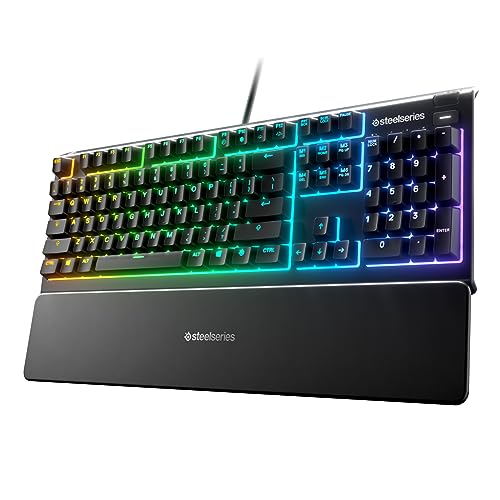
SteelSeries Apex 3
Its 150.9 mm depth gives a full‑size feel at a $49.99 price point, making it a budget‑friendly gamer keyboard.
Also considered
Score Analysis
Key score advantages vs. runner-up (Logitech MX Keys)
Price Range
Apple Magic Keyboard with Touch ID Black
$187.99
Logitech MX Keys S
$129.99
SteelSeries Apex 3
$49.99

Apple Magic Keyboard
$79.99

Tecknet Wired Keyboard
$19.99

Tecknet Gaming Keyboard
$29.99

HP 150
$13.00

Tecknet Large Print Keyboard
$17.99

Redragon K503
$25.64

Logitech Wave Keys
$69.99

Corsair K70 CORE
$84.99

Kinesis Freestyle2
$99.00
Spec Comparison
TL;DR: Apple’s Magic Keyboard with Touch ID Black offers a full‑size, low‑profile layout, 110 keys, built‑in numeric keypad and fingerprint sensor, all on a lightweight 0.81 lb frame, but it carries a premium $187.99 price tag.
The standout feature is the integrated Touch ID sensor paired with a full‑size numeric keypad, giving Mac users secure login without reaching for a mouse. The keyboard measures 16.48 in wide, 4.52 in deep and only 0.75 in high, while weighing just 0.81 lb, making it one of the slimmer full‑size options on the market. Its scissor‑mechanism keys travel between 0.16 in and 0.43 in, which Apple describes as “optimized” for comfortable typing.
Compared with the other eleven keyboards in this roundup, the Magic Keyboard with Touch ID is pricier than the Logitech MX Keys S and the Kinesis Freestyle2, but it also packs more built‑in functionality. It’s lighter than the Logitech MX Keys S and far lighter than the SteelSeries Apex 3, yet its footprint is wider than the compact Logitech MX Keys S and the standard Apple Magic Keyboard. Unlike the Kinesis Freestyle2, it includes Touch ID and a dedicated numeric keypad, and it offers more multimedia controls than the Corsair K70 CORE.
User feedback highlights the month‑long battery life as a major convenience, and reviewers praise the smooth Bluetooth pairing that automatically connects to a Mac running macOS 15.1 or later. Some owners, however, note that the low‑profile key feel isn’t as tactile as mechanical switches, and the larger size can feel cumbersome on a cramped desk. Professional reviewers also point out that the built‑in Touch ID adds a layer of privacy and speeds up authentication for everyday tasks.
Pros
Cons
Best for: Buyers willing to invest in a proven, high-quality option
Avoid if: You're shopping on a tight budget — it's priced at $187.99
TL;DR: The Logitech MX Keys S offers a full‑size, low‑profile scissor keyboard with smart white backlighting, a 5‑month battery life (backlight off), and solid multi‑device connectivity for $119.99.
One of the most notable specs is its battery endurance: a 1500 mAh rechargeable cell delivers up to 5 months of use when the backlight is off, far exceeding the typical few‑week span of many wireless keyboards. The keyboard also supports a wireless range of 10 m (33 ft) via Logi Bolt or Bluetooth Low Energy, and its keys travel just 1.8 mm with an actuation force of 60 g, giving a crisp, quiet typing feel.
In the context of the twelve‑product roundup, the MX Keys S sits at a higher price point than the Kinesis Freestyle2 and Apple Magic Keyboard, but it is lighter than the SteelSeries Apex 3 and considerably heavier than the Apple Magic Keyboard (0.9 lb). Its full‑size layout with a numeric keypad sets it apart from the compact tenkeyless designs like the Apple Magic Keyboard, while the fixed‑angle chassis makes it less adjustable than the split‑style Kinesis Freestyle2.
User sentiment repeatedly praises the keyboard’s low‑profile, spherically‑dished scissor keys and the smart white LED backlighting that reacts to hand proximity and ambient light. Professional reviewers call the typing experience “low‑profile perfection” and highlight the USB‑C fast charging and smooth Logitech Flow integration across up to three paired devices. The main criticisms focus on the fixed angle—no adjustable feet or tilt—and the 810 g weight, which some users find cumbersome for travel or cramped desks.
Beyond ergonomics, the MX Keys S incorporates a plastic chassis with some aluminum accents, a proximity sensor, and an ambient light sensor that together power the adaptive backlighting. Logitech provides a 1‑year parts warranty, and the keyboard runs on Logitech Options+ software for customization, making it a solid choice for productivity‑focused environments.
Pros
Cons
Best for: Buyers willing to invest in a proven, high-quality option
Avoid if: You're on a tight budget or only need basic functionality
TL;DR: The SteelSeries Apex 3 offers whisper‑quiet gaming switches, a magnetic wrist rest and a solid 20 million keystroke lifespan in a sturdy 2.80‑lb, 445 mm‑wide package for $49.99.
The standout spec is the “whisper‑quiet gaming switches” that promise low‑noise operation while still feeling clicky enough for gaming, backed by a 20 million keystroke lifespan. At 39.9 mm tall, 150.9 mm deep and a generous 445 mm width, the board also carries an IP32 spill‑resistance rating and ten RGB zones for customizable lighting.
Compared with the other eleven keyboards in this roundup, the Apex 3 is noticeably larger and heavier. Its 2.80‑lb (1270 g) weight tops the Corsair K70 CORE’s 2.06‑lb frame and exceeds the Logitech Wave Keys, which weighs about 1.24 lb (1238 g). The 445 mm width dwarfs Logitech’s 392.6 mm width and Redragon’s 200.5 mm width, while the 39.9 mm height is taller than Logitech’s 30 mm and Tecknet’s 27.9 mm profiles. In other words, you’ll get a more substantial feel than the slimmer, lighter peers, but you’ll also need a bit more desk real‑estate.
Reviewers consistently highlight the quiet switches and magnetic wrist rest as comfort boosters during long sessions. A high rating of 4.6 / 5 from 7,874 reviews shows most owners are satisfied with the build quality and the RGB lighting options. A few users note that the board’s large footprint can feel cramped on smaller desks, and the weight makes frequent repositioning a bit of a chore.
Pros
Cons
Best for: Most users looking for a well‑reviewed, reliable mainstream option
Avoid if: You have limited desk space or need portability
TL;DR: The Apple Magic Keyboard offers an ultra‑light 0.9 lb, low‑profile scissor‑mechanism typing experience with a month‑long rechargeable battery for $97.00.
Apple’s Magic Keyboard stands out with its compact tenkeyless layout of 78 keys, a low‑profile height of 0.73 in, and a sleek length of 12.13 in. Weighing just 0.9 lb, it feels almost weightless on a desk, and the built‑in rechargeable battery lasts about a month before needing a USB‑C top‑up.
When you line it up against the other eleven keyboards, the Magic Keyboard is noticeably lighter than the Kinesis Freestyle2 (2.0 lb) and the Corsair K70 CORE (about 2.06 lb). It’s also lighter than the SteelSeries Apex 3, which tips the scales at roughly 2.80 lb. While many peers use wires or are bulkier, Apple’s offering stays wireless and ultra‑thin, making it one of the most portable options in the group.
Users consistently praise the scissor mechanism for delivering “exceptionally comfortable and precise” typing, and professional reviewers echo that sentiment, noting the reduced key travel speeds up typing and improves accuracy. The month‑long battery life draws frequent commendation, with everyday users calling it “incredibly long‑lasting.” On the downside, the lack of backlighting and the absence of a built‑in trackpad draw common complaints, especially from those who work in dim environments or prefer an all‑in‑one input solution.
Technically, the keyboard pairs automatically via Bluetooth, integrates natively with macOS 15.1+ and even supports Apple Vision Pro, and includes a USB‑C charging cable out of the box. Apple markets its low‑profile design and scissor mechanism as 33 % more stable than previous Apple keyboards, delivering a premium feel without the bulk of mechanical switches.
Pros
Cons
Best for: Buyers willing to invest in a proven, high‑quality option
Avoid if: You're on a tight budget or only need basic functionality
TL;DR: The Tecknet TK‑KB037 offers a full‑size 104‑key layout, RGB backlighting and adjustable tilt for $19.99, making it a solid budget pick for desk‑bound work or casual gaming.
This wired keyboard stands out with a compact 27.9 mm height, 439.4 mm length and 132.1 mm width, delivering a full‑size footprint without taking up excessive space. Its low‑profile membrane keys can endure 80 million keystrokes, and the RGB backlight provides seven colors, four brightness levels and two lighting modes (static and breathing). The inclusion of 12 FN multimedia shortcuts and spill‑resistant construction adds practical convenience for everyday use.
Compared with the other eleven entries, the Tecknet sits at a similar price point to the Tecknet Large Print Keyboard, yet it adds RGB lighting that the Large Print’s green‑only design lacks. It’s narrower than the Redragon K503 (132.1 mm vs 200.5 mm width) and a touch shorter in length (439.4 mm vs 444.5 mm), which can be advantageous on tighter desks. Unlike the HP 150, which relies on low‑profile chiclet keys and quiet operation, the TK‑KB037 supplies full‑size keys with a numeric keypad and backlighting. The Tecknet Gaming Keyboard offers a metal base and stepped layout, but the TK‑KB037’s adjustable tilt and anti‑slip pads provide ergonomic support at a lower price. Features such as a magnetic wrist rest and the IP32 rating that the SteelSeries Apex 3 includes are missing here, positioning this model as a more basic, budget‑friendly option.
User feedback repeatedly highlights the comfort of the tilt legs and the quiet typing experience, noting that the spill‑resistant surface reduces anxiety over accidental drinks. Reviewers also appreciate the vibrant RGB zones for low‑light environments. The main criticism is the lack of detailed weight and depth information, which makes it harder to gauge how much desk real‑estate the keyboard will occupy. Additionally, the membrane key feel may not satisfy users who prefer mechanical switches.
Pros
Cons
Best for: Budget-conscious buyers seeking a reliable entry-level option
Avoid if: You have limited desk space or need portability
TL;DR: The Tecknet Gaming Keyboard offers a solid metal frame, 7° ergonomic tilt, quiet whisper‑switches and 15‑zone RGB lighting for $29.99, making it a well‑reviewed mid‑range choice for gamers who value durability and customization.
The most eye‑catching spec is the built‑in 7° ergonomic angle combined with a 35.56 mm low profile, which lets your wrists rest at a natural slope while the metal base adds a sturdy feel. Under the keys, 25 anti‑ghost switches and a whisper‑quiet gaming switch promise responsive, silent keystrokes, and the keyboard can auto‑sleep after 5 minutes of inactivity to save energy.
In a side‑by‑side look, the Tecknet sits taller than the Redragon K503 (35.56 mm vs 30 mm) but shorter than the SteelSeries Apex 3 (39.9 mm). Its 431.8 mm length is a touch shorter than Redragon’s 444.5 mm, while the 177.8 mm width exceeds the HP 150’s 168.91 mm yet remains well under the SteelSeries’s 445 mm span. Unlike many peers, it lists 15 RGB zones, 7 illumination modes and an IP32 rating, which most other keyboards don't detail.
Reviewers consistently highlight the keyboard’s quiet operation and the durability of its metal chassis, noting that the 12 multimedia keys and removable key cover add convenience for gamers. A recurring theme is the desire for an adjustable tilt; the fixed 7° angle satisfies most but leaves power users wishing for more customization. The 4.4‑star rating from 4,470 reviewers suggests solid satisfaction, though a few mention the size can feel bulky on very small desks.
Pros
Cons
Best for: Most users looking for a well‑reviewed, reliable mainstream option
Avoid if: You have limited desk space or need portability
TL;DR: The HP 150 delivers a full‑size, low‑profile wired keyboard with quiet chiclet keys, ergonomic tilt, a numeric pad and 12 shortcut keys for just $13, ideal for budget‑focused workstations.
The standout spec is its low‑profile chiclet key design combined with a 34.04 mm height and a 0.9700339528 lb (440 g) weight, giving a slim yet solid feel; professional reviewers say it provides “quick, responsive keystrokes.” Its ergonomic tilt legs further promote a natural wrist angle for all‑day typing comfort.
Compared with the other eleven keyboards, the HP 150's taller than the Tecknet Wired Keyboard’s 27.9 mm height and wider than its 132.1 mm width, while sharing a similar depth (436.88 mm vs. 439.4 mm). It's slightly taller than the Redragon K503’s 30 mm height but narrower than that model’s 200.5 mm width. Unlike the SteelSeries Apex 3, which weighs 2.80 lb, the HP 150 stays feather‑light at under 1 lb. Its USB‑A only connection makes it more limited than the Redragon’s Bluetooth and USB‑C options, but it also avoids the battery‑life concerns of wireless models.
User sentiment highlights the keyboard’s quiet operation and reliable plug‑and‑play setup. Everyday users praise the full‑size layout with a numeric keypad and the 12 programmable Fn shortcuts that streamline media control, email and homepage access. Professional reviewers also commend the LED status lights for Num Lock, Caps Lock and Scroll Lock, which improve usability in low‑light settings, though they note the lack of full backlighting.
Pros
Cons
Best for: Budget-conscious buyers seeking a reliable entry-level option
Avoid if: You have limited desk space or need portability
TL;DR: The Tecknet Large Print Keyboard delivers clear 4X‑enlarged keys, a light 45 g actuation force and customizable 7‑color backlighting for just $19.99, making it a solid budget pick for accessibility‑focused users.
What really sets this keyboard apart is the 4X font enlargement on every key, a feature explicitly marketed for users who need larger legends. The keys require only 45 g of actuation force and travel 3.2 mm, which many reviewers say feels gentle on the fingertips during long typing sessions. A 15° tilt angle adds a modest ergonomic angle, while the built‑in lighting offers seven colors, breathing and constant modes, and three brightness levels for low‑light environments.
Compared with the other eleven keyboards in the roundup, the Tecknet Large Print Keyboard is more specialized than the generic Tecknet Wired Keyboard, which lists dimensions, anti‑slip pads and quiet low‑profile membrane keys but offers no backlighting. The Redragon K503 brings wireless connectivity, a 6‑ft cable and a larger battery, features the Large Print model does not include. The HP 150 provides an ergonomic low‑profile chiclet design and a numeric keypad but lacks any illumination. The Tecknet Gaming Keyboard sports a stepped layout and metal base but only a 7° ergonomic angle, making the Large Print’s 15° tilt steeper. SteelSeries Apex 3 and Logitech Wave Keys both include dedicated multimedia controls and heavier builds, while the Large Print focuses on readability and a lightweight feel, though the manufacturer does not list its weight and overall dimensions.
User sentiment highlights the clarity of the enlarged legends as a major win for seniors and anyone with vision challenges. Reviewers also note the soft 45 g actuation makes typing less tiring, though a few mention the absence of a wrist rest and the limited adjustability beyond the fixed 15° tilt. Reviewers praise the backlighting for adding a fun visual cue without being distracting, and the 2‑year warranty reassures budget‑conscious buyers.
Pros
Cons
Best for: Budget-conscious buyers seeking a reliable entry-level option
TL;DR: The Redragon K503 offers 300 hours of battery life, three connectivity modes, and six lighting zones for $25.64, making it a solid entry‑level ergonomic keyboard for budget‑focused users.
The standout spec is its 300‑hour battery life when the RGB lighting is off, backed by a 4000 mAh cell. Pair that with Bluetooth, 2.4 GHz wireless, and a USB‑C wired option, and you get a truly flexible setup without worrying about frequent charging. The keyboard also packs six lighting modes, 25 anti‑ghosting keys, and a mix of 12 combination plus 10 independent multimedia keys, which helps keep shortcuts within reach.
In the context of the other eleven keyboards, the K503 sits in the middle of the size range. Its 30 mm height is taller than the Tecknet Wired Keyboard’s 27.9 mm but shorter than the SteelSeries Apex 3’s 39.9 mm. At 444.5 mm long, it outstretches the Tecknet Gaming model (431.8 mm) yet remains a touch shorter than the Apex 3’s 445 mm length. The 200.5 mm width makes it noticeably wider than the Tecknet Gaming’s 177.8 mm and the HP 150’s 168.91 mm, though it’s still narrower than the Apex 3’s 445 mm span. Its 6‑ft cable also gives it a longer reach than many wireless‑only peers, which list no cable length at all.
Reviewers frequently praise the long battery endurance and the convenience of swapping between Bluetooth, wireless dongle, and wired modes. Users also like the six lighting zones for a bit of flair without draining the battery too fast. On the flip side, the 4.3/5 star average and a few comments about the keyboard feeling a bit bulky on tighter desks indicate it isn’t the most compact option. The price point is attractive, but some buyers note that other keyboards in the same range squeeze in more premium materials for a similar cost.
Pros
Cons
Best for: Budget-conscious buyers seeking a reliable entry-level option
Avoid if: You have limited desk space or need portability
TL;DR: The Logitech Wave Keys offers a 3‑layer memory‑foam palm rest, 99‑key compact layout, Bluetooth 5.1 connectivity and up to 36 months of battery life, all for $52.49.
The standout feature is the integrated three‑layer memory‑foam palm rest that measures 82.55 mm deep, paired with a compact 99‑key layout and an 18.5 mm key pitch that keeps your hands close together for a more natural typing angle.
Weighing just 750 g, the Wave Keys is lighter than the SteelSeries Apex 3, which comes in at about 2.80 lb, and its price point places it above the ultra‑budget Tecknet keyboards, making it a mid‑range option rather than a low‑cost entry.
Professional reviewers note the palm‑rest design improves wrist posture, while users appreciate the long‑lasting battery—up to 36 months—with a visible indicator. The keyboard also supports Bluetooth 5.1, a wireless range of up to 10 m (32.81 ft), and can pair with three devices simultaneously. Its construction includes 46 % recycled plastic, adding a modest sustainability angle.
Pros
Cons
Best for: Office workers, financial analysts, and anyone who types four or more hours daily and wants a well‑reviewed ergonomic keyboard.
Avoid if: You have large hands, need full‑split ergonomics, or require backlighting for dim workspaces.
TL;DR: The Corsair K70 CORE delivers a full‑size aluminum‑framed mechanical keyboard with low‑actuation 45 g MLX Red switches, per‑key RGB and a detachable palm rest, but its bulk and price may limit cramped setups.
One of the most distinctive specs is the 1800 mm tangle‑free rubber cable, giving you plenty of reach without a mess. The keyboard’s MLX Red linear switches register at just 1.9 mm actuation distance and 45 g force, while the 1000 Hz polling rate and full NKRO ensure every keystroke registers instantly. With 104 keys, a 35.4 mm height and a 4 mm total travel, it packs a solid mechanical experience into a sturdy aluminum frame.
At 2.06 lb, the K70 CORE is heavier than the Apple Magic Keyboard’s 0.9 lb but lighter than the SteelSeries Apex 3’s 2.80 lb, placing it in the middle of the weight spectrum for this roundup. Its full‑size layout is larger than the tenkeyless Kinesis Freestyle2, which may appeal to users who need a numeric keypad but could feel bulky on smaller desks.
Reviewers consistently praise the smooth, low‑force MLX Red switches and the dual‑layer EVA foam that dampens sound, making typing feel quiet yet satisfying. The magnetic detachable soft‑touch palm rest adds ergonomic comfort and doesn't permanently add bulk. On the downside, users note the 448 mm length and overall weight can crowd tight workspaces, and the $84.99 price tag sits above many budget alternatives.
Pros
Cons
Best for: Gamers and content creators who want a full‑size mechanical keyboard with customizable RGB and a detachable palm rest.
Avoid if: You need a compact, lightweight keyboard for tight desk spaces or competitive e‑sports where every gram matters.
TL;DR: The Kinesis Freestyle2 offers a split, low‑force membrane layout with up to 228 mm of adjustable separation, making it an ergonomic choice for $99, though it’s a bit heavier than some ultra‑light keyboards.
The standout feature is its modular split design that lets you pull the two halves apart as much as 228 mm, so you can match shoulder width and reduce strain. Each half measures 405 mm in length, 235 mm in width, and only 32 mm in height, while the custom membrane low‑force switches deliver tactile feedback with minimal actuation effort.
Compared with the other eleven keyboards in this roundup, the Freestyle2 is heavier than the Apple Magic Keyboard (0.9 lb) and lighter than the SteelSeries Apex 3 (about 2.8 lb). Its 405 mm length is shorter than the Corsair K70 CORE’s 448 mm but longer than the Apple’s 12.13 in (≈308 mm) chassis. In height, it sits below the Logitech MX Keys S (38.1 mm) and Logitech Wave Keys (30 mm), positioning it in the mid‑range of profile sizes. Unlike the wireless options, it uses a wired USB connection, so there’s no battery life to manage.
Reviewers have given the keyboard a 4.3‑star rating across 1,420 reviews, indicating generally positive feedback. Many users praise the plug‑and‑play simplicity and the dedicated cut, copy, paste, and multimedia hotkeys, while a minority note that the membrane feel lacks the clicky response of mechanical switches. The included detachable pivot tether and quick‑start guide help set up the split layout quickly.
Pros
Cons
Best for: Buyers willing to invest in a proven, high‑quality option
Avoid if: You're on a tight budget or only need basic functionality
Breakdown
Apple Magic Keyboard with Touch ID Black
Pros
Cons
Logitech MX Keys S
Pros
SteelSeries Apex 3
Pros
Apple Magic Keyboard
Pros
Based on scoring data and product specs
Personalized picks
Best Overall Pick
Apple Magic Keyboard with Touch ID Black
Best OverallBest for: Buyers willing to invest in a proven, high-quality option
Logitech MX Keys S
Best for: Buyers willing to invest in a proven, high-quality option
$129.99-$58.00 vs winner
Skip Kinesis Freestyle2 if…
You're on a tight budget or only need basic functionality
Apple Magic Keyboard with Touch ID Black takes the top spot as the best ergonomic keyboard. It earned a 4.6 / 5 rating from 2,894 reviewers, offers built‑in Touch ID for secure logins, and includes a full‑size numeric keypad—all in a low‑profile, 0.81 lb design that fits comfortably on any desk.
The Logitech MX Keys S is the runner‑up and shines when you need a flexible, multi‑device setup. It pairs with up to three devices, runs for about five months on a single charge, and features smart backlighting with proximity and ambient light sensors—perfect for a shared office or home workspace where you switch between a laptop, tablet, and phone.
For tighter budgets, consider these alternatives:
Pick the Apple Magic Keyboard with Touch ID Black today for the most comfortable, secure typing experience.
The Logitech MX Keys S supports both a Logi Bolt USB receiver and Bluetooth Low Energy, allowing you to pair up to three devices. The Apple Magic Keyboard with Touch ID Black connects via Bluetooth only, so the MX Keys S provides more flexibility for multi‑device use.
No reviews yet — be the first to share your experience.
Please sign in to leave a review