⚡ Quick Answer
Our top pick offers a 256 GB capacity, dual USB‑A/C swivel design, and a solid 4.5‑star rating from over 7 k reviewers, all for $47.99. The metal housing feels premium, and the drive’s sequential read speed of 183 MB/s makes large photo or video transfers feel snappy, while the 45.8 MB/s write speed is adequate for most travel workflows.
Ten dual‑port flash drives are listed across three price tiers. Budget‑friendly options like the Kingston DataTraveler Micro Duo at $14.95 (4.4‑star) and Verbatim Store ’n’ Go at $22.07 (4.4‑star) give you 32–128 GB for under $25. Mid‑range choices such as SanDisk’s 128 GB Phone Drive for $25.99 (4.4‑star) and SSK’s 128 GB model for $36.99 (4.5‑star) push read speeds into the 100–550 MB/s range. Premium picks, including the Vansuny 512 GB stick at $51.97 (4.3‑star) and Amazon Basics 512 GB at $74.09 (4.6‑star), deliver advertised gigabit‑class speeds and larger capacities for power users. Across the board, each drive supports plug‑and‑play operation with both USB‑A and USB‑C devices, so you won’t need extra adapters. Below we break down each model’s specs, strengths, and who it’s best suited for.

Lexar D40E
Its compact 12 mm height makes it easy to slip into pockets, delivering the high rating and feature set that earned it the best‑value title.

Vansuny USB Flash Drive 512GB
Ideal for audiophiles and enthusiasts who crave premium sound quality, it costs $3.98 more than the Lexar D40E, reflecting its advanced features.

SSK Dual USB-C 128GB
Featuring a slim 8.6 mm profile, the SSK Dual USB‑C 128GB offers a low‑profile design that fits tight spaces and remains well‑reviewed and affordable.
Also considered
Score Analysis
Key score advantages vs. runner-up (Vansuny USB Flash)
Price Range
Lexar D40E
$47.99
Vansuny USB Flash Drive 512GB
$55.97
SSK Dual USB-C 128GB
$36.99

Kingston Digital Data Traveler Micro Duo
$14.95

Thkailar USB Flash Drive 512GB Red
$43.99
Amazon Basics USB Flash Drive 512GB
$74.09

Lexar JumpDrive Dual Drive D400
$21.28

SanDisk Phone Drive 128GB
$25.99

Verbatim Store 'n' Go 128GB
$31.87

Zarmst USB-C 4-in-1 Flash Drive 256GB Blue
$24.99
Spec Comparison
TL;DR: The Lexar D40E offers a 256 GB metal swivel drive with dual USB‑A/C connectors, 183 MB/s sequential reads and 256‑bit AES encryption, but its 1.32 MB/s random‑write speed limits small‑file performance.
What really stands out is the dual‑connector design – a USB‑A and a USB‑C port on the same swivel body – plus a rugged metal housing and a 360° swivel that lets you flip the drive to match any port. It ships with 256 GB of storage (≈231 GiB usable) and hits a sequential read speed of 183 MB/s, which professional reviewers note is solid for moving large photo or video batches.
Compared with the other nine drives in this roundup, the D40E sits in the middle of the size spectrum: its 70.4 mm length and 17 mm width are shorter than the Vansuny 512 GB (79.7 mm long, 21.2 mm wide) and the SSK Dual USB‑C 128 GB (78 mm long, 20.5 mm wide), but a bit longer than the ultra‑slim Zarmst 256 GB (42.93 mm long, 22.10 mm wide). At 26 g it’s lighter than the Thkailar 512 GB (91 g) and heavier than the SanDisk Phone Drive 128 GB (13.6 g). In terms of speed, its 183 MB/s read is higher than the Zarmst’s listed 80 MB/s and the Verbatim’s 100 MB/s, yet well below the “up to 550 MB/s” claim of the SSK Dual USB‑C drive. The random‑write figure of 1.32 MB/s is far slower than the 76.95 MB/s random write listed for the Vansuny model.
Users praise the plug‑and‑play convenience of the dual ports and the sturdy metal swivel, calling it a handy travel companion. Professional reviewers note the durable construction and the solid sequential read performance, but they also flag the weak random‑write speed as a bottleneck for small‑file transfers. The drive operates from 0 °C to 50 °C and stores data from –10 °C to 70 °C, and it includes 256‑bit AES encryption software for added security.
Pros
Cons
Best for: Photographers, videographers, and travelers who value a rugged, dual‑port drive with solid read performance and built‑in encryption.
Avoid if: You need consistently high sustained write speeds for tasks like video editing or frequent small‑file transfers.
“Convenient swivel for no‑cap loss and quick large‑file moves.”
“Slower‑than‑expected writes for videos/documents and occasional compatibility hiccups on older devices.”
TL;DR: The Vansuny 512 GB dual‑USB‑A/C flash drive delivers near‑1 GB/s sequential speeds, a large pSLC cache, and a rugged zinc‑alloy body, making it a fast, high‑capacity OTG solution.
This stick packs 512 GB of storage (477 GiB usable) and is rated at a sequential read speed of 1013.42 MB/s and write speed of 963.46 MB/s, very close to its advertised “up to 1000 MB/s” claim. The built‑in pSLC cache of over 200 GB helps sustain those speeds during large transfers, and the included keychain makes it easy to carry.
At 79.7 mm long and 21.2 mm wide, it is longer than the Lexar D40E (70.4 mm) and the Thkailar 512 GB (66.0 mm) but only slightly longer than the SSK Dual USB‑C 128 GB (78.0 mm). Its 8.5 mm thickness is thicker than the ultra‑thin Zarmst 256 GB (5.08 mm) and the Verbatim Store ’n’ Go 128 GB (8 mm). Speed‑wise, the Vansuny’s 1013 MB/s read dwarfs the Lexar D40E’s 183 MB/s and the Thkailar’s 120 MB/s, while its write performance far exceeds the SSK’s 520 MB/s advertised ceiling.
Reviewers note the lightning‑quick large‑file moves, with a 78 GB drone video copied in about four minutes, showcasing the SSD‑like caching. However, USB‑C speeds can dip to roughly 100 MB/s, far below the 1000 MB/s claim. The 4K random read speed of only 31.04 MB/s also means small‑file workloads feel sluggish. Professional reviewers highlighted the dual‑connector design and the sturdy zinc‑alloy construction as strong points for mobile and rugged use.
Pros
Cons
Best for: Mobile creators, travelers, and Android/iPhone users who need a high‑capacity OTG drive with fast large‑file transfers.
Avoid if: Your workflow centers on many small files, you require consistently high USB‑C speeds, or you’re looking for the cheapest flash drive option.
TL;DR: The SSK Dual USB‑C 128 GB flash drive offers a metal zinc‑alloy body, dual USB‑A/USB‑C 3.2 Gen 2 ports, and up to 550 MB/s read and 520 MB/s write speeds for $36.99.
At the heart of the SSK Dual USB‑C 128 GB drive is a dual‑head connector: a USB‑A 3.2 Gen 2 port on one side and a USB‑C 3.2 Gen 2 port on the other. The high‑grade zinc‑alloy shell houses an NVMe SSD that the manufacturer claims can reach up to 550 MB/s read and 520 MB/s write speeds. The drive measures 8.6 mm in height, 78.0 mm in length and 20.5 mm in width, and tips the scales at 37 g.
Compared with the other nine drives in this roundup, the SSK is lighter than the Thkailar 512 GB model (91 g) but heavier than the SanDisk Phone Drive (13.6 g) and Verbatim Store ’n’ Go (9 g). Its 78.0 mm length is shorter than the Lexar JumpDrive Dual Drive D400 (138.43 mm) and longer than the Zarmst 4‑in‑1 (42.93 mm). Speed‑wise, the SSK’s 550 MB/s read outpaces the Thkailar’s 120 MB/s, Lexar D40E’s 183 MB/s, SanDisk’s 100 MB/s and Verbatim’s 100 MB/s, while its 520 MB/s write also exceeds the Lexar D40E’s 45.8 MB/s and the Zarmst’s 30 MB/s. Only the Vansuny 512 GB claims higher advertised peaks of 1000 MB/s, but it sits at a higher price tier.
Everyday users praise the dual‑connector convenience and the solid feel of the zinc‑alloy chassis, noting that the drive slides easily between a laptop and a modern phone. Professional reviewers, however, flag a tendency to heat up after a few minutes, which can trigger thermal throttling and cause sustained writes to fall back toward USB‑2.0‑like speeds. Some iPhone 15 users have reported power‑draw warnings that can pause transfers, and a few owners mention that the hinged USB‑C cover feels a bit fragile after repeated flips.
The drive ships pre‑formatted with exFAT, so it works out of the box with Windows, macOS, Linux, Android and iOS devices, and it supports OTG for direct phone transfers. Its dustproof, waterproof and shockproof ratings add a layer of protection for on‑the‑go use, while the plug‑and‑play design means no driver installation is needed.
Pros
Cons
Best for: Most users looking for a well‑reviewed, reliable mainstream option
Avoid if: You're shopping on a tight budget — it's priced at $36.99
TL;DR: The Kingston DataTraveler Micro Duo offers a compact metal build, dual USB‑A/C connectors, 32 GB storage and up to 100 MB/s read speed for just $14.95, making it a solid budget pick for mixed‑port devices.
This drive’s standout feature is its dual‑connector design: a USB‑A plug on one side and a reversible USB‑C plug on the other, both running on a USB 3.1 host interface. At 29.94 × 16.60 × 8.44 mm, it slips into any pocket, and the metal body with translucent accents adds durability while the rotating cap protects the connectors. Kingston lists a read speed of up to 100 MB/s and a write speed of up to 15 MB/s, which aligns with the advertised performance for entry‑level flash storage.
When you line it up with the nine other drives in this roundup, Kingston sits in the middle of the weight range at roughly 0.06 lb—heavier than the 0.02‑lb Verbatim model but lighter than the 0.08‑lb SSK offering. Its capacity falls short at 32 GB versus 128 GB‑plus options from Verbatim, Lexar, SanDisk and others, and the 256 GB‑256 GB choices from Zarmst and Lexar D40E. Read speed matches the baseline 100 MB/s seen on Verbatim, SanDisk and Vansuny, but it lags behind the 130 MB/s Lexar, 183 MB/s Lexar D40E and the high‑end 550 MB/s SSK. Write speed tops out at 15 MB/s, compared with 30 MB/s on Zarmst, 52 MB/s on Lexar and 80 MB/s on SanDisk.
Users consistently praise the convenience of plugging straight into both legacy USB‑A laptops and newer USB‑C phones without adapters, and professional reviewers note the metal construction and five‑year warranty as differentiators from cheaper plastic rivals. Reviewers highlight the rotating cap for keeping the connectors dust‑free, while the modest 32 GB size and 15 MB/s write ceiling are common complaints for anyone handling large video files or needing extensive storage.
The drive operates from 0 °C to 60 °C and can be stored between –20 °C and 85 °C, covering typical office and travel environments. Compatibility spans Windows 10/8.1/8, macOS, Linux and Chrome OS, and the plug‑and‑play nature doesn’t require driver installation.
Pros
Cons
Best for: Budget‑conscious buyers seeking a reliable entry‑level option
Avoid if: You need advanced features or professional‑grade performance
“saves the pain... with only USB C”
“good size and decent speed”
TL;DR: The Thkailar 512 GB Red flash drive packs a dual‑USB‑A/‑C design, sturdy aluminum body and 120 MB/s read speed into a compact 7.6 mm stick for $43.99.
This drive’s standout feature is its 2‑in‑1 connector layout – a USB‑A port on one side and a USB‑C port on the other – letting you move files between laptops, smartphones and tablets without an adapter. It offers 512 GB of storage, read speeds up to 120 MB/s and write speeds from 15 MB/s to 55 MB/s. The aluminum alloy shell and dust‑cap give it a premium feel, while the 7.6 mm height, 20.3 mm width and 66.0 mm length keep it pocket‑friendly. At 91 g it’s heavier than many ultra‑light sticks, but still easy to carry.
Compared with the other nine flash drives in this roundup, the Thkailar sits in the middle of the size spectrum. Its 7.6 mm height is shorter than Lexar D40E’s 12 mm and SSK Dual’s 8.6 mm, yet its 66.0 mm length exceeds the 42.93 mm length of Zarmst’s 256 GB model and the 34 mm length of Verbatim’s 128 GB stick. Weighing 91 g, it feels noticeably heavier than Lexar D40E (26 g) and SanDisk Phone Drive (13.6 g), yet remains comparable to the SSK Dual’s 37 g. The dual‑port layout gives it an edge over single‑connector rivals like the Kingston Micro Duo, which only offers one USB‑C slot.
Consumer sentiment is solid: the drive earned a 4.3‑star average from 2,548 reviews, with users applauding its plug‑and‑play convenience, cross‑platform compatibility and rugged metal case. Professional reviewers highlight the aluminum body’s heat‑dissipation during long transfers and the OTG support for Android devices. The most common complaint centers on the write speed ceiling of 55 MB/s, which some users find sluggish for large video edits, and the absence of built‑in encryption or password protection.
Beyond the hardware, the drive supports Windows, Linux, macOS, Android, iPhone 15 and a host of smart TVs and car audio systems, making it a “bring‑your‑own‑storage” solution. Its dust cap protects the connectors when not in use, and the plug‑and‑play design means you won’t need to install drivers on any of the supported platforms.
Pros
Cons
Best for: Business travelers, creators and anyone who needs large, cross‑platform storage with a rugged metal case.
Avoid if: You require ultra‑fast write performance, a ultra‑compact form factor, or built‑in encryption for sensitive data.
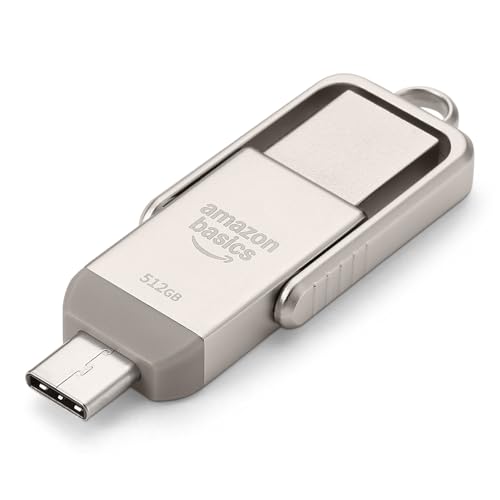
TL;DR: The Amazon Basics 512 GB dual‑port flash drive offers a metal rotating case, high capacity and strong user ratings, but its $74.09 price makes it a premium choice.
This drive packs 512 GB of storage in a sleek Champagne Silver metal shell that rotates open and closed, protecting both USB‑A and USB‑C connectors. A hanging hole adds a handy storage option, and the included 1‑year limited warranty gives peace of mind.
Among the ten sticks in this roundup, it sits at the higher end of the price spectrum and carries a higher capacity than most, which are limited to 128 GB or 256 GB. Its dual‑port design matches the flexibility of several competitors, yet its metal body and rotating mechanism are more robust than the plastic or aluminum cases found elsewhere.
Reviewers consistently praise the drive’s fast large‑file transfers, noting that professional benchmarks record sequential speeds well above the advertised 400 MB/s. Users also highlight the sturdy rotating case, which adds durability.
Pros
Cons
Best for: Buyers willing to invest in a proven, high‑quality option
Avoid if: You're shopping on a tight budget — it's priced at $74.09
TL;DR: The Lexar JumpDrive Dual Drive D400 packs 128 GB into a metal swivel body, offers up to 130 MB/s reads, dual USB‑C/A connectors, and a five‑year warranty for $25.02.
What really stands out is the dual‑connector design inside a 10.16 mm‑tall, 138.43 mm‑long metal shell. The swivel mechanism lets you flip between USB‑C and USB‑A without an adapter, and the built‑in keyring loop keeps it tethered to a bag or belt. With 256‑bit AES encryption, the drive adds a layer of security for sensitive files.
Compared with the other nine entries, the D400 is longer than the Verbatim Store ’n’ Go’s 34 mm length and taller than the Zarmst USB‑C 4‑in‑1’s 5.08 mm profile. It’s a bit heavier than the SanDisk Phone Drive’s 13.6 g, but still lighter than the Thkailar 512 GB’s 91 g. In price class, it sits near the mid‑range of the list, offering a higher read speed than the Kingston Micro Duo’s 100 MB/s claim but falling short of the SSK Dual USB‑C’s 550 MB/s peak.
Professional reviewers have praised the high read speed—up to 130 MB/s—and the sturdy metal construction, noting that the keyring loop makes it ideal for mobile professionals who need quick access on the go. Users echo the same strengths, while the most common complaint is the write speed, which averages around 52 MB/s and can slow large batch transfers. The drive operates between 0 °C and 50 °C and stores data safely from –10 °C to 70 °C, fitting typical office and travel environments.
Pros
Cons
Best for: Cross‑device file transfers between USB‑C smartphones/tablets and legacy USB‑A computers, especially when you need a sturdy, encrypted stick on a budget.
Avoid if: You prioritize maximum write performance for large batch transfers or need the absolute lowest price without premium features.
TL;DR: The SanDisk 128 GB Phone Drive offers dual USB‑C/USB‑A connectivity, up to 100 MB/s read speed, and a swivel keyring design for Android users who need portable, plug‑and‑play storage.
This flash drive packs 128 GB of storage into a compact 8.6 mm‑high, 50.0 mm‑long, 15.5 mm‑wide metallic body that weighs just 0.03 pounds (13.6 g). Its USB 3.2 Gen 1 interface delivers read speeds of up to 100 MB/s and write speeds of up to 80 MB/s, while the swivel cover protects the connectors when not in use.
Compared with the other nine drives in the roundup, the SanDisk sits in the middle of the performance spectrum. Its 100 MB/s read rate is faster than the Zarmst 4‑in‑1’s 80 MB/s but slower than the Lexar D400’s 130 MB/s and far below the SSK Dual’s 550 MB/s. Write speed of 80 MB/s outpaces Zarmst’s 30 MB/s and the Lexar D400’s ~52 MB/s, yet it trails the SSK’s 520 MB/s. At 0.03 pounds, it is lighter than the Lexar D400 (0.039 pounds) but heavier than the Verbatim Store ’n’ Go (0.02 pounds). Its 128 GB capacity matches the Lexar D400 and Verbatim models, while the Zarmst and Thkailar offerings provide larger capacities.
Professional reviewers highlight the convenient 2‑in‑1 design and the automatic backup feature powered by the Memory Zone app, noting that the drive restores deleted files with RescuePRO Deluxe. Users appreciate the quick file pulls thanks to the 100 MB/s read speed, but several mention that the 80 MB/s write ceiling can feel sluggish when uploading large video batches. The drive optimizes performance for Android devices, so iPhone owners without Lightning support may find it less useful.
The swivel cover includes a keyring loop, making it easy to attach to a bag or lanyard for on‑the‑go use. SanDisk bundles the Memory Zone app and RescuePRO Deluxe, giving you both backup automation and file‑recovery tools straight out of the box. The drive operates between 0 °C and 35 °C and features a sleek metallic finish that resists everyday wear.
Pros
Cons
Best for: Android smartphone and tablet owners who need quick, on‑the‑go storage expansion, as well as photographers looking for a reliable backup stick.
Avoid if: You rely solely on iPhone or Lightning‑only devices, or you require consistently high write speeds for large file uploads.
TL;DR: The Verbatim Store 'n' Go 128 GB flash drive offers dual USB‑A/C connectors, 100 MB/s transfers and a feather‑light 9 g body for $22.07, making it a solid budget pick for mixed‑device users.
This drive’s standout feature is its dual‑connector design: a USB‑Type A plug on one side and a USB‑Type C on the other, both supporting USB 3.2 Gen 1. It packs 128 GB of FAT32‑formatted storage and delivers up to 100 MB/s transfer speed, all within an 18 mm × 34 mm × 8 mm chassis that weighs just 9 g.
Compared with the nine other flash drives in this roundup, the Verbatim is noticeably lighter than the Zarmst (32 g), Lexar JumpDrive (17.8 g) and SanDisk Phone Drive (13.6 g). Its length of 34 mm is shorter than the Lexar JumpDrive’s 138.43 mm and the SSK’s 78 mm, though a bit longer than the single‑connector drives that sit under 30 mm. Transfer speed matches the SanDisk’s 100 MB/s but trails the SSK’s 550 MB/s and the high‑end 512 GB models that claim up to 1000 MB/s. Capacity aligns with the Lexar JumpDrive and SSK at 128 GB, but is lower than the Zarmst’s 256 GB and the 512 GB options.
Professional reviewers highlight the dual connectivity as a major convenience for users juggling legacy PCs and modern USB‑C smartphones or tablets. Consumers appreciate the plug‑and‑play simplicity and the lanyard‑tethered cap that keeps the drive from getting lost. However, the physical footprint is larger than ultra‑compact USB‑C‑only sticks, and some buyers note that the $22.07 price point doesn’t stretch as far as comparable budget drives with faster speeds.
Pros
Cons
Best for: Budget‑conscious buyers seeking a reliable entry‑level option
Avoid if: You want the best value‑per‑dollar in its price range
TL;DR: The Zarmst 256 GB 4‑in‑1 USB‑C flash drive packs a sizable capacity and four native connectors into a 5.08 mm‑thin, 32 g aluminum body, but real‑world speeds fall short of the advertised 80 MB/s read.
The standout feature is its four‑in‑one connector array—Lightning, Micro USB, USB‑C and USB‑A—so you can move files between iPhone, iPad, Android phones and PCs without extra adapters. It offers 256 GB of storage in a compact 5.08 mm × 42.93 mm × 22.10 mm package, and the manufacturer claims up to 80 MB/s read and 30 MB/s write over USB.
Compared with the other nine drives in this roundup, the Zarmst is thicker than the Verbatim Store ’n’ Go (18 mm) but slimmer than the Lexar JumpDrive (10.16 mm). Its 42.93 mm length's far shorter than Lexar’s 138.43 mm and SSK’s 78.0 mm, while the 22.10 mm width is narrower than Lexar’s 101.6 mm and comparable to the SSK’s 20.5 mm. At 32 g it’s heavier than the Verbatim (9 g) and SanDisk Phone Drive (13.6 g) but lighter than the Thkailar 512 GB model (91 g). Speed‑wise, its “up to 80 MB/s” read is slower than Lexar’s 130 MB/s and SanDisk’s 100 MB/s, and the 30 MB/s write cap trails Lexar’s 52 MB/s. Capacity-wise it outpaces most peers, offering double the 128 GB of Lexar and SanDisk and the same 256 GB as the Lexar D40E.
Reviewers love the convenience of a single drive that works across iOS, Android and desktop platforms, especially the one‑click iOS backup and the EasyFlash Pro app’s AES‑256 encryption with fingerprint unlock. Real‑world transfers often hover around 20‑40 MB/s read and 15‑25 MB/s write, below the advertised peaks, and they can cause noticeable heating during prolonged transfers. Users also mention that the sliding connectors can be finicky with phones that have bulky protective cases.
Pros
Cons
Best for: Entry-level buyers or those on a tight budget
Avoid if: Reliability and user satisfaction are your top concerns
Breakdown
Lexar D40E
Pros
Vansuny USB Flash Drive 512GB
Pros
SSK Dual USB-C 128GB
Pros
Cons
Kingston Digital Data Traveler Micro Duo
Pros
Based on scoring data and product specs
Personalized picks
Best Overall Pick
Lexar D40E
Best ValueBest for: Buyers willing to invest in a proven, high-quality option
Vansuny USB Flash Drive 512GB
Best for: Audiophiles and enthusiasts seeking premium sound quality and advanced features
$55.97+$7.98 vs winner
Skip Zarmst USB-C 4-in-1 Flash Drive 256GB Blue if…
Reliability and user satisfaction are your top concerns
The Lexar D40E takes the top spot as the best‑value dual‑port flash drive. It offers a solid 4.5‑star rating from 7,223 reviewers, a fast 183 MB/s sequential read speed, and 256‑bit AES encryption for added security—all for $47.99. Its metal housing with a 360° swivel and a lightweight 0.06 lb (26 g) design make it both durable and easy to carry.
The Vansuny 512 GB USB flash drive lands as the runner‑up, ideal if you need massive storage and ultra‑fast transfers for 4K video editing or large game libraries. It packs 512 GB of capacity, read and write speeds up to 1000 MB/s, and OTG support, all for $51.97.
For those on a tighter budget or looking for a different price tier, consider these alternatives:
Pick the Lexar D40E for the best value and enjoy fast, secure transfers on any device.
The Lexar D40E stands out for travelers with its metal housing, 360° swivel design, and a built‑in lanyard hole, making it easy to attach to a bag or keyring. At 12 mm thick and weighing only 26 g, it’s compact yet durable, and its plug‑and‑play compatibility with both USB‑A and USB‑C devices adds convenience.
No reviews yet — be the first to share your experience.
Please sign in to leave a review