⚡ Quick Answer
When you need to move sensitive files without leaving a software footprint, a hardware‑encrypted USB flash drive can be a lifesaver. In this roundup we looked at 8 options that span three price tiers – budget choices like the Kingston Ironkey Locker+ 50 at $50.99, mid‑range models such as the Apricorn Aegis Secure Key 3 NXC for $83.99, and premium offerings like the iStorage datAshur PRO 128 GB at $246.95. All of them promise AES‑256 encryption, but they’re different in durability, capacity and user interface.
For example, the Apricorn drive has a crush resistance of 6500 lb and a built‑in keypad, while the iStorage PRO reaches read speeds up to 310 MB/s and can survive a 4 m drop. The Kingston Ironkey Locker+ 50 carries a 4.5‑star rating from 800 reviews and delivers 145 MB/s read performance in a metal shell that’s just 20 g. On the budget end, the iStorage datAshur Personal2 offers 8 GB of storage for $69.95 and a 4.3‑star rating from 276 reviewers.
Below we break down each model’s strengths, so you’ll match the drive to your security needs and travel habits.

Apricorn Aegis Secure Key 3 NXC 4GB-Black
Its 6500 lb crush resistance protects data even if the drive is dropped or crushed, making it the most reliable mainstream choice.

iStorage datAshur PRO 128GB
Ideal for power users who need premium performance, even at $163 more than the Top Pick.

Kingston Ironkey Locker+ 50
Stands out with an ultra‑slim 9.6 mm height, offering a pocket‑friendly form factor the bulkier rivals lack.
Also considered
Score Analysis
Key score advantages vs. runner-up (iStorage datAshur PRO)
Price Range
Apricorn Aegis Secure Key 3 NXC 4GB-Black
$99.99
iStorage datAshur PRO 128GB
$244.95
Kingston Ironkey Locker+ 50
$50.99
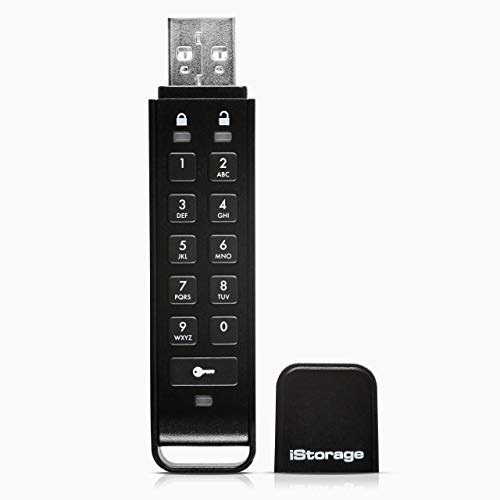
iStorage datAshur Personal2 8GB
$69.95

Corsair Flash Padlock 3 256GB Black
$134.99

iStorage datAshur BT 64GB
$61.00

Kanguru Defender Elite300 16GB
$104.49

Corsair Padlock 3 64GB
$69.99
Spec Comparison
TL;DR: The Apricorn Aegis Secure Key 3 NXC packs 256‑bit AES‑XTS hardware encryption, a 4 GB capacity, and a crush‑resistant aluminum shell that can survive up to 6 500 lb of force.
The standout spec is its FIPS 140‑2 Level 3‑validated 256‑bit AES‑XTS encryption, combined with a built‑in 7‑15‑digit PIN keypad and self‑destruct after multiple failed attempts. The drive also offers crush resistance of 6 500 lb, an IP68‑like waterproof rating, and shock resistance of 1 500 G (0.5 ms), all within a 22 g (0.05 pounds) aluminum body.
Compared with the seven other encrypted flash drives in this roundup, the Aegis Secure Key is heavier than the 15 g Corsair Padlock 3 and the 14 g iStorage datAshur Personal2, yet matches the 22 g weight of the Corsair Flash Padlock 3. Its 4 GB capacity is the smallest of the group, where peers range from 8 GB up to 256 GB. The 171 MB/s read and 160 MB/s write speeds sit on par with the fastest listed peer (iStorage Personal2 at 170 MB/s read) and outpace several lower‑speed models.
Reviewers praise the rugged extruded aluminum case, noting the IP68‑like dust and water resistance and the tamper‑evident design that deters physical attacks. The malware‑resistant AegisWare firmware, which disables BadUSB exploits, also receives positive mentions. The main criticisms focus on the limited 4 GB storage, which confines the drive to small documents, and the modest transfer speeds that lag behind high‑performance options such as the iStorage PRO.
Additional technical details include an internal rechargeable battery that powers PIN entry, a USB 3.2 Gen 1 Type‑C interface (up to 5 Gbps), operating temperatures from 0 °C to 70 °C, and humidity tolerance up to 95 % at ≤55 °C. The device also meets TAA compliance and offers a lock‑override feature for added flexibility.
Pros
Cons
Best for: Security‑focused professionals who need a highly durable, hardware‑encrypted USB‑C drive for small, sensitive files.
Avoid if: You require large storage capacities, ultra‑fast data transfers for big media, or a lighter, capacity‑rich alternative.
TL;DR: The iStorage datAshur PRO 128 GB packs FIPS‑validated AES‑256‑XTS encryption, IP68‑rated aluminum armor and up to 310 MB/s reads, but its bulk and battery‑dependent keypad make it a premium‑only choice.
What really sets this drive apart is its security hardware. It encrypts everything with AES‑XTS 256‑bit, FIPS 140‑2 Level 3 certification and a 7‑15 digit PIN keypad powered by a 3.7 V lithium‑polymer battery. The chassis is hard‑anodized aluminum with an IP68 rating, survives a 4 m drop onto concrete, and can take up to 2.7 tons of crush pressure. Performance‑wise, iStorage advertises up to 310 MB/s read and 246 MB/s write speeds, while offering 128 GB of storage.
Compared with the seven other drives in this roundup, the datAshur PRO weighs roughly 0.06 lb, making it the heaviest and edging out the lightest peer at about 0.03 lb. Capacity sits in the upper tier: only the Corsair Flash Padlock 3 tops it with 256 GB, while the rest range from 4 GB to 64 GB. Its price point lands it in the premium segment, and its 4.2‑star rating from 581 reviews is solid but not the highest among the group.
Reviewers consistently praise the military‑grade encryption and the rugged aluminum build, calling it “built for harsh environments.” However, several users note that real‑world read/write speeds can fluctuate, with some seeing results far below the 310 MB/s claim. The keypad’s battery also needs occasional charging, which some find inconvenient. Finally, the drive’s bulkier dimensions make it less pocket‑friendly than the slimmer rubber‑cased competitors.
Additional technical touches include a built‑in keyring, LED status indicator, read‑only mode for extra data safety, and tamper‑evident epoxy resin internals. The USB 3.2 Gen 1 Type‑A interface remains backward compatible, and the included aluminum sleeve adds extra protection when the drive is on the move.
Pros
Cons
Best for: Organizations and professionals that must protect sensitive data under strict regulations and need a rugged, hardware‑encrypted USB drive.
Avoid if: You're on a tight budget, need a ultra‑slim flash drive, or can't accommodate a battery‑powered keypad.
TL;DR: The Kingston IronKey Locker+ 50 packs FIPS‑certified AES‑256‑XTS hardware encryption, 32 GB of storage and a compact metal case into a 0.044 lb USB 3.2 flash drive for professionals who need secure, portable data.
The standout feature is its enterprise‑grade encryption: AES‑256‑XTS, which FIPS 197 certifies, plus digitally‑signed firmware for BadUSB protection and a lock that triggers after ten failed PIN attempts. The drive holds 32 GB and delivers up to 145 MB/s read and 115 MB/s write speeds, all while weighing just 0.0440924524 pounds and measuring 9.6 mm × 18.6 mm × 60.6 mm.
Compared with the other seven contenders, the IronKey weighs less than the iStorage datAshur BT (0.03637627323 pounds) yet offers a smaller capacity than its 64 GB sibling and the Corsair Padlock 3’s 64 GB. Its read speed of 145 MB/s trails iStorage’s 170 MB/s and the Apricorn Aegis’s 171 MB/s, and its write speed of 115 MB/s falls short of iStorage’s 130 MB/s and the Aegis’s 160 MB/s. Nonetheless, its price sits below many higher‑capacity models, and it carries a five‑year warranty.
User feedback praises the “enterprise‑grade data protection” and notes that no software install’s needed on Windows 10/11 or macOS 10.14–15. Reviewers also note performance can dip to around 30 MB/s read and 20 MB/s write on legacy USB 2.0 ports, and the 32 GB size may feel restrictive for larger projects. The drive also supports cloud backup to Google Drive, OneDrive, Amazon S3, Dropbox and Box, providing an off‑site safety net.
Pros
Cons
Best for: Professionals handling confidential data, frequent travelers needing secure portable backups, and small teams that value hardware encryption and a rugged metal design.
Avoid if: You require large storage capacities, Linux compatibility, or a low‑cost generic USB drive without advanced security features.
TL;DR: The iStorage datAshur Personal2 packs 8 GB of storage, XTS‑AES 256‑bit hardware encryption and up to 170 MB/s read speed into a 14 g, key‑chain‑sized USB‑3.0 drive for $69.95.
Its built‑in XTS‑AES 256‑bit hardware encryption stands out, running in real time without needing drivers. It stores 8 GB of data and can read at up to 170 MB/s and write at up to 135 MB/s, all powered by a 3.7 V rechargeable Li‑Polymer battery. At just 14 g (0.03 lb) and measuring 83 mm × 17.4 mm × 8.6 mm, it’s truly pocket‑friendly.
Compared with the other seven encrypted sticks, the Personal2 weighs less than the Corsair Padlock 3 (15 g) and iStorage datAshur BT (16.5 g) but a bit more than the Kanguru Defender Elite300 (12 g). Its 8 GB capacity makes it the smallest in the set, far below the 64 GB that the Corsair Padlock 3 and iStorage BT provide, and well under the 256 GB of the Corsair Flash Padlock 3. Pricing lands in the same budget tier as the Corsair Padlock 3, yet it offers a comparable read speed to the iStorage BT (both advertise up to 170 MB/s).
Users consistently praise the ultra‑compact, key‑chain‑compatible shape and the epoxy‑coated, wear‑resistant keypad that feels solid in daily use. Professional reviewers note the “world’s most portable personal encrypted USB drive” label thanks to its tiny footprint. The main complaints revolve around the limited 8 GB capacity, which many say feels low for modern file sizes, and occasional variability in real‑world speed versus the advertised 170 MB/s. Some find the 7‑15 digit PIN pad a bit fiddly for frequent entry.
Additional technical details include bootable support, compatibility with Windows, macOS, Linux, Chrome, Android, Thin Clients, Zero Clients, Embedded Systems, Citrix and VMware, and a 3‑year limited warranty. The device’s 3.7 V battery powers the keypad and encryption engine, and the USB 3.0 (USB 3.2 Gen 1) interface promises up to 5 Gbps transfer rates.
Pros
Cons
Best for: Entry‑level buyers or anyone needing a tiny, hardware‑encrypted USB drive for occasional sensitive files.
Avoid if: You need high‑capacity storage or consistently top‑tier transfer speeds for large media libraries.
TL;DR: The Corsair Flash Padlock 3 offers 256 GB of storage with AES‑256‑XTS hardware encryption, a built‑in keypad and USB 3.0, but its 15‑18 MB/s read speed and 8 MB/s write speed feel sluggish for large file transfers.
The standout specification is the massive 256 GB capacity paired with AES‑256‑XTS hardware encryption, meaning you get strong, on‑device protection without installing any software. You enter a 4‑10 digit PIN on the drive’s built‑in keypad, and the USB 3.0 interface lets you plug it into Windows, macOS or Linux machines straight out of the box.
Compared with the other seven drives in this roundup, the Padlock 3 is a bit heavier than the Kanguru Defender Elite300’s 0.03 pounds, and its 86 mm length exceeds the 77.21 mm length of the Kanguru as well as the 60 mm length of the iStorage datAshur BT. It also carries a larger form factor than the compact iStorage datAshur PRO, which features a slimmer profile. While the Padlock 3’s price sits in the premium tier, it provides more storage than the 64 GB Kanguru or the 64 GB iStorage BT, and it offers a full five‑year warranty that many lower‑priced peers lack.
Professional reviewers praise the drive’s “no‑driver” setup and cross‑platform compatibility, but they also flag the transfer speeds—averaging roughly 15‑18 MB/s for reads and 8 MB/s for writes—as a bottleneck for large files. Users frequently mention the short auto‑lock window of 10‑20 seconds and the bulkier shape that can block neighboring USB ports on thin laptops. The embedded, non‑replaceable battery powers the keypad, but it can’t be swapped out.
Pros
Cons
Best for: Travelers, shared‑workstation users, and anyone who values strong, hardware‑based encryption and a hassle‑free, driver‑free experience.
Avoid if: You need fast transfers, a compact drive that fits tight spaces, or advanced security features for high‑risk environments.
“Performance good enough for general use; easy setup.”
“Good price‑quality security ratio; usability strong but design humble.”
TL;DR: The iStorage datAshur BT packs 64 GB of encrypted storage, Bluetooth‑based biometric unlocking and IP57 protection into a 7.5 mm, 16.5 g flash drive for about $61.
This drive’s standout feature is its AES‑XTS 256‑bit hardware encryption, which meets FIPS 140‑2 Level 3 certification, combined with a smartphone‑based Bluetooth app that supports password, face ID, fingerprint and iris authentication. It offers a 64 GB capacity, up to 170 MB/s read speed and up to 130 MB/s write speed, and it’s powered by a 3.7 V Li‑Polymer rechargeable battery.
Compared with the other seven flash drives in the roundup, the datAshur BT is slightly heavier than the 8 GB iStorage Personal2 (0.0309 lb vs 0.0364 lb) but still lighter than the Kingston Ironkey Locker+ (0.0441 lb). Its 7.5 mm profile is far slimmer than the Corsair Padlock 3’s 15 mm height, though it lacks the built‑in PIN keypad the Corsair model provides. Read‑speed matches the Personal2’s 170 MB/s but trails the Apricorn Aegis’s 171 MB/s and the iStorage PRO’s 310 MB/s. Write speed is modestly lower than the Personal2’s 135 MB/s and the Apricorn’s 160 MB/s.
Professional reviewers praise the military‑grade encryption and the convenience of unlocking via a mobile app, but they also point out the dependency on a paired smartphone and the absence of a standalone keypad or dedicated fingerprint sensor. Because the drive isn’t bootable, it suits executives, healthcare staff or field IT admins who need secure, portable data without having to start a system from the USB.
Additional technical points include an IP57 rating that guards against dust and immersion up to 1 m for 30 minutes, LED status indicators, a key‑ring for easy attachment, and a three‑year warranty. The 16.5 g weight and compact 7.5 mm thickness make it easy to slip into a pocket or bag without adding bulk.
Pros
Cons
Best for: Entry-level buyers or those on a tight budget
Avoid if: You want the best value-per-dollar in its price range
TL;DR: The Kanguru Defender Elite300 16GB delivers FIPS‑140‑2 Level 2 AES‑256‑XTS hardware encryption, a physical write‑protect switch, and rugged durability, but its slower 150 MB/s read speed and $104 price make it a premium‑only choice.
What really sets this drive apart is its security suite: 256‑bit AES‑XTS encryption certified to FIPS 140‑2 Level 2, RSA‑2048 digitally‑signed firmware, and a built‑in Bitdefender 30‑day antivirus trial. The 16 GB capacity pairs with up to 150 MB/sec read and up to 100 MB/sec write speeds, while the device stays lightweight at just 0.03 lb.
Compared with the seven other flash drives in this roundup, the Defender Elite300 sits in the low‑mid capacity tier—more than the 4 GB Apricorn Aegis Secure Key but far below the 256 GB Corsair Flash Padlock. It’s also lighter than most peers, weighing 0.03 lb versus 0.05 lb for the Apricorn and 0.048 lb for the Corsair Flash. Its read speed trails the 171 MB/s of the Apricorn and the 170 MB/s of the iStorage datAshur Personal2, yet nudges ahead of Kingston’s 145 MB/s Ironkey. Write performance is slower than the 160 MB/s offered by the Apricorn and the 135 MB/s of the iStorage Personal2, placing it on the lower end of the group.
Professional reviewers applaud the drive’s military‑grade build, noting the FIPS certification and RSA‑2048 firmware signing as strong safeguards for classified or regulated data. Everyday users appreciate the plug‑and‑play encryption and the physical write‑protect switch, but many report slower transfers on legacy USB 2.0 ports and a learning curve when configuring the hardware encryption. The drive also endures harsh environments with water resistance, a 1000 G shock rating, and an operating temperature range of 0 °C to +70 °C. Power draw stays modest at 5 VDC @ 122 mA for reads and 5 VDC @ 182 mA for writes.
Pros
Cons
Best for: IT administrators, government or military personnel, and finance or healthcare professionals who need certified, hardware‑encrypted storage and are willing to invest in premium security.
Avoid if: you prioritize high transfer speeds, low cost, or a simple plug‑and‑play experience without advanced security features.
TL;DR: The Corsair Padlock 3 64 GB flash drive packs 256‑bit AES hardware encryption, a built‑in PIN keypad and rugged, water‑resistant housing for $69.99, though its bulk and unspecified speeds may deter casual users.
The standout feature is its 256‑bit AES hardware encryption, FIPS 197‑compliant, paired with a built‑in PIN keypad that works without any software. At 64 GB, it offers a mid‑range capacity while weighing only 0.03 lb and measuring 15 mm × 98 mm × 138 mm, making it sturdy yet portable enough for field work.
Compared with the other seven drives in this roundup, the Padlock 3 holds more capacity than the 8 GB iStorage datAshur Personal2 and the 4 GB Apricorn Aegis Secure Key, yet it’s lighter than the 0.05 lb Apricorn and the 0.05 lb Corsair Flash Padlock 3 256 GB model. Its length of 138 mm and width of 98 mm are larger than the 60 mm × 18 mm footprint of the iStorage datAshur BT 64 GB, which also weighs a bit more at 0.04 lb.
Users consistently praise the “government‑grade” encryption and the convenience of the keypad, noting that it removes the need for extra software on Windows, macOS or Linux. A common criticism is the drive’s bulk – the keypad adds size that makes it less suited for a minimalist keyring – and reviewers point out that the manufacturer hasn't disclosed the exact USB 3.0 read/write speeds, leaving performance expectations vague. The drive plugs into a USB 3.0 Type‑A port and comes with a five‑year limited warranty.
Pros
Cons
Best for: Professionals handling sensitive or confidential data who need hardware encryption without installing software.
Avoid if: You have limited desk space or need a compact, low‑profile flash drive.
Breakdown
Apricorn Aegis Secure Key 3 NXC 4GB-Black
Pros
iStorage datAshur PRO 128GB
Pros
Kingston Ironkey Locker+ 50
Pros
iStorage datAshur Personal2 8GB
Pros
Cons
Based on scoring data and product specs
Personalized picks
Best Overall Pick
Apricorn Aegis Secure Key 3 NXC 4GB-Black
Best OverallBest for: Most users seeking a balanced, mainstream option
iStorage datAshur PRO 128GB
Best for: Those prioritizing quality and willing to pay for premium performance
$244.95+$144.96 vs winner
Skip Corsair Padlock 3 64GB if…
You have limited desk space or need portability
Apricorn’s Aegis Secure Key 3 NXC 4 GB in black wins the top spot, thanks to its military‑grade 256‑bit AES XTS encryption certified to FIPS 140‑2 Level 3, an IP68 seal that guards against dust and water, and a crush resistance rating of 6 500 lbs. It delivers read speeds of 171 MB/s and write speeds of 160 MB/s, all while weighing just 22 g and carrying a 4.4‑star rating from 191 reviews.
The runner‑up is the iStorage datAshur PRO 128 GB, which shines when you need a larger capacity and faster transfers. It pushes read speeds up to 310 MB/s and writes up to 246 MB/s, packs a 128 GB drive, and adds rugged features like IP68 protection, 2.7‑ton crush resistance and a protective aluminum sleeve—all for a price of $246.95.
For tighter budgets, the Kingston Ironkey Locker+ 50 offers solid encryption at a friendly $50.99. If you’re after a mid‑range balance of price and protection, the Corsair Padlock 3 64 GB sits at $69.99 and delivers reliable hardware‑locked security. And for those who want the premium experience, the iStorage datAshur PRO remains the top high‑end choice with its sturdy build and top‑tier speeds.
Pick the Apricorn Aegis Secure Key 3 NXC today and secure your data with confidence.
The Apricorn Aegis Secure Key 3 NXC offers IP68 water resistance, crush resistance of 6,500 lbs, and shock resistance of 1,500 G, making it highly durable in harsh environments. Its compact dimensions (81 mm × 18.4 mm × 9.5 mm) and lightweight design (22 g) also help it stay portable on the go.
No reviews yet — be the first to share your experience.
Please sign in to leave a review