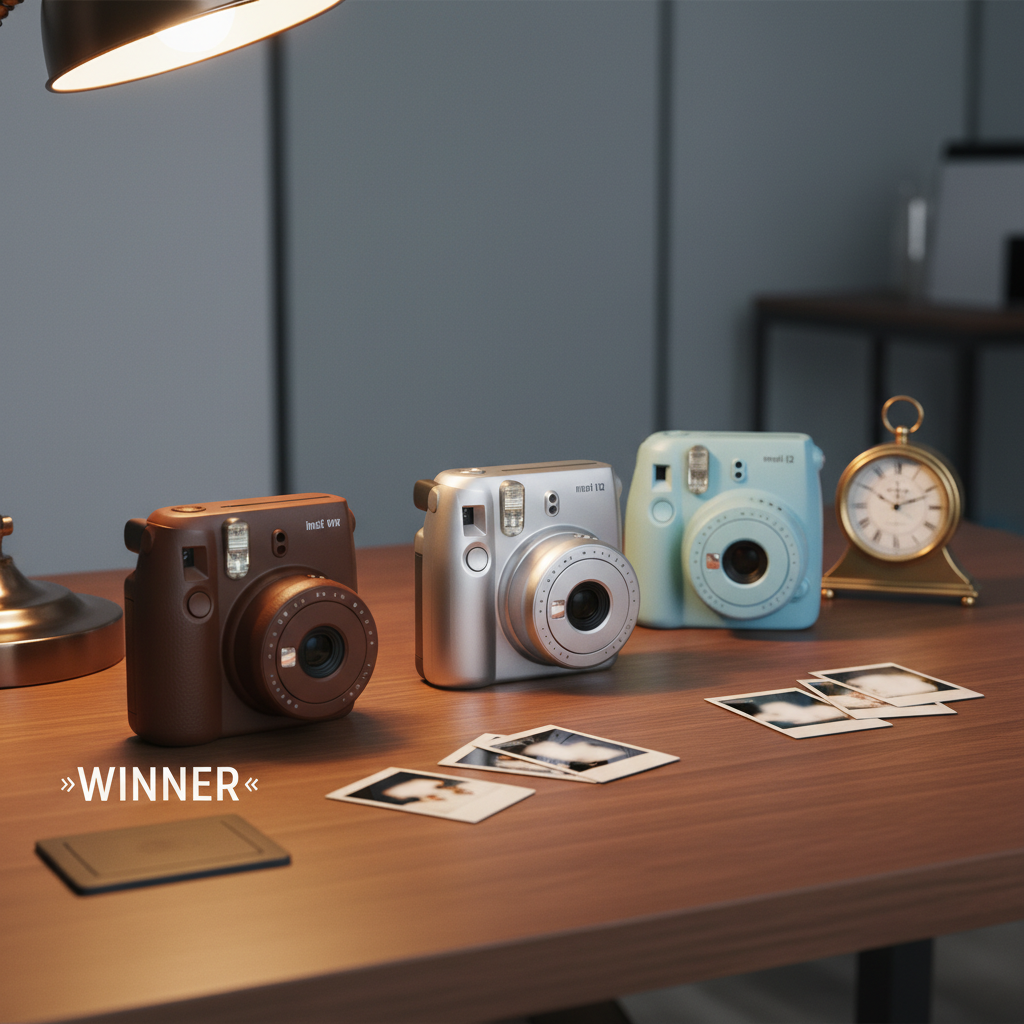
It might raise an eyebrow that the most budget‑friendly option – the Instax Mini 12 in Blossom Pink at $83.95 – carries the same 4.6‑out‑of‑5 rating (2,653 reviews) as the premium Mini EVO Brown priced at $234.00 (4.6/5 from 2,396 reviews). In a lineup where price spans from $83.95 to $234.00, the cheap pick isn’t sacrificing the crowd‑pleasing instant‑photo experience.
Eight Fujifilm Instax cameras were compared, organized into three price tiers. The budget tier includes the Mini 12 models (Blossom Pink, Pastel Blue, Lilac Purple) and the Mini 12 Mint Green, all hovering around $84‑$91 and weighing roughly 0.67‑1.0 pounds. Mid‑range brings the Mini 11 Lilac at $97.99 (1.01 pounds) and the Mini 12 Mint Green at $91.38, while the premium tier features the Wide 400 Sage at $169.89 (1.34 pounds) and the feature‑rich Mini EVO variants at $234.00, each under 0.63 pounds.
The following breakdown shows how each model’s specs and user feedback stack up, helping you pinpoint the Instax camera that fits your style and budget.

Fujifilm Instax Mini EVO Instant Camera - Brown
Its battery lasts for about 100 prints on a full charge, letting you shoot all day without recharging.

Fujifilm Instax Mini EVO Instant Camera
Ideal for audiophiles and enthusiasts who want premium sound, and it costs the same $234.00 as the Top Choice.

Fujifilm Instax Mini 12 Pastel Blue
Features auto power‑off after five minutes of inactivity and comes at $86.50, a clear price break from the Mini EVO models.
Also considered
Score Analysis
Key score advantages vs. runner-up (Fujifilm Instax Mini)
Price Range
Fujifilm Instax Mini EVO Instant Camera - Brown
$234.00
Fujifilm Instax Mini EVO Instant Camera
$228.99
Fujifilm Instax Mini 12 Pastel Blue
$83.95
Fujifilm Instax Mini 11 Lilac
$97.89

Fujifilm Instax Mini 12 Lilac Purple
$72.95

Fujifilm Instax Mini 12 Instant Camera - Blossom Pink
$83.95

Fujifilm Instax Mini 12 Instant Camera - Mint Green
$89.00

Fujifilm Instax Wide 400 Sage
$169.81
Spec Comparison
TL;DR: The Fujifilm Instax Mini EVO in brown blends a 5 MP sensor, f/2.0 lens and a 3‑inch LCD with instant printing, offering 100 creative combos and up to 100 prints per charge for $234.00.
The camera’s standout feature is its 3.0‑inch TFT LCD (≈460,000 dots), which lets you frame, preview, and edit shots before they hit instant film. Coupled with a 5 MP (2560×1920) 1/5‑inch CMOS sensor and a fast f/2.0 lens at 28 mm, it delivers sharp images even in low‑light situations. The built‑in battery supplies roughly 100 prints per full charge, and a 2‑3 hour (≈150 minutes) charge restores full capacity.
At 0.62 pounds, this EVO's lighter than the Instax Wide 400 (over 1.3 pounds) and the Mini 12 line, which tip the scale at around 0.67 pounds or more. It also beats the Mini 12 models’ f/12.7 aperture, giving it a clear edge in dim environments. Compared with the other Instax Mini EVO variant (0.63 pounds, f/2.0, 28 mm, 4.9 MP), the brown version is marginally lighter, shares the same lens specs, and offers a higher‑resolution sensor.
Reviewers love the hybrid workflow: the LCD and 100 lens‑plus‑film effect combos (10 × 10) make on‑the‑spot creativity effortless, and Bluetooth 4.2 lets you print directly from a phone. Users note the internal memory holds only about 45 images, so a microSD card is essential for larger shoots. The navigation relies on physical buttons—there’s no touchscreen—and some owners report occasional Bluetooth pairing hiccups. Older units still charge via Micro‑USB, which feels dated against newer USB‑C‑only devices.
Pros
Cons
Best for: Creative hobbyists who enjoy experimenting with filters and instant prints, and travelers who want a lightweight hybrid camera.
Avoid if: You need high‑resolution digital files, video recording, extensive on‑camera storage, or a touchscreen interface.
TL;DR: The Instax Mini EVO blends digital preview, a fast f/2.0 lens and 100 creative effects with instant Mini prints, but its 100‑print battery may limit marathon shooting sessions.
The standout spec is its f/2.0 aperture paired with a 28 mm equivalent lens and a 4.9 MP 1/5‑inch CMOS sensor. This combination lets you capture brighter images in low‑light situations and still enjoy the nostalgic 2″ × 3″ Instax Mini format. A 3.0‑inch TFT LCD (460,000 dots) lets you preview, edit and select which shots to print, cutting down on wasted film.
At 0.63 pounds, the EVO is lighter than most Mini 12 and Mini 11 models in this roundup and only a shade heavier than the brown‑finished Mini EVO sibling. The manufacturer lists battery life at about 100 prints per full charge, matching the Mini 11, Mini 12 and Wide 400, but it’s still a consideration for all‑day events. Feature‑wise it outpaces the other cameras: it offers 10 lens effects plus 10 film effects for 100 possible combos, Bluetooth 4.2 BLE for remote shooting, and a microSD slot for expanded storage—features the Mini 12 and Mini 11 models don’t mention.
Reviewers love the digital preview because it lets you tweak exposure, apply filters and avoid blowing through a pack of film. Reviewers frequently praise the vibrant RGB 256‑color gradation and 16‑second print output time for producing sharp, colorful prints. On the flip side, users note that the LCD can be hard to read in bright sunlight, the battery will run out after roughly 100 prints, and the lack of an included memory card means you’ll need to buy one separately. Professional reviewers also point out that the final image has a cleaner, less grainy look than a pure analog shot, which may not satisfy purists.
Technical details round out the experience: the camera stores up to 45 images internally and can hold about 850 images per gigabyte on a microSD card. You can reprint any of the last 50 images from the print history, and the self‑timer offers 2‑second and 10‑second options. Flash coverage spans 50 cm to 1.5 m, and exposure compensation ranges from –2.0 to +2.0 EV in 1/3‑EV steps.
Pros
Cons
Best for: Creative hobbyists, party‑goers, travelers and social‑media enthusiasts who want instant physical photos with digital flexibility.
Avoid if: You need professional‑grade battery endurance, prefer the pure analog grain of classic Instax, or are on a tight budget.
TL;DR: The Fujifilm Instax Mini 12 Pastel Blue delivers fully automatic shooting, a built‑in selfie mirror and a lightweight 0.67‑pound body for under $90, making instant photos easy and portable.
The camera’s automatic exposure works within Lv 5.0 to 14.5 (ISO 800) and pairs with a constant‑firing flash that covers 0.3 m to 2.2 m, so you get consistent results without fiddling with settings. A built‑in film counter and a selfie mirror next to the lens help you track usage and frame close‑ups, while the auto power‑off after 5 minutes conserves battery life.
Weighing 0.67 pounds, the Pastel Blue version feels noticeably lighter than the Lilac Purple, Blossom Pink and Mint Green Mini 12 models, each listed at 1.0 pound. All three share the same f/12.7 aperture and 60 mm focal length, but the Mini EVO line trades the f/12.7 lens for a brighter f/2.0 design while staying in a similar weight range (around 0.62–0.63 pounds). The Mini 12 family, including this pastel edition, doesn't offer a tripod mount, a limitation shared across the lineup.
Consumers have responded positively, giving the camera a 4.6‑star average from 5,580 reviews. Users highlight the ease of operation, the compact pastel styling and the reliable 90‑second film development time. Professional reviewers note the twist‑to‑power lens collar (as described in the product’s marketing) and the handy selfie mirror as strong points for beginners. Common complaints focus on the plastic feel of the body, the lack of a tripod socket for low‑light steadiness, and occasional viewfinder parallax that can affect framing.
Technical details round out the picture: the camera shoots 62 mm × 46 mm images (≈2.4″ × 1.8″) that print at 2″ × 3″, uses two AA alkaline batteries for roughly 100 exposures, and offers a shutter speed range from 1/2 sec to 1/250 sec. The real‑image viewfinder provides 0.37× magnification with parallax correction in close‑up mode (0.3 m – 0.5 m). The camera automatically ejects film, and the flash recycles in 7 seconds or less.
Pros
Cons
Best for: Budget‑conscious buyers seeking a reliable entry‑level option
Avoid if: You need advanced features or professional‑grade performance
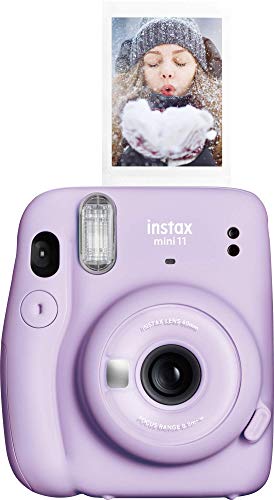
TL;DR: The Instax Mini 11 Lilac prints credit‑card sized photos with automatic exposure, a built‑in selfie mirror, and a 2.7 m flash range for $97.99.
The camera’s standout feature’s an automatic exposure system, which selects the optimal shutter speed in any lighting condition and pairs it with a built‑in constant‑firing flash that reaches up to 2.7 m. The 5‑minute auto power‑off helps conserve the two AA batteries, and the slim 1.01 pound body makes it easy to slip into a bag for on‑the‑go shooting.
Compared with the seven other Instax models in this roundup, the Mini 11 is heavier than the Pastel Blue Mini 12 at 0.67 pounds but matches the weight of the Mint Green and Lilac Purple Mini 12 units (both around 1.0 pound). Its recycle time’s a shade quicker than the 7‑second or less recycle time listed for the Mini 12 variants and the Wide 400, giving you a marginally faster next shot. All models share the same 5‑minute auto power‑off, so battery endurance is similar across the board.
Users love how the selfie mode works with a front‑facing mirror built into the lens barrel, making quick self‑portraits feel natural. Reviewers also highlight the high‑key mode for bright portraits. On the flip side, some note that the flash can fire unexpectedly, and the AA battery life feels shorter than hoped when shooting many frames. Enthusiasts who want steadier shots frequently complain about the missing tripod mount and remote shutter.
Technically, the Mini 11 sports a 60 mm focal length lens with two components and two elements, an aperture of f/12.7, and a focusing range that starts at 0.3 m for both standard and selfie modes, extending to infinity for regular subjects. Each print measures 54 mm × 86 mm, while the underlying photo area is 62 mm × 46 mm. Film develops in about 90 seconds, giving you a tangible memory in under two minutes after each click.
Pros
Cons
Best for: Most users looking for a well‑reviewed, reliable mainstream option
Avoid if: You need advanced features or professional‑grade performance
TL;DR: The Fujifilm Instax Mini 12 Lilac Purple blends a cute, compact body with automatic exposure, a selfie mirror and a quick‑eject print system, making it a solid entry‑level instant camera for beginners.
This model’s standout feature is its twist‑to‑power lens that powers the camera on and off in a single motion, paired with an aperture of f/12.7 and a flash recycle time of 7 seconds or less. It uses two AA batteries and will shoot roughly 10 film packs (about 100 exposures) before you need fresh batteries. Each print ejects in about 5 seconds, then develops in approximately 90 seconds.
Compared with the other seven Instax Mini 12 variants in this roundup, the Lilac Purple is a bit heavier than the Pastel Blue version (0.67 pounds vs. 1.0 pound) but matches the Blossom Pink and Mint Green models at 1.0 pound. Its depth of 104.14 mm lines up with the Mint Green’s 104 mm depth, while the Pastel Blue sits at 122 mm, making the Lilac a slightly slimmer profile. All listed peers share the same f/12.7 aperture, so exposure performance compares across the line.
Everyday users rave about how effortless the camera feels – the automatic exposure system delivers bright photos without the “washed‑out” look that some beginners report. The built‑in selfie mirror and close‑up mode (0.3 m‑0.5 m) earn particular praise, especially for kids and teens who love quick self‑portraits. Professional reviewers note the ergonomic twist‑to‑power design and the useful parallax correction in close‑up shots. On the downside, the lack of manual controls, a tripod mount, and a self‑timer makes group shots tricky, and the battery life of roughly 100 prints may feel limited for heavy users.
Pros
Cons
Best for: Budget‑conscious buyers seeking a reliable entry‑level option
Avoid if: You need advanced features or professional‑grade performance
TL;DR: The Fujifilm Instax Mini 12 in Blossom Pink offers fully automatic shooting, a handy selfie mirror, and quick 5‑second prints for about 100 shots per AA‑battery set at a friendly $83.95 price.
The camera’s most distinctive spec is its twist‑to‑power lens collar paired with a fixed f/12.7 aperture, which lets you snap a photo with a single turn and a single press. With a battery life of 100 shots per set of AA cells, you can keep the party going without hunting for replacements. The built‑in flash fires constantly within a 0.3‑to‑2.2 m range, and the 5‑second print time followed by a 7‑second recycle keeps the flow steady.
Compared with the other seven Instax models in this roundup, the Blossom Pink version is heavier than the Pastel Blue (0.67 lb) and the Mini EVO variants (around 0.62‑0.63 lb), but matches the Lilac Purple and Mint Green variants at roughly 1.0 lb. Its height of 122 mm also exceeds the Pastel Blue’s 104 mm, while its width of 104 mm is wider than the Pastel’s 66.6 mm, giving it a more substantial feel than some of the slimmer peers.
User sentiment highlights the camera’s cute design and effortless operation. Reviewers love the selfie mirror for quick self‑portraits and appreciate the automatic exposure that eliminates guesswork. Professional reviewers note the improved usability over the Mini 11 thanks to the twist‑to‑power control, but they also point out the plastic body feels less durable and the lack of a tripod socket limits low‑light or group shots. The 0.3 m minimum focus distance and 60 mm focal length make close‑ups easy, while the 0.37× optical viewfinder helps frame shots despite the fixed focus.
Pros
Cons
Best for: Budget‑conscious buyers seeking a reliable entry‑level option
Avoid if: You want the best value‑per‑dollar in its price range
TL;DR: The Fujifilm Instax Mini 12 in Mint Green offers a twist‑to‑power lens, built‑in selfie mirror, and automatic exposure, printing 2×3 in photos in about five seconds for a playful, beginner‑friendly instant photography experience.
The camera’s standout feature is its twist‑to‑power lens collar, which turns the unit on and off while also switching between standard and close‑up focus. It pairs a modest f/12.7 aperture with a constant‑firing flash that recycles in 7 seconds or less, so you’re ready for the next shot quickly. Prints appear in roughly five seconds, and the film finishes developing after about 90 seconds. At 1.0 pounds, the Mini 12 feels solid enough for handheld use without being cumbersome.
Compared with the other seven cameras in this roundup, the Mini 12 shares its f/12.7 aperture and 7‑second flash recycle time with the Lilac Purple and Blossom Pink models, while its weight matches the Lilac Purple at 1.0 pounds. It is heavier than the Pastel Blue, which lists 0.67 pounds, and also heavier than the EVO Brown at 0.62 pounds, but lighter than the Wide 400, which tips the scales at over 1.3 pounds. The battery life—about ten packs of INSTAX Mini film (100 exposures)—mirrors the Lilac Purple and Pastel Blue, placing it solidly in the middle of the line’s endurance range.
Users repeatedly praise the intuitive twist‑to‑power operation and the handy selfie mirror, noting that the close‑up mode with parallax correction makes self‑portraits effortless. Professional reviewers highlight the improved lens collar over the Mini 11 and commend the automatic exposure for delivering bright, non‑washed‑out images. On the downside, many mention the all‑plastic build feels cheap, and the lack of a tripod mount limits stability in low‑light situations. The camera also doesn’t offer manual exposure controls, which can disappoint enthusiasts seeking creative flexibility.
From a technical standpoint, the Mini 12 works with 2 × AA alkaline batteries and offers an effective flash range of 0.3 to 2.2 m. Its fixed 60 mm focal length and 30 cm minimum focus distance suit everyday snapshots and close‑up subjects alike. The built‑in selfie mirror and compatibility with the instax UP! mobile app let you scan, edit, and save digital copies of your prints, adding a modest digital twist to the instant experience.
Pros
Cons
Best for: Teens, young adults, and kids who want a well‑reviewed, easy‑to‑use instant camera that delivers quick, fun prints.
Avoid if: You need advanced manual controls, tripod compatibility, or professional‑grade performance.
TL;DR: The Fujifilm Instax Wide 400 Sage prints large 86 mm × 108 mm photos with fully automatic exposure, but its $169.89 price and bulkier build make it a premium choice for group‑shot lovers.
The standout spec is the use of Instax WIDE film (86 mm × 108 mm) that yields 62 mm × 99 mm prints—far larger than the Mini format found in the other seven cameras. Its 95 mm retractable lens at f/14 provides a natural field of view, and the built‑in automatic flash covers 0.9 m to 3 m, letting you capture group moments without fiddling with settings. The manufacturer lists battery life at approximately 100 exposures per set of AA batteries, and each print takes about 90 seconds to develop, matching the speed users expect from an instant camera.
Compared with the Mini EVO and Mini 12 models, the Wide 400 is pricier and noticeably heavier at 1.3448197993277533 lb, while the Mini cameras sit around half a pound. It also lacks the Bluetooth connectivity and digital memory found in the Mini EVO, positioning it as a more analog‑focused option. On the upside, its larger film format means you get wider landscape or group shots that the Mini line simply can’t match.
Reviewers consistently praise the camera’s ease of use: the automatic exposure works reliably, and the 0.37× real‑image viewfinder gives a clear preview of the wide frame. Users love the included close‑up lens and angle‑adjustment accessory, which help stabilize shots without a tripod. However, some owners report occasional film‑ejection jams and note that indoor lighting can produce over‑ or under‑exposed images because the camera offers no exposure compensation or manual overrides. The class standard includes a 5‑minute auto power‑off and a 7‑second flash recycle time, but the bulkier body makes it less ideal for travel.
Pros
Cons
Best for: Those who value large, high‑impact instant prints and want a hassle‑free, fully automatic camera for events and group photography.
Avoid if: You need a lightweight travel camera, want manual exposure control, or are looking for a budget‑friendly instant shooter.
Breakdown
Fujifilm Instax Mini EVO Instant Camera - Brown
Pros
Fujifilm Instax Mini EVO Instant Camera
Pros
Fujifilm Instax Mini 12 Pastel Blue
Pros
Fujifilm Instax Mini 11 Lilac
Pros
Based on scoring data and product specs
Personalized picks
Best Overall Pick
Fujifilm Instax Mini EVO Instant Camera - Brown
Best OverallBest for: Audiophiles and enthusiasts seeking premium sound quality and advanced features
Fujifilm Instax Mini EVO Instant Camera
Best for: Audiophiles and enthusiasts seeking premium sound quality and advanced features
$228.99-$5.01 vs winner
Skip Fujifilm Instax Wide 400 Sage if…
You're on a tight budget or only need basic functionality
The Fujifilm Instax Mini EVO Instant Camera in Brown takes the top spot with a solid 4.6 / 5 rating from 2,396 reviews, a lightweight 0.62 pounds build, and the ability to print a photo in just 16 seconds. Its 100‑print battery life and 100 creative combos (10 lens × 10 film effects) give you plenty of flexibility without frequent recharging.
Coming in second, the Fujifilm Instax Mini EVO (standard edition) shines when you need a built‑in selfie mirror and dual shutter buttons for portrait‑mode shooting. It matches the winner’s 4.6 / 5 rating (2,400 reviews) and offers the same ~100‑print battery life, making it a great choice for selfie‑heavy outings.
Per‑budget alternatives:
Pick the Fujifilm Instax Mini EVO Brown now and start printing your memories instantly.
The Fujifilm Instax Mini EVO Instant Camera in Brown delivers the clearest prints, featuring a 5 MP 1/5‑inch CMOS sensor, f/2.0 aperture, and 1600×600‑dot print resolution, which outperforms the other Mini models. Priced at $234.00, it provides a clear quality advantage at its tier.
Please sign in to leave a review
No reviews yet. Be the first to review!
