⚡ Quick Answer
Choosing an under‑sink water filter means balancing cost, space, and how much contamination you need to strip out. In this roundup we examined 11 models, spanning budget‑friendly units at $37.99 up to premium systems near $250. The selection covers three price tiers – a budget group (four Waterdrop models), a mid‑range pair (Waterdrop UA‑5Y and iSpring CU‑A4), and a premium class (iSpring RCC7, APEC Essence, iSpring RCC7AK Black, Express Water RO5DX). Each product’s flow rate, filter life and certifications were weighed against real‑world installation ease and ongoing expense.
The Waterdrop 10UA draws attention with its $37.99 list price, a 4.6‑star rating from 12,962 reviews, and an annual operating cost of about $33. Its compact 12.3‑inch height and 0.75 GPM flow fit snugly under most sinks, while the push‑to‑connect fittings promise a three‑minute DIY install. Despite its modest price, the system delivers multistage filtration that tackles chlorine, heavy metals, PFAS and PFOA/PFOS, keeping beneficial minerals in the water. That blend of performance and low waste makes it a compelling option among pricier rivals. Below we break down how each model stacks up on filtration strength, installation simplicity and long‑term value.


Waterdrop 15UB
Ideal for homeowners wanting a higher flow rate, the 15UB costs about $23.60 more than the 10UA but adds a 0.75 GPM rate and includes a faucet.

Waterdrop UA-5Y
Stands out with a 5‑year warranty and built‑in remineralization, plus a 60‑month filter life—features the 10UA and 15UB don’t offer.
Also considered
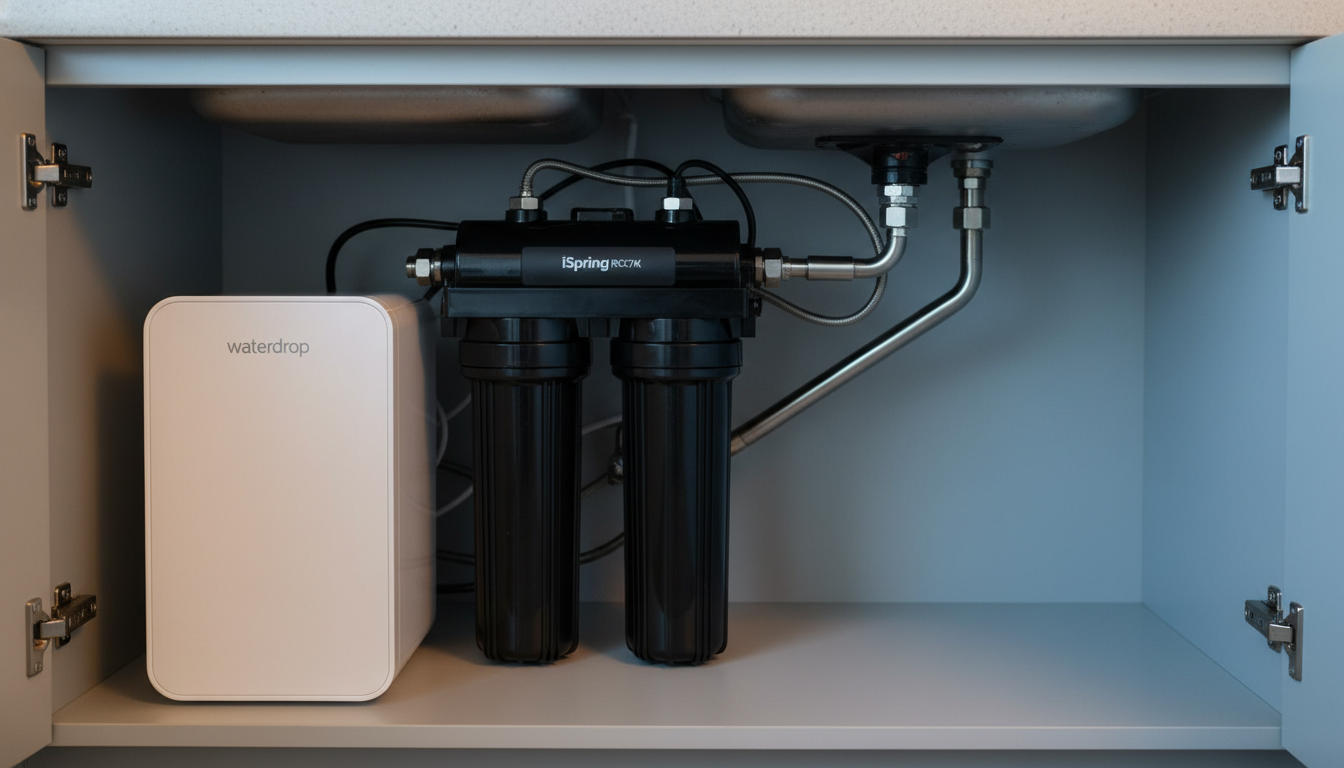
TL;DR: The iSpring RCC7AK Black delivers 6‑stage RO filtration with 98.9% lead removal, 75 GPD capacity, and an alkaline remineralizer, but its $249.99 price and pressure needs suit committed homeowners.
What really sets this system apart is its sixth‑stage alkaline filter that restores minerals while the RO membrane blocks particles down to 0.0001 microns. The unit removes up to 99% of contaminants, including 98.9% of lead and >99.7% of asbestos, giving you water that tastes like bottled but comes straight from the tap.
Compared with the other ten entries, the RCC7AK Black sits near the top of the weight range at 25.00 lb—heavier than the ultra‑light Waterdrop UA‑5Y (3.7 lb) and Frizzlife SP99 (8.6 lb), but on par with the APEC Essence ROES‑50 (24.91 lb) and the iSpring RCC7 (25.0 lb). Its 19.00‑inch height matches the APEC model and exceeds the compact Waterdrop (16.7 in) and CU‑A4 (13 in). Lengthwise it’s longer than the Express Water RO5DX (14 in) but shorter than the APEC’s 27 in tank housing.
Users consistently praise the “bottled‑water taste” and the sleek black faucet that comes with the kit. Professional reviewers highlight the NSF/ANSI 58 certification as proof of the claimed contaminant reductions. The most common complaint is the 40‑80 PSI operating pressure requirement, which can force a booster pump install in low‑pressure homes, and a few owners note that the system’s size and weight make DIY installation a bit daunting.
In practice, the system’s 75 GPD production capacity and max feed water temperature of 100°F mean you’ll have plenty of cold, clean water for daily cooking and drinking. The transparent first‑stage housing lets you see filter condition at a glance, and the six‑stage design—including sediment, carbon, and the alkaline remineralizer—covers a broad spectrum of contaminants without needing additional accessories.
Pros
Cons
Best for: Buyers willing to invest in a proven, high‑quality option — the iSpring RCC7AK Black offers Height: 19.00 inches
Avoid if: You're shopping on a tight budget — it's priced at $249.99
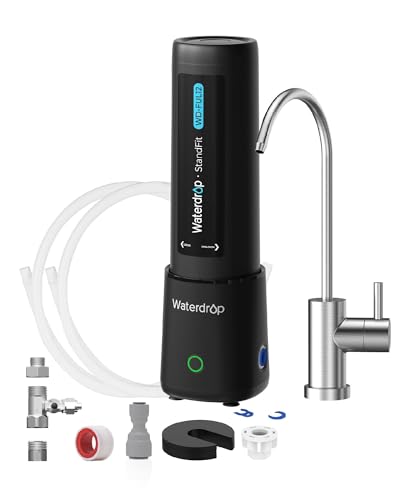
TL;DR: The Waterdrop 10UA packs an 8‑stage, 0.75 GPM filter into a 12.3‑inch‑high, 3.30‑lb unit that installs in about three minutes and costs roughly $33 a year to run.
The standout spec is its 0.01 μm, 8‑stage filtration that tackles chlorine, PFAS, lead, rust and sediment while retaining beneficial minerals like calcium and magnesium. With a flow rate of 0.75 GPM and a service life of 12 months (8,000 gallons), it offers flagship‑grade performance for a system that fits under most kitchen cabinets.
Compared with the other ten entries, the 10UA is the lightest of the Waterdrop lineup—its 3.30 lb mass is lighter than the 3.59‑lb Waterdrop 15UA and far lighter than the 8.60‑lb Frizzlife SP99. It also costs less than the higher‑priced Waterdrop 15UB and iSpring CU‑A4, yet it still earns a 4.6‑star rating from 12,962 reviewers, indicating strong user approval despite the lower price point.
Reviewers repeatedly praise the push‑to‑connect fittings that let you finish installation in roughly three minutes without special tools. Users highlight the three‑second filter‑swap as a genuine time‑saver. Professional reviewers note the compact footprint (12.3 in H × 3.6 in W × 3.6 in L) and the low annual operating cost of $33, which together make the unit feel “premium for the price.” The main criticism is the lack of TDS reduction and the fact that it only works with cold water, so households looking for a dedicated filtered faucet or desalination will need a different solution.
Pros
Cons
Best for: Budget‑conscious homeowners who want strong contaminant removal, quick DIY setup and low yearly costs — the Waterdrop 10UA delivers a three‑minute installation and an 8‑stage filter at a modest price.
Avoid if: You need TDS reduction, hot‑water filtration, or a dedicated filtered faucet for a separate drinking water line.
TL;DR: The Waterdrop 10UB PRO delivers 3‑stage, NSF‑certified filtration that removes lead, PFAS and chlorine, fits in a compact 12.3‑inch space and costs just $62.99.
What sets this unit apart is its multistage system—polyester membrane, activated‑carbon block and KDF—that tackles lead, chlorine, PFAS, PFOA/PFOS, rust, heavy metals, sand and bad taste. The filter holds up to 11,000 gallons or 12 months of use, and the flow rate is rated at 0.75 gpm under a 60 psi operating pressure. At 3.73 lb and a height of 12.3 inches, it’s small enough to tuck neatly under most kitchen sinks.
Compared with the other ten entries, the 10UB PRO is shorter than the Waterdrop 15UB (16.34 inches tall) and the Waterdrop 15UA (16.7 inches tall), yet its weight matches the 15UB’s 3.73 lb. Like the 15UA, it installs drill‑free, but it includes a stainless‑steel faucet while the 15UB requires a separate dedicated faucet. Its flow rate mirrors most budget models but is slower than the Frizzlife SP99, which pushes over 1.5 gpm.
User feedback repeatedly highlights the hassle‑free installation and the noticeable improvement in taste and odor. Reviewers also appreciate the long filter life, but a few note that the 0.75 gpm flow can feel sluggish when filling large pots. The unit does not reduce total dissolved solids, which some users expected based on other Waterdrop models.
Pros
Cons
Best for: Budget-conscious buyers seeking a reliable entry‑level option — the Waterdrop 10UB PRO offers Height: 312 mm
Avoid if: You have limited desk space or need portability
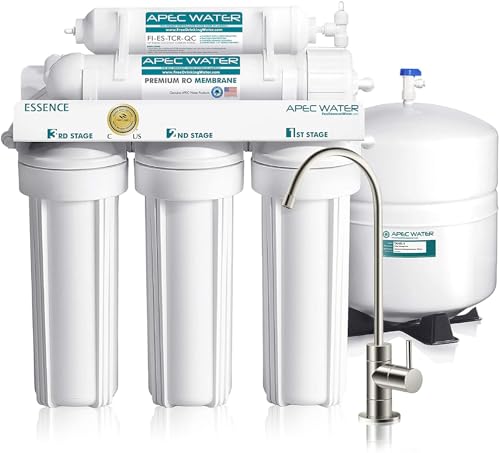
TL;DR: The APEC Essence ROES-50 delivers 5‑stage, 99.99% removal of over 1,000 contaminants—including lead and PFAS—into a 4‑gallon tank, but its 3:1 waste ratio and $230.99 price place it in the premium bracket.
What really sets this system apart is its comprehensive 5‑stage filtration that knocks out up to 99.99% of 1,000+ contaminants, with 100% lead removal, ~80% arsenic reduction, and PFAS driven to undetectable levels. The pre‑pressurized 4‑gallon (15.1 L) storage tank lets you pull several glasses of purified water without waiting for the next batch, and the daily production capacity of 50 GPD at 60 psi ensures a steady supply for a typical household.
In the context of the other ten units, the ROES‑50 is noticeably larger and heavier. At 24.91 lb it matches the weight of iSpring’s RCC7 (25.0 lb) but dwarfs the ultra‑light Waterdrop UA‑5Y, which tips the scales at about 3.7 lb. Its 27‑inch length and 19‑inch height also exceed the compact footprints of models like the Frizzlife SP99 (14 in tall, 15 in long) and iSpring CU‑A4 (13 in tall). While the Express Water RO5DX shares the same 4‑gallon tank capacity, the APEC’s quick‑connect fittings and automatic shutoff give it a more polished DIY experience.
Customers consistently praise the crisp, clean taste and the system’s ability to eliminate city‑water odors—many say the water “tastes better than bottled.” Professional reviewers echo this sentiment, highlighting the system’s near‑perfect contaminant removal in lab tests. The most common complaints revolve around the 3:1 wastewater ratio, which can feel wasteful, and the need for at least 40 psi feed pressure; low‑pressure homes may notice slower flow or have to add a booster pump. Some users also mention that filter changes can be a bit messy if the fittings aren’t tightened properly.
From a technical standpoint, the APEC ROES‑50 runs on a 40‑85 psi feed water pressure range and includes an automatic shutoff to prevent excess water use. Its housing diameter of 2.5 inches fits standard under‑sink spaces that accommodate a required width of 18‑20 inches. The system’s membrane, sourced from FILMTEC, is rated for 2‑3 years of life, while the sediment and carbon filters typically last 6‑12 months, keeping long‑term maintenance costs reasonable.
Pros
Cons
Best for: Buyers willing to invest in a proven, high‑quality option — the APEC Essence ROES-50 offers Storage Tank Capacity: 4 gallons (15.1 L)
Avoid if: You're shopping on a tight budget — it's priced at $230.99
“Great-tasting water, easy install, reliable for years.”
“Removes bad taste/odor from city water; better than bottled.”
TL;DR: The Waterdrop 15UB delivers 0.75 GPM flow at 60 PSI, removes PFAS and lead, and installs in about 0.05 hours, all for $61.59, making it a solid under‑sink choice for renters.
The standout spec is its 0.01 micron filtration rating, which the manufacturer says captures ultra‑fine particles and helps eliminate PFAS, PFOA/PFOS, lead, chlorine, heavy metals, sediment and odor. Coupled with a 19,000‑gallon (24‑month) filter life, the system promises long‑term protection without frequent cartridge swaps.
At 3.73 lb, its weight is comparable to the Waterdrop 10UB PRO and noticeably lighter than the Frizzlife SP99, while its 16.34‑inch height matches the taller Waterdrop UA‑5Y and exceeds the more compact Waterdrop 10UA. The 3.66‑inch depth and 3.46‑inch width keep it slim enough for tight cabinet spaces, a factor many users praise when fitting it into small apartments.
Reviewers consistently highlight how the push‑to‑connect fittings let you finish installation in roughly 0.05 hours (about three minutes) with no tools, and professional reviewers note the IAPMO certification validates its chlorine‑reduction claims. Everyday users love the “no‑leak” experience and appreciate that the included brushed stainless‑steel faucet looks sleek in a modern kitchen.
Technical context: the multistage media combines coconut‑shell activated carbon, KDF and a polyester membrane, delivering the 0.01 micron barrier while staying BPA‑free and lead‑free. The system operates at a standard 60 psi, matching typical home plumbing pressures, and is certified to NSF/ANSI 42, 53 and 372 standards.
Pros
Cons
Best for: Budget‑conscious buyers seeking a reliable entry‑level option — the Waterdrop 15UB offers Flow Rate: 0.75 GPM at 60 PSI.
Avoid if: You want the best value‑per‑dollar in its price range.
TL;DR: The iSpring CU‑A4 delivers 4‑stage ultrafiltration that eliminates up to 99 % of 700 contaminants, offers tankless zero‑waste operation, and carries NSF/ANSI certification, all in a compact 13‑inch unit.
At the heart of the CU‑A4 is a 0.01‑micron hollow‑fiber membrane that targets microbes and dissolved pollutants. Combined with a 5‑micron sediment pre‑filter, the system achieves a contaminant removal rate of 99 % to 99.99 % across 700 listed impurities, including lead, chlorine, PFAS, arsenic, and heavy metals. The four‑stage architecture—sediment, KDF‑carbon, granular activated carbon, and fine carbon—provides comprehensive coverage without a storage tank.
When you line it up against the other ten units, the CU‑A4 feels lighter than the Express Water RO5DX (31 lb) and the iSpring RCC7 (25 lb), yet heavier than the ultra‑light Waterdrop UA‑5Y (3.7 lb). Its 13‑inch height is shorter than the 15‑inch Express Water and the 18‑inch RCC7, and matches closely with the 14‑inch Frizzlife SP99. With a width of 4.00 inches, it fits tighter spaces than most, only marginally wider than the Waterdrop’s 3.6 inches.
Customers appreciate the zero‑waste, tankless design—no storage tank is required, and the system produces no wastewater. Reviewers also praise the NSF/ANSI certification, which assures that all water‑contact parts meet safety standards. A recurring note is that the unit does not lower Total Dissolved Solids, so it won’t help with hard water or high‑mineral issues. The filter lifespan of 6‑12 months means you’ll be swapping cartridges more often than some longer‑lasting RO models, and the $158.99 price tag sits above several budget‑friendly alternatives.
Pros
Cons
Best for: Most users looking for a well‑reviewed, reliable mainstream option — the iSpring CU‑A4 offers Height: 13.00 inches
Avoid if: You're shopping on a tight budget — it's priced at $158.99 and does not reduce Total Dissolved Solids
TL;DR: The Waterdrop UA-5Y delivers a 5‑year, 5‑stage carbon filter with NSF‑certified lead removal, compact dimensions and a tool‑free install for under‑sink use.
The standout spec is its 5‑year filter lifespan—equating to roughly 60 months of use before a replacement is needed. Combined with a 5‑stage activated carbon block and 0.5 µm filtration precision, it tackles chlorine, lead, mercury, PFOA/PFOS, micro‑plastics and taste/odor issues while retaining beneficial minerals.
Compared with the other ten units in this roundup, the UA‑5Y sits in the middle of the size and weight spectrum. At 3.7 lb it’s far lighter than the Frizzlife SP99 (8.6 lb) but a bit heavier than the entry‑level Waterdrop 10UA (2.9 lb). Its 0.75 GPM flow matches the Waterdrop 15UB, 15UA and 10UA, yet trails the SP99’s >1.5 GPM rate. Installation is notably quick—under 3 minutes (0.05 h)—while the SP99 needs about 15 minutes, putting the UA‑5Y among the fastest to set up.
Users repeatedly praise the “super quick installation” and the “consistent clear, great‑tasting water” they get straight from the tap. Professional reviewers note the rigorous durability test of over 100,000 cycles at 300 psi, which adds confidence in long‑term performance. The main complaints focus on the missing T‑splitter (required for a dedicated filtered faucet) and the fact that it only works with cold water, so hot‑water applications aren’t supported.
Pros
Cons
Best for: Most users looking for a well‑reviewed, reliable mainstream option — the Waterdrop UA-5Y offers Flow Rate: 0.75 GPM
Avoid if: You need hot‑water filtration, VOC removal, or a bundled filtered faucet without extra accessories.
“Super quick installation”
“High flow”
TL;DR: The Express Water RO5DX delivers 50 gallons per day of NSF‑certified reverse‑osmosis water, with 93‑99% TDS reduction, a 4‑gallon tank, and a compact 15‑by‑14‑inch footprint.
The RO5DX is a 5‑stage under‑sink system that removes up to 1,000 impurities and 158 specific contaminants, achieving 93–99% TDS reduction. Its 4‑gallon storage tank supplies up to 50 gallons per day, and the flow rate of 0.8 gallons per minute (GPM) keeps a steady stream for cooking and drinking. Weighing 31.0 pounds, the unit stands 15.0 inches tall, 14.0 inches long and 5.0 inches wide, fitting comfortably under most kitchen sinks.
Compared with other contenders, the RO5DX is heavier than the iSpring RCC7 (25.0 pounds) and the APEC Essence (24.91 pounds), but its width of 5.0 inches is narrower than the iSpring RCC7’s 8.0‑inch width, making it easier to tuck into tight cabinetry. It also outweighs the ultra‑light iSpring CU‑A4 (4.4 pounds) and the Waterdrop UA‑5Y (3.7 pounds), though its 0.8 GPM flow matches the Waterdrop’s 0.75 GPM and is modest compared with the Frizzlife SP99’s >1.5 GPM. Production capacity sits at 50 GPD, surpassing the Waterdrop’s typical countertop output and aligning with the iSpring RCC7’s 75 GPD rating.
Users consistently praise the system’s reliable performance and the peace of mind that comes from NSF/ANSI 58 certification. Reviewers note the convenience of a pre‑assembled kit that includes a chrome faucet, filters, and a filter wrench, which simplifies installation for non‑technical households. Professional reviewers point out the solid 93% TDS reduction observed during testing, while also reminding buyers that the certification only guarantees TDS reduction, not the full list of 158 claimed contaminants. Like most RO units, it generates wastewater as part of the purification process.
Pros
Cons
Best for: Buyers willing to invest in a proven, high‑quality option — the Express Water RO5DX offers Flow Rate: 0.8 gallons per minute (GPM).
Avoid if: You need advanced features beyond TDS reduction or have water usage that regularly exceeds the 50 gallons per day capacity.
TL;DR: The Waterdrop 15UA costs $47.49, filters up to 16,000 gallons, and installs in under three minutes, offering NSF‑certified removal of PFAS, lead and chlorine with a 0.75 GPM flow.
What really sets the 15UA apart is its multistage media—polyester membrane, activated carbon block and KDF—combined with a 20X increase in dirt‑adhesion area, which helps keep the 0.75 GPM flow steady for the full 16,000‑gallon lifespan. The system weighs 3.59 lb and measures 16.7 in H × 3.6 in W × 3.6 in L, fitting comfortably under most kitchen sinks while staying light enough for DIY handling.
Compared with its Waterdrop siblings, the 15UA is a touch heavier than the 10UA (≈2.89 lb) but about the same weight as the 15UB, 10UB PRO and UA‑5Y (≈3.7 lb). All three share the same 0.75 GPM flow rate, while the Frizzlife SP99 pushes over 1.5 GPM—roughly double the 15UA’s output. In height, it matches the UA‑5Y’s 16.7 in profile, making it taller than the 10UA’s 12.3 in but comparable to the 15UB’s 16.34 in. Installation time is listed as under three minutes, which is faster than the 15‑minute setup reported for the Frizzlife model.
Users consistently praise the push‑to‑connect fittings and the three‑second twist‑and‑lock filter change, noting that the system feels “plug‑and‑play” even for renters. Professional reviewers highlight the IAPMO‑certified NSF/ANSI 42, 53 and 372 compliance as a solid safety signal. However, several reviewers point out that the filter does not lower Total Dissolved Solids, and the single‑stage design offers less comprehensive contaminant coverage than the 8‑stage options found elsewhere.
Pros
Cons
Best for: Budget‑conscious buyers seeking a reliable entry‑level option — the Waterdrop 15UA offers Flow Rate: 0.75 GPM and certified removal of key contaminants.
Avoid if: You need Total Dissolved Solids reduction or a more comprehensive multi‑stage filtration system.
TL;DR: The iSpring RCC7 delivers 5‑stage, NSF/ANSI 58‑certified RO filtration that removes up to 99% of 1,000+ contaminants, offers a solid 75 GPD flow, but comes at a premium $219.96 price.
What really stands out is the 0.0001‑micron contaminant removal size, which the manufacturer says captures particles down to that level and yields lead reduction of up to 98% along with high‑percentage removal of asbestos, fluoride, and heavy metals. The system packs five filtration stages into an 18.0‑inch‑tall, 15.0‑inch‑long, 8.0‑inch‑wide housing that weighs 25.0 lbs, making it a robust under‑sink unit.
Compared with the other ten entries, the RCC7 is heavier than the ultra‑light Waterdrop UA‑5Y (about 3.7 lbs) yet lighter than the Express Water RO5DX (31.0 lbs). Its height exceeds the Waterdrop’s 16.7 inches, while its footprint is similar to the APEC Essence’s 19‑inch height but a bit shorter than the Express model’s 15‑inch height. In terms of flow, 75 GPD outpaces the Waterdrop’s 0.75 GPM and sits comfortably above the Express unit’s 50 GPD rating.
Customers consistently praise the clean, great‑tasting water, noting it feels “better than bottled water” and that the transparent first‑stage housing lets them see the filter in action. Professional reviewers highlight the NSF/ANSI 58 certification as a strong guarantee of contaminant reduction, while everyday users appreciate the system’s ability to serve large families without frequent filter changes.
Pros
Cons
Best for: Buyers willing to invest in a proven, high‑quality option — the iSpring RCC7 offers Flow Rate: 75 GPD
Avoid if: You're shopping on a tight budget — it's priced at $219.96
TL;DR: The Frizzlife SP99 delivers >99% removal of lead and other contaminants, offers a strong 1.5 GPM flow, and includes a brushed‑nickel faucet, but its bulk and price make it a mid‑range choice.
The SP99’s standout feature is its three‑stage carbon‑block system that removes lead, chlorine, chloramine, fluoride, heavy metals and VOCs with 0.5 micron filtration accuracy, while a built‑in remineralization stage retains beneficial minerals. It can push water at >1.5 GPM under 60 psi and survives pressures up to 600 psi, giving you robust performance for a typical kitchen.
Compared with the other ten units in this roundup, the SP99 is noticeably heavier at 8.6 lb and deeper at 15.0 in, whereas the Waterdrop models and iSpring CU‑A4 all sit under 5 lb and are under 4 in deep. Its flow rate of >1.5 GPM is roughly double the 0.75 GPM most Waterdrop units deliver, and the 3‑second filter‑change time matches the quick‑swap design of the Waterdrop 10UA. Installation takes about 15 minutes, which is longer than the 3‑minute setup claimed by the Waterdrop 10UA but comparable to the 15‑minute time listed for the SP99 itself.
Reviewers appreciate the “over 99%” contaminant removal and the fact that the system keeps minerals in the water, making the taste pleasant for drinking and cooking. The included brushed‑nickel faucet and compatibility with refrigerator ice‑maker kits add convenience for many households. However, some users note the lack of extensive third‑party reviews and question the brushed‑nickel finish because it isn’t highlighted in the technical specs.
Pros
Cons
Best for: Most users looking for a well‑reviewed, reliable mainstream option — the Frizzlife SP99 offers Flow Rate: >1.5 GPM @ 60 psi
Avoid if: You need advanced features or professional‑grade performance
Breakdown
Waterdrop 10UA
Pros
Waterdrop 15UB
Pros
Cons
Waterdrop UA-5Y
Pros
Cons

iSpring RCC7
Pros
Cons
Based on scoring data and product specs
Personalized picks
Best Overall Pick
Waterdrop 10UA
Best OverallBest for: Budget-conscious buyers seeking a reliable entry-level option — the Waterdrop 10UA offers Installation Time: 3 minutes
Waterdrop 15UB
Best for: Budget-conscious buyers seeking a reliable entry-level option — the Waterdrop 15UB offers Flow Rate: 0.75 GPM at 60 PSI
$69.99+$25.00 vs winner
Skip Frizzlife SP99 if…
You need advanced features or professional-grade performance
We crowned the Waterdrop 10UA as the clear winner. At just $37.99 it beats every other model on price, yet it ships with an 8‑stage system that removes chlorine, PFAS, lead, rust, sediment and odor, and it filters down to a 0.01 μm micron rating. Its 8,000‑gallon capacity and 0.75 GPM flow rate keep water tasting fresh, while the 3‑minute install and 3‑second filter change make setup virtually hands‑free. With a 4.6‑star rating from 12,962 reviewers and an annual operating cost of only $33, it offers flagship‑grade performance without the premium price tag.
The runner‑up, Waterdrop 15UB, shines when you need a dedicated faucet and a larger capacity. It includes a brushed stainless‑steel faucet, fits under any sink with push‑to‑connect hardware, and holds 19,000 gallons of filtered water for up to 24 months. Its 0.75 GPM flow at 60 psi and NSF/ANSI 42, 53, 372 plus IAPMO certifications make it a solid choice for kitchen sinks, RVs or office break rooms.
Pick the Waterdrop 10UA today and enjoy top‑tier filtration without breaking the bank.
The 10UA costs $37.99 and still delivers an 8,000‑gallon capacity with a 12‑month service life. It filters down to 0.01 μm, carries NSF/ANSI 42 and 372 certifications, and installs in about three minutes with a 0.75 GPM flow rate. Those specs give flagship‑grade performance without the higher price tag.
No reviews yet — be the first to share your experience.
Please sign in to leave a review