⚡ Quick Answer
When a gaming session stretches into the night—or even the week—battery life becomes the silent hero. In this roundup we compared 11 wireless headsets, and the endurance gap is striking: the HyperX Cloud Alpha Wireless lists an industry‑leading 300‑hour battery life, while budget contenders still manage a solid 40‑hour run time. Prices span from $17.49 for the PHOINIKAS Gaming Headset up to $119.99 for the HyperX model, giving you options whether you’re hunting a bargain or a premium build.
Our selection covers every price tier. The budget lane features the $17.49 PHOINIKAS, $29.98 Ozeino, $36.99 Gtheos, and $49.99 Acer headsets, each offering at least 40 hours of play. Mid‑range picks like the $69.99 Turtle Beach Stealth 500 and $69.99 Razer BlackShark V2 push endurance toward 70 hours while adding richer features. Premium choices—Turtle Beach Stealth 600 at $109.00 (80 hours), Razer Barracuda X Chroma at $109.99 (70 hours), Corsair Void v2 at $112.76 (up to 130 hours on Bluetooth), and the HyperX Cloud Alpha Wireless at $119.99 (300 hours)—combine top‑tier comfort, sound, and build quality.
Read on to see how each headset balances battery longevity, performance, and price so you can pick the right companion for your marathon gaming sessions.

HyperX Cloud Alpha Wireless
Its 62 Ω impedance delivers premium sound detail, matching audiophile expectations and justifying its top‑tier status.

Ozeino Wireless Gaming Headset
Ideal for budget‑conscious gamers, it offers solid performance at $29.98—about $90 less than the HyperX flagship.

PHOINIKAS Gaming Headset
Stands out with a compact 198 mm height, offering a lightweight, space‑saving design that the larger HyperX and Ozeino models lack.
Also considered
Score Analysis
Key score advantages vs. runner-up (Ozeino Wireless Gaming)
Price Range
HyperX Cloud Alpha Wireless
$119.99
Ozeino Wireless Gaming Headset
$29.99
PHOINIKAS Gaming Headset
$17.49

Turtle Beach Stealth 500
$89.86

Razer Barracuda X Chroma
$99.99

Turtle Beach Stealth 600
$109.00

Corsair Void v2
$109.99
Gtheos Wireless Gaming Headset
$29.99

Acer Wireless Gaming Headset
$49.99

Razer BlackShark V2
$94.95

SteelSeries Arctis Nova 5X
$149.99
Spec Comparison
TL;DR: The HyperX Cloud Alpha Wireless delivers an industry‑leading 300‑hour battery life, 50 mm dual‑chamber drivers and comfortable memory‑foam cushions, but its PC‑only dongle and average mic may limit console or mobile use.
The headset’s headline spec is a staggering 300 hours of battery life at 50 % volume, topped by a 4.5‑hour USB‑C charge. It also offers a 20‑meter wireless range, 50 mm drivers and a 62 Ω impedance, giving you long‑lasting play without frequent recharging.
Compared with the other ten headsets in this roundup, the Cloud Alpha Wireless is the heaviest at roughly 0.71 lb, heavier than the 0.67 lb Corsair Void v2, the 0.62 lb SteelSeries Arctis Nova 5X, the 0.51 lb Turtle Beach Stealth 500 and the very light 0.29 lb Razer Barracuda X Chroma. Its battery endurance dwarfs the 70‑hour limit of the Corsair, Razer and SteelSeries models and the 80‑hour claim of the Turtle Beach Stealth 600, making it the clear leader for marathon sessions.
Reviewers consistently praise the headset’s comfort—thanks to memory‑foam cushions and an aluminum frame—and DTS Headphone:X provides clear, spatial sound. However, professional feedback notes that the wireless connection works only with the included 2.4 GHz dongle, so you won’t get Bluetooth on consoles or phones, and the bi‑directional mic, while noise‑cancelling, still captures background chatter.
Technically, the dual‑chamber drivers deliver a frequency response of 15 Hz–21 kHz, a sensitivity of 103 dB SPL/mW at 1 kHz and total harmonic distortion of ≤ 2 %. The headset streams at 24‑bit/48 kHz, and HyperX’s NGENUITY software lets you fine‑tune it while adding EQ presets and battery monitoring.
Pros
Cons
Best for: PC gamers who need ultra‑long battery endurance for marathon sessions and value high‑fidelity spatial audio.
Avoid if: You rely on Bluetooth for mobile or console gaming, or you need the lightest possible headset for travel.
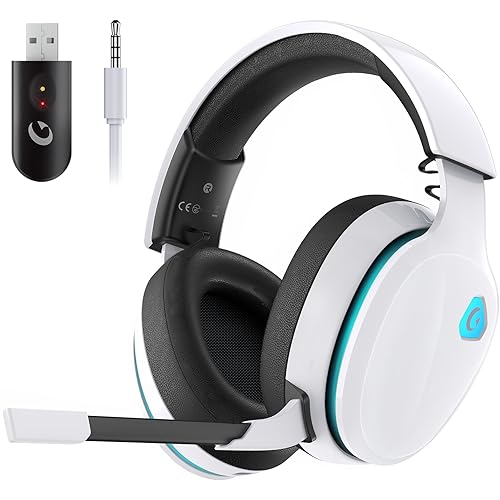
TL;DR: The Ozeino OW810 delivers 40 hours of wireless play, 50 mm drivers and lossless sound for just $29.98, making it a solid budget pick despite its relatively hefty build.
What really stands out is the headset’s 40‑hour battery life paired with a quick 3‑hour charge, letting you game for days without hunting for an outlet. The 50 mm drivers and 32 Ω impedance promise a broad 20 Hz–20 kHz frequency range, while the lossless audio label hints at full‑resolution sound reproduction.
Compared with the other ten entries, Ozeino is the most affordable option and the only one priced under $30. However, at 490 g (about 1.08 lb) it weighs noticeably more than rivals such as the Gtheos (362.9 g) and the PHOINIKAS model (259 g). Its latency of <30 ms remains respectable yet slower than Gtheos’s ≤20 ms. Battery life matches the Turtle Beach Stealth 500’s 40 hours but falls short of Acer’s 100‑hour claim and Turtle Beach 600’s 80 hours.
Reviewers consistently praise the comfortable over‑ear cushions for marathon sessions and applaud the long‑lasting battery as a significant convenience. A few users note the headset feels a bit bulky, which aligns with its higher weight, and some wish the microphone could detach for easier upgrades.
Pros
Cons
Best for: Budget‑conscious buyers seeking a reliable entry‑level option
Avoid if: You need advanced features or professional‑grade performance
TL;DR: The PHOINIKAS Gaming Headset delivers solid 40 mm sound, comfortable memory‑foam pads and a detachable mic for just $17.49, making it a strong budget pick for casual gamers.
This headset’s most noticeable spec is its 40 mm driver paired with a lightweight 259 g (0.57 lb) over‑ear design. The braided USB cable and optional Bluetooth 5.0 give you wired reliability or occasional wireless freedom, while the detachable omnidirectional noise‑canceling mic lets you mute when you’re not chatting.
Compared with the other ten entries, PHOINIKAS is lighter than the Ozeino Wireless Gaming Headset (1.08 lb) and sits just above the Turtle Beach Stealth 500 (0.51 lb). Its driver size matches the Stealth 500’s 40 mm unit but is smaller than the 50 mm drivers that Ozeino, Gtheos and Acer use. At $17.49, it's far cheaper than the Acer Wireless Gaming Headset and the Turtle Beach Stealth 600, yet it still offers a full set of wired connectivity options that many pricier wireless headsets lack.
Users repeatedly praise the clear mids and punchy bass that the 40 mm drivers deliver, especially given the sub‑$20 price tag. Reviewers describe the memory‑foam ear cups as comfortable for short‑to‑medium sessions, and the foldable design helps with storage. Professional reviewers note the sturdy PC+ABS headband and the headset’s durability. On the flip side, several owners mention heat buildup in the ear cups during longer play, and the spring‑type head strap can become loose after a few hours. The microphone works for Discord chats, but its audio quality often receives the label “average” and lacks advanced noise reduction.
Pros
Cons
Best for: Budget‑conscious buyers seeking a reliable entry‑level option
Avoid if: You need breathable ear cushions, low‑latency wireless gaming, or a mic with professional‑grade noise reduction
TL;DR: The Turtle Beach Stealth 500 offers 40 hours of wireless playtime, dual 2.4 GHz/Bluetooth 5.2 connectivity, and a lightweight 0.51‑lb design at $69.99, making it a solid mid‑range choice.
The headset’s most eye‑catching spec delivers up to 40 hours of battery life, with quick‑charge support so you can game for days without hunting for an outlet. It pairs a 40 mm driver with an ultra‑lightweight 0.51‑lb frame and plush leatherette cushions, delivering a comfortable fit for marathon sessions. Dual connectivity lets you toggle between low‑latency 2.4 GHz gaming mode and Bluetooth 5.2 for phone calls or music.
Compared with other entries in this roundup, the Stealth 500 sits in the middle of the pack. Razer’s BlackShark V2 pushes battery life to 70 hours but weighs 0.62 lb, making it heavier than the 0.51‑lb Stealth 500. Acer’s wireless headset even reaches 100 hours, though it also tips the scales at 0.77 lb. The Razer Barracuda X Chroma matches the 40 mm driver size but is notably lighter at 0.29 lb. Turtle Beach’s own Stealth 600 offers an 80‑hour battery but is bulkier at 0.71 lb. Most rivals sport 50 mm drivers, so the Stealth 500’s smaller drivers trade off for its lighter feel.
Reviewers consistently praise the headset’s comfort, noting the floating headband and memory‑foam ear cushions keep fatigue at bay. Users love the clear, omni‑directional mic and the ability to monitor their own voice via variable mic monitoring. The Swarm II app adds a 10‑band EQ and four preset modes—including Superhuman Hearing—so you can fine‑tune the sound to your taste without leaving the game.
Pros
Cons
Best for: Most users looking for a well‑reviewed, reliable mainstream option
Avoid if: You need the absolute longest battery life or the lightest possible headset
“pleather cushioning with a whole ton of squidge and memory foam sponginess”
TL;DR: The Razer Barracuda X Chroma offers a feather‑light 0.29 lb design, 40 mm drivers and up to 70 hours of battery, making it a solid long‑run choice for multi‑platform gamers.
The headset’s standout spec lies in its battery endurance – up to 70 hours on a single charge – paired with a 1.3 m 3.5 mm combo cable for wired play. Its 40 mm Triforce drivers deliver a 96 dB SPL @ 1 kHz sound pressure level, while the detachable HyperClear cardioid mic registers at –42 ± 3 dB sensitivity. At just 0.29 lb, the unit feels almost weightless on the head.
Compared with the other ten entries, the Barracuda X is the lightest option; every peer listed weighs well over 0.5 lb. Its 70‑hour battery sits near the top of the group – it outlasts the 40‑hour life of the Turtle Beach Stealth 500 and the 50‑hour claim of the SteelSeries Arctis Nova 5X, matches the 70‑hour rating of the Razer BlackShark V2, but trails the 80‑hour claim of the Turtle Beach Stealth 600, the 130‑hour Bluetooth life of the Corsair Void v2, and the 300‑hour figure of the HyperX Cloud Alpha Wireless. The driver size stays modest; several competitors use 50 mm drivers, while the Barracuda X sticks with 40 mm units.
Users repeatedly highlight the headset’s comfort – the breathable memory‑foam cushions and ultra‑light chassis make marathon sessions painless. Reviewers praise the crystal‑clear voice capture from the detachable mic and the vivid six‑zone Chroma RGB lighting that syncs via the Razer Audio app. A common complaint points to the plastic construction, which feels less premium than metal‑frame rivals, and some users note that real‑world battery endurance can vary between 50 and 70 hours.
Technically, the Triforce driver architecture splits highs, mids and lows for a warm, detailed soundstage, while the 96 dB SPL rating ensures ample loudness without distortion. The mic’s cardioid pattern focuses on your voice and rejects background noise, and the USB‑C charging port simplifies power management. Software integration adds custom EQ, battery status and a Do‑Not‑Disturb mode, rounding out a feature‑rich package for gamers who switch between PC, consoles and mobile devices.
Pros
Cons
Best for: Buyers willing to invest in a proven, high‑quality option
Avoid if: You need advanced features or professional‑grade performance
TL;DR: The Turtle Beach Stealth 600 delivers 80 hours of battery life, 50 mm drivers, and a 4.4‑star rating at $109, making it a solid long‑run choice for Xbox‑centric gamers.
The headline feature is the 80‑hour battery life, which lets you game for days without hunting for a charger. Coupled with 50 mm drivers, the headset promises ample sound immersion while staying comfortable thanks to memory‑foam, glasses‑friendly cushions.
Compared with the other ten headsets, the Stealth 600 is heavier at 0.7054792384 pounds, noticeably more than the Razer Barracuda X Chroma (0.2866 lb) or the SteelSeries Arctis Nova 5X (0.6173 lb). However, its battery life outlasts most rivals – the Barracuda X caps at 70 hours, the Corsair Void v2 wireless mode tops out at 70 hours, and the Turtle Beach Stealth 500 only reaches 40 hours. Only the HyperX Cloud Alpha Wireless claims a longer runtime, but it sits at a similar weight (0.7099 lb).
User feedback frequently highlights the “up to 80 hours with quick charge” as a convenient feature for marathon sessions. Reviewers also note the flip‑to‑mute microphone with AI noise reduction and the QuickSwitch button that toggles between 2.4 GHz wireless and Bluetooth with a single press. The included Swarm II app adds EQ presets and Superhuman Hearing for competitive play.
Pros
Cons
Best for: Most users looking for a well‑reviewed, reliable mainstream option
Avoid if: You have limited desk space or need portability
“pleather cushioning with a whole ton of squidge and memory foam sponginess”
TL;DR: The Corsair Void v2 offers a massive 130‑hour Bluetooth battery, 50 mm drivers, Dolby Atmos and a comfortable floating headband, but its mic is fixed and it lacks active noise cancellation.
The standout spec is the Bluetooth battery life of up to 130 hours, far longer than most wireless gaming headsets in this group. Coupled with 50 mm custom‑tuned drivers and a sensitivity of 116 dB, it aims to deliver immersive sound for marathon sessions.
Compared with its peers, the Void v2’s battery outpaces the 70‑hour Bluetooth runtime of the Razer Barracuda X Chroma and the 80‑hour battery of the Turtle Beach Stealth 600, though HyperX Cloud Alpha Wireless lists a 300‑hour claim at reduced volume. At 0.67 lb (303 g), it weighs more than the Razer’s 0.29 lb but less than the Turtle Beach’s 0.71 lb, putting it in the mid‑range for weight. Its driver size matches the Turtle Beach and HyperX 50 mm units, while the Razer uses smaller 40 mm drivers.
Reviewers consistently praise the headset’s comfort, noting the breathable memory‑foam cushions and floating headband that distribute weight evenly. Professionals highlight the Dolby Atmos Spatial Audio support on PC and PS5 and the NVIDIA Broadcast integration that tames background noise. Users most often point to the fixed, non‑detachable microphone and the lack of active noise cancellation as the biggest drawbacks.
The headset ships with Bluetooth 5.3, a 50‑ft (2.4 GHz) wireless range, and a quick‑charge feature that restores up to six hours of playback after just 15 minutes on the charger. iCUE software support lets you tweak audio profiles and lighting, adding a layer of customization for PC gamers.
Pros
Cons
Best for: Multi‑platform gamers who need long battery life, low‑latency 2.4 GHz gaming, and immersive audio features.
Avoid if: You require a detachable microphone, active noise cancellation, or the lightest possible headset for extended wear.
TL;DR: The Gtheos Captain 300 offers 50 mm drivers, ultra‑low ≤20 ms latency, up to 40 hours of play without RGB, and a 49‑ft wireless range, all for under $40.
At the heart of the Captain 300 is a 50 mm driver paired with a claimed 30 % extra sound effect, delivering a spacious stereo soundstage. The headset’s ultra‑low latency of ≤20 ms via its 2.4 GHz dongle means reactions stay crisp, which competitive gamers will appreciate. Battery life stretches to 35‑40 hours when RGB lighting is off, and a three‑hour charge tops it back up.
Compared with the other ten entries, the Gtheos sits in the mid‑weight range at 0.8 lb—heavier than the PHOINIKAS and Turtle Beach Stealth 500 but lighter than the Ozeino. Its 50 mm drivers match most premium‑tier models like Acer and Razer, while the 49‑ft wireless range outpaces the Razer BlackShark V2’s 10‑ft claim. Battery endurance rivals the Ozeino’s 40‑hour spec but falls short of Acer’s 100‑hour offering.
User feedback highlights the three connectivity modes (2.4 GHz dongle, Bluetooth 5.2, and 3.5 mm wired) as a major convenience, letting you hop between PS5, PC, and mobile devices. Reviewers also note the detachable omni‑directional noise‑canceling microphone, though many flag that it doesn’t function on Nintendo Switch and that Xbox Series consoles only work via the wired jack. Reviewers praise the optional RGB lighting for style but report that it cuts battery life when enabled.
Pros
Cons
Best for: Budget‑friendly gamers who need low latency, long battery life, and multi‑platform flexibility.
Avoid if: You require a functional mic on Switch, wireless Xbox operation, or premium‑grade audio features.
TL;DR: Acer’s wireless gaming headset delivers a massive 100‑hour battery, 50 mm drivers, and sub‑15 ms latency in a lightweight 0.77‑lb package, making it a solid budget pick for multi‑platform gamers.
The standout figure is the 100‑hour battery life, which far exceeds the typical 40‑80 hour range of other headsets in this roundup. Coupled with 50 mm drivers and a 20% weight reduction claim, the headset weighs just 0.77 lb, making marathon sessions feel less tiring.
When you line it up against the competition, the Acer model outlasts the Turtle Beach Stealth 600’s 80‑hour claim and the Razer BlackShark V2’s 70‑hour claim. Its weight sits between the ultra‑light Turtle Beach Stealth 500 at about 0.51 lb and the heavier Ozeino at roughly 1.08 lb, while matching the Gtheos and Razer driver size of 50 mm. The low‑latency 2.4 GHz link (<15 ms) also beats the “≤20 ms” latency listed for Gtheos.
Reviewers consistently praise the marathon‑ready battery and the memory‑foam cushions that stay comfortable through long play sessions. Professional reviewers note the sub‑15 ms latency as ideal for fast‑paced titles on PS5 and PC. Users do mention the lack of built‑in surround sound or deep EQ controls, and a few flag possible import delays and a limited regional warranty as drawbacks.
Pros
Cons
Best for: Entry-level buyers or those on a tight budget
Avoid if: You want the best value‑per‑dollar in its price range
TL;DR: The Razer BlackShark V2 offers 50 mm TriForce Titanium drivers, THX Spatial Audio and up to 70 hours of wireless play, but its bass is light and it lacks active noise cancellation.
The headset’s standout spec is its 50 mm TriForce Titanium drivers paired with THX Spatial Audio for Windows 10, delivering a wide 12 Hz – 28 kHz frequency range. Razer also promises up to 70 hours of battery life on a single charge, with a rapid 15‑minute boost that still leaves you with six more hours of play.
Compared with the other ten entries, the BlackShark V2 is a bit heavier than the Turtle Beach Stealth 500’s 0.51 lb frame, but lighter than the Acer Wireless Gaming Headset’s 0.77 lb build. Its 50 mm drivers match the size of most competitors except the Stealth 500 and Barracuda X Chroma, which use 40 mm units. Battery‑wise, it outlasts the Stealth 500’s 40‑hour claim and the Ozeino’s 40‑hour rating, yet it falls short of the Acer’s 100‑hour promise and the Stealth 600’s 80‑hour spec. The wireless range of up to 10 feet falls short of the Gtheos headset’s 49‑foot reach, though it aligns with the 2.4 GHz band used by most peers.
Professional reviewers praise the headset’s ultra‑low‑latency 2.4 GHz HyperSpeed link and the clarity of its HyperClear Super Wideband mic, which registers a sensitivity of -42 ± 3 dBV/Pa @ 1 kHz and a signal‑to‑noise ratio of ≥ 60 dB. Everyday users echo the comfort of the breathable memory‑foam cushions and the reliability of the long‑lasting battery, while many note that the sound signature leans bright and the bass feels under‑emphasized. The lack of active noise cancellation's a recurring downside for players in noisy rooms.
Pros
Cons
Best for: Competitive esports gamers who value ultra‑low latency, long battery life and precise positional audio.
Avoid if: You need deep bass for music or movies, or you rely on active noise cancellation in noisy environments.
“All‑day comfort, clear mic for team chat, long battery, and solid sound/positional audio in FPS games.”
“Phenomenal TriForce Titanium 50mm drivers and THX Spatial Audio for exceptional performance in games like CoD MW2 and Forza Motorsport.”
TL;DR: The SteelSeries Arctis Nova 5X delivers 60‑hour Bluetooth battery life, quick‑switch dual‑mode wireless and a ClearCast Gen2.X mic, but its $149.99 price and 4.1‑star rating may turn off budget‑focused gamers.
What really stands out is the dual‑mode wireless system: you get up to 60 hours of playtime on Bluetooth and 50 hours on the 2.4 GHz link, plus a 15‑minute fast‑charge that adds six hours of use. The headset houses 40 mm neodymium magnetic drivers, a 36 Ω impedance, and a bidirectional ClearCast Gen2.X microphone rated at –38 dBV/Pa. At 0.62 lb (265 g) it feels light enough for marathon sessions, and the 1.5 m cable offers a handy wired fallback.
Compared with the other ten entries, the Nova 5X is lighter than the HyperX Cloud Alpha Wireless (0.71 lb) and Turtle Beach Stealth 600 (0.71 lb), yet heavier than the Razer Barracuda X Chroma (0.29 lb). Its 40 mm drivers are smaller than the 50 mm units in HyperX, Corsair, Turtle Beach 600 and Razer BlackShark V2, matching only the Barracuda. Battery‑life-wise, 60 hours on Bluetooth falls short of HyperX’s 300‑hour claim but outpaces Turtle Beach Stealth 500’s 40‑hour limit, and it sits alongside Corsair’s 70‑hour wireless range and Razer BlackShark V2’s 70‑hour claim. The 36 Ω impedance lands between HyperX’s 62 Ω and BlackShark V2’s 32 Ω, offering a balanced load for most sources.
Reviewers consistently praise the headset’s comfort and the convenience of the Quick‑Switch wireless toggle. Professionals highlight the ClearCast Gen2.X mic’s noise‑cancelling performance and the long battery life that can “last well over 40 hours” on a single charge. On the downside, real‑world observations note that the 2.4 GHz battery often drops to around 42 hours, missing the advertised 50‑hour mark. Users also mention a tight headband out of the box and a default sound profile that rolls off low bass while accentuating harsh treble in the 6‑10 kHz range. Passive noise isolation is modest, making the headset less suited for noisy gyms or travel.
Pros
Cons
Best for: Multi‑platform gamers who want a lightweight headset with very long battery life and quick wireless switching.
Avoid if: You’re on a tight budget, need strong passive noise isolation for noisy environments, or primarily play bass‑heavy music.
Breakdown
HyperX Cloud Alpha Wireless
Pros
Ozeino Wireless Gaming Headset
Pros
PHOINIKAS Gaming Headset
Pros
Turtle Beach Stealth 500
Pros
Based on scoring data and product specs
Personalized picks
Best Overall Pick
HyperX Cloud Alpha Wireless
Best OverallBest for: Audiophiles and enthusiasts seeking premium sound quality and advanced features
Ozeino Wireless Gaming Headset
Best for: Budget-conscious buyers seeking a reliable entry-level option
$29.99-$90.00 vs winner
Skip SteelSeries Arctis Nova 5X if…
You're on a tight budget or only need basic functionality
We’re naming the HyperX Cloud Alpha Wireless as the clear winner. Its 300‑hour battery life at 50 % volume means you’ll hardly ever need to recharge, and the 24‑bit/48 kHz audio pipeline paired with dual‑chamber 50 mm drivers delivers detailed, immersive sound. At $119.99 it also lands a solid 4.2‑star rating from 6,179 reviewers, showing strong user confidence.
The Ozeino Wireless Gaming Headset takes the runner‑up spot, especially if you need ultra‑low latency for competitive play across many platforms. With latency under 30 ms, Bluetooth and USB‑C connectivity, and a respectable 40‑hour battery life, it stays responsive while you game on PC, consoles or mobile devices—all for just $29.98.
For tighter budgets, the PHOINIKAS Gaming Headset at $17.49 offers the cheapest entry point for a functional headset. If you can stretch a bit, the Turtle Beach Stealth 500 at $69.99 provides a balanced mid‑range package with solid feature set. And for those chasing premium performance, the SteelSeries Arctis Nova 5X at $149.99 delivers high‑end build quality and audio for the most demanding gamers.
Pick the HyperX Cloud Alpha Wireless today and enjoy marathon gaming sessions without worrying about power.
The HyperX Cloud Alpha Wireless leads the pack with a claimed 300 hours of battery life at 50 % volume, far outlasting the Acer’s 100 hours, Turtle Beach Stealth 600’s 80 hours, and the other models that top out around 70 hours.
No reviews yet — be the first to share your experience.
Please sign in to leave a review