⚡ Quick Answer
We compared 11 gaming keyboards that rely on Hall Effect or adjustable‑actuation switches, sorting them into clear budget, mid‑range and premium buckets. The most wallet‑friendly choices start at $39.99, while premium flagships climb toward $239.95. Budget contenders include the Aula WIN60 HE, Attack Shark X68 HE, Epomaker HE58 Lite and Nuphy Halo65 HE; mid‑range options are the Keychron K10 HE and Corsair Vanguard 96; the premium tier houses the SteelSeries Apex Pro, Corsair K70 PRO TKL, Razer Huntsman V3 Pro and GravaStar Mercury V75 Pro.
The Aula WIN60 HE, for example, has a 4.5‑star rating from 628 reviews, Hall Effect magnetic switches with a 0.02 mm rapid trigger distance and an 8000 Hz polling rate, all for $39.99. Across the set, latency ranges from sub‑millisecond (0.125 ms on the Attack Shark X68 HE) to 0.58 ms on the Razer Huntsman V3 Pro, and actuation forces sit between 32 gf and 40 g. Adjustable actuation ranges span 0.1 mm to 4.0 mm, giving gamers fine‑tuned control.
Below we’ll break down each model’s strengths, so you can match the keyboard that fits your play style, desk space and budget.

Aula WIN60 HE
Its Greywood Switch accuracy of 0.04 mm delivers precise keystrokes at a budget price.

Keychron K10 HE
Ideal for gamers who want a full‑size board with Hall‑Effect feel, it costs about $105 more than the Aula WIN60 HE.

Corsair K70 PRO TKL
Stands out with 8 MB onboard memory and a 21.2 cm wrist‑rest depth, catering to premium setups that value built‑in profiles and ergonomic comfort.
Also considered
Score Analysis
Key score advantages vs. runner-up (Keychron K10 HE)
Price Range
Aula WIN60 HE
$39.99
Keychron K10 HE
$123.24
Corsair K70 PRO TKL
$139.99

Razer Huntsman V3 Pro
$199.99

Attack Shark X68 HE
$37.99

Epomaker HE58 Lite
$44.99

Nuphy Halo65 HE
Out of Stock

SteelSeries Apex Pro with HyperMagnetic
$161.62

GravaStar Mercury V75 Pro
$239.95
Corsair Vanguard 96
$149.99
GK Gamakay NS68
$42.49
Spec Comparison
TL;DR: The Aula WIN60 HE packs Hall‑Effect magnetic switches, a 0.02 mm rapid trigger and an 8000 Hz polling rate into a lightweight 627 g 60% board for a budget‑friendly, ultra‑responsive gaming experience.
The standout feature is its Hall‑Effect magnetic switches with a rapid trigger distance of 0.02 mm and a polling rate of 8000 Hz, delivering contact‑free actuation that eliminates mechanical wear. The Greywood switch accuracy is listed at 0.04 mm with a 32 gf actuation force, while the Wing Chun variant offers 0.02 mm accuracy and 36 gf actuation force, giving you precise control for fast‑paced shooters.
Compared with the other ten keyboards in this roundup, the WIN60 HE is lighter than the Attack Shark X68 HE (855 g) and more compact than the Epomaker HE58 Lite, which measures 40.64 mm in height. Its price point sits below premium options like the Nuphy Halo65 HE and Keychron K10 HE, yet it still offers a richer set of adjustable actuation modes than many peers that only list basic switch types.
Users consistently praise the board’s speed and durability, noting that the 0.02 mm rapid trigger makes split‑second actions feel effortless. Professional reviewers highlight the strong value and the pressure‑sensing capability that lets you register partial key presses. The main caveats are the lack of wireless connectivity and the absence of extensive ergonomic features such as a wrist rest, which some users miss.
Beyond the switches, the keyboard gasket‑mounts the board to reduce vibration, sports PBT keycaps for a solid feel, and supports hot‑swappable switches with two extra switches included. Its south‑facing RGB lighting can display 16.8 million colors, and a web‑based customization tool lets you fine‑tune the seven actuation modes (RT, RS, DKS, MT, TGL, MPT, SOCD). The unit ships with a six‑month warranty.
Pros
Cons
Best for: Competitive FPS gamers and fast‑paced shooters who want ultra‑responsive performance without breaking the bank.
Avoid if: You need wireless connectivity, extensive wrist support, or prefer tactile mechanical switches.
“snappy and smooth”
“Fast, responsive gameplay experience suitable for competitive FPS titles like Valorant and CS2”
TL;DR: The Keychron K10 HE offers Hall‑Effect magnetic switches with 0.1 mm actuation, adjustable 0.2–3.8 mm range and 1000 Hz polling, but its 1310 g weight and tall profile may deter users seeking a lightweight, low‑profile board.
The standout feature is its Hall‑Effect magnetic switches, which can be set as low as 0.1 mm for actuation and adjusted anywhere between 0.2 mm and 3.8 mm. Rapid Trigger Mode and Snap Action come enabled out of the box, giving you instant key response without any firmware tweaks.
At $144.99 and a 4.4/5‑star rating from 374 reviews, the K10 HE sits in the mid‑tier price range of this roundup. It ships with Bluetooth 5.2, can pair with up to three devices, and also supports a 2.4 GHz wireless link—features that the wired‑only Corsair Vanguard 96 and the SteelSeries Apex Pro lack, as they list only fixed travel distances. Compared with the Nuphy Halo65 HE (788.5 g), the K10’s roughly 1310 g mass makes it noticeably heavier, while still offering a full‑size layout that many compact peers lack.
Reviewers consistently praise the ultra‑low latency achieved by the 1000 Hz polling rate in both wired and 2.4 GHz modes, calling it “perfect for competitive gaming.” They also highlight the adjustable actuation as a major win for users who want to fine‑tune key feel. On the downside, the same reviewers note the keyboard’s back height of about 39.52 mm feels tall for low‑profile setups, and the 1310 g weight can cause fatigue during marathon sessions.
Pros
Cons
Best for: Competitive gamers and office professionals who want ultra‑low latency, adjustable actuation and a full‑size layout.
Avoid if: You prioritize ultra‑lightweight keyboards for travel or low‑profile setups that sit close to the desk.
TL;DR: The Corsair K70 PRO TKL delivers ultra‑low 3.2 ms wired latency, 8,000 Hz polling and fully adjustable 0.1‑4.0 mm actuation in a solid tenkeyless package, but its tall, heavyweight design carries a premium price.
The standout spec is the adjustable MGX Hyperdrive Hall‑Effect switches, letting you set actuation anywhere from 0.1 mm to 4.0 mm in 0.1 mm steps. Coupled with an average wired latency of 3.2 ms and a polling rate of up to 8,000 Hz, Corsair built the keyboard for sub‑4 ms response times that competitive gamers crave. Its 52 g bottom‑out force and 30‑55 g actuation force range give a tactile feel, while the 0.3 mm pre‑travel and 19 mm key spacing keep each keystroke consistent.
Compared with other entries in the roundup, the K70 PRO TKL’s 2.13 lb weight is on par with the SteelSeries Apex Pro’s 2.14 lb chassis, yet noticeably lighter than the GravaStar Mercury V75 Pro’s 2.6 lb build. Latency‑wise, the Razer Huntsman V3 Pro lists an average of 0.58 ms—faster on paper—but both keyboards share the same 8,000 Hz polling rate and 0.1‑4.0 mm adjustable actuation, making the Corsair a strong alternative for those who value its aluminum base plate and magnetic wrist rest.
User sentiment repeatedly praises the heavy, premium feel and the rapid‑trigger button that shortens actuation for fast shooters. Professional reviewers from RTINGS.com and LTT Labs both highlight the 3.2 ms latency and the solid aluminum plate as key strengths. At the same time, many note the 3.9‑cm tall profile can feel imposing without the magnetic memory‑foam wrist rest, and the near‑kilogram weight makes the unit less portable.
The keyboard stores up to five user profiles in 8 MB of onboard memory, and its N‑KRO rollover ensures every key registers during intense combos. Pre‑lubricated stabilizers and a detachable USB‑C to USB‑A cable round out a feature set that targets esports‑level precision while keeping the layout compact at 80% (tenkeyless).
Pros
Cons
Best for: Competitive gamers and esports enthusiasts who need sub‑4 ms latency, adjustable actuation and a sturdy tenkeyless layout.
Avoid if: You're shopping on a tight budget—the unit is priced at $179.99—and if you need a lightweight, low‑profile or wireless keyboard.
TL;DR: The Razer Huntsman V3 Pro delivers sub‑millisecond 0.58 ms latency, adjustable 0.1‑4 mm actuation and full‑size build, making it a premium choice for competitive gamers who value speed over portability.
What really sets this keyboard apart is its ultra‑low average latency of 0.58 ms combined with an 8000 Hz polling rate, which professional reviewers cite as industry‑leading responsiveness. The Razer Analog Optical Switches Gen‑2 let you fine‑tune each key’s actuation between 0.1 mm and 4.0 mm, and the rapid‑trigger reset distance is as short as 0.1 mm, giving you instant key resets when you need them.
Compared with other contenders in the roundup, the Huntsman V3 Pro’s 0.58 ms latency is dramatically faster than the 3.2 ms reported for the Corsair K70 PRO TKL. Its 20.0 in length also dwarfs the 5.5 in length of the SteelSeries Apex Pro, placing it at the larger end of the spectrum. While the polling rate matches the 8000 Hz seen on several peers, few rivals match its combination of sub‑millisecond latency and per‑key analog control.
Consumer sentiment highlights the keyboard’s lightning‑quick response and solid build quality, especially the brushed aircraft‑grade aluminum top plate and textured doubleshot PBT keycaps. At the same time, users note the full‑size 100 % layout can dominate a small desk, and the wired‑only USB connection limits placement flexibility. Professional reviewers also note the 100 million keystroke lifespan and onboard storage as useful for tournament‑level play.
Pros
Cons
Best for: Professional esports players and competitive FPS gamers who need sub‑1 ms latency and per‑key customization.
Avoid if: You're on a tight budget, have limited desk space, or need a wireless keyboard.
TL;DR: The Attack Shark X68 HE delivers sub‑millisecond 0.13 ms latency, 8000 Hz polling and 0.01 mm rapid‑trigger accuracy in a compact 60% layout for $39.99.
The X68 HE’s standout spec is its rapid‑trigger accuracy of 0.01 mm, paired with an adjustable actuation range of 0.1‑3.4 mm. Combined with a measured latency of 0.13 ms and an 8000 Hz polling rate, the keyboard promises near‑instant key response. Its 32.5 × 11.8 × 4 cm chassis houses PBT OEM keycaps and a 66‑key 60% ANSI layout, keeping the footprint tiny without sacrificing functionality.
Compared with the Aula WIN60 HE, which lists a switch accuracy of 0.04 mm, the Attack Shark’s 0.01 mm accuracy is noticeably tighter. The Epomaker HE58 Lite shares the same 0.13 ms latency and 8000 Hz polling, but the X68 HE undercuts it on price. The GK Gamakay NS68 also offers 0.01 mm rapid‑trigger accuracy, yet it weighs more at 0.762 kg, making the Attack Shark’s 855 g feel lighter in hand. Other peers such as the Nuphy Halo65 HE and Keychron K10 HE carry heavier aluminum frames, so the X68 HE’s ABS plastic body is among the lighter options in this group.
Reviewers highlight the ultra‑low latency as a major factor for FPS and MOBA titles, praising the magnetic Hall Effect switches for their smooth feel. Users repeatedly call out the wired‑only USB‑C connection as a limitation for those who prefer wireless setups, and some note that the ABS plastic chassis feels less premium than aluminum alternatives. Still, the web‑based configurator and PC software let you fine‑tune the rapid‑trigger and assign custom actions, which many users find valuable.
The keyboard also ships with South‑facing RGB lighting capable of 16.8 million colors, adding visual flair without impacting performance. It's 4.6‑star rating from 372 reviews suggests strong community approval, and the inclusion of a Type‑C cable, keycap/switch puller, and manual rounds out the package for a budget‑friendly price.
Pros
Cons
Best for: Competitive FPS and MOBA gamers who need sub‑millisecond latency and highly tunable rapid‑trigger.
Avoid if: You need wireless freedom, a premium aluminum build, or a more casual gaming experience.
TL;DR: The Epomaker HE58 Lite delivers sub‑millisecond 0.125 ms latency, 8 KHz polling and adjustable 0.005 mm trigger travel in a compact 322.58 mm‑long white 65% keyboard for $44.99.
The standout spec delivers ultra‑low 0.125 ms latency combined with an 8000 Hz polling rate and a 128000 Hz scan rate, giving near‑instant key response. Its magnetic linear switches feature a dead zone of 0 mm and an adjustable trigger travel as fine as 0.005 mm, letting you fine‑tune actuation to your liking.
At 40.64 mm tall, the HE58 Lite is taller than the Aula WIN60 HE, which measures 27.94 mm in height, and its 322.58 mm length exceeds Aula’s 279.4 mm. It matches the Attack Shark X68 HE’s 8000 Hz polling rate, while being a touch shorter than Attack Shark’s 32.5 cm chassis. The Nuphy Halo65 HE also runs at 8000 Hz but targets a higher price tier and adds hot‑swappable Hall Effect switches.
Reviewers consistently praise the sub‑millisecond latency for competitive play, with professional outlet APH Networks calling the 0.125 ms response “a major advantage for esports performance.” Users also appreciate the Dynamic Keystroke (DKS) system that can register up to four actions per key press, and the macro‑recording support via Epomaker’s software for both Mac and Windows.
Pros
Cons
Best for: Entry-level buyers or those on a tight budget
Avoid if: You need powerful performance or professional‑grade features
TL;DR: The Nuphy Halo65 HE packs Hall‑Effect magnetic switches with 0.02 mm adjustable accuracy, 8000 Hz polling and a solid aluminum frame into a compact 65% layout for $129.99.
The standout spec is the magnetic Hall‑Effect switch system, offering a maximum adjustable accuracy of 0.02 mm and a sensitivity range starting at 0.1 mm. Coupled with an 8000 Hz polling rate, the keyboard delivers the ultra‑low latency that competitive gamers chase.
In practice, the Halo65 HE sits lighter than the Corsair Vanguard 96 (2.19 lb) and SteelSeries Apex Pro (2.14 lb), yet heavier than many ultra‑compact boards, weighing 788.5 g (1.74 lb). Its 65% ANSI layout is more compact than full‑size models like the Corsair K70 PRO TKL, and its wired‑only USB‑C connection means it lacks the Bluetooth pairing found on the Keychron K10 HE. While its price lands in the mid‑range of the roundup, it’s offering more premium features than entry‑level options.
Professional reviewers highlight the 0.25 ms total latency and the “thocky” acoustic feel that GhostBar dampening creates, noting that the keyboard sounds satisfying without being overly loud. Everyday users echo this praise, calling the magnetic switches “addictive” and the aluminum chassis “rigid and durable.” Common complaints focus on the absence of an ISO layout, the lack of wireless freedom, a slightly softer feel than a top‑mount plate might provide, and a perceived heaviness for a compact board.
Additional technical context includes dual‑action per key (two movements based on actuation pressure), hot‑swappable magnetic Jade Pro switches, RGB lighting, and a proprietary NuPhyIO driver that manages the high‑speed polling. The 67‑key count retains arrow keys, striking a balance between space‑saving design and everyday usability.
Pros
Cons
Best for: Competitive gamers and esports enthusiasts who need ultra‑low latency, precise actuation and a sturdy, feature‑rich keyboard.
Avoid if: You require an ISO layout, wireless connectivity, or a lighter, more portable keyboard.
“Sound 'eargasm' with perfect 'THOCK'”
TL;DR: The SteelSeries Apex Pro with HyperMagnetic offers 0.1‑4.0 mm adjustable actuation across 40 levels, a smart OLED panel, and full‑size RGB lighting, but its 2.14 lb weight and 17.2 in width make it a desk‑bound premium choice.
The standout feature is the OmniPoint 2.0 Adjustable HyperMagnetic switch, letting you set actuation anywhere between 0.1 mm and 4.0 mm with 40 distinct sensitivity levels. That range lets competitive players fine‑tune keys for rapid taps or slower, more deliberate presses, a flexibility rarely seen in mainstream keyboards.
At 2.14 lb (971 g) and a 17.2‑inch width, the Apex Pro sits in the mid‑to‑upper weight range of this roundup—heavier than the Nuphy Halo65 HE but comparable to the Corsair K70 PRO TKL and lighter than the GravaStar Mercury V75 Pro. Its full‑size footprint (5.5 in length, 1.6 in height) also occupies more desk real‑estate than the compact TKL options, placing it toward the larger end of the group.
Professional reviewers praise the “20× faster actuation” and “11× quicker response” enabled by the Rapid Trigger system, noting that the aluminum Series 5000 top plate adds a rigid, premium feel. Integrated Protection Mode and the clickable OLED display with media keys highlight useful tools for intense esports sessions, while the per‑key RGB lighting offers plenty of customization for streamers.
Pros
Cons
Best for: Competitive gamers who need ultra‑fast, customizable actuation and appreciate a sturdy, feature‑rich build.
Avoid if: You need a lightweight, compact keyboard for travel or a tight budget.
TL;DR: The GravaStar Mercury V75 Pro packs Hall‑Effect magnetic switches, 0.125 ms latency and an 8,000 Hz polling rate into a solid 75% aluminum frame, but its $239.95 price tags it as a premium choice.
The standout feature is the Hall‑Effect magnetic switch system with 0.005 mm precision and an adjustable actuation depth from 0.1 mm to 3.5 mm. Combined with an ultra‑low input latency of 0.125 ms and a polling rate of 8,000 Hz, the keyboard delivers the kind of responsiveness competitive gamers chase.
Compared with the other ten keyboards in this roundup, the V75 Pro is taller than the SteelSeries Apex Pro’s 1.6 in chassis but shorter than the Razer Huntsman V3 Pro’s 3.0 in height. At 2.6 lbs it is heavier than the Razer and SteelSeries models (both around 2.1 lb) and also heavier than the ultra‑light Nuphy Halo65 HE (≈1.74 lb). Its actuation force of 36 g is lighter than Razer’s 40 g and far lighter than the Corsair K70 PRO TKL’s 52 g bottom‑out force, making each keystroke feel feather‑light. The polling rate matches the 8,000 Hz used by Razer, Corsair K70 PRO TKL, SteelSeries Apex Pro, Corsair Vanguard 96 and Nuphy Halo65 HE, while its latency of 0.125 ms outperforms the Razer’s 0.58 ms and Corsair’s 3.2 ms.
User feedback repeatedly praises the magnetic switches for eliminating mechanical wear and delivering consistent feel, while reviewers from Tom’s Guide highlighted the solid aluminum construction and the 36 g actuation force as ideal for both fast gaming and comfortable typing. Reviewers note that the included 5‑layer acoustic foam and gasket‑mounted carbon plate dampen vibration, though some users miss the deeper key travel of traditional gasket‑mounted boards.
Pros
Cons
Best for: Competitive gamers and typists who demand ultra‑low latency, adjustable actuation and a premium aluminum build.
Avoid if: You're shopping on a tight budget — it's priced at $239.95.
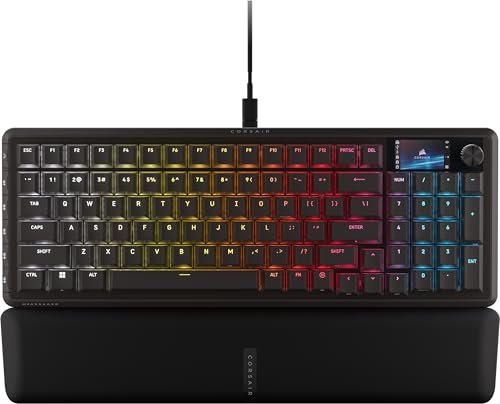
TL;DR: The Corsair Vanguard 96 packs a 96% layout, hot‑swappable MLX switches with 30‑35 g actuation, an integrated 1.9‑inch IPS LCD and up to 8,000 Hz polling, all for $149.99.
The standout feature is the built‑in 1.9‑inch IPS display (320 × 170 resolution) that sits above the key cluster, letting you keep profiles, timers or Discord alerts in view without reaching for the screen. Coupled with an adjustable actuation distance of 0.1‑4.0 mm and a light 30‑35 g force, the keyboard promises rapid, precise input for fast‑paced titles.
Compared with the other ten keyboards in this roundup, the Vanguard 96 weighs slightly more than the Nuphy Halo65 HE (1.74 lb) and the SteelSeries Apex Pro (2.14 lb), but still stays under the weight of the Corsair K70 PRO TKL (2.13 lb). Its 1.8 m detachable USB‑C cable runs longer than the typical cables on many rivals, giving you more desk‑clearance flexibility. The 96% layout offers a more compact footprint than the full‑size designs of the Keychron K10 HE and Razer Huntsman V3 Pro, yet it retains a numpad and arrow cluster that many tenkeyless boards lack. Like the SteelSeries and Razer models, it offers a full 0.1‑4.0 mm actuation range and an 8,000 Hz polling rate, placing it at the top end of latency‑focused keyboards.
Reviewers consistently praise the ultra‑low polling and the smooth feel of the MLX Fusion/Plasma/Quantum switches, noting the 30‑35 g actuation makes rapid double‑taps feel effortless. Professional reviewers also highlight the integrated LCD and the magnetic detachable wrist rest with leatherette cover as workflow boosters for streamers. On the downside, users mention that the iCUE/Web Hub software can be finicky when configuring macros, and the near‑1 kg weight (994 g) makes the unit less portable for LAN‑tour setups.
Pros
Cons
Best for: Competitive FPS/esports players and streamers who need ultra‑low latency, rapid actuation and on‑board macro visibility.
Avoid if: You prioritize a lightweight or wireless keyboard, or need a spill‑resistant design for a high‑traffic desk.
“Christ Centered Gamer praises the MLX Plasma switches for smooth performance, 8,000 Hz polling utility in Game Mode (switchable for efficiency)”
TL;DR: The GK Gamakay NS68 packs magnetic Hall‑Effect switches with 0.1‑3.7 mm adjustable actuation, 0.125 ms latency and a 4000 mAh battery for a compact 65% gaming keyboard at $49.99.
The standout spec is the adjustable actuation range of 0.1‑3.7 mm, fine‑tuned in 0.01 mm steps, paired with Outemu Peach magnetic Hall‑Effect switches and a measured latency of 0.125 ms. Wired mode runs at an 8 KHz polling rate, giving the kind of input lag that competitive gamers chase.
Compared with the other ten keyboards, the NS68 matches the Epomaker HE58 Lite’s 0.125 ms latency but trails its 128 KHz scan rate. At 0.762 kg, it's lighter than the Attack Shark X68 HE (855 g) and the Corsair Vanguard 96 (994 g), and also lighter than the Nuphy Halo65 HE (788.5 g). Its 65% ANSI layout makes it more compact than the full‑size Keychron K10 HE, while still offering arrow keys and a navigation cluster.
Reviewers repeatedly note the board’s responsiveness and the rapid‑trigger, snap‑tap and dynamic keystroke modes that give pixel‑perfect control. Professional outlets praise the 8 KHz polling and the rare adjustable actuation for the price point. The main complaints focus on the web‑based driver’s UI glitches and the lack of onboard memory, which means profiles must be loaded from a connected PC.
Pros
Cons
Best for: Competitive FPS and esports gamers who need ultra‑low latency and adjustable actuation on a budget.
Avoid if: You need a tactile or clicky switch feel, a dedicated function row, or the absolute best value‑per‑dollar in this segment.
Breakdown
Aula WIN60 HE
Pros
Keychron K10 HE
Pros
Corsair K70 PRO TKL
Pros
Cons
Razer Huntsman V3 Pro
Pros
Cons
Based on scoring data and product specs
Personalized picks
Best Overall Pick
Aula WIN60 HE
Best Budget PickBest for: Budget-conscious buyers seeking a reliable entry-level option
Keychron K10 HE
Best for: Most users seeking a balanced, mainstream option
$123.24+$83.25 vs winner
Skip GK Gamakay NS68 if…
You want the best value-per-dollar in its price range
The Aula WIN60 HE earns the top spot with its ultra‑low $39.99 price, a solid 4.5 / 5 rating from 628 reviews, and a lightning‑fast 8000 Hz polling rate. Its Hall Effect magnetic switches are hot‑swappable and come with a suite of adjustable actuation modes, while the gasket‑mounted design keeps the 60% layout compact at 279.4 mm × 127 mm × 27.94 mm and 627 g.
The runner‑up, Keychron K10 HE, shines if you need a full‑size keyboard that can jump between wired and wireless use, supporting up to three Bluetooth devices. It features Hall Effect magnetic hot‑swappable switches, an adjustable actuation range from 0.2 mm to 3.8 mm, and retails for $144.99 with a 4.4 / 5 rating based on 374 reviews.
For the tightest wallets, the Aula WIN60 HE is the best budget pick. If you want a step up without a premium price, the Keychron K10 HE offers the most features for its $144.99 tag. For a high‑end experience, the GravaStar Mercury V75 Pro, priced at $239.95, delivers the premium build and feature set expected at that tier.
Choose the Aula WIN60 HE now and get a Hall Effect gaming keyboard that delivers 8000 Hz polling and a 4.5 / 5 rating without the premium price tag.
At $39.99 it offers a 60% layout, gasket‑mounted Hall Effect magnetic switches, and a suite of eight adjustable actuation modes—including Rapid Trigger with a 0.02 mm distance—while still delivering 8000 Hz polling and 16.8 million‑color RGB. Its PBT keycaps, hot‑swappable switches, and comprehensive web‑based customization give it a data‑rich feature set that outpaces many pricier competitors.
No reviews yet — be the first to share your experience.
Please sign in to leave a review