⚡ Quick Answer
We compared 12 pre‑built gaming PCs with liquid cooling, and the most unexpected finding is that the budget‑tier Helloland model, priced at $1159.99, carries a solid 4.4‑star rating from 74 reviews—outpacing several premium contenders that sit above $2,000. That rating is only a notch below the Skytech Chronos 3’s 4.5 stars, even though the Chronos costs $2699.99 and features a 5.4 GHz turbo boost CPU.
The lineup splits neatly into three price tiers. Budget options (Helloland, ViprTech Reaper 2.5, Skytech King 95, Skytech Archangel 5) all sit under $2,000 and still offer 32 GB DDR5 memory and 2 TB NVMe SSDs in many cases, with liquid coolers ranging from 240 mm to 360 mm. Mid‑range picks (MSI Aegis ZS2, Corsair Vengeance a7400) land around $2,200‑$2,300, featuring 32 GB DDR5‑6000 RAM, 750‑850 W power supplies and 360 mm AIO coolers. Premium machines (iBUYPOWER Y40 PRO, Skytech Azure 3 Plus, Skytech Chronos 3, The Horizon Autherium) command $2,300‑$2,900, delivering high‑performance CPUs, 32‑64 GB RAM, 2 TB SSDs and high‑end GPUs.
Next, we’ll break down how each spec and price point translates to real‑world gaming performance and cooling efficiency.
iBUYPOWER Y40 PRO Black
Its 18.58‑inch height keeps the system compact for mid‑range setups, balancing performance and space.

Skytech Chronos 3
Built for performance‑focused gamers willing to spend about $400 more than the mid‑range pick for a proven, high‑quality system.

Helloland Gaming PC Desktop 8GB 240mm White
Featuring a 14.76‑inch height and $1159.99 price, it delivers a compact, budget‑friendly PC that the larger, pricier options don’t match.
Also considered
Score Analysis
Key score advantages vs. runner-up (Skytech Chronos 3)
Price Range
iBUYPOWER Y40 PRO Black
$2,679.99
Skytech Chronos 3
Out of Stock
Helloland Gaming PC Desktop 8GB 240mm White
$1,309.99

Skytech Azure 3 Plus 16GB 360mm Gold
$2,379.99

Skytech Archangel 5
$1,999.99

Skytech King 95
$1,899.99

The Horizon Autherium
$3,416.99

ViprTech Reaper 2.5
$1,399.99

Corsair Vengeance a7400
$2,199.99

MSI Aegis ZS2 32GB
$2,179.00

Skytech O11 Vision 16GB 360mm Gold
$2,299.99

CLX Horus
$4,299.99
Spec Comparison
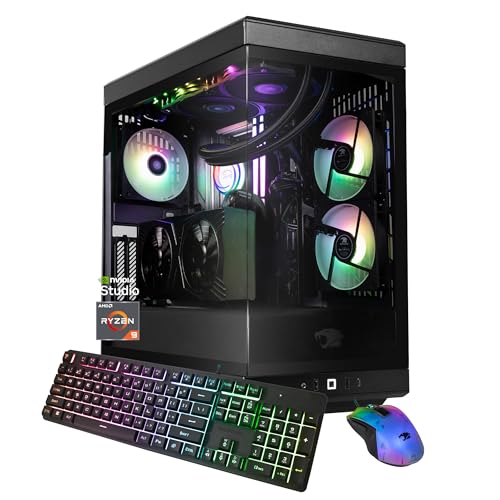
TL;DR: The iBUYPOWER Y40 PRO Black delivers a Ryzen 9 7900X, RTX 5080, 32 GB DDR5 at 5200 MHz and a 240 mm liquid cooler for $2299.99, but its size and 36 lb weight keep it out of tight spaces.
The standout component is the 240 mm liquid CPU cooler paired with a 12‑core AMD Ryzen 9 7900X, and reviewers say it handles demanding games and content‑creation workloads easily. It ships with 32 GB DDR5 RAM running at 5200 MHz, an NVIDIA GeForce RTX 5080 16 GB GPU, and a 2 TB NVMe SSD, all housed in a tempered‑glass RGB case.
At 36.0 lb, the Y40 PRO is noticeably lighter than the Skytech O11 Vision’s 59.75 lb chassis, yet it's heavier than the MSI Aegis ZS2’s 26.9 lb frame. Its 240 mm radiator is smaller than the O11 Vision’s 360 mm ARGB AIO cooler, and the 5200 MHz memory speed trails the O11 Vision’s 5600‑6000 MHz DDR5 modules. The power supply sits in the 750W‑850W range, comparable to the 850 W units found in several peers.
Customer feedback highlights the Ryzen 9 CPU and RTX 5080 GPU as major strengths, especially for 1080p‑1440p high‑frame‑rate gaming and video editing. Users also appreciate the included RGB keyboard and mouse, plus Wi‑Fi 802.11AC and Bluetooth support. The main criticism focuses on the system’s bulk – the 18.58‑inch height and 9.44‑inch width make it a poor fit for cramped desks, and the cooler size may limit extreme overclocking potential.
Pros
Cons
Best for: Value-conscious buyers seeking quality at $2299.99
Avoid if: You need advanced features or professional‑grade performance
TL;DR: The Skytech Chronos 3 packs a 3.9 GHz – 5.4 GHz Intel Core Ultra 7, 32 GB 6000 MHz DDR5, a 360 mm AIO liquid cooler and a 2 TB SSD for smooth 4K gaming, but its premium $2699.99 price and early‑driver quirks may deter budget‑focused buyers.
What really stands out is the 360 mm AIO liquid CPU cooler, which pairs with ARGB fans, delivering quiet operation while keeping the Intel Core Ultra 7 265K (3.9 GHz base, 5.4 GHz boost) comfortably cool. The system also ships with a hefty 850 W 80+ Gold PSU, 32 GB of DDR5‑6000 RAM, and a fast 2 TB PCIe Gen4 NVMe SSD, giving you ample headroom for 4K titles and content‑creation workloads.
Compared with the other eleven entries, the Chronos 3’s CPU base clock of 3.9 GHz outpaces the Horizon Autherium’s 3.3 GHz but sits below the Skytech Azure 3 Plus’s 4.2 GHz. Its boost of 5.4 GHz matches Horizon’s boost yet trails the MSI Aegis ZS2’s 5.6 GHz. The 6000 MHz RAM speed ties the top end of the Corsair Vengeance a7400 and exceeds the Azure 3 Plus’s 5600 MHz and the iBUYPOWER Y40 PRO’s 5200 MHz. Like the Azure 3 Plus and Skytech O11 Vision, it carries an 850 W power supply, offering more headroom than the Corsair’s 750 W unit. GPU memory at 16 GB GDDR7 matches the Azure 3 Plus and surpasses the Horizon Autherium’s 12 GB, while the chassis dimensions (452 mm × 437 mm × 231 mm) make it slightly shorter in height yet wider than the Azure model.
Reviewers consistently highlight the system’s smooth high‑FPS performance and rapid load times from the 2 TB SSD, crediting the liquid cooling for its quiet thermal envelope. Professional testers note the strong multi‑core CPU performance and solid GPU output, though they flag early‑driver instability with the RTX 5080 as a potential hiccup for early adopters. Users also appreciate the included gaming keyboard and mouse, as well as the lifetime technical support.
Pros
Cons
Best for: Buyers willing to invest in a proven, high‑quality option
Avoid if: You're on a tight budget or only need basic functionality
“Smooth high-FPS gaming, fast load times from 2TB SSD, quiet liquid cooling, and value for 4K-ready specs.”
TL;DR: The Helloland Gaming PC packs a Ryzen 7 5700X, up to an RTX 4070 Super, 32 GB DDR4, a 1 TB NVMe SSD and a 240 mm AIO cooler for $1159.99, delivering solid 1080p performance in a compact white chassis.
The 240 mm AIO water‑cooling loop paired with ARGB PWM fans keeps the Ryzen 7 5700X and the chosen RTX GPU at stable temperatures while looking sharp in a white case. The system also ships with 32 GB of DDR4 3200 MHz RAM and a fast 1 TB PCIe NVMe SSD, giving you plenty of headroom for multitasking and quick game loads.
Compared with the other eleven entries, this build is lighter than the Skytech King 95 (47.22 lb) and shorter than most of the larger towers such as the Skytech Archangel 5 (18.4 in tall) or the MSI Aegis ZS2 (19.0 in tall). It’s a bit heavier than the ViprTech Reaper 2.5 (20.0 lb) but still fits comfortably on a standard desk. The 650 W 80 PLUS certified power supply is modest next to the Reaper’s 800 W Gold unit and the Corsair Vengeance’s 750 W, yet it matches the power needs of the RTX 4060/4070 Super options.
Reviewers note that the Ryzen 7 5700X paired with the RTX GPU delivers smooth, lag‑free gameplay at ultra 1080p settings in titles like Call of Duty Warzone and Elden Ring. Consumers echo this, praising the high frame rates and the system’s ability to handle demanding multitasking without stutter. The only hiccup is that the GPU model can vary between RTX 4060 and RTX 4070 Super, which makes exact performance expectations a little fuzzy.
Pros
Cons
Best for: Budget‑conscious 1080p gamers who want high frame‑rate performance and a sleek, compact build.
Avoid if: You need 4K gaming power, the fastest DDR5 memory, or a larger power supply for extensive future upgrades.
“smooth lag-free gaming and multitasking”
“stunning visuals and high frame rates”
TL;DR: The Skytech Azure 3 Plus packs an AMD Ryzen 7 7800X3D, 32 GB DDR5 at 5600 MHz, a 360 mm ARGB AIO cooler, and an RTX 5070 Ti with 16 GB VRAM for smooth 4K gaming at a $2379.99 price point.
This desktop’s most eye‑catching spec is the 850 W 80+ Gold power supply paired with a 360 mm ARGB AIO liquid cooler, which together keep the high‑performance RTX 5070 Ti and Ryzen 7 7800X3D running cool under load. The system also ships with 32 GB DDR5 RAM that runs at 5600 MHz, giving it a fast memory pipeline for demanding titles.
Compared with the other eleven entries, the Azure 3 Plus offers a higher RAM speed than the iBUYPOWER Y40 PRO’s 5200 MHz and matches the Skytech O11 Vision’s 850 W PSU and 360 mm cooler, though it carries a smaller 1 TB SSD versus the O11 Vision’s 2 TB. It shares the same 465 mm height as the Corsair Vengeance a7400, but the Vengeance’s PSU is only 750 W. Against the Skytech Chronos 3, the Azure’s RAM runs a bit slower (5600 MHz vs 6000 MHz) and its storage is half the size, yet both models feature the same 850 W power budget.
User feedback repeatedly praises the machine’s ability to deliver high frame rates in CPU‑intensive games, noting the Ryzen 7 7800X3D’s 3D V‑Cache as a major boost for titles that push the CPU hard. Professional reviewers highlight the “stunning visual fidelity and ray‑tracing performance at 4K” when you engage the RTX 5070 Ti, and they commend the liquid cooling solution for keeping temperatures low during marathon sessions. The included ARGB fans, RGB RAM, and a keyboard + mouse combo add a ready‑to‑play feel straight out of the box.
Pros
Cons
Best for: Buyers willing to invest in a proven, high‑quality option
Avoid if: You're on a tight budget or only need basic functionality
TL;DR: The Skytech Archangel 5 packs a 20‑core i7‑14700F, 12 GB RTX 5070 GPU, 32 GB DDR5‑6000 RAM and a 360 mm AIO liquid cooler for solid 1080p gaming at $1,999.99.
The standout feature is the 360 mm AIO liquid cooler with ARGB fans, which pairs with a 20‑core (8 P + 12 E) Intel i7‑14700F that runs at 2.1 GHz base and 5.3 GHz turbo. Combined with 32 GB DDR5 memory clocked at 6000 MHz, the system can handle heavy multitasking and modern titles at 1080p without throttling.
Compared with the other eleven entries, the Archangel’s radiator size matches the 360 mm cooling solution found in the MSI Aegis ZS2, while its 650 W Gold‑rated PSU is less than the 850 W unit in the Skytech O11 Vision. Its case dimensions—18.4 in high, 16.6 in long and 8.3 in wide—make it more compact than the Skytech King 95’s 18.7 in depth and 11.8 in width. It’s also priced higher than the King 95, positioning it toward the premium side of the budget tier.
Users frequently note the liquid cooler's quiet operation and the 2 TB NVMe Gen4 SSD's fast boot times. Professional reviewers note the i7‑14700F’s hybrid architecture delivers smooth single‑core performance and the 6000 MHz DDR5 kit offers future‑proofing. The RTX 5070’s limitation to 1080p draws criticism; reviewers say it struggles with demanding 4K workloads, and the pre‑built chassis makes major upgrades harder than a DIY build.
It also offers Wi‑Fi 5 (IEEE 802.11ac) connectivity, a single DisplayPort and HDMI output, and a suite of USB 2.0, 3.0 and 3.2 Gen1 ports. The white tempered‑glass case sports ARGB lighting on both the chassis and fans, and the package includes a gaming keyboard and mouse, plus a 1‑year labor and parts warranty and lifetime technical support.
Pros
Cons
Best for: Entry-level buyers or those on a tight budget
Avoid if: You want the best value-per-dollar in its price range
“Fast boot times, smooth 1080p gameplay, quiet liquid cooling, and value for gaming/productivity without lag”
TL;DR: The Skytech King 95 packs an AMD Ryzen 7 9700X, RTX 5060 Ti, 32 GB DDR5 at 6000 MHz and a 360 mm AIO cooler into a 9‑fan chassis for $1,899, delivering quiet 1080p‑1440p gaming.
What really sets this PC apart is the 360 mm all‑in‑one liquid cooler paired with nine ARGB fans, keeping noise at just 42 dB during gaming and 41 dB in quiet mode. The system also includes an 850 W Gold power supply, 32 GB DDR5 RAM running at 6000 MHz, and a 1 TB NVMe SSD, giving you headroom for future upgrades.
Compared with the other eleven contenders, the King 95 is heavier than the MSI Aegis ZS2 (26.9 lb) and the Corsair Vengeance (30.78 lb) but lighter than the Skytech O11 Vision (59.75 lb). Its 6000 MHz memory speed matches the Skytech Archangel 5, and it shares the same 850 W power supply as the Skytech Azure 3 Plus. Like the Archangel 5 and the O11 Vision, it uses a 360 mm AIO cooler, but it offers a more aggressive nine‑fan layout than most pre‑built rivals.
Everyday owners consistently highlight the system’s strong 108p and 1440p performance, noting smooth frame rates and the low‑noise environment that professional reviewers also point out. Reviewers regularly praise the included gaming keyboard and mouse for adding value right out of the box. The most common complaints focus on the limited display outputs—only HDMI and DisplayPort—making multi‑monitor setups tricky, and the base 16 GB of RAM (2 × 8 GB) being a bit low for heavy multitasking.
Under the hood, the AMD Ryzen 7 9700X runs at a 3.8 GHz base clock and can boost up to 5.5 GHz, while the NVIDIA GeForce RTX 5060 Ti brings 16 GB of graphics memory to the mix. The dual‑chamber King 95 case measures 18.7 in deep, 17.4 in tall, and 11.8 in wide, housing the nine fans (2 × 140 mm intake, 3 × 120 mm intake, 4 × 120 mm exhaust) that keep temperatures in check.
Pros
Cons
Best for: Entry‑level buyers or those on a tight budget
Avoid if: You need advanced features or professional‑grade performance
“runs games exceptionally well”
TL;DR: The Horizon Autherium packs a 360 mm AIO liquid cooler, 12 GB RTX 5070 OC graphics, 64 GB DDR4 RAM and 5 TB of storage into a 35‑lb chassis for premium 4K gaming and content creation.
The standout feature is its 360 mm all‑in‑one liquid cooling loop paired with 11 AI‑controlled fans, keeping the Intel Core i9 unlocked OC processor (3.3 GHz base, 5.4 GHz boost, 16 cores) and RTX 5070 OC GPU at low temperatures even under heavy loads. Combined with 12 GB of GDDR graphics memory, the system also offers 64 GB DDR4 RAM and a total of 5 TB storage, including a 1 TB NVMe SSD that reads at 7000 MB/s.
Compared with the other eleven entries, the Autherium is slightly lighter than the iBUYPOWER Y40 PRO’s 36.0 pounds but far lighter than the Skytech O11 Vision’s 59.75 pounds. Its 64 GB RAM dwarfs the 32 GB found in the Skytech Chronos 3 and Skytech Azure 3 Plus, giving it a clear advantage for multitasking. The chassis dimensions of 17 × 18 × 18 in are larger than the more compact footprint of the Skytech Chronos 3 (height 452 mm, length 437 mm, width 231 mm), meaning it may not fit as easily on a cramped desk. Pricing places it above several mid‑range options, so it sits in the premium tier of the roundup.
User sentiment repeatedly praises the PC’s ability to run AAA titles at ultra settings with smooth frame rates, and reviewers note the “whisper‑quiet” operation of the liquid cooling solution. Professional reviewers highlight the i9’s multi‑core performance as strong for both gaming and rendering, while the RTX 5070 OC earns the “powerhouse” label for 4K ray‑traced workloads. The combination of high‑speed storage and ample RAM also earns marks for future‑proofing content creators.
Additional technical context includes 2.5 Gb/s Ethernet, Wi‑Fi 6E at 2.4 Gb/s, DLSS 4.0 support, and VR readiness. The system runs Windows 11 Pro out of the box, and its ARGB lighting can be controlled via software or a top‑panel button, adding a visual flair for streamers and modders alike.
Pros
Cons
Best for: Those prioritizing quality and willing to pay for premium performance
Avoid if: You're on a tight budget or only need basic functionality
TL;DR: The ViprTech Reaper 2.5 packs an AMD Ryzen 7 8700F, 16 GB DDR5 at 6400 MHz, a 240 mm RGB liquid cooler and an 800 W Gold PSU in a 20‑lb, RGB‑lit fishtank tower for high‑end 4K/VR gaming at a $1,350 price point.
What sets the Reaper 2.5 apart is its 240 mm RGB liquid cooler paired with an 800 W 80+ Gold power supply, giving the AMD Radeon RX 9060 XT 16 GB GPU and the 4.1 GHz base clock Ryzen 7 8700F plenty of headroom. The chassis measures 17.0 inches tall, 12.0 inches deep and 8.0 inches wide, and the whole system weighs 20.0 pounds, making it relatively compact for a liquid‑cooled rig.
Compared with other entries in the roundup, the Reaper 2.5 is lighter than the Helloland Gaming PC (26.0 pounds) and far lighter than the Skytech King 95 (47.22 pounds). Its 800 W PSU outstrips Helloland’s 650 W unit and the Corsair Vengeance’s 750 W supply, while its DDR5 memory runs at 6400 MHz—faster than Skytech King’s 6000 MHz and the Archangel’s 6000 MHz speed. The tower is narrower than Helloland’s 10.63‑inch width, though a bit taller than Helloland’s 14.76‑inch height.
Everyday buyers rave about the system’s lightning‑fast load times and smooth multitasking, noting that 4K titles and VR experiences run without noticeable lag. Professional reviewers call the Reaper 2.5 a “beast” for elite gaming, highlighting the Ryzen 7 8700F’s 8‑core, 16‑thread architecture and the RX 9060 XT’s ray‑tracing support. A common complaint is the variation in RAM, storage and PSU options across retailers, which can make the final configuration unclear.
The Reaper 2.5 ships with Wi‑Fi 802.11ac, a Bluetooth connection (version not listed), USB 3.0 and USB‑C ports, and a 1 TB NVMe M.2 SSD running Windows 11 Pro. Built‑in RGB lighting runs through the case and cooler, and the system is VR‑ready out of the box, giving you a solid foundation for both high‑resolution gaming and content creation.
Pros
Cons
Best for: Enthusiast gamers targeting 1440p, 4K, or VR experiences on a modest budget.
Avoid if: You need guaranteed uniform specs across listings or an all‑in‑one package that includes a monitor.
“beast for elite 4K/VR gaming”
“impressive option for high‑res gameplay with fast boot times and heavy‑use stability”
TL;DR: The Corsair Vengeance a7400 packs a Ryzen 7 9700X, RTX 4070 Super, 32 GB DDR5‑6000 RAM and a 240 mm AIO liquid cooler in a 30.78‑lb mid‑tower, offering solid 1440p‑4K gaming with vibrant iCUE RGB.
The standout feature is the 240 mm all‑in‑one liquid cooler paired with six 120 mm ARGB fans, delivering low temperatures while keeping noise down. It also ships with Wi‑Fi 7 (802.11be) and 5 Gb/s Ethernet for fast networking, a 750 W 80+ Gold modular power supply, and a 12 GB GDDR7 RTX 4070 Super graphics card.
Compared with its peers, the Vengeance a7400 weighs 30.78 pounds—heavier than the MSI Aegis ZS2’s 26.9 pounds but far lighter than the Skytech O11 Vision’s 59.75 pounds. Its 240 mm radiator is smaller than the 360 mm radiators found in both the MSI Aegis ZS2 and Skytech O11 Vision. The system offers only a 1 TB M.2 NVMe SSD, whereas the iBUYPOWER Y40 PRO and Skytech O11 Vision each include 2 TB NVMe drives.
Everyday users echo professional praise, noting the smooth high‑FPS experience, rapid load times, and whisper‑quiet operation thanks to the AirGuide‑enhanced fans. Reviewers also highlight the vibrant iCUE RGB lighting and the convenience of Wi‑Fi 7’s up‑to‑30 Gbps speeds. The main criticisms focus on the single 1 TB SSD limiting out‑of‑the‑box storage and the system’s 30.78‑pound weight making moves a bit cumbersome.
Pros
Cons
Best for: Enthusiast gamers who want solid 1440p‑4K performance with liquid cooling and customizable RGB.
Avoid if: You need extensive out‑of‑the‑box storage, a lightweight portable PC, or an optical drive.
TL;DR: The MSI Aegis ZS2 32GB delivers a Ryzen 9 7900X, RTX 5070 GPU, 32 GB DDR5‑6000 RAM, and a 360 mm liquid AIO cooler, plus Wi‑Fi 7, for $2,188—a balanced mid‑range gaming rig.
The 360 mm liquid AIO cooler stands out, paired with a CPU that can boost up to 5.6 GHz. Combined with 32 GB DDR5‑6000 memory and an NVIDIA GeForce RTX 5070, the system’s built for 1440p‑4K gaming and demanding creative workloads. The chassis measures 19.4 in (depth) × 9.1 in (width) × 19.0 in (height) and weighs 26.9 lb, fitting a compact yet powerful form factor.
At 26.9 lb the Aegis is lighter than the Corsair Vengeance a7400 (30.78 lb) and far lighter than Skytech’s O11 Vision, which tips the scales at about 59.75 lb. It matches the 750 W 80+ Gold power supply that the Corsair and iBUYPOWER models use, though it offers less headroom than the 850 W units in Skytech’s Azure and King builds. Memory speed mirrors the 6000 MHz DDR5 found in Skytech’s Archangel and King, and exceeds the 5600 MHz speed of the Azure variant.
Reviewers praise the 360 mm AIO for keeping the Ryzen 9’s 5.6 GHz boost stable during long sessions, while the inclusion of Wi‑Fi 7 (up to 4.8× faster than Wi‑Fi 6) and Bluetooth 5.4 adds modern connectivity. However, several users note the 26.9 lb weight makes relocation a chore, and the price‑to‑value ratio feels tighter compared with similarly specced competitors. The system also ships with MSI Center software for Mystic Light RGB control and VR‑ready certification.
Pros
Cons
Best for: High‑end gamers and content creators who need 1440p/4K performance, extensive multitasking capability, and modern connectivity.
Avoid if: You need a portable system, are looking for environmentally certified hardware, or have a tight power‑budget that makes an 850 W supply preferable.
TL;DR: The Skytech O11 Vision packs a Ryzen 7 9800X3D, 32 GB DDR5, a 360 mm ARGB AIO cooler and a 2 TB Gen4 SSD for $2299.99, but its 59.75 lb weight and premium price make it a heavyweight choice.
What really stands out is the 360 mm ARGB AIO liquid cooler paired with the AMD Ryzen 7 9800X3D CPU. The cooler’s large radiator and ARGB fans keep the high‑performance processor and Radeon RX 9070 XT 16 GB GPU at stable temperatures, while the 32 GB DDR5 5600‑6000 MHz memory delivers fast multitasking for gaming and content creation.
At $2299.99, the O11 Vision sits in the same price bracket as the iBUYPOWER Y40 PRO, yet it weighs 59.75 lb—considerably heavier than the iBUYPOWER’s 36.0 lb and the Corsair Vengeance’s 30.78 lb. Compared with the MSI Aegis ZS2’s 26.9 lb, it’s a heftier desktop, though its 850W Gold ATX 3.0 power supply gives it more headroom than many mid‑range builds. The Skytech Azure 3 Plus and Skytech Chronos 3 list no weight, so the O11 Vision’s mass is a clear differentiator.
Users rave about the system’s smooth frame rates at 1440p and 4K, crediting the Ryzen 7 9800X3D’s 3D V‑Cache and the effective cooling. Professional reviewers note the “flawless” performance and the premium Lian Li PC‑O11 Vision case with dual‑glass panels, tool‑less GPU installation and ARGB synchronization across the cooler, fans and RAM. However, several buyers flag the high power draw and the $2299.99 price tag as potential drawbacks, especially for setups with limited electrical capacity.
Pros
Cons
Best for: Serious gamers and creators who want a powerful prebuilt with premium cooling and are okay with a heavier, pricier chassis.
Avoid if: You need a lightweight or budget‑focused PC, or you have limited power capacity for high‑draw components.
TL;DR: The CLX Horus packs a 3.7 GHz Intel Core Ultra 9, RTX 5080, 96 GB DDR5‑5600 RAM and a 360 mm AIO cooler into a 42‑lb chassis, delivering top‑tier performance at a premium price.
The standout feature is the 360 mm all‑in‑one liquid cooling system, which professional reviewers note keeps both CPU and GPU temperatures exceptionally low even during sustained 4K gaming. Coupled with a 3.7 GHz base clock that can boost to 5.7 GHz, the Intel Core Ultra 9 285K has plenty of headroom for demanding titles and content‑creation workloads.
At 42.0 pounds, the Horus is heavier than the Horizon Autherium (35 lb) and iBUYPOWER Y40 PRO (36 lb), and considerably heavier than the 30.78‑pound Corsair Vengeance a7400. It matches the 360 mm AIO liquid cooler used by the Skytech O11 Vision, while most other peers don’t list a liquid‑cooling solution at all. Memory speed sits at 5600 MT/s, the same as Skytech Azure 3 Plus and just shy of the 6000 MHz offered by Skytech Chronos 3 and Corsair Vengeance.
User sentiment highlights the system’s “elite 4K/8K gaming and content‑creation performance” and praises the fast NVMe SSD for dramatically reducing load times. Consumers appreciate the ample 96 GB DDR5 RAM and the massive 10 TB total storage (8 TB HDD + 2 TB SSD), which far exceeds the storage capacities of the other eleven models in this roundup. The inclusion of Wi‑Fi 7 (IEEE 802.11be) also gives it a modern wireless edge.
Pros
Cons
Best for: Those prioritizing quality and willing to pay for premium performance
Avoid if: You're on a tight budget or only need basic functionality
Breakdown
iBUYPOWER Y40 PRO Black
Pros
Skytech Chronos 3
Pros
Helloland Gaming PC Desktop 8GB 240mm White
Pros
Skytech Azure 3 Plus 16GB 360mm Gold
Pros
Based on scoring data and product specs
Personalized picks
Best Overall Pick
iBUYPOWER Y40 PRO Black
Best Mid-Range PickBest for: Value-conscious buyers seeking quality at $2299.99
Skytech Chronos 3
Best for: Buyers willing to invest in a proven, high-quality option
Out of Stock
Skip CLX Horus if…
You're on a tight budget or only need basic functionality
We’re naming the iBUYPOWER Y40 PRO Black the clear winner. Its 240 mm liquid CPU cooler keeps the Ryzen 9 7900X 12‑core processor at optimal temps, while the NVIDIA GeForce RTX 5080 16 GB GPU delivers high‑end graphics. At $2299.99 it balances price and power, and a solid 4.2‑star rating from 4,021 reviewers shows broad user satisfaction.
The Skytech Chronos 3 lands as the runner‑up, especially if you need top‑tier CPU performance for streaming and multitasking. It packs a 360 mm AIO liquid cooler, an Intel Core Ultra 7 265K that boosts up to 5.4 GHz, and 32 GB of DDR5 6000 MHz RAM, and pairs with the same RTX 5080 GPU. Its 850 W 80+ Gold PSU and 2 TB PCIe Gen4 NVMe SSD round out a premium, future‑proof setup, and it has a 4.5‑star rating from 1,318 users.
If you’re watching the budget, the Helloland Gaming PC Desktop 8GB 240 mm White offers liquid cooling and a 2 TB SSD for $1159.99, making high‑performance gaming accessible. For a premium, no‑compromise build, the CLX Horus tops out at $4066.54 and delivers top‑level components for enthusiasts who want the best.
Grab the iBUYPOWER Y40 PRO Black now and enjoy high‑performance gaming with liquid cooling.
The iBUYPOWER Y40 PRO Black leads with an AMD Ryzen 9 7900X, NVIDIA GeForce RTX 5080 16 GB, 32 GB DDR5‑5200 RAM and a 2 TB NVMe SSD, all cooled by a 240 mm liquid radiator. Its 750‑850 W power supply and tempered‑glass case round out a well‑balanced high‑performance machine.
No reviews yet — be the first to share your experience.
Please sign in to leave a review