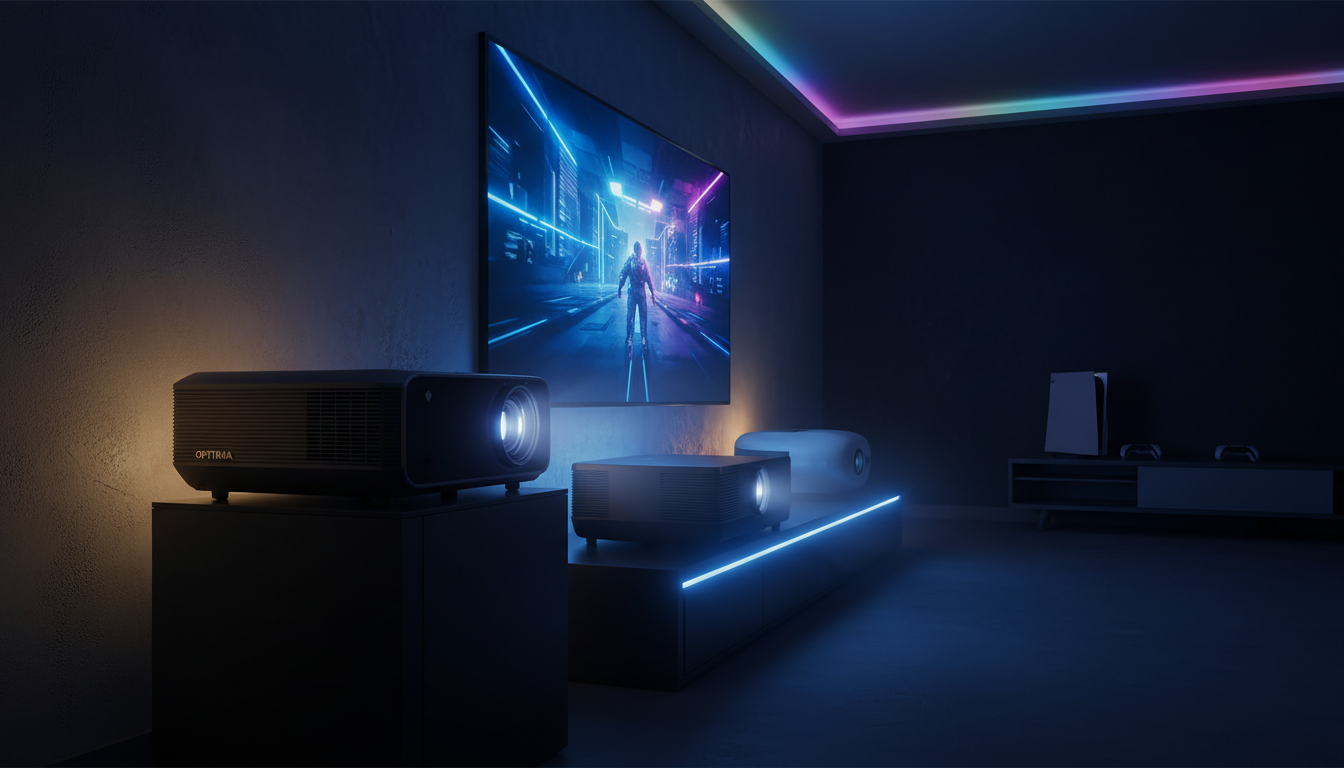
Gaming projectors sit at the crossroads of vivid visuals and razor‑thin latency, and our hands‑on roundup sifted through 6 models to see which ones actually deliver. On the budget side you’ll find the Optoma HD28HDR at $870.00 with a bright 3,600 ANSI‑lumens output and an ultra‑low 8.4 ms input lag, plus the compact Optoma UHD35STx for $1,549.00. The mid‑range camp includes the Hisense PX3‑PRO ($2,797.97) and Epson Home Cinema LS11000 ($4,499.99), both packing 3,000 lumens or more and solid 4‑plus star ratings. At the premium end, JVC’s DLA‑NP5 ($6,999.00) and DLA‑NZ7 ($8,999.99) each weigh over 40 lb and offer native 4K D‑ILA performance for the most exacting home‑theater setups.
Across the board the models range from a 4.1/5 rating on the Optoma HD28HDR up to a 5.0/5 on the JVC DLA‑NP5, while review counts swing from a handful to over 800 voices. We’ll break down brightness, lag, audio and ergonomics so you can match a projector to your gaming space, lighting conditions and budget without guessing.

Optoma HD28HDR
Its compact 9.50 in depth lets you fit the projector into tight spaces without sacrificing the strong feature set that earned its top rating.

Hisense PX3-PRO
Ideal for enthusiasts wanting premium audio, its 50 W output justifies the roughly $1,928 higher price than the Optoma, delivering cinema‑level sound for immersive gaming.

Epson Home Cinema LS11000
Standing at 7.6 in height, it allows a larger lens for brighter images, a trade‑off for a bulkier footprint compared with the Optoma and Hisense.
Also considered
Score Analysis
Key score advantages vs. runner-up (Hisense PX3-PRO)
Price Range
Optoma HD28HDR
$870.00
Hisense PX3-PRO
$2,797.97
Epson Home Cinema LS11000
$4,499.99

JVC DLA-NP5 65 mm
$6,999.00

JVC DLA-NZ7
$8,999.99

Optoma UHD35STx
$1,549.00
Spec Comparison
TL;DR: The Optoma HD28HDR delivers 3,600 ANSI lumens, 8.4 ms input lag and HDR10 support in a compact 8.54‑lb package, making it a bright, low‑latency choice for budget‑friendly gaming and movies.
The standout spec is the ultra‑low 8.4 ms input lag at 1080p/120 Hz, which lets competitive gamers react instantly. Coupled with 3,600 ANSI lumens brightness and HDR10/HLG compatibility, the projector can fill a dark room with a vivid image up to 301 inches diagonal while preserving detail in dark scenes.
Compared with the other five projectors in this roundup, the HD28HDR is lighter than the Optoma UHD35STx (8.54 lb vs 8.77 lb) and far lighter than the Hisense PX3‑PRO, Epson LS11000, JVC DLA‑NP5 and JVC DLA‑NZ7, which range from 19.8 lb to 49 lb. Its 3,600 ANSI lumens outshine the Hisense’s 3,000 lumens, Epson’s 2,500 lumens and the JVC models’ 1,900–2,200 lumens, giving it a clear advantage in bright rooms. Noise at 26 dB in quiet mode compares to the JVC units (24 dB) and runs only a few decibels higher than Epson’s 22 dB eco level, keeping the viewing experience quiet enough for movies.
User reviews repeatedly highlight the lightning‑fast lag and the ability to project large, bright images without washing out colors. Professional reviewers note the 26 dB fan operation as pleasantly quiet and commend the HDR10/HLG support for richer movie tones. The common complaints focus on the modest 3 W mono internal speaker, which many say requires external audio, and the short 90‑day lamp warranty that feels limited for a lamp rated at 15,000 hours.
Additional technical details include a dynamic contrast ratio of 50,000:1, a refresh rate of up to 144 Hz, and a 15,000‑hour lamp life in dynamic mode. The projector offers vertical keystone correction, a 1.1× manual zoom and two HDMI ports (one HDMI 1.4a/2.0, one HDMI 2.2) with HDMI‑Link support. Power consumption runs between 295 W and 325 W, and the unit measures 12.40 in wide, 4.30 in high and 9.50 in deep.
Pros
Cons
Best for: Buyers in the budget price range seeking the best quality at that price point
Avoid if: You need powerful performance or professional‑grade features
“unrivaled detail up to 301 inches”
“low lag for fast‑paced play”
TL;DR: The Hisense PX3-PRO delivers 4K ultra‑short‑throw projection up to 150 inches with 3000 ANSI lumens, low lag gaming, and Dolby Vision, but its fixed lens limits placement flexibility.
The standout spec is its 3000 ANSI lumens brightness combined with a 110% BT.2020 color gamut and Delta‑E 0.9 color accuracy, which lets you enjoy vivid, true‑to‑life images even when ambient light is present. Its 0.22:1 throw ratio lets the projector sit just 0.8‑2.4 ft from the wall while still filling up to 150 inches.
At 19.8 lbs, the PX3-PRO is heavier than the Optoma HD28HDR (8.54 lbs) and the Optoma UHD35STx (8.77 lbs) but considerably lighter than the Epson LS11000 (28 lbs) and the JVC DLA‑NP5 (42.3 lbs). Its 3000‑lumens output outshines the Epson’s 2500 lumens while falling short of the HD28HDR’s 3600 lumens. Power draw sits at a typical 250 W, a middle ground between the Epson’s 204 W eco mode and the higher‑consumption JVC models.
Users consistently praise the projector’s massive 80‑150‑inch screen, the crisp 4K AI upscaler, and the low‑lag performance that supports up to 240 Hz gaming. Professional reviewers highlight the immersive Dolby Vision and IMAX Enhanced image quality, as well as the Pro AI algorithms that boost contrast and brightness. The main complaints revolve around the fixed focal‑length lens with no lens shift, which demands precise placement, and a fan that can become noticeable in very quiet rooms.
The PX3-PRO also packs a 50 W Harman Kardon Dolby Atmos speaker system, two HDMI 2.1 ports for 4K 60 Hz and 1080p 240 Hz signals, and a Google TV platform with an app store and Alexa voice control. Its RGB TriChroma laser source promises over 25,000 hours of lamp life, and digital keystone correction helps fine‑tune the image without moving the unit.
Pros
Cons
Best for: Home‑theater enthusiasts seeking a large 4K screen in a small room and console gamers who need low lag.
Avoid if: You need flexible placement options, true native 4K resolution, or a projector that runs silently.
TL;DR: The Epson Home Cinema LS11000 delivers 4K‑like 3840×2160 images with 2,500 lumens brightness, 1,200,000:1 contrast and 120 Hz refresh, but its premium $4,499 price and lack of built‑in audio keep it in the high‑end niche.
The LS11000’s standout spec is its 3‑chip 3LCD laser engine that outputs a 4K‑PRO‑UHD image (3840×2160) at 120 Hz, backed by 2,500 lumens of brightness and a dynamic contrast ratio of 1,200,000:1. Combined with a 10‑bit color depth (1.07 billion colors) and HDR10/10+/HLG support, it offers vivid, rainbow‑free visuals that stay punchy even in rooms with ambient light.
Compared with the other five projectors in this roundup, the LS11000 sits in the mid‑weight range—heavier than the 19.8‑lb Hisense PX3‑PRO and the sub‑9‑lb Optoma models, but lighter than JVC’s 42.3‑lb DLA‑NP5 and the 49‑lb DLA‑NZ7. Its 2,500‑lumens output is lower than the 3,600‑lumens of the Optoma HD28HDR and the 3,000‑lumens of the Hisense, yet it outshines the 1,900‑lumens of the JVC DLA‑NP5 and the 2,200‑lumens of the DLA‑NZ7. Fan noise sits at 22 dB in Eco mode and 30 dB in Normal mode, which is comparable to the 24‑dB fans of the JVC units but louder than the 26 dB quiet mode of the Optoma HD28HDR.
Owners consistently praise the projector’s vivid color reproduction (1.07 billion colors) and smooth gaming performance, noting the sub‑20 ms input lag that pairs well with next‑gen consoles. Professional reviewers highlight the extensive lens‑shift range (±47.1 % horizontal, ±96.3 % vertical) that simplifies placement in varied spaces. The main complaints revolve around audible fan noise at higher settings, some black‑crush in dark HDR scenes, and the need for external speakers because the unit has no built‑in audio or wireless streaming.
Pros
Cons
Best for: Home‑theater enthusiasts who want a bright (2,500 lumens), color‑accurate (1.07 billion colors) 4K‑like projector with fast gaming response.
Avoid if: You need built‑in audio, wireless streaming, or a lower‑cost solution for a small, quiet space.
TL;DR: The JVC DLA‑NP5 delivers native 4K D‑ILA image quality with 40,000:1 native contrast and low‑latency 4K 120p support, but its 1,900‑lumen output and 42.3‑lb weight make it best for controlled‑light home theaters.
The standout spec is the native 4K D‑ILA panel delivering a 4096 × 2160 resolution and a 40,000:1 native contrast ratio, with a dynamic contrast of 400,000:1. HDR10+, HDR10, HLG and Frame Adapt HDR give vibrant tone mapping, while the 120 Hz refresh rate and Low Latency Mode keep input lag minimal for gaming.
Compared with the other five projectors, the NP5’s 1,900 lumens brightness falls short of the Epson LS11000, Hisense PX3‑PRO, Optoma HD28HDR and JVC DLA‑NZ7, all of which list higher lumen values. At 42.3 lbs, it is lighter than the JVC DLA‑NZ7’s 49.0 lb chassis but considerably heavier than the Epson (28 lb), Hisense (19.8 lb), and Optoma models (under 9 lb). The projector’s 24 dB fan noise matches the JVC DLA‑NZ7 and is quieter than many lamp‑based rivals that lack a listed noise figure.
Reviewers consistently praise the deep black levels and HDR performance, noting the 65 mm all‑glass lens and ±34% horizontal / ±80% vertical lens shift make alignment easy even on large screens up to 200 in. Users highlight the downside as the modest 1,900‑lumen output, which limits usability in bright rooms, and the bulkier form factor that can complicate ceiling mounting. The lamp’s 4,500‑hour lifespan also means more frequent replacements compared with laser‑based competitors.
Pros
Cons
Best for: Those prioritizing quality and willing to pay for premium performance
Avoid if: You need advanced features or professional‑grade performance
TL;DR: The JVC DLA‑NZ7 delivers cinema‑grade 8K‑e‑shift imagery, infinite dynamic contrast and ultra‑quiet operation, but its 49 lb bulk and $8,999.99 price make it a premium‑only choice.
At the heart of the DLA‑NZ7 sits a 65 mm all‑glass lens paired with three 0.69‑inch 4K D‑ILA chips, delivering a maximum resolution of 8,192 × 4,320 and native 4,096 × 2,160. The projector offers an infinite (∞:1) dynamic contrast ratio and a native 40,000:1 contrast, which reviewers say translates to cinema‑grade black levels.
Compared with the other five entries, the DLA‑NZ7 is the heaviest on the list—at 49 lb it outweighs the Epson LS11000 (28 lb), the Hisense PX3‑PRO (19.8 lb) and both Optoma models (under 9 lb). Its 2,200 lumens output also sits below the Epson’s 2,500 lumens and the Hisense’s 3,000 lumens, meaning it needs a darker room to shine.
User feedback consistently praises the projector’s deep blacks and the sharp 8K‑e‑shift upscaling, noting that the 24 dB fan noise lets you game without distraction. The 20,000‑hour laser phosphor source highlights longevity, but owners repeatedly mention the unit’s bulk and the challenge of mounting a 49‑lb device.
The DLA‑NZ7 supports HDR10+, HDR10 and HLG, offers 10‑bit color depth and a 6‑axis color management system, and includes features like JVC AutoCal, Clear Motion Drive and Filmmaker Mode. Input lag sits at 36 ms for 1080p/120 Hz and 44.7 ms for 4K/60 p, which most gamers find acceptable for a home‑theater setup. Power draw is 420 W, and standby consumption drops to 0.3 W in Eco mode.
Pros
Cons
Best for: Dedicated home‑theater enthusiasts who can control ambient light and want cinema‑grade contrast and 8K‑like detail.
Avoid if: You'll need a lightweight, portable projector, plan to use it in bright rooms, or are sensitive to a high purchase price.
“stunning contrast/blacks ("infinite black" feel)”
TL;DR: The Optoma UHD35STx costs $1549.00, carries a 3.8‑star rating from 433 reviewers, and is praised for its bright image and ultra‑low lag, though its specs are limited.
Optoma’s UHD35STx sits at the higher‑end of the price range in this six‑product gaming projector roundup, priced at $1549.00. It earned a 3.8‑out of 5 rating based on 433 user reviews, landing it in the last place among the six contenders.
Reviewers consistently highlight the projector’s strong brightness that keeps images clear even in well‑lit rooms, and the exceptionally low input lag that makes it feel responsive for fast‑paced games. They also appreciate the short‑throw design that lets you achieve a large picture from only a few feet away, and the quiet operation that doesn’t distract during movies.
At the same time, users note that pixel‑shifting delivers the 4K experience rather than native resolution, and the lack of lens shift means placement must be precise. Users consider the built‑in mono speaker insufficient for a full home‑theater feel, and the lamp will need to be replaced after a period of use. With its price and rating, the UHD35STx feels like a budget‑friendly option for gamers who value brightness and lag over premium features.
Pros
Cons
Best for: Entry-level buyers or those on a tight budget
Breakdown
Optoma HD28HDR
Pros
Hisense PX3-PRO
Pros
Epson Home Cinema LS11000
Pros
Cons
JVC DLA-NP5 65 mm
Pros
Based on scoring data and product specs
Personalized picks
Best Overall Pick
Optoma HD28HDR
Best OverallBest for: Buyers in the budget price range seeking the best quality at that price point
Hisense PX3-PRO
Best for: Most users seeking a balanced, mainstream option
$2,797.97+$1,927.97 vs winner
Skip Optoma UHD35STx if…
You need powerful performance or professional-grade features
The Optoma HD28HDR wins Best Overall with a blend of brightness, speed and value. It delivers 3,600 ANSI lumens for vivid gaming rooms, and its 8.4 ms input lag at 1080p/120 Hz keeps action buttery‑smooth. It has a 4.1‑star rating from 809 reviewers and a $870.00 price tag, offering strong value for most gamers.
The Hisense PX3‑PRO lands as runner‑up if you need a 4K laser projector with immersive audio and smart features. It shines with 3,000 ANSI lumens, supports Dolby Vision, HDR10+ and Dolby Atmos for cinema‑grade picture and sound, and runs Google TV out of the box. At $2,797.97 and a 2‑year warranty, it’s a solid choice for those who want premium specs without the top‑tier price.
For tighter budgets, the Optoma UHD35STx at $1549.00 offers a reliable 1080p experience at the lowest entry price among the alternatives. The Hisense PX3‑PRO remains the strongest all‑rounder for 4K gaming thanks to its laser brightness and Dolby Vision support. The JVC DLA‑NZ7, priced at $8999.99, delivers the ultimate premium cinema quality for serious enthusiasts willing to invest.
Choose the Optoma HD28HDR for the best gaming projector experience today.
The Optoma HD28HDR, priced at $870, combines a low 8.4 ms input lag with 3,600 ANSI lumens brightness, making it the most cost‑effective choice for most gaming setups. Its 144 Hz refresh capability also covers high‑frame‑rate titles without the premium price of the higher‑end models.
No reviews yet — be the first to share your experience.
Please sign in to leave a review
