⚡ Quick Answer
If you want the best gaming speakers with Bluetooth, the Edifier G2000 catches the eye with a 4.6‑star rating from 3,408 reviewers, a peak output of 32 W and a compact 2.75‑inch driver, all for $99.99. Its RGB lighting and three EQ presets make it a solid fit for small desks, while the mix of Bluetooth, USB and AUX keeps your PC, console or laptop connected without hassle.
Our comparison spans 11 models, organized into clear price tiers. The budget camp includes the Jeecoo M30 ($19.99, 10 W total), Smalody speakers ($24.67, 5 W × 2) and Kapeydesi set ($24.99, 10 W total), plus the Bluedee option at $53.99 with 15 W output. Mid‑range choices feature the Razer Leviathan V2 X at $84.99 (90 dB max SPL) and the Edifier G2000 itself. Premium picks such as the SteelSeries Arena 3 ($149.99, 4‑inch drivers), Audioengine A1 ($199.00, 60 W) and Logitech G560 ($249.99, 120 W RMS) deliver higher power and advanced lighting, while the Audioengine A2+ tops the list at $279.00 with a low 30 ms Bluetooth latency.
Below you’ll find a closer look at each speaker’s strengths, so you can match the right audio vibe to your gaming setup.
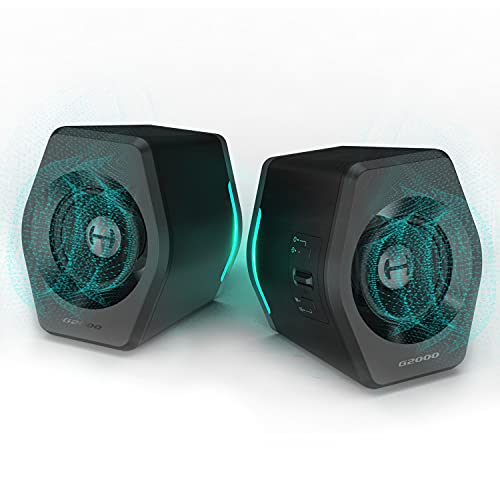
Edifier G2000
Its 2.75‑inch drivers deliver clear sound while keeping noise under ≤25 dB(A), offering strong value and reliability.

Razer Leviathan V2 X
Ideal for value‑conscious gamers who want solid performance, the Leviathan V2 X comes in at $84.99—about $15 less than the Edifier G2000.

Logitech G560
The G560 stands out with a 240 W peak power output and 97 dB max SPL, delivering immersive lighting‑synced audio that the Edifier and Razer models don’t provide.
Also considered
Score Analysis
Key score advantages vs. runner-up (Razer Leviathan V2)
Price Range
Edifier G2000
$99.99
Razer Leviathan V2 X
$85.00
Logitech G560
$249.99

SteelSeries Arena 3
$124.58

Smalody Computer Speakers
$23.37
Jeecoo M30
$19.99

Audioengine A2+
$279.00
Bluedee Computer Speakers
$56.99

Audioengine A1
$195.02

Kapeydesi Computer Speakers
$24.99

Fifine A22
$72.99
Spec Comparison
TL;DR: The Edifier G2000 packs 2.75‑inch drivers, 16 W RMS output and 12‑color RGB lighting into a 4.21‑lb column‑shaped set, offering solid gaming sound for a compact desk.
The standout spec is the 2.75‑inch full‑range drivers paired with a 16 W RMS power rating, delivering surprisingly punchy audio from a cabinet that measures just 5.47 in deep, 9.09 in high and 8.31 in wide. A built‑in mechanical shift lever lets you dial volume without reaching for software, and the 12 customizable RGB light patterns add a gamer‑friendly vibe.
At 4.21 lbs, the G2000 is heavier than the Razer Leviathan V2 X (1.98 lb) and the Bluedee speakers (2.0 lb) but lighter than the Fifine A22 (5.07 lb). Its driver size sits below SteelSeries Arena 3’s 4‑inch drivers and above Smalody’s 50.8 mm units, placing it solidly in the mid‑range of the lineup. The 5.47‑inch depth’s a touch deeper than Fifine’s 5.35 in but shallower than Kapeydesi’s 6.5‑in design, keeping it well suited for tight desk spaces.
Users consistently praise the G2000’s compact footprint and the “punchy” output that belies its size, as well as the straightforward Bluetooth pairing and vivid RGB effects. Professional reviewers note the sleek hexagonal column shape and the HIFI tuning that balances mids and highs, while some buyers mention occasional Bluetooth or USB drops and a plastic build that feels less premium than metal‑chassis rivals.
Additional technical notes include a low noise level of ≤25 dB(A), a 0.65 L cavity that houses the backward‑facing mega bass port, and three EQ presets—Music, Game and Movie—that let you tailor the sound without extra software. Edifier backs the set with a 1‑2‑year warranty, and the package comes with a USB cable, 3.5 mm audio cable, power adapter and the speakers themselves.
Pros
Cons
Best for: Budget‑conscious gamers and desktop users who need a well‑reviewed, space‑saving speaker set with Bluetooth connectivity.
Avoid if: You prioritize deep, extended bass, a metal‑chassis build, or need a highly portable audio solution.
TL;DR: The Razer Leviathan V2 X packs a 140 mm subwoofer, 10‑band EQ and 14‑zone RGB into a 1.98‑lb soundbar, offering low‑latency Bluetooth for tight gaming audio at $84.99.
What really sets the Leviathan V2 X apart is its 2.1‑channel design that combines a 140 mm down‑firing subwoofer with dual full‑range drivers and a 20 mm tweeter. The system can reach a maximum SPL of 90 dB and delivers a frequency response of 45 Hz – 20 kHz, while Bluetooth 5.2 keeps latency down to 60 ms for responsive game sound.
At 1.98 lb, the Leviathan V2 X is considerably lighter than the Fifine A22 (5.07 lb) and the Edifier G2000 (about 4.21 lb), and it matches the weight of the Jeecoo M30. It weighs just a shade less than the Bluedee speakers (2.0 lb). Most of the other speakers in this roundup lack any RGB lighting, whereas the Leviathan V2 X offers 14‑zone Razer Chroma illumination for a more immersive setup.
Reviewers consistently praise the crisp treble and punchy bass that the multi‑driver layout provides, and users love the easy Bluetooth pairing and the vibrant lighting. The downsides that keep the rating at 4.2 / 5 include reported bugs in the Razer Synapse software, a limited selection of input ports, and a subwoofer that can dominate a small desk. Professional outlets also note that the sound can distort when the volume is cranked to the 90 dB maximum.
Pros
Cons
Best for: Value-conscious buyers seeking quality at $84.99
Avoid if: Reliability and user satisfaction are your top concerns
“great audio”
TL;DR: The Logitech G560 delivers 120 W RMS power, 97 dB SPL and RGB LIGHTSYNC in a 2.1 desktop system, but its $249.99 price and 2‑channel layout suit gamers willing to invest.
The G560 packs 120 W RMS output across its two satellite speakers and a 60 W subwoofer, reaching a maximum SPL of 97 dB. Its satellite drivers measure 63.5 mm, while the subwoofer’s 165 mm driver pushes bass down to 40 Hz – a rare low‑end reach for a PC speaker set.
At 12.1 pounds, the system weighs almost twice as much as the Audioengine A2+ and A1, which each weigh 6.0 pounds, and it’s considerably heavier than the Razer Leviathan V2 X’s 1.98 pounds. Bluetooth range sits at 25 m, a few meters shorter than the Audioengine A1’s 30 m, but still ample for a typical desk setup. Unlike many peers, the G560 adds four RGB zones with 16.8 million colors and DTS:X Ultra positional audio, features not noted on the other models.
Professional reviewers praise the “intense bass” and the way LIGHTSYNC reacts to in‑game events, while everyday users love the desk‑shaking low end and easy Bluetooth pairing. A recurring complaint is that the subwoofer can become overly loud or emit a humming noise at maximum volume, and some report occasional software glitches that affect volume or lighting controls.
Additional technical details include an input impedance of >10 kΩ, a sensitivity of 84 dB, and support for up to two simultaneous Bluetooth connections. The system also offers a 3.5 mm aux input, a headphone jack, and a 1‑year limited hardware warranty.
Pros
Cons
Best for: Buyers willing to invest in a proven, high-quality option
Avoid if: You're shopping on a tight budget — it's priced at $249.99
“clear, pure sound”
“huge soundscape”
TL;DR: The SteelSeries Arena 3 delivers powerful 4‑inch drivers, Bluetooth pairing and RGB lighting for $149.99, but its bulkier footprint and modest 4.2‑star rating may deter space‑conscious gamers.
The Arena 3 stands out with dual 4‑inch organic‑fiber drivers that cover a frequency response of 50 Hz – 20 kHz. At 3.18 kg total weight and a footprint of 7.7 in depth, 5 in height and 4.1 in width, it makes a solid presence on a desk. RGB lighting, an adjustable tilt stand and on‑speaker controls add both style and ergonomics, while SteelSeries Sonar software provides a 10‑band EQ and Spatial Audio.
Compared with other speakers in this roundup, the Arena 3 is heavier than the Audioengine A1 (2722 g) but lighter than the Razer Leviathan V2 X (4400 g) and far lighter than the Logitech G560 (12.1 lb). Its 4‑inch drivers are larger than the 2.75‑inch drivers of the Edifier G2000, giving it a broader soundstage, and it offers RGB lighting that the Edifier and Fifine models lack. While the Bluedee speakers weigh only 2.0 lb, they also lack the adjustable tilt and software tuning that the Arena 3 provides.
Users consistently praise the crystal‑clear highs, vibrant mids and surprisingly powerful bass for a 2.0 system, noting that Bluetooth pairing is hassle‑free thanks to the on‑speaker multi‑function button. Reviewers also like the easy dial volume control and the ability to fine‑tune sound via the 10‑band EQ. On the flip side, several owners mention the bulkier footprint and that the lack of a dedicated subwoofer can leave the deepest lows feeling thin, especially at very high volumes.
The system supports both wired 3.5 mm input and Bluetooth, with echo cancellation built in to keep voice chat clear. It comes with a 1‑year warranty and an external power adapter, so you won’t need to worry about battery life. Compatibility spans PC, TV, phones, tablets and other audio devices, making it a versatile addition to a gaming or media setup.
Pros
Cons
Best for: Those prioritizing quality and willing to pay for premium performance
Avoid if: You're on a tight budget or only need basic functionality
“These speakers are the best. They’re so loud... Good price for what you get. Easy to use.”
TL;DR: The Smalody speakers deliver 10 W RMS through 50.8 mm drivers, Bluetooth 5.0, and RGB lighting for $24.67, making them a solid budget pick for desktop gaming.
At the heart of the Smalody set are dual 5 W drivers that sit in a 50.8 mm honeycomb panel. The speakers draw 5 V DC at 1 A via USB, keeping power consumption at 5 W. Bluetooth 5.0 and a 3.5 mm audio jack give you wired or wireless options, while a detachable design lets you separate the left and right units for flexible placement. Cool‑blue RGB lighting runs across a honeycomb surface, adding a subtle gaming vibe without extra cost.
Compared with the other ten entries, the Smalody speakers are lighter than the Bluedee model (2 lb) and a touch lighter than Kapeydesi’s 0.84 kg unit, coming in at 830 g (≈1.83 lb). Their depth of 200 mm exceeds the 165 mm depth of Kapeydesi and the 82 mm depth of the Jeecoo M30, giving a sturdier footprint, but the height of just 50 mm makes them the most compact‑height option in the lineup. Power‑wise, they match Kapeydesi and Jeecoo at a total RMS output of 10 W, while the Bluedee and Fifine speakers push higher wattage, placing Smalody in the mid‑range for loudness.
Reviewers consistently praise the clear, balanced sound up to about 75 % volume and the plug‑and‑play convenience of the rotary volume knob and power switch. Professional reviewers note the RGB lighting as a nice ambience boost for the price, but they also flag the limited maximum loudness and the lack of user control over the lighting cycle. Everyday users love the easy setup and the cool‑blue glow, yet several mention wobbling on uneven desks and wish for stronger bass at full volume.
Technically, the speakers cover a frequency range of 25 Hz–25 kHz and have a signal‑to‑noise ratio of ≥80 dB, which helps keep distortion low in quiet rooms. The 1‑year warranty promises a replacement rather than a repair, reinforcing confidence in a budget‑focused product. With a 4.3‑star rating from 375 reviews, the Smalody speakers balance feature set, size, and price for entry‑level gamers.
Pros
Cons
Best for: Entry-level buyers or those on a tight budget
Avoid if: You need powerful performance or professional‑grade features
“shocking for its price”
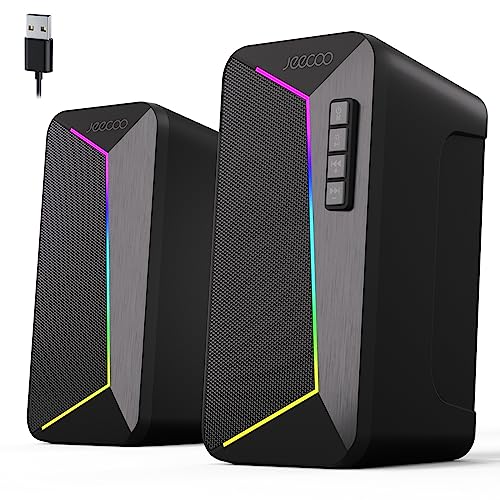
TL;DR: The Jeecoo M30 offers 10 W of stereo sound, RGB lighting and Bluetooth/USB plug‑and‑play in a compact 900 g design for just $19.99, making it a solid budget gaming speaker.
The standout spec is the 10 W total power output – two 5 W full‑range drivers deliver stereo audio while six RGB lighting modes add a visual punch. At 82 mm depth, 75 mm height and 150 mm width, the pair weighs 900 g (about 1.98 lb), keeping the desk footprint tiny.
Compared with the other ten speakers in this roundup, the M30 is a touch heavier than the Smalody set (which weighs about 1.83 lb) but far shallower than its 200 mm depth. It matches the Kapeydesi speakers on power (both 10 W total) while being slightly heavier than Kapeydesi’s 840 g chassis. The Bluedee speakers deliver 15 W and are lighter, so the M30 sits in the middle of the power‑to‑weight spectrum.
Users appreciate the ultra‑low $19.99 price, the plug‑and‑play USB power and the easy Bluetooth/USB toggle on the front panel. Professional reviewers note the clear, louder sound over laptop speakers and the convenience of the captive 1.5 m USB cable, though they also point out that the plastic housing can vibrate and the bass response's modest. The six lighting modes are a hit for gaming rigs, while the lack of a detachable cable limits placement flexibility.
Pros
Cons
Best for: Budget‑conscious gamers, office workers, and casual users who want a compact desk audio upgrade.
Avoid if: You need deep bass, a rigid build for heavy vibration, or flexible wired placement.
“on par for affordable options”
TL;DR: The Audioengine A2+ packs a 15 W RMS per‑channel, Bluetooth‑5.0 system into a 6‑inch‑high desktop speaker that delivers clear mids and low latency for gaming, but its thin bass may leave EDM fans wanting more.
The standout spec for the A2+ is its Bluetooth latency of just 30 ms, which pairs with aptX low‑latency support and Bluetooth 5.0. That latency's low enough to keep on‑screen actions in sync with audio cues, a key factor for competitive gaming. The speakers also deliver 15 W RMS per channel, ample for a desktop setup while staying well within the 65 Hz – 22 kHz ± 2.0 dB frequency range.
Weighing 6.0 pounds, the A2+ feels considerably lighter than the Logitech G560’s 12.1 pounds, making it easier to position on a cramped desk. Its RMS power of 15 W per channel falls far below the G560’s 120 W RMS, so it won’t overwhelm a small room the way a high‑output system might. The A2+ shares the same 100 ft (30 m) Bluetooth range as the Audioengine A1, while the SteelSeries Arena 3 tips a bulkier 3.18 kg and lacks Bluetooth entirely. In short, the A2+ sits in a sweet spot of portability and wireless convenience among the eleven contenders.
Reviewers consistently praise the A2+ for its detailed mids and crisp highs, noting that the custom‑tuned drivers and silk‑dome tweeters give a surprisingly full sound for a chassis that measures roughly 6 in H × 4 in W × 5.25 in D. Users love the plug‑and‑play simplicity of USB‑C, RCA and 3.5 mm inputs, and people describe the Bluetooth pairing as “instant”. The most common complaint centers on the limited bass extension below 65 Hz, which can make heavy bass drops feel thin, especially in EDM or movie soundtracks. Professional reviewers also point out a slight harshness in the treble when cranked to maximum volume.
Under the hood, the A2+ uses a TI/Burr Brown PCM2704C DAC and a CSR8670 receiver chip, delivering a signal‑to‑noise ratio greater than 95 dB (A‑weighted) and total harmonic distortion plus noise under 0.05 % at all power settings. Its 10 kΩ input impedance ensures clean interaction with most source devices, and the cabinet’s 6.35 mm MDF construction adds rigidity for accurate driver performance.
Pros
Cons
Best for: Buyers willing to invest in a proven, high‑quality option
Avoid if: You're on a tight budget or only need basic functionality
“nice detail and punch”
“cute”
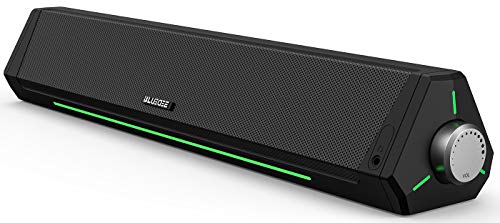
TL;DR: The Bluedee BD‑SK010 offers 15 W of Bluetooth‑5.0 stereo sound in a compact 2.0 lb, RGB‑lit bar for $53.99, earning a solid 4.3‑star rating from over 7 k reviewers.
At the heart of the BD‑SK010 are dual drivers with separate diaphragms, delivering a rated 15 W of power output. The speaker measures just 2.67 in deep and tall, while spanning 16.45 in in width, so it fits neatly on a desk without crowding your workspace. Weighing only 2.0 lb, it’s light enough to reposition easily yet feels sturdy on a tabletop.
Compared with the other ten entries, the Bluedee sits between the heavier Fifine A22 (5.07 lb) and the lighter Kapeydesi speakers, which weigh less. Its 15 W output outpaces the Kapeydesi’s 10 W total and the Smalody’s 10 W total, though it trails the Edifier G2000’s higher RMS rating. In price, it lands below premium options like the Razer Leviathan V2 X while offering more power than many budget‑oriented models.
Reviewers frequently mention the clear stereo separation and the anti‑magnetic technology that keeps static interference at bay. The RGB LED lighting and multiple effects highlight a fun visual touch for gaming setups. Some users note that, given the $53.99 price, the value‑per‑dollar isn’t the strongest in its segment, especially when higher‑output alternatives are on sale.
The unit runs off a USB power source and includes a nylon‑braided Y‑cable that combines power and audio, reducing desk clutter. Bluetooth 5.0 ensures a stable wireless link, and the speaker can be wall‑mounted or used as a tabletop bar, adding flexibility for small rooms or dorm desks. An 18‑month (1.5‑year) manufacturer warranty rounds out the package.
Pros
Cons
Best for: Budget‑conscious buyers seeking a reliable entry‑level option
Avoid if: You want the best value‑per‑dollar in its price range
“shocking for its price”
TL;DR: The Audioengine A1 delivers CD‑quality sound with aptX low‑latency Bluetooth, a solid wood cabinet and 60 W output, but its premium $199 price and modest volume suit small‑room gaming.
The standout spec for the A1 is its aptX Bluetooth codec paired with a 100 ft (30 m) range, giving you low‑latency wireless audio that stays in sync with fast‑paced games. It also packs 60 W of power into a compact 200 mm × 300 mm × 380 mm enclosure, and the cabinet uses wood to reduce resonance.
When you line it up with the other ten speakers, the A1 sits toward the higher end of the price spectrum and is heavier than the Edifier G2000 (around 4.2 lb) while still lighter than the Logitech G560 (12.1 lb). Its Bluetooth range exceeds that of the Logitech G560’s 25 m, and it offers more power than the Edifier’s 32 W peak output. Compared with the ultra‑compact Razer Leviathan V2 X, the A1 provides a larger wood cabinet and more robust output, though it lacks the sub‑woofer’s dedicated bass driver.
Users consistently praise the “punchy bass” and clear mids that fill a desk or dorm room, noting the easy Bluetooth pairing and the sturdy feel of the wood chassis. Professional reviewers echo this sentiment, highlighting the “big sound” from the tiny enclosure and the accurate two‑way silk‑dome tweeter plus aramid‑fiber woofer that musicians tune. Both consumer and expert feedback point to limited bass extension and a maximum volume that can feel restrained in larger spaces. Some owners also mention occasional Bluetooth drop‑outs when pushed to the edge of the 30 m range.
Pros
Cons
Best for: Those prioritizing quality and willing to pay for premium performance
Avoid if: You're shopping on a tight budget — it's priced at $199.00
TL;DR: The Kapeydesi SplitX offers a detachable 2‑in‑1 desktop setup with 10 W total stereo output, Bluetooth, six RGB modes and a compact USB‑powered design for just $24.99.
The standout feature is its detachable 2‑in‑1 design that lets you place each speaker wherever your desk layout works best, while still sharing a single 39.3‑inch (1 m) USB cable. Each driver delivers 5 W, giving a combined 10 W of stereo power, and the unit supports Bluetooth pairing as well as a USB audio input. Six customizable RGB lighting modes add a visual boost that many gamers appreciate during long sessions.
Compared with other speakers in this roundup, the SplitX is lighter than the Bluedee pair (2.0 lb) at just 0.84 kg, and its cable is shorter than the Jeecoo M30’s 1.5 m lead, making desk routing simpler. Its 10 W total output matches the Smalody speakers, which also list a 10 W RMS rating, while offering more lighting flair than those models. It sits near the budget end of the spectrum without sacrificing the core Bluetooth and USB connectivity found on many higher‑priced options.
Reviewers consistently praise the clear treble and surprisingly punchy bass for a 10 W system, noting that the rotary volume knob and touch‑sensitive mode switch make everyday adjustments effortless. Professional reviewers highlight the solid build quality and the immersive effect of the six RGB modes during gameplay. The main drawback mentioned is the limited frequency response of only 2 kHz, which can leave the low end feeling thin, especially for bass‑heavy titles. The product carries a 4.4‑star rating from 186 users, reflecting generally positive sentiment despite the narrow frequency range.
Pros
Cons
Best for: Entry-level buyers or those on a tight budget
Avoid if: You need powerful performance or professional‑grade features
“shocking for its price”
TL;DR: The Fifine A22 is a $72.99 2.1‑channel gaming speaker set with 10 W RMS output, RGB lighting, Bluetooth/optical/AUX connectivity, and a compact 5.35 × 10.20 × 11.30 in design weighing 5.07 lb.
At its core the A22 packs a 4.5‑inch woofer and two satellite drivers that together deliver 10 W RMS total power, giving you a lively soundstage without needing a separate amp. The chassis measures 5.35 in deep, 10.20 in tall and 11.30 in wide, and the whole system tips the scales at 5.07 lb, making it sturdy enough for a desk while still portable enough to move between rooms. Dynamic RGB lighting that pulses to the beat adds a gamer‑friendly visual touch.
Compared with other speakers in this roundup, the A22 is heavier than the Bluedee (2.0 lb) and Edifier G2000 (4.21 lb) but lighter than the Razer Leviathan V2 X system, which lists a total weight of 4400 g. Its width of 11.30 in is narrower than the Bluedee’s 16.45 in width, yet wider than the Edifier’s 8.31 in, giving it a balanced footprint. While the Kapeydesi (0.84 kg) and Smalody (1.83 lb) units are noticeably lighter, the A22 makes up for that with a richer feature set, including Bluetooth, 3.5 mm aux, optical input and OTG support—all absent or less extensive on several peers.
Reviewers praise the clear treble and the convenience of the multiple input options, noting that the built‑in EQ presets (game, music, movie) are easy to toggle via the function keys. Pros note the solid bass handling for its size, though many users mention that the subwoofer can sometimes dominate mids in complex tracks, making the sound feel a bit shallow. Many users note that the optical input lacks TV remote volume control.
Pros
Cons
Best for: Budget‑conscious gamers and streamers seeking a compact 2.1 speaker system with versatile connectivity.
Avoid if: You need deep, cinema‑level bass, wireless satellite placement, or TV remote volume control through the optical input.
“clear vocals, just enough bass thump, solid feel/weight, and good modes (music for bass, game for clarity), loud at low volumes.”
Breakdown
Edifier G2000
Pros
Razer Leviathan V2 X
Pros
Cons
Logitech G560
Pros
Cons
SteelSeries Arena 3
Pros
Cons
Based on scoring data and product specs
Personalized picks
Best Overall Pick
Edifier G2000
Best OverallBest for: Most users looking for a well-reviewed, reliable mainstream option
Razer Leviathan V2 X
Best for: Value-conscious buyers seeking quality at $84.99
$85.00-$14.99 vs winner
Skip Fifine A22 if…
You have limited desk space or need portability
We’re naming the Edifier G2000 the clear winner. It sports a 4.6‑star rating from 3,408 reviewers, a 2.75‑in driver and a 32 W peak output that delivers punchy sound, while its 12‑zone RGB lighting and dedicated Music/Game/Movie EQ modes give you both style and flexibility for any gaming session.
The runner‑up is the Razer Leviathan V2 X, which shines if you need a compact soundbar with low Bluetooth latency for fast‑paced shooters. Its Bluetooth 5.2 connection adds just 60 ms of lag, the 2.1 speaker layout includes a 140 mm subwoofer for deep bass, and the 45 Hz–20 kHz frequency response keeps details crisp, all for $84.99.
For tighter budgets, the Jeecoo M30 delivers basic gaming audio at just $19.99, making it the go‑to ultra‑budget pick. If you’re willing to splurge for premium fidelity, the Audioengine A2+ tops the list at $279.00, offering a high‑end alternative for audiophiles who want studio‑grade sound in their gaming rig.
Pick the Edifier G2000 now and give your games the sound they deserve.
The Edifier G2000’s column‑shaped design measures just 106 × 105 × 130 mm per speaker and weighs 4.21 lb, making it easy to fit on a small desk while still delivering HIFI‑tuned sound. Its built‑in RGB lighting and dedicated subwoofer output also add a premium feel without taking up much space.
No reviews yet — be the first to share your experience.
Please sign in to leave a review