⚡ Quick Answer
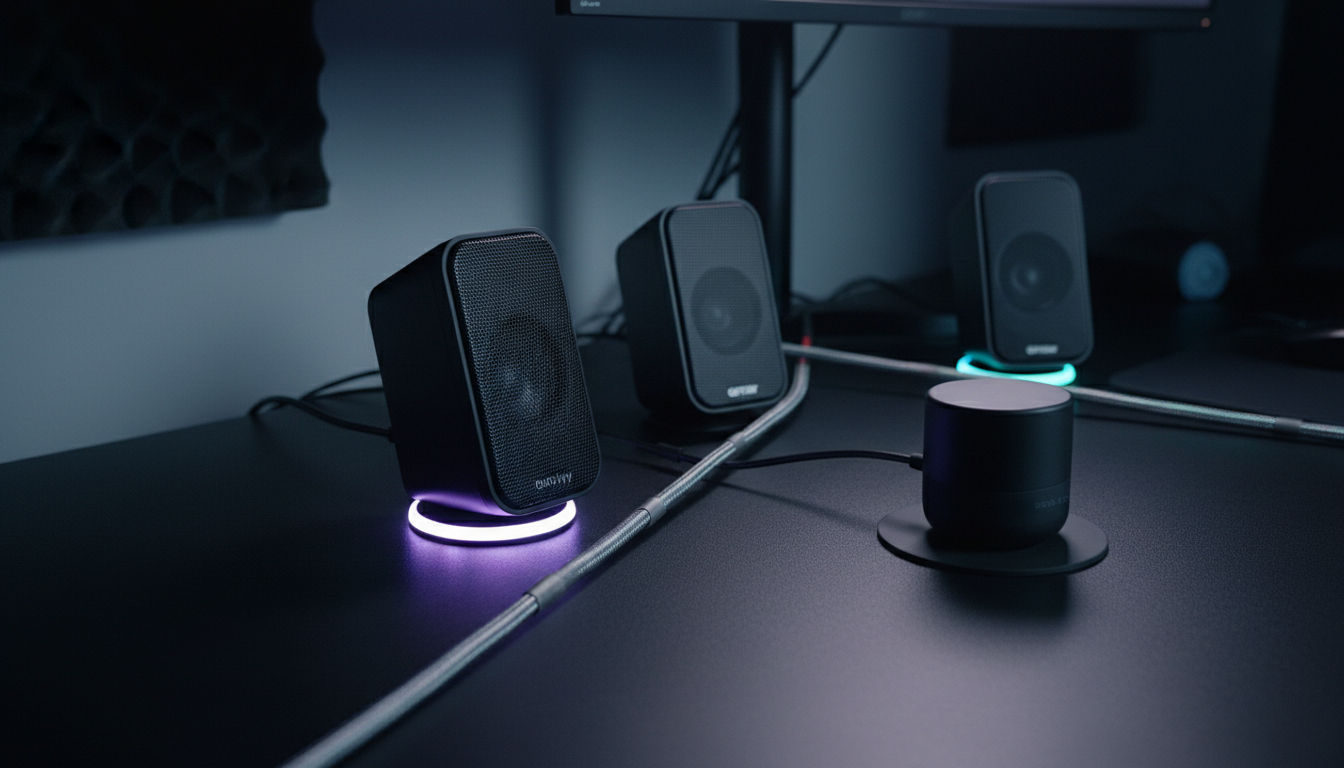
Out of the 11 speakers we compared, the $13.99 Busp‑hyy Computer Speakers snagged the top rank. Despite a modest price tag, they earned a 4.4 / 5 rating from 667 reviews, pack dual 3 W drivers and deliver 6 W RMS total output. That combo of solid power, compact 155 mm height and six RGB lighting modes makes them a surprisingly strong contender for anyone looking to upgrade a small desk without breaking the bank.
The roundup spans three price tiers. The budget camp houses Busp‑hyy, the Jeecoo M30 ($19.99), Lenrue ($19.99) and Creative Pebble SE ($22.99), all hovering around 4.5 / 5 ratings. Mid‑range picks include Offsir ($24.99) and Redragon GS560 ($33.97), while the premium tier features the Redragon GS520 ($34.99), Razer Leviathan V2 X ($84.99), Edifier G2000 ($99.99) with a 4.6 / 5 rating, and the Logitech G560 ($249.99). Now we’ll explore each model to find the best fit for your gaming setup.

Busp-hyy Computer Speakers
Offers solid 3 W per driver output, delivering clear sound at an entry‑level price.

Creative Pebble SE Minimalist 2.0
Ideal for home or office users who want a tidy setup; at $22.99 it’s about $9 more than the top pick.

Offsir Computer Speakers
Stands out with 50 mm drivers and 5 W RMS per channel, offering fuller mids and bass that the lower‑powered picks lack.
Also considered
Score Analysis
Key score advantages vs. runner-up (Creative Pebble SE)
Price Range
Busp-hyy Computer Speakers
$12.59
Creative Pebble SE Minimalist 2.0
$22.99
Offsir Computer Speakers
$24.99
Edifier G2000
$99.99
Redragon GS520 RGB
$27.99

Logitech G560
$249.99
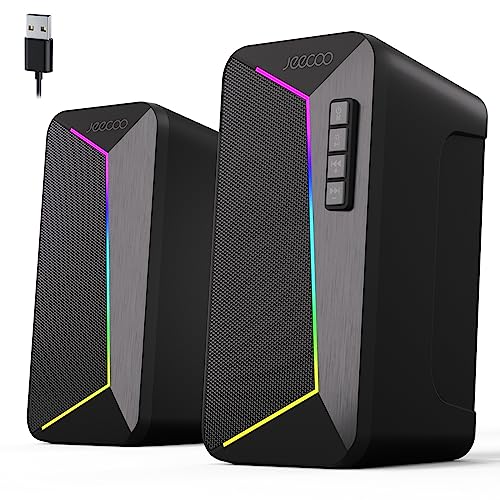
Jeecoo M30
$19.99

Redragon GS560 RGB
$32.99

Razer Leviathan V2 X
$85.00

Lenrue Computer Speakers
$16.99

OROW Computer Speakers
$19.99
Spec Comparison
TL;DR: The Busp‑hyy E‑1062 delivers stereo sound with dual 3 W drivers, six RGB lighting modes, and USB‑C power for just $13.99, making it a compact, budget‑friendly upgrade for gaming desks.
What really sets this speaker apart is the combination of 3 W per driver and a total RMS output of 6 W, backed by a signal‑to‑noise ratio of ≥80 dB. A touch sensor controls the six dynamic RGB lighting modes—Symphony, Flowing, Breathing, and three solid colors—adding a visual flair that most rivals in the roundup lack.
When you line it up against the other ten contenders, the Busp‑hyy sits at the lower end of the price spectrum while still offering a full set of connectivity options, including a 1000 mm AUX cable and a 1000 mm USB‑C power cable. Competitors such as the OROW or Jeecoo models list higher RMS power (10 W total) or larger drivers, but they don’t provide the same RGB lighting suite. In short, you get more visual customization for less money, even if the raw loudness isn’t the highest.
Reviewers consistently note the clear, “surprisingly full” stereo image for a speaker in this price range, and they appreciate the tactile volume knob for quick adjustments. The compact ABS plastic housing (80 mm deep, 155 mm high, 160 mm wide) slides easily under most monitors, and the portable design means you’ll move it between workstations without hassle. Professional reviewers also point out that the ≥80 dB SNR keeps background hiss to a minimum, which is a nice bonus for late‑night gaming sessions.
Pros
Cons
Best for: Budget‑conscious gamers, students, and office workers who want a sleek, RGB‑lit desktop speaker without breaking the bank.
Avoid if: You need high‑volume, deep‑bass performance for large rooms or a dedicated battery for true portability.
“Really clear stereo sound”
“Super slim and sits nicely under monitor”
TL;DR: The Creative Pebble SE Minimalist 2.0 packs 2‑inch drivers, 7 RGB effects and USB‑C power into a 125 mm‑deep, 1.9‑pound desktop speaker that’s bright‑looking but modest in volume.
The integrated RGB lighting with 7 selectable effects stands out, controlled from the main speaker’s knob, while the 2‑inch full‑range drivers and passive radiators deliver a frequency response of 80–20,000 Hz and an 85 dB signal‑to‑noise ratio.
At 1.9 pounds, the Pebble SE is lighter than the Redragon GS560 RGB (2.03 pounds) and Jeecoo M30 (1.98 pounds) but heavier than Lenrue (0.96 pounds) and OROW (1.19 pounds). Its inter‑speaker cable is 1.5 m, longer than Offsir’s 130 cm cable and Busp‑hyy’s 1.0 m cable, matching Jeecoo’s 1.5 m length. However, the RMS power is only 4.4 W, which is lower than the 5 W per channel of Offsir, the 5 W per driver of Jeecoo, and the 10 W RMS of OROW, so it won’t fill a large room.
Reviewers praise the ultra‑compact 125 mm depth and height, noting that the USB‑C power cable (1.2 m) eliminates a bulky wall adapter. The same reviewers point out the limited loudness from the modest 4.4 W RMS output and the non‑detachable cables, which can be a hassle for custom setups. The lack of Bluetooth and a subwoofer also means it’s best suited for desktop‑bound gaming rather than a full‑room sound system.
Pros
Cons
Best for: Home and office users seeking a balance of features and value
Avoid if: You need high volume, deep bass, wireless connectivity, or detachable cables
TL;DR: The Offsir GS005 offers 10 W total RMS power, a detachable 50 mm driver pair, and RGB breathing LEDs controlled by touch, all for $24.99 on a compact desktop.
What sets these speakers apart is the combination of a detachable 2‑speaker design and four‑mode RGB breathing lights that respond to a touch‑sensitive control. Each driver measures 50 mm, delivering up to 5 W RMS per channel for a combined 10 W total output, which is surprisingly loud for a unit that fits on a small desk.
Compared with the other ten entries, the Offsir speakers are lighter than the Creative Pebble SE (which weighs about 862 g) yet heavier than the Jeecoo M30 (around 900 g). Their 130 cm cable is a touch longer than the Pebble’s 120 cm audio cable but shorter than the Pebble’s 150 cm inter‑speaker link. The 90 mm depth and 260 mm height keep the footprint modest, similar to the OROW model’s slim profile, while offering more power than many budget‑oriented rivals.
Users consistently praise the plug‑and‑play USB power and the audible volume that fills a small room, noting that the speakers “produce surprisingly loud output for their compact size.” Professional reviewers highlight the easy USB connection and the visual appeal of the RGB lighting for gaming rigs. The most common gripe: you have to manually select the speakers as the default audio device after plugging them in, and the 150 Hz low‑end of the 150 Hz – 18 kHz frequency response means deep bass is limited.
Additional technical touches include a multi‑function volume/power knob, a tabletop mount for stable placement, and a 5 V USB power source that eliminates the need for an external adapter. The RGB LEDs breathe in four preset modes, and the touch control lets you cycle them without reaching for a button.
Pros
Cons
Best for: Most users seeking a balanced, mainstream option
Avoid if: You're shopping on a tight budget — it's priced at $24.99
“Really clear stereo sound”
“Super slim and sits nicely under monitor”
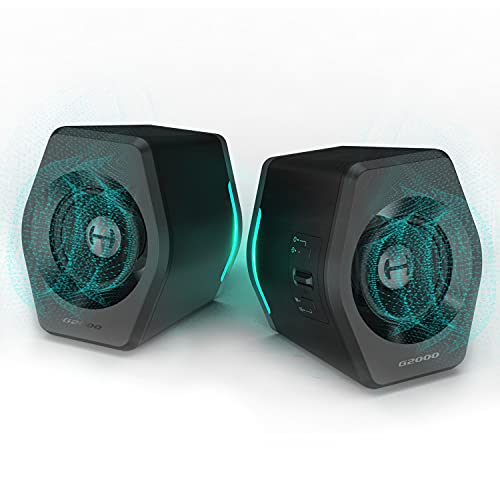
TL;DR: The Edifier G2000 packs 2.75‑inch drivers, 16 W RMS power and 12 RGB light modes into a compact 5.47‑in‑deep column that’s ideal for tight gaming desks, though it sits at a premium $99.99 price.
The standout feature is the 12 customizable RGB light effects combined with a 2.75‑in driver and 16 W RMS output, all housed in a column‑shaped cabinet that measures just 5.47 in deep, 9.09 in high and 8.31 in wide. Its dedicated power adapter and mechanical shift‑lever volume control give a stable, plug‑and‑play experience.
Compared with the other speakers in this roundup, the G2000 is noticeably heavier than the Redragon GS520 RGB (1.8 lb) and the Razer Leviathan V2 X (1.98 lb), reflecting its larger drivers and built‑in lighting system. Its 2.75‑in drivers also outsize the 2‑in drivers used in both the Redragon GS520 and GS560 models, and its 16 W RMS rating exceeds the 8 W RMS of the GS560, giving it a louder presence on a small desk.
Users consistently praise the straightforward Bluetooth pairing and the vibrant lighting that syncs with game action, while professional reviewers note the compact hexagonal form saves space and delivers “punchy” gaming sound. The main complaints revolve around occasional Bluetooth or USB connectivity drops and a frequency response that starts at 98 Hz, which limits deep bass compared with larger speaker sets.
Additional technical details include a noise level of ≤25 dB(A), a 0.65 L cavity volume, and three EQ presets (Music, Game, Movie). The unit ships with a USB cable, 3.5 mm audio cable, power adapter and a 1‑2‑year warranty, and some reviewers describe its plastic construction as less premium.
Pros
Cons
Best for: Buyers willing to invest in a proven, high‑quality option
Avoid if: You're shopping on a tight budget — it's priced at $99.99
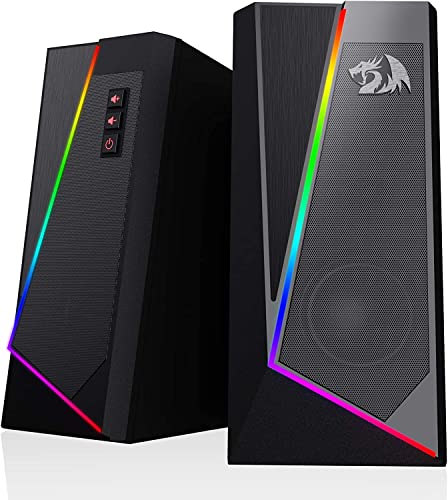
TL;DR: The Redragon GS520 RGB delivers 2‑inch drivers, 6 touch‑controlled lighting modes and plug‑and‑play USB power in a compact 1.8 lb chassis, but its 3 W RMS per channel limits volume and bass for larger rooms.
The standout feature is the touch‑controlled RGB ring with six vibrant color modes, letting you sync the speakers to your gaming rig without a separate controller. Each driver measures 2 in, and the frequency response reaches 20 kHz, which matches typical desktop speakers.
At 1.8 lb the GS520 is lighter than the Redragon GS560’s 2.03 lb build but heavier than Lenrue’s 0.96 lb and OROW’s 1.19 lb speakers. Its RMS power of 3 W per channel (5 W peak) sits below the 4 W per channel of the GS560 and the 5 W RMS of the Jeecoo M30, so you’ll notice a quieter output and thinner bass compared with those models.
Users consistently praise the RGB lighting and the convenience of individual volume up/down buttons on each speaker. Professional reviewers also highlight the clear soundstage given the 3 W RMS output and the brushed‑metal finish that feels sturdy on a desk. Many comments note the modest bass response and the 31 in (80 cm) speaker‑to‑speaker cable, which can feel short on wider setups.
The speakers draw power via USB, so you don't need an external adapter, and the 3.5 mm AUX and mic/headset jacks give you flexibility for PCs, laptops, TVs or mobile devices. The package dimensions (4.33 in × 7.48 in × 6.69 in) fit easily into a small workspace, and Redragon backs the unit with a 1‑year warranty.
Pros
Cons
Best for: Budget gamers, office workers, and anyone who wants a compact desktop speaker set with eye‑catching RGB lighting.
Avoid if: You need deep bass, high volume for large rooms, or audiophile‑grade sound quality.
“attractive RGB vibes”
“Potentially thin bass at max volume due to low power; some note it's "basic" for larger rooms”
TL;DR: The Logitech G560 delivers 120 W RMS power with a 60 W subwoofer and 16.8 million‑color RGB LIGHTSYNC, but its $249.99 price and 12.1 lb weight make it a premium choice for serious gamers.
The G560’s most eye‑catching spec is its 120 W RMS output paired with a 60 W subwoofer that reaches 97 dB max SPL. Its satellite drivers measure 63.5 mm, and the system supports DTS:X Ultra 3D surround sound. On the lighting side, LIGHTSYNC offers four zones and 16.8 million colors that pulse in time with in‑game audio.
In this roundup the G560 is considerably heavier than the Edifier G2000’s 4.21 lb and the Razer Leviathan V2 X’s 1.98 lb, reflecting its larger drivers and more robust enclosure. It also out‑powers the Edifier’s 16 W RMS and the Redragon GS560’s 8 W RMS, giving it a clear advantage for gamers who demand louder, room‑filling sound. Feature‑wise it adds RGB zones and DTS:X, which many other speakers lack.
Reviewers repeatedly praise the thunderous bass that “shakes the desk” and the immersive RGB that syncs with explosions. Most users find Bluetooth pairing straightforward, thanks to the 25 m range. On the downside, some note that the subwoofer can hum at maximum volume and that the Logitech software may glitch during initial setup, especially on macOS where support is only partial. The system carries a 1‑year limited hardware warranty.
Pros
Cons
Best for: PC gamers and RGB enthusiasts seeking an immersive audio‑visual experience on a desk setup.
Avoid if: You're shopping on a tight budget — it's priced at $249.99.
“clear, pure sound”
“huge soundscape”
TL;DR: The Jeecoo M30 offers 10 W stereo sound, a compact 82 mm × 75 mm × 150 mm footprint and six RGB lighting modes for just $19.99, making it a solid entry‑level gaming speaker.
The standout feature is its built‑in RGB lighting with six selectable modes—three solid colors and three dynamic cycles—controlled by a single short‑press button. Audio-wise the pair packs two full‑range drivers, each rated at 5 W, delivering a combined 10 W RMS output while staying under a modest 1.5 m captive USB cable.
Compared with the other ten speakers in this roundup, the M30 is heavier than the Lenrue (0.96 lb) and OROW (1.19 lb) models, and its 82 mm depth exceeds Lenrue’s 63.5 mm depth. Its 150 mm width is narrower than Lenrue’s 381 mm span, giving it a slimmer desk profile. While the Busp‑hyy speakers list a lighter 576 g chassis, the M30’s 900 g build feels sturdier, though reviewers note the plastic housing can vibrate under bass peaks.
Users consistently praise the plug‑and‑play simplicity of switching between USB and Bluetooth with a short press, as well as the louder, clearer sound compared with laptop speakers. Professional reviewers highlight the decent audio quality for the price and the eye‑catching lighting for gaming rigs. Common complaints focus on the non‑detachable 1.5 m cable limiting speaker placement, a plastic case that transmits vibration, and modest bass response that falls short for bass‑heavy game soundtracks.
Technical details reinforce its value: each driver draws 5 W, totaling 10 W RMS, and the USB input accepts 5‑20 V DC, so no external adapter's needed. The speakers sit at 75 mm height and 82 mm depth, making them easy to tuck beside a monitor without crowding the workspace.
Pros
Cons
Best for: Budget‑conscious buyers seeking a reliable entry‑level option
Avoid if: You want the best value‑per‑dollar in its price range
“on par for affordable options”
TL;DR: The Redragon GS560 RGB soundbar delivers 8 W RMS of stereo sound, a compact 68.58 mm width, and four RGB lighting modes for a bright‑but‑budget‑friendly gaming desk.
At the heart of the GS560 is a 2‑inch driver paired with a total output of 8 W RMS, which the manufacturer says provides clear mids and a punchy bass response. The unit measures 401.32 mm deep, 71.12 mm high, and only 68.58 mm wide, making it short enough to tuck under most monitors. Power comes from a 5 V USB input, drawing 4 W per channel, and you can also feed audio through a 3.5 mm jack. Touch‑control RGB switching and a volume knob round out the on‑desk controls.
Compared with the other speakers in this roundup, the GS560 is heavier than the Lenrue Computer Speakers (which sit under 1 lb) and deeper than their 63.5 mm profile, but it offers a wider RGB lighting suite than most. Its driver size mirrors the 50 mm unit in the Offsir speakers, placing it squarely in the mid‑range driver category. While the Jeecoo M30 and OROW models both tout 10 W total output, the GS560’s 8 W RMS still holds its own for desktop gaming without the need for Bluetooth.
Users consistently praise the soundbar’s “clear sound” and “eye‑catching lighting” that syncs with game action, noting that the four lighting modes—wave, disco, rain, and static—add a subtle visual boost without being distracting. Reviewers also highlight the plug‑and‑play setup: just plug the USB for power and the 3.5 mm line for audio, and you’re ready to go. The 1‑year warranty and a solid 4.3/5 star rating from over 5,000 reviewers reinforce confidence in the build quality.
In practice, the GS560’s compact footprint and USB‑powered design make it a tidy addition to cramped desks, while the 921.5 g (2.03 lb) weight keeps it stable during intense gaming sessions. The ≥65 dB signal‑to‑noise ratio delivers adequate performance for most gaming environments, though audiophiles seeking ultra‑clean playback might look elsewhere.
Pros
Cons
Best for: Gamers who want RGB lighting that syncs with gameplay, desktop users needing a space‑saving audio solution.
Avoid if: You have limited desk space or need a highly portable speaker system.
TL;DR: The Razer Leviathan V2 X delivers 14‑zone Chroma RGB, THX Spatial Audio and low‑latency Bluetooth in a compact 2.1 soundbar for about $85, but its software quirks and bulky subwoofer keep it from being a flawless choice.
The standout spec is the 14‑zone Razer Chroma RGB lighting that wraps the soundbar and subwoofer, letting you sync colors to in‑game events. Coupled with a 10‑band custom EQ in the Razer Audio app, the system promises fine‑tuned sound that matches your visual setup. It also supports THX Spatial Audio for an immersive soundstage, and its Bluetooth 5.2 connection boasts a 60 ms latency—fast enough for most competitive games.
At 1.98 pounds, the Leviathan sits about the same weight as the Jeecoo M30 and Creative Pebble, yet it’s noticeably lighter than the Edifier G2000’s 4.21 lb chassis. It’s a touch heavier than the Redragon GS520 RGB’s 1.8 lb speakers, but still far more portable than many full‑size 2.1 systems. In terms of features, the Leviathan offers more RGB zones than the Redragon models and includes THX Spatial Audio, which those peers lack. The Leviathan limits connectivity to a USB‑C power port, a USB‑A audio input and a subwoofer output, so you won’t find HDMI or optical inputs that some rivals provide.
Professional reviewers note the “crisp treble and punchy bass” that the dual full‑range drivers, 20 mm tweeter and 140 mm down‑firing subwoofer deliver, while everyday users praise the compact fit under a monitor and the easy Bluetooth pairing. However, the same reviewers point out occasional software glitches in Razer Synapse and distortion when you crank the system to its 90 dB maximum SPL. The subwoofer’s 3000 g weight contributes to a desk‑occupying footprint that some users find cumbersome.
Pros
Cons
Best for: Those prioritizing quality and willing to pay for premium performance
Avoid if: Reliability and user satisfaction are your top concerns
“great audio”
TL;DR: The Lenrue E‑1103 delivers 10 W of USB‑powered stereo sound with touch‑controlled RGB lighting, a compact under‑monitor design, and plug‑and‑play simplicity for under‑$20.
The Lenrue speakers combine dynamic RGB/LED lighting that reacts to touch with a single USB‑C cable that supplies both power (5 V / 1 A) and audio. With a maximum output of 10 W and an 80 dB signal‑to‑noise ratio, they provide clear stereo sound without needing an external power brick.
Weighing roughly 0.96 pounds (435 g), they’re lighter than the Jeecoo M30, which tips the scales at about 1.98 pounds, and their 381 mm width makes them wider than the Busp‑hyy speakers (160 mm). Their 63.5 mm depth and height exceed the ultra‑slim OROW design, yet they still fit comfortably under most monitors.
Users consistently praise the hassle‑free plug‑and‑play setup and the visual flair of the RGB lights, noting that the touch‑sensitive volume knob feels intuitive. Professional reviewers highlight the clear stereo separation and low background noise, while common complaints focus on the modest bass response from the 10 W drivers and the fact that the lighting can’t be fully turned off.
Technical details include 2.0 channel stereo output, a 3.5 mm AUX input, a headphone jack, and touch or knob volume control. The speakers mount under a monitor, keeping desk space free, and require no additional drivers.
Pros
Cons
Best for: Budget‑conscious buyers seeking a reliable entry‑level option
Avoid if: You have limited desk space or need portability
“Really clear stereo sound”
“Super slim and sits nicely under monitor”
TL;DR: The OROW S201 offers 10 W RMS stereo sound, a compact 1.16‑inch depth design, and toggleable RGB lighting for under $20, but its shallow bass and lack of Bluetooth keep it in the entry‑level camp.
The standout spec is the 10 W RMS power output, which dual 5 W drivers deliver with a built‑in bass diaphragm. Combined with a 50 Hz low‑frequency start, the speakers can fill a small desk space with surprisingly loud stereo audio. The RGB lighting is dynamic, and you can switch it on or off with the rotary volume knob, adding a gamer‑friendly visual cue without extra cables.
At 1.1904948 pounds, the OROW pair is lighter than the Jeecoo M30, which weighs about 1.98 pounds, and it also sits on a shallower 1.16‑inch depth compared with Jeecoo’s 82 mm depth. Compared with the Lenrue speakers, OROW is a bit heavier (Lenrue is 0.96 pounds) but still compact enough for tight setups. Unlike several rivals that list Bluetooth connectivity, the OROW relies on USB power and a 3.5 mm AUX input, so its connectivity options are fewer.
Professional reviewers highlight the crisp, clear stereo image that sounds impressive for such a small package, and everyday users repeatedly praise the “loud, clear audio” that fills a modest workspace. The plug‑and‑play setup—just connect USB for power and a 3.5 mm jack for sound—gets the speakers running instantly, a point many reviewers note as a major convenience. The most common complaints focus on the shallow bass response from the small drivers and the absence of Bluetooth, which some users find limiting for wireless setups.
Technically, the speakers run on USB power, eliminating the need for a wall outlet, and the rotary knob on the right speaker doubles as a volume control and RGB light toggle. The high‑quality ABS varnish finish adds durability, while the 2.0‑channel stereo layout and 10 W RMS output keep the audio punchy for gaming or media. The manufacturer offers a 1‑year warranty for peace of mind.
Pros
Cons
Best for: Budget‑conscious gamers, students, and office workers who need a compact, USB‑powered desktop speaker with a splash of RGB.
Avoid if: You require deep bass performance, Bluetooth connectivity, or a high‑power solution for larger rooms.
“Really clear stereo sound”
“Super slim and sits nicely under monitor”
Breakdown
Busp-hyy Computer Speakers
Pros
Creative Pebble SE Minimalist 2.0
Pros
Offsir Computer Speakers
Pros
Cons
Edifier G2000
Pros
Cons
Based on scoring data and product specs
Personalized picks
Best Overall Pick
Busp-hyy Computer Speakers
Best OverallBest for: Budget-conscious buyers seeking a reliable entry-level option
Creative Pebble SE Minimalist 2.0
Best for: Home and office users seeking a balance of features and value
$22.99+$10.40 vs winner
Skip OROW Computer Speakers if…
You have limited desk space or need portability
The Busp-hyy Computer Speakers earn the top spot as the best gaming speakers. They come in at just $13.99, have a solid 4.4‑star rating from 667 reviews, and feature six RGB lighting modes that sync to your gameplay. With a total output of 6 W RMS and Bluetooth support, they deliver clear audio without breaking the bank.
The Creative Pebble SE Minimalist 2.0 lands as runner‑up, ideal if you need a sleek desktop setup that packs a bit more punch and a richer lighting palette. Priced at $22.99, it offers seven RGB lighting effects, two 2‑inch full‑range drivers, and an 85 dB signal‑to‑noise ratio, giving you louder, cleaner sound for immersive gaming sessions.
Pick the Busp‑hyy speakers today for great value at $13.99 and vibrant RGB flair.
The Edifier G2000 leads with 12 RGB light effects. Other speakers include Creative Pebble SE with 7 modes, Busp‑hyy, Redragon GS520 and Jeecoo M30 each with 6 modes, Offsir and Redragon GS560 with 4 modes, and Lenrue with dynamic RGB lighting. So the Edifier G2000 gives the widest visual customization.
No reviews yet — be the first to share your experience.
Please sign in to leave a review