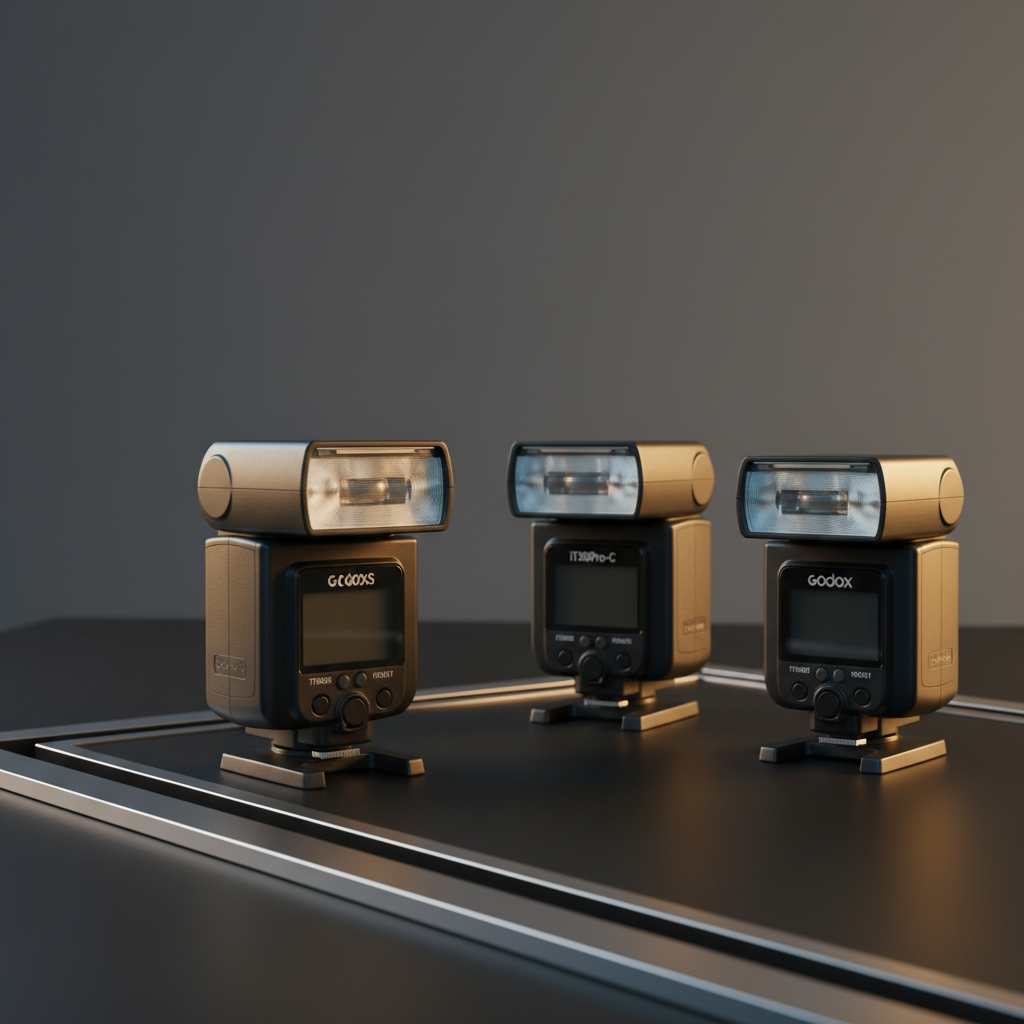
Choosing the right flash can feel overwhelming, especially when Godox offers 11 different models in one lineup. Prices span from $30.90 for the ultra‑compact iM30 up to $299.00 for the pocket‑studio AD100Pro, while guide numbers range from a modest 15 m on the iT30Pro‑C to a powerful 60 m on the TT600S. With ratings hovering between 4.3/5 and 4.7/5, each unit promises a solid mix of performance and value.
The options fall into three price tiers to simplify the hunt. The budget tier—iM30, iT20 F, TT520II and TT520 III—covers entry‑level needs, with the iT20 F even earning a 4.9/5 rating at $39.90. Mid‑range choices like the TT600 ($65.00, 4.5/5) and the iT30Pro‑C ($67.90, 4.6/5) add wireless X‑system control and TTL features without breaking the bank. Premium picks, including the TT600S ($70.00, 4.5/5), MS300V ($119.00, 4.7/5) and the AD100Pro ($299.00, 4.6/5), deliver higher guide numbers, HSS capability and more robust build quality for demanding shoots.
Below you’ll see how each flash stacks up on key specs, real‑world usability and total value, so you can pinpoint the perfect fit for your photography style.

Godox TT600S
Its compact 63.96 mm height keeps it low‑profile on‑camera while delivering strong performance at a good value.

Godox TT600
Ideal for everyday shooters who want a proven, reliable flash, and it’s $5 cheaper than the Best Overall at $65.

Godox iT30Pro-C
Stands out with a built‑in 560‑flash battery life and 900 mAh capacity, giving you cordless shooting that the TT600 and TT600S lack.
Also considered
Score Analysis
Key score advantages vs. runner-up (Godox TT600)
Price Range
Godox TT600S
$70.00
Godox TT600
$65.00
Godox iT30Pro-C
$74.90

Godox MS300V
$129.00

Godox AD100Pro
$259.00

Godox iM30
$30.90
Godox TT520 III
$59.00
Godox iT30 Pro S
$74.90

Godox TT520II
$48.60

Godox iT20 F
$39.90
Godox TT520 II
$46.99
Spec Comparison
TL;DR: The Godox TT600S delivers a GN60 guide number, 100 m wireless range and 1/20,000 s flash duration for $70, making it a solid manual flash for Sony shooters who need off‑camera power.
The standout spec is its 60‑meter guide number at ISO 100 (200 mm), which exceeds many entry‑level units in the same lineup. Coupled with a 100 m 2.4 GHz radio, 32 channels and five group slots, you can reliably control multiple lights across a studio or outdoor setting. Its fastest flash duration of 1/20,000 s and high‑speed sync up to 1/8000 s (off‑camera only) let you freeze motion even in bright daylight.
Compared with its peers, the TT600S is considerably heavier than the iT30Pro‑C, which tips the scales at just 120 g, but it matches the original TT600’s 500 g weight and guide number. It also offers a longer reach than the TT520 III and TT520 II series, both listed with a GN33 (≈33 m). While the iT30 models feature a smaller form factor (around 47 mm tall), the TT600S provides a full‑size head with a 14 mm wide‑angle panel and 360° swivel, giving you more flexibility in positioning.
Users consistently praise the flash’s value and reliable wireless performance, noting the built‑in diffuser and large backlit LCD as handy for quick adjustments. Professional reviewers highlight the GN60 output and 100 m radio as rare strengths in a manual‑only unit. The main complaints revolve around the lack of TTL, the flash can't use high‑speed sync when mounted on‑camera, and the reliance on four AA cells, which limits runtime.
Pros
Cons
Best for: Budget‑conscious Sony shooters who need a powerful off‑camera flash with solid wireless control.
Avoid if: You rely on TTL or need on‑camera high‑speed sync for fast event photography.
“Perfect for off-camera flash on a budget.”
“HSS works great with my X1T-S trigger – I can shoot wide open in daylight.”
TL;DR: The Godox TT600 offers a GN 60 (m at ISO 100), 32‑channel 2.4 GHz radio and fast 0.1–2.6 s recycle in a compact, manual‑only flash for budget‑friendly off‑camera lighting.
What really stands out is the 60‑meter guide number paired with a reliable 2.4 GHz X‑system that reaches up to 100 m line‑of‑sight and supports five slave groups on 32 channels. The flash recycles in as little as 0.1 seconds and can fire about 230 full‑power flashes on a set of four AA Ni‑MH cells. Its LCD panel stays bright even in bright studio light, and the unit weighs 1.1 pounds with dimensions of 190 mm depth, 76 mm height and 64 mm width.
Compared with the other flashes in this roundup, the TT600 is heavier than the iT30Pro‑C (which tips the scales at 120 g) but matches the TT600S’s weight of roughly 1.1 pounds. It also out‑lights the TT520 series, whose guide numbers sit at 33 m, and it offers twice as many wireless channels as the TT520 II (32 versus 16). In size, the TT600’s 190 mm depth dwarfs the TT520 III’s 72 mm flash depth, giving it a sturdier feel for studio work.
Everyday users praise the consistent output and the ease of wireless syncing, especially for product and studio shoots. Professional reviewers note the flash’s solid integration with Godox’s broader X‑system, making future upgrades straightforward. The main trade‑off is the manual‑only operation – there’s no TTL or built‑in high‑speed sync when the unit sits on‑camera, and Sony users will miss native TTL support.
Additional technical details include a flash duration range of 1/300 s to 1/20 000 s, color temperature stays at 5600 K ± 200 K across all power levels, and you can adjust power output from 1/1 to 1/128 in 1/3‑stop steps. The unit runs on four AA batteries (Ni‑MH recommended) and offers both S1 and S2 optical slave modes, giving you flexibility for mixed‑lighting setups.
Pros
Cons
Best for: Beginner to intermediate photographers learning off‑camera flash, product and studio shooters who want a well‑reviewed, reliable manual flash with solid wireless range.
Avoid if: You rely on TTL automation, need on‑camera HSS, or use a Sony camera that requires native TTL support.
“Perfect for product photography — consistent output and easy to sync.”
“I use four TT600s with X1T triggers for portraits — rock-solid wireless performance.”
TL;DR: The Godox iT30Pro‑C packs a 15 m guide‑number, 2.8‑inch touchscreen and 560‑flash battery into a 120 g pocket‑sized unit, making it a versatile travel flash for Canon shooters.
The standout spec is its 15 m (49.2 ft) guide‑number at ISO 100, which delivers enough power for most on‑location shoots while the flash duration ranges from 1/1000 s to 1/30,000 s for crisp freeze‑motion results. A 2.8‑inch full‑color touchscreen paired with a rotary dial lets you set TTL, manual and HSS modes without digging through menus, and the built‑in 2.4 GHz X‑system controls three external groups directly from the unit.
Compared with the other ten flashes in this roundup, the iT30Pro‑C is markedly lighter than the TT600S and TT600, both weighing around 500 g, and its 65 mm length is far shorter than the TT600S’s 189.93 mm length. It shares the same 120 g weight as the iT30 Pro S, yet offers more wireless channels (32 vs. the TT520 II’s 16) and a longer wireless range of 100 m, giving it an edge in flexible studio or on‑site setups.
User feedback consistently praises the ultra‑compact design and the built‑in diffuser that softens light without extra gear. Reviewers also note the reliable TTL metering that avoids the “rabbit‑in‑the‑headlights” look, and the fast USB‑C charging that keeps the 560‑flash battery ready for long days. However, several users mention that the flash head sits low, so larger lenses may cast unwanted shadows unless you add a riser, and the lack of tilt or swivel limits bounce lighting without accessories.
Additional technical context includes a multi‑flash frequency of up to 100 Hz, a recycle time of 1.5 s at full power, and a TTL compensation range of ±3 EV in 0.3 EV steps. The 2.5 mm sync port and 4‑group wireless control round out a feature set that rivals larger speedlights while staying pocket‑friendly.
Pros
Cons
Best for: Travel and street photographers who need a discreet, lightweight flash with full TTL, HSS and wireless control.
Avoid if: You require built‑in tilt/swivel for bounce lighting or need a heavy‑duty studio flash.
“the best small camera flash I’ve tested so far”
“pocket-sized powerhouse”
TL;DR: The Godox MS300V delivers 300 Ws of studio power, a 58 m guide number and 100 m wireless range in a compact, fan‑cooled unit, though it lacks TTL and HSS.
At the heart of the MS300V is a 300 Ws maximum output and a guide number of 58 m (ISO 100) measured with a 7″ 55° reflector. The built‑in 2.4 GHz radio gives you up to 32 channels, 5 groups and a 100 m (328 ft) radio range, while the flash can fire as fast as 1/2000 s and recycle in as little as 0.1 s at low power.
Compared with the other ten flashes in this roundup, the MS300V sits at the higher end of the price spectrum, making it pricier than the entry‑level TT600 models. It is also heavier than the lightweight TT600 (about 1.1 lb versus 5.51155655 lb) but offers a sturdier build and a larger Bowens S‑Type mount. Its 58 m guide number is slightly lower than the TT600’s 60 m, yet the MS300V adds wireless flexibility that many of the battery‑powered peers lack.
Everyday users applaud the flash’s compact dimensions—336 mm depth, 229.1 mm height and 191 mm width—and the dimmable 10 W LED modeling lamp that stays cool while providing accurate 5800 K ± 200 K color. Reviewers also note the reliable anti‑preflash function and the ability to control output remotely via X‑Series triggers. The most common complaints focus on the audible fan during long sessions, the absence of TTL and high‑speed sync, and the requirement for AC power rather than a battery.
Additional technical touches add a 5A fuse for circuit protection, an LCD dot‑matrix panel for easy setting changes, and optical slave modes S1 (auto sync) and S2 (ignores pre‑flashes). The package includes a power cable, Bowens‑compatible softboxes, stands, umbrellas, reflectors and wireless triggers, making it a ready‑to‑shoot package for studio work.
Pros
Cons
Best for: Those prioritizing quality and willing to pay for premium performance
Avoid if: You're shopping on a tight budget — it's priced at $119.00
“Perfect for small studios”
“LED modeling is a game-changer”
TL;DR: The Godox AD100Pro packs 100 Ws of power, 1/8000 s high‑speed sync and a built‑in 2.4 GHz X wireless system into a 524 g, OLED‑controlled pocket flash.
The standout spec is its 100 Ws output paired with a flash duration as short as 1/8000 s, letting you freeze fast motion or shoot wide apertures in bright daylight. An OLED screen shows battery level, and the 2600 mAh lithium‑ion pack delivers up to 360 full‑power flashes before needing a recharge.
Compared with the other ten flashes in this roundup, the AD100Pro is heavier than the ultra‑light iT30Pro‑C (120 g) but lighter than the studio‑grade MS300V (2500 g). Its 100 Ws output exceeds the TT600S and TT600, which list lower guide numbers, while the MS300V tops out at 300 Ws but at a much larger size. Wirelessly, the AD100Pro’s 32 channels, 5 groups and 100 m transmission range outstrip the TT520 III’s “up to 100 m line‑of‑sight” but match the TT600’s range, giving you reliable off‑camera control without extra triggers.
Users love the flash’s portability and the intuitive OLED interface, often praising it as ideal for on‑location work. Professional reviewers highlight the fast recycle time (as low as 0.01 s) and the strong TTL integration across multiple camera brands. Common complaints focus on the modest 1.8 W modeling lamp, which many videographers find insufficient, and occasional reliability hiccups after limited use. The lack of a continuous‑light mode also limits video applications.
Additional technical details include a stroboscopic rate of 90 flashes/s, an adjustable power range of 9 stops (81 levels), and a 30‑minute auto power‑off timer. The built‑in ID support for 99 devices and the dual 1/4"-20 bracket threads add flexibility for mounting on light stands or brackets.
Pros
Cons
Best for: Those prioritizing quality and willing to pay for premium performance
Avoid if: You're shopping on a tight budget — it's priced at $299.00
“Works well in a home studio for portraits & still life as well as location.”
TL;DR: The Godox iM30 costs $30.90, delivers a 15 m guide number, runs 230 full‑power flashes on two AAA cells, and weighs just 78 g without batteries.
The iM30’s most eye‑catching spec features a pocket‑size chassis – only 71.5 mm wide, 76 mm high and 206 mm deep – and a bare‑bones weight of 78 g without batteries (108 g with batteries, about 0.172 lb). Despite its tiny footprint it still manages a 15 m (49.2 ft) guide number at ISO 100, putting it in the same power class as many larger speedlights.
Compared with its peers, the iM30 is heavier than the iT20’s 45 g body but still lighter than the TT520II’s 310 g build. Both the iM30 and iT20 share the same 15 m guide number, yet the iM30 lacks the iT20’s rechargeable 300 mAh battery and offers fewer flashes per charge (230 vs. 700). It also trails the TT520II’s 33 m guide number and 1 500‑flash capacity, making it a budget‑friendly, manual‑only option.
Reviewers consistently praise the flash’s retro aesthetic and the convenience of AAA batteries, noting that the tiny unit slips into any camera bag. However, users also flag the absence of a battery indicator, a recycle time of 3.6 seconds that stretches as batteries drain, and the fixed head that delivers harsh direct light without bounce or swivel. Professional reviewers echo these points, calling the design “a perfect reincarnation of 70s and 80s flashes” while warning that the lack of TTL, HSS, and radio wireless limits creative flexibility.
Technically, the iM30 offers seven manual power steps (1/64 to 1/1), a flash duration range from 1/2000 s at low power to 1/300 s at full power, and a daylight‑balanced color temperature of 6500 K ± 200 K. Optical slave modes S1 and S2 let you trigger the unit off‑camera via light pulses, and a 2.5 mm sync port provides a basic wired connection.
Pros
Cons
Best for: Budget‑conscious buyers seeking a reliable entry‑level option
Avoid if: You need advanced features or professional‑grade performance
“perfect reincarnation of 70s and 80s flashes”
“doesn’t ruin the camera’s profile”
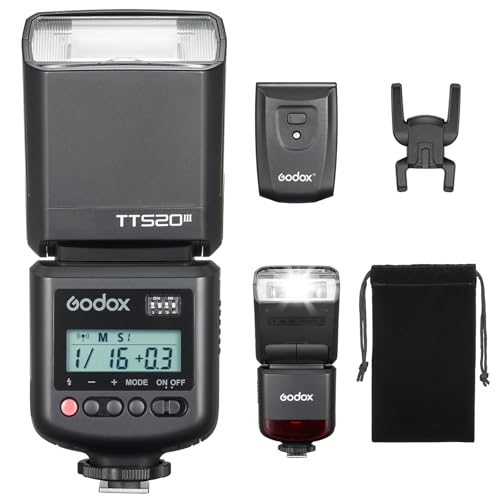
TL;DR: The Godox TT520 III costs $64.00, delivers a GN 33 m (108 ft) output, recycles in about 1.8 s, weighs roughly 0.67 lb, and offers 433 MHz wireless with a 15‑30 m range.
Its guide number of 33 m (108 ft) at ISO 100 stands out, paired with a fast 1.8‑second recycle time on full power. The flash head swivels 0°‑330° horizontally and tilts –7° to +120°, giving you plenty of positioning flexibility. At 0.67020527648 pounds (304 g) it’s lightweight enough to carry on‑camera or off‑camera, and the included RT‑16 transmitter adds 31 g of weight while providing 16 wireless channels on a 433 MHz band.
Compared with the other ten flashes in this roundup, the TT520 III is cheaper than the Godox TT600, which lists at $65.00, yet it’s significantly lighter than the TT600’s 1.1‑pound (≈500 g) body. Its GN 33 m matches the older TT520 II but falls short of the TT600’s GN 60 m, placing it squarely in the mid‑range output tier. Wirelessly, the TT520 III’s 15 m official range (20 m indoor, 30 m outdoor) is modest against the TT600’s up‑to‑100 m line‑of‑sight reach, though it still exceeds the iT30Pro‑C’s 15 m range (not listed, but implied by its compact design). The iT30 series is lighter (≈120 g) but offers a much lower GN of 15 m, so the TT520 III balances power and portability better than those ultra‑compact units.
Shooters consistently praise the flash’s bright output and the intuitive LCD controls, noting that the rotatable head and AA‑battery power make on‑the‑go shooting painless. Professional reviewers highlight the precise manual power steps (8 levels from 1/1 to 1/128 in 1/3‑stop increments) and the crisp flash duration ranging from 1/510 to 1/31,000 s. The main complaints focus on the lack of TTL and high‑speed sync (HSS), occasional wireless hiccups in bright environments, and a plastic housing that feels less rugged than higher‑priced alternatives. Consumers frequently note compatibility gaps with newer mirrorless bodies.
Pros
Cons
Best for: Value-conscious buyers seeking quality at $64.00
Avoid if: You need TTL/HSS, longer wireless range, or guaranteed compatibility with the latest mirrorless camera bodies
TL;DR: The Godox iT30 Pro S delivers TTL and high‑speed sync in a pocket‑sized, 120 g flash with a 2.8‑inch touchscreen, built‑in 2.4 GHz wireless and a 15 m guide number for travel‑friendly lighting.
The iT30 Pro S packs a 2.8‑inch full‑color LCD touchscreen and full high‑speed sync up to 1/8000 s, letting you freeze motion even in bright conditions. Its guide number of 15 m (49.2 ft) at ISO 100 provides enough power for on‑camera fill, while the built‑in 2.4 GHz wireless system reaches up to 100 m, eliminating the need for separate triggers.
Compared with the larger TT600 series and the TT520 line‑up, the iT30 Pro S is dramatically lighter and more compact—at just 120 g and dimensions of 65 × 46 × 47 mm it slips into a pocket, whereas those competitors weigh around 500 g and measure well over 180 mm in height. It shares a similar weight with the iT30Pro‑C and even matches its 2.8‑inch screen, but offers a slightly higher battery voltage (7.4 V vs 7.2 V) and the same 900 mAh capacity.
Everyday users rave about the flash’s tiny footprint and the ease of navigating settings on the touchscreen, calling it a “travel‑friendly” solution that delivers reliable TTL exposure. Professional reviewers note the feature set for the size but warn that the modest 15 m guide number and the fixed, non‑rotating head can produce harsh light without modifiers. The battery delivers up to 560 full‑power flashes, and recycle times are quick—0.4 s at 1/4 power, 0.7 s at 1/2 power, and 1.5 s at full power—so you won’t miss a shot.
Pros
Cons
Best for: Travel photographers, street shooters, and event photographers who need a lightweight fill flash with TTL and wireless control.
Avoid if: You need high‑power output, bounce or swivel capabilities, or studio‑grade soft lighting.
“Perfect for travel”
“TTL works flawlessly”
TL;DR: The Godox TT520II delivers a 33‑meter guide‑number flash, built‑in 433 MHz wireless on 16 channels, and an integrated diffuser for just $48.60, making it a solid entry‑level speedlite for budget‑focused shooters.
The standout spec is its wireless system: a built‑in 433 MHz receiver that works on 16 channels with an indoor range of 15 meters, letting you fire the flash off‑camera without extra triggers. Coupled with a guide number of 33 meters (ISO 100) and a minimum flash duration of 1/20,000 s, the TT520II packs enough power and speed for indoor portraits and small‑venue events.
Compared with its peers, the TT520II sits in the middle of the pack. The sibling TT520 II (B0CKZ2F6ZN) shares the same 15 m range and 16‑channel setup, while the larger TT600 offers a much higher guide number of 60 meters but weighs about 500 g—significantly heavier than the TT520II’s 310 g. The TT520 III matches the 33 meter guide number yet is listed at roughly 0.67 pounds, making it a tad heavier. In contrast, the ultra‑light iT20 F tips the scales at just 45 g and only reaches a 15‑meter guide number, and the iM30 comes in at about 108 g with a lower output. The iT30Pro‑C is also lighter at 120 g and provides a 15‑meter guide number, so the TT520II offers more power than those compact options while staying lighter than the high‑output TT600.
Users repeatedly praise the flash’s reliable wireless triggering and the soft, even light from its built‑in diffuser and bounce card. Professional reviewers note its broad compatibility with Canon, Nikon, and Sony bodies, and beginners appreciate the straightforward manual mode and eight power‑output steps from 1/128 to full power. The lack of TTL or high‑speed sync, and the absence of an LCD, mean you set power levels by feel. On alkaline batteries the recycle time can stretch to the listed maximum of 5 seconds, which some users find sluggish for rapid shooting.
Pros
Cons
Best for: Budget‑conscious buyers seeking a reliable entry‑level option
Avoid if: You need advanced features or professional‑grade performance
TL;DR: The Godox iT20 F packs a 15 m guide‑number, TTL control and USB‑C charging into a 45 g, pocket‑sized flash that’s perfect for on‑the‑go Fujifilm shooters.
The standout spec is its ultra‑light 45 g weight combined with a compact 32 mm depth, making it one of the smallest on‑camera flashes you can mount on a Fujifilm mirrorless body. Its built‑in 300 mAh Li‑ion battery charges via USB‑C in about 70 minutes and can fire roughly 700 full‑power flashes before needing a recharge.
Compared with the other ten flashes in this roundup, the iT20 F's dramatically lighter than the Godox TT520II (310 g) and the Godox iM30 (108 g with batteries). Its depth of 32 mm is also far shorter than the TT520II’s 55 mm length, giving it a far slimmer profile for travel or street photography. While it lacks the wireless radio found in several peers, its simplicity and low price keep it competitive in the budget tier.
Professional reviewers praise the flash’s TTL accuracy and the convenience of magnetic accessories that snap on diffusers or CTO gels in seconds. Everyday users love how the flash feels “almost invisible” on the camera and appreciate the fast 1.5 second recycle time at full power. The main criticisms focus on the fixed head—there’s no bounce or swivel—and the absence of high‑speed sync or off‑camera wireless triggering, which can limit creative lighting setups.
Pros
Cons
Best for: Entry‑level buyers or those on a tight budget
Avoid if: You need advanced features or professional‑grade performance
“the *perfect* compact flash”
“makes photography feel fun again”
TL;DR: The Godox TT520 II delivers a GN33 output, 16‑channel 433 MHz wireless control and 270° swivel for just $49.99, making it a solid budget flash for manual‑learning photographers.
The flash’s guide number of GN33 at ISO 100 gives enough power for typical indoor and outdoor shoots, while the built‑in 433 MHz receiver works on any of the 16 wireless channels. Its transmission range reaches up to 15 m line‑of‑sight, letting you trigger the unit from a reasonable distance without extra accessories. Weighing about 312 g with batteries, the unit stays lightweight enough to mount on‑camera and doesn't unbalance most DSLR or mirrorless bodies.
Compared with other flashes in this roundup, the TT520 II sits between the ultra‑light iT20 F (which weighs just 45 g) and the heavier TT600 (which tips in at about 500 g with batteries). It shares the same 16‑channel wireless capability as its sibling TT520 II peer, but it is lighter than the TT520 III, which lists a weight of roughly 0.67 lb. In short, it offers more power than the entry‑level iT20 F while staying more portable than the larger TT600.
Users consistently praise the low price and the smooth head swivel that makes bounce lighting easy, noting the pull‑out diffuser and white bounce card as handy for softening harsh light. Professional reviewers point out the solid plastic housing and reliable manual output across all 8 power steps. Common complaints focus on the lack of TTL and high‑speed sync, and on slower recycle times when using alkaline AA cells.
Technically, the flash can fire from 1/300 s down to 1/20,000 s depending on power output, giving you a fast enough duration for most still‑life work. Recycle time varies between roughly 0.1 and 5 seconds, influenced by battery type and selected power level. You can adjust power output in 8 steps from 1/1 to 1/128 in 1/3‑stop increments, giving fine‑grained control for manual exposure.
Pros
Cons
Best for: Entry-level buyers or those on a tight budget
Avoid if: You need advanced features or professional‑grade performance
Breakdown
Godox TT600S
Pros
Godox iT30Pro-C
Pros
Godox MS300V
Pros
Cons
Based on scoring data and product specs
Personalized picks
Best Overall Pick
Godox TT600S
Best OverallBest for: Audiophiles and enthusiasts seeking premium sound quality and advanced features
Godox TT600
Best for: Most users looking for a well-reviewed, reliable mainstream option
$65.00-$5.00 vs winner
Skip Godox TT520 II if…
You need advanced features or professional-grade performance
Godox TT600S takes the top spot as the best overall flash, thanks to its high guide number of 60 meters (ISO 100, 200 mm), a solid 22 power‑level range, and roughly 230 full‑power flashes per battery set. It also sports a large backlit LCD for easy settings tweaks and includes a built‑in diffuser panel, buzzer, focus‑assist lamp, and over‑temperature protection, making it a well‑rounded workhorse for serious shooters.
The runner‑up, Godox TT600, shines when you need broad camera compatibility. It works with Canon, Nikon, Pentax, Olympus, Fujifilm and Panasonic bodies via a standard hot shoe, while still delivering the same 60 m guide number and 0.1–2.6 s recycle times as the TT600S. Its built‑in 2.4 GHz X‑system and 32 wireless channels give you reliable off‑camera control for multi‑flash setups.
For tighter budgets, the Godox iM30 at $30.90 offers an ultra‑affordable entry point for hobbyists. The TT600 at $65.00 remains the best mid‑range choice, balancing power, guide number and wireless flexibility. If you’re willing to invest, the AD100Pro at $299.00 provides the premium‑class output and portability that pros often demand.
Pick the Godox TT600S today and lock in a flash that covers every lighting scenario you’ll face.
The AD100Pro offers built‑in high‑speed sync up to 1/8000 s and a fast recycle time of 0.01–1.5 s, making it ideal for fast‑moving outdoor subjects. It also packs 100 Ws of power and a 100 m wireless range, so you can stay off‑camera without losing power.
Please sign in to leave a review
No reviews yet. Be the first to review!
