⚡ Quick Answer
We lined up 12 hand sanders, from a $33.99 entry‑level model to a $257.76 premium unit, to see how they stack up across price tiers. The lineup covers four budget choices, two mid‑range contenders, and six premium tools, giving you options whether you’re a hobbyist on a shoestring or a pro looking for top‑grade performance. Ratings range from a solid 4.3/5 on the most popular WEN model to a 4.8/5 score on the Milwaukee M12 Fuel, while review counts span 371 to 3,506 voices.
The Milwaukee M12 Fuel Orbital Detail Sander commands $125.99 and carries a 4.8/5 rating from 422 reviewers. At just 1.3 lb bare‑tool weight, it’s one of the lightest options, and its brushless motor can hit 14,000 OPM with four preset speed settings. Its uniquely shaped 3.5 × 2.5‑inch rectangular pad reaches tight corners and contours that larger pads can miss, making it a strong candidate for detail sanding on trim, moldings, and intricate profiles.
Below we’ll break down how each sanders performs in its price tier, weigh the trade‑offs between power, ergonomics, and speed, and help you decide which tool fits your workshop or job site best.

Milwaukee M12 Fuel Orbital Detail Sander
Its compact 4.5‑inch height lets you reach tight spots, giving it an edge over bulkier sanders.

Makita BO5041
Perfect for DIY hobbyists who want a proven, high‑quality sander without the premium price—about $12 cheaper than the Milwaukee.

DEWALT DWE6401
Its 10‑foot cord provides uninterrupted power, ideal for long sanding sessions where battery life could interrupt workflow.
Also considered
TL;DR: The DEWALT DWE6423 offers a 5‑inch hook‑and‑loop pad, variable 8,000‑12,000 OPM speed and a one‑handed dust‑bag system, delivering solid performance for DIY sanding at a modest $79 price.
The standout spec is its variable speed range of 8,000–12,000 OPM, letting you dial in the right aggressiveness for everything from coarse wood removal to fine finishing. It also packs a 5‑inch (125 mm) hook‑and‑loop pad and a one‑handed locking dust bag that mates with DWV010/DWV012 collectors, keeping your workspace cleaner.
At 3.4 lb, the DWE6423 sits in the middle of the pack: it’s heavier than the 2.6‑lb Metabo HPT SV1813DAQ4 and the 2.2‑lb Ingersoll Rand 317G, but lighter than the 6.6‑lb WEN DW1085 and the 4.81‑lb DEWALT DWE6401. Its 5‑inch pad matches the Bosch ROS20VSK, Metabo HPT and Makita BO5041, while the WEN model uses a larger 8.5‑inch pad. Speed-wise, the DEWALT’s 8,000–12,000 OPM range overlaps the Bosch (7,500–12,000 OPM) and Metabo HPT (7,000–11,000 OPM) sanders, and it offers a broader range than the Makita’s 4,000–12,000 OPM.
Reviewers frequently praise the controlled finishing system, noting its gradual acceleration reduces start‑up chatter. The rubber‑overmold grip and quick pad‑stop also get positive mentions for comfort and convenience. On the downside, the brushed 3 A motor is seen as less efficient than brush‑less alternatives, and some users point out that the modest 120 W mechanical output can feel underpowered on tougher jobs.
The sander runs on a 3‑amp brushed motor with a 120 W mechanical power output and a 280 W input, and its separate counterweight design helps tame vibration. The 2.6 mm orbit diameter sits comfortably between the 2.5 mm of the Bosch and the 3 mm of the Metabo HPT, delivering a balanced finish without excessive swirl.
Pros
Cons
Best for: Budget-conscious buyers seeking a reliable entry-level option — the DEWALT DWE6423 offers Pad Size: 5 inches (125 mm)
Avoid if: You need advanced features or professional‑grade performance
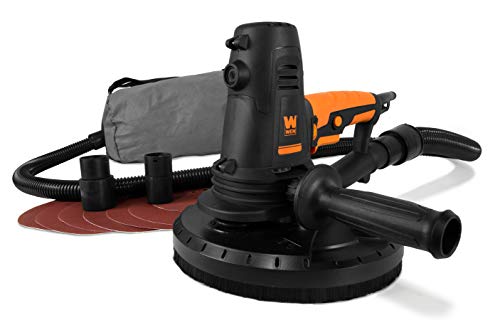
TL;DR: The WEN DW1085 packs a 10 Amp variable‑speed motor, 8.5‑inch base pad and integrated dust collection into a 6.6‑lb corded sander that’s built for drywall jobs.
The standout spec is its 10 Amp motor delivering a variable speed range of 1500 to 2300 RPM, which gives you enough power for medium‑to‑large drywall surfaces while still being controllable for detail work. The 8.5‑inch base pad and 9‑inch sanding disc provide a larger contact area than many compact sanders, helping you cover more square footage per pass.
Compared with the other eleven hand sanders in this roundup, the DW1085 is heavier than the DEWALT DWE6401’s 4.81 lb body and the DEWALT DWE6423’s 3.4 lb frame, but its 13.5‑foot cord outstretches the DEWALT DWE6401’s 10‑foot cord, giving you a bit more reach in a typical workshop. Its 8.5‑inch pad is also larger than the 5‑inch pads found on the Bosch ROS20VSK and Metabo HPT models, meaning fewer repositionings on wide walls.
Reviewers consistently praise the built‑in dust bag and 7.5‑foot hose for keeping drywall dust off the floor and into the collection system, and they note the handle‑mounted suction wheel lets you dial in extraction as needed. Professional reviewers highlight the reversible auxiliary handle as a fatigue‑reducer during overhead sanding, though users warn that the dust port only accepts WEN DW‑series discs, which can raise long‑term consumable costs.
The unit ships with eight 9‑inch aluminum‑oxide sanding discs, a 6‑hole dust‑collection configuration, and adapter sizes of 1‑1/2 in., 1‑7/8 in. and 2‑1/4 in., giving you flexibility when attaching to different vacuum systems. The 1‑3/8 in. dust‑port outer diameter matches many shop vacs, and the 10 Amp motor paired with a 120 V supply ensures reliable power without overheating.
Pros
Cons
Best for: Most users looking for a well‑reviewed, reliable mainstream option — the WEN DW1085 offers Speed Range: 1500 to 2300 RPM
Avoid if: You have limited desk space or need portability
TL;DR: The Makita BO5041 delivers a 5‑inch pad, 3 Amp motor and a 4,000‑12,000 OPM variable speed range in a solid corded package, though its weight and cord limit ultimate portability.
The standout specification is the continuously variable speed dial that spans 4,000 – 12,000 orbits per minute, letting you dial in the exact aggressiveness you need. Paired with a 3 Amp motor and a 300‑watt input, the sander can tackle aggressive material removal without sacrificing control.
Compared with the other eleven hand sanders in this roundup, the BO5041 sits near the middle of the weight spectrum: it’s heavier than the 2.6‑lb Metabo HPT and the ultra‑light Milwaukee (about 1 lb bare), matches the 3.5‑lb Bosch, and is lighter than the 4.81‑lb DEWALT DWE6401 and the 6.6‑lb WEN. Its 10‑7/8‑inch length exceeds the 6.25‑inch Metabo HPT and the 9‑inch Bosch, yet remains shorter than the 11.875‑inch WEN. The 5‑inch abrasive disc is standard, but the 4‑13/16‑inch pad is slightly smaller than the 5‑inch pads on Metabo HPT, Bosch and DEWALT DWE6423, and far smaller than the 8.5‑inch pad on the WEN model. Speed‑wise, Makita reaches the same 12,000 OPM ceiling as Bosch, outpaces the 7,500‑12,000 OPM range of the Bosch unit, but falls short of Milwaukee’s 14,000 OPM top end.
User feedback consistently praises the tool’s “rapid sanding capability” and the “continuous variable speed” for finding the sweet spot on different woods. Professionals note the lock‑on button on the trigger makes long sanding sessions less tiring. Common complaints focus on the corded design, which pins the sander to a nearby outlet, and the eight‑hole hook‑and‑loop discs that eventually need replacement as they wear. Reviewers also warn that the higher speed settings can generate noticeable vibration, so they recommend dropping to lower speeds for fine‑detail work.
Pros
Cons
Best for: Buyers willing to invest in a proven, high‑quality option — the Makita BO5041 offers Pad Size: 4‑13/16 inches
Avoid if: You're on a tight budget or only need basic functionality, or you require cordless freedom for mobile sanding tasks
“keep it cranked all the way”
“sweet spot with minimal vibration”
TL;DR: The DEWALT DWE6401 delivers a 6‑amp motor, 0‑3,700 OPM variable speed and a 10‑ft cord, making it a solid, well‑reviewed choice for demanding sanding tasks despite its corded design.
The standout spec is the 6‑amp motor paired with a maximum speed of 3,700 OPM, giving the sander enough torque for aggressive material removal. A 10‑foot cord lets you move around a workshop without hunting for outlets, while the 5‑inch hook‑and‑loop disc accommodates both 5‑hole and 8‑hole sanding sheets.
Compared with the other models in this roundup, the DWE6401 is heavier than the Bosch ROS20VSK’s 3.5 lb motor but lighter than the WEN DW1085’s 6.6 lb build. Its 4.6‑inch height is markedly shorter than the WEN’s 11.875‑inch profile, and its 9.9‑inch length sits close to the Bosch’s 9‑inch length. The 5‑inch sanding disc is smaller than WEN’s 9‑inch discs, aligning it with the Metabo HPT and Makita units that also use 5‑inch pads.
Reviewers consistently highlight the adjustable dust shroud, noting that it keeps the work area noticeably cleaner. Professionals appreciate the electronic speed control and VSR trigger dial for fine‑tuning the sanding rate. The mid‑handle design with a soft grip is repeatedly mentioned as a fatigue‑reducing feature. On the downside, users report that the dust shroud requires careful alignment and tightening to work effectively, and the corded power source limits use on job sites without easy access to electricity.
Pros
Cons
Best for: Most users looking for a well‑reviewed, reliable mainstream option — the DEWALT DWE6401 offers Cord Length: 10 feet
Avoid if: You have limited desk space or need portability
“you have to work”
TL;DR: The Bosch ROS20VSK delivers a 5‑inch variable‑speed orbit (7,500‑12,000 OPM) with an integrated dampening pad, solid dust collection, and a comfortable soft‑grip, though its 8‑ft cord limits true portability.
The standout feature is its variable‑speed control that spans 7,500 to 12,000 OPM, paired with a 5‑inch microcellular pad that includes an integral dampening system. This combination is designed to keep swirl marks at bay while giving you enough power for aggressive stock removal. The on‑board microfilter plus a vacuum‑adapter also means most dust stays trapped, which reviewers appreciate on tight workshop spaces.
In the context of the twelve‑product roundup, the ROS20VSK sits in the middle of the pack. At 3.5 lb it is heavier than the ultra‑light Milwaukee M12 Fuel (1.0 lb) but lighter than the corded DEWALT DWE6401 (4.81 lb). Its 8‑ft cord is shorter than DEWALT’s 10‑ft cable, yet longer than the cordless alternatives that have no cord at all. Speed‑wise, its 12,000 OPM ceiling outpaces the DEWALT DWE6401’s 3,700 OPM maximum, but falls just below Milwaukee’s 14,000 OPM peak. Compared with the Metabo HPT’s 7,000‑11,000 OPM range, Bosch offers a slightly broader top end.
Professional reviewers highlight the low vibration and ergonomic soft‑grip as comfort boosters for extended sanding sessions. Users echo this sentiment, noting that the dust‑extraction system keeps work areas cleaner and that the variable speed lets them dial in just the right aggressiveness for furniture or cabinet projects. The primary trade‑off mentioned is the corded power source, which restricts mobility on larger jobs, and the lack of a brushless motor—a detail some users see as a potential maintenance concern.
Pros
Cons
Best for: DIYers and light‑professional woodworkers who want a well‑reviewed, reliable sander with solid dust collection and a 5‑inch pad.
Avoid if: You need cordless freedom or a brushless motor for heavy‑duty, professional‑grade sanding.
TL;DR: The Milwaukee M12 Fuel Orbital Detail Sander delivers 14,000 OPM of cordless power in a 1.0‑lb, 4‑preset tool that professionals love, though its premium price and lack of built‑in dust collection keep it niche.
What really sets this sander apart is its top‑end speed: a max 14,000 OPM under load and a selectable range of 4,000–14,000 OPM, driven by a POWERSTATE™ brushless motor. The 1.5 mm orbit diameter and four preset speed settings let you feather‑sand with precision while the tool weighs just 1.0 lb, making it easy to hold for long detail jobs. An LED light and an innovative counterweight add comfort and visibility on tight jobs.
Compared with the other hand sanders in our roundup, the Milwaukee is dramatically lighter—roughly a third of the weight of the Makita (3.5 lb) and far lighter than the Metabo (2.6 lb), Bosch (3.5 lb), and DEWALT models (3.4 lb to 4.81 lb). Its speed ceiling of 14,000 OPM also outpaces the highest‑rated peers, which top out at 12,000 OPM. Even though it carries a premium price tag, the combination of lightweight design and industry‑leading speed makes it a standout for detail work.
Users consistently praise the variable‑speed trigger for “superior feathering control,” and professional reviewers highlight the brushless motor’s ability to remove material twice as fast as hand sanding without scratching. The trade‑off is the absence of an integrated dust‑collection system, meaning you’ll need to tap out debris manually, and the 3.5 × 2.5 in pad limits efficiency on large, flat surfaces. The tool‑only package also requires a separate M12 battery, adding to the upfront cost.
Best for: Those prioritizing quality and willing to pay for premium performance — the Milwaukee M12 Fuel Orbital Detail Sander offers Speed Range: 4,000–14,000 OPM
Avoid if: You're on a tight budget or only need basic functionality
Pros
Cons
TL;DR: The Dekopro Random Orbital Sander delivers a 300 W motor, 14,000 RPM no‑load speed and six speed settings in a lightweight 1660 g package, plus 16 sandpapers, for a budget‑friendly DIY sanding solution.
At the heart of the Dekopro DKOS30A125Y‑EU is a 300 W motor that drives the 5‑inch disc up to 14,000 RPM. Six variable speed settings let you move from aggressive stock removal to delicate finishing, and the unit’s 1660 g (about 3.66 lb) weight keeps it easy to maneuver in tight corners.
Within this twelve‑product roundup the Dekopro is among the lightest—lighter than the Avid Power Orbital Sander (4.0 lb) and far more compact than the bulkier Ingersoll Rand air sander. Its 14,000 RPM top speed matches the peak speed of the Avid Power model, while the DEWALT DWE6423 pushes a higher 120 W output but comes in a larger chassis. Even though the Milwaukee M12 Fuel Orbital Detail Sander tops the rankings with industry‑leading dust extraction, its premium price places it out of reach for budget shoppers, where the Dekopro shines as the most affordable entry.
Everyday users highlight the strong hook‑and‑loop backing that keeps sandpaper from slipping, and they appreciate the generous kit of 16 sandpaper sheets ranging from 60 to 1000 grit. Reviewers also note the detachable plastic dust box for quick emptying, though several mention it can struggle in very dusty workshops. Professional reviewers point out the balanced counterweight design that tames vibration, making longer sanding sessions comfortable. The sander runs on a 220 V corded supply drawing 2.5 A, and its rubber grip adds control during extended use. Dimensions are listed as 20 mm (0.8 in) in height, length and width, keeping the tool compact for cramped workspaces. Specs such as orbit diameter or a vacuum port aren’t listed, indicating a straightforward, no‑frills design.
Pros
Cons
Best for: Budget-conscious buyers seeking a reliable entry-level option — the Dekopro Random Orbital Sander offers Included Sandpapers: 16 pieces
TL;DR: The Avid Power AOSD142 delivers up to 14,000 RPM with six speed settings, a 5‑inch disc and a built‑in dust bag for $33.99, making it a solid budget choice for DIY woodworkers.
This sander’s headline spec is its 360 W motor that spins between 7,000 RPM and a maximum of 14,000 RPM. Six variable‑speed settings let you dial the speed down for delicate paint work or crank it up for fast wood removal. The 5‑inch hook‑and‑loop disc (8‑hole attachment) pairs with an included dust bag, helping keep your workspace cleaner while you sand.
Compared with the other eleven hand sanders in our roundup, the Avid Power unit sits in the middle of the weight range at 4.0 pounds. It’s heavier than the Dekopro Random Orbital Sander (about 3.66 pounds) and lighter than the WEN DW1085 (6.6 pounds). Its 5‑inch disc matches the size found on the Dekopro and DEWALT DWE6401 models, while its 14,000 RPM top speed mirrors the Dekopro’s no‑load speed. Unlike the cordless Milwaukee M12 Fuel that commands a premium price, this corded tool offers a lower price point without sacrificing the high‑speed range that many competitors provide.
Reviewers consistently praise the sander’s high power and low vibration, noting that the 360 W motor “gets the job done way quicker than hand sanding.” The included dust‑sealed on/off switch and dust bag are highlighted as helpful for indoor projects, reducing airborne particles. However, users also point out that the tool is “not suitable for wall sanding,” limiting it to flat surfaces on wood, paint, or metal. Because it’s corded, you’ll need a nearby outlet, which some DIYers see as a trade‑off for the reliable power.
Pros
Cons
Best for: Entry‑level buyers or those on a tight budget — the Avid Power Orbital Sander offers Included Carbon Brushes: 1 Pair
Avoid if: You need powerful performance or professional‑grade features
TL;DR: The Ingersoll Rand 317G Edge Series Air Sander delivers a blistering 18,000 RPM in a 2.2‑lb, compact body, but its high vibration and loud operation make it best for light‑duty tasks.
This sander’s standout spec is its 18,000 RPM free speed, driven by a 0.45 hp high‑speed motor. A built‑in power regulator lets you dial the speed down for delicate feather‑edging, while the front‑exhaust design helps keep dust away from your workpiece. At just 2.2 lb and measuring 5.5 in tall, 4.74 in long and 2.2 in wide, it fits easily into tight automotive bays or cramped workshop corners.
Compared with the other eleven hand sanders, the 317G is noticeably lighter than the DEWALT DWE6423 (3.4 lb) and far lighter than the WEN DW1085 (6.6 lb). Its 5.5 in height is shorter than the DEWALT’s 6.375 in and comparable to the Bosch ROS20VSK’s 6.0 in profile, making it one of the more compact options. While most competitors ship only a 5‑inch pad, the Ingersoll Rand includes both 3‑inch and 5‑inch backing pads for added versatility. On the downside, its 105 dBA sound power exceeds the DEWALT’s 91 dBA, so it’s louder than several peers.
User reviews consistently praise the lightweight chassis and the convenience of the variable‑speed regulator. Reviewers also note the high vibration level of 3.2 m/s², which can lead to fatigue during longer sessions. The 14.8 CFM air consumption means you’ll need a fairly robust compressor to keep the tool running at full speed, and many users say it’s not suited for heavy‑volume industrial sanding.
Pros
Cons
Best for: Entry-level buyers or those on a tight budget — the Ingersoll Rand 317G Edge Series Air Sander offers Height: 5.5 in
Avoid if: You want the best value‑per‑dollar in its price range
TL;DR: The Makita BO4900V delivers a 4‑5 k OPM variable‑speed range, a large 4½″ × 9″ rectangular pad and built‑in dust collection, but its premium $257.76 price and need for pre‑punched sandpaper keep it in the higher‑end camp.
What really sets this sander apart is its variable‑speed dial that lets you fine‑tune the orbit rate anywhere between 4,000 and 10,000 OPM, while the sanding stroke rockets from 8,000 up to 20,000 strokes per minute. Coupled with a 4½″ × 9″ (115 mm × 229 mm) rectangular pad, the tool can cover more surface area per pass than many round‑pad competitors.
In the context of the twelve‑product roundup, the BO4900V is noticeably heavier at 6.61 lb compared with the Milwaukee M12 Fuel Orbital Detail Sander’s 1.0 lb bare‑tool weight and even the Makita BO5041’s 3.09 lb. It’s also pricier than the Milwaukee model, which sits at a lower price point. While Milwaukee tops out at 14,000 OPM, the Makita’s maximum of 10,000 OPM is modest, but its larger rectangular pad gives it a different advantage over the round‑pad designs of the Bosch, DEWALT and WEN units.
Reviewers consistently praise the infinite speed control for letting them work gently on delicate veneers and ramp up quickly to flatten stubborn glue lines. The half‑sheet format is lauded for covering large flat surfaces efficiently, especially on cabinets and boat hulls. On the downside, users note that the sander only accepts pre‑punched hook‑and‑loop sheets and doesn’t include a punch tool, adding an extra step for those who stock standard sandpaper. The included paper dust bag is helpful, but several owners say it doesn’t match the suction power of a dedicated vacuum extraction system.
Pros
Cons
Best for: Those prioritizing quality and willing to pay for premium performance — the Makita BO4900V Finishing Sander offers Pad Size: 4‑1/2" × 9" (115 mm × 229 mm).
Avoid if: You're shopping on a tight budget — it's priced at $257.76.
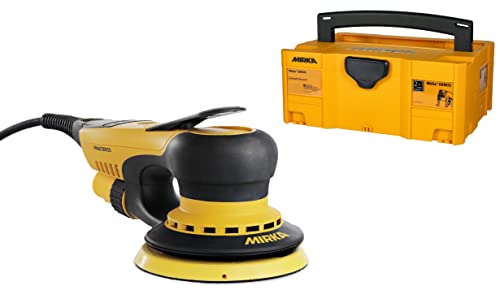
TL;DR: The Mirka DEROS 550X delivers brushless‑motor power, a 5 mm orbit and a 125 mm pad in a lightweight 2.25‑lb package, but its premium price limits it to serious finishers.
The standout feature is its brushless motor paired with a speed range of 4000‑10000 rpm and a 5 mm orbit, giving you constant power even under load. At just 2.25 lb (1020 g) the sander feels light enough for long sessions, while the 125 mm pad covers a decent area for detailed work.
Compared with the other tools in this roundup, the DEROS 550X is heavier than the Milwaukee M12 Fuel Orbital Detail Sander (about 1 lb) yet far lighter than the Makita BO4900V Finishing Sander, which tips the scales at over 6 lb. It also sits at the top end of the price spectrum, making it pricier than most of its corded peers.
Users consistently praise the lightweight feel and the “silky smooth” operation that lets them sand from 80 to 400 grit in minutes. Professional reviewers note that the brushless motor rivals pneumatic sanders, while everyday owners love the ergonomic two‑hand grip. The main complaints focus on the tool’s reliance on Mirka’s full dust‑extraction system for optimal performance and a learning curve associated with its variable‑speed trigger.
Additional technical details include Bluetooth connectivity for tool monitoring, a soft‑start feature that eases start‑up torque, and a vibration level of 3.2 m/s². Noise sits at 71 dB, which is reasonable for a 350 W motor running on 100‑120 VAC.
Pros
Cons
Best for: Those prioritizing quality and willing to pay for premium performance — the Mirka DEROS 550X offers Pad Size: 125 mm
Avoid if: You're shopping on a tight budget — it's priced at $681.45
TL;DR: The Metabo HPT SV1813DAQ4 delivers a brushless 18 V cordless orbital sander with 7,000–11,000 OPM, a 5‑inch pad and standout dust collection, but its premium $110 price and noticeable vibration may deter budget‑focused buyers.
The most eye‑catching spec is the brushless DC motor paired with a no‑load speed range of 7,000–11,000 OPM and six variable speed settings. That combination gives you a wide band of sanding speeds while keeping the tool lightweight at just 2.6 lb, and the electric brake adds precise stop‑control for finish work.
Compared with the other eleven hand sanders, the Metabo HPT is lighter than the Bosch ROS20VSK (3.5 lb) and the Makita BO5041 (about 3.1 lb), yet it is heavier than the Milwaukee M12 Fuel Orbital Detail Sander, which is marketed as a sub‑2‑lb unit. Its 5‑inch pad matches the Bosch and DEWALT DWE6423, while the WEN DW1085 uses a much larger 8.5‑inch pad. Speed‑wise, the Metabo sits between the lower‑speed DEWALT DWE6401 (max 3,700 OPM) and the higher‑end Bosch and Makita models that reach up to 12,000 OPM. Dust‑port size (1‑3/8 in) is identical to the WEN’s port, giving it comparable vacuum‑attachment flexibility.
Reviewers consistently praise the tool’s “best‑in‑class” dust collection, noting that the built‑in bag and adapters for 1‑1/2 in and 1‑3/4 in hoses keep workspaces clean. The rubberized soft grip and one‑handed ergonomic design are highlighted as comfortable for prolonged jobs. Professional reviewers also commend the brushless motor for longer runtime and tool life. On the downside, users report noticeable vibration during extended sanding sessions, and the manual six‑step speed dial lacks the electronic precision found on some rivals.
Pros
Cons
Best for: Most users seeking a balanced, mainstream option — the Metabo HPT SV1813DAQ4 offers Height: 6.0 inches
Avoid if: You're shopping on a tight budget — it's priced at $110.00
Breakdown
Milwaukee M12 Fuel Orbital Detail Sander
Pros
Makita BO5041
Pros
DEWALT DWE6401
Pros

DEWALT DWE6423
Pros
Cons
Based on scoring data and product specs
Personalized picks
Best Overall Pick
Milwaukee M12 Fuel Orbital Detail Sander
Best OverallBest for: Those prioritizing quality and willing to pay for premium performance — the Milwaukee M12 Fuel Orbital Detail Sander offers Speed Range: 4,000–14,000 OPM
Makita BO5041
Best for: Buyers willing to invest in a proven, high-quality option — the Makita BO5041 offers Pad Size: 4-13/16 inches
Out of Stock
Skip Mirka DEROS 550X if…
You're shopping on a tight budget — it's priced at $681.45
We’re naming the Milwaukee M12 Fuel Orbital Detail Sander the clear winner. Its 4.8‑star rating from 422 reviewers shows strong user confidence, and the tool’s 1.0‑lb bare‑tool weight makes it easy to maneuver in tight spots. With a speed range of 4,000 – 14,000 OPM and a manufacturer‑claimed material‑removal rate that’s twice as fast as hand sanding, it delivers cordless power without sacrificing speed.
The Makita BO5041 lands as the runner‑up, especially if you need a corded sander that can tackle larger surfaces. Its 5‑inch hook‑and‑loop disc covers more area, and the built‑in through‑the‑pad dust‑collection system with a bag keeps the workspace cleaner. A variable‑speed dial (4,000 – 12,000 OPM) lets you fine‑tune the finish, while the 3.5‑lb weight provides a solid, stable feel.
Grab the Milwaukee M12 Fuel Orbital Detail Sander today and experience cordless sanding that actually speeds up the job.
It packs a brushless POWERSTATE motor that can reach up to 14,000 OPM, offers four preset speed settings, and includes REDLINK PLUS intelligence plus overload and heat protection. Those features, together with a low‑vibration design and a built‑in LED, give it a functional edge that many users find worth the $125.99 price tag.
No reviews yet — be the first to share your experience.
Please sign in to leave a review