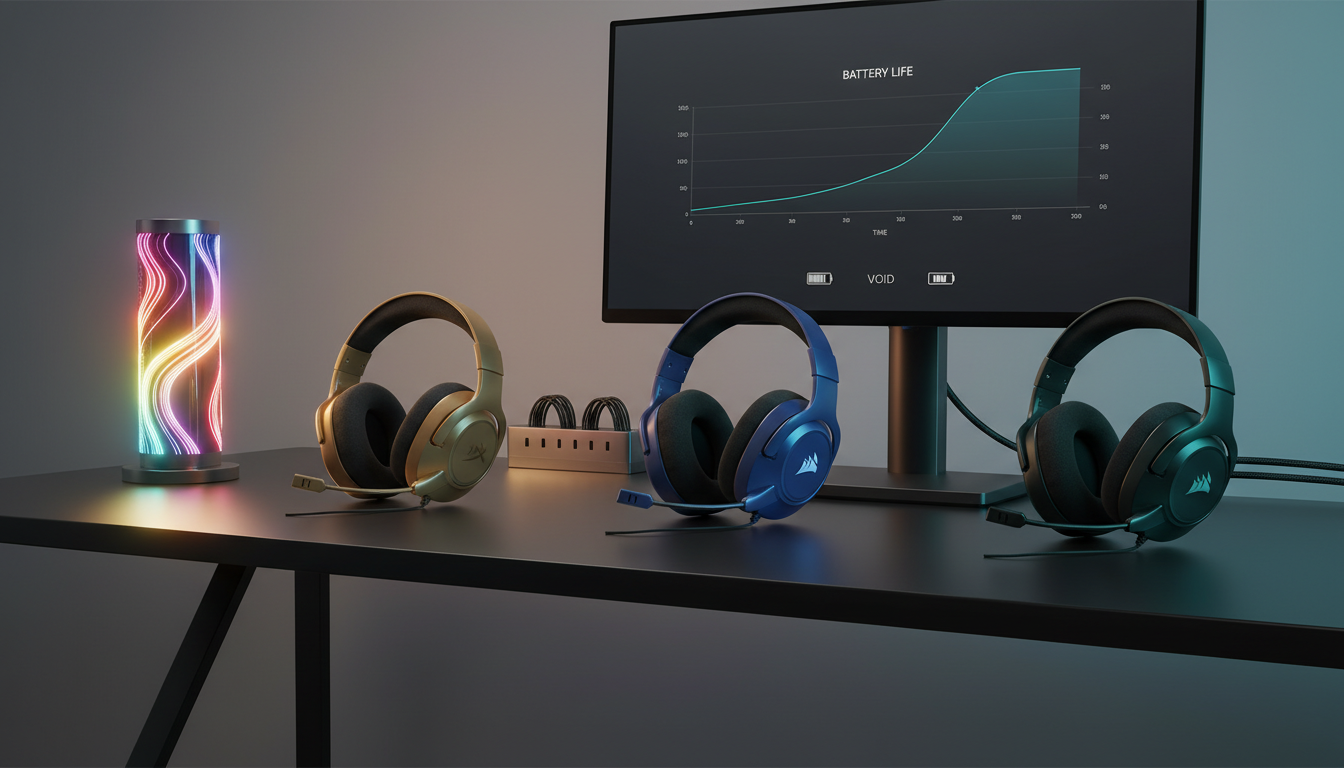
When battery life stretches into the hundreds of hours, you can game, stream, or work without hunting for an outlet. We pit 8 wireless headsets against each other, and the HyperX Cloud III S tops the list with a manufacturer‑claimed 200 hours of Bluetooth playtime and a solid 4.4‑star rating from 1,131 reviewers. Even the budget‑friendly options push past 40 hours, proving long sessions aren’t limited to premium models.
The selection spans three price tiers. Budget contenders include the PrancyBt Bluetooth Headset at $59.94, Turtle Beach Stealth 500 at $89.99, and Turtle Beach Stealth 600 Black at $109.00, each delivering 40‑80 hours of use. Mid‑range picks are the Corsair Void v2 for $112.76 (4.2‑star rating, up to 130 hours Bluetooth) and Razer BlackShark V3 at $119.99, both offering around 70 hours of play. Premium choices—HyperX Cloud III S, SteelSeries Arctis Nova 5 ($129.99) and Arctis Nova 7 ($199.99)—provide 60‑200 hours and higher‑end driver tech.
Below we break down each model’s battery endurance, comfort, and connectivity so you’ll match the right headset to your marathon sessions.

HyperX Cloud III S
Its 53 mm drivers provide immersive audio while keeping the price at $129.99, delivering strong value for a proven, high‑quality headset.

Corsair Void v2
Ideal for home and office users, it offers up to 130 hours Bluetooth play for $112.76—about $17 cheaper than the HyperX Cloud III S.

Turtle Beach Stealth 600
Offers 80 hours of battery life at $109.00, delivering the longest‑lasting entry‑level experience and the highest user rating among the three.
Also considered
Score Analysis
Key score advantages vs. runner-up (Corsair Void v2)
Price Range
HyperX Cloud III S
$129.99
Corsair Void v2
$112.76
Turtle Beach Stealth 600
$109.99

Razer BlackShark V3
$145.99

SteelSeries Arctis Nova 5
$129.99

Turtle Beach Stealth 500
$89.99
PrancyBt Bluetooth Headset
$59.94
SteelSeries Arctis Nova 7
$199.99
Spec Comparison
TL;DR: The HyperX Cloud III S delivers up to 200 hours of Bluetooth playtime, a 53 mm driver, and sturdy build quality, but its bulk and lack of ANC may limit portability.
The standout spec is the staggering battery endurance: HyperX lists 120 hours on its 2.4 GHz dongle and an even longer 200 hours in Bluetooth mode. Those figures dwarf the 60‑hour life of the SteelSeries Arctis Nova 5 and the 70‑hour run time of the Razer BlackShark V3, making the Cloud III S a clear leader for marathon gaming sessions.
When you line it up against the other seven headsets, the Cloud III S is heavier at about 0.78 lb versus the Arctis Nova 5’s 0.62 lb and the Turtle Beach Stealth 600’s 0.71 lb. Its 53 mm dynamic drivers also outsize the 50 mm units found in Razer, Corsair, and Turtle Beach models, and are larger than the 40 mm drivers of the Stealth 500. While the wireless range of 20 m matches typical 2.4 GHz kits, the headset’s Bluetooth 5.3 support and extensive codec list (SBC, MPEG‑2, AAC‑LC) provide broader codec support.
Reviewers consistently praise the comfort of the memory‑foam, leatherette ear cushions and the durability of the steel‑aluminum frame. Professional testers note the low‑latency USB dongle as a boon for competitive play, and DTS Headphone:X spatial audio activates for life. On the flip side, users frequently call out the headset’s bulk and its 0.78 lb weight as a transport hassle, and the absence of active noise cancellation—even though marketing hints at it—leaves a gap for noisy environments. The low‑frequency isolation also falls short of expectations, which some users mention in their feedback.
Beyond endurance, the Cloud III S packs a 64 Ω impedance, 111.94 dB SPL sensitivity, and a detachable 10 mm boom mic with noise‑cancelling capabilities. The 494 mm cable offers a wired fallback, and the 20 m wireless range keeps you untethered on a typical gaming desk. The companion NGENUITY app lets you tweak settings without needing third‑party software.
Pros
Cons
Best for: Serious gamers who need low‑latency wireless performance and marathon‑length battery life.
Avoid if: You’re a traveler, fitness enthusiast, or anyone needing a compact, lightweight headset with active noise cancellation.
TL;DR: The Corsair Void v2 delivers 130 hours of Bluetooth playtime, Dolby Atmos spatial sound and a comfortable floating headband for under $115, making it a solid long‑life choice for multi‑platform gamers.
The standout spec is the Bluetooth battery life of up to 130 hours, paired with a 70‑hour runtime on the 2.4 GHz wireless mode. Its custom‑tuned 50 mm drivers feed a frequency response of 20 Hz‑20 kHz, and the headset supports Dolby Atmos Spatial Audio on PC and PS5, which reviewers praise for precise positional cues.
Compared with the seven other headsets in this roundup, the Void v2 sits in the mid‑weight range at about 0.67 lb (303 g). It’s lighter than the HyperX Cloud III S (0.78 lb) and the PrancyBt Bluetooth Headset (0.95 lb), but a touch heavier than the SteelSeries Arctis Nova 5 (0.62 lb). Its driver size matches the Turtle Beach Stealth 600 and Razer BlackShark V3 at 50 mm, and it outpaces the Turtle Beach Stealth 500’s 40 mm drivers. Battery life also outstrips the Stealth 600’s 80 hours and Razer’s 70 hours, though HyperX advertises a 200‑hour Bluetooth claim.
User feedback highlights the breathable memory‑foam ear cushions and the floating headband as all‑day comfort winners. Professional reviewers note the NVIDIA Broadcast integration in the omni‑directional mic reduces background chatter, while the quick‑charge feature adds six hours of play after just 15 minutes on the charger. Bluetooth 5.3 ensures stable pairing, and the 2.4 GHz link reaches roughly 15.24 m (50 ft), giving you freedom to move around your gaming space.
Pros
Cons
Best for: Multi‑platform gamers who need marathon‑level battery life, low‑latency 2.4 GHz connectivity and immersive spatial audio.
Avoid if: You require a detachable microphone, active noise cancellation, or the lightest possible headset for extended wear.
TL;DR: The Turtle Beach Stealth 600 delivers an 80‑hour battery, 50 mm drivers and glasses‑friendly memory‑foam cushions, but its weight and price‑to‑value aren’t the best in its class.
The headline spec is the 80‑hour battery life, which lets you game for days without hunting for a charger. It pairs that endurance with 50 mm drivers that match the size of many competing headsets, and the unit weighs 0.7054792384 pounds (about 320 g).
Compared with the seven other headsets in this roundup, the Stealth 600 sits in the middle of the weight range – it’s heavier than the Corsair Void v2 (0.668 lb) but lighter than the HyperX Cloud III S (0.785 lb). Its 80‑hour battery outlasts most peers: longer than the Razer BlackShark V3 (70 h), the Stealth 500 (40 h) and the SteelSeries Arctis Nova 5 (60 h), yet it falls short of the HyperX Bluetooth mode’s 200‑hour claim.
Reviewers consistently highlight the flip‑to‑mute microphone with AI noise reduction and the QuickSwitch button that toggles between 2.4 GHz wireless and Bluetooth with a single press. The memory‑foam ear cushions earn praise for being glasses‑friendly, and the Swarm II app adds custom EQ presets and Superhuman Hearing for competitive play. Some users note the headset feels a bit bulky for long sessions.
The Stealth 600 also offers mappable controls – a mode button, wheel button and customizable EQ presets – giving you quick access to game‑chat mix, mic monitoring and Bluetooth volume without leaving the game.
Pros
Cons
Best for: Xbox and PC gamers who need ultra‑long battery life without sacrificing core features.
Avoid if: You prioritize the lightest possible headset or the absolute best price‑to‑feature ratio.
TL;DR: The Razer BlackShark V3 delivers ultra‑low 10 ms latency, 70 hours of wireless playtime and a detachable 9.9 mm HyperClear mic, but its bulkier build and premium price may limit appeal for casual users.
What really sets the BlackShark V3 apart is its 10 ms HyperSpeed Gen‑2 latency, a figure that professional reviewers flag as “near‑instant” for competitive shooters. Coupled with 50 mm TriForce Titanium drivers and a 50% harmonic distortion reduction, the headset promises clear positional cues without sacrificing bass depth, thanks to a 75% magnet size increase.
When you line it up against the seven other contenders, the BlackShark V3’s 70‑hour battery life lands it in the middle of the pack: it outlasts the SteelSeries Arctis Nova 5 (60 h) and the Turtle Beach Stealth 500 (40 h), yet falls short of the Corsair Void v2’s 130 h (Bluetooth) and the HyperX Cloud III S’s 120 h (2.4 GHz). Its 50 mm drivers match the Corsair and Turtle Beach models, while the HyperX pushes a slightly larger 53 mm unit. At 367 g, it's heavier than the SteelSeries Arctis Nova 5 (≈0.62 lb) and the Turtle Beach Stealth 600 (≈0.71 lb), but lighter than the PrancyBt’s 0.95 lb frame.
Everyday owners echo the pros highlighted by experts: the detachable 9.9 mm HyperClear boom mic earns praise for crisp voice capture and effective background‑noise cancellation, and the 70‑hour battery lets you game marathon sessions without hunting for a charger. On the flip side, users note the over‑ear bulk can slip during vigorous movement, and the default V‑shaped sound signature often needs EQ tweaks for music listening. Professional reviewers also point out that while the headset’s THX Spatial Audio 7.1.4 and four‑level hybrid ANC are technically impressive, they add to the overall heft.
Beyond the headline numbers, the BlackShark V3 packs a suite of tweaks: four adjustable active‑noise‑cancelling levels via the Razer app, customizable EQ profiles through Synapse, and a 15° swivel joint for a more personalized fit. These features give you granular control over both game‑time immersion and everyday comfort, even if the headset’s size may feel imposing on smaller heads.
Pros
Cons
Best for: Competitive esports gamers who need sub‑10 ms latency and precise positional audio.
Avoid if: You prioritize a lightweight headset for intense physical activity or prefer a neutral sound signature straight out of the box.
“excellent wireless gaming headset”
“no delay, no stutter”
TL;DR: The SteelSeries Arctis Nova 5 delivers 60 hours of wireless play, 100+ esports‑tuned presets, and a lightweight 280 g frame for $129.99, though its bulky over‑ear build may limit active‑use scenarios.
The standout spec is its 60‑hour battery life, paired with a fast‑charge capability of 15 minutes to reach six hours of play. At just 280 g (about 0.62 lb) and a compact 89.4 mm height, the headset feels light on the head while still packing custom Neodymium Magnetic drivers and a ClearCast Gen2.X microphone.
Compared with the other seven headsets in this roundup, the Nova 5 is lighter than the HyperX Cloud III S (0.78 lb) and the Corsair Void v2 (0.67 lb), and it also undercuts the SteelSeries Arctis Nova 7 at 0.72 lb. Its battery life sits in the middle: longer than the Turtle Beach Stealth 500’s 40 hours but shorter than the HyperX Cloud III S’s 120‑hour 2.4 GHz runtime and the Corsair Void v2’s 70‑hour wireless claim.
User feedback praises the marathon‑ready 60‑hour battery and the 100+ esports‑tuned audio presets that highlight critical in‑game sounds. Professional reviewers also note the ClearCast 2.X mic’s higher bandwidth and the quick‑switch wireless modes (2.4 GHz and Bluetooth 5.3) that let you hop between PC, consoles and mobile devices. However, several users call the over‑ear, closed‑back design “bulky,” saying it feels impractical for workouts or travel.
Pros
Cons
Best for: Buyers willing to invest in a proven, high-quality option
Avoid if: You're on a tight budget or only need basic functionality
“poorly suited for sports and fitness”
“comfortable with long battery life and good controls”
TL;DR: The Turtle Beach Stealth 500 offers 40 hours of battery, a feather‑light 0.51 lb frame, 40 mm drivers and dual 2.4 GHz/Bluetooth 5.2 connectivity for solid budget gaming.
The headline feature is its 40‑hour battery life, letting you game through marathon sessions without hunting for a charger. Weighing just 0.51 lb, the headset feels almost weightless on the head, and the 40 mm drivers deliver the classic Turtle Beach sound signature. It also supports both 2.4 GHz wireless and Bluetooth 5.2, so you'll hop between consoles, PC and mobile devices without swapping gear.
Compared with the other seven headsets in this roundup, the Stealth 500 sits on the lighter side—its 0.51 lb mass is lower than the 0.71 lb Stealth 600 and the 0.67 lb Corsair Void v2. Its driver size of 40 mm is smaller than the 50 mm units found in the Stealth 600, Corsair Void v2 and Razer BlackShark V3, and also smaller than the 53 mm drivers of the HyperX Cloud III S. Battery endurance trails the Stealth 600’s 80 hours and the Corsair Void v2’s 130‑hour Bluetooth claim, but still exceeds many budget options that list under‑30‑hour runtimes.
User feedback repeatedly praises the headset’s long battery life and the plush, memory‑foam ear cushions that stay comfortable during extended play. Reviewers also note the convenient flip‑to‑mute mic and four EQ modes for quick sound tweaks. One criticism is that, at its $89.99 price point, the value‑per‑dollar feels lower than some competitors that bundle larger drivers or longer battery life.
Pros
Cons
Best for: Budget‑conscious buyers seeking a reliable entry‑level option
Avoid if: You've limited desk space or need portability
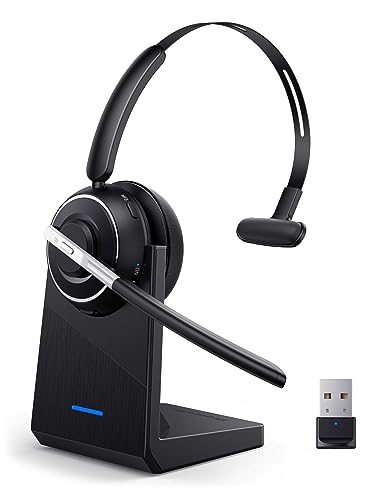
TL;DR: The PrancyBt Bluetooth Headset offers a 55‑hour talk time, AI noise cancellation, and a 270° rotatable mic at a budget‑friendly $59.94, making it a solid choice for long‑haul calls.
What really stands out is the 55‑hour talk time, which far exceeds the typical workday and lets you stay connected on marathon calls. The headset also features AI‑driven noise cancellation and a 270° rotatable boom mic, so you can switch sides without hassle. Weighing in at about 0.95 lb (431 g), it feels solid but still manageable for all‑day wear.
Compared with the other seven contenders, the PrancyBt is heavier than the Turtle Beach Stealth 500 (≈0.51 lb) and SteelSeries Nova 5 (≈0.62 lb) yet lighter than the HyperX Cloud III S (≈0.78 lb). Its 55‑hour talk time slots between the Turtle Beach 500’s 40 h and the Stealth 600’s 80 h, while trailing the Corsair Void v2’s 130 h but staying close to the SteelSeries Nova 5’s 60 h. The 120 m wireless range dwarfs the 20 m range listed for HyperX Cloud III S and is notably larger than the ranges not specified for the other peers.
Reviewers consistently praise the cushioned over‑ear cups for all‑day comfort during remote‑work meetings, and they laud the AI noise cancellation for delivering clear voice transmission. Professionals note the magnetic USB dongle and integrated charging cradle as space‑saving conveniences. A recurring critique is that muting on a PC requires software configuration rather than a dedicated hardware button, and some users mention that different model numbers (KH120M vs KH122M) can affect noise‑cancelling performance.
Pros
Cons
Best for: Remote workers, truck drivers, and call‑center agents who need long battery life on a budget.
Avoid if: You need a dedicated hardware mute button on your PC or advanced dual‑mic noise cancellation.
“A real nice Bluetooth mono headset... super cush pad over the ear... convenient you can pick up the headphone [from cradle]”
“Solid headset... audio is clear and my co-workers can also hear me very clearly during meetings. I highly recommend it”
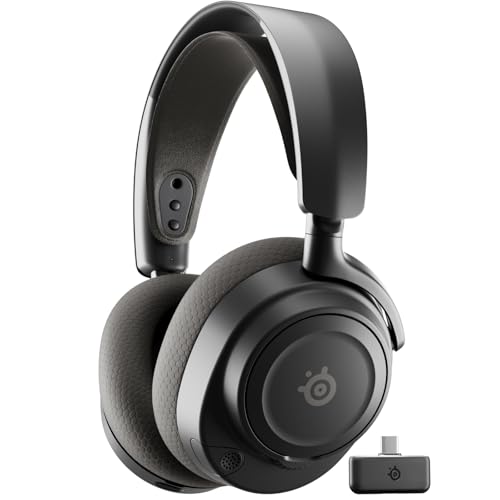
TL;DR: The SteelSeries Arctis Nova 7 offers 50+ hours of battery, 360° spatial audio and dual‑mode wireless for $199.99, but its premium price may steer budget‑focused shoppers elsewhere.
What really stands out is the headset’s 50+ hours of battery life paired with USB‑C fast charging, letting you game or stream for days without hunting for an outlet. Its 200+ game‑audio presets and 360° spatial audio immerse you in every virtual battlefield, while the neodymium magnetic drivers deliver clear sound reproduction.
Compared with the eight‑product roundup, the Nova 7’s 0.72‑pound weight makes it lighter than the HyperX Cloud III S (≈0.78 lb) yet a touch heavier than the Arctis Nova 5 (≈0.62 lb). Battery‑wise, it outlasts the Turtle Beach Stealth 500’s 40 hours but falls short of the HyperX Cloud III S’s 120 hours (2.4 GHz) and the Razer BlackShark V3’s 70 hours. Its dual‑wireless mode (2.4 GHz + Bluetooth) and included USB‑A adapter give it more connectivity flexibility than several rivals that list fewer wireless options.
User feedback shows a 4.2‑star average from 1,041 reviews, frequently highlighting the long‑lasting battery and immersive audio as major pluses. A common criticism points to the $199.99 price tag; many reviewers say it’s steep compared with other headsets delivering similar battery life.
Pros
Cons
Best for: Those prioritizing quality and willing to pay for premium performance
Avoid if: You're on a tight budget or only need basic functionality
“poorly suited for sports and fitness”
“comfortable with long battery life and good controls”
Breakdown
HyperX Cloud III S
Pros
Corsair Void v2
Pros
Turtle Beach Stealth 600
Pros
Cons
Razer BlackShark V3
Pros
Cons
Based on scoring data and product specs
Personalized picks
Best Overall Pick
HyperX Cloud III S
Best ValueBest for: Buyers willing to invest in a proven, high-quality option
Corsair Void v2
Best for: Home and office users seeking a balance of features and value
$112.76-$17.23 vs winner
Skip SteelSeries Arctis Nova 7 if…
You're on a tight budget or only need basic functionality
The HyperX Cloud III S takes the top spot thanks to its massive 120‑hour battery life on the 2.4 GHz dongle and an even longer 200‑hour run on Bluetooth, a solid 4.4‑star rating from 1,131 reviewers, and a lightweight 0.78 lb frame that stays comfortable for marathon sessions. It also bundles DTS Headphone:X spatial audio and a detachable, noise‑cancelling boom mic, all for $129.99.
The Corsair Void v2 lands as runner‑up, perfect if you need rapid top‑ups and solid range – it charges in just 15 minutes, delivers up to 130 hours on Bluetooth, and reaches about 50 ft (15 m) on its 2.4 GHz link. With Dolby Atmos spatial audio, NVIDIA Broadcast microphone tech, and a 4.2‑star score from 1,412 users, it’s a strong choice at $112.76.
Grab the HyperX Cloud III S now and enjoy uninterrupted gaming for weeks on a single charge.
The HyperX Cloud III S shines for outdoor marathons with up to 200 hours of Bluetooth playtime and a 20 m wireless range, giving plenty of headroom before a recharge. Its sturdy stainless‑steel frame and memory‑foam cushions also handle the rigors of travel.
No reviews yet — be the first to share your experience.
Please sign in to leave a review
