⚡ Quick Answer
High‑DPI gaming mice promise pinpoint accuracy and rapid response, but the market offers everything from feather‑light wireless rigs to feature‑packed wired beasts. The guide reviews 10 models, spanning a price spread from $19.98 up to $126.99, and groups them into budget, mid‑range and premium tiers to keep the guide easy to follow.
At the top end, the Razer Viper V3 Pro Wireless pushes a 35,000 DPI sensor and 8000 Hz polling, while weighing just 54 g and delivering up to 95 hours of battery life for $119.99. The Logitech G305 LIGHTSPEED impresses with a 12,000 DPI HERO sensor, 1000 Hz report rate and a staggering 250‑hour battery on a single AA, priced at $26.99. Budget picks like the Acer Wired Gaming Mouse sit at $19.98 with 12,800 DPI, and the Redragon M801 offers 16,000 DPI for $25.49.
Below you’ll find each tier broken down, with key specs, user ratings and what type of gamer each mouse caters to, so you can zero in on the perfect high‑DPI companion for your setup.

Razer Viper V3 Pro Wireless
Its 95‑hour battery life lets you game wireless for days without recharging, supporting the high‑DPI performance you expect from Razer.

Logitech G305 LIGHTSPEED Black
Ideal for budget‑conscious gamers who want reliable performance; at $26.99 it’s about $93 cheaper than the Razer Viper V3 Pro Wireless.

Razer DeathAdder V3 Wired
Offers a classic, ergonomic shape with a 44 mm height and 128 mm length, delivering a wired, plug‑and‑play feel that the wireless rivals don’t provide.
Also considered
Score Analysis
Key score advantages vs. runner-up (Logitech G305 LIGHTSPEED)
Price Range
Razer Viper V3 Pro Wireless
$119.99
Logitech G305 LIGHTSPEED Black
$26.99
Razer DeathAdder V3 Wired
$43.99
Acer Wired Gaming Mouse
$19.97

UtechSmart Venus
$32.99

Redragon M908 Impact
$22.49

ASUS ROG Spatha X
$111.99
Redragon M913 Impact Elite
$29.98
Corsair Scimitar RGB Elite
$89.99

Redragon M801
$29.99
Spec Comparison
TL;DR: The Razer Viper V3 Pro Wireless delivers an ultra‑light 54 g frame, a 35000 DPI sensor and up to 8000 Hz polling, but its $119.99 price and extra dongle requirement keep it in the premium tier.
The standout spec is the 35000 DPI Razer Focus Pro 35K Gen‑2 sensor paired with an 8000 Hz polling rate—both only reachable when you add the optional HyperPolling dongle. Combined with a 0.2 ms switch actuation, the mouse promises razor‑thin latency for fast‑paced shooters.
At roughly 0.12 pounds (54 g), it’s dramatically lighter than the Logitech G305 at 0.21 pounds and far lighter than the ASUS ROG Spatha X at 1.9 pounds. Its 8000 Hz polling outpaces most rivals that sit at 1000 Hz, matching only the Razer DeathAdder V3. The 35000 DPI ceiling also eclipses the highest competitor DPI of 19000 DPI found in the ASUS model.
User reviews repeatedly praise the near‑weightless feel and the mouse’s ability to track accurately on glass and other smooth surfaces. Professional reviewers note the low latency and sensor performance, calling it a top choice for esports pros. The 95‑hour battery life and eight fully programmable buttons round out a feature set that suits competitive play.
Pros
Cons
Best for: Buyers willing to invest in a proven, high-quality option
Avoid if: You're shopping on a tight budget — it's priced at $119.99
“great mouse, safe recommendation”
“top wireless gaming mouse with exceptional latency”
TL;DR: The Logitech G305 LIGHTSPEED offers a 12,000 DPI HERO sensor, 1 ms wireless latency, 250‑hour battery life, and six programmable buttons at $26.99, making it a solid, well‑reviewed choice for most gamers.
The mouse packs a HERO optical sensor that reaches a maximum of 12,000 DPI, with a minimum of 200 DPI, and can accelerate beyond 40 G at speeds over 400 IPS. Its LIGHTSPEED 2.4 GHz wireless link reports at 1000 Hz (1 ms), delivering the low‑latency feel many competitive players crave. Weighing just 0.21 pounds (95.25 g) and measuring 2.54 mm tall, 116.6 mm long and 62.23 mm wide, it stays compact enough for travel, while six programmable buttons give you enough customisation for most FPS titles.
At $26.99, the G305 lands in the mid‑tier price bracket, undercutting many wired rivals while still offering premium wireless performance. It's lighter than the Redragon M801 (0.3417165061 pounds) and the Acer Wired Gaming Mouse (0.4188782978 pounds), but a touch heavier than the ultralight Razer Viper V3 Pro (0.11904962148 pounds) and Razer DeathAdder V3 (0.13007273458 pounds). This positioning gives it a sweet spot for gamers who want wireless freedom without paying premium prices.
Users consistently praise the 250‑hour battery life on a single AA cell and the precise HERO tracking, noting that the mouse feels reliable even after long sessions. Professional reviewers highlight the ultra‑low 1 ms latency and the sensor’s accuracy as ideal for competitive play. The main complaints centre on the 99 g weight, which feels relatively heavy compared to newer ultralights, and the small form factor that can feel cramped for larger hands. The lack of a free‑scroll or tilt wheel also limits its appeal for productivity‑heavy tasks.
The mouse also carries a carbon footprint of 8.76 kg CO₂e, offers onboard memory for one profile (expandable to five via Logitech G HUB software), and includes a USB nano receiver, extender cable, AA battery and documentation right out of the box.
Pros
Cons
Best for: Most users looking for a well‑reviewed, reliable mainstream option
Avoid if: You need advanced features or professional‑grade performance
TL;DR: The Razer DeathAdder V3 Wired packs a 30,000 DPI sensor, 8,000 Hz polling and a feather‑light 59 g ergonomic body for fast, precise FPS play at a mid‑range price.
Razer equips the DeathAdder V3 with a Focus Pro 30K optical sensor that delivers a maximum DPI of 30,000 and an 8,000 Hz polling rate, while its optical switches actuate in just 0.2 ms. Weighing 59 g (about 0.13 lb), it feels almost weightless in the hand, and reviewers note it reduces fatigue during long sessions.
Compared with the other nine entries, the DeathAdder V3 weighs significantly less than the Redragon M913 (≈0.29 lb) and the Corsair Scimitar Elite (≈0.27 lb). Its 8,000 Hz polling outpaces the typical 1,000 Hz found in most peers, and its 30,000 DPI ceiling tops the 18,000 DPI of the Corsair and the 12,000‑16,000 DPI range of the other wired mice. It's positioned at a mid‑tier price—higher than the budget Acer and Redragon models but well below the premium Razer Viper V3 Pro Wireless.
Reviewers highlight the ultra‑light chassis and the sensor’s “best‑in‑class” accuracy, noting that the 90 million‑click optical switches stay consistent over time. Everyday users echo the comfort of the right‑handed ergonomic shape and the smooth glide of the 100 % PTFE feet, though several mention that the Speedflex cable can develop minor kinks after unpacking. The six programmable buttons satisfy most FPS setups, but power users who rely on extensive macro layouts find the button count limiting.
It also includes five onboard memory profiles, up to eight programmable controls (including DPI toggle), and an asymmetric cut‑off with 26 lift‑off distance levels. The mouse features Motion Sync and Smart Tracking, rounding out a feature set aimed at competitive play.
Pros
Cons
Best for: Competitive FPS players with medium to large hands who favor palm or claw grips and need rapid, precise input.
Avoid if: You need a large number of programmable buttons, have small hands, or are looking for the lowest‑cost entry‑level mouse.
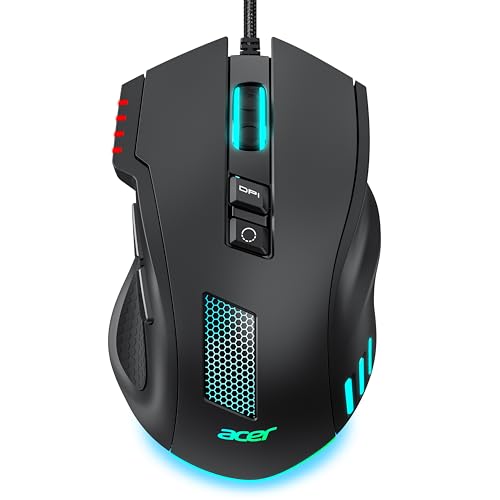
TL;DR: The Acer Wired Gaming Mouse delivers 12,800 DPI, 8 programmable buttons and 12 RGB modes for just $19.98, making it a solid budget pick for FPS and MOBA gamers.
Its maximum DPI of 12,800 stands out, letting you fine‑tune cursor speed on high‑resolution displays. It also offers eight programmable side buttons and twelve RGB backlit modes, all sitting in an ABS shell that feels solid to the touch. Onboard memory lets you save your button profiles without software.
At $19.98 it sits below the price point of the Redragon M801 and the UtechSmart Venus, making it one of the more affordable options in the ten‑mouse lineup. However, it has fewer side buttons than the Redragon M908 Impact’s 18 and the Venus’s 18, so power users may notice the difference. Weighing about 0.42 lb (190 g), it's heavier than the ultra‑light Logitech G305 (0.21 lb) but lighter than the Redragon M913 Impact Elite (0.29 lb).
Professional reviewers highlighted the continuous RGB lighting that wraps the sides, back and top, calling it “striking.” Users repeatedly mention the dedicated DPI button as quick and intuitive, and they praise the scroll wheel’s tactile clicks for precise scrolling. The cross‑platform compatibility with Windows, Linux and macOS also earns frequent nods for flexibility.
Technical notes include an optical sensor with a listed acceleration of 20 G and a 3‑ft wired USB‑A cable that keeps latency low. The mouse’s dimensions—2.54 mm tall, 119.38 mm long and 73.66 mm wide—fit comfortably in most hand sizes, while the eight programmable buttons give enough customization for most FPS and MOBA titles.
Pros
Cons
Best for: Budget‑conscious buyers seeking a reliable entry‑level option
Avoid if: You want the best value‑per‑dollar in its price range
TL;DR: The UtechSmart Venus packs 18 programmable buttons, up to 16400 DPI and an 8‑weight tuning system for $25.16, but its 0.4875 lb heft makes it a bulky, heavy choice for MMO fans.
The standout feature is the 18‑button layout, including 12 side‑mounted programmable keys, paired with a maximum DPI of 16400 and a polling rate of 1000 Hz. An 8‑piece, 2.4 g removable weight system lets you dial the 0.4875 lb mouse up or down, while the Avago laser sensor delivers 12000 FPS and 30 G acceleration. You also get over 16 million RGB colors across five backlit modes and five onboard memory profiles.
Compared with the nine other mice in this roundup, the Venus is noticeably heavier than the Redragon M801 (≈0.34 lb), Redragon M908 (≈0.39 lb), Acer (≈0.42 lb), Logitech G305 (0.21 lb) and the high‑end Razer models that sit under 0.14 lb. Its 1000 Hz polling rate matches most wired options but falls short of the 8000 Hz found on the Razer DeathAdder V3 Wired and Razer Viper V3 Pro Wireless. On the button count, it ties with the Redragon M908 Impact at 18 buttons and outpaces the Redragon M801’s nine‑button layout and the Acer’s eight.
Professional reviewers praise the extensive weight‑tuning system and the 12 side buttons as ideal for MMO and MOBA play, noting the Avago sensor’s precision during fast sweeps. Everyday users love the comfortable grip and the intuitive side‑button placement, but many echo the same complaint: even without weights, the mouse feels heavy and bulky, which can hinder agility and portability. Many view the 1000 Hz polling rate as a modest trade‑off against faster competitors.
The Venus ships with a 6 ft braided‑fiber cable, Omron micro switches, and a right‑handed ergonomic shape with a thumb rest. Its dimensions (38.1 mm height × 116.8 mm length × 76.2 mm width) give it a solid, stable feel on the desk, while the RGB lighting adds a splash of personality for long gaming sessions.
Pros
Cons
Best for: Serious MMO and MOBA players who need a wealth of side buttons and customizable weight.
Avoid if: You have limited desk space, need a lightweight travel mouse, or prioritize the fastest possible polling rates.
TL;DR: The Redragon M908 Impact offers 12400 DPI, 18 programmable buttons, and a 6‑ft braided cable for just $24.29, making it a solid budget high‑DPI mouse for casual gamers.
The standout spec is its 12400 DPI maximum, giving you fine‑grained cursor control without breaking the bank. Combined with a 1000 Hz polling rate and 30 G acceleration, the sensor feels snappy for fast‑paced shooters and RTS titles.
Compared with the other nine mice, the M908 is lighter than the Razer Viper V3 Pro (0.12 lb) and Razer DeathAdder V3 (0.13 lb), but heavier than the Logitech G305 (0.21 lb). Its 6‑ft braided cable is longer than the Acer Wired mouse’s 3‑ft lead, matching the UtechSmart Venus’s 6‑ft cable while staying shorter than the Corsair Scimitar Elite’s 1.8 m (about 5.9 ft). With 18 side‑buttons, it outnumbers the Redragon M801’s 9 buttons and matches the UtechSmart Venus’s 18 total buttons, yet it offers fewer DPI levels than the M801’s 16000 DPI peak.
Reviewers frequently highlight the 18 side‑buttons and the vibrant 16.8 million‑color RGB lighting as major pluses. Many note that the 6‑ft cable reduces desk drag during long sessions, though a few mention the plastic shell feels a bit flimsy compared with higher‑priced rivals.
Pros
Cons
Best for: Budget‑conscious buyers seeking a reliable entry‑level option
Avoid if: You need advanced features or professional‑grade performance
TL;DR: The ASUS ROG Spatha X packs a 19,000 DPI sensor, 12 programmable buttons and a 67‑hour battery into a solid 1.9‑pound chassis, but its premium $126.99 price and bulk may deter budget‑focused gamers.
What really sets the Spatha X apart is its 19,000 DPI optical sensor paired with ROG Micro Switches rated for 70 million clicks, giving you ultra‑precise tracking and durability for marathon sessions. The mouse also offers a magnetic charging dock, so you can snap it onto a dock and keep gaming without fiddling with cables.
Compared with the nine rivals in this roundup, the Spatha X weighs the most at 1.9 pounds (862 g), noticeably bulkier than the lightest peer, the Razer Viper V3 Pro Wireless, which weighs just 54 g. Its 67‑hour battery life sits between the Logitech G305’s 250 hours and the Redragon M913 Impact Elite’s 45 hours (backlit mode). DPI‑wise, the Spatha X lands in the middle: higher than the Corsair Scimitar Elite’s 18,000 DPI and the Logitech G305’s 12,000 DPI, but below the Viper’s 35,000 DPI and the DeathAdder V3’s 30,000 DPI. The 1000 Hz polling rate matches most wired options (Corsair, Redragon M801, UtechSmart) yet trails the 8000 Hz rate of the Viper and DeathAdder. With 12 programmable buttons, it offers more customization than the 9‑button Redragon M801 but fewer than the 18‑button UtechSmart Venus.
Users rate the Spatha X at 4.3 stars from 1,806 reviews, praising the high‑DPI sensor, the satisfying click feel of the ROG switches, and the vibrant RGB lighting that syncs with other ASUS gear. Some gamers find the mouse’s substantial weight stable for aiming but cumbersome for quick flicks. The $126.99 price tag also shows up repeatedly as a hurdle for those hunting value‑focused options.
Pros
Cons
Best for: Buyers willing to invest in a proven, high‑quality option
Avoid if: You're shopping on a tight budget — it's priced at $126.99
“LOVE this mouse... search is over!! Asus NEVER disappoints”
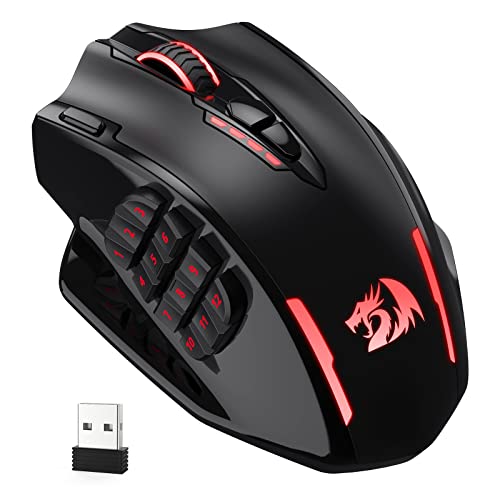
TL;DR: The Redragon M913 Impact Elite offers a 16‑button layout, up to 16,000 DPI and an 80‑hour Eco‑mode battery for $36.99, making it a solid mid‑range choice with a few trade‑offs.
The standout spec is the Pixart 3335 optical sensor that reaches a maximum of 16,000 DPI with a 1 ms response time, paired with 16 programmable buttons (12 on the side). Its 16.8 million‑color RGB lighting adds flair, while the wireless 2.4 GHz link and USB‑C wired option give flexible connectivity.
At 0.291 lb (132 g), the M913 is heavier than the ultra‑light Razer Viper V3 Pro (0.119 lb) and the Razer DeathAdder V3 wired (0.130 lb), but lighter than the UtechSmart Venus (0.488 lb) and the Redragon M908 Impact (0.386 lb). Its 175 mm length exceeds the Logitech G305’s 116.6 mm and the Acer wired mouse’s 119.38 mm, while the 115 mm width is wider than the Razer DeathAdder V3’s 68 mm but narrower than the UtechSmart Venus’s 76.2 mm. DPI‑wise, the M913’s 16,000 DPI matches the Redragon M801 and tops the Logitech G305’s 12,000 DPI, though it falls short of the Razer Viper V3 Pro’s 35,000 DPI.
Reviewers frequently praise the long battery life—45 hours with backlighting on and 80 hours in Eco mode—as a major convenience for wireless sessions. Reviewers also note the extensive button count and vibrant lighting. However, several users mention that the $36.99 price feels high compared with lighter, lower‑priced competitors, and the 4.3/5 rating suggests a few reliability concerns among the community.
Pros
Cons
Best for: Most users looking for a well‑reviewed, reliable mainstream option
Avoid if: You have limited desk space or need portability
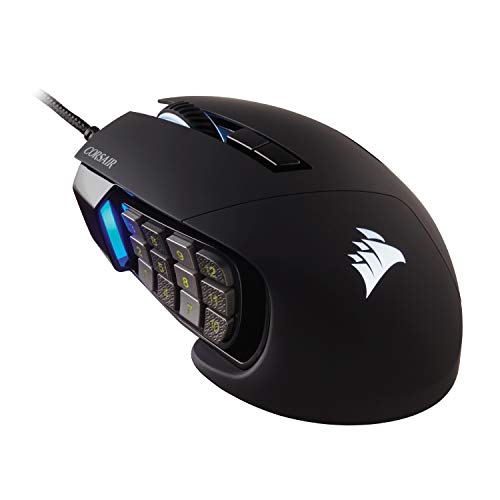
TL;DR: The Corsair Scimitar Elite RGB Wired offers a 17‑button layout, 18,000 DPI sensor and a 1.8 m braided cable for $59.99, making it a solid premium choice for MMO‑focused gamers who value customizability.
The standout spec is the PixArt PMW3391 optical sensor that reaches a maximum of 18,000 DPI with sub‑millimeter lift‑off (<1 mm) and a selectable 1000 Hz polling rate. Combined with 17 programmable buttons—including 12 adjustable side keys via the Key Slider—this mouse gives you granular control without sacrificing precision. Its 4‑zone dynamic RGB adds flair, while the PTFE mouse feet keep glides smooth.
At $59.99 the Scimitar Elite sits above the Razer DeathAdder V3 Wired ($43.99) and the Logitech G305 LIGHTSPEED ($26.99), yet well under the Razer Viper V3 Pro Wireless ($119.99). Weighing about 0.27 lb (122 g), it's heavier than the DeathAdder V3 (0.13 lb) and the G305 (0.21 lb) but lighter than the Redragon M913 Impact Elite (0.29 lb) and the UtechSmart Venus (0.49 lb). Its 1.8 m braided fiber cable extends farther than many entry‑level options, reducing tension during long sessions.
Professional reviewers praised the ergonomic palm‑grip shape with thumb and pinky rests, noting it reduces fatigue during marathon MMO raids. Users love the adjustable side‑button grid and the vibrant RGB, but several mention the fixed 122 g weight feels bulky for fast‑paced FPS titles. The lack of a tilt‑scroll wheel and the right‑handed only design also limit appeal for left‑handed or claw‑grip players.
Pros
Cons
Best for: MMO and MOBA players who need a high‑button count and precise tracking.
Avoid if: You prioritize ultra‑lightweight FPS performance, need left‑handed support, or have a small hand that may find the palm‑grip too large.
TL;DR: The Redragon M801 offers a 16,000 DPI sensor, 9 programmable buttons and a 1000 Hz polling rate at a modest $25.49, making it a solid entry‑level high‑DPI mouse for budget‑focused gamers.
The standout spec is the 16,000 DPI Avago sensor, which sits above the 12,000 DPI found in most of the other wired contenders and still trails only the premium Razer models that push 30,000 DPI or more. Coupled with a 1000 Hz polling rate, the M801 promises responsive tracking for fast‑paced shooters and MOBA play.
Compared with its nine peers, the M801 is lighter than the UtechSmart Venus (0.49 lb) and the Acer Wired Gaming Mouse (0.42 lb) but heavier than the ultra‑light Logitech G305 (0.21 lb) and the Razer Viper V3 Pro (0.12 lb). Its 9 programmable buttons outnumber the 8‑button layout of the Acer mouse, though it falls short of the 18‑button setups on the UtechSmart Venus and Redragon M908 Impact. The included 8‑piece weight tuning set gives you more fine‑tuning than the standard‑weight designs of the Razer DeathAdder V3 and Corsair Scimitar Elite.
Reviewers consistently highlight the high DPI range and the ability to fine‑tune the mouse’s feel with the weight set, noting that the Omron micro switches feel solid for the price. 3,891 users gave it a 4.4‑star rating, showing general satisfaction, though some users mention the mouse feels a bit heavier than the lightest wireless options and wish for a wireless variant.
Pros
Cons
Best for: Budget‑conscious buyers seeking a reliable entry‑level option
Avoid if: You need advanced features or professional‑grade performance
Breakdown
Razer Viper V3 Pro Wireless
Pros
Cons
Logitech G305 LIGHTSPEED Black
Pros
Razer DeathAdder V3 Wired
Pros
Cons
Acer Wired Gaming Mouse
Pros
Cons
Based on scoring data and product specs
Personalized picks
Best Overall Pick
Razer Viper V3 Pro Wireless
Best ValueBest for: Buyers willing to invest in a proven, high-quality option
Logitech G305 LIGHTSPEED Black
Best for: Most users looking for a well-reviewed, reliable mainstream option
$26.99-$93.00 vs winner
Skip Redragon M801 if…
You need advanced features or professional-grade performance
The Razer Viper V3 Pro Wireless takes the top spot with its 35000 DPI sensor, a blazing 8000 Hz polling rate, and eight programmable buttons—all packed into a feather‑light 54 g chassis. Its 0.2 ms actuation and 90 million click lifecycle give you precision and durability, while the 95‑hour battery life keeps you in the game without frequent recharges.
The Logitech G305 LIGHTSPEED lands as the runner‑up, ideal if you need ultra‑long wireless stamina for marathon sessions. It offers a 250‑hour battery life on a single AA cell, a reliable 1000 Hz report rate, and six programmable buttons, all for just $26.99.
Grab the Razer Viper V3 Pro Wireless today and level up your high‑DPI gaming.
The Razer Viper V3 Pro Wireless combines a feather‑light 54 g chassis with a 35000 DPI sensor and an 8000 Hz HyperPolling rate, giving ultra‑fast response for fast‑paced shooters. Its 95‑hour rechargeable battery also lets you game wirelessly without frequent recharges, making it a strong choice for on‑the‑go FPS sessions.
No reviews yet — be the first to share your experience.
Please sign in to leave a review