
⚡ Quick Answer
High‑DPI gaming mice push past the 20,000 DPI mark to give you razor‑sharp cursor control, but the right balance of sensor precision, latency and weight can vary wildly. Nine options span a $31.99‑to‑$89.99 price range, each with at least a 4.5‑star rating from thousands of reviewers – for example, the Logitech G502 HERO holds a 4.6/5 score from 57,572 reviews.
The lineup splits into three price tiers. Budget picks include the Magic‑refiner Attack Shark X11 at $31.99, the Logitech G502 HERO at $35.99, and the Razer Basilisk V3 at $36.95. Mid‑range offers the Attack Shark X3 White for $37.79, the Razer Viper V3 HyperSpeed Wireless at $59.99, and the Glorious Model O Wireless at $79.99. Premium selections feature the ASUS ROG Harpe Ace and Corsair Sabre v2 PRO, both listed at $79.99, and the HyperX Pulsefire Haste 2 Pro Wireless at $89.99. Sensor peaks range from 26,000 DPI on several models up to 42,000 DPI on the Attack Shark X11, while latency can be as low as 1.38 ms on the Razer Basilisk V3.
The next section breaks down how each mouse performs in real‑world scenarios, so you can match the specs to your gaming style.

Logitech G502 HERO
Its 2100 mm cable gives you ample reach and smooth control, a practical edge that helped it clinch the top spot.
Razer Basilisk V3
Ideal for gamers who want a solid grip and extra buttons, it’s just $0.96 pricier than the G502 HERO.

Attack Shark X3 White
With its 200‑hour battery life, you get long wireless sessions without the need to recharge often.
Also considered
Score Analysis
Key score advantages vs. runner-up (Razer Basilisk V3)
Price Range
Logitech G502 HERO
$33.49
Razer Basilisk V3
$36.99
Attack Shark X3 White
$41.99
Glorious Model O Wireless
$79.99

Razer Viper V3 HyperSpeed Wireless
$59.99

HyperX Pulsefire Haste 2 Pro Wireless Gray
$89.99

Magic-refiner Attack Shark X11
$30.39

ASUS ROG Harpe Ace
$99.99
Corsair Sabre v2 PRO
$79.99
Spec Comparison
TL;DR: The Logitech G502 HERO packs a HERO 25K sensor with up to 25,600 DPI, 11 programmable buttons and a tunable weight system into a solid wired mouse for under $36.
The standout spec is the HERO 25K optical sensor, offering a DPI range of 100–25,600 and a USB reporting rate of 1000 Hz. Combined with an average wired latency of 2.26 ms, the mouse delivers fast, sub‑micron tracking that pros praise for “zero smoothing, acceleration, or filtering.” Its 50 DPI increment steps let you dial in precision without jumping between settings.
At 0.27 pounds, the G502 HERO is heavier than the Razer Basilisk V3 (0.2225 pounds) and the Attack Shark X3 (0.108 pounds), which many ultralight users notice. Its 2100 mm cable exceeds the 1.8 m cable on the HyperX Pulsefire Haste 2 Pro, giving you extra reach on a desk but reducing portability compared with detachable‑cable models. Latency sits at 2.26 ms, a bit higher than the Basilisk V3’s 1.38 ms wired latency, so it isn’t the absolute fastest in the lineup.
User sentiment repeatedly highlights the deep customization: eleven programmable buttons, five side buttons, and an optional weight system that adds up to 18 g. Reviewers note the solid build, Omron mechanical switches and PTFE footpads that can endure over 250 km of travel. The downsides that surface are the heavier feel, the right‑hand‑only shape, and the cable that stays permanently attached, which some users find limiting for travel.
Pros
Cons
Best for: Competitive FPS and MOBA players who want high DPI, many programmable buttons and solid build quality without a premium price tag.
Avoid if: You are left‑handed, need an ultralight or detachable‑cable mouse, or prioritize extreme portability.
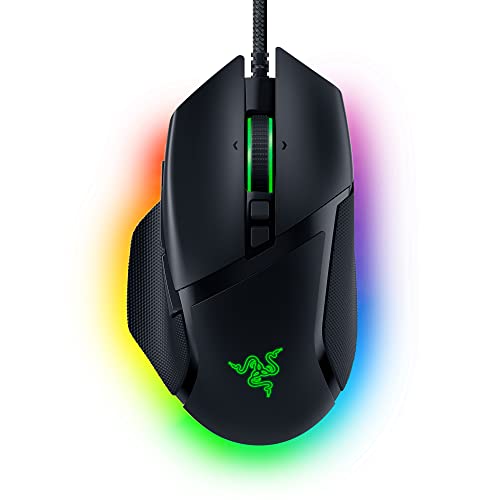
TL;DR: The Razer Basilisk V3 packs a 26,000 DPI Focus+ sensor, 8,000 Hz polling and 11 programmable buttons into a wired ergonomic mouse for about $36.95.
The standout spec is the Razer Focus+ optical sensor rated at 26,000 DPI, paired with an 8,000 Hz polling rate and a wired latency of 1.38 ms. Those numbers give you ultra‑smooth tracking and rapid response, while the 11‑zone Chroma RGB adds a splash of color.
At 0.2225 lb (101 g) the Basilisk V3 is lighter than the Logitech G502 HERO (0.27 lb) but noticeably heavier than most of the wireless rivals such as the Attack Shark X3 White (0.108 lb) and the Razer Viper V3 HyperSpeed (0.181 lb). Its overall dimensions—62 mm grip width, 42.5 mm height, 130 mm length and 75 mm width—make it larger than the Attack Shark X3 White (61 mm × 39.7 mm × 118.5 mm) while still fitting under the Logitech G502’s 132 mm height.
Reviewers consistently praise the comfortable thumb rest and the ergonomic right‑handed shape, noting it works well for palm and claw grips on medium‑to‑large hands. Professionals highlight the sub‑1 mm lift‑off distance and the 0.2 ms switch actuation as ideal for FPS precision. On the downside, users point out the 101 g weight as it's a bit bulky for fast‑movement shooters, and the lack of a wireless option disappoints those who prefer cable‑free setups.
Additional technical details include a lift‑off distance of <1 mm, 100 % PTFE feet for low friction, and a 70‑million‑click switch lifecycle. The mouse stores up to five onboard profiles and features 11 lighting zones capable of 16.8 million colors; Razer backs it with a two‑year manufacturer warranty.
Pros
Cons
Best for: Right‑handed gamers with medium‑to‑large hands who need a budget‑friendly, macro‑rich mouse.
Avoid if: You are left‑handed, have a small hand, or require a wireless mouse for fast‑paced FPS play.
TL;DR: The Attack Shark X3 White delivers a feather‑light 49 g build, a 26,000 DPI PixArt PAW3395 sensor and a 200‑hour battery, all for $37.79, making it a solid mid‑range choice.
The mouse’s standout spec is its ultra‑light 49 g weight (0.10802650838 pounds) combined with a high‑end 26,000 DPI PixArt PAW3395 sensor and a 200‑hour battery life. Its Kailh Black Mamba switches require only 65 gf operating force and 25 gf release force, while the 0.3 mm travel distance keeps actuation crisp. With a polling rate of 1000 Hz, max tracking speed of 650 IPS and 50 G acceleration, the X3 packs flagship‑level responsiveness into a budget‑friendly package.
Compared with the other eight mice in this roundup, the X3 is lighter than the Razer Basilisk V3 (≈0.22 lb), Logitech G502 (≈0.27 lb) and the Magic‑refiner Attack Shark X11 (≈0.13 lb), but a touch heavier than the Corsair Sabre v2 PRO (≈0.08 lb). Its 26,000 DPI matches the Basilisk V3 and sits below the X11’s 42,000 DPI, positioning it solidly in the high‑DPI tier. Priced similarly to the Basilisk V3 and Logitech G502, it offers comparable tracking specs without a premium price tag.
Reviewers note the mouse feels solid despite the low weight, with no creaks or hollow sensation. They praise the crisp Kailh Black Mamba clicks, and they highlight the tri‑mode connectivity (Bluetooth 5.2, 2.4 GHz dongle, USB‑C wired) as a versatile win for budget shoppers. However, professional testers flag click latency as inconsistent, which can hurt performance in fast‑paced competitive shooters. They describe the stock PTFE feet as average, prompting many users to swap in aftermarket skates for smoother glide.
Additional technical details include RGB lighting, onboard memory for profile storage, a 300 mAh battery, and a sensor‑driven max acceleration of 50 G. The mouse’s dimensions are 118.5 mm × 61 mm × 39.7 mm, fitting comfortably in most hand sizes, while the 65 gf operating force and 25 gf release force suit both click‑heavy and rapid‑click scenarios.
Pros
Cons
Best for: Casual gamers, budget‑conscious FPS or MMO players, and hybrid work‑gaming users who need a light, feature‑rich mouse.
Avoid if: You need ultra‑low click latency or professional‑grade performance for high‑level esports.
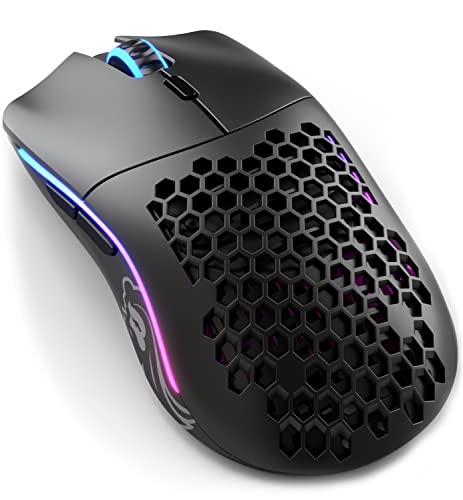
TL;DR: The Glorious Model O Wireless weighs just 69 g, offers 71 hours of battery life with RGB off, and delivers the lowest‑latency wireless performance for competitive gamers.
The mouse’s most eye‑catching spec is its ultralight chassis: at 69 g (0.1499 lb) it feels almost weightless, and the honeycomb shell keeps the profile slim at 2.54 mm tall, 127 mm long and 66.04 mm wide. It also offers “lowest in class” wireless latency and a full‑RGB lighting system, while the USB‑C charging cable lets you switch between wired and wireless modes instantly.
Compared with the eight peers, the Model O Wireless sits in the middle of the weight range – lighter than the Razer Viper V3 (0.1808 lb) but heavier than the Corsair Sabre v2 PRO (0.079 lb). Its 71‑hour battery life outlasts the Corsair’s 70 hours but falls short of the ASUS ROG Harpe Ace’s 90‑hour claim and the Razer Viper V3’s up‑to‑280‑hour rating. The mouse’s 0.12‑lb ASUS rival is marginally lighter, while the HyperX Pulsefire Haste 2 Pro (0.1345 lb) is a bit heavier. In DPI terms the Glorious sensor tops out at 26,000 DPI, which is lower than the Corsair’s 33,000 DPI and far below the Magic‑refiner Attack Shark X11’s 42,000 DPI.
Users consistently praise the long battery life and the crisp, 80‑million‑click‑rated switches, noting that the lightweight design makes rapid flicks effortless. Professional reviewers echo the battery praise and highlight the “no unexpected double‑click” guarantee. The most common criticism is the side‑button placement, which many palm‑grip users find too high, and some listings mention an older sensor generation that may lag behind newer competitors.
Pros
Cons
Best for: Competitive FPS gamers who favor claw or fingertip grips, have medium‑sized hands, and want an ultra‑light wireless mouse with strong battery life.
Avoid if: You rely on a full palm grip, need low‑profile side buttons for macro‑heavy workflows, or are looking for the cheapest entry‑level mouse.
TL;DR: The Razer Viper V3 HyperSpeed Wireless delivers a 30,000‑DPI sensor, up to 280 hours of battery life, and optional 8 kHz polling in a 0.18 lb (82 g) wireless mouse priced at $59.99.
The standout spec is the Razer Focus Pro 30K optical sensor, which offers a maximum of 30,000 DPI for precise tracking in fast‑paced shooters. Coupled with a battery that lasts up to 280 hours on a single AA cell, you can game for weeks without worrying about recharging.
At 0.18 lb (82 g), the Viper V3 sits heavier than ultralight rivals like the Corsair Sabre v2 PRO (0.08 lb) and Glorious Model O Wireless (0.15 lb), but it’s still lighter than the Razer Basilisk V3 (0.22 lb) and Logitech G502 HERO (0.27 lb). Its 280‑hour battery life outlasts every other mouse in the nine‑product set, with the next longest being the Attack Shark X3 White at 200 hours.
Professional reviewers praise the mouse’s low click latency and reliable wireless performance, while everyday users highlight the sturdy construction and comfortable claw‑or‑fingertip grip. People note the lack of RGB lighting as a power‑saving benefit, and the optional HyperSpeed dongle unlocks the top‑tier 8,000 Hz polling rate for ultra‑responsive play.
Additional technical touches include six programmable buttons, eight programmable controls, 26 lift‑off distance levels, and a switch lifespan of 60 million clicks, giving you plenty of customization and durability for long gaming sessions.
Pros
Cons
Best for: Competitive esports players who need a well‑reviewed, reliable wireless mouse with high DPI and long battery life.
Avoid if: You're shopping on a tight budget — it's priced at $59.99.
TL;DR: The HyperX Pulsefire Haste 2 Pro Wireless packs a 61 g frame, a 26,000 DPI sensor and a native 4000 Hz wireless polling rate, while delivering up to 90 hours of battery life at 1000 Hz.
What really sets this mouse apart is its 4000 Hz wireless polling rate, a figure that tops most of the competition and pairs with a HyperX 26K sensor that reaches 26,000 DPI. At just 61 g (0.13 lb) and a 1 mm profile, the chassis feels feather‑light, and the rechargeable Li‑ion polymer cell can run for 90 hours when the mouse is set to 1000 Hz, dropping to 30 hours at the full 4000 Hz speed.
Compared with the eight other entries, the Haste 2 Pro sits in the middle of the weight spectrum: it’s lighter than the Glorious Model O Wireless (69 g) and Razer Viper V3 (82 g), but heavier than the Corsair Sabre v2 PRO (36 g) and ASUS ROG Harpe Ace (54 g). Its 90‑hour battery life matches ASUS’s top‑end endurance and outlasts most rivals, though it falls short of the Razer Viper’s 280‑hour claim and the Attack Shark X3’s 200‑hour run‑time. In polling speed, 4000 Hz beats ASUS’s 1000 Hz and the Bluetooth 125 Hz mode, yet it doesn’t reach the 8000 Hz rates of the Corsair Sabre v2 PRO, Razer Viper V3 (dongle) and Magic‑refiner Attack Shark X11. DPI-wise, 26,000 sits below the Corsair’s 33,000 and Razer Viper’s 30,000 but matches the Razer Basilisk V3.
User feedback repeatedly praises the ultra‑light 61 g build for reducing hand fatigue during marathon sessions, and reviewers highlight the “breakthrough” 4000 Hz wireless tracking as delivering ultra‑smooth, low‑latency aim. Reviewers laud the PTFE‑coated skates for friction‑less glide, while the built‑in NVIDIA Reflex validation adds confidence for competitive play. On the downside, the Bluetooth mode caps at 125 Hz, which many users find insufficient for high‑level FPS work, and the single onboard memory slot forces you to rely on the NGENUITY software for extra profiles. A few reviewers note that the symmetrical shape can feel cramped in larger hands.
Beyond the headline specs, the mouse includes a 1.8 m USB‑C detachable cable for wired use, a 50 G acceleration rating and a 650 IPS maximum speed, ensuring rapid cursor movement. The Instant Pair feature lets you connect via 2.4 GHz dongle without extra steps, and the RGB LED lighting adds a subtle visual touch without compromising the lightweight design.
Pros
Cons
Best for: Competitive FPS gamers who value ultra‑low latency, a feather‑light chassis and long battery endurance.
Avoid if: You have large hands, need multiple onboard profiles, or rely heavily on Bluetooth for high‑speed gaming.
TL;DR: The Magic‑refiner Attack Shark X11 delivers a feather‑light 59 g build, 42,000 DPI sensor and 8000 Hz polling at a $31.99 price, making it a budget‑friendly ultra‑responsive gaming mouse.
The standout spec is the PAW3950MAX sensor capable of a maximum 42,000 DPI and a static scan rate of 20,000 FPS, paired with an 8000 Hz polling rate. At just 59 g (0.13007273458 lb), the mouse feels almost weightless, and its 300 mAh battery promises up to 65 hours of wireless play.
Compared with the eight other mice in this roundup, the X11 is lighter than the Logitech G502 HERO (122 g) and the Razer Viper V3 Wireless (82 g), yet a bit heavier than the Corsair Sabre v2 PRO (36 g) and the ASUS ROG Harpe Ace (54 g). Its 42,000 DPI tops the Razer Basilisk V3’s 26,000 DPI and the Razer Viper V3’s 30,000 DPI, while matching the 8000 Hz polling of the Corsair Sabre v2 PRO and the Razer Viper V3 Wireless. Battery life at 65 hours falls short of the 70‑plus hours that the Glorious Model O Wireless and the ASUS Harpe Ace achieve, but still outlasts many mid‑range options.
Reviewers consistently praise the ultra‑light carbon‑fiber chassis and the non‑slip nano‑metal ice coating, noting that the mouse stays comfortable during marathon FPS sessions. Professional reviewers highlight the sensor’s “lightning‑fast moves” and the convenience of the magnetic RGB charging dock, which charges quickly from a 10‑minute boost. On the downside, users report that the protruding side edges can snag fingers during high‑CPS games, and the scroll‑wheel button feels heavier than expected. Reviewers describe the software as a bit clunky, requiring extra tweaks for DPI shortcuts.
Pros
Cons
Best for: Competitive FPS gamers who want an ultra‑light, high‑DPI mouse without breaking the bank.
Avoid if: You rely on high‑CPS clicking (e.g., Minecraft speed‑runs) or need the longest possible battery life.
TL;DR: The ASUS ROG Harpe Ace offers a 54 g ultralight frame, 36,000 DPI AimPoint sensor and up to 90 hours of battery life, but its five‑button layout and premium $79.99 price may limit casual users.
The standout spec is the 36,000 DPI ROG AimPoint optical sensor paired with a 1000 Hz report rate, delivering sub‑1 % CPI deviation for precise tracking. Weighing just 54 g (0.12 pounds) and measuring 39.6 mm tall, 127.5 mm long and 63.7 mm wide, the mouse feels featherlight while still housing a 70 million‑click mechanical switch.
Compared with the eight other contenders, the Harpe Ace sits in the middle of the weight range: it’s heavier than the Corsair Sabre v2 PRO at 0.08 pounds but lighter than the Glorious Model O Wireless at 0.15 pounds and the Razer Viper V3 at 0.18 pounds. Its $79.99 price tag aligns with the premium tier of the roundup, matching the list price of several peers while offering a longer no‑lighting battery life of 90 hours versus the 71 hours the Glorious Model O Wireless lists.
Reviewers consistently praise the mouse’s ultra‑light chassis and the Aim Lab Optimizer that fine‑tunes settings for FPS and MOBA titles. Professional reviewers highlight the low‑latency ROG SpeedNova 2.4 GHz transmission and the Omni Receiver’s ability to pair up to three devices. On the downside, users note the limited five‑button layout, which can feel restrictive for complex macro setups, and the ambidextrous shape that may not suit right‑hand‑only ergonomics.
Pros
Cons
Best for: Competitive FPS and MOBA players who prioritize ultra‑light weight, high DPI and low‑latency wireless connectivity.
Avoid if: You need a right‑hand‑specific ergonomic shape, a larger button count for complex macros, or a lower‑priced entry‑level mouse.
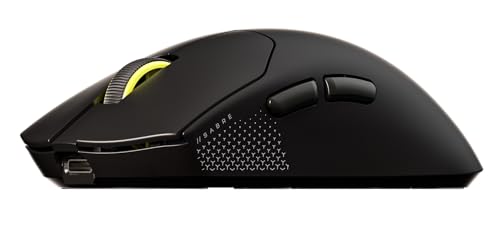
TL;DR: The Corsair Sabre v2 PRO delivers a feather‑light 36 g chassis, 33,000 DPI sensor and 8,000 Hz polling, but its all‑plastic shell scratches easily and it sits at a premium $79.99 price.
Its ultra‑light 36 g weight, 33,000 DPI CORSAIR MARKSMAN S sensor and 8,000 Hz hyper‑polling rate deliver rapid, low‑latency tracking for fast‑paced shooters. It also offers up to 70 hours of wireless battery life on a 210 mAh cell, letting you game for days without recharging.
At 36 g, the Sabre v2 PRO is lighter than every other mouse in this nine‑product roundup—Glorious Model O Wireless weighs 69 g, ASUS ROG Harpe Ace 54 g, HyperX Pulsefire Haste 2 Pro 61 g, Razer Viper V3 82 g, Attack Shark X3 49 g, Razer Basilisk V3 101 g, Logitech G502 122 g, and Magic‑refiner Attack Shark X11 59 g. Its 70‑hour battery life sits just shy of the Glorious Model O Wireless’s 71 hours and the Asus Harpe Ace’s 90 hours, yet still far exceeds many wired‑only competitors.
Everyday users rave about the “basically weightless” feel and the long battery endurance, calling it ideal for competitive FPS titles. Professional reviewers highlight the 8,000 Hz hyper‑polling and the sensor’s 99.7 % accuracy as strong points, while noting the sensor is a mid‑tier 3950 model. A recurring complaint is the full‑plastic shell’s susceptibility to visible scratches, and the lack of RGB lighting leaves some gamers wanting more visual flair.
Pros
Cons
Best for: Elite FPS gamers on Windows PCs who prioritize ultra‑light weight, low latency, and long wireless battery life.
Avoid if: You are left‑handed, need top‑tier sensor performance, or want RGB lighting and a more scratch‑resistant finish.
“LTT Labs measured it at 35.7 g, praising the full plastic shell for remarkable lightness in a wireless FPS mouse.”
“A MouseReview analysis called it "basically weightless" and a "great FPS option".”
Breakdown
Logitech G502 HERO
Pros
Razer Basilisk V3
Pros
Attack Shark X3 White
Pros
Glorious Model O Wireless
Pros
Based on scoring data and product specs
Personalized picks
Best Overall Pick
Logitech G502 HERO
Best OverallBest for: Budget-conscious buyers seeking a reliable entry-level option
Razer Basilisk V3
Best for: Budget-conscious buyers seeking a reliable entry-level option
$36.99+$3.50 vs winner
Skip Corsair Sabre v2 PRO if…
Reliability and user satisfaction are your top concerns
The Logitech G502 HERO takes the top spot thanks to its 100–25,600 DPI HERO sensor, ultra‑low 2.26 ms average latency and a hefty 11 programmable buttons that let you bind every command you need. At 122 g it feels solid yet still light enough for marathon sessions, and the included five 3.6 g tuning weights give you fine‑tuned balance without extra accessories. Its 4.6‑star rating from 57,572 reviewers underscores the broad appeal.
Razer Basilisk V3 lands as the runner‑up, especially if you crave an ergonomic right‑handed shape for competitive shooters. It pushes a 26,000 DPI Focus+ sensor and a lightning‑fast 1.38 ms wired latency, while the 8,000 Hz polling rate delivers buttery‑smooth tracking. With 11 programmable buttons and a thumb rest, it delivers precise, high‑speed play without sacrificing comfort.
Looking at the budget tier, the Magic‑refiner Attack Shark X11 shines at $31.99, offering solid DPI performance for a pocket‑friendly price. In the mid‑range camp, the Attack Shark X3 White at $37.79 balances cost and feature set, making it a sensible step up from entry‑level mice. For those willing to invest, the HyperX Pulsefire Haste 2 Pro Wireless in gray at $89.99 delivers premium wireless freedom and high‑end specs for serious gamers.
Pick the Logitech G502 HERO today and lock in the most reliable high‑DPI experience for your gaming rig.
The Razer Viper V3 HyperSpeed Wireless stands out with up to 280 hours of battery life, a 30,000 DPI sensor, and an 8,000 Hz polling rate, making it ideal for long sessions away from a desk. The Attack Shark X11 also offers wireless freedom with 65 hours of battery and a record‑breaking 42,000 DPI, but its battery life is shorter than the Viper’s.
No reviews yet — be the first to share your experience.
Please sign in to leave a review